Writers Chat 19: Maria Donovan on “The Chicken Soup Murder” (Seren Books: Bridgend,Wales, 2017)

Maria, You are very welcome to my WRITERS CHAT series. Congratulations on your debut novel, The Chicken Soup Murder (Seren, 2017), a finalist for the Dundee International Book Prize and shortlisted for the Rubery Book Award. This publication follows on from your short story collection Pumping Up Napoleon and Other Stories (Seren, 2007) and your flash fiction Tea for Mr Dead (Leaf, 2006).
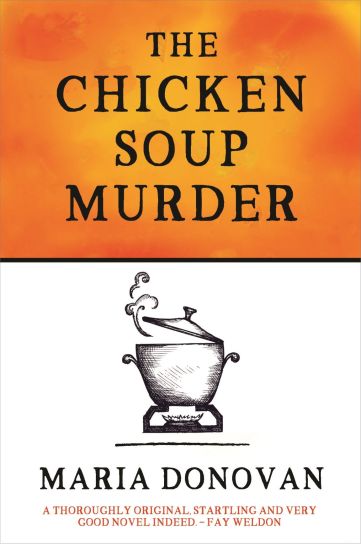
The Chicken Soup Murder border

SG: I thoroughly enjoyed The Chicken Soup Murder and agree with the description which says it’s “part crime fiction and murder mystery, part meditation on grieving, friendship and family”. Essentially, it is a great story, I think, which defies genre, and sits outside all those boxes that the book industry want novels to sit in. Can we talk a little bit about this – did you set out to break with genre or did you set out to write a good story, filled with complex and lovable characters? What was your intention when you started writing?

MD: I tried not to think in terms of barriers and boxes while I was writing. A novel has to be written before it is anything at all and the only way I could see of getting there was to be true to myself, to the characters and the story. Of the story strands only one is the crime, the others have to do with the meaning of family and of ways in which different characters respond to their experiences of bereavement. Having said that, I should not be surprised that it is most often sub-categorised as ‘crime and mystery’. It’s just that it’s also humorous general literary or contemporary fiction, which could be described as ‘coming of age’ since the narrator is an eleven-year-old boy who goes through many changes.

The novel evolved, beginning with an incident in which my husband nearly killed me while I was making chicken soup. My reaction, after a bit, was to laugh, as Irma does: both of us laughing in the face of our fear of death. I teased my husband that I would one day write a story called ‘The Chicken Soup Murder’ and I filed it away under ‘Crime’. Yes, I did think that a puzzle and a mystery would give the reader something strong to follow but whatever the story was going to be I wanted it to also have emotional significance. I had no idea how that would work, or who the characters in it would be or what the story was or that it would even be a novel, until much time had passed and my life drastically changed. I didn’t begin work on it until I was already two years a widow. I did my best with what I had and was concerned with making something that did my themes justice and made an enjoyable, if sometimes troubling read.

But then comes the business of communicating with agents and publishers and the reading public. You have to succinctly describe what it is you’re offering. It is certainly much easier for publicity and marketing, for libraries, literary festivals, reviewers and reading sites, if you can do that in a few words and have a strong identity. You start noticing the industry use of the word ‘brand’.

It’s logical that booksellers and libraries need to know where you’re supposed to go on the shelf: from there stems an entire system of categorisation. Would it be a neat marketing idea to have a novel on several shelves in a bookshop at once? Or would that just be confusing? Would it seem as if the novel had much to offer or would it be seen a weakness? Anyway a first-time novelist must be glad of being given any space at all.

Only the experience of reading the novel will tell you if you like it but that can be said of many a book. Take it off the bookshelf and read the first paragraph. Online, you can ‘Look inside’. But here we come full circle. In some way you have, in the first place, to give people the notion that this is the sort of book they would like to read.

For the future: while I have learned more about this kind of categorisation, and respect the reasons for it and keep it in mind, I wouldn’t want to feel this put a brake on writing the kind of story or novel I want to write because then I might not do it at all and there’d be nothing to discuss.

SG: That’s quite amazing, Maria, that the idea involving chicken soup came from your own life, and then how you wove this personal incident into a whole fictional world. And then, in relation to how the novel is presented to the reading public, well, I love the idea of a novel appearing across genres – – and on many shelves! 

Writer Francesca Rhydderch has described this novel as ‘a lovely, warm-hearted novel about love and grief.’ What makes this exploration of grief so powerful was how it is firstly told through the eyes of Michael, an eleven-year-old who understands life through its patterns and habits. In a way, it’s what we all do – an attempt to control life – but seeing Michael struggle at Irma’s sudden death (which he is convinced is a murder) really brings the vulnerability of being human home to the reader. As Michael reflects:

Sometimes I wanted to cry about it: sometimes I wanted to shout or run to break the tight feeling – but everyone else was being normal so I had to be normal too.

And then later, on a rare trip to the beach “I keep thinking: Luxury. The luxury of being alive.”

This is something that we should all remind ourselves. Did you find that using a child narrator at this key age of transition helped you be more authentic in the exploration of life and death and coming of age? 

MD: It certainly helped me that I was filtering everything through Michael’s consciousness. His sensibilities about death and bereavement and how he sees other people cope or not cope were all things I wanted to show in an emotionally realistic way. Remembering what it was like to be that age and having been a child who thought about death quite a bit, I felt I could help him tell his story. Another thing: his observations of the adults around him are all we have and though it is important that his understanding of them as well as himself can grow and change, being Michael saved me, in this novel, from falling down the well of my own grief. If I had been too close to Janey’s mother or to Nan there would have been a danger of that. Though I tried once to change the novel to third person, it felt wrong and I couldn’t do it. It was Michael’s story and, given that I had so many other things going on, I was glad that I kept it in his voice.

SG: Yes, it is such a strong voice that really, I think the story couldn’t be told in any other. Sickness, loss, and the stories we tell ourselves to make things better also run through The Chicken Soup Murder. Janey’s family have lost their father, Michael has been deprived of his father and, without spoiling the plot, both of these subplots grow and change as the book progresses. You do this with a three act structure (the three parts to the novel) rather than using traditional chapters. Was this something that came organically to you as you wrote it or did you impose the structure when you’d finished?

MD: It was my plan to write a novel in three parts because I knew it would give the book a strong dramatic structure and as I have a tendency to incorporate ideas on the fly, it felt good to have reminders that we were supposed to be going somewhere. But the structure also felt organic to the novel. Each part represents a new phase in Michael’s understanding. If it hadn’t been right I suppose I would have done something different. I wanted a flow to it within these three big sections so just settled for white space to show changes in time, place or subject rather than clearly defined chapters. My dad said that this was fine but he didn’t know when to stop reading. Perhaps that could be seen as an advantage!

SG: My favourite character was that of Nan. She’s witty and she’s wise and she is a very complex character – she feels very real to me. When everyone around her is struggling, she manages to surmise the situation with humour and grace. She says to Janey when she’s worried that everyone has forgotten about her father because Irma has died “Ah, the league tables of grief. But it’s not a competition, Janey. Nobody wins.” Tell me about how you developed Nan.

MD: Nan is like an old friend now, one I loved from the start though I had to get to know her with all the experiences of her years. I felt I could rely on her to be herself and do and say what came naturally in any given situation. It is important that I knew her well because she has been the biggest influence on Michael’s life and character. Their relationship is key. I wanted her to be funny, forthright and fearless though for a long time her presence is muted by her need to keep a big secret.

In developing Nan it helped things along quite a bit to think of her as a person with more to her than her identity as Michael’s grandmother, though it is important to her to do a good job in that role. She’s a young grandmother though it might not always seem like that to Michael. She and I share certain cultural references and I wanted to show glimmers of her as the woman called Zena, who back in the day had been a rebellious teenager listening to Wreckless Eric. For a time, to remind myself that she has never quite lost her attitude, I kept a postcard of ‘Xena, Warrior Princess’ in view, in which the heroine is scowling, alongside the caption, ‘The way to a man’s heart is through his ribcage’. Nan takes no prisoners but deep down she’s kind and if you can make her laugh you’re halfway to disarming her. Nan has had some adventures in her life but now she’s dedicated to looking after her grandson and that is her strength and purpose. But she’s still her own person. I wanted her to use her sense of humour as a shield and to be willing to follow her own judgement. I made her wary of commitment, because she can’t bear to do half a job. If she takes on a responsibility she takes it seriously and does her very best. I also allowed her to speak her mind, which is useful, since what Michael tells us about what she says and does is all we can know about her. She is unabashed about giving what she thinks is good advice, such as the quote you mention. I’m grateful to her because if it weren’t for Nan that observation would have stayed in my mind, instead of which I could write it down and let the words come out of her mouth. And if Janey rolled her eyes when Nan said that, we don’t know, because Michael was in the back seat of the car.

SG: I love how real Nan has become to you, and you’re so right; perspective is everything in a novel. The first line of The Chicken Soup Murder is a great one – “The day before the murder George Bull tried to poison me with a cheese sandwich”. It captures the tone of the novel – serious topics told with humour and tenderness. Was it the first line you wrote or did it come to you when you’d finished the novel?

MD: As I recall I had that first line from the start – or very early on. I liked the idea of introducing my hero and identifying his enemy in one go, of Michael making a joke, half at his own expense, while establishing the important fact of the murder on which the novel depends. I liked the idea of him having not one big fatal flaw but a series of small ones, like lactose intolerance. It also helps to know that the big event is coming soon. Before we get to it Michael tells us about his paradise lost. Life has already changed because of the coming of the bully and the falling apart of his ‘family’ after Janey’s dad dies from cancer.

The only real difference is that the character also known as Bully started out with a different first name associated with yet another theme. When I’d nearly finished I had to deal with the fact that the name, which Michael uses most mockingly and cruelly in that draft, was also the name of a boy I knew. I struggled with this and though his mother gave me the go-head to use his name, in the end I decided that the whole theme, which was about child abduction and abuse, was pulling so hard that it was going to move the story away from where I wanted it to be. It was the right thing to do to remove that storyline. Changing the name to George gave me a name with a similar sound and a new set of associations that fitted fine with the novel as it was meant to be.

SG: It’s fascinating to hear about these big changes which are invisible to the reader but so present, even in their absence to the writer. 
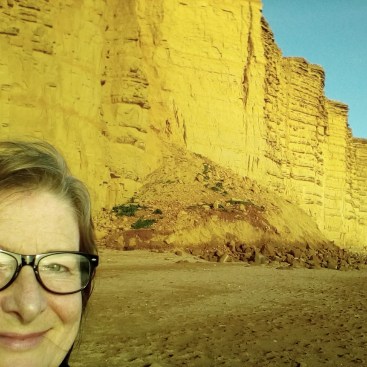
West Bay October 2017
Maria at West Bay – featured in The Chicken Soup Murder

Lastly, Maria, some fun questions:

Mountains or sea? Sea. I’m scared of heights. But looking at mountains is fine too. I’m also fond of the Dutch mountains.

Ha! I love it. Brown bread or white bread? I nearly always buy brown but sometimes look longingly at white as if that is the greater treat.

Cats or dogs? Both have been wonderful friends to me but now I have neither and am mostly interested in the doings of the birds and insects in my garden and anywhere I go. Creatures that have the power of flight amaze me, as does the idea that birds still manage to live amongst us – just about. Blue tits built their nest in the garden last year and raised six young. That felt like an achievement.

Bertie headshot
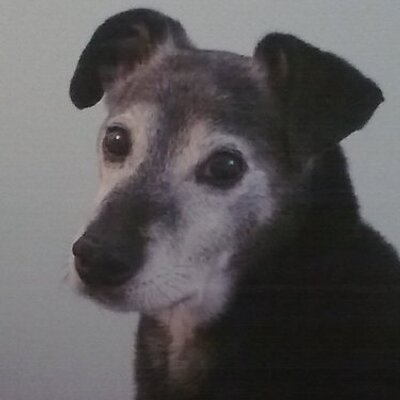
Maria’s dog Bertie, sadly deceased a few years ago.

What writing project are you working on now? I am aiming to finish another novel called The Miller’s Wife. It’s set in a dystopian near future in the southernmost part of the Netherlands and mostly concerns the miller’s agony of uncertainty as he tries to find out what has happened to his wife. There’s also an odd but possible romance with his new neighbour, an immigrant woman, who has been in the country for many years and who sets up her own investigation out of mistrust of the miller’s version of the story. Like Michael and Nan in The Chicken Soup Murder, these two will need each other’s help to solve the mystery. As you can see, I’ll need to work on that fifteen-word description.

SG: Well fifteen or fifty-word description, The Miller’s Wife sounds fascinating… I look forward to it!

I have in the background the novel I stopped writing when my husband died, and a few short stories I would like to complete to put together another collection.

For that short term finishing and publishing hit, I sometimes write very short fiction, poetry (of a sort) and songs. There are blog posts over at www.mariadonovan.com. There I experiment with ideas about truth and time, and question various assumptions. I am also trying to write a little more about the background to The Chicken Soup Murder so I thank you for your kind comments and your questions and the chance to go back and think about it all again. It has been educational.

SG: Oh, Maria, it has been wonderful to chat to you and it has been educational for me, too. Thanks once again and I’d encourage everyone to read The Chicken Soup Murder and check out your website. 
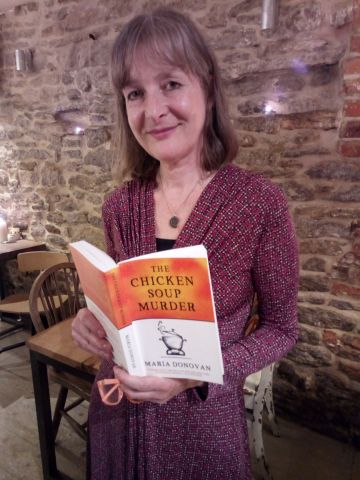
Maria TCSM launch
Maria Donovan at the launch of The Chicken Soup Murder


Writers Chat 13: Nuala O’Connor on “Becoming Belle” (Piatkus: UK, 2018)

READERS! To be in with a chance to win a free signed copy of Becoming Belle, just add your name and a comment below and say why you’d love to read Becoming Belle! All the names will be put into a draw and the winner announced on Friday 14th September at 19.00hr (Irish time)

Welcome, Nuala. When we last had a chat in February of this year, you told me that your Da said he ‘fell in love’ with Belle. What better review could you get? Having now read Becoming Belle, I also felt myself falling for her, hoping that the men around her would become as strong and feisty as Belle herself.

And hearing you read from Becoming Belle in August at the wonderful Victorian Afternoon Tea (at No. 1 Pery Square in Limerick) and at your launch at the Gutter Bookshop in Dublin on 5th September (launched beautifully by Mia Gallagher) – well these readings really brought the era to life.

Becoming Belle UK cover

SG: Tell me firstly about the structure of the novel. We know the end point – Belle is the Countess of Clancarty in 1891 – and the novel brings us into Belle’s life in the four years prior to this point through dated sections and short chapters with wonderful titles such as “A Promise”, “A Performance”, “A Ceremony”, “An Outpouring” and so on. Did you have fun playing with the structure or did the story come to you formed as such?

NOC: Well, the novel I submitted as complete is very different to the novel that’s published today. It’s 40k words longer for one thing. I had started Belle’s story much later – at the point where she is already a successful actress and is changing her name from Isabel to Belle – but my editors urged me to go back to her childhood and tell the story chronologically rather than in flashbacks. There were three re-writes which was rather challenging.

I love using chapter titles, it’s my homage to E.M. Forster who did it so prettily and wittily.

SG: Well, the challenge was worth it – I really loved getting to know Belle as a young woman, away from her destiny yet yearning for it!

One of the relationships which I really enjoyed was that between Belle and Flo. They work and perform together (as the Bilton Sisters) but also have an incredibly deep understanding of each other. “They were as familiar as a cradle song with each other’s foibles and frailties.”

You show their support of each other through their singing warm-ups, and their dress, with wonderful historical detail. I was really taken with the milliner Madame Gilbert who, we are told, “had a generous ear and a snug, discreet mouth”. What a great description, and of course, most important for sisters who are famous. Did historical records help in this respect or is the heart-warming relationship in Becoming Belle that of your imagination?

NOC: There really are very few historical records about Belle and Flo. There’s the court case coverage and a few theatre reviews. All of that bellowing of life into long dead lungs is where the imagination comes into play. I have sisters myself so it’s not hard to imagine the sisterly honesty and shorthand in speech, I know it first-hand. My research involved a lot of poring over photographs and reading of social history to try to put together a picture of what life was like for the feisty Victorian woman, as opposed to the ‘ideal’ woman of that age. Belle and Flo were bohemians and their lives and personalities had to reflect that.

SG: It sounds like very enjoyable research, Nuala.

Much of Becoming Belle is concerned with the prickly thorns and muddy waters of motherhood that come through as the story progresses and also the mother/daughter relationship that Belle and Flo have with their mother which we see in the first part of the novel. This is a theme that you enjoy exploring in much of your work. She really was a strong and inspirational woman, so sure of what she wanted, a feminist centuries ahead of her time, if you will, something in her which her mother sees early on. As you did your research and wrote the novel did you discover anything about Belle that surprised you?

NOC: I suppose, in a sense, her personality is my invention. In press photographs of Belle, she often looks deeply melancholic but the events of her life show that she must have had deep courage and daring to act as she did (baby out of wedlock, elopement with a viscount etc.) So I wanted to paint a picture of a woman who, initially, was ambivalent about motherhood, who wanted to get on and who pushed herself forwards by every means she knew. It takes ages for me to understand my characters and round them out so that they are nicely flawed but still somewhat likeable or, at least, compelling. I suppose I didn’t fully know Belle until I’d written the whole story because, by the end, she realises what she has wanted all along.

SG: Following on from this, the Bilton Sisters manage to live life how they wish to in terms of earning a living, being true to themselves, and having fun all within the confines of the expectations of family, society and gender. This, despite the fact, as Belle says to Flo early on – “life is different for ladies; we don’t possess the freedoms afforded to men”.

However, the Clancarty family are more concerned about material wealth and appearances and threaten to destroy all that Belle has worked for. Without spoiling the plot, how unusual were the freedom of the Bilton Sisters in Victorian London? How different were they to their peers?

NOC: They were different to their working and upper class sisters but not to the others who worked in the milieu they were operating in. Theatre people had a different lifestyle to everyone – they worked and played by night. Because of that they mixed with the rich, who could afford to socialise often, and that’s how attachments were formed. Belle was one of the early commoner-to-countess women from the theatre world.

SG: Another strand that runs through Becoming Belle is that of friendship. I was particularly taken with the character of Wertheimer and his deep affection and friendship with Belle. He really is her saviour in many ways, and she his (in your novel), and yet she sticks fast to William, even when, at times, it seems he is not the one. From the notes at the back, Isidor Wertheimer ended up living a rather tragic life after Belle left London. How drawn were you to his character?

NOC: Friendship really interests me; I have loads of acquaintances but, because I’m an introvert, very few deep friendships. I crave more of those.

I adore Wertheimer, he’s the solid, sweet best friend we all dream of: classy, fun, a great listener and very helpful. Love is fickle: Belle appears not to have loved Wertheimer the way he loved her and, though William is a bit of an un-catch, in many ways, she seems to have genuinely loved him.

SG: Yes, at many points throughout the novel, I was wishing she’d change, and go to Wertheimer!

Names and identity are crucial to the characters in Becoming Belle, as the title suggests. From the first page we see Isabel Bilton playing around with versions of her name and, as she meets the various people of London, they are all defined by their name – class, religion, wealth – and this extends, somewhat sadly, to her own child who changes from Isidor to Dory, again, to suit his circumstances. Our names are so important and even more so if we are in the public eye, as Belle, Flo, and the Clancarty clan were.  

NOC: I’m obsessed with names, it’s one of the joyous parts of writing for me. Obviously 99% of my characters for this novel already had their names, but I was thrilled when I discovered, through research, the real names of characters like Jacob Baltimore and Godley Robinson. Such brilliant, evocative names. The fact that Belle named her first child after Wertheimer is significant and later, she gave her daughter his mother’s name, Franziska, as her second name. Unearthing details like that always gives me an excavational thrill.

SG: When I reached the last page of Becoming Belle, I really wanted to read on, to stay with Belle in Galway, see how she handled that new life. Is there any chance of a sequel?

NOC: Oh janey, I doubt it. I’m waaaaay into the writing of novel #5 now and I’ve so many other projects I want to tackle, including a contemporary novel that’s been nagging at me for years. But, never say never, maybe Belle will call me back some day.

Lastly, Nuala, some fun questions:

  • Canaries or Budgies (there’s a thread from the novel in there too!)? We had dozens of budgies as kids but as a canary owner now, I have to say canaries.
  • Sand or grass? Oh, that’s hard. I’ll say grass as I grew up in the Liffey Valley, surrounded by it.
  • Coffee or tea? Tea. I can only drink milky, sugary coffee so I just don’t bother.
  • What was the last history book you read? I’m currently reading Jan Morris’s sublime Trieste and the Meaning of Nowhere, which is social history/travelogue. She is amazingly clever, her sentences are delicious.
  • What are you reading now? As usual I have about ten books on the go including The Mermaid and Mrs Hancock, which is a fabulous Georgian-era novel: great language, very funny. Also Meg Pokrass’s latest flash fiction collection, Alligators at Night (odd, quirky, funny); I’ll be reviewing Lorrie Moore’s fantastic book of essays, reviews and articles, See What Can Be Done. What a generous, flexible-minded writer she is. I just love her. I’m also reading scads of biographies and histories for my novel-in-progress, an Edwardian era, Europe-set story. Loving it.

A fantastic collection of books on the go! Lots of recommendations there, thanks. Tell us about readings and events relating to Becoming Belle happening in the next few months.

  • Galway launch of Becoming Belle, Ballinasloe Library, 11th September, 6pm. Launch by Mary O’Rourke.
  • Shorelines Arts Festival, Portumna 15th September, 3pm. Portumna Library.
  • Clifden Arts Week – 18th September with Alan McMonagle. 4.30pm, Station House
  • Wexford launch of Becoming Belle, Gorey Visitor Centre, 21st September, 6pm. Launch by Caroline Busher.
  • Red Line Festival, 9th October – Victorian Mavericks with Bernie McGill & Caroline Busher, 7.30pm, Pearse Museum, Dublin

  • DLR Voices, 23rd October – The Pavilion, Dun Laoghaire – reading and interview with Sarah Maria Griffin. Time tbc.

READERS! To be in with a chance to win a free signed copy of Becoming Belle, just add your name and a comment below and say why you’d love to read Becoming Belle! All the names will be put into a draw and the winner announced on Friday 14th September at 19.00hr (Irish time)

And don’t forget to follow this blog for more featured Writers Chats!

Nuala O'Connor photo by Úna O'ConnorPhoto of Nuala by Úna O’Connor. 

Keep up to date with Nuala on her website.

Writers Chat 12: Catherine McNamara on “The Cartography of Others” (Unbound: London, 2018)

Catherine, You are very welcome to my WRITERS CHAT series. Congratulations on your second collection of short stories, The Cartography of Others (Unbound: London, 2018) ,which transported me into other worlds, as good stories do!

CORRECT thumbnail

SG: First and foremost, tell me a little about how you went about assembling the collection. There are many award winning stories here and your stories cover a wide span of geography in terms of where they are placed yet we often feel we are in familiar territory. How important was setting for you in compiling the collection and selecting the order?

CMN: Great question! It was very complex for me to select the story order, and I had story titles on bits of paper flying everywhere. Because around half of the stories are set in West Africa, and the others mostly in Europe and Australasia, we had to keep the locations apart. It was also important to separate common themes or elements, and more titillating stories from slower, quiet ones. Rhythm was so important. Some of the stories are heavy and require breathing space, others race on and are more light-hearted. Another factor to consider in selecting story order was the gender of the protagonist – and not have the ‘female’ or ‘male’ stories bunched together – and we also needed a good distribution of first, second or third person pieces.

The main factor however was setting, as the reader needed to be gently tugged from one place to the next. My hope was that these faraway environments would feel vivid and tangible amongst more familiar settings such as London and Paris.

SG: Yes, that’s actually an element that I enjoyed – not knowing where I’d be transported to next! Some of the stories have fantastic first lines. For example, the opening of one of my favourites, “Magaly Park” begins: “There is a murderer in the new apartment block on the Point in the garage downstairs, it’s all cordoned off.”

This really sets the scene and captures the atmosphere of the whole story. The narrator, Grant, is somehow disconnected from his surroundings and yet incredibly embedded in them. He sees but does not always feel everything. Tell me how important are beginnings for you?

CMN: I cannot start writing a story unless I am curious about where the first sentence will take me. Beginnings are essential for me, and once I can ‘hear’ a first sentence I will rarely change it or the first paragraph. Like the first notes of a piece of music, the first notes must set the tone for the rest of the story, and elicit a precise response from the reader. It is the voice and the echo chamber of the work.

SG: Yes, tone is so vital to the short story in particular. Now, many of the couples in The Cartography of Others have trouble communicating what they really want to say. Some resort to silence, others let their bodies speak. It got me thinking about the power of silence and the potency of voice. I’m thinking about “Adieu, Mon Doux Rivage” and “Three Days in Hong Kong” in which the narrator Philomena M manages to be humorous in her overt sensuality. And in “Return from Salt Pond” – “even her suffering silence was dialogue, insinuating itself along the cords of his brain, snaking with his thoughts, coaxing words from him that were unwilling and unclotted.” Can you talk a little about silence and voice?

CMN: This is a really interesting point.

The dynamic of the couple can be endlessly fascinating, with the alternation between spoken and unspoken, physicality and detachment, and the search for balance and equality – rarely attained. So much of the stories of our lives take place in our heads: we are almost always viewing, measuring, recollecting, and the short story is a wonderful avenue for exploring these alleyways, and the porous skin between thought and speech.

I do like humour. And the dry, slightly-tortured-dialogue-with-self in “Three Days in Hong Kong” was a lot of fun to write, with Philomena M’s sensuality a distinct character within the piece. Flaunted at the hotel window, her body changes from a sensual device to the channel she will use to recover her sense of self. Other stories like “Return to Salt Pond” chart the plunging of a rapport into miscommunication and hardening thoughts, while events and context hover around the protagonists.

SG: You also have a great eye for detail. At times I felt I was reading lines from notebooks, where maybe you had sat in a café people watching…(It’s something that I love to do!). For example, this wonderful description of Russian girls in Moscow “The Ukrainian Girl”: “the statuesque silken women who would one day decompress into their pillowy mothers with pincushion faces and arms.” Can you tell us a little about your methods for recording the physical aspects of your characters.

CMN: Thank you, Shauna. I hate to say that I am hopeless with notetaking. I’ve tried recording details and scenes in notebooks – as I imagined a real writer should do – but I rarely look at them again! I know there are a few mostly empty Moleskins around the house.

When I have an idea for a story I become immersed in its fabric and I really enjoy creating characters from scratch. Recalling locations or perhaps people I’ve observed, and really sewing these new beings into the piece. I love the act of writing and I try to switch on as much of my brain as I can – tuning in with the subconscious where a type of magic occurs and images are thrown up, and the language takes on a pace and shape as the story progresses. I am always observing and listening to people. I’ll talk to anyone and if I’m not assessing them my subconscious probably is, storing up vital images, scents, energy.

SG: Oh how wonderful to be able to store images, scents and energy like that. I love the idea of storing an energy for a story. In this last question we return to place, and specifically, landscape. In many of the stories, the sea has a wonderful healing power and the land is stifling. In “The Bamboo Furnace”, the siblings return to “their sorrowful Eden”, literally battered and bruised by places they have lived in, and in “Astragàl” the emotions at Luna’s disappearance echoed by the view out the window (reminiscent of Hitchcock, I thought) –  “He looked up in a rage at the first folds of the peak and the summit in a crust of white pleats”. Can you tell us a little about the importance of the landscape in your stories?

CMN: For me landscape is a vital part of the story, often a character itself. In the opening story, “Adieu, Mon Doux Rivage”, the sea is a balm that unblocks the wounded voice of a Japanese soprano, while soothing the pain of the narrator whose partnership may be tapering to a close. The two mountain stories – “Astragàl” and “The Kingdom of Fassa” – were written to express our belittlement before the cruel alpine environment. In a world where many of our emotions and thoughts are responses to what we read online, it is almost refreshing to feel the plain power of nature, the dramatic simplicity of an accident, or the course of the seasons and the futility of man’s efforts to tame these forces. Like everyone, I am gravely concerned by global warming and the changes I already see locally (I live in the Veneto countryside, close to the Dolomites), so these stories are an attempt to record and value these places.

Having moved around a lot, I am fascinated by the harrowing effect context and environment can have upon a person. Displacement is one of my major themes, and several of the stories explore the discomforts of being an isolated foreigner. These can span from basic communication issues to the need to accept a different climate and culture, sometimes leading to a remodelling of self within the new circumstances. Some characters adapt and survive. Others, like Santo, a Ghanaian migrant in northern Italy in “The Healing of Santo Yeboah”, do not. In the final story, “The Cliffs of Bandiagara”, the magical highland of Mali and its celestial firmament bring enlightenment and harmony to an embattled couple.

 Finally, five fun questions, Catherine:

  1. Dogs or Cats?

Dogs! I live in the countryside and have a German Shepherd called Astrid.

  1. Paperbacks or Hardbacks?

Paperbacks from good bookshops.

  1. Mountains or Sea?

The sea – I’m a swimmer. But I live near the Dolomites and also ski and hike.

  1. What’s next on your ‘to read’ pile?

I’ve just started My Name is Red by Orhan Pamuk, and next up will read Watermark, a story collection by Australian Joanna Atherfold Finn.

portrait

Thanks again, Catherine, for stopping by and chatting.

Keep up to date with Catherine here: Facebook – Catherine McNamara, Twitter/Instagram – @catinitaly, Unbound – The Cartography of Others

The Cartography of Others is available at all good bookshops or online at Hive, Amazon UK