Writers Chat 61: Katherine O’Donnell on “Slant” (New Island: Dublin, 2023)

Cover image of “Slant” showing three women standing in front of bookshelves, and smiling directly at the camera.

Katherine, You’re very welcome to my Writers Chat series. We’re going to chat about your debut Slant (New Island: Dublin, 2023) which I devoured, and loved, though it did make me cry.

SG: Let’s start with the title – taken from the Emily Dickinson poem “tell all the truth but tell it slant” – which, to me, seemed to describe Ro McCarthy’s life experience. She’s on the outside, spectoring her own life. Can you talk about this theme of not being able to face or talk about the truth head on, at always having to tackle it at a slant?

KOD: Dickinson’s line for me is a perfect summary of the super-power of fiction – which has the potential to make a world for a reader but only when it resonates as ‘true’. Fiction is created through sentences running across pages – slantwise – yet when fiction works for an audience it is not received as ‘fake’ or ‘false’ but as illuminating the real world – all the truth.

Ro McCarthy appears as a reliable narrator but we also experience her as a young, naïve woman; as foolish, duplicitous at times, unaware of danger, inexperienced, and sometimes cowardly. I wanted to write a young voice that we see mature. The older Ro sees more – but as you point out, both young and older Ro have their own particular turning into and away from the environments in which they find themselves in. Their perspective is framed by their orientation to the world and is always partial – just like all of our perspectives. In seeing how the experiences and hence the characters of Ro younger and older are shaped by their environment, readers get a taste of a fundamental truth – we are all formed in and through the contexts in which we move or remain stuck.

SG: Of course, the narrative of Slant is not only the communal story of life for Irish emigrants in Boston in the mid-eighties but is also a looking back novel, that of the formation of self, and ones place in the world. Towards the end of the novel Ro, sitting at her window, muses (quite movingly, I felt):

I feel a type of loneliness, a singular aloneness, that makes me feel secure and that the world I am in is full of possibilities. I know myself by my loneliness. This is me. This is me.

It struck me that she is right – despite the parties, the craic, the people, all with the wonder and grief of life – Ro is comfortable in her own skin and, in her fifties, is finally content enough to allow herself to feel that singular aloneness. Can you talk a little about the individual/ communal support in the community (especially the Lesbian community) that she seeks and finds in Boston in the mid-eighties?

KOD: I am very gratified to see how deeply you’ve connected with Ro and Slant. I am so glad that Slant has found such an engaged first reader! When I wrote those lines about Ro’s loneliness I was drawing on that wonderful poem by Adrienne Rich “Song” where the speaker is responding to the question ‘Are you lonely’. She answers ‘yes’ in four short, intensely lyrical and visual verses and she describes her loneliness as a sense of journeying, independence and expanding freedom. She answers that yes, she’s a plane riding lonely over the Rockies aiming for ‘blue-strung aisles/of an airfield on the ocean’; she’s a woman driving across country; she’s the first person awake in a house full of sleeping people, at dawn in a city; she’s lonely like a frozen rowboat at a lake at the end of December, ‘that knows what it is, that knows it’s neither/ice nor mud nor winter light/but wood, with a gift for burning.’ I have always loved that poem and it was a touchstone for developing the character of the older Ro.

Ro’s ‘ singular aloneness’ is buoyed by her deep experience of community so that she remains confident that world is still alive with possibilities. When she threw herself into the tribe of lesbians in 80s Boston, she had no idea where she would land – we remember that she didn’t want to describe herself as ‘coming out’ but ‘coming in’ – she came into herself, into a lesbian life and was caught in a safety-net of connection with Eily, Mels, the Boys, ACT-UP. We see her in her later life among deep friendships and in a ritual calendar of dyke activities that continue to structure her days and support her in joyful connection.

SG: Yes, “joyful connection” really sums it up. Ro also finds community through social activism – in the 80s she throws herself into AIDS activism and in the 2000s she’s marching the streets of Cork and remembering that in the 80s she

was part of a tribe moving as wind: sometimes salty, sometimes rain-drenched, sometimes howling, then playful, tickling, a gentle breeze; but always bringing more oxygen and possibility to the world, changing the atmosphere and dappling the light.

All of those times “were already an overlooked history” and she feels “the dissonance of that time” with her life as she now lives it. These sentiments echo not only the passing of time but also the huge changes in Irish society and attitudes towards sexuality and identification. And yet, going door-to-door, Ro finds that not much has changed at all. Can you talk about how the personal echoes the social throughout Slant?

KOD: Ro McCarthy’s personal trials and tribulations have allowed me to write a micro-history of Ireland from the last two decades of the twentieth century into the first two decades of this twenty-first century. It surprises me that fiction and film have not focussed much on the tens of thousands of Irish ‘illegals’ who lived in the 80s and 90s in cities across the USA. Even in more recent years the figure of Irish illegal aliens in America is reliably estimated to be about 50,000. The Irish ‘illegals’ are embedded in distinct communities and I wanted to write about that culture, particularly as I imagined it existing in the 1980s. I hope that acknowledging Ireland’s very recent history as a strong exporter of economic migrants during our dire economic recessions in the 1980s that we might remain sensitive and sympathetic to economic migrants living and working and enriching Ireland today.

Ro’s other community in Boston is her queer community who lived through the battle of the AIDS crisis – Ro remembers it as a war and her shell shock is reactivated in her experience of the Marriage Equality campaign. I wanted the reader to be able to witness the cumulative trauma-toll of social marginalisation and oppression on one individual who doesn’t quite understand herself that she has PTSD. In the reader’s empathetic experience of Ro’s life, I hope to inculcate an understanding of the undue suffering of all those whose social identities leave them vulnerable to prejudice and exclusion.   

SG: And you capture this cumulative trauma subtly, and well. Russ declares to Ro “I don’t know if fags and dykes will ever get to write the history, dear Rose Marie, but we will certainly make the art.” There’s a meta-narrative in Slant that of creativity allowing people to be more themselves – for some it’s through singing/dancing/ music and for Ro it’s through writing. Like many writers, Ro writes to make sense of the world, she often wakes with “a wisp of a story” in her head and she tries to chase it down. Can you talk about how writing, for Ro, is about (as she says) “re-membering” herself, reclaiming her body, trauma, grief and from always having “to be brave facing the public world”.

KOD: Yes, the central claim of Slant is that creativity allows us to connect with empathy and understanding, and kindness, and maybe even joy, both to our own experience and that of strangers. I hope that the ending reveals how readers as much as writers of fiction play their part in fostering these enriching connections.

SG: I loved the tone of Slant; Ro’s humour and wry observations of the world around her. She likes American people despite the fact that they “were astonishingly, uniformly intent on amplifying happiness…all that positivity was the perfect antidote to being Irish.” Despite the horror and devastation AIDS brings to many of Ro’s circle, it’s this humour – often self-deprecating – that allows her to be honest, and this can be seen in the wonderful employee/employer relationship she has with the elderly spirited Clara as well as the great friendship groups she has – the misfits – and Eily and Mels. Did this voice come for you through characterisation or theme?

KOD: What another lovely observation and question! The humour came from both the character and the theme – groups that struggle collectively to resist social prejudice and oppression can only survive if they routinely create spaces for joy and laughter. And Ro is simply very funny.

SG: Without plot spoiling, Slant manages also to cover power, abuse, control and silence in close relationships. Again, this seemed to me to echo society as a whole. I’m thinking here of two central relationships to the story – that of Jenny and that of Terri. Can you talk about this theme? 

KOD: In writing the dynamic of the ‘bad’ lesbian relationship I was inspired by In the Dream House by Carmen Maria Machado (2019) but also definitely prompted by that line in the glorious Lesbian Avengers Dyke Manifesto (1993) – “Lesbian Avengers are old fashioned: pine, long, whine stay in bad relationships”. That line – amidst the juicy rhapsody on LESBIAN SEX – has always made me laugh. I feel a bit apologetic to lesbian readers – as we are so starved of cultural representation – that I wrote a lesbian character who was so controlling and manipulative – but, dear reader, she was a complete delight to write and I remain very fond of her. I gave her a happy ending.

It is interesting that you also think that Jenny was in a similar relationship of control, I hadn’t quite realised that. I think that we are so culturally used to the conventional dynamic of traditional heterosexual relationships that we can be blind to their overtly transactional nature.

SG: Yes, for me, Ro and Jenny had a type of echo and call with each other from within their unhealthy relationships. And Machado’s Dream House is such an impactful read. So, we’ll end this Writers Chat, Katherine, with some short questions:

  • New York or Boston? Provincetown.
  • Sorry, I should have offered Provincetown as an option! So, coffee or tea? I need coffee, I enjoy tea.
  • Mountains or sea? Always, always the Sea. In, on, under, or within sight or smell of it.
  • What are you writing now? Reworking a novella entitled Close/Close and also working on developing more picture-book stories for infants (with my friend Soren Mayes) based on Buddhist teachings.
  • I love the title of your novella, and interesting that you’re also working on stories for infants. Tell me, what are you reading now? Couplets: A Love Story by Maggie Millner (Faber 2023) and about to start Lara by Bernardine Evaristo (1999) – I missed it the first time around
Photograph of Katherine O’Donnell seated at a table resting her face on her hand, looking directly at the camera. Photo provided by the author Photo Credit: Emma Jervis.

Thank you to New Island and Peter O’Connell for the advance copy of Slant.

Thanks to Katherine for such an engaging Writers Chat – I wish her much success with this novel. Readers can purchase Slant directly from New Island.

Writers Chat 60: Greg Dinner on “A Requiem for Hania” (Ogham & Dabar Books: Clare, 2022)

Cover of “A Requiem for Hania” showing sepia photograph of railway tracks with ice on them and a forest in the distance

Greg, You are very welcome to my WRITERS CHAT series. Congratulations on your third novel, A Requiem for Hania (Ogham & Dabar Books: Clare, 2022). Let’s start with the structure. A Requiem for Hania spans three generations, continents and perspectives. You bring us to 1942, 1968 and 2006, all significant political, cultural, and of course, personal events in this epic story. How difficult was it for you to form this complex story of identity and family into a coherent structure?

GD: It took many years to find the structure I needed, and the reasons for how I chose to do so. Firstly you need to understand the genesis of the project.  I come out of the film world.  A Polish actress I was friendly with came to visit us in London in 2014.  Having a cockeyed sense of humour, I was teasing her one day that she was so neurotic, she reminded me of my own family—therefore she should have been Jewish (I’m both sides of this equation, particularly the neurotic part, so I almost get away with such jokes.)  We had a good laugh at this.  Then many weeks later, my friend rang me with a story she thought I should hear.  She’d gone to the Baltic Sea with her family to celebrate her Grandmother’s 90th birthday.  My friend was telling them about me, about my teasing comments.  Her Grandmother became quite angry, wanting to know how I could say such a terrible thing, not seeing the joke. 

The next morning the Grandmother gathered the family together to tell them that in fact–she was Jewish:  she’d been in the Warsaw Ghetto, escaped, changed her name, identity, everything, and never told a soul—not husband, family, the State, no one, until that moment

Thus the joke ended and ultimately my journey, my obsession with the meaning of such revelation in the light of my own family background, began. 

Then a second story:  I met my wife Annie in the late 1970s when I was living in Paris and she was the manager of well-known bookshop Shakespeare and Company on the Left Bank.  Yes, Joyce comes into it but that’s another story.  Before Annie had started at the bookshop she’d been an au pair for two architects—the wife German, the husband Polish and Jewish.  We all remain close to this day.  I was always fascinated by his story:  he’d left Warsaw in 1968 and was not allowed to return until the Wall came down in 1989.  Warsaw 1968 was a time of student uprising and protests, although as I learned when researching the reasons for this were very different than I’d assumed.  Now this era was also the time of my own coming of age.  I too am a child of the late 1960s/70s.  I wanted to bring this period, and the Cold War, into the story of the Warsaw Ghetto triggered by my friend’s Grandmother, as well as a more contemporary story.  But I did not know how to tie them into one another.

Then in 2018 my father passed away.  I spent many weeks at his bedside in Colorado, sitting with him night after night because I suffer badly from jetlag.  I would pass those nights, hour upon hour, quietly listening to music as he slept…. And it was through this emotional upheaval that I found a way to structure the material, how to tell the story, and what would be at its centre.

That would be music.  The tie that binds.

I’ve always been drawn to structure and how to tell a story.  Structure has long obsessed me.  And in ‘Hania’ I found Voice when structuring the book as a requiem in both its story and its storytelling.  Thus the novel is structured not with chapters but as in musical form, with a Prelude, Four Movements and a Coda—each section with an appropriate Latinate description.  Music is all.  By utilizing this as central to the stories and themes I needed to tell, and how to tell them, I found the structure I needed.  The structure allowed me to tie together disparate stories and characters over three generations and to develop its central themes of identity, the search for self, the need to witness. 

SG: Wow that is a fascinating story – I love how it began and then seemed to build upon itself, the impact of truth-telling, death/grief (sympathies on the death of your father); the circularity of it all. Of course, I am glad that you talked a little about the musical form, as you say, the book “as a requiem in both its story and its storytelling.” It works beautifully and your writing style often echoes the character-narrative, in particular, when trauma is involved. For example, Hania’s narrative in the Warsaw Ghetto veers from almost chatty to staccato. Can you talk about the importance of syntax to the story telling?

GD: Whether in screenwriting or fiction I’ve always explored ways to tell a story and how can it reflect the themes I want to explore.  In ‘Hania’ for example a central theme is what it means to witness, and more importantly, especially to Jews post-Holocaust, the metaphorical concept of Bearing Witness.  It’s a concept I can talk at length about.  In ‘Hania’ this is partly reflected in the use of witnesses.  Each movement begins with a witness commenting on and then participating in story.  I needed to find the language of these witnesses that might be the syntax of the ‘movement’ as well as that character’s own specific syntax.  Thus the witness of the First Movement, a psychoanalyst, writes in the language of Freud’s notes about his patients.  In the Second Movement the ‘witness’ is a security agent secretly taping and following the primary character, so his language needs to be from official reports submitted to a superior—a style I copied from German Stasi files I’ve viewed; in the Third Movement the witness is a young Israeli researcher who writes short letters home to his family, thus the epistolary style; in the final movement a Conductor Maestro’s manager gives a lecture to Juilliard students, and I used a lecture syntax that I use in my own talks and lectures. 

So too is the case with direct syntax, with the grammatical structure of language and style in the narrative itself.  I’ve said that Music is the story, and the storytelling.  I wanted elements of music to be reflected in narrative style, replete with language at times staccato or legato, andante or da capo, with cadence and rhythm, with melody and harmony.  The language of music and the words of the characters become one.  I’m very conscious of what I’m doing.  It’s also why in particular I use repetition often, as indeed does musical composition:  repetition with the slightest deviation, as if circling around and around in trying to discover some element of ‘truth’ in narrative.  I am sometimes criticized for it.  But I’m doing such with intent.  In music I’ve been deeply influenced particularly for this project by Phillip Glass and Max Richter, let alone Bach.  If you want to understand why I insist on repetition of story and syntax, listen to Glass.  And look at the variations in syntax, of sentence structure, as a form of musical score.  It’s what I mean when I say that music is not only central to story itself—it is as a reader discovers by the end of the book—but to storytelling.  One reflects the other.

SG: And I also think that the witnessing is two-fold – those recording and those experiencing. I have to say, it sounds complex – and it is, to write and deconstruct as we are doing – but it is not this way for the reader. Writing, creating and recording all play a vital and life saving role in the novel. Do you think that part of what A Requiem for Hania is doing is also recording the importance of literature and the arts in helping us remember and talk about the hurt we continue to inflict on each other, in the name of ideologies?

GD: As an executive in film, then as screenwriter and teacher, we always talked of ‘Voice’ and what that means.  The personal seeking the universal; the universal defining the personal.  Voice is everything, what I always seek.  I refer to Leonard Bernstein.  In talking about Music he said: “Music can name the unnameable and communicate the unknowable.”.  He also said: “This will be our reply to violence: to make music more intensely, more beautifully, more devotedly than ever before.”  I would expand beyond music into art itself.  To its creation.  In the story I tell, yes, writing, creating, acting, recording all explore and give Voice.  And help me to answer against the violence not only of the past, of the Warsaw Ghetto, or the anti-Semitic government-instigated violence of Poland in 1968, but to answer against the violence of today.  For me, ‘A Requiem For Hania’ is not simply about the Warsaw Ghetto and the Holocaust, is not simply a Jewish story.  Rather it is my own desperate need to look at my world and the work I have done and still do, from the Holocaust to Vietnam, from Bosnia to Rwanda, from Syria and Afghanistan to Ukraine—very much to Ukraine—and say–no.  And say I Bear Witness.  In Hebrew, alliterated, you see these words often, particularly at Holocaust memorials ‘Le olam lo, Le Olam al tishkach’.  ‘Never again, Always remember.’  In my life and work I’ve seen too many agains, again and again.  Thus those two Hebrew words ring hollow.  But Le olam al tishkach—never forget, always remember—to me is about Bearing Witness.  That is my need, my pain and my journey, and I have found voice to do so through writing, in words and pictures and music, and mostly in stories.

SG: It is what we do as artists – bear witness so that we don’t forget and always remember. One of the most prevalent themes in the novel is that of naming and identity. Without revealing or spoiling any plotlines, it is clear from the outset in the very arresting Prelude: Trisagion: Hymn of Prayer and Remembrance that this theme ties into memory and place:

He looks at them, the old woman, the young woman. He does not know their names. He does not know why this place […] reflected there are notes that play out his life, his name, which he cannot remember, who he is, which he cannot remember […] his hands drop sharply, slightly, his palms raised as if holding up the sky, holding perhaps time itself…

I’m perhaps merging questions here but it strikes me that the lyrical and – at times bodily – writing interspersed through the book pushes the reader to experience disconnect, as the characters do in each of the narratives. The role of memory is tied to the thread of investigation that ties all three generations together. Can you comment on this?  

GD: ‘Hania’ tells the story of three personal journeys as my three primary characters try to find, understand and accept self.  Each of these characters is indeed disconnected—from their personal histories, their political histories.  In order to find self they do indeed literally and figuratively investigate the past as the present, and their role in particular times and places.  Often history is seen as something separate, other.  The past disconnected.  But such is not disconnected.  I was struck that as Queen Elizabeth was buried and the tens of thousands waited to pass by her lying in state, when asked many said they were there to ‘be a part of history’, as if history is other.  But we are history, living it every day, a part of who and what we are.  In order to understand and define the present, we must define ourselves through the past.  My characters have many names, many identities.  Each of the three primary characters have their names changed by history, by necessity.  But to find who they are, they must journey into that personal and political past to define the parameters of self.  At one point a character warns another:  it is not the name that matters, it is what is within one’s heart.  And there lies memory:  to discover identity is a journey, and at times an investigation, not into name, but into the universe of what is within one’s heart.  Kant called it the ‘Moral Imperative’.  I would argue that each of these characters must find the imperative of who they are, which is indeed a moral question, seeking through memory the past, to give license not just to the present, but to the future.  Memory is something not just ‘outside’ us, it is within. 

It’s worth adding another story.  I went on my own to visit Treblinka.  Now Treblinka, unlike many other camps, was completely destroyed by the Nazis.  Nothing remained.  On the extermination site is a beautiful monument of hundreds of rough, standing stones of different sizes, some with the names of every village, town and city where the victims came from engraved.  The vast site is surrounded completely by forest; a monument of ‘train track ties’ in concrete leads up to it.  It’s not an easy place to get to unless you take a tour.  Most do. I went alone.  I arrived early, walked the kilometre to the site, and found myself in the vast, painful place completely, utterly alone for three hours, until I left. There amidst the ghosts and the breeze I found memory, and silence, where the quiet whispers of wind through pine trees brought me forward and back.  The song of tears.  Being alone mattered, and in that silence I found that that disconnect I also felt, and feel that, through memory, I could also embrace the stories I needed to tell.  I should add that I have been an expat for more of my life than not, far away from a large family, an exile.  Indeed I argue often that I am in exile.  The writer Thomas Wolfe wrote ‘you can’t go home again’.  You can’t, but all my life I have been metaphorically trying to do so.  The disconnect you mention is incredibly prevalent in my Voice.  In ‘Hania’ the characters too are seeking to find their way home.  …. You have to read the book to know if, arguably, they do… and how.

SG: That sounds like it was a transformational experience for you, Greg. The other weighty element to the novel (for this reader anyhow!) was that of communication. Silence, speech, music, performance – and acting in all the senses – are what your characters do to survive. These ways of being cross into creative practices and then are echoed in the form of this novel. Can you talk about how these reveal or cover truths of who we are, what we have done, and who we might become?

GD: I spoke above of the importance of Voice, of ‘art’ within defining us. To find expression through the arts helps therefore to define us as individuals, becomes identity itself. 

I will tell another story.  It is what I do.  I also spent time at Auschwitz.  I rather hated Auschwitz—a long discussion for another time.  And as I’d done much research into Auschwitz, there was little I hadn’t already known.  Auschwitz in fact consists of two primary camps—Auschwitz I and Auschwitz II that we call Birkenau, as well as many satellite camps.  As we moved around there was one thing the woman guide said on three occasions that really hit me, hard, although I’m not sure the others in my group, the many tourists, registered it in the same way.  The guide said:  in the camps here, 1.3 Million people died, 900,000 of whom were Jews.  Now it took at least two hours for the remains of a person to become ash in the crematoria.  The numbers don’t add up.  1.3 Million, a huge number of remains the Nazis sought to hide.  It’s a lot of ash, she said.  A huge amount.  So the Nazis scattered ash not only everywhere in this valley, they dumped it in rivers, lakes, forests…everywhere.  But of course, ash doesn’t disappear.  It seeps into the ground but it is there in the soil. 

So realize, she said, the dust is still here.  Even today.  You are breathing in the dust.  You are breathing in the dead…

I would take that further.  I would say one breathes in the dead not just in Auschwitz, or Treblinka, or the camps, or Warsaw, or Poland, or Central Europe—one metaphorically breathes in the dead in Western Europe, here in Ireland, in the US, everywhere.  Because the dead are within us.  Always within us.  Their tears are our tears.  Their laments, our laments.  Their requiems sing for us as well as them.

Thus the role, my role, is to use the arts, just as the characters in ‘Hania’ do, to come face to face with the dust of those we inhale, the dust locked in our hearts and memories. To understand past and who we are in relation to that past. It is the role of this story, the true responsibility of all stories, music, art to give us our common humanity and to express what is deep within us, including the past, in order to understand who we are.  We Bear Witness to the events of the past, and indeed the present, and find ways to cry out that common humanity.  For me, for the characters, such acts of expression are a rejection of the violence of the past, and an understanding of it.  Expression allows my characters to survive, and me to survive.  What is being expressed is the dust of the dead, to remind us that we have survived, and that we will struggle forever to do so. 

SG: And if we take that further, the ashes – once living – keep memories, and these memories are like the tears and the laments that you describe. This is an epic novel with the geneses inspired by real events. Are you interested in returning to any of the characters – and here I’m thinking of Aga? Or indeed, any of the themes?

GD: I had hoped when finishing ‘A Requiem For Hania’, I would exorcise many ghosts and thus move on to other stories, other obsessions.  But I’ve found I cannot so easily do so.  I’m therefore picking up some of the characters in ‘Hania’, some of the minor or referred to characters, and travelling with them further.  I don’t want to return to the Holocaust period per se, and indeed want to move now somewhat in a more contemporary world.  But I’m not ready to let them go, by necessity.  I’ve two books in mind further and they are what I’m now beginning to work on—not in quite the same way, or the same time period, but continuing still.  As for themes—I find in forty years of writing work that I return to the same themes in different guises over and over:  identity, Bearing Witness, the ‘grey zone’ between that which is dark and that which is light within an individual, how “art” gives us our desperate humanity, and of course trying to find one’s way home.  I don’t expect to leave these themes now.  They just become manifest in different ways.

SG: As with so many artists – we have our obsessions, our questions to ask! So, to finish up, Greg, some fun questions

  • Live or recorded concert? Music, like theatre or dance, is not static.  But a recorded version of such suggests it is.  So always live because there is always a sense of the unknown and discovery—whether it’s improv jazz, or watching Elvis’s moves, a Bruce Springsteen marathon or the slightest differences in performances of Mahler or Bach depending on the conductor.   In a communal audience you too are performer, you too are artist.
  • Tea or Coffee? Tea.  A surprising answer for one who is usually found on Ryanair flights hand carrying bags of deep roasted coffee beans of different countries from my favourite Soho Coffee distributor.  However—I am drawn to the memories of many drives from London to Portlaoise with my then small sons in the car.  When we’d arrive, my mother-in-law would always say sit down, have a quiet cup of tea.  Take a breath.  And while coffee gives me a needed morning burst of life, tea blesses me with silence, with thoughts, with harmonies, with reflection. 
  • Mountains or sea? I love both and both speak to me, but I grew up in the mountains of Colorado.  Mountains whisper their near silent thoughts and sing in voices that I understand.  The sea draws you in and casts you out.  Mountains however sing of the possible.  And as I said above, I’m trying to get home again and know I’ll never be able to get there.  But mountains, for me, are memory.
  • What’s next on your reading pile? I just finished Colum McCann’s ‘Apeirogon’.  Absolutely required reading.   Brilliant.  I’m now reading Janine di Giovanni’s ‘Madness Visible’ about the Balkans.  Janine is a wonderful journalist who helped me out a long time ago and along with others is responsible for the road I now travel.  She showed me tragedy and great pain, but showed me that I need to bear witness to events.  And to remember…. After that I’m anxious to start Cormac McCarthy’s new novel, and after Barbara Kingsolver’s, both magnificent writers, both books on my bedside table.
  • What are you working on or thinking about now? The film/television rights to ‘Hania’ have been optioned and while I have said I don’t think I should write for it, I am thinking about what the director we’re now hoping to attach might bring to it.  A composer/pianist also contacted me about the stage rights and I’m interested to see what she’ll do.  I’ve put it to her that perhaps she could look at some piano recitals in Europe in a year’s time, performing some works referenced in the book,–Bach, Chopin, Penderecki– along with something new, interspersed with some very short readings from the book, I hope both in English and Polish.  I dream of things such as that.  Then after the New Year I’ll begin the slow process of developing the two books I want to do spinning both from and away from ‘Hania’.  I hope to spend time in Krakow next year, also Lviv and Kyiv, and Jerusalem, as I research and develop these two long term projects.  ‘A Requiem For Hania’ took almost eight years to produce.  I’m hoping these two other projects might take less time, but …. But.

Very exciting to hear that the film/TV rights have been optioned. I look forward to hearing how it all goes and also to the new projects. I spent a very short time in Krakow and loved it, a beautiful city and most welcoming people. Thank you, Greg, for such open answers and insight into your thinking, intention, and hopes for A Requiem for Hania.

Photograph of Greg Dinner wearing a blue shirt and wool coat against a background of trees and green leaves with sun shining. Photograph courtesy of the author.

A Requiem for Hania can be purchased from independent booksellers such as Kennys, O’Mahoneys or international sellers such as Amazon or Waterstones

Writers Chat 59: Maureen Gallagher on “Limbo” (Poolbeg Crimson: Dublin, 2022)

Maureen, You are very welcome to my WRITERS CHAT series. Congratulations on your debut novel Limbo: A Kate Frances Mystery (Poolbeg Crimson: Dublin, 2022).

It’s a real page-turner of a thriller that reminds us of how far we’ve come in terms of equality and bodily autonomy but also how far the reality has still to go.

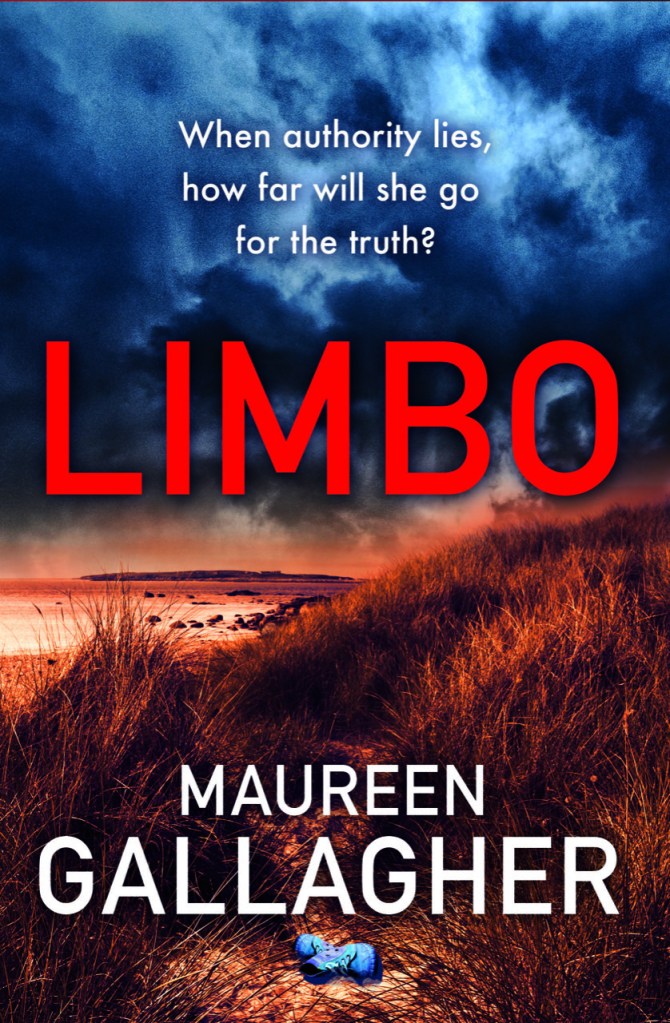
Cover of Limbo featuring seascape and sand dunes with an abandoned pair of child’s boots. This photograph is of Port Arthur in Gweedore, taken by Peter Trant.

Limbo is the first in a series featuring the brilliantly complicated and humanly flawed Detective Kate Francis whom we get to know as Frankie. Tell me about the cover, the title and the series.

MG: Thank you very much for inviting me to WRITERS CHAT, Shauna. The front cover image of Limbo depicts the dunes at Port Arthur strand in northwest Donegal – marram grass and patches of bright sand in the foreground with a view out to sea and the islands in the distance. The image was taken by my brother-in-law – Peter Trant – an accomplished photographer, who is very familiar with the beaches in Gweedore, and took many photographs of the dunes for me to choose from.  The final image is enhanced by David Prendergast, Poolbeg’s designer, who darkened the sky, and skilfully coated the entire landscape with a thrilling orange hue. When it came to choosing a title, Limbo came to me pretty easily, for the layers of meaning that inhabit the word, not least the state of babies souls and the fact that Roche can’t give them a Christian burial. In addition,  Frankie’s indecision and paralysis about what she wants out of life career or family is an important aspect in the novel. The title is also in tune with the tone of the book, which is an attempt to imbue the story with a whiff of incense, given the dominance of the Catholic Church at that time. Limbo is a the first of three. My plan is to set the series at ten-year intervals, so that it charts Frankie’s growth and development personally and professionally, and also gives some idea of the way Ireland has changed in the past 35 years. 

SG: Very interesting to hear about the ten-year intervals. I love that idea and because I really liked Frankie who is very much of her time but is also an everywoman, can you talk about how Frankie developed both as protagonist and character within the framework of the storyline?  

MG: Detective Kate Francis aka Frankie works in a male dominated workplace in  nineteen eighties Ireland. Sexism is rife. In the very first paragraph, sergeant Brannigan, ruminates:

‘To think, godammit, the reinforcements they’re sending from the city, includes a woman. A battle-axe, no doubt, built like a barn.’

So from very early on, we see Frankie dealing with the hostility of Brannigan, while at the same time fending off the unwanted attentions of her married boss, and trying to placate her boyfriend, resentful at her long hours at work. As she struggles to advance the investigation, these personal challenges deepen. Her boyfriend asks her: What do you want out of life? To be the best sleuth? To settle down and become a mother? Frankie is conflicted. She doesn’t see why she can’t do both. When she’s left to solve the case on her own, we see Frankie’s professional confidence grow, as she stands up to the corrupt sergeant and follows her own instinct for finding the killer. Alongside this confidence comes an insight into how she will address the apparent contradictions in her life. In the end we see a changed Frankie, one who has grown personally over the course of solving the murder, and who is grounded and at peace with herself.

SG:  Limbo is set in 1989 in Donegal, with the stunning landscape key to both the mystery and the reading experience. Your descriptions are beautiful and even more impactful as they are set against the investigation of two murdered babies, from Port Arthur Strand, Gweedore to Errigal Mountain and the River Claddy is “the warm colour of tea”, “On the horizon, Frankie can see the islands floating in the Atlantic, surrounded by thousands of foaming white horses fringing the waves: Gola, Inishmaan, Inisheer.” How important was the setting to the novel and to the series?

MG: I spent most summers as a child in Gweedore in Donegal, where my parents grew up. My father taught in Ranafast, and the family simply decamped to the Gaeltacht for July and August. So many images from childhood mean Gweedore to me: Errigal mountain, salmon fishing, snuff, the bitter winter I spent there with its howling storms; sea and sand and picnics on the strand. Summer seemed to go on forever back then and we spent much of it in one or other of the three glorious beaches, including Port Arthur, which features prominently in the novel. I was fascinated with juxtaposing a horrible crime like the murder of a baby against a backdrop of such exquisite beauty. The idea for the novel came from an assignment at a workshop to write a 300-wordpitch for a crime thriller. The writer,  John Fowles, once said that he usually started with a powerful image, and then tried to work out what the story behind it was and how it developed, The French Lieutenant’s Woman being the most obvious example. The image of the mysterious woman at the coast staring out to sea is not so far away from the image of a baby found on the beach. So my novel opens with the most awful crime imaginable. Just as south eastern Sicily is like a character in Andrea Camilleri’s Montelbano thrillers, I wanted Gweedore to feature almost as a character in the story, with the mountain Errigal a touchstone for everything.

SG: Lovely to hear your authorial intention, Maureen, and I do think that comes through to the reader. Over the course of the investigation, Frankie realises how the patriarchal systems of power are skewed towards men, from the hospitals – early on in Limbo a matron exclaims, as if there were no men involved in procreation “these young girls, you’d feel so sorry for them” – to the force which employs her as a detective – she figures out which battles to fight with Brannigan, how to negotiate her desire with Moran (“there’ll be none of that she tells herself”) and her future, whatever that might be, with Rory. Can you talk about your exploration of gender in the Ireland of 1989?

MG: The action takes place in 1989, ten years after the pope’s visit, an era when people’s mindset had not changed much at all from the 50’s and 60’s. I wanted to explore what we were like as an nation back then, and ultimately what that led to: women vilified for no greater crime than becoming pregnant. At one point the protagonist, Frankie, asks: “Do we not value pregnancy and birth in this country?” So you could say my focus was the treatment of women in late 20th century Ireland. When it came to naming my female protagonist, I had to think long and hard. My main reason for giving my female character a name that is somewhat androgynous was because I didn’t want her to be referred to by her first name while all the men in Limbo were referred to by their surnames – Moran, Brannigan, O’Toole etc. I felt that would have rendered her somewhat inferior, in a situation where she is already facing prejudice. But neither did I want to distance her from the reader. So I set about finding a surname that sounded like a first name. Even though there are female Frankie’s, there is the intentional false assumption that Frankie is a male name. At the very least it is gender neutral, androgynous. My intention was to give my protagonist a modicum of gravitas in a male world.

SG: And Frankie as a name for this character works so well. So, part of Frankie’s initial investigations lead her to Umfin Island to meet with members of followers of the Brigid, Goddess of Fertility. She finds

“she’s conflicted. On the one hand, she’s impressed with the back-to-nature self-sufficient element of the lifestyle she’s observed….on the other, at the very least there was a level of violence in the ritual she’s just witnessed that was disturbing.”

In a way, this experience also sums up Frankie’s view of Irish society and politics, and the power of the Catholic Church. It appears to be one thing but actually – including and especially figures in authority – is another. Can you talk about how these themes influenced the story line (or was it vice-versa?).

MG: What was an eye-opener for me when I started to write Limbo, was that the structure of the crime novel – you could say its limitation – allowed me to explore social issues, something dear to my heart. The very nature of the genre frees up the imagination. The two underlying themes I had in mind when starting the novel, was the power of the Catholic Church in Irish society and the subordinate position of women. Someone once coined the phrase ‘the Catholic Taliban’, to describe the hold the Catholic Church had on the lives of women in Ireland all down the century since independence. Throughout the thirties, forties and fifties, and even up to the eighties women’s bodies were a battleground. I wanted to show how the Catholic Church dominated the whole narrative, how it was woven into the very fabric of society, and for this to inform the tone of Limbo. The backdrop to the story is a misogynistic state hand in glove with a powerful church and its impact on women. But I was conscious too that exploring social context should not mean long passages of exposition. The bottom line is that the novel has to be entertaining – people want to know what happens next.  Crime writing, like all fictional writing, is best done through scene setting, dialogue, believable characterisation. Or as the late great John McGahern would say, told slant.  

SG: Yes indeed – ‘told slant’ – a lesson in writing fiction! Lastly, in Limbo, as in our history, those who don’t confirm to prescribed behaviours and identities are locked up or hide themselves away – claiming their voice as their own by not speaking, for example Hannah. Part of what Frankie has to do is to listen to what is behind the stories that people tell, see what is beyond the land and within the houses. In this way, as Frankie “feels resentful at how the Church has commandeered all the major events in people’s lives”, Limbo is as much about agency and power as it about a thrilling story. Was this your intention?  

MG: Limbo is very much about the struggle women have to gain autonomy within the suffocating limitations imposed on them. Hannah’s response to the violent strictures visited on her is to choose not to speak, to metaphorically lock herself away. Her daughter Sarah, in contrast, determinedly manages to rise above her awful experiences and leaves Ireland to embrace a new life. Frankie addresses head-on the challenges she faces and in so doing gains insight into her own personal predicament and how to resolve it. The novel is very much about agency and power. It charts both the tragic predicament of the women who are crushed by their oppression, but also the empowerment and joy of the women who transcend it.

SG: To finish up, Maureen, some fun questions

  • Sandy or Stony Beach?  Sandy. Definitely not stony – I value my ankles!
  • Tea or Coffee? Mostly tea. But when my daughter – who now lives in Spain – visits, I bring her to Tigh Neachtain in Galway, which serves an excellent coffee.
  • Music or quiet when writing? I love music but not when I’m writing. I like total silence when I’m writing.
  • What’s next on your reading pile? I’m re-reading of Lajos Egri’s superb The Art of Dramatic Writing as research for Book 2, and for leisure reading I’ve started Maggie O’Farrell’s The Marriage Portrait, which I’m enjoying very much.
  • What are you working on or thinking about now? Now that the launch of Limbo is behind me, I’m picking up where I left off on Book 2 in early summer. The book’s premise is ‘Misogyny Fuels Femicide’, an idea I’m very engaged with and I can’t wait to get stuck back in.

Thank you, Maureen, for such engaging and thorough answers. I very much look forward to the next two books in the series and to seeing more of Frankie!

Readers can order Limbo here

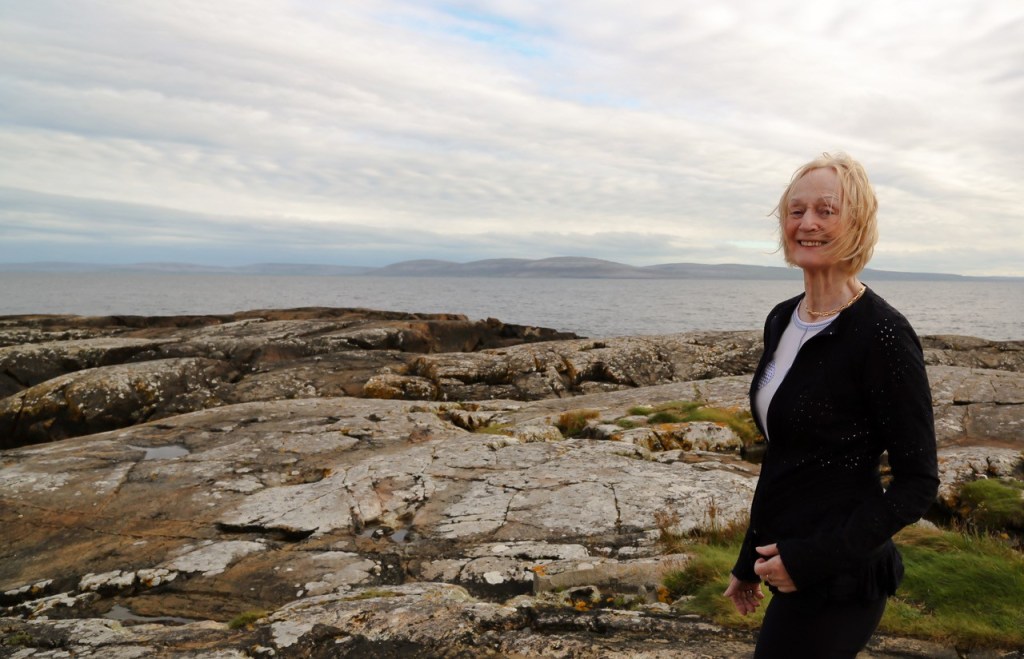
Author Maureen Gallagher. Photo courtesy of author.

With thanks also to Poolbeg Crimson for the advance copy of Limbo