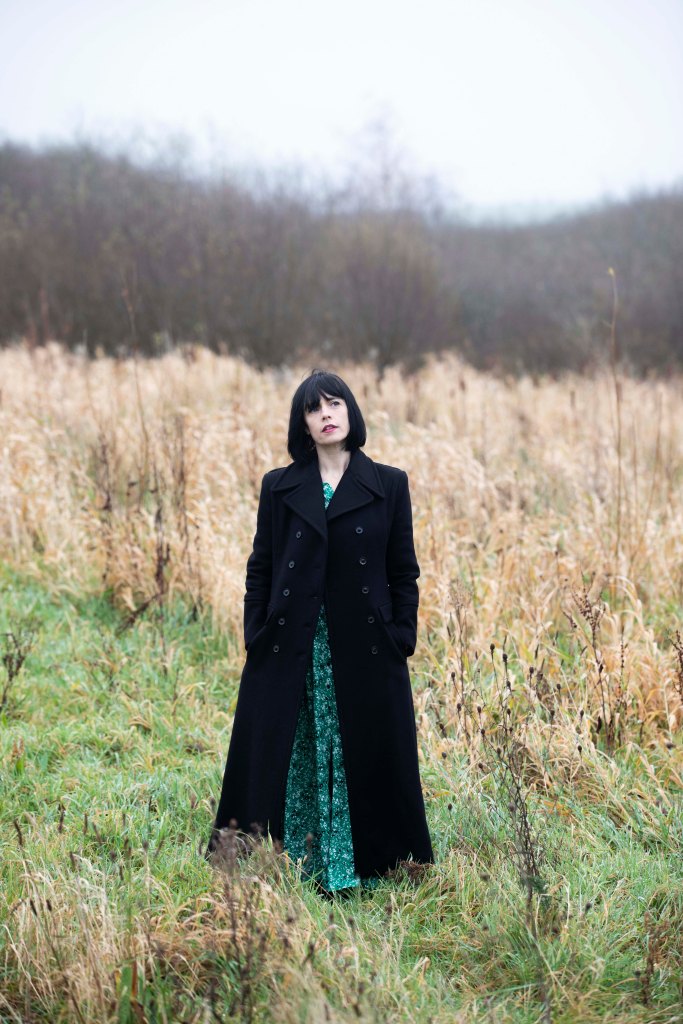
Writers Chat 35: Ethel Rohan on “In The Event of Contact” ( Dzanc Books: Michigan, 2021)

Ethel, welcome back to my Writers Chat Series. This time we’re here to discuss your short story collection In The Event of Contact.

ER: I’m delighted to be back, thank you, Shauna. This is my first interview for In the Event of Contact and I’m so grateful for your enthusiastic response.
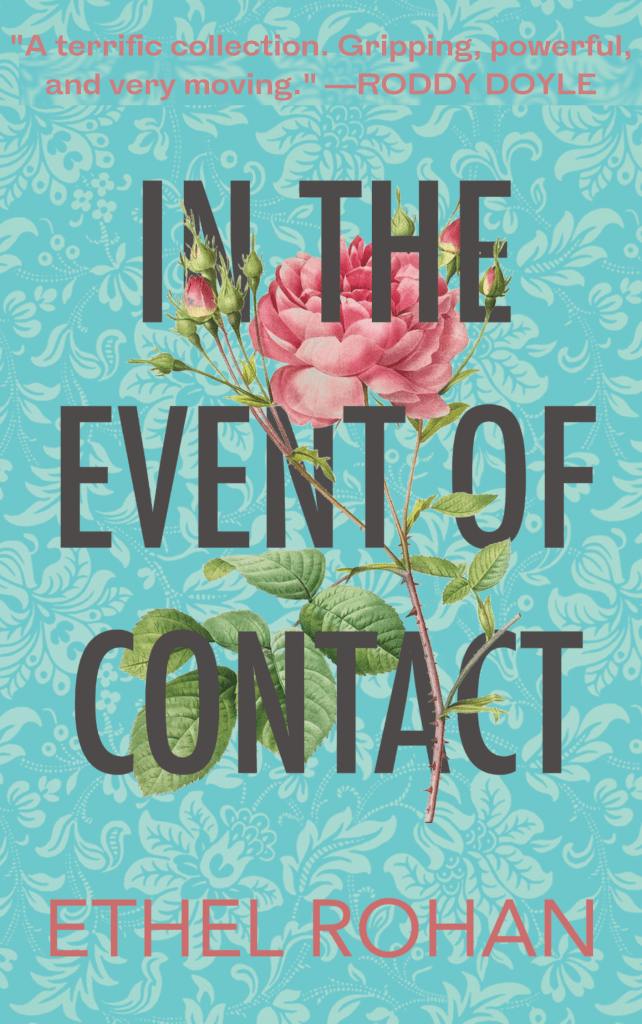
Cover of “In The Event of Contact” by Ethel Rohan

I’m honoured to learn that this is your first interview about this collection, which won the Dzanc Books Short Story Collection Prize and is due to be published in Spring 2021. We’ll therefore skate around plot spoilers as this really is a collection of tight-knit page-turning stories.

SG: The title of this collection and the opening story “In The Event of Contact” place the reader in a liminal space where instinct rules and also confuses. ‘The caged bird knew’ we are told after a series of startling events involving Ruth–who can’t bear any form of touch–her family, and the mysterious and dangerous Mr Doherty. Can you speak a little about this theme of gut and instinct in the collection and why you chose this title.

ER: These are stories of primal fears and urges, and of fight or flight responses. In the title story, menace and danger are intuited by the most attuned of the story’s characters, its narrator Elizabeth and the cockatoo, Jimmy–I’m fascinated by animals’ keen senses and highly intuitive intelligence–while other characters are not so much confused by their gut and instinct but dulled to its messages and guidance.

Our gut and instincts can keep us safe and help us make our best choices, yet too often we under-utilise this capability. I’ve found my body often knows more than my mind. When I need to make major decisions–will I emigrate? Marry? Jump careers? Keep writing?–I tune into my gut for the answers. That involves getting quiet and still and feeling out whether my dread and confusion are coming from my mind or my gut. There’s a calm that settles inside me when I listen to the knowingness of my heart and not the angst of my head.

I have strong memories as a child of intuiting tension and the sinister. I can feel threat and danger in my gut, and remember being perplexed and appalled by how adults often appeared oblivious of the same. I wish my sensitivity and instincts were duller, it makes for a lot of anxiety, but like every curse there’s an element of gift, too, and I don’t think I would be a storyteller, or nearly as empathetic, without that ability to feel deeply and see into people.

As for the title, I worked on the titular short story over years and could never get it quite right until I hit on its final title and then everything else offered itself up. The collection was also created and compiled over many years and again it didn’t come together until I fixed on the title and that gave the stories their beating heart. The title is a twist on our expectations of the familiar phrase: ‘in the event of [my death, fire, other emergency]’ and I love turning the familiar in my stories into the strange and surprising. Once I decided on the collection’s title, I knew what did and didn’t belong in the final manuscript. It’s at the centre of everything, really, isn’t it? What and who do and do not touch us. And how. These are largely stories of crises of consent.

SG: You’ve said it perfectly, Ethel. Crises of Consent. Well, I very much enjoyed how the collection explores connection and disconnection by way of the families we marry into and the countries we move to. Much of what is explored is identity and compartmentalizing – being present in body but not in mind and showing different parts of ourselves to different groups. Was this something that emerged when you gathered these stories into a collection or was it present as you wrote these stories?

ER: In storytelling we’re creating and revealing characters and worlds, but we’re also revealing ourselves, whether we like it or not. I’m guilty of serial compartmentalization–mostly as a daydreamer and sometimes as a coping tool, like I’m physically present but my mind has checked out–and clearly that tendency bleeds into the plots and characters of my stories and was very much present as I wrote each of the stories in this collection.

As an emigrant, I’m also familiar with fracture, that sense of being divided between places and people. That splitness is exacerbated by the pressure to present different versions of myself to meet various expectations (like being Dublin enough, Irish enough, good enough, humble enough, nice enough, smart enough, cool enough, and not too American). Unfortunately, our tendency is to bend ourselves in order to be accepted. Until, that is, we free ourselves of that oppression. So, yeah, these are intrinsic themes that show up repeatedly in my stories. Even before I immigrated to San Francisco, as far back as my earliest memories, I’ve suffered a feeling of never quite fitting in and belonging–always at the edge of things, looking on. So while it’s never my intention as I set out to write–I’m eager to be open to each character’s unique journey–the coerced and marginalized inevitably show up in my stories.

SG: Thank you for such an open and honest answer, Ethel. The collection is also concerned with what is known and what is hidden, and we realise how powerful the unsaid is. Your characters communicate a great deal through what they are silent about. Can you talk a little bit about how dialogue serves to reveal and hide character motivation and narrative truth?

ER:  I love dialogue, and in the past year have at last written a feature script. Something I really have to work on in revision, though, is dialogue that’s too direct. As much as I hate confrontation in real life, I do tend to tell it straight, but that’s the exception rather than the rule and is therefore rarely true of my characters. Subtlety and nuance are much more truthful and powerful in storytelling, anyway, not least because they align with the universal experience of how much is left unsaid, and how much suffering these absences of aired feelings can cause. Despite our singular gift of language, we humans tend to be reticent, uncommunicative, and passive-aggressive–largely because of toxic messaging around being tender and revealing pain. That hiding, that inability to thaw and talk from deep within, causes so much damage, including the cover-up of a multitude of personal and systemic wrongs.

SG: In “Blue Hot” – with its pitch-perfect title – the narrator tells us “Boys are attracted to girls who look like they’re loads of fun, or who seem especially tragic. I’d read that in a glossy magazine. Or maybe I’d heard it on the radio, TV, or bus.” And this troubling message echoes the signals she receives from her family and friends about relationships and physicality, and with dire consequences.

When you’re creating characters, do you find yourself following character archetypes based around the era in which the story is set, or do you base them on what or who you know emotionally?

ER: Typically, I know very little going into each story. I start with some spark that urges me to the page and go word by word from there, filling in the blanks. That spark is always centred around a particular character and my process is to follow the character from scene to scene and see what they reveal about themselves and their world. So, while I don’t think of myself as writing archetypes around era, every character is affected by their who, what, when, where, how, and in particular why. Those internal and external factors colour everything about the character and their perspective. Messaging, particularly early in life, shapes us, and too often misshapes us. A central thread in “Blue Hot” is pervasive patriarchal messaging that devalues women and promotes toxic masculinity.

SG: And you tackle that central thread so well. It truly had a physical impact on me.

Place and space also feature heavily in the collection – in particular Dublin, your hometown – as well as parks. In “Wilde”, the Merrion Square park is used to springboard us into the encounter the narrator has with Oscar Wilde. In the final story in the collection, “The Great Blue Open,” we begin down on the ground in the park and finish with the narrator seeing herself from above. How important was the sense of place – and space – to you as you wrote these stories, and during the editing process with the team at Dzanc Books.

ER: Place and space get back to what shapes us and leaves its mark–imprinting, if you will. Place affects people. Enormously. Particularly our birth place, and those places we call home. As does space. I was just talking with women friends the other day about how I spent decades taking up as little space as possible, be it on buses, planes, in buildings, and on the street. I was always making way for others (particularly men) and giving them the right of way and more than their fair share of space while denying myself the space I needed and which was my due. Now I’m like, Move Over! As for parks, I love trees and woods and open spaces–anywhere with Mother Nature and all her glory. I think if we studied, valued, and emulated her more, this world would be a far better place and we humans would be a far superior and happier race.  

SG: Move over, folks, and welcome Nature. I like it! So let’s finish, Ethel, with some brief questions:

  • What book is on your nightstand now? Shuggie Bain by Douglas Stuart.
  • I have it on my nightstand too (waiting!) So, mountains or Sea? Sea.
  • Wine or Whiskey? Both.
  • But not together! Do you have a favourite book of 2020? Cleanness by Garth Greenwell.
  • I must look that one up. Finally, what is your one writing wish for 2021? Money.

Ethel, I wish you much success with In The Event of Contact. Thank you for your generous answers and with gratitude to Dzanc Books for providing me with a copy of your stunning collection.  The official publication date for Ireland and the UK is June 3, 2021, and elsewhere May 18, 2021.

Photo Credit: Justin Yee (Photograph also on Ethel Rohan’s website)

Keep up with Ethel by visiting her website.
Writers Chat 34: Grace Wilentz on “The Limit of Light” (Gallery Press Books: Meath, 2020).

Grace, I’m delighted to welcome you to talk about your debut poetry collection The Limit of Light (Gallery Press Books: Meath, 2020). I really enjoyed hearing you read in The Gallery at 50 Celebratory Series (Episode 13 [time 10.59 – 15.30]) This collection holds a beautiful understated sensuality in its exploration of memory, body, desire, death, all without drama.

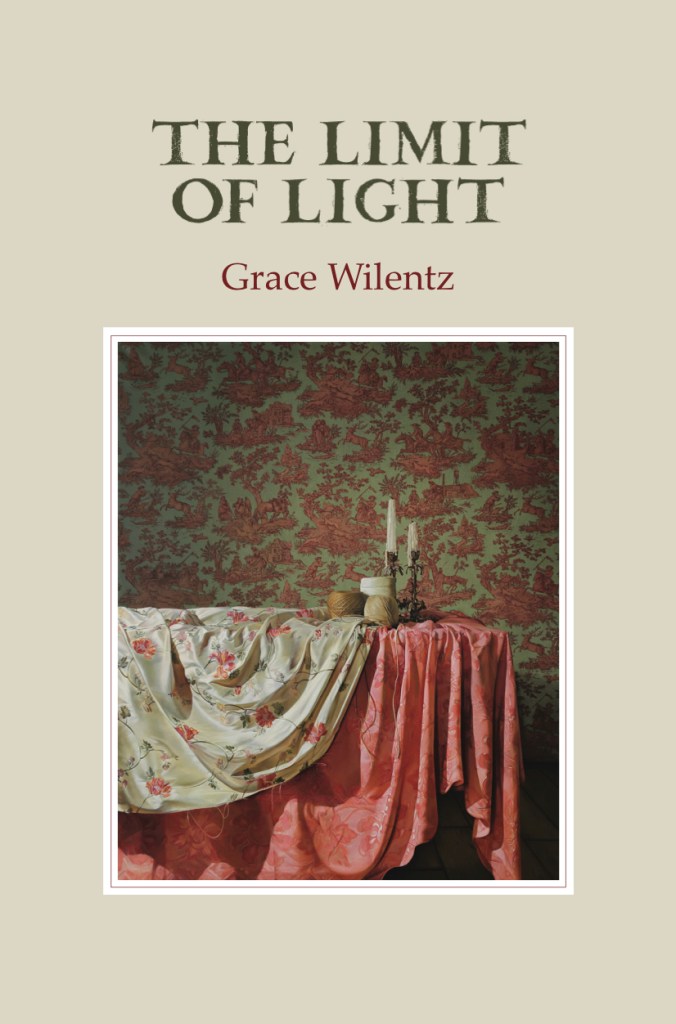
Cover image of The Limit of Light

SG: Let’s first talk about your journey as a poet, thus far. In that Episode you read the ‘Northern Lights’ by Nuala Ní Dhomhnaill, a poet who you say has had a huge influence on you making Ireland your home and who, like you, has lived in many countries and cultures. Could you talk about your reading habits and early influences?

GW: Firstly, let me say a huge thank you to you for inviting me to do this interview, and for giving The Limit of Light a platform to reach more people. Thank you, also, for your beautiful close reading of my work. Your questions are so reflective, and it means so much to have the work thoughtfully read by a fellow writer!

[SG: I’m so pleased the questions resonate with you, Grace.]

GW: My early influences were books of poetry for children. My parents read to me every night, and my favourites were illustrated books of poems like The Oxford Book of Children’s Verse and The Random House Book of Poetry for Children. Talking to the Sun edited by Kenneth Koch and Kate Farrell and illustrated with images from the Metropolitan Museum of Art is still a favourite. It was in listening to those poems before going to sleep that I began to know I loved language. It was also when I started learning poems by heart.

Since that time, the poets who have really shaped me include Elizabeth Bishop, Allen Ginsberg, Jorie Graham, Shane McCrae, Mary Oliver, Wisława Szymborska, Norman Dubie, Stanley Plumly, Ocean Vuong, James Merrill and Dorothy Molloy, just to name a few. I had the great fortune to study with Jorie and I still marvel at how I got to be so lucky.

Reading Nuala Ní Dhomhnaill at 18 led me to study the Irish language as an undergraduate. This was what drew me to Ireland, and changed the course of my life. Nuala Ní Dhomhnaill’s poems speak to me as much now as they did then. I love that her writing presents the world as a whole, with all of its sorrows and joys integrated. I respect the work she has done to protect the vitality and diversity of the Irish language. From Nuala I learned that one of the safest ways to ensure the longevity of something you love that is under threat, is to wrap it up with beauty, poetry, tenderness, vulnerability. That way, no one will be able to resist helping you care for it.

SG: I love the notion of wrapping what you love with beauty, poetry, tenderness and vulnerability. And what a varied list of influences! The Limit of Light is a beautiful production with the very arresting imagine ‘The Ties That Bind’ on the front cover. I found this fascinating – and immediately I linked it to the first few poems as I read, how every day objects, a turn of light, and patterns become signifiers for something else. Tell me about the link between the themes in this collection, the wonderful title and the cover image.

GW: I actually can’t take credit for the cover. Jennifer Truton’s beautiful painting was suggested by Peter, my editor. It was the right choice. For all that The Limit of Light is very forthright and honest in its subject matter, I hope that like ‘The Ties that Bind’ the book holds its mystery, and that the more time you give to it, the more depth will emerge. When I look at the painting, I feel as if it is calling me to use my imagination to assemble a narrative. I hope my book does that too, and that there is pleasure in finding the narrative threads that knit the poems together, and that everyone brings their own imagination and interpretation.

As for the title, I’m not sure if I can explain it so well, but The Limit of Light, is partly about reaching the depths of grief. It is about being in a place of extremity. And it’s also, perhaps, about being in that place where the light is disappearing and learning to see in the dark, finding a way forward when there is no path and no one to show you the way. Writing this collection, grief was a strong theme, but resilience equally so.

SG: Yes, I felt that as I read it grief was side-by-side with resilience. You read ‘Belly of the Whale’ so beautifully and evocatively. It strikes me that many of these poems explore the unspoken, the unnoticed and, to borrow a phrase from this poem, how time is “parcelled out”. ‘Belly of the Whale’ opens Part Three of the collection which follows on from the terribly moving sequence of poems about your mother and her cancer in which you offer the reader through a variety of wonderful forms a glimpse into your joint experience of health, care, and helplessness. It strikes me that perhaps this poem opens the door for another strong theme – that of grief. Can you comment on this?

GW: ‘Belly of the Whale’ is a poem about the summer after my mother passed away. She died in my last year of high school and suddenly I found myself alone, without family or the structure of school days. I just felt sort of suspended. I literally went days without speaking and remember not recognising my own voice when one day I ordered a sandwich at a local deli.

I did feel an incredible helplessness then, and all through her illness, like this thing was just barreling towards us and there was no telling how it would all end up. I wanted to write something authentic, that communicates honestly what those experiences were like, without putting a nice veneer on loss or fear, without any need to tie it all up in a bow. Just letting thing be as they are in the poem.

I recently collaborated with a brilliant filmmaker, Gabriela Concha Valcárcel, who made ‘Belly of the Whale’ into a short film. Our collaboration began in early 2020, just before Covid-19 reached Europe and South America, so almost from the start, we were constrained by it. But it forced us to be creative within strict limits. We used a lot of archival footage, reworking it to make something new. Gabriela was incredible to collaborate with, and she worked so intuitively to translate the poem from words to motion picture, that at times I wondered if she wasn’t a mind reader. I am so proud of what we made together and feel very excited to share it with audiences this year.

SG: The authenticity shines through, Grace, and my sympathies at the loss of your mother at such a tender age. The collaboration with Gabriela Concha Valcárcel sounds wonderful and I can’t wait to watch the ‘Belly of the Whale’ as a short film. Staying with your exploration of grief – which is also a contemplation on life – I was really struck by the symmetry between and structure of the poems ‘Hovenweep’, ‘The Limit of Light’ and ‘Last Look’. I found myself whispering the words aloud, and loved how a little further on, the incantation of ‘Alsace Shabbat’ really begs to be read aloud. Considering space, line breaks and stanza formation, do you think there is a link between sound and grief in these poems?

GW: I love that idea! I don’t know if I connected sound and grief in my own mind, but definitely when working with the ‘hot’ material of your own life, form can put some necessary structure and pressure to help shape it into art. I also take great pleasure in poems that are doing something sonically. It’s a powerful tool in terms of resonance, energy and creating an emotional response. Though I draft silently, I complete poems aloud.

SG: A great insight into your process, Grace, thank you – drafting silently, completing aloud. ‘Words on the Body’ is a beautiful exploration of memory, image, meaning and connection. I found the simplicity of story within this poem truly moving and made me consider how threads of time can suddenly become visible. Could you comment on your approach to writing poetry and the power of story?

GW: Yes, there’s definitely something there, as you say, ‘about the threads of time becoming visible’ or even inhabiting the same moment. Not all traditions conceive of time as linear; for some, it is cyclical. I think that poem, for all it seems kind of unassuming, is a hinge between parts of the book. To me, it’s looking backwards and forwards at experiences of love over time—and of being near to, and looking closely at someone you love. It’s about these two moments—being carefree on a beach with my mother in childhood, and then in adulthood, a partner presenting me with a bag of chips and integrating these two moments through these memories of text transferred onto skin. It is also in some ways about connecting the experience of the love within the family you’re born into, and the love you experience in the family you make for yourself. I am so glad the poem moved you, as when I take risks or try to do something more expansive, I’m always afraid it might not land.

SG: Social commentary is woven into your collection, too. ‘Covers: March 3, 1973 and December 19, 1942’ with, for me, a most beautiful end and a mantra in one: “What if everything I ever wanted/is what I have already received?”, ‘Becoming Esther’, ‘Handwriting’ and ‘The Deal’ where we witness your realisation of the existence of other, difference, transformation and privilege, and I include in this question the personal duo of ‘On a Gallery Bench’ and ‘Partridge Wrapping Paper’ which show the complexity and beauty of connection, again with a beautiful ending “YOU ARE THE LIGHT OF MY LIFE”. These have an echo with the final poem in the collection, the very current ‘A Year with Two Springs’. Do you think the personal and social are inextricably entwined in your work?

GW: That is a great question and something I am still coming to understand in my work. To me, the social and political are present, but they are explored through the lens of personal experience, so they don’t always declare themselves overtly. I think all of our lives brush up against the political issues of our time, and also the issues that are of all time—inequality, migration, difference, the challenges of human relationships, etc. and that a poem can encounter these subjects in many ways. I tend to favour, at least at this point in my career, subtler approaches.

SG: The Limit of Light warrants a read through as it is an almost magical experience in how you quietly build a picture of a live lived and living – with places, people and companionship threaded through it – but one can also dip in and out of sections. It seems that you are also searching for the commonality between ritual, tradition and travel – and turning a mirror to it for the reader. Was this a theme that emerged for you as you ordered the poems into sections, named the sections and prepared them for publication?

GW: I had not connected those themes in my own mind, but it’s very possible. I think tradition and change bring an interesting tension. Ritual is definitely there, both as a vehicle for meditative and emotional processes, but also in recognition of the parts of us that are open to believe and aren’t always rational. As for travel, it can be a way to understand the world better, and oneself better. Ultimately what I think holds them all together is the life at the centre of this collection. You’re so right, I am trying to communicate something lived as truthfully as possible. I didn’t always have the courage to do that and I hope I can stick with it.

SG: I love how my curiosity about your process and the meanings I took from your work often brought out new ways of seeing it for you, and in your generous answers, how I have begun to re-view the collection and will return to your poems with expanse and knowledge of some of what lies behind them. So, Grace, to end our chat, I’ve a few lighter questions:

Coffee or Tea? coffee (for now)

Silence or music when writing? silence

What are you reading now? The IChing, Gina Franco’s The Accidental, (re-reading) Jorie Graham’s Erosion and The Dream of the Unified Field, and Sally Rooney’s Mr Salary.

(Great diverse reading list – I haven’t read The IChing since I was a teenager. I must go back!) What are you writing now? I am completing a commission that is looking at new ways of exploring history through poetry. I am also working through my notes and slowly developing new poems for what might turn into my next manuscript, let’s see. I’m just having fun with it at the moment.

Well, I wish you all the very best with your commission (which sounds intriguing) and much fun with your new work. Thank you again, Grace, for your time and generosity with your answers. Readers, purchase The Limit of Light directly from Gallery Press and connect with Grace on her website.

Writers Chat 33: Doireann Ní Ghríofa on “A Ghost in the Throat” (Tramp Press: Dublin, 2020)

Cover of A Ghost in The Throat by Doireann Ní Ghríofa

Doireann, You are most welcome to my Writers Chat Series and sincere thanks for participating. Many congratulations on A Ghost in the Throat (Tramp Press: Dublin, 2020) which you introduced most beautifully on YouTube. Not only has it won The Irish Book Awards Non-Fiction Book of the Year but it has also been selected by The Guardian as one of the best books of 2020. And deservedly so.

I found the experience of reading this singular text quite profound, and one which still sits with me. You’ve poured your passion for and dedication to Eibhlín Dubh Ní Chonaill’s life and lament into your text and onto its many readers. Not only have you, as you say, “left something” of yourself in the translation of the lament, I feel you have also given something beautiful of yourself to this work.

SG: You open A Ghost in the Throat by naming it as “a female text” “composed while folding someone else’s clothes” and inviting the reader to “join in” this “chant” and “keen”, “lament” and “echo”. In doing so it seems you are readying the reader to be immersed in your experience of reading and researching Eibhlín Dubh Ní Chonaill’s lament and story, so that we, as readers, “ricochet” between your story and hers. We chase you through the book – as you chase Eibhlín Dubh – and what remained when I turned over that stunning dust jacket and cover, was a sense that through the act of reading – joining in – I was also creating my version of “a female text”.

Mid way, you tell your readers how to make a marionette, and you say, “Remember this lesson: in every page there are undrawn women, each waiting in her own particular silence.” Had you hoped that readers would be moved to consider the undrawn women that surround them or consider their own “female text”?

DNíG: I, for one, am fascinated by learning of women’s lives, and I think that curiosity is shared by many others too. To look towards history, as it has traditionally been composed, is often to overlook women’s lives. The manner whereby the larger story is recounted selects which lives are worthy of mention, and which are ignored. That leaves us in a strange position, as readers – if we wish to understand such lives, there is work to be done in uncovering their stories. In recent decades, many writers have set upon this important work. I hope, as time goes on, that more and more such histories will be written, and that the Undrawn will find themselves among the Drawn.

SG: And of course A Ghost in The Throat plays an important part in this work of uncovering. I very much enjoyed the structure of the book – the quotations from Caoineadh Airt Uí Laoghaire, the section titles and the jewel at the end – your translation of Eibhlín Dubh Ní Chonaill’s stunning poem. Did this structure and order come to you when you had finished the book or when you’d found that “echo with which that first page” began?

DNíG: It felt important to weave Eibhlín Dubh’s own words, in her own voice – as fossilised within her extraordinary poem Caoineadh Airt Uí Laoghaire – throughout the text of this book. I wanted readers to find her voice alongside mine, to have the sense of both voices occurring simultaneously, like a duet. I hoped that such an approach would decresase the reader’s sense of the distance between our lives, despite the fact that one voice speaks from the 18th century and the other from the 21st.

SG: Yes, it is like a beautiful duet! Many readers will identify with your experiences and explorations of mothering, nurturing and domesticity. Being a list maker myself (and calendar buyer in November!)  I found it quite wonderful that you celebrate lists and the work and running of a household. You don’t shy away from how difficult it can be – though never impossible – to fit work in around other people’s needs. I loved the line: “As everyone else dreamed my eyes were open in the dark” and it put me in mind of Eavan Boland and Sylvia Plath, always giving of themselves to their craft and children, always open to words. Can you talk a little more about how the needs of our different selves – as girls, women, lovers and mothers – co-exist?

DNíG: I suppose that in order to thrive, we each have to nurture our various selves, don’t we? I can’t speak for anyone else, but for me, this is a bit of a struggle – too often, I let myself become subsumed in domestic drudgery, letting my own needs drop to the very bottom of my lists (that’s if they feature at all!). It’s terrible, really, to neglect those needs despite knowing that there’s a heavy price to be paid. When I encounter the efforts of others in this regard, those who draw a better balance than I do, I observe them in admiration. I’m attempting to change though, slowly but surely. As for housework, well, the unending labours of domesticity often feels like a Sisyphean battle against the forces of entropy. It felt important, within this book, to honour the (often unseen) tasks that those of us who work in the home perform every day. Hence the inclusion of my To-Do Lists.

SG: Those never-ending tasks, unseen, much like the Drawn and Undrawn we spoke about before. Like the language in your poetry, the prose here is quite stunning and I re-read many passages, wanting to drink them in. Your work had echoes of Hélène Cixous in how the narrative is embodied by self and text yet very much grounded in place. You use bodies to explore a journey of lived lives and identity formation for both you and Eibhlín. Do you experience that intertwining of body and language – reading, translating, writing – as a sacred act? And how important was the sense of place and rootedness for you in this book?

DNíG: Thanks Shauna, I’m glad you enjoyed the prose elements of this book. I am only beginning to dabble in prose really, and I feel that I have a lot to learn – I’m still wearing my L plates! Contemplations on the Body have been extraordinarily important to me, ever since I first began to write poetry. It’s a subject that has fascinated me since school, a fascination that was deepened by my experience of dissecting a human body at the age of 17. I suppose every book reflects the author’s natural scope of interests, and for me, both Place and the Body are significant passions of mine. To inhabit such a storied landscape is to find oneself attuned to the many layers of life and literature embedded in our ideas of Place, and the many events – both ordinary and extraordinary – that have occurred over previous centuries.

The Irish tradition abounds with folklore and history, two subjects I am always eager to learn more of. Such is our inheritance: our many pasts, all the countless layers of antiquity, legend, and language, and the many ways in which these layers of both nourish and oppose each other. The act of cartography holds power in my practice, whether in terms of mapping the Body, mapping Place, mapping Kinship, or other layers of identity. To engage in mapping of any sort is to engage in the act of looking, of documenting, and of considering one’s own position. On tourist maps, one will always find a bright arrow labelled ‘You Are Here’ – perhaps it shouldn’t come as any great surprise to us if literary mapping reveals a similar revelation – through mapping, one finds oneself revealed.

SG: I just love how you express the experience and practice of literary mapping, Doireann.

Throughout A Ghost in the Throat, there are many stories. I found “the dissection room” both visceral and comforting – tracking the shift from youth to adulthood, an opening to and reckoning with desire and self-knowledge. I was very moved by your choice to donate your body to science and the image of the white ink tattoo – “a message for the strangers who would be the last to touch me” – that serves to unite the experiences mined here, as well as the lived desire and grief that Eibhlín Dubh explores in her lament. Can you talk a little about the healing power of narrative and how the honesty in your writing might bring the reader to those same boundaries of remembering and reflection?

DNíG: What a spectacular question, Shauna, and so beautifully phrased too! The words people choose for tattoos always fascinate me, as do the words that are chosen for gravestones. Both kinds of texts carry a particular resonance that really moves me. It was important for me, in attempting to uncover and write the life of Eibhlín Dubh with a kind of brazen openness, that I account for myself with a similar openness. Weaving that narrative required a lot of thought in how best to express the truths of my life, as I understand them, and to attempt to honour Eibhlín Dubh’s life with a similar honesty.

SG: And of course, it is not only those thoughts about how to best express the truths of your life, but which truths. You said in an interview with Tomás Kenny that you become the writer you are with the material you have and it really struck me how determined you were to follow the trail – and dead ends – with belief and trust in the process and in the unknown which then became this work.

Looking back now, how do you view the creation of A Ghost in the Throat? Did you find and pull on an emotional thread woven by Eibhlín Dubh? Was it the writing or the writer that drove you? And can we – or should we – separate the two?

DNíG: I felt I was most compelled to research Eibhlín Dubh’s story by something very simple – the sound of her voice. It occurred so clearly through the text of her poem, it felt so true to me, and so alive, that I was driven to listen more and more closely. That act of listening was what eventually drew me towards her, and towards the act of writing this book.

SG: How wonderful, the act of listening lead you to the act of writing which came, in part, through the act of mapping, as you’ve already said. Thank you for such honesty and openness in this Chat, Doireann. We’ll finish with a few quick, light questions:

  • Mountains or sea? Mountains
  • Theatre or cinema? Cinema
  • If you could go anywhere now where would you go? Home to Clare! I’ve found myself so homesick during this latest lockdown…
  • (I hear you! But it too will pass). Silence or music when writing? Music
  • What reading material is on your bedside locker or near to you? ‘In the Dream House’ by Carmen Maria Machado
  • What’s next on the cards for A Ghost in the Throat? I’m as curious to discover the answer to this question as you are – I suppose we’ll both just have to wait and see!

SG: I am sure many exciting things, Doireann. Thanks for being so giving of your energy and time to this Writers Chat. I wish you and A Ghost in the Throat much more success in the knowledge that it will reach the readers it needs to reach – this is a voice that travels far!

Buy A Ghost in The Throat direct from Tramp Press or from your local bookshop, or borrow it from you local library.

Doireann Ní Ghríofa – winner of Odgers Berndtson Nonfiction Book of the Year in association with The Business Post for ‘A Ghost in the Throat’ : Photography by Clare Keogh [Photo provided by Doireann Ní Ghríofa]