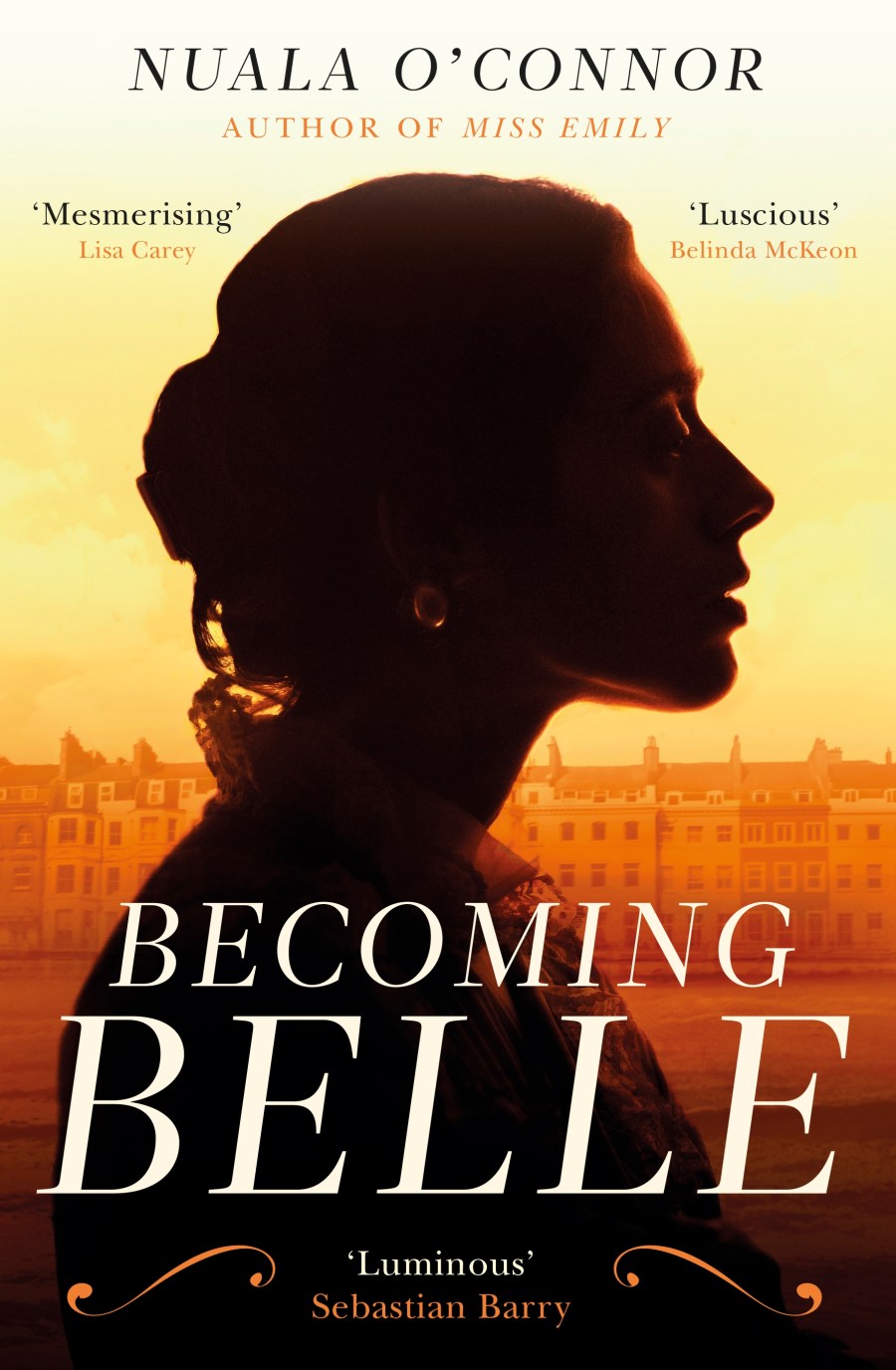
READERS! To be in with a chance to win a free signed copy of Becoming Belle, just add your name and a comment below and say why you’d love to read Becoming Belle! All the names will be put into a draw and the winner announced on Friday 14th September at 19.00hr (Irish time)
Welcome, Nuala. When we last had a chat in February of this year, you told me that your Da said he ‘fell in love’ with Belle. What better review could you get? Having now read Becoming Belle, I also felt myself falling for her, hoping that the men around her would become as strong and feisty as Belle herself.
And hearing you read from Becoming Belle in August at the wonderful Victorian Afternoon Tea (at No. 1 Pery Square in Limerick) and at your launch at the Gutter Bookshop in Dublin on 5th September (launched beautifully by Mia Gallagher) – well these readings really brought the era to life.

SG: Tell me firstly about the structure of the novel. We know the end point – Belle is the Countess of Clancarty in 1891 – and the novel brings us into Belle’s life in the four years prior to this point through dated sections and short chapters with wonderful titles such as “A Promise”, “A Performance”, “A Ceremony”, “An Outpouring” and so on. Did you have fun playing with the structure or did the story come to you formed as such?
NOC: Well, the novel I submitted as complete is very different to the novel that’s published today. It’s 40k words longer for one thing. I had started Belle’s story much later – at the point where she is already a successful actress and is changing her name from Isabel to Belle – but my editors urged me to go back to her childhood and tell the story chronologically rather than in flashbacks. There were three re-writes which was rather challenging.
I love using chapter titles, it’s my homage to E.M. Forster who did it so prettily and wittily.
SG: Well, the challenge was worth it – I really loved getting to know Belle as a young woman, away from her destiny yet yearning for it!
One of the relationships which I really enjoyed was that between Belle and Flo. They work and perform together (as the Bilton Sisters) but also have an incredibly deep understanding of each other. “They were as familiar as a cradle song with each other’s foibles and frailties.”
You show their support of each other through their singing warm-ups, and their dress, with wonderful historical detail. I was really taken with the milliner Madame Gilbert who, we are told, “had a generous ear and a snug, discreet mouth”. What a great description, and of course, most important for sisters who are famous. Did historical records help in this respect or is the heart-warming relationship in Becoming Belle that of your imagination?
NOC: There really are very few historical records about Belle and Flo. There’s the court case coverage and a few theatre reviews. All of that bellowing of life into long dead lungs is where the imagination comes into play. I have sisters myself so it’s not hard to imagine the sisterly honesty and shorthand in speech, I know it first-hand. My research involved a lot of poring over photographs and reading of social history to try to put together a picture of what life was like for the feisty Victorian woman, as opposed to the ‘ideal’ woman of that age. Belle and Flo were bohemians and their lives and personalities had to reflect that.
SG: It sounds like very enjoyable research, Nuala.
Much of Becoming Belle is concerned with the prickly thorns and muddy waters of motherhood that come through as the story progresses and also the mother/daughter relationship that Belle and Flo have with their mother which we see in the first part of the novel. This is a theme that you enjoy exploring in much of your work. She really was a strong and inspirational woman, so sure of what she wanted, a feminist centuries ahead of her time, if you will, something in her which her mother sees early on. As you did your research and wrote the novel did you discover anything about Belle that surprised you?
NOC: I suppose, in a sense, her personality is my invention. In press photographs of Belle, she often looks deeply melancholic but the events of her life show that she must have had deep courage and daring to act as she did (baby out of wedlock, elopement with a viscount etc.) So I wanted to paint a picture of a woman who, initially, was ambivalent about motherhood, who wanted to get on and who pushed herself forwards by every means she knew. It takes ages for me to understand my characters and round them out so that they are nicely flawed but still somewhat likeable or, at least, compelling. I suppose I didn’t fully know Belle until I’d written the whole story because, by the end, she realises what she has wanted all along.
SG: Following on from this, the Bilton Sisters manage to live life how they wish to in terms of earning a living, being true to themselves, and having fun all within the confines of the expectations of family, society and gender. This, despite the fact, as Belle says to Flo early on – “life is different for ladies; we don’t possess the freedoms afforded to men”.
However, the Clancarty family are more concerned about material wealth and appearances and threaten to destroy all that Belle has worked for. Without spoiling the plot, how unusual were the freedom of the Bilton Sisters in Victorian London? How different were they to their peers?
NOC: They were different to their working and upper class sisters but not to the others who worked in the milieu they were operating in. Theatre people had a different lifestyle to everyone – they worked and played by night. Because of that they mixed with the rich, who could afford to socialise often, and that’s how attachments were formed. Belle was one of the early commoner-to-countess women from the theatre world.
SG: Another strand that runs through Becoming Belle is that of friendship. I was particularly taken with the character of Wertheimer and his deep affection and friendship with Belle. He really is her saviour in many ways, and she his (in your novel), and yet she sticks fast to William, even when, at times, it seems he is not the one. From the notes at the back, Isidor Wertheimer ended up living a rather tragic life after Belle left London. How drawn were you to his character?
NOC: Friendship really interests me; I have loads of acquaintances but, because I’m an introvert, very few deep friendships. I crave more of those.
I adore Wertheimer, he’s the solid, sweet best friend we all dream of: classy, fun, a great listener and very helpful. Love is fickle: Belle appears not to have loved Wertheimer the way he loved her and, though William is a bit of an un-catch, in many ways, she seems to have genuinely loved him.
SG: Yes, at many points throughout the novel, I was wishing she’d change, and go to Wertheimer!
Names and identity are crucial to the characters in Becoming Belle, as the title suggests. From the first page we see Isabel Bilton playing around with versions of her name and, as she meets the various people of London, they are all defined by their name – class, religion, wealth – and this extends, somewhat sadly, to her own child who changes from Isidor to Dory, again, to suit his circumstances. Our names are so important and even more so if we are in the public eye, as Belle, Flo, and the Clancarty clan were.
NOC: I’m obsessed with names, it’s one of the joyous parts of writing for me. Obviously 99% of my characters for this novel already had their names, but I was thrilled when I discovered, through research, the real names of characters like Jacob Baltimore and Godley Robinson. Such brilliant, evocative names. The fact that Belle named her first child after Wertheimer is significant and later, she gave her daughter his mother’s name, Franziska, as her second name. Unearthing details like that always gives me an excavational thrill.
SG: When I reached the last page of Becoming Belle, I really wanted to read on, to stay with Belle in Galway, see how she handled that new life. Is there any chance of a sequel?
NOC: Oh janey, I doubt it. I’m waaaaay into the writing of novel #5 now and I’ve so many other projects I want to tackle, including a contemporary novel that’s been nagging at me for years. But, never say never, maybe Belle will call me back some day.
Lastly, Nuala, some fun questions:
- Canaries or Budgies (there’s a thread from the novel in there too!)? We had dozens of budgies as kids but as a canary owner now, I have to say canaries.
- Sand or grass? Oh, that’s hard. I’ll say grass as I grew up in the Liffey Valley, surrounded by it.
- Coffee or tea? Tea. I can only drink milky, sugary coffee so I just don’t bother.
- What was the last history book you read? I’m currently reading Jan Morris’s sublime Trieste and the Meaning of Nowhere, which is social history/travelogue. She is amazingly clever, her sentences are delicious.
- What are you reading now? As usual I have about ten books on the go including The Mermaid and Mrs Hancock, which is a fabulous Georgian-era novel: great language, very funny. Also Meg Pokrass’s latest flash fiction collection, Alligators at Night (odd, quirky, funny); I’ll be reviewing Lorrie Moore’s fantastic book of essays, reviews and articles, See What Can Be Done. What a generous, flexible-minded writer she is. I just love her. I’m also reading scads of biographies and histories for my novel-in-progress, an Edwardian era, Europe-set story. Loving it.
A fantastic collection of books on the go! Lots of recommendations there, thanks. Tell us about readings and events relating to Becoming Belle happening in the next few months.
- Galway launch of Becoming Belle, Ballinasloe Library, 11th September, 6pm. Launch by Mary O’Rourke.
- Shorelines Arts Festival, Portumna 15th September, 3pm. Portumna Library.
- Clifden Arts Week – 18th September with Alan McMonagle. 4.30pm, Station House
- Wexford launch of Becoming Belle, Gorey Visitor Centre, 21st September, 6pm. Launch by Caroline Busher.
-
Red Line Festival, 9th October – Victorian Mavericks with Bernie McGill & Caroline Busher, 7.30pm, Pearse Museum, Dublin
-
DLR Voices, 23rd October – The Pavilion, Dun Laoghaire – reading and interview with Sarah Maria Griffin. Time tbc.
READERS! To be in with a chance to win a free signed copy of Becoming Belle, just add your name and a comment below and say why you’d love to read Becoming Belle! All the names will be put into a draw and the winner announced on Friday 14th September at 19.00hr (Irish time)
And don’t forget to follow this blog for more featured Writers Chats!
 Photo of Nuala by Úna O’Connor.
Keep up to date with Nuala on her website.



 Shauna Gilligan Writer