
For my 20th WRITERS CHAT, I’m delighted to welcome back Ethel Rohan.
Since we last chatted in August 2017, Ethel, your debut novel The Weight of Him was an Amazon, Bustle, KOBO, and San Francisco Chronicle Best Book, and winner of a Plumeri Fellowship, Silver Nautilus Award, and the Northern California Publishers and Authors’ Award. Congratulations, and thanks for returning to Writer’s Chat.
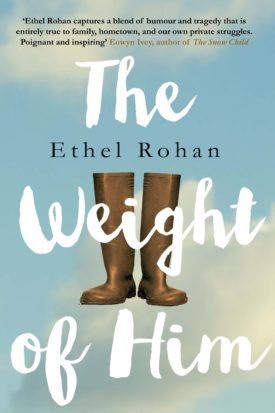
SG: Can you tell us a little about the reception of The Weight of Him, and if, and how, it affected your writing? I always find that it is so difficult for writers to keep those two hats on – one in the midst of finding the way into a new creative project, and the other out and about meeting people and talking about the already published project.
ER: From my publishers’ perspective ( St. Martin’s Press and Atlantic Books), my debut novel wasn’t received well i.e. its sales were disappointing. As much as I tried to prepare myself for the challenges this book would have reaching readers (it centers on difficult subject matter, suicide, and a marginalized protagonist, 400lb Billy Brennan) I was hopeful it would succeed and was crushed when it didn’t fare better. The blow knocked my confidence and two years later I’ve only just recovered. From my own perspective, I still continue to receive a wealth of emails, messages through social media, letters (yes, handwritten letters!), and IRL responses that speak to how deeply the reader was affected by the book. This generous, heartfelt feedback has greatly buoyed me. I persist, and losing myself in writing new work has been my greatest salve.
SG: Well, if you consider why we write, alongside one of the roles of literature in society, I think it is to affect those who engage with it and to shine a mirror on society. Isn’t that the real measure of success?
In your new work, do you find yourself returning to the themes of The Weight of Him? They are themes not easily released from our psyche, I find.
ER: I never enter a story with any theme in mind, but invariably the same patterns and obsessions emerge. I think that’s true of all artists. I’ve even tried to fight it: This story will not be about food, hunger, guilt, shame, loneliness, friendship, missing parts, another “bad” parent, or one more dysfunctional marriage etc. but sure enough… I’ve made peace with my psyche at this point. My only objective is to tell the best, the most interesting and urgent, stories I can. Thus I allow whatever best serves the story to surface in freewrites and survive in revision.
SG: What a noble aim – to tell the best, the most interesting and the most urgent stories. And, of course, holding on to that belief that the work (the writing) will prevail. Tell me, Ethel, what are you working on now?
ER: Christ, I write so much, it’s finishing that’s the challenge. I’m good at plotting stories (which is interesting because I always enter a story blind, never knowing what’s going to unfold) but beyond the beginning, middle, and end where I have to work hard is with character, giving them interiority and complexity, and allowing the reader to deeply connect with each of them and the protagonist in particular. I currently have two draft novel mss completed, and am handwriting a third. The two complete draft mss need further full revisions that focus on theme and character, and I’ll return to them when I’ve finished this handwritten novel draft.
SG: That’s a fantastic outpouring and I completely get that – I’m the same, constantly moving and working on multiple projects. What’s next for publication?
ER: Aside from hopefully publishing some short stories I’ve been working on, and returning to personal essays, I hope to next publish one of the three novel mss mentioned above, and ultimately to publish all three. I’ll lead with whichever “finished” ms I believe to be the strongest and see what happens. What’s daunting, and frankly frightening, is that the low book sales for The Weight of Him will make publishers less likely to take another chance on me and I know I’ve got to write a story powerful enough (or in their own words “big” enough) to sway them. What I won’t do, though, is pander to any trend or market need. I’m staying true to the stories that I most need to tell, those that arrive unbidden and insistent, like surprise, pressing gifts.
SG: I think that’s the most difficult part of the writing life – that industry push against the creative urge. I’ll say it again… the work will prevail!
Lastly, Ethel, some fun questions
- What’s next on your to-be-read-pile and and what’s last on the (same) pile? I have shelves of unread books, and a tower on my desk, and another by my bedside. From that former looming tower, I’m eager to next read Devi Laskar’s The Atlas of Reds and Blues and at the bottom of that pile (simply because I’m so behind in my consumption) is Sarah Perry’s The Essex Serpent. My first read when I return to Ireland in July with be Sinéad Gleeson’s Constellations.
- I have Constellations on my pile now, nearing the top and at the moment I’m reading Niamh Boyce’s wonderful Her Kind. Tell me, Ethel, where did you take your last holiday? Aside from a couple of nights recently in Portland, Oregon, the answer is Ireland (although I’m not sure it can be considered a holiday in that it’s never restful!). Since I emigrated in 1992, I’ve returned 30+ times. My husband’s also Irish and all our family members are there, so the pull is huge.
- And when you’re on holiday, do you bring Kindle or paperback with you? Never Kindle. Mostly paperback, sometimes hardback. And I leave every holiday with more books than I brought.
- Tea or coffee when writing? Barry’s tea (and way too much Cadbury’s or See’s chocolate). Always. Praise be for the several import shops here in San Francisco where we can get all our Irish favourites (albeit at a premium).
- Dogs or cats? Both, with a definite preference for dogs.
Thanks, once again, Ethel, for joining me in a Writers Chat session. I wish you the very best of creativity and luck with your current and new writing projects. Below is the ORIGINAL Q&A WRITERS CHAT, PUBLISHED AUGUST 2017

I am delighted to welcome Ethel Rohan for a Q&A session on her debut novel The Weight of Him. Thanks, Ethel for agreeing to be featured on my blog and many congratulations on the wonderful reviews and accolades that your novel has been getting.

READERS: See below for the chance to win a copy of The Weight of Him!
Shauna: Let’s start right away with the title and your starting point for the story. In the Dublin launch in Hodges Figgis in June, you mentioned that the idea began with an image of a snow globe in a window. I remember thinking that was a powerful image – there’s layers there – and when I read that scene where Billy looks in the shop window, I knew exactly what you meant.
‘Billy wanted to shake the globe and bring it to life…His hand pressed the side of his head, as though trying to keep the egg of himself together.’
Can you expand a little more on this initial characterisation of Billy, in particular his emotional nub.
Ethel: Thank you, Shauna, for hosting me and for your tremendous support of writers and books.
The initial spark for my novel was a conversation I overheard in a Dublin pub about an obese woman in mourning. “The grief might just kill her before her weight does.” That statement stuck in my imagination and I wondered what if this woman’s grief and weight don’t kill her, but propel her to do something extraordinary?
That’s the question that drove me to the blank page. As soon as I started writing, Big Billy Brennan appeared in the white space. The first scene I wrote was, as you mentioned, Billy standing in front of a shop window, his attention fixed on a snow globe. As you’ve quoted, he’s filled with the urge to shake the globe and bring it to life. I knew in that moment I’d hit on Billy’s emotional nub and his impossible burning desire to bring his loved one back from the dead.
I don’t plan my stories, so the novel’s first draft(s) was really just me continuing to answer questions on the page as they arose. It was a risky novel to write and to publish (thank you, St. Martin’s Press and Atlantic Books). I met many hurdles in the telling, largely fueled by self-doubt. Mostly, I struggled with whether or not I had the authority to write about a 30 stone man. I worried whether or not I could make the unlikely marriage of the difficult topics of obesity and suicide work. I felt an enormous responsibility to handle both topics with sensitivity, compassion and honesty.
Shauna: While the narrative is told from the perspective of Billy, I found we got some close insights into his wife Tricia’s point of view. Can you tell us about their relationship and how much of it is viewed through the lens of grief, loss and unanswered questions?
Ethel: Point-of-view was another major challenge. I knew I was taking yet another risk in keeping the story wholly in Billy’s perspective—he’s the camera through which everything is filtered. But after multiple drafts, I became convinced that close third point-of-view was the right choice for this story. That sense of limit and containment mirrors how trapped Billy feels in his body and his grief, and also underscores how trapped Michael felt, and to a lesser extent, Tricia. The close third point-of-view also felt true to life. We can’t get inside others’ heads in reality—we know others only by their story and what they say and do—and that’s the way I kept it on the page. Limiting, yes, but sin a bhfuil.
With the close third point of view, it’s a bigger challenge to render the other characters as fully as possible, and in particular the main secondary character, Tricia. I only had the use of backstory, Billy’s perspective, and what Tricia does and says in scene. I learn who my characters are by both interviewing them off stage and putting them in scenes, to see what they say and do and how they interact with others.
In discovering who my characters were, I learned that Billy and Tricia’s marriage was troubled long before Michael’s death and that they were merely coasting along in a largely humdrum existence. Tricia felt betrayed by Billy because early in the marriage he lost the agency and sense of empowerment he’d exhibited in their courtship—his brief sense of bravado and buoyancy was fueled by the first glow of their love. When Michael dies, their relationship inevitably unravels further and they each grieve, and try to go on, in startlingly different ways.
Leaving some questions unanswered in the novel might seem like another risk, but again I tried to best reflect life and truth. Reality can’t be wrapped up and tied with a permanent, pleasing bow and neither should story. Suicides leave behind more questions than answers and our relationships with food and our bodies is ever-evolving. There is never resolution in all things in the world, so how can there ever be complete resolution in story?
Shauna: Oh I agree. Much of life is spent searching for resolutions, and often through stories, so leaving some questions unanswered was one of the powerful elements of The Weight of Him and one that served the portrayal of Billy and Tricia’s relationship well.
Now without giving away the plot, one of the elements of the story that stayed with me long after I’d finished the book was the emotional weight that is evoked through the work Billy puts into building his ‘other world’ made up of the imperfect miniature figures from the factory where he works. It is only in this world that he can save Michael, the son he lost to suicide, and it is only in this world he can be the ‘right son’ and the best father. Can you talk to us about the psychology of this powerful subplot.
Ethel: Thanks, Shauna, it took restraint in final revisions to keep concise and not get too caught up with the subplot of Billy’s alternate world, a wonderland that fired up my imagination.
In that first draft, I was deep in the writing, answering the question of where Billy worked, and the toy factory came to life on the page, and then the damaged toys appeared. When Billy secretly pocketed the first damaged toy, a soldier that represented Michael in his mind, the subplot developed from that pivotal moment. It was one of those rewarding, exhilarating gifts in the writing when what a character does surprises you and you know you’ve opened a rich vein.
Many of the scenes in this miniature ‘other world’ didn’t end up in the final manuscript but they did allow me to fully understand Billy’s psychology with relation to the damaged toys and the idyllic tiny village he creates for them—a perfect world where Michael is returned and the Brennan family is whole again. Of course, perfect doesn’t exist, not even in Billy’s pretend world. That was another of the lessons Billy had to learn and more of the suffering he had to withstand in this story.
Shauna: I walked for Pieta House this year as part of their world wide appeal Darkness into Light and was really moved by the sense of community and hope. Billy walks for suicide and uses the media as a way to come to terms with his loss and also give hope to others.
In a scene where his mother takes ill, the nurse in the hospital turns to him:
Her eyes stayed on him. “You’re the father from the newspapers, aren’t you, the one doing the suicide prevention fund-raiser? I heard you on the radio too. Well done, you’re an absolute inspiration.”
Ethel, not only did you donate the net earnings from your Dublin launch to Pieta House, but much of the novel focuses on the difficulty in getting people to talk about suicide and suicide prevention, and the roles (positive and sometimes negative) the media can play in this – in other words, how do we talk about something that is so painful when often the very thing to prevent, or help heal that grief, is to talk?
Ethel: Thanks for walking, Shauna. I did too, here in San Francisco. Suicide is preventable and one of the key ways to prevent it is to talk about it. For those suffering suicidal thoughts, it is never too early or too late to seek help and talk about your illness. For those, like me, who have overcome suicidal ideation, is it important to share our stories so others know that they are not alone and that there is great hope.
As a culture we need to educate ourselves on suicide and mental illness and lift the last of the stigma. At my most ill, I became convinced that no one would understand or care. We need to send a clear message as a culture that we do understand and we do care. Like every person suffering an illness, the suicidal should be accorded compassion, dignity, and the best of treatment.
Silence has its value, but not when it’s silence locked up by secrecy, shame and fear. That kind of silence causes enormous damage, and can be killing. So, please, just talk out the thing. I’ve found whatever it is we least want to talk about, that thing that we most want to keep in, that’s exactly what we should talk about and let out.
Shauna: Yes. And literature – storytelling – can be a way in which we can speak of these things and also the means by which conversations can be started. In The Weight of Him, despite the initial subject matter- that of an obese man who has just lost his eldest son to suicide – there is much beauty and hope.
“He roared. Roared till the scorch inside his throat and chest made the sting of his bloodied knuckles feel like nothing. Roared till he’d nothing left. Breathless, spent, he struggled back to standing, his feet slipping about in the muck and the pain pulsing in the sides of his knees. He pushed himself to the farthest edge of the cliff and lowered the flashlight to the ground. In life, Michael would not have been able to stand here next to him on the cliff’s edge. It would be nice to think the boy’s spirit was standing alongside him now.”
I found it to be a very human story touching on identity, relationships and discovering – through Billy – that we are all, in our various ways, striving to fully embrace who we are. And that wonderful line that Billy’s younger son Ivor says: “We get reminders about dying, so we don’t forget to make the most of living.”
Ethel: Thanks for such a close and generous read, Shauna, and for these excellent questions and observations. I think all my writing is ultimately my characters and me trying to find the beauty and hope in damage and loss. It’s how we can best go on.
Shauna: And isn’t that, yet again, much of life? Finding the beauty in the cracks, the cracks that are in themselves, beautiful. Thanks again, Ethel for such wonderful, honest answers. I wish you further success with The Weight of Him and I look forward to your next novel.
And now for the opportunity to win a signed copy of The Weight of Him – Irish and UK readers only! Simply add a comment below along with your name (first name will do) and an email address so we can contact you if you win. The winner will be picked out of a hat on Monday 28th August at 8pm.

Connect with Ethel here: Twitter, @ethelrohan; Facebook, @EthelRohanAuthor; Instagram, @ethelrohan. Website, http://ethelrohan.com.
Order The Weight of Him on Amazon or your local bookshop!
If you have been affected by issues raised in this post please contact the Samaritans in confidence on 116 123
********

AND THE WINNER…of Ethel’s Rohan’s debut novel The Weight of Him…is Shauna!
Congratulations and thank you for reading and commenting. I will contact you to get details of where to send the novel.

Thanks once again to my son for doing the honours of closing his eyes and pulling out a name!
And thank you to all those who have read and/or commented and most of all to Ethel Rohan for such generous answers.
Happy reading, folks!

 Shauna Gilligan Writer