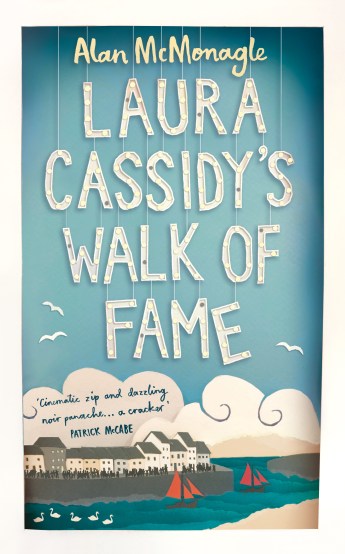
Writers Chat 27: Alan McMonagle on “Laura Cassidy’s Walk of Fame” (Picador: London, 2020)

Alan, You’re very welcome to another WRITERS CHAT (readers see our last chat here). Your second novel, Laura Cassidy’s Walk of Fame, was launched to a huge crowd in Galway City Library in early March 2020 – just before the Pandemic lock-down – and has been described by The Irish Times as a “vigorous novel” and “an infectious portrayal of brazen optimism”. Laura Cassidy high res jpeg(with Quote)
SG: Can you tell us, firstly, about the genesis of the novel, which explores serious themes of grief and denial through what we might call a playacting lens?

AMcM: That’s not a bad descriptor. At the most rudimentary level it began as a voice. A voice that acquired flesh and blood. A voice that announced itself as a young woman, a burgeoning actress with a dream to pursue. A voice that swings both high and low, that flip-flops between the world of dream, invention, imagination and the more concrete world of the everyday. It was a voice that also, at times, misbehaves. And once misbehaving kicks in, things have a chance to become interesting…

SG: Yes, how messiness is always interesting – where we find the good stuff! I was particularly taken with the structure of Laura Cassidy’s Walk of Fame. It is divided into five parts and each part follows (literally!) Laura Cassidy’s “Walk of Fame” so that we feel we are walking with her. I love the titles and how each part is inspired by a different starlet and theme – for example, Part 1 Barbara Stanwyck “Just be truthful – and if you can fake that, you’ve got it made.” Seems like we should all be listening to that motto – especially the highly successful Imelda! Was this structure there from the start or did it come to you once you had the story down?

AMcM: The structure was born out of this playful lens you refer to in the previous question. And there was play aplenty involved early on, all in service to Laura’s perceived life as a famous star. I fabricated imaginary interviews which  Laura conducts with various journalists she is only too happy to wind up no end and lead down the garden path. From there other features, just as unlikely, quickly arrived. Acceptance speeches, movie pitches, interactions with directors, agents, film executives. I had great fun outlining a sequence of movie parts tailor-made for Laura, I even wrote an obituary for an her. Out of all this ‘play’ it is the mini-biographies of the starlets of yore that made the final cut. (Along with the rollercoaster life of Imelda J Ebbing.) And these bios had to be drastically cut down, from an initial number of over twenty, then fifteen, and finally to five – what a wrench that was. At times, I felt I was auditioning all these brilliant actresses from the era of classic cinema for a part in my novel. And now that I am talking this out with myself it occurs to me that this might be something interesting to explore in a piece of writing.

SG: That would be so interesting – a series of interviews with stars from the era of classic cinema. It sounds like you’re not quite done with the starlets and the star system! Laura Cassidy is well-drawn – she’s feisty, snappy, funny and endearing and also, at times, a very lonely and misunderstood person. Can you tell us a little about her development and journey as you wrote the novel?

AMcM: I think the death of her father looms large in Laura’s story. She witnesses his death. She is quite young when it happens. She also witnesses it at a crucial moment in her own life – she has just bagged the lead part in the school play and the first person she wants to share the good news with is the person who has planted this acting dream inside her to begin with, her father. I think she has a very complicated reaction to his untimely death. I don’t think Laura herself is aware of how and when this reaction is going to manifest itself. But it has damaged her psyche. There’s a fair old cocktail bubbling away inside her. A combination of grief and trauma, probably some guilt, she can do a nice line in denial. It’s a heady mixture, a combination that could potentially kipple her when it matters most. And so yes, Laura becomes a pocketbook of complications and contradictions; of uncertainty and confusion. She vacillates greatly between unusual levels of self-belief and deep-set fear; between self-sabotaging hope and blind optimism.

I find weighty themes such as grief, trauma, guilt very difficult to come at straight on. And of course setting out I wasn’t aware that these weighty themes were going to become a significant part of the story. My approach has to be more angular, slanted, with twists and knots and complications and contradictions. We’re in the realm of confusion and uncertainty. Chaos. And chaos is slippery, and tricky, tricky to meet head on. I think that as a writer it’s how I find my way towards that X on the treasure map. That X being a moment of discovery or realisation or revelation. And not knowing what this X might be is what kept bringing me back to the desk every day, to spend time with Laura, unearth what was making her tick – or, more accurately, not tick.

SG: I love that notion of slipping through the chaos towards discovery and finding moments of why. This brings us neatly on to the internal and external worlds of Laura. As much time as she spends in her head, her complex and witty self is revealed when she is with other people, even though it’s difficult for her. I’m thinking here of her relationship with Fleming and with her doctor, both of whom take her as she is. For example, speaking to her doctor she says

“Doc, you’ve been saving my life for a year now and I have to say I think you’re doing a terrific job. So I have no fears on that score. If you ever need a reference you know where to come.”

Laura is, as the doctor calls her “a charmer.” Can you talk a little bit more about this charm that brings us with her on her journey?

AMcM: Essentially, Laura is an unreliable narrator. And of course, as a writer, to a certain extent you must allow the reader in on this. So there is an attempt to strongly suggest – even from the get-go – that things are not going to go according to plan for Laura. This theatre/movie stardom dream of hers is going to remain out of reach. But as a counter to this I don’t allow Laura for one minute believe, certainly not in her interaction with the world, that she is not going to make it. And so the thing becomes a balancing act, a wire walk. And as is the way of wire walks, sometimes you fall. And when you fall, you’ve got to pick yourself up and go again. When we first meet her, I think there is a gap between where Laura is and where she would like to be. And for Laura, this gap becomes a place of invention, imagination and dream. And one thing I think the novel might be trying to do is emphasise or explore the power of dream and invention and imagination for those in the world who are more vulnerable than others. Explore the fine line between the language of dreams and reality. And so there is a version of herself Laura presents to the everyday world, and to those with whom she must interact in order to get through the days or her life. This so-called charm gets switched on. The humour and the wit. Lots of colour. After all, she sees herself as an actress, performing is second-nature. But we also become privy to the goings-on inside her head, when she is alone, contemplating, reflecting, in her own way dealing with all the headstuff that gradually declares itself and does it thing, as the dream and all that it might have entailed begins to unravel.

SG: Yes, the narrative captures that slow – and almost inevitable – unravelling quite beautifully. I’d say that most readers will identify with the difficulty of family: how we are defined by it, compared within it and have expectations imposed on us by it. Sibling rivalry and relationships are explored through the lenses of presence and absence, in particular, Laura’s relationship with her sister Jennifer and her young son Juan, Laura’s nephew. Can you talk a little about how you use humour, black humour and a lightness of touch to explore these themes?

AMcM: Laura and Jennifer. Obviously there are differences in their circumstances. Jennifer gets to fly the coop and ‘save the world’. Laura remains in the home house, in the throes of a much more interior journey, a journey into fantasy & delusion. Laura is clearly wary of, suspicious of Jennifer upon her return. She is dismissive and mocking of Jennifer. She definitely displays child-minding skills that, at best, can be described as questionable. Jennifer, too, initially offers her sunny side to the neighbourhood. There are humorous stories of her time abroad, she wants to tag along to the pub, shine in the presence of everyone and anyone. But, gradually, this is undermined. Her life is not going as smoothly as she would like everyone to believe. And so I think it’s fair to say they are both deluded in their separate and very individual approaches to the world. Laura with her hi-fantasy ambitions of stardom and Jennifer seemingly convinced she is some kind of modern day miracle worker. The humour, I think, becomes an attempt to throw light on the not-so-funny aspect of all of this. That is to say, how Laura and Jennifer have chosen to enter the world, get through the days of their lives. And for all their flaws and delusions and contradictions and mishaps and missteps, these respective approaches must be recognised and acknowledged as something valid.

SG: Yes, that resonates – that, despite ourselves, we do actually chose to enter the world and, as you say, get through the days of our lives in a certain way. So finally, let’s come to the acting, the stage, and the other side of this coin – that of grief. It always strikes me that there is something similar in acting to that of writing – it’s about escaping yourself and at the same time ‘becoming’ more yourself on the stage/page than off it. As Laura says

“For a time…. I could float, drift, hover wherever I liked, when the mood took me…I could be here and not here….I used to so enjoy imagining the world around me through the eyes of others….”

Without giving anything away, in Laura’s case it seems to be true that wanting to play the leading part in Streetcar Named Desire is more than just wanting that part. Her insistence and perseverance are both tragic and funny and I found myself despairing for her and also laughing at many of the scenes with the director Stephen (of the precisely and perfectly named Khaos Theatre). Was this something that emerged through the narrative and characterisation or something you were consciously interested in exploring?

AMcM: It’s a great question, as is your observation in relation Laura’s desire to snag this leading role she so craves being more than merely wanting the part.

There is something else at stake for her here, I feel. Pursuing her dream, not matter how unlikely her chances, may cost her dearly, but I suspect she has made this reckoning with herself at a very early time in her life and has decided that, come what may, chasing after whatever it is she is after will be worth it. The journey and all that it entails, hi-fantasy, setbacks, desperation and all, is what matters to her. I suspect she may feel trapped inside her own skin, that the only way she can become who she wants to be, or at least a semblance of who she wants to be, is through whatever viable outlet presents itself to her – in this case, through a life inhabiting many ‘roles’, a life performing, a life spent stepping in and out of the everyday world.

And again, I wonder has she realized that how she sets about getting through the days of her life will fall short of her expectations. It’s a complex question you’ve asked me, at least I think it’s complex, and I’m thinking about it as I write this, and yes, it is something I’m interested in exploring, and yes I do think it’s connected to the desire to create, to the magic place it comes from, to finding a way to be in the world and at the same time at a remove from it.

SG: Let us know what Laura has to say on that – maybe we could meet her 20 years from now….So lastly, five fun questions, Alan: 

  1. Theatre or Film? Yes!
  2. Dogs or Cats? Dogs.
  3. Coffee or tea? Coffee.
  4. Best ‘Coronavirus/Covid-19 Lockdown’ tip? Dance.
  5. Oh I love that one! So, what’s next on your ‘to read’ pile? Dance Prone by David Coventry.

SG: Thanks so much, Alan, for such thoughtful answers, I’ve thoroughly enjoyed our Writers Chat. 

Readers, hear and watch Alan read: at Cuirt Festival  at The Live Network and at The Holding Cell

alanCtrib2020

Readers can purchase Laura Cassidy’s Walk of Fame from all good bookshops and keep updated with Alan on his website.


Writers Chat 3: Alan McMonagle on “Ithaca” (Picador: London, 2017) and “Psychotic Episodes” (Arlen House: Galway, 2013)

The third post in my “Writers Chat” series is mix of old and new chats: a re-post of a chat with Alan McMonagle about his second short story collection Pyschotic Episodes and a new chat about his highly acclaimed debut novel Ithaca…

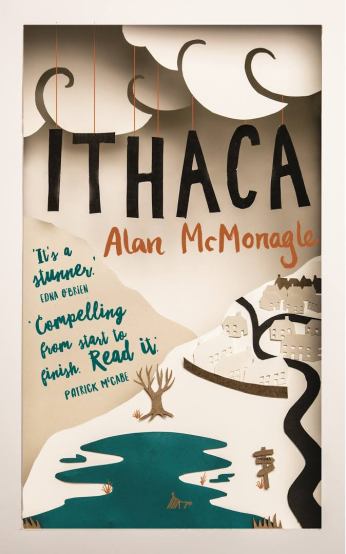
Alans novel

Alan since our last “Writers Chat” five years ago, your writing has gone from strength to strength, most recently with the astounding and well-deserved success of your debut novel Ithaca (Picador, 2017).

The Irish Times described it as a “fierce and funny modern odyssey” and while I do not disagree, I wonder if what they have described is what essentially makes up all stories – that of the hero’s journey. Did you set out to write Jason’s story as an odyssey (I’m thinking of the title here, of course, and the reference to Greek mythology) or did the story start with character and then evolve into an odyssey as you, the writer, journeyed with Jason?

When it comes down to it there are two stories to tell: a person goes in search of something and a stranger comes to town. This remark has been attributed to many writers, and while I wouldn’t go so far as to say that Jason’s ‘search’ arrived fully formed from the get-go, a journey of sorts slowly began to present itself as the basis of a narrative arc. Jason’s story, however, started out as a voice. A youthful voice, playful and unreliable, that evolved into a character and to whom I bequeathed a hinterland, a stomping ground along with its motley population with whom Jason was going to interact in varying degrees. This mix of voice and character, of setting and encounters, I suppose, offered a tension that helped sustain a narrative thrust. However, from the outset I always felt there was a gaping hole in Jason’s psyche. And the further the narrative progressed the stronger this feeling took hold. Writing is an act of faith, and so I pursued my wayward narrative in the hope that what this gaping hole was would eventually present itself. As a writer I spent a lot of time looking outside of Jason. To his nearest and dearest. To his enemies. To pretty much everyone with whom he was interacting. I was constantly looking to the hinterland, to the claustrophobic horizons of Jason’s stomping ground. I was three quarters way through a solid draft when I realized I was looking in the wrong places. I shouldn’t be looking outside of Jason – I should be looking inside. This guy literally wouldn’t harm a fly, I said to myself. The only person he is a danger to is himself. And then it came to me – he is a self-harmer. He is a self-harmer because he is in need of a hero – a parental figure – he can look to. And so I went back to the beginning. And in this manner the narrative of Ithaca takes on that classical trope of the hero’s journey – but I think it is very much an inner journey, in addition to the more obvious outward journey as Jason strikes out beyond the confines of his stomping ground. So really the evolution voice into character provides the basis for the quest my narrator sets himself.

What a fascinating insight into your process, Alan. Lots to ponder here about character formation and narrative voice. Now the town, in Ithaca like in much of your short fiction, is another character. Tell me about the divisions of the town – the Swamp, McMorrows, Rich Hill – and how they might echo the divisions and gaps in Jason’s own life.

Great question. The Swamp, McMorrow’s, Rich Hill are key locations for Jason as he sets about locating his elusive ‘Da’.  The Swamp is where he first meets the Girl. She is in the water, and thinking the worst, he fishes her out and so begins one of the story’s two central relationships. A relationship that provides Jason with a means to reveal a side of himself he will most likely otherwise conceal. Another location, Rich Hill, provides Jason with a taster of how the other half lives, the ‘haves’ as opposed to the ‘have-nots’. Rich Hill in general and Fat Grehan’s unfinished mansion in particular serve to highlight Jason’s ‘wrong side of the tracks’ origins. It’s also the part of town where he gives himself permission to lash out at his circumstances and terms of existence. It’s where he is most likely to get in trouble, fall foul of the law and so forth. A third key locale, McMorrow’s (‘dimly lit pub’), is where he goes to seek out Flukey, the initial candidate Jason posits as his Da. And so, yes, the pub is representative of another crucial gap in Jason’s existence, and as far as Jason is concerned, probably the gap that matters most. At the end of his famous play Life Of Galileo, Brecht has Galileo’s friend say, Unlucky the man that has no heroes. And Galileo says, Lucky the man that needs no heroes. Well, for better or worse, my little guy needs a hero, and in his case it involves a journey that is a mix of humour and pain and chaos and desperation. A journey that involves a search for someone or something that may remain out of reach, elusive. And ultimately what I think the narrative of Ithaca is trying to do is convey the measures Jason is prepared to take as his search becomes more desperate and he finally begins to realize that who or what he is looking for may be a lot to closer to home than he is ready to believe when we first meet him. The locales you mention in your question, along with one or two others, all have a part to play.

Yes, I love how everything in Ithaca fits together. There are no wasted characters in this landscape. 

Read on for the Writers Chat Alan and I had in 2013 about his short story collection Psychotic Episodes.

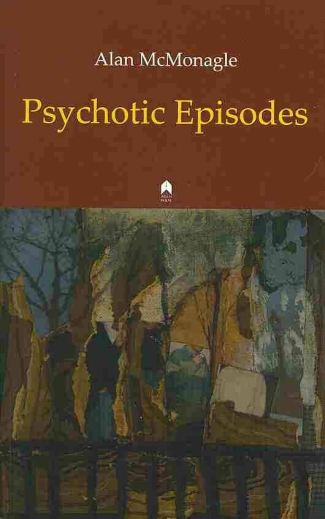
psy episodes cover

I’ve just finished Psychotic Episodes, one of the few story collections I have read in one sitting. It seemed to me that what brought all the stories together was that thread of the absurd coupled side by side with a sense of dread and caustic humour. Tell me, did you have a plan or a vision for this collection or did it evolve into itself?

A plan – definitely not. In fact I am fairly certain that each of the stories has their own story to tell as to how they came into existence. One or two arrived unannounced from the farthest recesses of my imagination and insisted on writing themselves with little or no input from myself. One or two literally fell out of larger pieces that were paying absolutely no heed to anything I was telling them to do. Others were not so keen until they looked a certain way and so needed a little finessing. Others said to hell with the rules, let’s just go for it. The upshot of all of this is that I am, at various times, an instinctive, reluctant, plodding, spontaneous writer. It was only when I started looking over what had accumulated that the common ground began apparent – the absurdity and chaos you refer to, that teetering on the brink. The stories are in a big way influenced by my own reading and, of course, by my own latent sensibilities, how I perceive and receive the world.

I’m interested, also, in the sequencing of the stories. You start with the moving ‘Looking after Little Patrick’ – I love the child’s name here and though there is something shocking about the cocktail making at the start, by the mid to end of the story I was laughing out loud and feeling they were all having a lovely time until, of course, your killer ending, which wiped the smile off my face and left me feeling guilty for laughing!

Your question, as well as being so well thought out, is also the ideal compliment you can give this particular story, Shauna. My good writing friend and all round purveyor of lightning wisdom, Ger Mills, says my stories snuggle up to you and then take a bite. I like this description and think it can be applied to the story you speak of. The story is essentially a psycho-drama – with the comedy thrown in. At the time I was re-reading Who’s Afraid of Virginia Woolf and sitting up late watching Elizabeth Taylor and Richard Burton go at it in the film version. Also, at the time, my neighbours’ little baby seemed intent on establishing a new world record for crying. Also, at the time, my girlfriend and myself were given our little nephew for the day. Somehow the disparate yet timely elements coalesced. Instinctively, I placed this story as the opening story for the tone it quickly sets, for the early flavour it provides of the skewed sensibilities in the stories. It was also the first story I finished after my first collection.

That’s really interesting, such an insight into the creation of the story, and indeed, the collection. I’d like to hear about how you get into character. You’re fond of first person voice and move well between a child’s voice (‘The Story Teller and the Thief’ and ‘Runaways’) and a female voice (‘Psychotic Episodes’).

I am an aural learner (as opposed to the more common visual learning). And so, in any piece of writing, I need to ‘hear’ everything – narration, reflection, observation – in addition to dialogue. In my own reading there are writers I return to time and time again precisely for this purpose. William Saroyan (his wonderful take on childhood). Flannery  O’Connor (for the darkness). Sergei Dovlatov (for the chaos). Grace Paley and Amy Hempel (great female voices). These (among others), if you like, are my tuning forks. I’ve read about the so-called advantages of the third person narrator, its flexibility and omniscience. However, I feel if you have a strong enough ‘voice’ then a first person narrative becomes an essential part of story.

I must look Hempel up I don’t know her work. Now, tell me about endings. You have some wonderful ones – ‘Gutted’ and the wonderfully titled ‘Elizabeth Taylor and the Tour de France Cyclist’. Are you ever surprised by the endings that come to you as you write or do you plan the ending?

Almost every time – surprised. Which is why I think writing is an act of faith – at some point in the future you are depending upon something presenting itself (an ending, for example) that doesn’t yet exist. Endings, as well as beginnings, are delicate, require soft hands. It is what takes you from beginning to end that involves cement and mortar and blood and tears. I think it was Philip Larkin, of all people, who said a good story should have a beginning, a muddle and an end. All too often I find myself muddling…And then, from nowhere it seems, a way out – an ending – offers itself. The two stories you refer to here are good examples.

What a wonderful quote, I love the idea of muddling. But I have to ask you if you cycle – I like the way cycling and bikes feature in the collection, almost little creatures in themselves.

Bicycles as little creatures – what a lovely observation…I take a push bike around the narrow Galway streets. On my way in to town, there is a certain road I always use because it slopes downhill and so gets me where I have to be quickly and without huge effort. However, there is a certain hour in the day – early to mid-afternoon – whereupon if you find yourself on this road and on a bicycle you really are running the gauntlet. I also take my bike out on the backroads near where I live. I am restless by nature, need to be in motion, and it amazes me some of the ideas that arrive while pedalling through the desolation and dignity of Old Clybaun.

I  think the collection holds some of that desolation and dignity. But I was also tickled by nostalgia with all the references to 99s, flakes, Tayto crisps and I laughed out loud at the ‘Bloomsday Bus Driver’ which seems quintessentially Irish to me with the ice-creams, the desperation to catch every last ray of sun, the need, generally to get and keep something good while it’s still going. Any reflections on this?           

My grandfather used to work on the buses out of Sligo. Occasionally I would tag along, the five-mile trip from Sligo town to Rosses Point being a particular favourite. ‘Bus Driver’ (in many ways) is a slender story, but I like its simplicity, its purity, which I feel is in keeping with the time it is attempting to reflect. A couple of people whose judgement I respect have said to me that it rings so true. I was even given a wonderful anecdote by a Galway poet about his long-ago experience on slow-moving trains. It is very satisfying to hear that this story is speaking to a generation from a time I myself barely experienced.

Finally, if you’re willing to reveal, what are you working on now?

There are poems to coerce, new stories to plámás into life. Someone has asked me to write a one-act play, the one constraint being that it has to be set in a bar – which, for an Irish writer, surely has to be the most liberating constraint conceivable! And now I’ve put the hex on myself and no doubt I’ll soon be muddling again…

Wow, a play in a bar. Interesting indeed. And poems. Good luck with that. I look forward to reading what comes of the muddling!

Aoife Casby’s wonderful artwork graces the front and back cover. Find out about Aoife here: http://www.aoifecasby.net/