Writers Chat 71: Brian Kirk on “Hare’s Breath” (Salmon Poetry: Galway, 2023)

Brian, Welcome back to Writers Chat. This time we’re talking about Hare’s Breath your latest collection published by Salmon (2023). It’s a collection that deserves to be read with care – as much care as you clearly put into the language in the poems and the shape of the collection – and one that rewards the reader with each re-read.
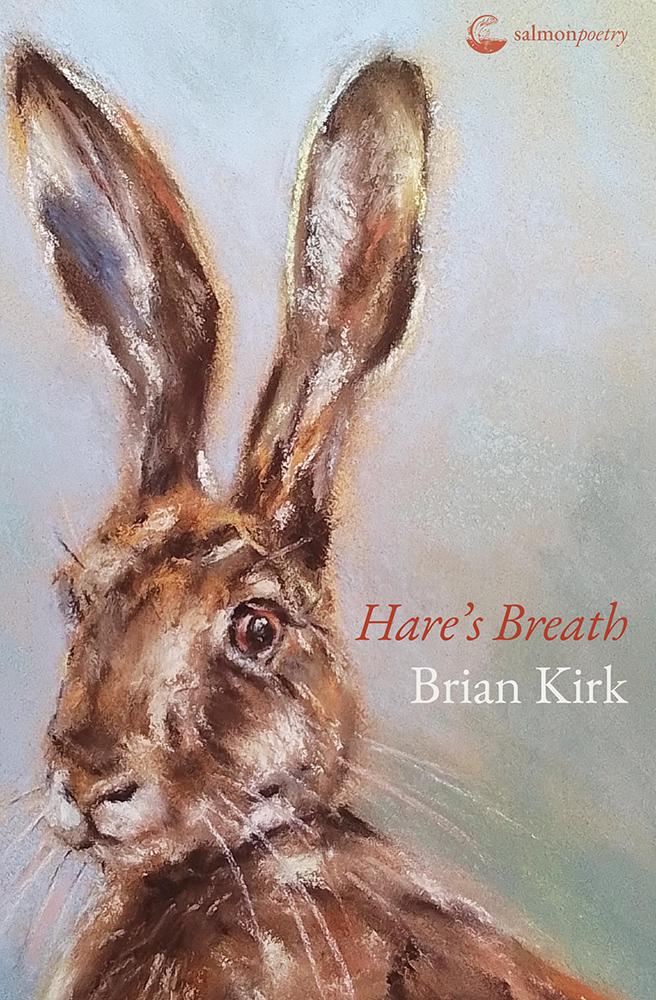
Cover of Hare’s Breath featuring a drawing of a hare (cover image artwork by Rosaleen Fleming)

SG: Let’s begin with the title poem, “Hare’s Breath”, which explores the process of living and that of creating. You wrote an early draft when you were resident in Cill Rialaig. It seems without that residency, that poem would not have been written – the landscape, literally, provided you with the theme, the images, and a way (back?) into your creative self. I’m thinking of the opening lines: “I came here to work/but needed to stop.” Could you tell us more about the writing of this poem?

BK: It’s so good to be invited back to Writers Chat, thanks, Shauna. Yes, the poem “Hare’s Breath” came relatively late to the collection and went on to provide the title, so it’s an important poem for me. I was in Cill Rialaig last February ostensibly to work on the first draft of a new novel. I was very much concerned with word count and making progress which is not always a good idea. I did do some work on other poems I was writing at the time while I was there too, but this poem came from my daily solitary walks up Bolus Head. I love walking and the landscape there is so beautiful and isolated. On one of my first walks, I encountered a hare and each day after that I would go looking for it, but only saw it again briefly on one occasion. The poem as you say is about creativity or inspiration – where art or writing comes from and how difficult it can be to grasp it and hold on to it in the world we live in now that is so full of distractions.  

SG: As with your previous collection, After The Fall, the main themes in Hare’s Breath are relationships – with family, friends, self, creativity – and time. But here it feels that you’re casting your internal eye back and focusing on the formation of a genetic line in time and place that time changes. I’m thinking of “Kingdom”

….we didn’t lick it off the ground…But we grew up and let him down…dreaming another kind of life outside the fortress that he built from duty, faith and love…His kingdom didn’t last. No kingdom does.

This is also seen in the pairing of “Belturbet Under Frost” and “Googling My Parents” which are beautiful love songs to the past. There’s an emotional weight in these poems which draws the reader back again to re-read. Could you comment on these poems?

BK: I think the past will always be a repository of ideas for me. In After The Fall I had some poems about my parents, but I think I approached them in an oblique way. In “Leave-taking” the picture of a dying father are mediated through the memories of an older brother while I was away living in London. In “The Kitchen in Winter” my mother is conjured from the memory of repeated winter mornings in the place where she held sway. In Hare’s Breath there is more of a sense of celebration of their lives I hope, certainly in the sonnet ‘Belturbet Under Frost’ which re-imagines the beginnings of their love. In poems like “Kingdom” and “Windfall” my father is portrayed as a man of his time, struggling at times in the face of a world that is changing. In some ways he is the child and his children the adults. In “Googling My Parents” I suppose I was trying and failing to reclaim my parents. They both died in the late 1980s within six months of each other while I was living in London, and there’s always a sense of things left unsaid. The closing lines of the poem came to me slowly over time. I was trying to say something, I think, about memory and the human mind, its power and its shortcomings. I was trying to liken the brain/mind to a machine (not a very original simile I know) but that wasn’t enough. I was thinking about that story in the Gospel about the Transfiguration. Peter was bumbling around talking about building tents on the mountain when a cloud appeared and a voice spoke out of it to them. I knew then that that was what I was looking for. My parents speaking to me from the cloud (even if only in dreams). It seemed apt as, after all, everything is stored in the cloud nowadays.

SG: A poignant observation indeed. “My First Infatuation”, “Sour” and “Bully” examine early love and hurt through the eyes of a knowing adult. I’m curious about both the positioning of these poems in the collection and the process of writing them – did they come (almost) fully formed, or did you need to tease them out as part of a reckoning with the past in order to move foreword?

BK: When I’m writing poems I’m not thinking in terms of a collection or where each one might appear in a collection, but when I got to the stage where I sensed I had enough good work to look at putting a book together certain poems grouped themselves. In the case of the poems “My First Infatuation”, “Sour” and “Hydra” I do remember these being written around the same time. They are of a piece in terms of style and subject matter, poems about adolescence, I suppose, being considered from a later vantage point. When I was putting the collection together, I realized that “Bully” sat well in there too and also “Sundays in June” and the most recent poem I wrote for the collection “That Last Summer”. I was concerned I think with re-visiting earlier versions of myself – some of whom I didn’t altogether recognise at first. While writing of these poems, each emerged quite quickly and were then subsequently revised, mainly in terms of the sounds. I think sound is very important in my poems and how they read aloud is key for me when revising.

SG: I can see that, alright. There were a number of your poems that I read aloud to compare the experience of reading them in my mind. I enjoyed the back-and-forth glances between past and possible futures or futures that will now never be – in “Exile”, “Dog Days”, “Multiverse”, and in “Excursion into Philosophy” where you end with that wonderful question “Are beginnings and endings the same?” There is a solid sense of regret but alongside this there is a sharp sense of hope, like you’ve focused a lens in on it. Did you find solace and clarity in writing these poems?

BK: I’m glad you’ve alluded to the future in these poems. I wouldn’t want readers to think that I’m merely obsessed by the past (but yes, I do go back a lot to work things out for myself in the now). The collection is dedicated to my kids and to the future and the book, as it progresses, opens out I hope into a meditation on how the past feeds into the future in a cyclical fashion. I think everyone harbours pain from past experience, but what is really amazing is how, every day, people, even in the most extreme straits, manage to get up again and keep going on. I tend to agree with Joan Didion in that I write to find out what I really think, so there is always a sense of discovery.

SG: Yes, a sense of discovery and a hope that opens up. Hare’s Breath also spans outwards from your life exploring other journeys, the luck of survivors – in, for example, “Hibakusha”, “The Last Days of Pompeii”, “Train Dreams”, “Small Things” – and our impact on nature – in “Houses,” “Seaside Fools” and with that punch of a line in “Gaia”:

We’re dust, and nature doesn’t give a fuck

about our self-importance or regrets:

one day our books will float away in streams

Our own concerns fade into nothing in the bigger picture you paint, and yet, you show us how we – and all that we do, and those that we love – are so fragile and that is what really matters. That acknowledgement of vulnerability and with that a lightness, like in the final poem in the collection, “The Invisible House”, where you end with laughter. Is that the cure for us all?

BK: I think living is a constant coming to terms with things. Community, family, friendships are the things that make it possible for us to continue to live. (I think Covid reminded us of that also. There are some Covid poems in here which seem to fit). In the later stages of the collection the poems begin to look outward more, away from the subjective experience to a broader sphere, taking on social, political and ecological subjects. I’m convinced that being able to laugh at ourselves is one of the most important and one the hardest things to do in life. I hope there are moments of humour in the collection too, in poems like “Seaside Fools”, “The Workshop”, “The Last Days of Pompeii” and “Out of Time.” I’d like to think people will smile from time to time as they read.

SG: We will end with a few light questions:

  • Most surprising poem from Hare’s Breath? I think perhaps “The Last Days of Pompeii” because it is the most overtly political poem in the collection. It came in a rush as a kind of ‘state of the world’ poem and on reflection I think I was channelling the late Kevin Higgins who was a great mentor to many poets and had such a wickedly humorous way of making a political point in a poem.
  • It has that sense of humour and the punch of politics, like in much of Kevin’s work alright. Coffee or Tea? It has to be tea. I do enjoy an occasional coffee but limit myself to no more than one a day.
  • Sea or Mountains? I grew up by the sea in Rush, so it has to be the sea. But I love all things rural even though I’ve spent nearly all my life living in cites or suburbs.
  • Do you have a go-to book that you frequently re-read? Yeats’ poetry and lately Derek Mahon’s collected. I do have a look at Ulysses also every few years and I tend to re-read a lot of favourite short stories.
  • Quite a wide variety of go-to genres there! Any literary events coming up for you? I’ll be reading at ‘The Listeners’ at The Revels. Main Street, Rathfarnham Village on Tuesday 6th February 2024. After that I’m hoping to get to readings and festivals around the country during the year as much as possible.

Best of luck with the readings and festivals and I wish you much continued success with the collection. Hare’s Breath may be purchased from Salmon Poetry.

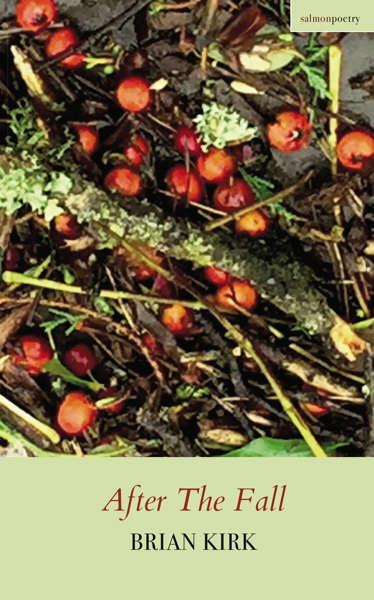
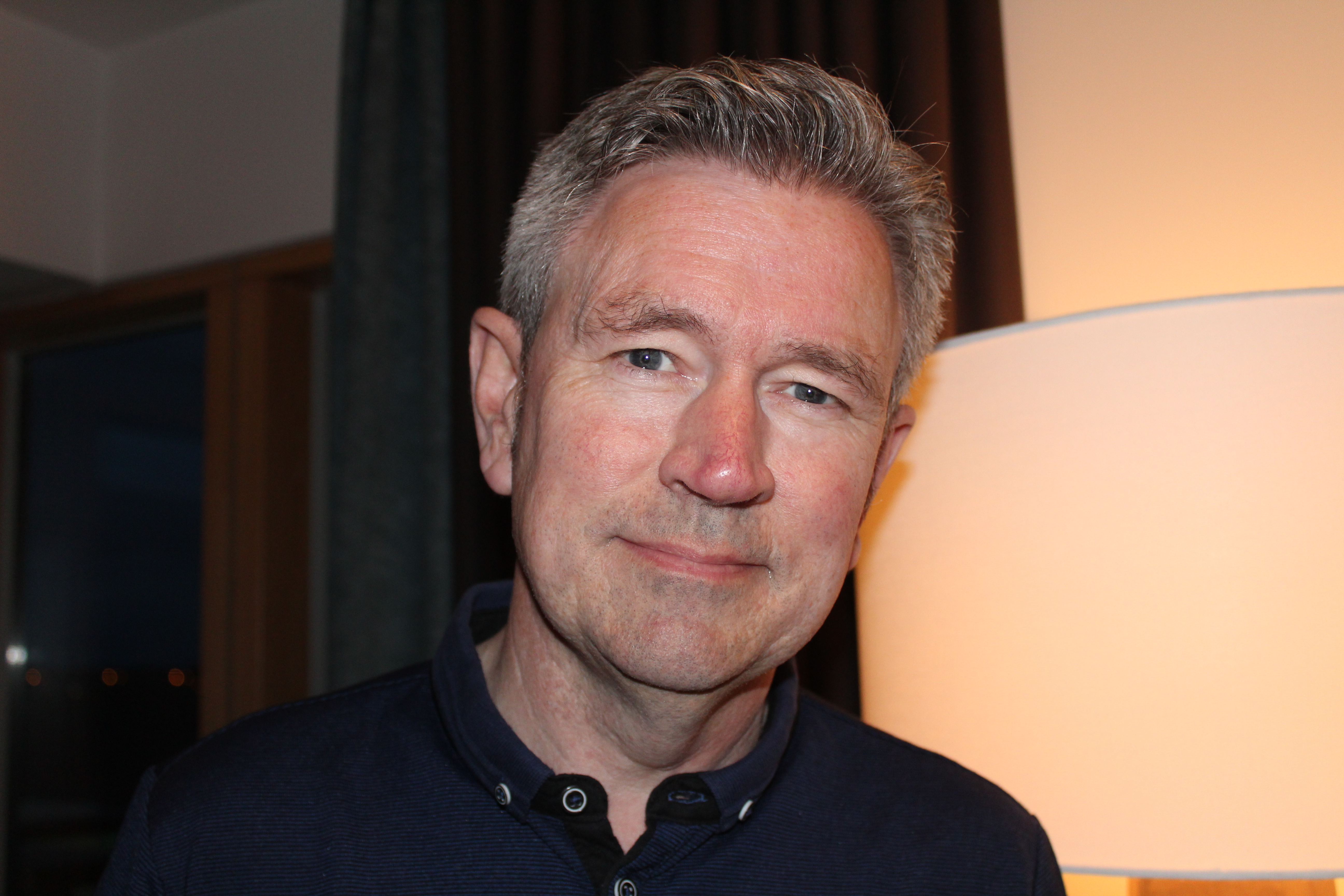
Photo of Brian Kirk in a blue shirt in front of shrubbery, courtesy of Brian Kirk.

Writers Chat 1: Brian Kirk on “After The Fall” (Salmon Poetry: Galway, 2017)

As the first to feature in my “Writers Chat” Series, I’m delighted to welcome Brian Kirk to my blog. We chat about his debut poetry collection After The Fall (Salmon, November 2017).

Be in with a chance to win a signed copy of After The Fall! Simply comment on this blog post and your name will be entered into the draw on January 20th.

afterthefall

I’m always interested in process. Having published a novel The Rising Son in 2015 and a poetry collection which you say was ten years in the making, in 2017, have you found any similarities, if I may suggest, between constructing a collection of poetry and structuring a novel?

I think of the two things, writing poems and writing novels/stories, as two very different disciplines. Generally as a writer I am very structured about how I shape stories and poems, but how the poems work together is very different to how the extended narrative of a novel works. Having said that, I’ve always been able to move between the two over the years. I’m lucky that I can revert to poetry when the novel isn’t going well and vice versa. The sustained effort of editing and finishing a novel can be very demanding, however. With The Rising Son I had a very clear picture in my mind of the characters and the structure of the novel from the start and wrote the first draft in six months or so. During that time, back in 2013, the poetry was on the back burner for a while. Ten years seems like a long time to take to produce a collection but in the context of other works being undertaken during that period – stories, novels, plays – perhaps not that long.

***

That’s interesting to hear that you can switch between the two. I do the same with short and long fiction. Sticking to form and process for a moment, if you don’t mind, many of the poems in After The Fall tell a story, or stories, and I note from the extensive array of publications and awards on your blog, the short story is another form in which you excel.

The poems I am thinking of here are ones such as “Two Foxes”, “Chameleon”, and “Persephone”. Is there any particular way you find the form when you have the story in your head? In other words, have there been occasions when something begins life as a poem and morphs into a story or the other way around?

I do have a love of narrative in poetry, although there are more imagistic poems in the collection also. The poems you mention and others run on narrative lines, and very often the narrative is lifted from life, mainly from memory. The poet, George Szirtes, talks about poetry being an amalgam of memory and imagination and a lot of the poems in After The Fall reflect that. It has happened on occasion that I’ve had an idea for a story and it ends up being a poem or vice versa, but in the main poems come as poems and stories as stories. I use quite a bit of formal structuring in the collection and have always found it helps me when writing poems to have that structure in place at the outset even if it doesn’t always remain there in the end. Formal structure doesn’t always pay off, but when it does the demands of the form can add so much more to the poem I think.

***

Fascinating that the poems arrive as poems and stories as stories. I found, in both dipping into the collection, and reading it right through, a real sense of identity forming, and a need to look back in order to look forward – in, for example, “The Flowering of Age”, “To Youth” and “When We Were Small”. How does this theme relate to both the title of the collection, and the title poem “After The Fall” where we’re reminded that we have both “lack and appetite”?

The main themes I suppose are around family and relationships, with love, religion and politics in the mix also. When I was writing and sending out poems at first I was simply writing individual poems without much thought of overall themes. But a few years back when I started to think in terms of a collection I was able to discern a strain of recurring concerns in some of the poems. The title of the collection appears in three of the poems and has obvious biblical connotations as well as a nod towards the season. In terms of the religious reference to the creation story in the Judeo-Christian tradition, I like to think of The Fall as not just being a negative thing, but having a positive aspect also; the original transgressive act that opens up the world of the senses to mankind. I also see the bible as a trove of poetical language and images and probably my first introduction to the notion of poetry. Blake’s Songs of Innocence and of Experience are a source of inspiration also. The poems you refer to above hanker after youth but also find some satisfactions in age.

***

I particularly enjoyed the snapshots of generations in the collection. I found myself nodding at my own memories reading “Ouija”, smiling at the picture painted in “Young People”, and again nodding at the familiar feelings you portray in “In My Day”.

Particularly the last line where the narrator is “not old enough to make free with the future/the way I have with the past.” You had me thinking of the timelessness of being – despite the specifics of growing up in a particular era.

It’s funny but when I was reading the proofs of the collection and getting ready for publication I began to see more threads in the collection than I had identified previously. One of these is the theme of ageing – which I shouldn’t be surprised by really – but which took me by surprise a little. There is a sense that we are all on a journey regardless of age. Many of the poems consider my parents and their generation but also my children’s generation and their concerns. There is definitely a sense of continuity – collective and individual memory playing out.

***

Many of your poems look at what it means to be human – that it is both a curse and gift. In “Repetition”, there is both “nothing in this world as beautiful as repetition” and also “nothing in this world as terrible as repetition”.

Yet what holds everything together, a sort of binding, if you will, are the simple illustrations of love. Poems such as the Forward-Prize nominated “Orienteering”, “Birthday” and “A Memory” although different in their contexts, really moved me. Was this a theme that emerged through choosing the poems for the collection or was it more of a conscious choice?

One of the earliest recurring themes that emerged when I was compiling the collection was that of map making. I was very much taken with Eavan Boland’s poem That the Science of Cartography is Limited, which knits the individual specific experience so well into the public, political and historical. Poems like Orienteering, Home, The Man, The Boy And The Map, and A Map reflect failed attempts to site specific experience in exact physical locations. It’s hard to know where this desire springs from, but as a kid I always enjoyed looking at maps and reading books that had maps on the inside pages to help guide the reader. The broader theme of the imperfection and beauty of life, encapsulated in the idea of The Fall, swallowed up that lesser theme along the way. I love the image of love being the glue that holds all these disparate elements together!

And of course maps makes us think of the maps on our hands – our palms to be specific – and that push/pull between fate and destiny. 

Brian Kirk Author Photo colBrian Kirk

***

Lastly, Brian, a few fun questions:

  • What are your five most loved books of 2017?

It’s hard to limit it to five. Of novels I read during the year the best were Jon McGregor’s Reservoir 13, Robert Seethaler’s A Whole Life (which reminded me a lot of the late Denis Johnson’s excellent Train Dreams), Carol Shield’s The Stone Diaries and Hans Fallada’s Little Man, What Now? In short stories June Caldwell’s Little Room Darker, and I read some great work in Issues 7 and 8 of the Lonely Crowd which is an excellent journal and also I have to include an ambitiously superb story by Kevin O’Rourke Romance and Revolution in Long Story Short Literary Journal. In poems there were excellent first collections by Annemarie Ní Churreáin (Bloodroot) and Amanda Bell (First the Feathers). I’m currently reading Maeve O’Sullivan’s collection of poetry, haiku and haibun Elsewhere and enjoying its breadth tremendously.

  • Oh yes. Ní Churreáin’s collection and Caldwell’s stories are on my to read pile, and I loved those novels by McGregor, Shield, and Seethaler. Some wonderful recommendations, there. So what will you read in 2018?

I received a copy of John Banville’s Mrs Osmond for my birthday in December and am planning to read The Portrait of a Lady before diving into it. After that I will read another Hans Fallada, probably Alone in Berlin (I’ve been reading his work over the last few years and really enjoying it). In terms of stories I’m looking forward to Valerie Sirr’s collection coming out during the year. In poetry Maurice Devitt’s first collection is one I can’t wait to read and also a new and very interesting collection from John Murphy which should turn a lot of heads.

  • Would you believe it, I’ve just started that very book by Fallada! I’m also  looking forward to Valerie Sirr’s story collection; I love her work. And I’ll watch out for the poetry collections by Devitt and Murphy. So, Brian, to end our chat, what’s next for you in the writing world – Poetry? Stories? Plays? Novels?

I will continue to write poems and hopefully bring After The Fall to more readers around the country, but my main writing focus will be on compiling a collection of short stories and hopefully finding a publisher. I already have new stories forthcoming in 2018 at online journals Fictive Dream and Cold Coffee Stand. I have a novel in progress also which I hope to complete a first draft of very soon. My full length stage play Story was shortlisted at Listowel last year and I would really love to see a staging this year or even a rehearsed reading. So plenty to be getting on with!

Thanks for inviting me to chat, Shauna.

You’re welcome, Brian and thanks for engaging so thoroughly with my questions. I wish you every success with your writing and look forward to reading more of your work, and perhaps even seeing Story on stage.

Readers – be in with a chance to win a signed copy of After The Fall! Simply comment on the blog and your name will be entered into the draw on January 20th.


And the winner is….IMAG0069

Congratulations, Karen. Brian will be in touch with you to arrange delivery of After The Fall.