Writers Chat 59: Maureen Gallagher on “Limbo” (Poolbeg Crimson: Dublin, 2022)

Maureen, You are very welcome to my WRITERS CHAT series. Congratulations on your debut novel Limbo: A Kate Frances Mystery (Poolbeg Crimson: Dublin, 2022).

It’s a real page-turner of a thriller that reminds us of how far we’ve come in terms of equality and bodily autonomy but also how far the reality has still to go.
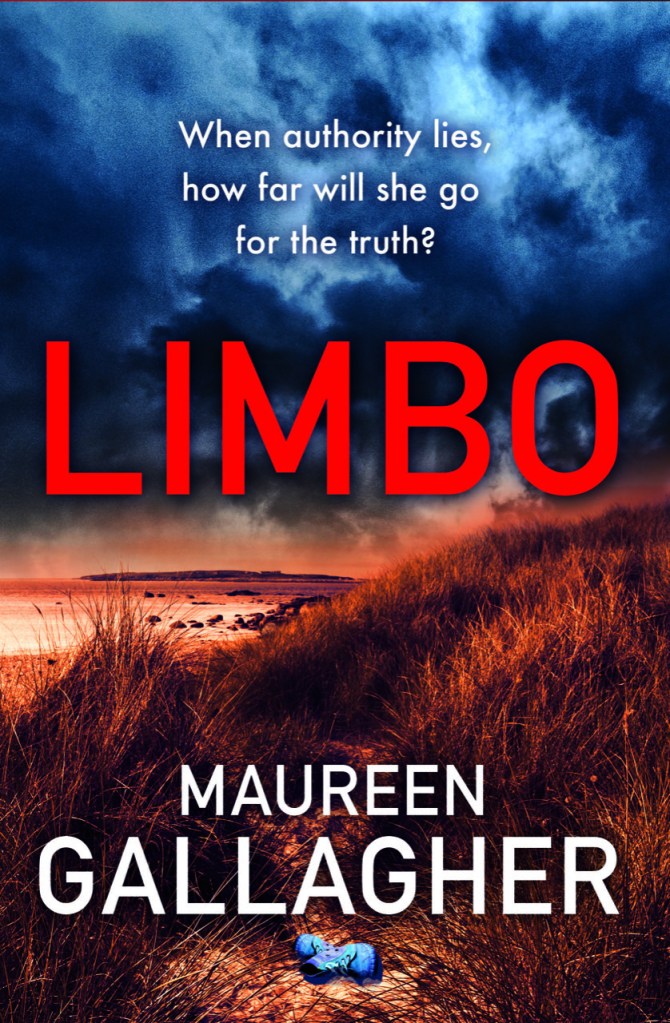
Cover of Limbo featuring seascape and sand dunes with an abandoned pair of child’s boots. This photograph is of Port Arthur in Gweedore, taken by Peter Trant.

Limbo is the first in a series featuring the brilliantly complicated and humanly flawed Detective Kate Francis whom we get to know as Frankie. Tell me about the cover, the title and the series.

MG: Thank you very much for inviting me to WRITERS CHAT, Shauna. The front cover image of Limbo depicts the dunes at Port Arthur strand in northwest Donegal – marram grass and patches of bright sand in the foreground with a view out to sea and the islands in the distance. The image was taken by my brother-in-law – Peter Trant – an accomplished photographer, who is very familiar with the beaches in Gweedore, and took many photographs of the dunes for me to choose from.  The final image is enhanced by David Prendergast, Poolbeg’s designer, who darkened the sky, and skilfully coated the entire landscape with a thrilling orange hue. When it came to choosing a title, Limbo came to me pretty easily, for the layers of meaning that inhabit the word, not least the state of babies souls and the fact that Roche can’t give them a Christian burial. In addition,  Frankie’s indecision and paralysis about what she wants out of life career or family is an important aspect in the novel. The title is also in tune with the tone of the book, which is an attempt to imbue the story with a whiff of incense, given the dominance of the Catholic Church at that time. Limbo is a the first of three. My plan is to set the series at ten-year intervals, so that it charts Frankie’s growth and development personally and professionally, and also gives some idea of the way Ireland has changed in the past 35 years. 

SG: Very interesting to hear about the ten-year intervals. I love that idea and because I really liked Frankie who is very much of her time but is also an everywoman, can you talk about how Frankie developed both as protagonist and character within the framework of the storyline?  

MG: Detective Kate Francis aka Frankie works in a male dominated workplace in  nineteen eighties Ireland. Sexism is rife. In the very first paragraph, sergeant Brannigan, ruminates:

‘To think, godammit, the reinforcements they’re sending from the city, includes a woman. A battle-axe, no doubt, built like a barn.’

So from very early on, we see Frankie dealing with the hostility of Brannigan, while at the same time fending off the unwanted attentions of her married boss, and trying to placate her boyfriend, resentful at her long hours at work. As she struggles to advance the investigation, these personal challenges deepen. Her boyfriend asks her: What do you want out of life? To be the best sleuth? To settle down and become a mother? Frankie is conflicted. She doesn’t see why she can’t do both. When she’s left to solve the case on her own, we see Frankie’s professional confidence grow, as she stands up to the corrupt sergeant and follows her own instinct for finding the killer. Alongside this confidence comes an insight into how she will address the apparent contradictions in her life. In the end we see a changed Frankie, one who has grown personally over the course of solving the murder, and who is grounded and at peace with herself.

SG:  Limbo is set in 1989 in Donegal, with the stunning landscape key to both the mystery and the reading experience. Your descriptions are beautiful and even more impactful as they are set against the investigation of two murdered babies, from Port Arthur Strand, Gweedore to Errigal Mountain and the River Claddy is “the warm colour of tea”, “On the horizon, Frankie can see the islands floating in the Atlantic, surrounded by thousands of foaming white horses fringing the waves: Gola, Inishmaan, Inisheer.” How important was the setting to the novel and to the series?

MG: I spent most summers as a child in Gweedore in Donegal, where my parents grew up. My father taught in Ranafast, and the family simply decamped to the Gaeltacht for July and August. So many images from childhood mean Gweedore to me: Errigal mountain, salmon fishing, snuff, the bitter winter I spent there with its howling storms; sea and sand and picnics on the strand. Summer seemed to go on forever back then and we spent much of it in one or other of the three glorious beaches, including Port Arthur, which features prominently in the novel. I was fascinated with juxtaposing a horrible crime like the murder of a baby against a backdrop of such exquisite beauty. The idea for the novel came from an assignment at a workshop to write a 300-wordpitch for a crime thriller. The writer,  John Fowles, once said that he usually started with a powerful image, and then tried to work out what the story behind it was and how it developed, The French Lieutenant’s Woman being the most obvious example. The image of the mysterious woman at the coast staring out to sea is not so far away from the image of a baby found on the beach. So my novel opens with the most awful crime imaginable. Just as south eastern Sicily is like a character in Andrea Camilleri’s Montelbano thrillers, I wanted Gweedore to feature almost as a character in the story, with the mountain Errigal a touchstone for everything.

SG: Lovely to hear your authorial intention, Maureen, and I do think that comes through to the reader. Over the course of the investigation, Frankie realises how the patriarchal systems of power are skewed towards men, from the hospitals – early on in Limbo a matron exclaims, as if there were no men involved in procreation “these young girls, you’d feel so sorry for them” – to the force which employs her as a detective – she figures out which battles to fight with Brannigan, how to negotiate her desire with Moran (“there’ll be none of that she tells herself”) and her future, whatever that might be, with Rory. Can you talk about your exploration of gender in the Ireland of 1989?

MG: The action takes place in 1989, ten years after the pope’s visit, an era when people’s mindset had not changed much at all from the 50’s and 60’s. I wanted to explore what we were like as an nation back then, and ultimately what that led to: women vilified for no greater crime than becoming pregnant. At one point the protagonist, Frankie, asks: “Do we not value pregnancy and birth in this country?” So you could say my focus was the treatment of women in late 20th century Ireland. When it came to naming my female protagonist, I had to think long and hard. My main reason for giving my female character a name that is somewhat androgynous was because I didn’t want her to be referred to by her first name while all the men in Limbo were referred to by their surnames – Moran, Brannigan, O’Toole etc. I felt that would have rendered her somewhat inferior, in a situation where she is already facing prejudice. But neither did I want to distance her from the reader. So I set about finding a surname that sounded like a first name. Even though there are female Frankie’s, there is the intentional false assumption that Frankie is a male name. At the very least it is gender neutral, androgynous. My intention was to give my protagonist a modicum of gravitas in a male world.

SG: And Frankie as a name for this character works so well. So, part of Frankie’s initial investigations lead her to Umfin Island to meet with members of followers of the Brigid, Goddess of Fertility. She finds

“she’s conflicted. On the one hand, she’s impressed with the back-to-nature self-sufficient element of the lifestyle she’s observed….on the other, at the very least there was a level of violence in the ritual she’s just witnessed that was disturbing.”

In a way, this experience also sums up Frankie’s view of Irish society and politics, and the power of the Catholic Church. It appears to be one thing but actually – including and especially figures in authority – is another. Can you talk about how these themes influenced the story line (or was it vice-versa?).

MG: What was an eye-opener for me when I started to write Limbo, was that the structure of the crime novel – you could say its limitation – allowed me to explore social issues, something dear to my heart. The very nature of the genre frees up the imagination. The two underlying themes I had in mind when starting the novel, was the power of the Catholic Church in Irish society and the subordinate position of women. Someone once coined the phrase ‘the Catholic Taliban’, to describe the hold the Catholic Church had on the lives of women in Ireland all down the century since independence. Throughout the thirties, forties and fifties, and even up to the eighties women’s bodies were a battleground. I wanted to show how the Catholic Church dominated the whole narrative, how it was woven into the very fabric of society, and for this to inform the tone of Limbo. The backdrop to the story is a misogynistic state hand in glove with a powerful church and its impact on women. But I was conscious too that exploring social context should not mean long passages of exposition. The bottom line is that the novel has to be entertaining – people want to know what happens next.  Crime writing, like all fictional writing, is best done through scene setting, dialogue, believable characterisation. Or as the late great John McGahern would say, told slant.  

SG: Yes indeed – ‘told slant’ – a lesson in writing fiction! Lastly, in Limbo, as in our history, those who don’t confirm to prescribed behaviours and identities are locked up or hide themselves away – claiming their voice as their own by not speaking, for example Hannah. Part of what Frankie has to do is to listen to what is behind the stories that people tell, see what is beyond the land and within the houses. In this way, as Frankie “feels resentful at how the Church has commandeered all the major events in people’s lives”, Limbo is as much about agency and power as it about a thrilling story. Was this your intention?  

MG: Limbo is very much about the struggle women have to gain autonomy within the suffocating limitations imposed on them. Hannah’s response to the violent strictures visited on her is to choose not to speak, to metaphorically lock herself away. Her daughter Sarah, in contrast, determinedly manages to rise above her awful experiences and leaves Ireland to embrace a new life. Frankie addresses head-on the challenges she faces and in so doing gains insight into her own personal predicament and how to resolve it. The novel is very much about agency and power. It charts both the tragic predicament of the women who are crushed by their oppression, but also the empowerment and joy of the women who transcend it.

SG: To finish up, Maureen, some fun questions

  • Sandy or Stony Beach?  Sandy. Definitely not stony – I value my ankles!
  • Tea or Coffee? Mostly tea. But when my daughter – who now lives in Spain – visits, I bring her to Tigh Neachtain in Galway, which serves an excellent coffee.
  • Music or quiet when writing? I love music but not when I’m writing. I like total silence when I’m writing.
  • What’s next on your reading pile? I’m re-reading of Lajos Egri’s superb The Art of Dramatic Writing as research for Book 2, and for leisure reading I’ve started Maggie O’Farrell’s The Marriage Portrait, which I’m enjoying very much.
  • What are you working on or thinking about now? Now that the launch of Limbo is behind me, I’m picking up where I left off on Book 2 in early summer. The book’s premise is ‘Misogyny Fuels Femicide’, an idea I’m very engaged with and I can’t wait to get stuck back in.

Thank you, Maureen, for such engaging and thorough answers. I very much look forward to the next two books in the series and to seeing more of Frankie!

Readers can order Limbo here
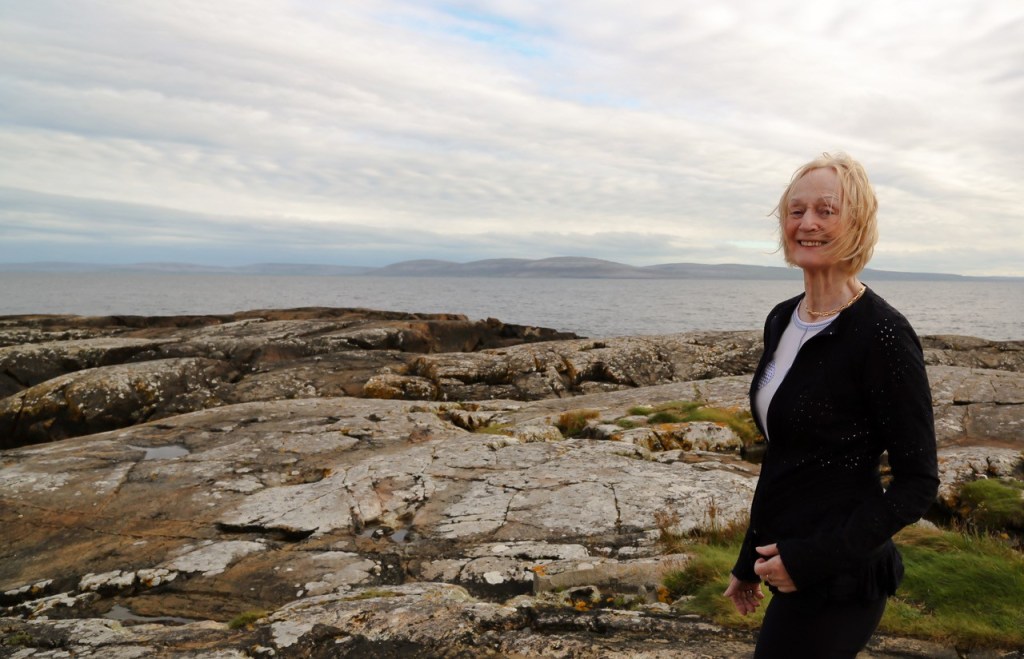
Author Maureen Gallagher. Photo courtesy of author.

With thanks also to Poolbeg Crimson for the advance copy of Limbo
Writers Chat 49: Eamon Somers on “Dolly Considine’s Hotel” (Unbound: London, 2021)

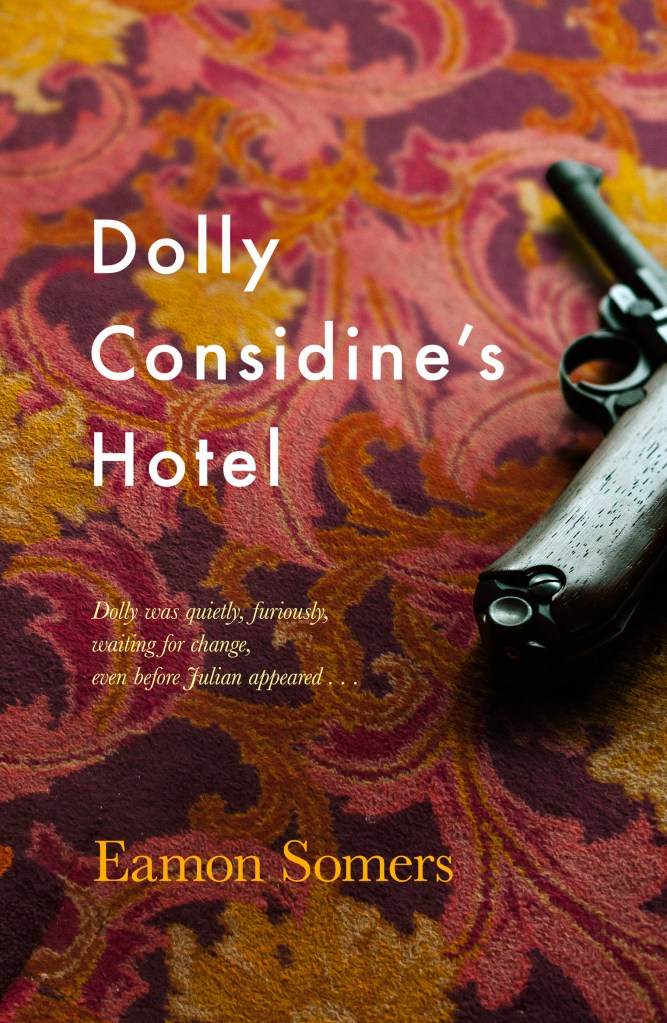
Cover image of Dolly Considine’s Hotel by Eamon Somers – colourful carpet with a black pistol on the floor

Eamon, You are very welcome to my WRITERS CHAT series. Congratulations on Dolly Considine’s Hotel which was published by Unbound in 2021. I must thank you for taking the time to do a reading as part of this WRITERS CHAT – readers, you’ll find the reading mid-way through this chat so treat it like an interval!

SG: Before we get into the details of the characters, history, politics and love in Dolly Considine’s Hotel, I was struck by the honesty with which you describe the writing journey and path to publication. I think it’s very refreshing. Can you talk a little about this and your experience with Unbound and may I, in the same breath, comment on the perfect cover. I just love that patterned carpet and the revolver. It captures so much of what the novel is about.

ES: Hi Shauna, it’s an absolute pleasure and a privilege to be invited onto your famous writers chat. Let me start with the cover which was designed by book designers Mecob and has received a lot of praise. I tracked down the patterned carpet photo on Shutterstock, it was taken by Irish photographer Julie A Lynch and she called it “creepy old hotel in ireland carpet”. If anyone knows Julie, please pass on my gratitude to her for such a great image.

I submitted an earlier novel to over 100 agents and publishers. One agent was interested, and we worked for months to get it ready to send out. But without success. He told me to put that novel in my bottom drawer and to write another. I resurrected something I had previously worked on, and Dolly was born. But by the time I had an acceptable draft, the agent had moved on, and I started the submission business again. Eventually, just as I was about to give up and self-publish, Unbound said ”yes”.   

Unbound operates like a traditional publisher, except that their financial model requires publication costs to be raised through a crowdfunding campaign, run by the author on the Unbound website. That was hard work, but very rewarding especially because it introduced me to the world of promotion via social media. With so many books being published it appears that unknown and debut novelists have little chance of finding readers (and as, importantly, reviews) unless they embrace the world of Twitter and Instagram.  

SG: Yes, these days as well as writing the novel writers are expected to promote their work across multiple social media platforms – hard work when you need to be writing! But now let’s talk about the structure of Dolly Considine’s Hotel. There’s a split timeline for most of the book – between 1950s and 1980s – and it’s through the two stories, running along almost like parallel tracks that we come to understand the significance of the Dolly’s hotel as the main character. Coupled with the wonderful chapter titles (for example, “No Time To Be Squeamish”, “Julian Remembers the smell of chocolate that encircled the Cadbury girls”, “A visit to the theatre”) and the short, snappy chapters, the novel is a surprisingly fast read at over 500 pages. Did the structure play as important a part in writing as it does in the reading experience?

ES: I didn’t start out to write anything complex. I wanted to set the story in a version of an hotel I had briefly worked in when I was in my early twenties. And because I was very disillusioned with Ireland after the pro-life referendum was passed and the possibility of divorce was rejected, I wanted to portray life in the early ‘80s. I admit to wanting to write something a bit different from the usual linear story: hero/heroine overcoming obstacles to find themselves or love. More importantly I wanted to play with readers, to upset their trust a little, hint at unspoken complexities, cast doubt on the certainties they expected, give them shaky ground, like a fairground ride. At the time of writing, experimental writers were beginning to play with multimedia things and to give readers some power to control the story. But that wasn’t for me, instead I tried to give entertaining variety from which readers could choose what to believe and what to just laugh at. This may not answer your question, but the hotel building has been around for two hundred years, and I wanted to share the histories that made it the complex entity that it is today. History doesn’t happen overnight; it is built up and built upon over many years. Ghosts have to come from somewhere. And Dolly has lived/is living through periods. She chose her path (or it chose her) in the ‘50s, when she moved into the hotel, taking with her own family’s history.

SG: I found there was a lot to laugh, disbelieve, and wonder… but alongside this playing with the reader, one of the main themes is that of identity and gender; the names we call each other, the names we call ourselves, the limitations and expectations of society and of ourselves. Dolly’s hotel is a type of refuge for those who want to step outside the norms of 1950s/1980s Ireland. And of course, Dolly Considine – and through the hotel – plays with notions of power and politics, from her seduction of GI and Cathal, to her hold over the staff. Can you talk about Dolly, identity and gender?

ES: Identity is very important to me. I was married at 22 and was the father of two children by the time I found out/acknowledged I was gay and my marriage broke up. Often when I meet new people it is the fact that I have children that emerges rather than the fact that for nearly forty years I have lived in a committed relationship with another man. So (as a committed zealot) I feel obliged to correct any assumptions.  Less frequently, but equally, I feel obliged not to deny my children when I make new gay friends. This is who I am, as is my Irishness, and my confused class heritage.

If Dolly or other characters defy expectations, then I am pleased. The female characters perhaps try to control their environments, but I think they have to reduce their expectations, so they are in line with what is possible. And although it was Julian that was the inspiration, I had wanted more for Dolly than she got. So, in that sense I let her down and allowed the lion’s share of attention go to the male protagonist.

SG: And to be honest that is probably why I picked her out for that question! I wanted more for her too!

I loved how the meta-narrative of the novel that Julian is writing – “The Summer of Unrequited Love” – evolves with the main narrative (that of the hotel) in such a way that we have trouble distinguishing between the action in Julian’s notebooks and those in the hotel, just as Julian himself does. At one stage, “It had only been seven or eight hours, but his fingers were twitching as if they’d never hold a pen again.” And, for example, we’re in a scene in which Julian’s lover, Bláthín, has had most of the wine:

‘The wine was gone. She’d had the most of it.’ He whispered the words to fix them in his head. It would be a springboard line for his journal. He leaned into the low table to search for blank paper she wouldn’t miss; even his own mother kept scraps for shopping lists. His pen already in his hand, twisting like a divining rod tuned to blank paper.

How important to you were these parallel stories which reflect and talk to each other to what you wanted to say through the novel about the acts of perceiving, recording, and writing?

ES:  The parallel stories confront the reader with a messy, erotic, unashamed version of Ireland. In the extract you choose, Julian is writing his fictional Summer of Unrequited Love, while also participating in the real-life events of Dolly Considine’s Hotel.

Julian is a young idealist, and a “real” artist, ready to “suffer” for his art. But equally there is the serious work of how a writer portrays their characters. Which aspects of their behaviour will best represent them? Julian wants only meaningful characteristics, the ones (perhaps just one) that will resonate instantly with his readers; he wants to ignore those that merely pad out the portrait.

But Josie’s story, Sylvia’s story, Dolly’s father’s story, Brendan’s story all explore, and as you say, talk to the main and ostensibly more reliable/truthful narrative, and hopefully in their own way, produce a more meaningful truth and deeper feelings in the mind of the reader.

Eamon reads two short extracts featuring Dolly and Julian

(total time: 4 mins, 10 seconds)

Eamon Somers reading two short extracts which focus on Dolly and Julian

SG: Thank you for such a wonderful reading, Eamon. So, following on from that reading, we can say that much of Dolly Considine’s Hotel examines bodies and terminations – ideological, political, literary – through acting and enacting, writing and reading, interpreting and imagining. It’s a slow build – starting with Mikhail Mayakovsky/ the Mother Ireland scene and returning to it later – and continuing with the series of “Terminations” in Julian’s notebook – whilst following the adventures of Julian’s body in the hotel and beyond. I also couldn’t help feeling that the side exploration of urban/rural – for example, when Bláthín tells Julian in Cavan to “listen to the babies…you can’t come down here and trample anywhere you like. You have to respect the established order.” – also echoed this theme of bodies. I thought it was an interesting way to explore choice. Can you comment on this?

ES: Although it is not foregrounded except perhaps in Cathal’s naming, and Julian’s frustration at not understanding the history of the state’s inception, I was conscious of the civil war all the time I was writing the book. As a nationalism sceptic I don’t want to big up too much the “idealism” of 1916 and the war of independence, but for me the civil war marked the termination of those aspirations embodied in the Irish Literary Renaissance of the 19th century, and which were then fetishised and mythologised in the new state. Mother Ireland and her pregnancy reminds us of the loss of idealism and choice that the pro-life victory represents. Many of us who grew up in cities (but especially Dublin) under Eamonn De Valera and Bishop John Charles McQuaid were made to feel that the authentic Irish lived in the country. Dubliners are Jackeens, they took the king’s shilling, they were not to be trusted. Bláthín has absorbed the myths and is retelling them in her radio work, but she also recognises that Julian might have his own working class inner-city naive truth.

SG: Yes, of course, there’s the theme and voice of class running through the novel too. Now, we’ve discussed some of the themes and narratives but I can’t leave this Writers Chat without mentioning the humour and the chance encounter (or was it a chance!?) between Paddy/ Julian and the mysterious Malone in Busárus that sets Julian on the road to Dolly’s hotel. You really capture that era (1983), one in which the world outside Ireland was full of possibilities but an Ireland which was closed in on itself in every way (economically, sexually and so on). Can you talk about the genesis of this beginning?

ES: The people of Ireland’s 26 counties often get criticised for ignoring and/or completely misunderstanding what life is like for people who live in the North of Ireland. I wanted to play with the complexities and to allow Julian to have what he considered to be reasonable (but were often conspiratorial) interpretations for the things he witnessed/imagined about Malone, and about Dolly and GI – viz the safe house. But I also wanted a cross border romantic interest, even if the erotic only went as far as Julian wearing Malone’s pants and underwear.

SG: And speaking of pants and underwear, the erotic – particularly, male – is key to the novel and yet is not the only theme that defines it. How would you categorise Dolly Considine’s Hotel – if it can be categorised or boxed?

ES: I think of Dolly Considine’s Hotel as a post-gay novel, a book where the issue of sexuality is taken for granted.  This doesn’t make characters nicer or less nice or even more worked out, but their sexuality is just a fact, like their eye colour. Recent years have seen a market opening up for gay fiction across all genres, however in my writing I seem to have been regarded as either too gay for mainstream publishers or not gay enough for niche publishers.  And although it was not my intention when writing the book, I’d love to think that Dolly can bridge that divide.

SG: To finish up, Eamon, some fun questions

  • Countryside or city? Except for three months when I was eleven (on a Gael Linn scholarship in Connemara) I have always lived in cities. Like many city dwellers I secretly think I would love the countryside, but in reality, suspect I will always prefer to visit rather than live there.
  • Tea or Coffee?  I am definitely a coffee person. But have very little time for fussy machinery, or coffee shops, and except for weekends, will settle for instant. I switch to decaf at noon.
  • Bus or train?  I love trains, especially for long journeys. But in the city I like buses, so much better for linking London’s villages. And during covid, somehow safer than the underground.
  • First draft handwritten or typed? Typed, onto my old Amstrad in 1998, although I was also very fond of a notebook, but mainly for late night drunken ramblings.
  • What’s next on your reading pile? I supported my fellow Unbound author Patrick McCabe’s crowdfunding campaign for his latest book, Poguemathone and I’m looking forward to getting stuck into that.

With thanks to Eamon Somers and Unbound for the copy of Dolly Considine’s Hotelpurchase the book here

Photograph of Eamon Somers (courtesy of Justin David)

Writers Chat 24: Helen O’Leary on “The Heart Stone”.

Helen, You are very welcome to my WRITERS CHAT series. Many congratulations on the publication of your first novel The Heart Stone (Millbrook Press: Kildare, 2019). You write both short and long fiction and have won a number of prizes for your work, the most recent being the Michael Mullan Short Story prize –  many congratulations!

The Heart Stone Photograph

Let’s first start with the geneses of The Heart Stone – your dual identity as writer and counsellor. Could you speak a little about how these professions fed off each other as you wrote the novel?

The Heart Stone grew not out of my desire to write a novel but out of my need to tell a story.  Over the years, in my work as a teacher and therapist, I have met many children like Danielle and her classmates.  I have long been concerned about the quiet child in the classroom; the child who may have suffered trauma or loss; the child who is anxious or sad but who is unnoticed because there may be other needy children in the room more actively seeking attention, and the child, who, like Danielle, slips by until her feelings become unbearable.  I hope this book will be of help to teachers in understanding the process of therapy with grieving children, to therapists in understanding the dynamics of a busy classroom, and most importantly to children and teenagers in learning that they are not alone.

I think your need to tell a story about a quiet child is a wonderful way into writing The Heart Stone and it is a novel which is accessible for adults and younger readers. You’ve also given a beautiful, moving story a fitting title. Did the title come during writing the novel, before or after? And if there were other possible titles, what were they?

The title The Heart Stone came to me as I was writing the book.  Many children who find it difficult to verbalise their feelings can work very well with art materials, therapeutic stories, play therapy, drama and music.  Putting myself in Mollie’s shoes, I asked what materials I as a therapist would offer her and what would she be likely to choose.  Some children like working with clay, shaping it to see what emerges rather than setting out to make something in particular (a bit like the writing process!).  It seemed natural and maybe expected, that for Danielle a heart would emerge, but her feelings are more complex than that, so she goes on to use the heart to express what she needs to express.  It also tied in nicely with a happy memory she had shared with her Daddy, so it seemed a fitting title.

The split structure of The Heart Stone enables the narrative to be revealed in short chapters. Did you find that your experience in short story writing fed into writing your novel or is it the other way around?

Yes, it certainly was my experience in short story writing that fed into the novel.  The Heart Stone grew out of a short story about a child’s experience of grief – not actually a story about Danielle, but about her classmate Dylan, a much more out- there, attention seeking character.  This led to me thinking about grief in the silent child in the classroom and how that might be explored.  As I began to write, the novel came to me scene by scene, in no particular order.  It was almost completely character driven.  As I got to know Danielle, I began to explore how she might react in different situations so gradually a narrative thread emerged.

Danielle is a feisty, strong and yet very vulnerable young girl with whom readers can identify with on an emotional and nurturing level. Can you tell us a little bit about how her character is the driver behind some of the difficult themes – such as depression and suicide – that you skillfully tackle in The Heart Stone?

Danielle is vulnerable, but she is also strong.  She lives in a world where depression, drug taking, jail sentences, poverty and disadvantage are the norm.  Young though she is, she may have already encountered suicide in her community.  She and her friends are tough because they have to be.  In some ways Ms. Phillips, Mr. Power and Mollie are part of another world – softer and less harsh, because that has been their lived experience.  Yet Danielle and her friends survive, kept going by the love of the adults in their world but also by each other, as each child, at some level, recognises the struggle in the other.  She is feisty and strong, and it may be necessary for her to become even more so.  Although the book has a happy ending, the story must remain real.  And in the real world, Danielle and Lisa and the others will inevitably face many more challenges.  Resilience is a buzz word at the moment, but I have to say I admire children and adults like these because they are resilient without even knowing the term.  They don’t have to be taught it – they embody it.

You are so right, Helen, I love how you express Danielle’s strength – that she doesn’t have to be taught resilience, she embodies it. While The Heart Stone is about grief and truth on one level it is also filled with humour and is, I feel, really about what it means to be human and perhaps delivers an important message about being kind. Did these sentiments emerge for you as you were writing or after you’d written the novel?

What I would like to say about this, is that it has been a privilege for me to work with children like Danielle, her classmates, her parents and her teachers – people often dealing with the most unimaginable circumstances.  For some, like Danielle’s Daddy, it all becomes too much and they just can’t cope.  But for the most part, they just get on with it, and fun and humour, and joy and laughter are a huge part of it.  I enjoyed imagining what they might say or do in certain situations.  The character of Nicola becomes an important one in lightening the mood, as does Dylan with his classroom antics.  It was important for me too, that Danielle’s mam Lisa, not only survives but thrives, as transformation following adversity is possible too.  As teachers and therapists, we are often told that one kind person or perhaps an act of kindness remembered, can make a difference to a child’s later life and I know that in schools up and down the country there are many people; teachers, principals, classroom assistants and other members of the school community who strive on a daily basis to be that one person who makes the difference.

I think you’ve touched on something very important here – how kindness can be the greatest gift and difference. Can you speak a little about your experience of the publishing process – from idea to draft to manuscript to editing and finally to launching and selling The Heart Stone?

This is, by choice, a self-published book, because I wanted to do the project that felt right for me.  I did not initially set out to publish it but when the project was complete, I strongly felt that if it could help one child, one parent, teacher or therapist then it was worth putting it out there.  I have had very many positive responses including from adults who have themselves lost a parent in childhood, and who found the book of benefit in terms of understanding their own experience of loss and grief.  The editing process was interesting, I had to lose some parts that were dear to my heart, but which didn’t really contribute to the overall project.

The self-publishing process was made surprisingly easy by the staff at Millbrook Press and although a steep learning curve for me, I thoroughly enjoyed it.  The launch was of course daunting, but I surrounded myself with family and friends and through the whole publishing process I read and re-read Julia Cameron’s Walking in the World, constantly reminding myself, “A book deadline in not a NASA launch.  A concert date is not a countdown for nuclear testing.”

Lastly, Helen, some fun questions:

    • Mountains or sea? Sea.
    • Tea or coffee? Coffee.
    • What’s on your Santa list? The Faber and Faber Poetry Diary 2020. I use it every year to record what I am currently reading, writing, studying and events I attend which feed my creativity.
    • What are you working on now? After I finished The Heart Stone, I subconsciously distanced myself from Danielle’s world by writing a short memoir of a time I had spent living abroad. Some short stories arose out of that, but I am now back in there and working on a collection of stories featuring some of the more minor characters in the novel.
    • What are you reading right now? Olive, Again by Elizabeth Strout.

Some lovely suggestions for books and the Faber and Faber diary. Thank you, Helen, for being so open and honest about your motives and experience in writing your novel. It has already found its way into the hearts of many and I wish you much continued success with The Heart Stone

The Heart Stone is available for purchase at: