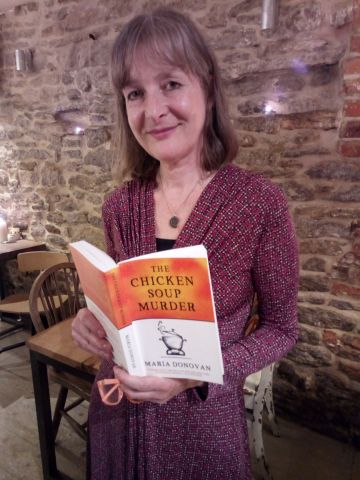
Writers Chat 23: James Claffey on “The Heart Crossways” (Thrice Publishing: USA, 2018)

James, You’re very welcome back to my Writers Chat series. The last time we chatted, in 2012, we focused on Blood a Cold Blue a collection of short fiction. This time we’re chatting about your wonderful debut novel The Heart Crossways where you bring us into an Ireland that’s hardly recognisable today.Print
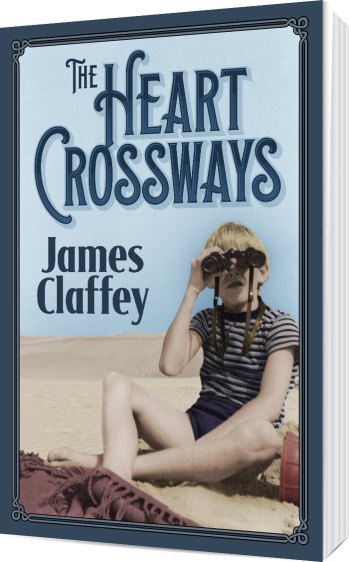
So, let’s start with language. As a tool it is very much part of the narrative of the The Heart Crossways. Take the wonderful opening section:

“On rainy days the time passes slowly. Trance-like, I tongue my bedroom window and lick the condensation from the glass. My nose smushes against the cold pane. The seagulls glower below, on the roof of the coal shed…”

How much of these wonderful verbs came to you on the first few drafts or was it when you edited the novel that they emerged? I am thinking of what Sheenagh Pugh once said – that great writing is in the editing.

JC: So, interestingly enough, Thrice Fiction Magazine published three short pieces in their March, 2012 issue, and one of those pieces was “Dublin On a Wet Day,” which was remarkably close to the opening beat of the novel. Over multiple drafts the frame of the book shifted considerably, and in several drafts the opening pages were completely different and set at a far different time in Patrick’s life. The image came to me in a memory of my childhood in Rathgar, and how on rainy days my brothers and I would stand at the windows, noses pressed against the glass, cursing the weather that forced us indoors. I went over and over different variations of that opening, changing tense, point of view, at least three to four times, and ended up with a first person narrator that finally seemed to work.

SG: It really is an arresting opening. I love that throughout the novel the power of books comes through. From the old blue ledger the Old Man uses to record transgressions and the books (from Mark Twain to Tennyson) our hero, Patrick, reads to escape. Was this one of those hidden symbols that emerged when you’d finished writing the book?

JC: Yes, I think the books as symbolism emerged through the drafting process, and the ledger idea came to me from an actual ledger from my father’s business, filled with the incoming and outgoing monies for quite a few years, in fact. In several places in the ledger are crude drawings we did of dinosaurs and lions when we were probably bored on rainy days! Further, I wanted to seed Patrick’s world in the literature and drama of the time, the importance that books played in young children’s lives, long before iPhones and Fortnite. I grew up in a house filled with books, drama, literature, and as kids my brothers and I would sprawl in front of the coal fire reading comics, books, and newspaper cartoons, composting that love of books and all things literary.

SG: What beautiful memories, James. The Heart Crossways is set in an era (mid-seventies) when appearances – that you are perceived as good in the eyes of the neighbours and the church – still count for everything. As the Mam says, “All you have in this life is your good name.” Patrick – not unlike Stephen in Joyce’s Portrait of the Artist as a young man – negotiates appearances and tracks his way through his father’s alcoholism, his mother’s worries and lusting after both Cathy and Mrs Prendergast by using humour. “Seducing Mrs. Prendergast is the mission I have accepted and in silence I try to plan how this will happen. Maybe she will wear a velvet cloak and come running to me like Maria in The Sound of Music?” Patrick is both teenage and reflective in his self-analysis. Can you talk about the development of Patrick’s character?

JC: Patrick began in those early stories as a lonely boy with time on his hands and parents too consumed with keeping hearth and home together to pay him much attention. I suppose there’s a part of him that’s living in his own head, thinking and overthinking life, and there’s a part of him that’s a small boy, desperate for his parents’, particularly his father’s attention. As the book unfolds, he moves from a more simplistic worldview, to one more complex, where he gains some understanding of the complicated nature of life in a Catholic and repressed Ireland. His use of humor as a compass to guide him through the fog of his life is, in my opinion, particularly Irish, in that we use humor to decode, to defuse, and to deflect the missiles life fires at us. And the sex. As a child of the seventies, Patrick is mired in the repression of the time, cosseted by his parents, stifled by the overshadowing Catholic hierarchy that divided the schools into same sex institutions where sex was what Kavanagh called the “wink-and-elbow language of delight.”

SG: A great phrase from Kavanagh! Yes, it is a particularly Irish trait, the use of humour. Continuing with this –  there are many laugh-out-loud incidents, for example, when De Valera (the aptly named three-legged greyhound that serves as a pet) chews on the Old Man’s false teeth, or when Patrick gets a bowl cut when the Old Man thinks the barber didn’t take enough off – are any of these taken from real life situations?

JC: Well, we never had a three-legged dog, but some years ago I was in Solvang, near Santa Barbara, for breakfast and there was a American Greyhound Society event taking place in the town. One of the greyhounds was three-legged, and that stuck with me as something that might become part of a story one day. As for haircuts, most of us growing up in Dublin have had our run-ins with the local barber, and mine was with Mr. Roche, whose son was in my class in primary school. We’d tramp up to Terenure Village and enter the barber shop with its red-and-white striped pole, wait for “Skinner” Roche to cut us to shreds, and appear at school the next day to bear the brunt of the insults. Eventually, my mother started taking us to the Peter Mark Salon, a more contemporary place to get one’s “hair did,” than at the “Skinner’s.” My dad always threatened us with the scissors and bowl if we didn’t behave, and my oldest brother grew a ponytail and drew the ire of our Old Man on many occasions.

SG: Oh I remember Peter Mark Salon – still going – it was the height of sophistication! One of the themes I picked up on was that of emigration, and with it, the importance of place – of leaving and returning – creating and re-creating new identities with each new ‘start’. Although the Old Man is a difficult character in every sense of the word, and plays the role of too-little-too-late father (or, as Patrick puts it “a one-man wrecking ball”), I can’t help but think that working on the oil rigs (if that is where he goes to – there is a sense, connected to his drinking, that he frequently disappears) can’t have been easy for him. This must do with economics; the Brogan’s aren’t well-off but they have food on the table and go on holidays. Can you comment on this theme and what it might mean to you, an emigrant yourself?

JC: The Old Man spends three weeks away working the oil rigs in the North Sea at a time, and the work is gruelling and tremendously hard on his body. Patrick’s dad, of course, isn’t used to graft and his body shuts down over time, leading to physical issues that emerge in the latter stages of the novel. Everything the Brogans experience in their lives, scrimping and saving, getting groceries on credit at the local store, are moments from my own childhood. We didn’t have much in terms of financial wherewithal, but we had food, shelter, clothing and warmth, those critical components of Maslow’s hierarchy of needs. Money for the Brogans is tight, and Patrick’s mother is adept at stretching the pounds, shillings, and pence to make their home as comfortable as possible. For me, as both an immigrant and a child who grew up with not enough money to go around, the theme of economics rings loud, knowing how in my early years in America, I worked a bunch of retail jobs, barely getting by, and only really found my feet financially when I graduated from university and became a high school teacher. Even now, decades later, my greatest fear is running out of money, and I go into a panic mode if our bank account ever gets too close to the bone. I feel my parents’ desperation in those moments and return to those fraught childhood days, until I remind myself I am not my parents and I can make different decisions than they may have.

SG: While religion snakes through the story I found that the sense of loss overtook it. While Patrick imagines “God as a bitter, angry one who takes delight as he metes out punishment to ordinary sinners” he also prays for his own sorrow and torments to end- his relationship with his father. Not wanting to give any of the plot away, the ending of The Heart Crossways was fitting and poignant.

JC: The Church looms large in the story, and the strict Catholic childhood I grew up in shaped me in many ways. I walked away from the whole Mass on Sunday world and found my own way of navigating faith and belief over the years. Today, I identify as a Unitarian Universalist, cleaving to the ideas of Jefferson, Emerson and the Transcendentalists. There’s a freedom, a breath of relief when I’m at a service, with no sense of guilt or shame. As for loss, it defines my life. My father lived his life grieving for the business he lost in the 1960s, never letting it go. He reached his dying day filled with regret, loss and anger towards those he perceived did wrong by him. Being Irish, for me at least, means embracing loss, finding comfort in that feeling, knowing that one cannot be happy every day of one’s life, and that loss is as big a part of life as love, or happiness. Emotions are our weather patterns and there’s a beauty to all seasons, even those that bring devastation to our door. I know this too well, having lived through recent wildfires and debris flows in the area I’ve settled in Southern California.

SG: That’s very poetic – embracing loss. Finally, James, a little on the character of the mother and the Bird. There’s something familiar in both of these and it was lovely to return to them after meeting them briefly in your short stories. Could you talk a little about how characters can re-appear in our writing in different guises, under different circumstances and across genre?

JC: The Bird is a character I brought to life from early flash fictions I wrote about growing up in Ireland. He was a real person, a customer in my father’s pub in Moate, Co. Westmeath. The reappearance of the Bird is timely, after a project I did with Matt Potter of “Pure Slush,”—A Year in Stories. I wrote twelve stories revolving around the Bird, and one of my favorite ones appeared in Causeway/Cabhsair a few years back. In January I returned to the rich vein of material the Bird springs from, and am working on a project where I write a page a day about his life. He never was my mother’s beau, but I remember her commiserating with my father one morning as he read the obituaries in the “Irish Independent,” and announced, “The Bird is dead. The poor auld hoor.” I love how characters ebb and flow in our work, receding for years at a time, only for a re-emergence years later as the tidal patterns of our creativity shift.

SG: I think you’ve just captured the real essence of creativity – the flow and ebb of characters in tandem with our own tidal patterns of creativity. So, to finish up, James, let’s have some fun questions: 

  • Kindle or paperback? Paperback
  • Novel or short story? Novel
  • Short story or flash? Flash
  • What’s the last sentence you read? “An aliveness that lit up the world,” Michelle Elvy’s The Everrumble.
  • Great sentence! What’s the last sentence you wrote? “Oh, poor man. The center of his universe hollowed out and collapsed.”
  • Another great sentence! The best jam in the world? Our family’s business is Red Hen Cannery, and we make the most delicious Boysenberry Jam.

Thanks, James for an engaging chat. The Heart Crossways can be purchased direct from the publisher or on amazon.  Connect with James on his website

Below is our chat from January 2012. 

*****************

WRITERS CHAT – JANUARY 2012 – ON “BLOOD A COLD BLUE”

Blood_a_Cold_Blue_cover

Welcome to James Claffey, originally from County Westmeath but now living in Carpinteria, CA, USA with his wife, writer and artist Maureen Foley. James is a prolific writer and his most recent full-length publication is Blood a Cold Blue, a collection of short fiction.

James, tell me about the title and cover of your collection Blood a Cold Blue. Was the title one you had in mind or one that emerged once you had the collection completed and formed? Tell me also about the photograph on the collection, I know you had trouble tracking down the photographer for permissions but was that image of a bird in snow with a crumb an image that you had in mind?

Yes, I submitted the collection to several places and it was always titled Blood a Cold Blue. I chose the title from a line in one of the stories that also bore the same name (I’ve got this habit of titling my stories with fragments from the text). As for the photograph, the publisher, Press 53, sent a couple of early cover suggestions that I didn’t like at all, and then they sent the bird photograph and I loved it straight away. It turned out to have been taken by an Icelandic photographer and he was unresponsive to the publisher’s attempts to contact him. We waited a week or two and there was no word so Kevin at Press 53 said we might want to look at other options including a new title completely, so I went on the hunt for the photographer. All the usual social media avenues were fruitless and on the verge of giving in, I did a last Google search and found an old LiveJournal blog he’d had years ago. It had an Icelandic email address and I sent a message asking him to contact Press 53 about the image and the next day he got in touch with Kevin and agreed to let us use the photograph.

Great to hear it all worked out! You’ve stated that “Skull of a Sheep” is your favourite story in the collection. Can you expand on the idea of having a favourite story?

“Skull of a Sheep” is a fictionalized version of a family vacation in Mayo when I was a kid, and the unpunctuated stream-of-consciousness mirrors the breathlessness of the drive down the country and back again, I found the story stirred my sense of hiraeth, that Welsh word that suggests nostalgia for home, but with some sense of longing for those departed. My father passed away in 2000 and the piece was written right before my mentor and friend, Jeanne Leiby, died in a car crash in Louisiana, so there’s a sense of this story having more weight because of these events. Also, the piece ran in the New Orleans Review, and that is a publication that means a great deal to me, having spent three years in the South, learning the ropes of what being a writer means.

There’s a great sense of compassion, compression and a long breath of emotion in that piece. You capture so much in it – all that lies beneath the landscape and landmarks.

I’d like to hear about how you get into character. Do you have a favourite character in the collection? If not, why not, if so, whom?

I do. The Bird, a character in a couple of stories I’ve written, is close to home for me. My father, if I recall correctly, who used to run a pub/grocery in the Midlands, had a customer who was called by the same name, The Bird, so I found myself putting myself in this man’s head and imagining what it would have been like to wander the streets and fields of my old hometown. I’m currently working on a year of stories for Pure Slush, an Australian publication edited by Matt Potter, with this same character. I find great latitude in taking on the task of creating a life from so few details.

That’s interesting to hear, James, as The Bird is one of the characters that stood out for me. Now tell me about settings. You have some wonderful ones that seep through via the use of names, the turn of phrase (for example “Fragments of the Bird”), from the absurd to the very real and named (for example “Fryday, June 17th, in the year 1681” or “Hurried Departure”). Do the settings come first, or come to you as you write? Or are they sometimes somewhat peripheral?

Thank you. Place is incredibly important to me, and I tend to write with almost reverence about certain locations—New Mexico, Ireland, Louisiana, California. “Fryday, June 17th…” came out of an old print of an Elephant’s skeleton and the story of its death, and I reimagined the actual events of the disaster, which actually took place in Dublin back in the 15th Century. As for “Hurried Departure,” it’s almost a fantastical world slightly based on the area surrounding our house in the avocado trees. Detail, even as liminal as the light over a stand of trees, is terrifically important to give a piece of writing an anchor in the world and as I’ve gotten less naïve as a writer, I find myself noticing the small details of objects and places much more than before.

I think, for me, anyhow, that’s what is so great about this collection. The myriad of different experiences in different settings that you (re)imagine/capture.

On writing, if you’re willing to reveal, what are you working on now?

Well, the year in stories project at Pure Slush, for one. Also, I’m working on an untitled novel with Thrice Publishing, and that’s about a small boy growing up in Dublin with a father who works away on the oil rigs in the North Sea and a mother who struggles at home to raise her son and deal with her own aging mother who lives with them. I’ve also got a novella project I’m collaborating on with another wonderful writer, and I’m very excited about that opportunity. On top of all that I’ve returned to teaching high school English, so I’m having to really be creative in terms of finding time to write, what with my wife and two kids to devote time to, and a dog that needs walking!

That’s a pretty full and creative life!  Finally, James, what three books are on your bedside table and what three books are on your ‘to read’ list.

Varieties of Disturbance by Lydia Davis, Bound in Blue, by Meg Tuite, and Gears by Alex Pruteanu, are on my bedside table, and to read are The Goldfinch by Donna Tartt, Transatlantic by Colm Toibin, and A Place to Stand by Jimmy Santiago Baca (a re-read).

Thanks, James, for such insightful and fascinating answers.You can find out more about James and his writing on his website and blog: www.jamesclaffey.com
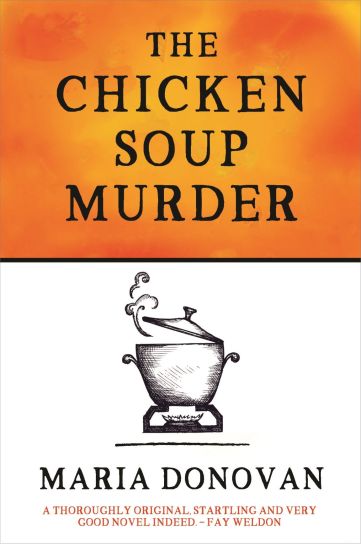



Writers Chat 19: Maria Donovan on “The Chicken Soup Murder” (Seren Books: Bridgend,Wales, 2017)

Maria, You are very welcome to my WRITERS CHAT series. Congratulations on your debut novel, The Chicken Soup Murder (Seren, 2017), a finalist for the Dundee International Book Prize and shortlisted for the Rubery Book Award. This publication follows on from your short story collection Pumping Up Napoleon and Other Stories (Seren, 2007) and your flash fiction Tea for Mr Dead (Leaf, 2006).

The Chicken Soup Murder border

SG: I thoroughly enjoyed The Chicken Soup Murder and agree with the description which says it’s “part crime fiction and murder mystery, part meditation on grieving, friendship and family”. Essentially, it is a great story, I think, which defies genre, and sits outside all those boxes that the book industry want novels to sit in. Can we talk a little bit about this – did you set out to break with genre or did you set out to write a good story, filled with complex and lovable characters? What was your intention when you started writing?

MD: I tried not to think in terms of barriers and boxes while I was writing. A novel has to be written before it is anything at all and the only way I could see of getting there was to be true to myself, to the characters and the story. Of the story strands only one is the crime, the others have to do with the meaning of family and of ways in which different characters respond to their experiences of bereavement. Having said that, I should not be surprised that it is most often sub-categorised as ‘crime and mystery’. It’s just that it’s also humorous general literary or contemporary fiction, which could be described as ‘coming of age’ since the narrator is an eleven-year-old boy who goes through many changes.

The novel evolved, beginning with an incident in which my husband nearly killed me while I was making chicken soup. My reaction, after a bit, was to laugh, as Irma does: both of us laughing in the face of our fear of death. I teased my husband that I would one day write a story called ‘The Chicken Soup Murder’ and I filed it away under ‘Crime’. Yes, I did think that a puzzle and a mystery would give the reader something strong to follow but whatever the story was going to be I wanted it to also have emotional significance. I had no idea how that would work, or who the characters in it would be or what the story was or that it would even be a novel, until much time had passed and my life drastically changed. I didn’t begin work on it until I was already two years a widow. I did my best with what I had and was concerned with making something that did my themes justice and made an enjoyable, if sometimes troubling read.

But then comes the business of communicating with agents and publishers and the reading public. You have to succinctly describe what it is you’re offering. It is certainly much easier for publicity and marketing, for libraries, literary festivals, reviewers and reading sites, if you can do that in a few words and have a strong identity. You start noticing the industry use of the word ‘brand’.

It’s logical that booksellers and libraries need to know where you’re supposed to go on the shelf: from there stems an entire system of categorisation. Would it be a neat marketing idea to have a novel on several shelves in a bookshop at once? Or would that just be confusing? Would it seem as if the novel had much to offer or would it be seen a weakness? Anyway a first-time novelist must be glad of being given any space at all.

Only the experience of reading the novel will tell you if you like it but that can be said of many a book. Take it off the bookshelf and read the first paragraph. Online, you can ‘Look inside’. But here we come full circle. In some way you have, in the first place, to give people the notion that this is the sort of book they would like to read.

For the future: while I have learned more about this kind of categorisation, and respect the reasons for it and keep it in mind, I wouldn’t want to feel this put a brake on writing the kind of story or novel I want to write because then I might not do it at all and there’d be nothing to discuss.

SG: That’s quite amazing, Maria, that the idea involving chicken soup came from your own life, and then how you wove this personal incident into a whole fictional world. And then, in relation to how the novel is presented to the reading public, well, I love the idea of a novel appearing across genres – – and on many shelves! 

Writer Francesca Rhydderch has described this novel as ‘a lovely, warm-hearted novel about love and grief.’ What makes this exploration of grief so powerful was how it is firstly told through the eyes of Michael, an eleven-year-old who understands life through its patterns and habits. In a way, it’s what we all do – an attempt to control life – but seeing Michael struggle at Irma’s sudden death (which he is convinced is a murder) really brings the vulnerability of being human home to the reader. As Michael reflects:

Sometimes I wanted to cry about it: sometimes I wanted to shout or run to break the tight feeling – but everyone else was being normal so I had to be normal too.

And then later, on a rare trip to the beach “I keep thinking: Luxury. The luxury of being alive.”

This is something that we should all remind ourselves. Did you find that using a child narrator at this key age of transition helped you be more authentic in the exploration of life and death and coming of age? 

MD: It certainly helped me that I was filtering everything through Michael’s consciousness. His sensibilities about death and bereavement and how he sees other people cope or not cope were all things I wanted to show in an emotionally realistic way. Remembering what it was like to be that age and having been a child who thought about death quite a bit, I felt I could help him tell his story. Another thing: his observations of the adults around him are all we have and though it is important that his understanding of them as well as himself can grow and change, being Michael saved me, in this novel, from falling down the well of my own grief. If I had been too close to Janey’s mother or to Nan there would have been a danger of that. Though I tried once to change the novel to third person, it felt wrong and I couldn’t do it. It was Michael’s story and, given that I had so many other things going on, I was glad that I kept it in his voice.

SG: Yes, it is such a strong voice that really, I think the story couldn’t be told in any other. Sickness, loss, and the stories we tell ourselves to make things better also run through The Chicken Soup Murder. Janey’s family have lost their father, Michael has been deprived of his father and, without spoiling the plot, both of these subplots grow and change as the book progresses. You do this with a three act structure (the three parts to the novel) rather than using traditional chapters. Was this something that came organically to you as you wrote it or did you impose the structure when you’d finished?

MD: It was my plan to write a novel in three parts because I knew it would give the book a strong dramatic structure and as I have a tendency to incorporate ideas on the fly, it felt good to have reminders that we were supposed to be going somewhere. But the structure also felt organic to the novel. Each part represents a new phase in Michael’s understanding. If it hadn’t been right I suppose I would have done something different. I wanted a flow to it within these three big sections so just settled for white space to show changes in time, place or subject rather than clearly defined chapters. My dad said that this was fine but he didn’t know when to stop reading. Perhaps that could be seen as an advantage!

SG: My favourite character was that of Nan. She’s witty and she’s wise and she is a very complex character – she feels very real to me. When everyone around her is struggling, she manages to surmise the situation with humour and grace. She says to Janey when she’s worried that everyone has forgotten about her father because Irma has died “Ah, the league tables of grief. But it’s not a competition, Janey. Nobody wins.” Tell me about how you developed Nan.

MD: Nan is like an old friend now, one I loved from the start though I had to get to know her with all the experiences of her years. I felt I could rely on her to be herself and do and say what came naturally in any given situation. It is important that I knew her well because she has been the biggest influence on Michael’s life and character. Their relationship is key. I wanted her to be funny, forthright and fearless though for a long time her presence is muted by her need to keep a big secret.

In developing Nan it helped things along quite a bit to think of her as a person with more to her than her identity as Michael’s grandmother, though it is important to her to do a good job in that role. She’s a young grandmother though it might not always seem like that to Michael. She and I share certain cultural references and I wanted to show glimmers of her as the woman called Zena, who back in the day had been a rebellious teenager listening to Wreckless Eric. For a time, to remind myself that she has never quite lost her attitude, I kept a postcard of ‘Xena, Warrior Princess’ in view, in which the heroine is scowling, alongside the caption, ‘The way to a man’s heart is through his ribcage’. Nan takes no prisoners but deep down she’s kind and if you can make her laugh you’re halfway to disarming her. Nan has had some adventures in her life but now she’s dedicated to looking after her grandson and that is her strength and purpose. But she’s still her own person. I wanted her to use her sense of humour as a shield and to be willing to follow her own judgement. I made her wary of commitment, because she can’t bear to do half a job. If she takes on a responsibility she takes it seriously and does her very best. I also allowed her to speak her mind, which is useful, since what Michael tells us about what she says and does is all we can know about her. She is unabashed about giving what she thinks is good advice, such as the quote you mention. I’m grateful to her because if it weren’t for Nan that observation would have stayed in my mind, instead of which I could write it down and let the words come out of her mouth. And if Janey rolled her eyes when Nan said that, we don’t know, because Michael was in the back seat of the car.

SG: I love how real Nan has become to you, and you’re so right; perspective is everything in a novel. The first line of The Chicken Soup Murder is a great one – “The day before the murder George Bull tried to poison me with a cheese sandwich”. It captures the tone of the novel – serious topics told with humour and tenderness. Was it the first line you wrote or did it come to you when you’d finished the novel?

MD: As I recall I had that first line from the start – or very early on. I liked the idea of introducing my hero and identifying his enemy in one go, of Michael making a joke, half at his own expense, while establishing the important fact of the murder on which the novel depends. I liked the idea of him having not one big fatal flaw but a series of small ones, like lactose intolerance. It also helps to know that the big event is coming soon. Before we get to it Michael tells us about his paradise lost. Life has already changed because of the coming of the bully and the falling apart of his ‘family’ after Janey’s dad dies from cancer.

The only real difference is that the character also known as Bully started out with a different first name associated with yet another theme. When I’d nearly finished I had to deal with the fact that the name, which Michael uses most mockingly and cruelly in that draft, was also the name of a boy I knew. I struggled with this and though his mother gave me the go-head to use his name, in the end I decided that the whole theme, which was about child abduction and abuse, was pulling so hard that it was going to move the story away from where I wanted it to be. It was the right thing to do to remove that storyline. Changing the name to George gave me a name with a similar sound and a new set of associations that fitted fine with the novel as it was meant to be.

SG: It’s fascinating to hear about these big changes which are invisible to the reader but so present, even in their absence to the writer. 

West Bay October 2017
Maria at West Bay – featured in The Chicken Soup Murder

Lastly, Maria, some fun questions:

Mountains or sea? Sea. I’m scared of heights. But looking at mountains is fine too. I’m also fond of the Dutch mountains.

Ha! I love it. Brown bread or white bread? I nearly always buy brown but sometimes look longingly at white as if that is the greater treat.

Cats or dogs? Both have been wonderful friends to me but now I have neither and am mostly interested in the doings of the birds and insects in my garden and anywhere I go. Creatures that have the power of flight amaze me, as does the idea that birds still manage to live amongst us – just about. Blue tits built their nest in the garden last year and raised six young. That felt like an achievement.

Bertie headshot
Maria’s dog Bertie, sadly deceased a few years ago.

What writing project are you working on now? I am aiming to finish another novel called The Miller’s Wife. It’s set in a dystopian near future in the southernmost part of the Netherlands and mostly concerns the miller’s agony of uncertainty as he tries to find out what has happened to his wife. There’s also an odd but possible romance with his new neighbour, an immigrant woman, who has been in the country for many years and who sets up her own investigation out of mistrust of the miller’s version of the story. Like Michael and Nan in The Chicken Soup Murder, these two will need each other’s help to solve the mystery. As you can see, I’ll need to work on that fifteen-word description.

SG: Well fifteen or fifty-word description, The Miller’s Wife sounds fascinating… I look forward to it!

I have in the background the novel I stopped writing when my husband died, and a few short stories I would like to complete to put together another collection.

For that short term finishing and publishing hit, I sometimes write very short fiction, poetry (of a sort) and songs. There are blog posts over at www.mariadonovan.com. There I experiment with ideas about truth and time, and question various assumptions. I am also trying to write a little more about the background to The Chicken Soup Murder so I thank you for your kind comments and your questions and the chance to go back and think about it all again. It has been educational.

SG: Oh, Maria, it has been wonderful to chat to you and it has been educational for me, too. Thanks once again and I’d encourage everyone to read The Chicken Soup Murder and check out your website. 

Maria TCSM launch
Maria Donovan at the launch of The Chicken Soup Murder


Writers Chat 14: Nessa O’Mahony on “The Branchman” (Arlen House: Galway, 2018)

Nessa, You are very welcome to my WRITERS CHAT series. Congratulations on your debut novel, The Branchman, which follows on from four previously published books (three critically acclaimed poetry collections plus a novel in verse).

READERS: To win a signed copy of THE BRANCHMAN, simply comment on this blog saying why you’d like a copy and what you enjoyed about our chat. Winner will be drawn on Monday 29th October!

 Branchman-full-cover-300x217

Although in previous poetry collections you have explored some of your family history, and, in particular, that of your grandfather, for your latest publication, The Branchman, you explore a fictionalised version of his early time in An Garda Síochána using the genre of a thriller and the form of a novel. How did you decide the novel was the right form for the story?

NOM: Thanks so much for having me, Shauna! And you’re absolutely right, I’ve previously used poetry to explore family history – it was a consistent theme in each of the four previous volumes, but I think there was also always a strong narrative thread in the poems I included. The verse novel, which was a PhD project, deliberately explored the overlaps between poetry and narrative; it was straining at the bit to be a novel, to be honest, so I think it was only a matter of time before I committed myself to a full-length prose narrative. But it was researching my grandfather Michael McCann’s life that finally convinced me the time was right to try my hand as novel-writing.

I’d been researching his time spent in the new Garda Síochána and made contact with the Garda Archives to see what I could find out about his time spent there. All I got back was an A4 page with information about his date of enlistment, and retirement, and the fact that he’d given ‘exemplary service’. I knew from reading newspapers of the period that there was considerably more to meet the eye than that and that he must have seen some remarkable events; Ireland during the period immediately after the Civil War was still a lawless place, and I imagined there’d be any number of alarming incidents to recount. Somebody was going to write a good piece of civil war noir fiction, and I decided I wanted that to be me.

SG: You’ve really captured that adage that rather than write what you know, writers write from what they know into what they don’t know. You wrote from the knowledge of “exemplary service” and allowed your writerly self to re-imagine and invent the story of what could be behind “exemplary” and “service”.

Now, although the pace and tone are most definitely that of a thriller/crime novel, much of the writing in The Branchman is wonderfully poetic – a lot of sensory detail, descriptions, the writing at times visceral and at times contemplative. For example in a scene where a body is found, we start with this beautiful description:

“The field behind St Brigid’s Hospital was more boy than pasture – there were no signs of any recent grazing and here and there tufts of grass and bog asphodel peppered the ground.”

Do you think this is your poet-self showing through or is it a style of writing that was more deliberate – used to reflect the external and internal world of The Branchman, Michael Mackey? And on from this, I used one of your chapters – which covered a scene or two and were deliciously short, staccato and page turning – with my novel writing group in Maynooth University and we had a discussion about your possible process. We were curious about the length – did you set out to write short, sharp chapters (given the genre and story) or was it to do with time (one can write a scene in a short space of time) or your poetic sentiment?

NOM: Well first of all, thanks so much for saying that about my style. I’d been concerned that I’d eradicated all my poetic instincts in a desire for pacy prose, so I’m delighted that you found some of it lyrical. I think I do always think like a poet when wanting to describe the world of my story and it felt natural to make use of imagery and sensual description to try to bring that world alive. I wanted the reader to see what Mackey saw, in as much sensual detail as possible. I’m not sure that he has the soul of a poet, but he certainly is an observant man with a good eye for detail.

As for those short chapters, it started off accidental but became deliberate as I grew aware of the advantage of being able to switch scenes mid-way through the action. It’s very possible that my poetic instinct to distill things to their essence influenced the shape of the chapters in the first instance – that I was seeing them much as I see stanzas and ensuring that they contained only the essential information. But then I realised that one could generate suspense by switching to a new character or a new site of action so that each chapter became a little teaser of sorts. And I enjoyed writing that way. Some chapters are longer, of course – the ones that contain necessary backstory, for example – but most aren’t much more than a couple of pages long. I tell people that the book looks far longer to read (at 360 pages) that it actually takes and those short chapters seem to suck people in, somewhat.

SG: Yes, you’re right. The heft of the book disguises the page-turner the book is and much of this is down to the short, sharp chapters, the hooks and how you deftly manage the plot and the reveals.

The Branchman was a real page-turner, but I found that the relationships between the characters stayed with me after I’d finished the book, in particular the Daly family. You deftly capture the politics and contradictory nature of war, of nationhood, and of identity through very strong characterisation, and, of course, in your main protagonist, Detective Officer Michael Mackey.

 These themes are explored through Mackey’s relationships through the novel. We’re told that “The Civil War may be over, but there’s no peace, not by a long chalk…” and in another scene, Annie makes one of her many cutting comments to Mackey:

“Detective,” she snorted. “They let anyone into the Guards these days. As long as you were on the winning side, or at least claimed to be.”

 For a man who has fought in many places and many wars to literally keep the peace, he is now the ultimate outsider in his homeland. Danger lurks in every corner – or through the eyes of man perhaps suffering from post-traumatic stress, the possibility of it:

“It all looked innocent enough, but who knew what old animosities were lurking in those green fields?” And as he knows, “you couldn’t talk what you’d gone through or even where you’d been.”

This is a part of our national history that many families (and historians) have struggled to have honest conversations about. Do you think that in writing with such glorious detail many of the issues and contradictions by following the journey of Mackey, The Branchman could open up some new honest public conversations?  

NOM: I’d be delighted if the novel started off some public conversations. Part of the instinct to write this was my awareness of the persistent reticence about this period of our history. My grandparents lived through this time, but rarely spoke about their experiences. Anything my mother told me had been drip-fed to her by her own mother, and her father never spoke about it at all. It’s not surprising, really. How could a community that had come through the trauma of three wars (World War I, the War of Independence and the Civil War, as my grandfather had) be able to talk about things with any detachment. I’m convinced that half the population had undiagnosed PTSD. Add to the mix the change in political allegiances in the newly independent Ireland – all those soldiers coming back from the Somme, unable to speak about where they’d been – and the guilt of the dreadful things done to friends and neighbours during the Civil War and you have a very toxic recipe for dysfunction, which of course the crime-writer thrives upon. I’d never read stories set in this period, and I really feel that creative writing can help us to explore what had previously been unsayable or undiscussable, if that’s a word.

I also think that we’ve shown that we can deal with difficult topics during this first half of the decade of commemoration, but most people admit that public debate will get more and more difficult the closer we get to the anniversaries of the War of Independence and the Civil War, where many facts are still virulently contested. So I think that any creative writing that prompts discussion and an effort to understand the nature of those troubled times should be welcomed.

SG: Yes, there seems to be a burgeoning maturity in our psyche when it comes to assessing our recent history. I hope The Branchman will play a part in these public conversations – art in all its forms is often a way in, and indeed, for historians examining social history, historiography, art is often the key.

You’ve said that Mackey

“bears more than a passing resemblance to my grandfather but, as with many fictional heroes, has his own characteristics, flaws and plot points, which almost certainly never happened in real life, or at least not in the way I tell them here.”

Could you comment on how you found that process – using fact to create fiction and how the two overlapped, intertwined, and possibly changed as you wrote and edited the novel. Indeed, is it that you hold the emotional centre of the truth and work out from there?

NOM: I’ve been playing with the overlap between fact and fiction all my writing life, I suppose, filling the hiatuses and gaps with my own imaginings so that the characters I write about from real life end up being highly fictionalised. Michael Mackey is inspired by my grandfather, but I have little memory of the real man (I was 6 when he died) and drew on my mother’s stories about him for the main inspiration. But as the narrative developed, Mackey’s character had to change as he took on traits needed for the plot. This fictionalisation is especially true of the ‘love interest’ if I can call Annie that. She was originally based much more on my grandmother, but as the plot developed, I needed her to take on a much more dynamic motivation than my grandmother would ever have recognised (indeed she’d have been appalled by her fictional counterpart, I suspect). So yes, I do hope that there is an emotional centre of truth in the novel, but rather than these characters being similar to my own grandparents, they should be believable characters in their own rights, with plausible motivations that ring true.

SG: I think Mackey and Annie, as characters in the novel certainly ring true, I suppose I was curious about the process of transference and filtering. On another note, I loved the sense of place you create in The Branchman. Galway and Mayo feature heavily but we hear about Dublin, America, England too. Many of the characters have returned to Ballinasloe having previously been sent away. In some cases to create safety or for safety, (Mackey, Latham), and for others, such as Annie, Ballinasloe is the place they have found as a safe haven. The notion of return and change – in identity, in politics – is a motif that I enjoyed very much through the novel. Did you set out to explore identity and place, in particular?

NOM: I’m so pleased you enjoyed the sense of place. It was very important that I got that right, particularly in the case of Ballinasloe, which is my mother’s beloved home town and a place I’ve visited with her many times. Indeed, when I began to write the book, I took a trip with her and we walked around many of granddad’s old haunts, even visiting the police station. I took that ‘field-work’ with me in the writing and redrafting of the novel, wanting to be sure that I was accurate about where places were and whether it would be possible to walk from location to another in the time I suggest. My mother’s sense of place is particularly strong – at age 90, she still returns in her memory to a childhood spent exploring Ballinasloe. I was very envious of her growing up, as the pebble-dashed childhood surburb of Churchtown where we lived seemed very pale in comparison. So I guess that fed into my recreation of a fictional Ballinasloe here. Kiltimagh had a similar status – I’d heard almost as many stories about that town as I had about Ballinasloe, and wanted to present that correctly too. But you’re right, and I hadn’t really thought about it until you said it, the book is also about remaking identity and trying to fit in. Practically everyone here is an outsider – if they weren’t one before, the various wars made them so, so people’s identities are shifting all the time – they have to as a matter of survival.

SG: I can’t leave our chat without commenting on the stunning cover image. Arlen House is well known for their use of art, and with The Branchman, the cover shows a detail from a painting by Brian Maguire entitled The World is Full of Murder. Did you have an input into the decision making around the title of your novel and the cover?

NOM: There’s a great story around the cover, actually. We’d orginally been talking about using a Sean Keating painting (one of his Civil War series) as the cover art, but that was becoming too difficult to source and time was running out. Then, by coincidence, I was down in Skibbereen on holiday when the Great Hunger exhibition was being shown at the local arts centre, Uilleann. We wandered around and came across Brian Maguire’s painting, which is a huge and dramatic canvas. Apart from the image’s sheer beauty, the title conveyed everything I wanted to suggest in the novel, and I had to have it for the book. I’d no idea how to contact Brian, but this is Ireland, where everyone knows somebody who knows somebody. I contacted a friend who knew Brian; he passed on Brian’s email address and I’d got permission both from him and from Quinnipiac University, who own the painting, within a day.

As for the title, it was The Branchman, from the outset. I had the title before I had the novel. I’ve no idea where it came from, it was just there. And I googled it to check that there wasn’t another novel with the same title out there. There wasn’t at the time I started, although more recent google searches have revealed there is now another one in the US, though it appears to be horror rather than crime!

SG: Wow. Permission within a day. It was certainly meant to be. I love that you had your title before the novel. Fantastic. 

Some fun questions

  1. What are you reading now? I’ve just started Anna Burns’s Milkman. It’s every bit as great as people say it is.
  2. I’m reading it too! So far, wonderful. City or town? Well, I am a Dubliner, so it has to be city, doesn’t it? I do love my rickety dirty old Dublin.
  3. Mountains or sea? Sea, in a heartbeat. It’s the recurring dream to live by the sea – I was lucky enough to live with a sea-view when I was doing my PhD in Wales – and that was the best time of my life in so many ways.
  4. What’s your favourite drink when you’re writing? Sadly, a nice cup of tea. I’d have loved to have said absinth, honestly.
  5. Ha! That put a smile on my face. I love Earl Grey tea when I’m deep into a book and a strong black coffee when I’m starting off. Nothing ‘cool’ like absinth for me either!

Lastly, where can we find you reading from The Branchman? I’ll be reading from The Branchman at the Speakers’ Corner sessions at the Murder One Festival in Smock Alley on the 3rd November, at 11am. There’ll be a Belfast launch for it at the Crescent Arts Centre on 16th November, and I’ll be reading from it at the Rostrevor Festival in Co. Down on 24th November.

Great to hear that we can catch you in a variety of places, Nessa. The Murder One Festival sounds fantastic. I believe tickets can be obtained hereThanks, again, for engaging so generously in our chat and for providing such insight into the process and hopes of The Branchman. I wish you much continued success. 

Readers, keep up to date with Nessa 

READERS: To win a signed copy of THE BRANCHMAN, simply comment on this blog saying why you’d like a copy and what you enjoyed about our chat. Winner will be drawn on Monday 29th October!

……And the winner is…..

IMAG1184Andrew! Congratulations. I’ll put you in touch with Nessa. Thanks for reading and commenting.

nessaheadshot3-2