Writers Chat 53: Lia Mills on “Another Alice” (Arlen Classic Literature, Dublin: 2022)

Lia, You are very welcome to my Writers Chat series and I’m delighted to be talking to you about your novel Another Alice first published by Poolbeg in 1996, and reissued this year (2022) as part of the Arlen House Classic Literature Series. I spent much of the early to mid 1990s outside of Ireland so missed out on this important and impactful novel when it was first published.

Cover of Another Alice by Lia Mills (title in yellow font, author name in white font): showing a dark leafless tree against a contrasting background of green, on a shadow of a hill with the figure of a child in black silhouette in the foreground. Image is art by Carmel Benson.

SG: Let’s begin with the beautiful cover (by Carmel Benson) which captures both a loneliness and melancholy that is echoed in how Alice experiences life (internally and externally) in Another Alice. Did you have an input into the cover image and how does this new edition speak to the Ireland of 2022 just as the cover of 1996 spoke to Ireland then?

LM: I chose that image! Carmel is a friend, I love her work and this print has hung in our kitchen for years. I was very happy that she gave me permission to use it. And I have to say, Arlen House do beautiful covers. Alan Hayes, the publisher, is exceptional in the level of choice he gives to writers with regard to covers and the results work very well.

As for the 1996 cover, I’ve always disliked it. The woman whose face is depicted on the cover wears frosted lipstick. Alice is not a frosted lipstick kind of person.

SG: I love how Arlen House covers often use contemporary art to grace their covers. With regards the original, I’d agree with you about the lipstick but I do like the sea-scape as this speaks to Alice’s relationship with the coast. So, you’ve outlined in your interview with Catherine Dunne why Another Alice is being issued now – especially in relation to the central theme of gender-based violence and how Alice’s story is still relevant to today’s Ireland. I liked how you expressed that learning to see is what the novel is about. So just as

She practised forgetting what she knew, because if she didn’t know, she couldn’t tell

then as the story evolves, Alice unlearns all these practices.

Could you talk a little about how this forms the arc for Alice as a character – learning to see into herself and know that beyond the stories she has told herself, and those told about her, is where the real Alice lies?

LM: I should say at the outset thatmost of my understanding of how (I think) Another Alice works has come to me since I wrote the novel. The actual process of writing it was a long process of trial and error and feeling my way through a very murky series of confusions and reluctance.

As I mentioned in that interview with Catherine, Alice has never been able to claim childhood experiences as hers because they have been denied by everyone around her, renamed even as they happen, while she is blamed for any damage, any harm that comes to her. This is apparent to a reader from early on in the novel but it’s not clear whether Alice herself is aware of it. Later on, however, a different narrative voice surfaces, describing and expressing the process of splitting, which was Alice’s defence mechanism as a child. This new voice tells us what happened and how Alice escaped what happened. If she wants to be a fully autonomous (literally a self-naming) person, the adult woman has to rediscover, recognise and reclaim the lost parts of herself revealed by that voice and learn to trust her own perceptions. She needs to remember herself, as in: putting a shattered self back together, and become a conscious individual.

What’s important to Alice as Holly’s mother (as opposed to as an individual person) is that she learns to recognise the ways in which she was shut down when she was a child. She sees the patterns in her own reactions to Holly when she does things she regrets, and slowly learns to correct those urges to protect herself at Holly’s expense.  So, she becomes both a more integrated person, which is to her own benefit, and a better, stronger mother for Holly.

SG: You really showed this process of Alice’s change really well – as a reader it felt like I was experiencing what she was going through! Another element that made for a very emotional read was the tone in which much of the story is told.

We meet Alice through an omniscient third-person narrator and we’re told a version of her early life but beneath this is an underlying tone that both propels us to read on with a sort of subliminal knowledge of what may happen, that is felt more than known. This seems to echo Alice’s own first person voice and makes, at times, for an uncomfortable read, I think because Alice is so disassociated from her body and memory. Was this intentional or did it emerge instinctively through the writing?

LM: It took time for me to find the right voices for this story. The key, really was finding a way to write it where the reader would recognise the dysfunction in Alice’s world while also leaving room for potential ambiguity. I was interested in the mechanisms of denial, and there are scenes where I wanted to show incidents that many people might be happy to shrug off or overlook, but in the context of Alice’s overall story and the power relations within her family, it becomes clear (I hope) how destructive they are. For example, we’ve all seen – and some people may have experienced – a child being tickled when they don’t want it, begging for mercy. As the younger Alice tells it, that experience is clearly abusive. The issues here are about power (psychological and physical), consent, relative strength. As so many abusive situations are. I have to tell you that when a friend of mine read the novel back in the 1990s, she told me the character she identified with the most was Alice’s mother. Which is a whole other conversation.

In retrospect the use of a third-person, past tense narrative voice for the main story was a fairly straightforward decision but this was my first novel and I tried it in different ways.  Having decided on that, I still had to learn how to tell the story without killing it with detail. And all the time, I was being pulled into this other voice, first person, present tense, chaotic and emotional. It seems obvious now, but it took me a while to recognise that I had to make room in the narrative for that voice – and she solved a lot of problems for me when I just decided to let her get on with it.

SG: Voice is also so central to a novel, and I think using these voices, you’ve captured the power/consent/strength issues in a very subtle and unsettling way. And on Alice’s mother, well, that is another conversation as there was the definite impression of a whole backstory to her behaviour and denial.

I really enjoyed the movement – and change – in Alice’s friendships, in particular Nell, but also Kate. You show these women’s growth and struggles in terms of conformity, societal expectations and emergent motherhood. And the thing is that those challenges are still faced by women in Ireland today. There is no “dating” these themes, despite the theoretical changes in this country. Could you comment on this?

LM: I don’t think the core experiences of human life change very much over time. Becoming a mother is a prime example. It’s such a seismic shift in perspective and awareness, and so many of us are utterly unprepared for it – I know I was. Everyone’s circumstances are different, so we each have our own adjustments and negotiations to navigate, each within our own lives and whatever context we find ourselves in. It’s the contexts (social, physical, financial, historical cultural) that change and obviously they affect the nature of the emotional and physiological experience. It’s a rich seam, for fiction, because we can all find elements we recognise in a fictional mother’s story at the same time as we see issues that are foreign to us. So there’s a balance of recognition and surprise that allows us to empathise while also wondering what we might do or feel in similar circumstances.

Friendship is friendship. It’s such an immense part of our lives and I don’t think it gets enough attention in fiction. Over a lifetime our relationships with friends change, we can get closer and more distant and then closer again, we might have dramatic break-ups, reconciliations, reunion after long separations … it’s a fascinating dynamic, every bit as interesting as other relationships, with a whole spectrum of emotions running through it.

SG: I love how you express that – “a rich seam for fiction”. It was emotional seeing Alice as a young mother struggling with her own self (literally), what it means to be a mother, and how to be with her daughter, Holly. “She watched herself mothering…” I cried at two scenes – the one with car – and the one where she slaps Holly. Both of these acts – rooted in a desperation to control – end up as acts as freedom because Alice is able to name what she has done and acknowledge this anger. They also echo some of the disconnection that Alice felt with her own mother, for example, when Elaine breaks down, “She watched herself watch her mother crying at the kitchen table.” These were incredible scenes and opposite to the oppressive and stifling scenes of her younger self. I’d imagine these parts of the narrative were difficult decisions to make a writer – which way does Alice go? – and also tricky to write?

LM: These were tricky scenes to write, yes, because I think our instincts drive us to protect our characters and sometimes we just have to put them in danger, or make them do things we’d rather they wouldn’t do. But isn’t that the whole point of writing? To explore the more painful, difficult truths of human experience. If all our characters stayed on the straight and narrow path all the time and made all the right choices, there’d be no story.

Who was it who said that ‘writers write what other people think/know but can’t say’? In this novel, Alice is in trouble not just because of her childhood but because she is out of control in many ways. There’s no point in pretending that she never does anything wrong, or that she’s somehow not responsible for what she does (which is actually what her denials are all about: transferring blame to Holly, as her parents transferred blame to her). Her task is to learn how to understand and correct the mistakes she makes. Like life, for all of us. Like writing. As Beckett has it: Failing, then failing better.

SG: You’ve expressed the point of writing so succinctly, Lia “to explore more painful, difficult truths of human experience.”

LM: Of course, writing is about imagining and expressing other things too: beauty, hope, alternative worlds … yet another conversation!

SG: Yes, of course, writing is also about re-imagining…So let’s finish up with some light-hearted questions:

  • Tea or Coffee? I’m a Libran – it depends what time of day, what mood I’m in. Coffee usually comes first, tea later
  • Music or silence when writing? Silence
  • Cats or dogs? Both!
  • Sea or Mountains? Sea
  • What are the next three books on your reading pile? Thin Places by Kerri Ní Dochartaigh; Susan McKay’s Northern Protestants: An Unsettled People; and Walk Through Walls: A Memoir by Marina Abramovic.

SG: Oh you’ll love Thin Places and I have McKay’s on my tbr pile. I must look up Abramovic. Thanks for the recommendations. Thanks, Lia for such open, generous answers. I wish you many new and re-readers of Another Alice.

Follow Lia on her blog
Buy Another Alice here

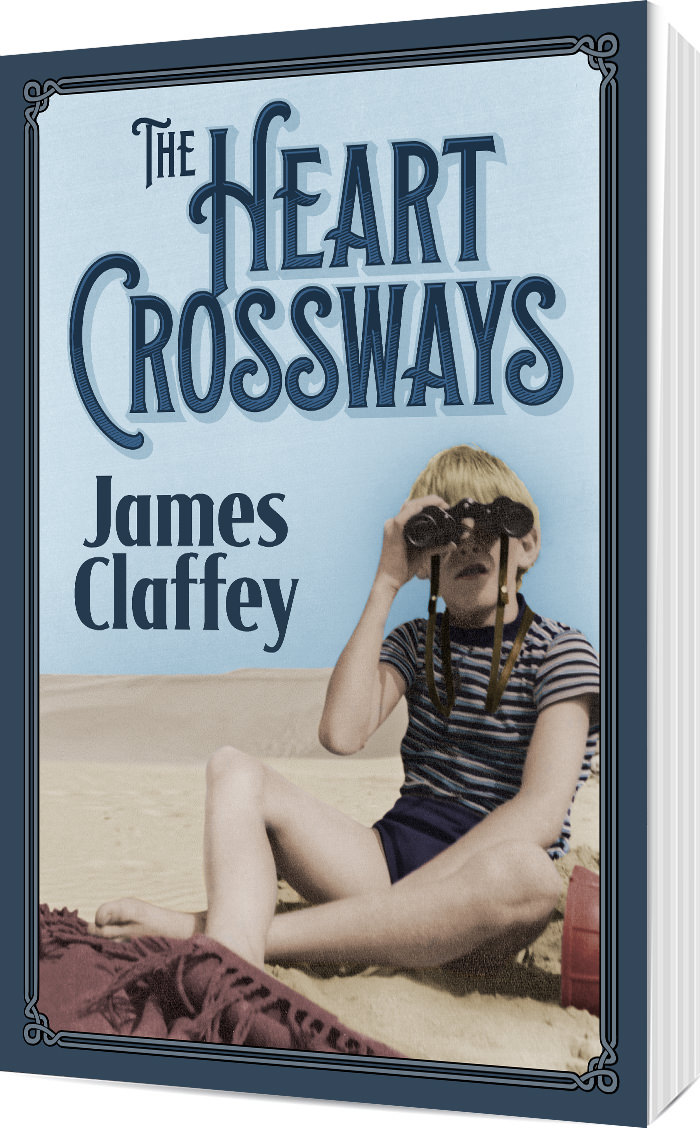
Writers Chat 23: James Claffey on “The Heart Crossways” (Thrice Publishing: USA, 2018)

James, You’re very welcome back to my Writers Chat series. The last time we chatted, in 2012, we focused on Blood a Cold Blue a collection of short fiction. This time we’re chatting about your wonderful debut novel The Heart Crossways where you bring us into an Ireland that’s hardly recognisable today.Print

So, let’s start with language. As a tool it is very much part of the narrative of the The Heart Crossways. Take the wonderful opening section:

“On rainy days the time passes slowly. Trance-like, I tongue my bedroom window and lick the condensation from the glass. My nose smushes against the cold pane. The seagulls glower below, on the roof of the coal shed…”

How much of these wonderful verbs came to you on the first few drafts or was it when you edited the novel that they emerged? I am thinking of what Sheenagh Pugh once said – that great writing is in the editing.

JC: So, interestingly enough, Thrice Fiction Magazine published three short pieces in their March, 2012 issue, and one of those pieces was “Dublin On a Wet Day,” which was remarkably close to the opening beat of the novel. Over multiple drafts the frame of the book shifted considerably, and in several drafts the opening pages were completely different and set at a far different time in Patrick’s life. The image came to me in a memory of my childhood in Rathgar, and how on rainy days my brothers and I would stand at the windows, noses pressed against the glass, cursing the weather that forced us indoors. I went over and over different variations of that opening, changing tense, point of view, at least three to four times, and ended up with a first person narrator that finally seemed to work.

SG: It really is an arresting opening. I love that throughout the novel the power of books comes through. From the old blue ledger the Old Man uses to record transgressions and the books (from Mark Twain to Tennyson) our hero, Patrick, reads to escape. Was this one of those hidden symbols that emerged when you’d finished writing the book?

JC: Yes, I think the books as symbolism emerged through the drafting process, and the ledger idea came to me from an actual ledger from my father’s business, filled with the incoming and outgoing monies for quite a few years, in fact. In several places in the ledger are crude drawings we did of dinosaurs and lions when we were probably bored on rainy days! Further, I wanted to seed Patrick’s world in the literature and drama of the time, the importance that books played in young children’s lives, long before iPhones and Fortnite. I grew up in a house filled with books, drama, literature, and as kids my brothers and I would sprawl in front of the coal fire reading comics, books, and newspaper cartoons, composting that love of books and all things literary.

SG: What beautiful memories, James. The Heart Crossways is set in an era (mid-seventies) when appearances – that you are perceived as good in the eyes of the neighbours and the church – still count for everything. As the Mam says, “All you have in this life is your good name.” Patrick – not unlike Stephen in Joyce’s Portrait of the Artist as a young man – negotiates appearances and tracks his way through his father’s alcoholism, his mother’s worries and lusting after both Cathy and Mrs Prendergast by using humour. “Seducing Mrs. Prendergast is the mission I have accepted and in silence I try to plan how this will happen. Maybe she will wear a velvet cloak and come running to me like Maria in The Sound of Music?” Patrick is both teenage and reflective in his self-analysis. Can you talk about the development of Patrick’s character?

JC: Patrick began in those early stories as a lonely boy with time on his hands and parents too consumed with keeping hearth and home together to pay him much attention. I suppose there’s a part of him that’s living in his own head, thinking and overthinking life, and there’s a part of him that’s a small boy, desperate for his parents’, particularly his father’s attention. As the book unfolds, he moves from a more simplistic worldview, to one more complex, where he gains some understanding of the complicated nature of life in a Catholic and repressed Ireland. His use of humor as a compass to guide him through the fog of his life is, in my opinion, particularly Irish, in that we use humor to decode, to defuse, and to deflect the missiles life fires at us. And the sex. As a child of the seventies, Patrick is mired in the repression of the time, cosseted by his parents, stifled by the overshadowing Catholic hierarchy that divided the schools into same sex institutions where sex was what Kavanagh called the “wink-and-elbow language of delight.”

SG: A great phrase from Kavanagh! Yes, it is a particularly Irish trait, the use of humour. Continuing with this –  there are many laugh-out-loud incidents, for example, when De Valera (the aptly named three-legged greyhound that serves as a pet) chews on the Old Man’s false teeth, or when Patrick gets a bowl cut when the Old Man thinks the barber didn’t take enough off – are any of these taken from real life situations?

JC: Well, we never had a three-legged dog, but some years ago I was in Solvang, near Santa Barbara, for breakfast and there was a American Greyhound Society event taking place in the town. One of the greyhounds was three-legged, and that stuck with me as something that might become part of a story one day. As for haircuts, most of us growing up in Dublin have had our run-ins with the local barber, and mine was with Mr. Roche, whose son was in my class in primary school. We’d tramp up to Terenure Village and enter the barber shop with its red-and-white striped pole, wait for “Skinner” Roche to cut us to shreds, and appear at school the next day to bear the brunt of the insults. Eventually, my mother started taking us to the Peter Mark Salon, a more contemporary place to get one’s “hair did,” than at the “Skinner’s.” My dad always threatened us with the scissors and bowl if we didn’t behave, and my oldest brother grew a ponytail and drew the ire of our Old Man on many occasions.

SG: Oh I remember Peter Mark Salon – still going – it was the height of sophistication! One of the themes I picked up on was that of emigration, and with it, the importance of place – of leaving and returning – creating and re-creating new identities with each new ‘start’. Although the Old Man is a difficult character in every sense of the word, and plays the role of too-little-too-late father (or, as Patrick puts it “a one-man wrecking ball”), I can’t help but think that working on the oil rigs (if that is where he goes to – there is a sense, connected to his drinking, that he frequently disappears) can’t have been easy for him. This must do with economics; the Brogan’s aren’t well-off but they have food on the table and go on holidays. Can you comment on this theme and what it might mean to you, an emigrant yourself?

JC: The Old Man spends three weeks away working the oil rigs in the North Sea at a time, and the work is gruelling and tremendously hard on his body. Patrick’s dad, of course, isn’t used to graft and his body shuts down over time, leading to physical issues that emerge in the latter stages of the novel. Everything the Brogans experience in their lives, scrimping and saving, getting groceries on credit at the local store, are moments from my own childhood. We didn’t have much in terms of financial wherewithal, but we had food, shelter, clothing and warmth, those critical components of Maslow’s hierarchy of needs. Money for the Brogans is tight, and Patrick’s mother is adept at stretching the pounds, shillings, and pence to make their home as comfortable as possible. For me, as both an immigrant and a child who grew up with not enough money to go around, the theme of economics rings loud, knowing how in my early years in America, I worked a bunch of retail jobs, barely getting by, and only really found my feet financially when I graduated from university and became a high school teacher. Even now, decades later, my greatest fear is running out of money, and I go into a panic mode if our bank account ever gets too close to the bone. I feel my parents’ desperation in those moments and return to those fraught childhood days, until I remind myself I am not my parents and I can make different decisions than they may have.

SG: While religion snakes through the story I found that the sense of loss overtook it. While Patrick imagines “God as a bitter, angry one who takes delight as he metes out punishment to ordinary sinners” he also prays for his own sorrow and torments to end- his relationship with his father. Not wanting to give any of the plot away, the ending of The Heart Crossways was fitting and poignant.

JC: The Church looms large in the story, and the strict Catholic childhood I grew up in shaped me in many ways. I walked away from the whole Mass on Sunday world and found my own way of navigating faith and belief over the years. Today, I identify as a Unitarian Universalist, cleaving to the ideas of Jefferson, Emerson and the Transcendentalists. There’s a freedom, a breath of relief when I’m at a service, with no sense of guilt or shame. As for loss, it defines my life. My father lived his life grieving for the business he lost in the 1960s, never letting it go. He reached his dying day filled with regret, loss and anger towards those he perceived did wrong by him. Being Irish, for me at least, means embracing loss, finding comfort in that feeling, knowing that one cannot be happy every day of one’s life, and that loss is as big a part of life as love, or happiness. Emotions are our weather patterns and there’s a beauty to all seasons, even those that bring devastation to our door. I know this too well, having lived through recent wildfires and debris flows in the area I’ve settled in Southern California.

SG: That’s very poetic – embracing loss. Finally, James, a little on the character of the mother and the Bird. There’s something familiar in both of these and it was lovely to return to them after meeting them briefly in your short stories. Could you talk a little about how characters can re-appear in our writing in different guises, under different circumstances and across genre?

JC: The Bird is a character I brought to life from early flash fictions I wrote about growing up in Ireland. He was a real person, a customer in my father’s pub in Moate, Co. Westmeath. The reappearance of the Bird is timely, after a project I did with Matt Potter of “Pure Slush,”—A Year in Stories. I wrote twelve stories revolving around the Bird, and one of my favorite ones appeared in Causeway/Cabhsair a few years back. In January I returned to the rich vein of material the Bird springs from, and am working on a project where I write a page a day about his life. He never was my mother’s beau, but I remember her commiserating with my father one morning as he read the obituaries in the “Irish Independent,” and announced, “The Bird is dead. The poor auld hoor.” I love how characters ebb and flow in our work, receding for years at a time, only for a re-emergence years later as the tidal patterns of our creativity shift.

SG: I think you’ve just captured the real essence of creativity – the flow and ebb of characters in tandem with our own tidal patterns of creativity. So, to finish up, James, let’s have some fun questions: 

  • Kindle or paperback? Paperback
  • Novel or short story? Novel
  • Short story or flash? Flash
  • What’s the last sentence you read? “An aliveness that lit up the world,” Michelle Elvy’s The Everrumble.
  • Great sentence! What’s the last sentence you wrote? “Oh, poor man. The center of his universe hollowed out and collapsed.”
  • Another great sentence! The best jam in the world? Our family’s business is Red Hen Cannery, and we make the most delicious Boysenberry Jam.

Thanks, James for an engaging chat. The Heart Crossways can be purchased direct from the publisher or on amazon.  Connect with James on his website

Below is our chat from January 2012. 

*****************

WRITERS CHAT – JANUARY 2012 – ON “BLOOD A COLD BLUE”

Blood_a_Cold_Blue_cover

Welcome to James Claffey, originally from County Westmeath but now living in Carpinteria, CA, USA with his wife, writer and artist Maureen Foley. James is a prolific writer and his most recent full-length publication is Blood a Cold Blue, a collection of short fiction.

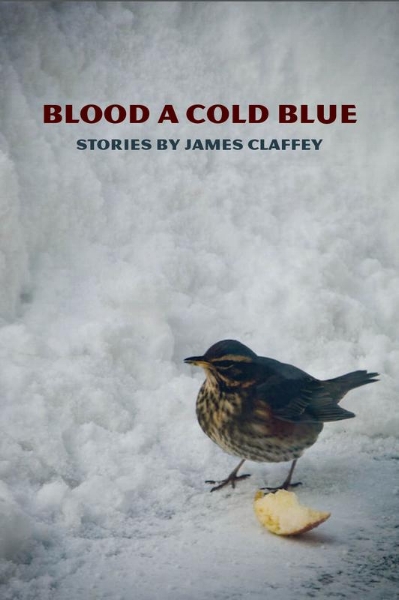
James, tell me about the title and cover of your collection Blood a Cold Blue. Was the title one you had in mind or one that emerged once you had the collection completed and formed? Tell me also about the photograph on the collection, I know you had trouble tracking down the photographer for permissions but was that image of a bird in snow with a crumb an image that you had in mind?

Yes, I submitted the collection to several places and it was always titled Blood a Cold Blue. I chose the title from a line in one of the stories that also bore the same name (I’ve got this habit of titling my stories with fragments from the text). As for the photograph, the publisher, Press 53, sent a couple of early cover suggestions that I didn’t like at all, and then they sent the bird photograph and I loved it straight away. It turned out to have been taken by an Icelandic photographer and he was unresponsive to the publisher’s attempts to contact him. We waited a week or two and there was no word so Kevin at Press 53 said we might want to look at other options including a new title completely, so I went on the hunt for the photographer. All the usual social media avenues were fruitless and on the verge of giving in, I did a last Google search and found an old LiveJournal blog he’d had years ago. It had an Icelandic email address and I sent a message asking him to contact Press 53 about the image and the next day he got in touch with Kevin and agreed to let us use the photograph.

Great to hear it all worked out! You’ve stated that “Skull of a Sheep” is your favourite story in the collection. Can you expand on the idea of having a favourite story?

“Skull of a Sheep” is a fictionalized version of a family vacation in Mayo when I was a kid, and the unpunctuated stream-of-consciousness mirrors the breathlessness of the drive down the country and back again, I found the story stirred my sense of hiraeth, that Welsh word that suggests nostalgia for home, but with some sense of longing for those departed. My father passed away in 2000 and the piece was written right before my mentor and friend, Jeanne Leiby, died in a car crash in Louisiana, so there’s a sense of this story having more weight because of these events. Also, the piece ran in the New Orleans Review, and that is a publication that means a great deal to me, having spent three years in the South, learning the ropes of what being a writer means.

There’s a great sense of compassion, compression and a long breath of emotion in that piece. You capture so much in it – all that lies beneath the landscape and landmarks.

I’d like to hear about how you get into character. Do you have a favourite character in the collection? If not, why not, if so, whom?

I do. The Bird, a character in a couple of stories I’ve written, is close to home for me. My father, if I recall correctly, who used to run a pub/grocery in the Midlands, had a customer who was called by the same name, The Bird, so I found myself putting myself in this man’s head and imagining what it would have been like to wander the streets and fields of my old hometown. I’m currently working on a year of stories for Pure Slush, an Australian publication edited by Matt Potter, with this same character. I find great latitude in taking on the task of creating a life from so few details.

That’s interesting to hear, James, as The Bird is one of the characters that stood out for me. Now tell me about settings. You have some wonderful ones that seep through via the use of names, the turn of phrase (for example “Fragments of the Bird”), from the absurd to the very real and named (for example “Fryday, June 17th, in the year 1681” or “Hurried Departure”). Do the settings come first, or come to you as you write? Or are they sometimes somewhat peripheral?

Thank you. Place is incredibly important to me, and I tend to write with almost reverence about certain locations—New Mexico, Ireland, Louisiana, California. “Fryday, June 17th…” came out of an old print of an Elephant’s skeleton and the story of its death, and I reimagined the actual events of the disaster, which actually took place in Dublin back in the 15th Century. As for “Hurried Departure,” it’s almost a fantastical world slightly based on the area surrounding our house in the avocado trees. Detail, even as liminal as the light over a stand of trees, is terrifically important to give a piece of writing an anchor in the world and as I’ve gotten less naïve as a writer, I find myself noticing the small details of objects and places much more than before.

I think, for me, anyhow, that’s what is so great about this collection. The myriad of different experiences in different settings that you (re)imagine/capture.

On writing, if you’re willing to reveal, what are you working on now?

Well, the year in stories project at Pure Slush, for one. Also, I’m working on an untitled novel with Thrice Publishing, and that’s about a small boy growing up in Dublin with a father who works away on the oil rigs in the North Sea and a mother who struggles at home to raise her son and deal with her own aging mother who lives with them. I’ve also got a novella project I’m collaborating on with another wonderful writer, and I’m very excited about that opportunity. On top of all that I’ve returned to teaching high school English, so I’m having to really be creative in terms of finding time to write, what with my wife and two kids to devote time to, and a dog that needs walking!

That’s a pretty full and creative life!  Finally, James, what three books are on your bedside table and what three books are on your ‘to read’ list.

Varieties of Disturbance by Lydia Davis, Bound in Blue, by Meg Tuite, and Gears by Alex Pruteanu, are on my bedside table, and to read are The Goldfinch by Donna Tartt, Transatlantic by Colm Toibin, and A Place to Stand by Jimmy Santiago Baca (a re-read).

Thanks, James, for such insightful and fascinating answers.You can find out more about James and his writing on his website and blog: www.jamesclaffey.com


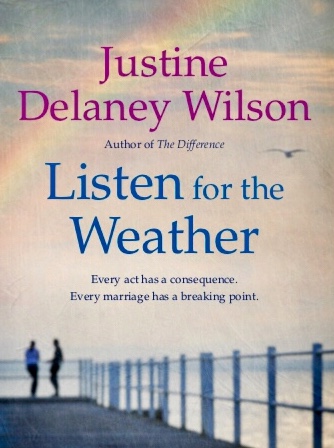
Writers Chat 10: Justine Delaney Wilson on “Listen for the Weather” (Hachette: Ireland and Australia, 2018)

front cover

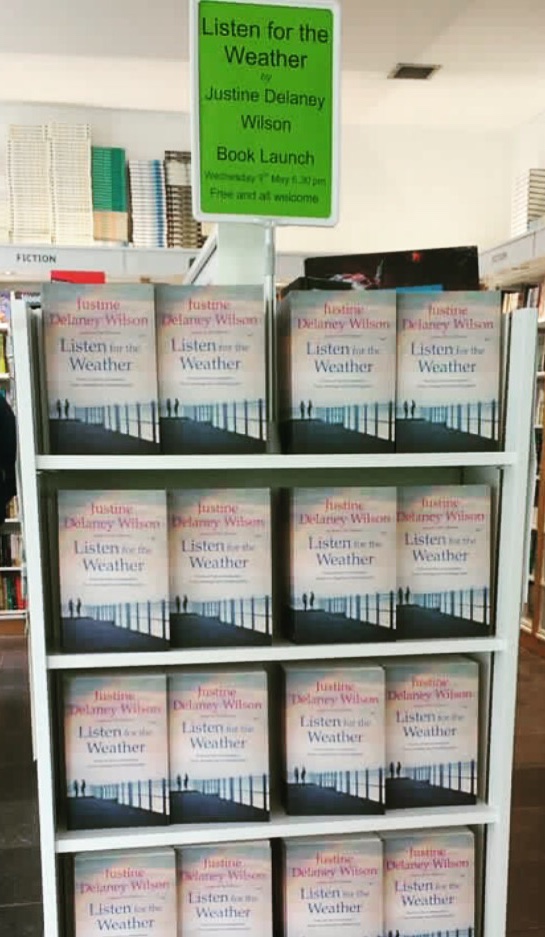
Justine, You are very welcome to WRITERS CHAT. Congratulations on your second novel Listen for the Weather which was launched in May at the wonderful Gutter bookshop in Dublin.

gutter sign

SG: Reading Listen for the Weather I found the voice of the narrator Beth combined with the short scenes really moved the story along and I just kept turning those pages! It was very much pitch and pace perfect. Can you tell us a little about how you picked the voice and the structure through which to tell the story of Beth and Steve’s marriage?

 JDW: Thanks Shauna. That’s really lovely to hear. My writing style tends to be sparse and precise, and my scenes and paragraphs always on the short and punchy side. Sometimes, I’ll make a conscious effort to let a scene breathe a bit more, to really give it some room or extra time, but it will jar with me immediately when I read it back, and I’ll end up putting a red line through everything that I added in the misguided interests of  fleshing things out.

I like to read fiction that doesn’t give me a mountain of background and isn’t heavy on set-up detail; I want to get straight into the heart of things. I appreciate writers who plate-spin throughout the text, allowing me to pick up the observations as I go. I rather fill my cup with the characters’ joy or pain, and with the truth of things. Not with a lot of front-loading about smells or the colour of the curtains.

I enjoy reading short stories for this reason – the writer’s time and space is precious, so everything superfluous has been cut away, and I find the writing is powerful as a result. I don’t know if I’m actually more of a natural editor than a writer really, in that I always want every single word to justify itself. My background is in research and writing for television, and journalism, so perhaps it comes from a learned need to keep things lean and concise for broadcast or for the allotted space.

In terms of writing in Beth’s voice, at this stage I know her character so well that I can second-guess her thoughts and actions in most situations. I understand what motivates her so I find writing in her voice feels natural.

SG: That’s the wonderful advantage of being with a character for so long, isn’t it. You really know their nuances, like a dear friend. Listen for the Weather is set mainly in New Zealand but there are scenes in Ireland. How important is place to love? Tell me about the split setting, one which you have experienced in your own life.

JDW: This book opens in New Zealand, a couple of years after the Rogers family moved there. My previous novel The Difference, which came out this month two years ago, was almost entirely set in Ireland, with the family’s move to New Zealand coming toward the end. Listen for the Weather is a mirror-image of it, in a way. Beth and Steve have moved to the other side of the world to outrun damage to their relationship and to escape the containment of their old lives. But of course, no amount of running, no matter where, will save any of us from ourselves.

Place is important, in that it informs and shapes our identity. And yet, it also isn’t; when faced with a threat to our family and the loss of everyone we love, we see that it is people who are our home.

I left Ireland early in the Autumn of 2016 to go to New Zealand, and I came back in the Spring of last year. I wrote most of this book while I was away, and then I returned home to a familiar place, and to similar weather as when I’d left – But everything just felt off.  It reminded me of the ‘Crowded House’ line; Walking ‘round the room singing stormy weather. I remember hearing Neil Finn interviewed about that song, Weather with You. He talked about how we create our own weather, how we are always making our own situations. I definitely think my feelings of dislocation and of having to make my own environment in New Zealand – a new life, new securities for my children on the other side of the world – informed my writing of this story and my depiction of the characters.

SG: Having lived away from Ireland for many years myself, I can totally understand that strangeness of being in your ‘home’ country and feeling totally out of kilter. I love what you say that it is people who are our home.

Now tell me about the role of the video calls Beth makes to her mother back in Ireland. What a great device to bring us out of Beth’s head, reminding the reader that another world, another past and indeed another present exist. It’s also a reminder that no matter how difficult the circumstances or experience you are going through, the normality of life is always continuing elsewhere. And yet, the normality often hides other depths, as we learn later in the book.

JDW: Through video calls we catch moments of what we’ve left behind, or what has left us. But, like photographs, these calls only show what’s in frame at the time. Sometimes what’s in frame can relieve and sate us, but sometimes it can also mislead.

Beth’s mother, Johanna, has been tethered to her own desperation for much of her adult life and so has only ever been available to Beth in a very limited way. That said, her familiar mannerisms and expressions during these calls do provide her daughter with some comfort when she desperately needs it. Small hints of Johanna’s hard-won insight into the reality of love, which comes much later in the book, are suggested earlier in some of her seemingly throw-away comments over Skype.

launch shelving

SG: I have to admit my opinion on Johanna changed as the story unfolded, for the very reasons you cite above. Having said that, my favourite character in Listen for the Weather was that of Mae, and how, many times, she is the only one of the family who is grounded in who she is and how she is – she is the solid comforter. For example in the scene when they are driving to the zoo, it’s Mae who asks for Beth’s hand right when Beth needs to be comforted. And in Ireland, it’s Mae who is the touchstone for Beth and her granddad. Really, she is herself, and not trying to fit into a role that society or family has created for her.

 JDW: I’m drawn to write about emotional turbulence – the power-plays in families; the betrayals within relationships; the sense of being at odds with your place in your own domestic world – these ordinary, but difficult, human things. Against this backdrop of adults feeling their way along their own jagged paths stands the character of 7 year-old Mae.

Mae wields a clear and positive power in this book. She manages to love more, but care less. She’s full of empathy – she is the emotional barometer in the house – and yet is nobody’s fool. I think she brings her entire family to life in a way that otherwise might never have happened for them. Mae’s disability allowed me to explore new jealousies in this novel – the uncomfortable envy a mother feels toward a ‘perfect’ child, a little girl who doesn’t have special needs.

Through the innate honesty of her daughter, Beth comes to see and cut through the artifice around her. And it’s from following Mae’s lead that she manages to get her head around what it is she needs to do.

SG: Throughout Beth’s journey, she gives us some beautifully poetic insights into her experience of what love is, or can be – a few of them:

“the heart has a blind spot….isn’t that the human condition? To desire what is not certain.”

 “love chooses not to see, chooses to ignore what doesn’t suit it.”

“The affair is a “tear in the fabric of life.”

“Most of love’s power is how badly it hurts.”

“Love with our eyes open. With the dark colours, as well as the bright.”

Was this a theme that you were always going to write about or did it emerge in the writing of the novel?

JDW:  From the get go, I wanted to look at love in this book. I think everything comes down to love, really. Having it, being denied it, growing up without it, learning to hold onto it, messing it up, confusing it with something else, confusing something else for it, cherishing it.

I’m intrigued by the accepted idea that love is kind, because it isn’t always. The “You are perfect as you are. You complete me” sort of thing doesn’t interest me at all. There’s a laziness in that idea of completion, of having reached some idyll. It’s not the sort of love I want to write about, or even read about. Love is active; it bowls you over, for better and worse. And it keeps pushing you back on yourself, on your own resources, into a space where you think and grow. Beth comes to realise that life is possible for her without Steve, which is the place I needed her to arrive at. Whatever way she goes after that is then a real, eyes-open decision, and not just one based on blind panic or lack of courage.

SG: Yes, I enjoyed being on that journey with Beth, as hard as it was in places, a realisation and a choice based on strength. As you say, a real decision.

Thanks for popping over to participate in my Writers Chat Series and for your generous answers, Justine. To finish off, I’ve five fun questions for you:

Mountains or Sea? The sea, most definitely. The sounds, the constant movement, the tidal changes, the sense of possibility. I had the privilege of living at the ocean in New Zealand and I must say that having half an hour in the evening to walk or sit at the water’s edge is something I’d highly recommend. Mountains are all very well but they don’t hold anything like the same fascination for me. After five minutes, I could probably give or take a mountain, to be honest. I like to be amongst things, amongst possibilities and activity, and I associate mountains with distance and seclusion. A city with a coastline would be my ideal. 

Coffee or tea? Tea. I’m a very committed tea drinker. The kettle in my house is always either on or still warm from the previous cup. I don’t like coffee, which is probably just as well because I’m not the best at things in moderation, and tea seems like the lesser of two charming evils.

Kindle or Paperback? Oh, paperback! I don’t own a kindle and I hope nobody ever buys me one. I like to feel the pages, to turn them, to flick back if I need to, and occasionally I’ll write on them. I love the physicality of books – the cover, the smell. And as décor, there’s surely nothing better than shelving full of well-read books, their spines lined up together. The fact that books don’t need charging is also glorious.

What are you writing now? In the latter stages of every manuscript, I swear that I’ll NEVER do this to myself again. But then the finished book comes out, and I see it in someone’s hands being read, and I quickly forget the pain of its birth. The faucet for the next novel is dripping away in the background here already. It’s called An Open Door and is set in present-day Dublin and 1990s New York.

What’s next on your ‘to read’ pile? My TBR pile was so high recently that I had to split it into a Pile A and a lesser Pile B. I was starting to feel some anxiety at the height of the tower glaring down at me. So on the top of pile A is The Long-Winded Lady, which I’ve already started. It’s a collection of Maeve Brennan’s columns for The New Yorker between 1954 and 1981, recently published by ‘The Stinging Fly’. Below Maeve, and currently in the following order to be read, are; White Houses by Amy Bloom, Problems by Jade Sharma, Norah Hoult’s Cocktail Bar and the just-added Calypso by David Sedaris. I’m dying to read Kudos by Rachel Cusk. She is among my favourite authors and this is the final book in her recent trilogy. I’m waiting for my copy to arrive, and it will rudely jump to the top of Pile A when it does.

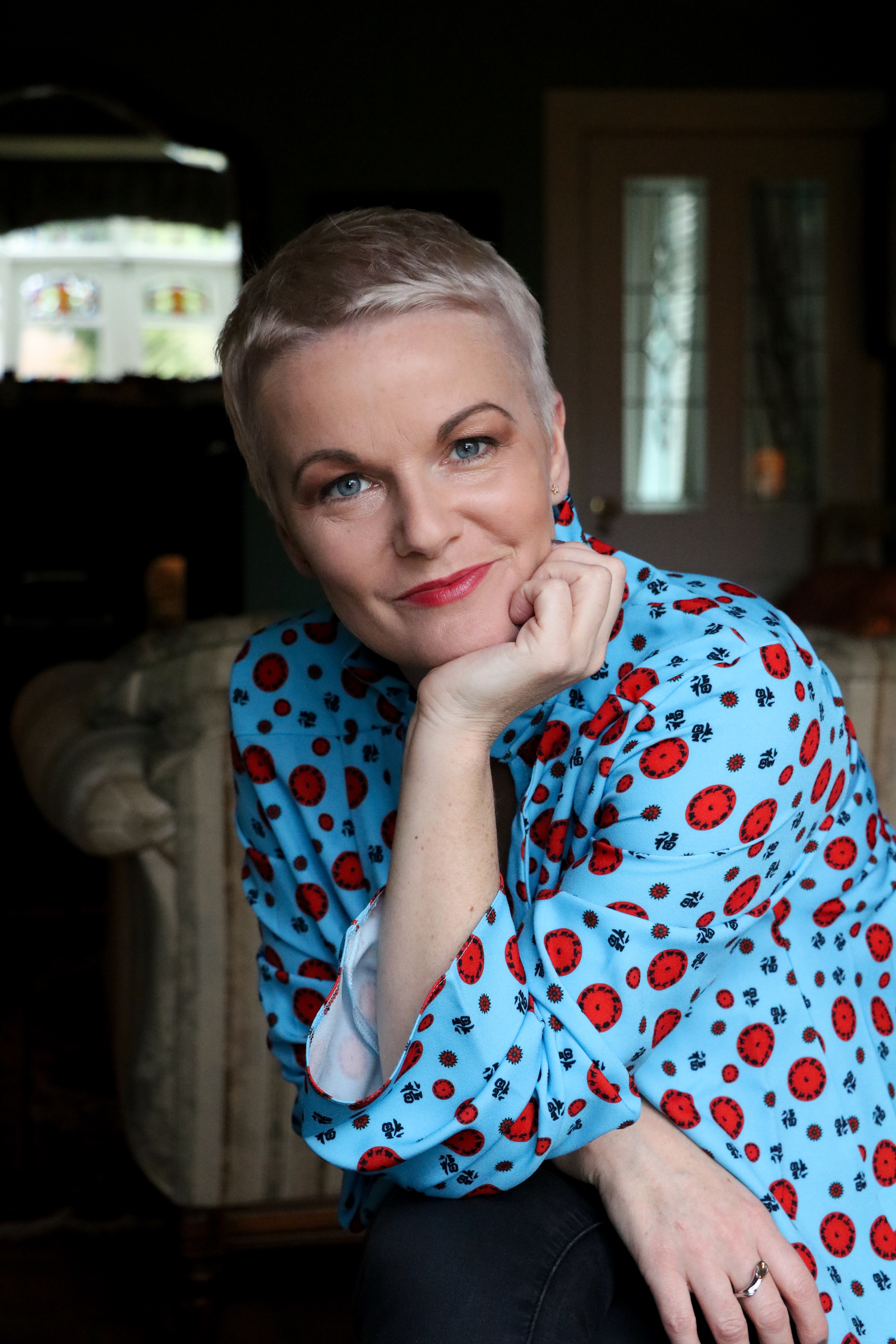
JDW Nov pic 2

Connect with Justine on Twitter @justinedelw and her publishers @hachette

Look out for Justine in the media – articles and interviews coming up in The Irish Times, Daily Mail, Sunday Independent and The Gloss.