Writers Chat 78: Nuala O’Connor on “Seaborne” (New Island: 2024)

Nuala, You’re very welcome back to my Writers Chat series. This time we’re here to chat about Seaborne, longlisted for the Dublin Literary Award and described by Donal Ryan as “sublimely imagined and beautifully told.”
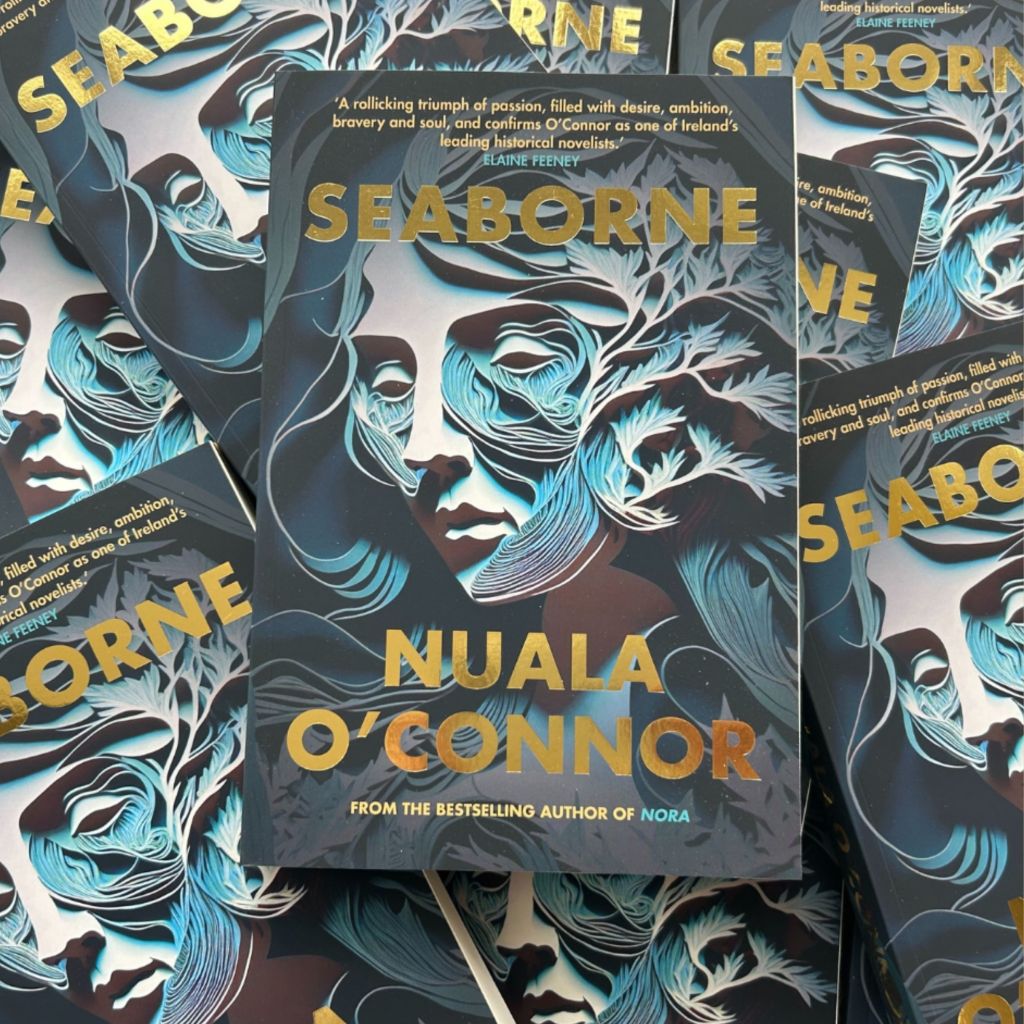
Multiple images of Seaborne by Nuala O’Connor with the title and author name in gold lettering and blue/grey art showing a woman’s face formed by seaweed.

SG: The cover art is stunning. It’s inviting without having read the book and once you’ve read it, you realise the cover totally reflects both title and the complex character of Anne Bonny. Did you have an input into the design and the title?

NOC: I did, yes. New Island are brilliantly collaborative when it comes to the cover. They asked me to make a Pinterest board of images and book covers I liked. I gathered lots of pics of swirly water, women in water, women with big hair and ships on their heads, and so on. Then Karen Vaughan, the designer, came up with loads of possibilities. The final cover image is the one we all had the biggest love for and there were many colour and font tweaks until everyone was happy. The gold foil was an added bonus and I love it. A great experience.

SG: I loved the gold foil! Stunning. It struck me that where Anne is located is a vital part of her identity as much as are people around her. How important was place to you in the writing of this epic book which follows Anne from Kinsale to Carolina?

NOC: Hugely important. There are a lot of myths that swirl around Anne Bonny, and the places she lived or hailed from are included in that. There is no solid evidence of her origins at all, but I chose to use Kinsale and the Carolinas because they were already cited. I travelled to Kinsale but the pandemic prevented my research abroad, so I had to rely on the net, archives, and books for research. Luckily, historical houses, bloggers, and archives are very generous digital sharers of their wealth and knowledge.

SG: Anne is a maverick, and you said in our Writers Chat about Nora Barnacle, another maverick, that you like “women who push against societal norms.” How did you find your research helped or hindered in the creation of the Anne Bonny we meet in Seaborne, given scant records about her illegitimacy, fluid identification with gender, and the push against the barriers of class?

NOC: Any woman who became a seafarer or pirate was considered untoward. With untowardness – in this historic, patriarchal paradigm – goes low morals, bad temper, wantonness etcetera, so Anne was perceived as a feisty dissenter, a rulebreaker and, therefore, bad. It’s not hard to jump from there to the strong-willed quester that I made of Anne. But she has her soft side too – her loving nature.

SG: And you capture her warmheartedness throughout Seaborne. I enjoyed your representations of the changing relationship Anne has with her body – from how she feels and is seen in clothes, to her interaction with men and women, and how she is driven by feeling (physical and emotional) through the book. Can you talk about how your sensory writing is such a fit for a sensuous character?

NOC: I’m an empath and, being autistic, I’m hyper-sensitive to my environment, to clothing, to sensory input and so on, so it’s really easy for me to write those kind of characters, because I live that way – I knock against the world and everything in it as I move through it. So I made Anne is like that too.

SG: Language is at the heart of this book. In the chapter “Quelling an Unsettled Heart”, speaking of Gabriel Bonny, Anne tells the reader that

“The truth stands, though I treat him with disdain, that I like Bonny’s company, I enjoy being near him, and he enjoys me – I see the kindle in his eyes when he looks at me…I like the weight my sailing outfit gives me, it makes me both strong and invisible along the wharf, and there be power to savour in that.”

How did you decide on chapter titles, and what was the process in keeping them inline with the narrative voice which is true to its era and character?

NOC: I had some of the final titles already and then Aoife Walsh, Commissioning Editor at New Island, suggested strengthening them to reflect the content more. I worked with her, and the copy editor, to pick juicy bits from the text as titles. I like all that finessing of a manuscript before it gets to be a book – the cherries on the top, so to speak. I was delighted when Aoife said I could have a map, too – I love novels with maps.

SG: Thank you for being so open about the process! One of Anne’s strengths is her openness and adaptability to linguistic expression – the changes of speech from Cork to Carolina are deftly handled, as are her imitations – while at the same time, she stays true (and firm) to her need of the sea. Was this an important element of the reimagining of Anne, for you?  

NOC: I wrote her as neurodivergent before I even knew I was autistic myself. I got my diagnosis shortly after finishing the manuscript, if memory serves. So, she blends, mimics, and adapts in order to fit in (the same thing I’ve been trying to do for all of my life). This masking/imitation includes speech patterns, ways of behaving, clothing and so on. Anne is a chameleon the way many autistic people are.

SG: And this ability to change and blend shines as a gift rather than any type of limitation. The power and strength Anne gets from some female relationships is also explored through her friendships with Hannah Spratt and Bedelia. Can you talk about the role of this trio of women in the overall narrative and how it might compare or contrast with Anne’s relationship with her mother?

NOC: Bedelia is Anne’s beloved friend. There is an imbalance – Bedelia is her servant – but Anne loves Bee fiercely, relies on her totally. Anne is wary of Hannah from the start, she seems too fond of Bedelia. But Anne learns to like her a little when she sees that Bedelia likes her. It’s an unbalanced trio and it never quite goes right, as the reader will see.

Anne’s mother Mag was steady and wise, she was Anne’s main advisor and, her early death left Anne a bit rudderless. With no steady hand to guide her, we see Anne flounder, fragment, and act chaotically.

SG: Lastly, Nuala, some fun questions:

  • Boat or plane/Sea or land? I’m not a fan of flying. Too little control. At least on a boat you can walk around. I love the sea but, if I had to choose, land.
  • What was your favourite place you visited as part of the research for this novel? Kinsale – such a beautiful, colourful, rich part of Ireland. Also, the Caribbean of my mind. I enjoyed describing tropical beaches while locked down during the pandemic.
  • The power of words! Is there an era in history you would not like to explore through historical fiction? If so, why? I’ve done 18th, 19th, & first half 20th C, so I’ve covered a fair bit. A WW2 novel is appealing, but I have no firm plans. The novel I’ve just finished writing is contemporary.
  • What are you reading now? A book of Greek poetry. And I’m back with Ferrante because I’m going to Naples this year. I’ve blurbed nine books so far this year and have one more to go, so my reading has been prescribed a lot (time to take a blurb break, I think!). I have Seán Hewitt’s new novel lined up and am also finishing some Virginia Woolf, because she comforts me, and I’m always reading Elizabeth Bowen’s stories again, because I’m in a Bowen Reading Group. I always have loads of books on the go. Plus podcasts.
  • That is a lot! Naples is stunning – in all the senses. What are you writing now? A memoir about late-diagnosed autism, writing, depression, the alcohol-free life – I’m throwing the lot at it!

As always, Nuala, thank you for your generous answers and insight into your process as well as the editorial process with New Island. Wishing you continued success with the novel and good luck with your memoir. Seaborne can be purchased directly from New Island.

Nuala O’Connor sitting on a wooden chair on a beach with the sea behind her. Photograph by Úna O’Connor. Used with permission.

Nuala O’Connor lives in Co. Galway. Her sixth novel Seaborne, about Irish-born pirate Anne Bonny, was nominated for the Dublin Literary Award and was shortlisted for Eason Novel of the Year at the 2024 An Post Irish Book Awards. Her fifth poetry collection, Menagerie, was published by Arlen House in spring 2025.

Writers Chat 61: Katherine O’Donnell on “Slant” (New Island: Dublin, 2023)

Cover image of “Slant” showing three women standing in front of bookshelves, and smiling directly at the camera.

Katherine, You’re very welcome to my Writers Chat series. We’re going to chat about your debut Slant (New Island: Dublin, 2023) which I devoured, and loved, though it did make me cry.

SG: Let’s start with the title – taken from the Emily Dickinson poem “tell all the truth but tell it slant” – which, to me, seemed to describe Ro McCarthy’s life experience. She’s on the outside, spectoring her own life. Can you talk about this theme of not being able to face or talk about the truth head on, at always having to tackle it at a slant?

KOD: Dickinson’s line for me is a perfect summary of the super-power of fiction – which has the potential to make a world for a reader but only when it resonates as ‘true’. Fiction is created through sentences running across pages – slantwise – yet when fiction works for an audience it is not received as ‘fake’ or ‘false’ but as illuminating the real world – all the truth.

Ro McCarthy appears as a reliable narrator but we also experience her as a young, naïve woman; as foolish, duplicitous at times, unaware of danger, inexperienced, and sometimes cowardly. I wanted to write a young voice that we see mature. The older Ro sees more – but as you point out, both young and older Ro have their own particular turning into and away from the environments in which they find themselves in. Their perspective is framed by their orientation to the world and is always partial – just like all of our perspectives. In seeing how the experiences and hence the characters of Ro younger and older are shaped by their environment, readers get a taste of a fundamental truth – we are all formed in and through the contexts in which we move or remain stuck.

SG: Of course, the narrative of Slant is not only the communal story of life for Irish emigrants in Boston in the mid-eighties but is also a looking back novel, that of the formation of self, and ones place in the world. Towards the end of the novel Ro, sitting at her window, muses (quite movingly, I felt):

I feel a type of loneliness, a singular aloneness, that makes me feel secure and that the world I am in is full of possibilities. I know myself by my loneliness. This is me. This is me.

It struck me that she is right – despite the parties, the craic, the people, all with the wonder and grief of life – Ro is comfortable in her own skin and, in her fifties, is finally content enough to allow herself to feel that singular aloneness. Can you talk a little about the individual/ communal support in the community (especially the Lesbian community) that she seeks and finds in Boston in the mid-eighties?

KOD: I am very gratified to see how deeply you’ve connected with Ro and Slant. I am so glad that Slant has found such an engaged first reader! When I wrote those lines about Ro’s loneliness I was drawing on that wonderful poem by Adrienne Rich “Song” where the speaker is responding to the question ‘Are you lonely’. She answers ‘yes’ in four short, intensely lyrical and visual verses and she describes her loneliness as a sense of journeying, independence and expanding freedom. She answers that yes, she’s a plane riding lonely over the Rockies aiming for ‘blue-strung aisles/of an airfield on the ocean’; she’s a woman driving across country; she’s the first person awake in a house full of sleeping people, at dawn in a city; she’s lonely like a frozen rowboat at a lake at the end of December, ‘that knows what it is, that knows it’s neither/ice nor mud nor winter light/but wood, with a gift for burning.’ I have always loved that poem and it was a touchstone for developing the character of the older Ro.

Ro’s ‘ singular aloneness’ is buoyed by her deep experience of community so that she remains confident that world is still alive with possibilities. When she threw herself into the tribe of lesbians in 80s Boston, she had no idea where she would land – we remember that she didn’t want to describe herself as ‘coming out’ but ‘coming in’ – she came into herself, into a lesbian life and was caught in a safety-net of connection with Eily, Mels, the Boys, ACT-UP. We see her in her later life among deep friendships and in a ritual calendar of dyke activities that continue to structure her days and support her in joyful connection.

SG: Yes, “joyful connection” really sums it up. Ro also finds community through social activism – in the 80s she throws herself into AIDS activism and in the 2000s she’s marching the streets of Cork and remembering that in the 80s she

was part of a tribe moving as wind: sometimes salty, sometimes rain-drenched, sometimes howling, then playful, tickling, a gentle breeze; but always bringing more oxygen and possibility to the world, changing the atmosphere and dappling the light.

All of those times “were already an overlooked history” and she feels “the dissonance of that time” with her life as she now lives it. These sentiments echo not only the passing of time but also the huge changes in Irish society and attitudes towards sexuality and identification. And yet, going door-to-door, Ro finds that not much has changed at all. Can you talk about how the personal echoes the social throughout Slant?

KOD: Ro McCarthy’s personal trials and tribulations have allowed me to write a micro-history of Ireland from the last two decades of the twentieth century into the first two decades of this twenty-first century. It surprises me that fiction and film have not focussed much on the tens of thousands of Irish ‘illegals’ who lived in the 80s and 90s in cities across the USA. Even in more recent years the figure of Irish illegal aliens in America is reliably estimated to be about 50,000. The Irish ‘illegals’ are embedded in distinct communities and I wanted to write about that culture, particularly as I imagined it existing in the 1980s. I hope that acknowledging Ireland’s very recent history as a strong exporter of economic migrants during our dire economic recessions in the 1980s that we might remain sensitive and sympathetic to economic migrants living and working and enriching Ireland today.

Ro’s other community in Boston is her queer community who lived through the battle of the AIDS crisis – Ro remembers it as a war and her shell shock is reactivated in her experience of the Marriage Equality campaign. I wanted the reader to be able to witness the cumulative trauma-toll of social marginalisation and oppression on one individual who doesn’t quite understand herself that she has PTSD. In the reader’s empathetic experience of Ro’s life, I hope to inculcate an understanding of the undue suffering of all those whose social identities leave them vulnerable to prejudice and exclusion.   

SG: And you capture this cumulative trauma subtly, and well. Russ declares to Ro “I don’t know if fags and dykes will ever get to write the history, dear Rose Marie, but we will certainly make the art.” There’s a meta-narrative in Slant that of creativity allowing people to be more themselves – for some it’s through singing/dancing/ music and for Ro it’s through writing. Like many writers, Ro writes to make sense of the world, she often wakes with “a wisp of a story” in her head and she tries to chase it down. Can you talk about how writing, for Ro, is about (as she says) “re-membering” herself, reclaiming her body, trauma, grief and from always having “to be brave facing the public world”.

KOD: Yes, the central claim of Slant is that creativity allows us to connect with empathy and understanding, and kindness, and maybe even joy, both to our own experience and that of strangers. I hope that the ending reveals how readers as much as writers of fiction play their part in fostering these enriching connections.

SG: I loved the tone of Slant; Ro’s humour and wry observations of the world around her. She likes American people despite the fact that they “were astonishingly, uniformly intent on amplifying happiness…all that positivity was the perfect antidote to being Irish.” Despite the horror and devastation AIDS brings to many of Ro’s circle, it’s this humour – often self-deprecating – that allows her to be honest, and this can be seen in the wonderful employee/employer relationship she has with the elderly spirited Clara as well as the great friendship groups she has – the misfits – and Eily and Mels. Did this voice come for you through characterisation or theme?

KOD: What another lovely observation and question! The humour came from both the character and the theme – groups that struggle collectively to resist social prejudice and oppression can only survive if they routinely create spaces for joy and laughter. And Ro is simply very funny.

SG: Without plot spoiling, Slant manages also to cover power, abuse, control and silence in close relationships. Again, this seemed to me to echo society as a whole. I’m thinking here of two central relationships to the story – that of Jenny and that of Terri. Can you talk about this theme? 

KOD: In writing the dynamic of the ‘bad’ lesbian relationship I was inspired by In the Dream House by Carmen Maria Machado (2019) but also definitely prompted by that line in the glorious Lesbian Avengers Dyke Manifesto (1993) – “Lesbian Avengers are old fashioned: pine, long, whine stay in bad relationships”. That line – amidst the juicy rhapsody on LESBIAN SEX – has always made me laugh. I feel a bit apologetic to lesbian readers – as we are so starved of cultural representation – that I wrote a lesbian character who was so controlling and manipulative – but, dear reader, she was a complete delight to write and I remain very fond of her. I gave her a happy ending.

It is interesting that you also think that Jenny was in a similar relationship of control, I hadn’t quite realised that. I think that we are so culturally used to the conventional dynamic of traditional heterosexual relationships that we can be blind to their overtly transactional nature.

SG: Yes, for me, Ro and Jenny had a type of echo and call with each other from within their unhealthy relationships. And Machado’s Dream House is such an impactful read. So, we’ll end this Writers Chat, Katherine, with some short questions:

  • New York or Boston? Provincetown.
  • Sorry, I should have offered Provincetown as an option! So, coffee or tea? I need coffee, I enjoy tea.
  • Mountains or sea? Always, always the Sea. In, on, under, or within sight or smell of it.
  • What are you writing now? Reworking a novella entitled Close/Close and also working on developing more picture-book stories for infants (with my friend Soren Mayes) based on Buddhist teachings.
  • I love the title of your novella, and interesting that you’re also working on stories for infants. Tell me, what are you reading now? Couplets: A Love Story by Maggie Millner (Faber 2023) and about to start Lara by Bernardine Evaristo (1999) – I missed it the first time around
Photograph of Katherine O’Donnell seated at a table resting her face on her hand, looking directly at the camera. Photo provided by the author Photo Credit: Emma Jervis.

Thank you to New Island and Peter O’Connell for the advance copy of Slant.

Thanks to Katherine for such an engaging Writers Chat – I wish her much success with this novel. Readers can purchase Slant directly from New Island.

Writers Chat 48: Laura McVeigh on “Lenny” (New Island: Dublin, 2022)

Laura, You are very welcome to my WRITERS CHAT series. Congratulations on your second novel, Lenny (New Island, 2022) which I thoroughly enjoyed.

Cover image of Lenny by Laura McVeigh with a drawing of a canopy of trees with hanging foliage and blue skies lit up by stars

SG: Let’s start with the dual narratives in Lenny – that of the mysterious pilot in the Ubari Sand Sea in 2011 and that of Lenny in Louisiana in 2012. The narrative structure not only allows the narratives to converse with each other but, as they converge and the themes of home and belonging really come to the fore, they form a third, beautifully unifying story. Can you talk about your structural decisions when writing Lenny?

LMcV: I am always very interested in notions of time, memory, how we experience moments – and like to examine that in my writing, both in the substance and structurally. And one of the main themes within the novel for me in the writing was our relationship to time and reality, so a lot of the structure explores that in various ways. The dual narratives allowed me to create a sort of mirroring within the storylines – as you suggest, a kind of conversation – but also opened up the sense of time more broadly, allowing the reader to travel with that feeling in different ways.  I wanted to stretch and bend narrative time in the storytelling, just as Jim, Lenny’s father suggests is possible later in the story.

When I write, I write fairly instinctively.  So I don’t work out a structural scheme beforehand – I write into the story, and I find multiple narrative streams gives a depth and resonance to the writing, helping create echoes, connections – as you say, unifying.  I pull the threads together as I go.

SG: I think your instinctual writing is very much reflected in the tone of Lenny, as it carries the reader in a sort of wonderworld. Something that stayed with me long after I’d read Lenny, was the feeling that somehow, we are ageless, or that age does not matter when we zoom out and consider the world as a universe. While characters such as Miss Julie and Lucy and indeed Lenny’s mother, Mari-Rose, find themselves limited or restricted by age, the cumulative impact of the thread of The Little Prince (referenced throughout) and narratives of the pilot and Lenny was that I was left really pondering how we limit ourselves in so many ways in opposition to our world rather than in harmony with it. Lenny remembers Mari-Rose telling him that sometimes

“A story can end all sorts of ways…sometimes it doesn’t end at all, it’s just beginning.”

And towards the end of the novel, we find Lenny is “stretching time all around him.” Was this playing with time something that you had consciously or unconsciously woven into the novel?

LMcV: I love this question. And the idea that we are ageless! But it’s true, why don’t we look at life in harmony with nature and time, and see that we are part of something much more beautiful, infinite and mysterious.  In the story, we see Lenny’s watch that doesn’t work, the elastic band on Mari-Rose’s wrist, both symbols of how we try to hold on to the impossible. We tend to fear aging, fear death, decay. We are always fighting life, struggling – it’s in the very language we put upon ourselves constantly.  

So within the novel, yes, I was very consciously playing with time and our understanding of time and the universe, and the part we play within it.  In life we often look for narrative coherence – a story – a way of understanding a situation.  We explain everything to ourselves via story. But of course stories, like time, don’t travel in straight lines, simply from one point to another. So I wanted to explore and play with all of that, and push against those limits. I hope the novel reflects that desire for openness and possibility.

SG: Yes, I think Lenny reflects your desire for openness and possibilities and I think it comes out also in the relationships Lenny has with Miss Julie and Lucy and how though they both play mothering roles in the book, it’s Lenny who brings the women out of themselves, and opens the world to them. He starts off thinking that “believing is for adults” he comes to understand that to change the world and people, “you just had to believe”. It is such a beautiful message of hope. Did you feel you were writing a novel of hope when you were writing it or did this emerge through the writing process?

LMcV: Yes, that connection between Lenny and Miss Julie, or as the novel progresses with Lucy too. It’s so important for Lenny I think, at this point in his life to have someone looking out for him, someone who cares, but of course, it’s his spirit that is bringing healing and renewed purpose to them.  I suppose it’s that sense that we gain when we give – that in caring for Lenny they are opening up to being more caring towards themselves too, becoming more forgiving, more open-hearted.  I love that childhood sentiment of how life could be anything at all, so long as you believed it.  I think we lose that sense along the way sometimes, and yet life is such a gift – even with all its hardship and pain – so how do we navigate that with grace and love?  When I was writing Lenny, yes, I was seeking – whether consciously or unconsciously –  to write a story full of hope and love, because I think sometimes we forget, we lose sight of hope. Our better angels, I think Miss Julie might call it.

SG: Oh yes, our better angels! I love it. Places (and worlds) are in themselves characters in the novel. I really enjoyed how you played around with the individual experience of place and how this bleeds into human connection at all levels. We’re all connected by place as the Imuhar way states:

A man who wanders is free…he is not tethered, neither to place nor possessions

You touch on the magic of place and I thought this came out in the relationship between the pilot who falls from the sky in Libya, a seemingly empty canvas, but also later in the budding relationship between Lenny’s father Jim (who “looked like all he wanted to do was to walk away from himself”) and Lucy (who “knew her heart was full with joy around him.”). Can you talk about Lucy, the lonely librarian/activist with her lovely cat?

LMcV: With Lucy, at first we discover her really as others might see her – and I wanted to capture that sense of how much there is beneath the surface view – for all of us.  It’s not just the shorthand, the glance, the first impression.  Lucy is a work in progress, and she recognises that about herself I think.  She’s trying to heal after a lot of loss and hurt, and a sense of always feeling out of place. So I think Lucy is searching for ‘her place’ and in the novel she seems to find that in Jim.  I love that there are lots of contradictions alive within Lucy – I find that very human.  She’s caring and yet scared to open up her heart and life and let others in, she’s fearful of many things yet wants to live a bigger, fearless life.  In the novel, she has to ask herself if she’s willing to stand up for the things she cares about, if she’s willing to put herself out there – I love that vulnerability and uncertainty coupled with her determination.

SG: And I think it’s both ways – for Jim also finds an idea of home in Lucy. Lenny experiences life by interpreting place and time through senses and memory. He imagines what life would be like if his mama had not left him, if his daddy had not learnt to fly, and if the chemical companies hadn’t come…

“Lenny, half reading, half daydreaming, blinked into the dust imagining other planets, similar to his own, yet different all the same.”

In Lenny you capture that uncanny ability children have, to inhabit the world and at the same time understand wholly that there exists an alternative reality. In what way is Lenny an exploration of this – the what if question?

LMcV: Absolutely. In the novel I wanted to explore that possibility.  Science tells us it’s possible, indeed almost a certainty. And of course, in so far as life is perceived as experiential and experience is subjective, then we can accept that multiplicity of perception at the very least.  In childhood we live in dreams, but what if that is actually closer to understanding the mysteries of life? Again, the novel, on one level, is really an invitation to think differently, to move outside of our daily preoccupations and take a longer, wider view of life.

SG: Big business (and big countries) and the impact on the environment is one of the strong themes in Lenny. I loved that as an author you don’t preach, and that the theme fit so well into the story of who Lenny is and where he’s from. Can you talk about the importance of this theme and how Lenny with his warmth and lovability is the perfect character to encourage readers to consider the environmental destruction?   

LMcV: Within the novel I wanted to show how these things can affect a lifetime, a community, a place, land, and how what happens in one part of the world, impacts what happens in another. The novel really explores the ways in which war, big business, political interests all interconnect – so how do we stand up to that systemic challenge?  How do we start to really understand that a problem for Libya, for example, (water shortage/land degradation/conflict/migration/political instability) or for Louisiana (land loss/climate uncertainty/environmental pollution/over-industrialisation/home instability) is also a wider, interconnected, global problem. 

While the novel explores the idea of other possible worlds, it is also true that we all share this one planet – sadly unequally, often destructively. So how do we do better? What can we change?

The story therefore looks at the power of the individual to affect change, and that is where Lenny’s sense of ‘believing’ is essential.  With hope, everything is possible.

SG: Again, we’re back to hope. But war changes land, and people. Miss Julie hangs on to Stanley, Mari-Rose tries to believe in Jim, Goose wants to believe in what Tayri and Izil offer him – and all of them are in denial about their own part in destruction, and their inability to protect. Yet Lenny, because he is a child, he still finds hope and can still see the stars and possibilities, even when his town is literally sinking. Can you talk about the impact of war on the story? It feels especially relevant given what’s happening in our world right now.

LMcV: I have always had a deep interest in writing about war, conflict and its impacts on individual lives and communities.  I think this is born out of growing up in the North of Ireland in the 1980s in the Troubles’ years.  Even as a young child, of around Lenny’s age, I would have been very interested in the idea of peace, of the importance of peace.  So it’s a theme I continue to explore in writing.  

In Lenny we see Lenny’s father Jim return from the war, broken, suffering from Post Traumatic Stress Disorder (PTSD), taking refuge in alcohol.  Part of the structure of the novel is in a way a reflection of that mental state – the short chapters, the jumping from image to image, idea to idea, the forgetting and remembering within the story.  But of course it’s not just Jim who is suffering – it affects his whole family, and all of his connections with other people. Miss Julie’s life too has been shaped by a war – with the absence of her husband Stanley since 1952.  So there is that sense of a life’s possibilities taken. Izil and his family are surrounded by conflict and the impacts of conflict and are trying to navigate that all too dangerous reality in the desert sands.  So the ‘what if’ questions become important and give us a way through to hope.

There are so many parts of our world where conflict and war is a daily lived reality for millions – Ukraine, Libya, Yemen, just a few that currently come to mind. Take a map of the world and colour in the countries where war or armed conflict is happening. Look at the history books and we see that war has always been with us. Does that mean we should surrender hope or look the other way?  Or can we, even through small acts of hope and love, make for a better reality?

SG: And in a way, that is one of the important roles of literature in the world – to get us thinking, to ask questions, and to give a sense of hope and possibility. Thank you for your generous answers, Laura and we’ll now end with five short, fun questions.

  • Southern or Northern hemisphere? Wherever the story takes me.
  • Ha! A very writerly answer. Woods or Beach? Ideally a hike in the mountain woods with a view down to the water. Having grown up by the Mourne Mountains next to Carlingford Lough I love both, forest and sea.
  • I’ve been on a few hikes in the Mourne Mountains – stunning. Music or silence while you write? Both, silence for thinking, music for feeling.
  • What are you reading now?  Io non ho paura (I’m not scared) by Italian writer Niccolò Ammaniti and Ursula K. Le Guin’s The Dispossessed but in Catalan – Els Desposseïts.
  • I loved I’m not scared when I read it a few years ago. And I must read more Le Guin! So, Laura, what are you writing now? I’m finishing a children’s novel for my daughter, writing the screenplay of Lenny, writing a collection of travel stories, and working on a new novel.

Well, that’s an astonishing amount of writing at once – your daughter’s a lucky girl! I especially look forward to the screenplay of Lenny and hope – and trust – Lenny will continue to reach many readers!

Black and White Photograph of author Laura McVeigh courtesy of Laura McVeigh

With thanks to Peter O’Connell Media and New Island Books for the advance copy of Lenny.