Writers Chat 21: Niamh Boyce on “Her Kind” (Penguin: Dublin, 2019)

Niamh, You are very welcome back to my WRITERS CHAT series. Congratulations on your second novel, Her Kind (Penguin: Dublin, 2019) already shortlisted for the EU Prize for Literature. This follows on from your poetry collection Inside the Wolf and your debut novel The Herbalist (Penguin, 2013) which we talked about at our last Writers Chat (republished at the end of this chat!).

61568757_294908148129777_376787877331206144_n

SG: I thoroughly enjoyed being immersed in 14th Century Kilkennie. Anna Carey in her review in The Irish Times rightly said that ’14th century Kilkenny is so evocative and atmospheric the reader can almost taste the honeycombs in Petronelle’s carefully tended hives and feel the heavy animal pelts that line Alice’s secret chamber…’ 

Her Kind is set in Kilkenny over the course of seven months and I loved the details you included at the start of each chapter, for example, in September we get a line from The Triads of Ireland, ninth century: “Three darknesses into which women should not go: the darkness of mist, the darkness of night, the darkness of a wood.”

In your Irish Times interview with Rosita Boland, you spoke about how Her Kind aims to reach out to women like Petronelle. Can you tell us a little about your research – how you came to evoke –what feels so accurately to me – the land, the society, the politics, the divisions, the lives of the women and girls in this place, at this time?

NB: Thanks Shauna, I am really glad you enjoyed the epigraphs at the start of each chapter, I love that ancient triad, it’s very telling, the mist, woods, and night are such liminal spaces. The quotations that start each chapter, are there to indicate the era without hitting the reader over the head with history. I wanted the unfolding story of the sorcery trial to feel immediate and vivid – so research wise, I was seeking out the micro-history – the textures, taste and atmosphere of that time, as much as the politics. The research took a few years – I took a bee keeping course, studied effigies from the 14th century, reading archaeological reports, researched food, wolves, Brehon law, common law, the ancient custom rolls, translations of ancient manuscripts and spent a lot of time in Kilkenny itself. I came across so many fascinating books, highlights included works by John Bradley and John Prim, Cosman’s Medieval Word Book, Coulter’s Medieval Panorama, Maeve Brigid Callan’s The Templars, The Witch and the Wild Irish by Four Courts Press, and Witches Spies and Stockholm Syndrome by Finbar Dwyer, The Sorcery Trial of Alice Kyteler; A contemporary narrative by Pegasus Press and the Liber Primus Kilkennius.

SG: Such solid research, Niamh. And what you found in these publications you seamlessly wove into your fictional narrative. Following on from this, the city of Kilkenny and its surrounds are drawn out beautifully in Her Kind.

Just like Hightown and Irishtown, the cathedral itself was behind walls. Kilkennie, it seemed, was a riddle of walls, a stone honeycomb. We climbed steps to yet another archway and entered the grounds. Before us, stood the highest, narrowest bell tower I’d ever seen. Its door was set off the ground, with no stairs or ladder to reach it. The cathedral huddled behind it, like a giant child. I walked towards the church, taking in the coloured-glass windows and enormous oak door. Heads were carved above it, watchful monkish faces, peering down.

You also help place the reader right in-situ through snappy dialogue. This is a long quote but I just love how we really feel we’re there with the women:

The shambles was rowdy with pigs, sheep and chickens, penned or tethered. A pup lapped a pool of blood. Shit spilt from the haunches of frightened beasts. The air was full of flies and feathers. Meat hung on hooks from the butcher’s house front. He was a winky smiler.

Helene elbowed me and grinned. ‘I’d marry him on the spot only for the sound of those knives sharpening.’

We came then to a wide road where houses stood shoulder to shoulder. Shutters were propped like tables beneath each window, laden with bolts of cloth, medicines and bright spices. ‘Paprika. Ginger. Cinnamon …’ Helene chanted, waving her finger, mimicking Dame Alice’s habit of listing her treasures.

Traders shouted their wares, boys pushed barrows of offal, swine ran riot.

It strikes me that you might have enjoyed re-visiting Kilkenny and perhaps took many a stroll through the city to help you?

NB: That’s true! I spent a lot of time in Kilkenny, especially during the first three years of writing the book. I walked the city, following in the footsteps of my characters as I wrote their scenes. The medieval Mile Museum hadn’t been finished then – it’s a must see for anyone visiting Kilkenny – but I spent time examining the effigies on the site. I visited St Canice’s Cathedral itself – where the effigy of Bishop Ledrede is still in place. It was he who instigated the trial against Alice for Sorcery. It’s eerie to stand beside his stone likeness. His remains are no longer inside the tomb, it’s said that Cromwell’s soldiers tossed them on the dung heap when they invaded. The cathedral was also where I came across the anchoress’s grave. An anchorite or anchoress is a hermit who gives up ordinary life for a solitary life of prayer – they are often sealed in between the walls of a church, with only small ‘squints’ or windows to receive food through. The figure of a nun is carved onto the anchoress’s grave stone.  Her hands are held in old style prayer position, palm facing outwards rather than palms together. When I placed my palms over her stone ones, I felt a strange sensation, close to the one that Petronelle describes in Her Kind, that of an old truth pushing back – that day the character of Agnes the anchoress came to life.

SG: Oh how wonderfully eerie. The picture of your palms over her stone ones made the hair on my arms stand on edge! I was particularly taken by the portrayal of the inequality based on gender, language, looks, and, of course, wealth. The theme of economic and bodily power runs strong through Her Kind and, as we all know, is not so different to today’s society. Petronelle’s daughter Basila – a teenager in today’s terms – is very aware of this. She states: “Most of the musicians were Gaels, and it wasn’t just their long hair that made me know this – there was something about their faces. I wondered about mine and my mother’s. Did our faces tell on us, too?”

That her true identity will be discovered is a constant worry for Petronelle, yet, without spoiling anything for those who have yet to read the novel, Basilia’s muteness is what proves to empower. (What a last line!) Can you talk a little about this mother-daughter relationship coupled with the power of speech – what people say, or do not say, and the role of the act of naming and re-naming in Her Kind.

NB: The gaps between ‘Motherhood’ as a construct versus motherhood the reality interests me greatly. I enjoyed writing the soothsayer Lithgen most of all, probably because she predates contemporary assumptions about motherhood. She does not follow her daughter Petronelle when she is driven from Flemingstown. She does not even consider doing so. In today’s society she would be considered a ‘bad mother’ – self-sacrifice has become so central to the concept of motherhood. Lithgen however, is herself, first and foremost. It is she who recognises that Basilia uses silence as a weapon. Basilia who becomes mute after a trauma, soon realises she might not even want to start speaking again. It becomes a way of punishing her mother. She has very little leverage, so withholding her voice becomes a sort of power.

Gaels were not welcome in Hightown, which was also known as Englishtown. So, when Dame Alice takes the mother and daughter in, she renames them Petronelle and Basilia. It’s the price they pay when they cross her threshold. Esme the cook calls it being named and tamed. They may have been named, but they are not tamed. When Petronelle says – I am not myself.  Basilia wonders where her mother’s real self is…’had my mother and her soul become parted in the woods – could it still be there, caught in high branches, dark from the distance like a crow’s nest?’

SG: Yes, I love how nature reminds the women of who they really are, and their true power, throughout the novel. I really loved Basilia’s narrative voice. You captured her youth, her naivety, but also her powerful observations and ability to survive. This line, for me, so wonderfully summarized her character: “If only it was as easy to stop dreaming as it was to stop speaking.” How did her character to come to you, in contrast to the characters such as Alice Kytler, or Basilia’s mother, Petronelle de Midia who are based on real women.

NB: Basilia is less well known, but is on record as being Petronelle’s daughter. I’ve spent so long with her as a character, it’s not easy to remember a time before she existed, to recall how her character first arrived. I looked back on early drafts of the book to see what the first sentence of Basilia’s was, and found – Dame Alice gave us new names, safer than our old ones. I think her character grew from that line, and as one sentence led to another, she became more real. I free write the first draft by hand, and just let it flow. Initially the character of Basilia was born out of her relationship with Alice, her acceptance of the new name, her delight in Alice’s house, which she saw as like being in court, or what she imagined a court might be. I had the suspicion early on that she would not speak, and I always knew what that last line would be, so her characters arc was available to me (as a very faint line) as I wrote.

SG: I like how you describe her character line as faint – so it was there but you could not quite see it and it became clearer as you wrote her narrative. Your language is very poetic – not surprising given your talents as a poet – take, for example, this description of the daily task of washing that turns from one thing and brings us to another place, entirely:

After some time and an aching back, we lifted out the cloth, dumped it in cool water and wrung it out. When I unravelled the folds, I saw the embroidered nightingales had come up darker than the silk itself. ‘Give it another dunk. Use the stick. No need to soak your hands like that – look at your skin!’ My hands were tinted darkest at the cuticles, next to which my nail crescents gleamed grey. Later, in the kitchen, I tried to scrub my hands clean but my skin kept the blue tinge. I turned up my palms: my life, love and heart lines looked as if they were drawn with a quill. They seemed strange, as if they belonged to someone else. I thought of the lady, her dead baby and her desperate pleas.

Was this use of close, sensory detail that came to you in the first drafts or something that evolved as you went through the redrafting process?

NB: That image in particular, and a lot of the sensory detail came early in the first stage of freewriting, I think of it as an anti-logical phase and just follow the images. I catch them, and record them without trying to fix them into a narrative. I love Jane Hirshfield’s book – ‘Nine Gates, entering the mind of poetry’. She talks about how images hold the shapeshifting wisdom of a dream. The dye on Petronelle’s skin, the way the woad darkened the lines on her hand – was an early image, one of the first that came as I wrote. I recorded it, without knowing where it came in the narrative, or why it was significant. There’s a strong element of trusting the process, and just collecting images.

SG: And that’s something that takes strength to do, I think. To trust the process and follow – often blindly – one image to the next, one word to the next. Lastly, Niamh, some fun questions:

  • Kilkenny city or county? (A hard one, I know!) County, then I get to keep both.
  • Sun or snow? Snow.
  • Tea or coffee? Tea.
  • What are you writing now? A novel.
  • What are you reading now? Womankind Magazine.

Thanks so much for your generous answers, Niamh. I look forward to your next novel and wish you much continued success with Her Kind. 

Keep in touch with Niamh on her blog and on twitter @NiamhBoyce

61835730_691242591311881_5268770479472115712_n

Awarded Hennessy XO New Irish Writer of The Year in 2012, Niamh’s debut novel THE HERBALIST, was critically acclaimed, won Debut of the Year at the Irish Book Awards and was nominated for an IMPAC Award. Inside the Wolf, her poetry collection was released in 2018. Her fiction and poetry have been broadcast, adapted for stage and anthologised, most recently in ‘The Long Gaze Back,’ ‘The Hennessy Anthology’ and ‘Hallelujah for 50 Foot Women.’ Her second novel, HER KIND (Penguin Random House) is based on the Kilkenny Witchcraft Trial of Alice Kytler. Nominated for the EU Prize for literature, the judges called Her Kind, ‘as searing a critique of our own times as is Arthur Millar’s The Crucible’.


WRITERS CHAT –  NIAMH BOYCE – THE HERBALIST

ORIGINALLY PUBLISHED JULY 2013

Niamh, many congratulations on your debut novel The Herbalist which is receiving rave reviews and climbing up the top ten charts! And welcome to my blog!

herbalist

 Now that The Herbalist has been launched, is in bookshops around the country, you’re giving public readings from it. Tell me how you choose which section to read? Do you have a favourite character or scene which you find yourself returning to again and again? I’m thinking, of course, particularly about the female characters which are so strongly envisaged in your novel.

Thanks Shauna, yes, I’m delighted with the reviews so far. As for readings, I try to read from the early sections in the book so as not to give too much away, usually from Emily’s point of view. She’s the girl who falls first and hardest for The Herbalist, and she can be quite funny. Lately though I’ve been drawn more and more to Aggie’s voice, despite the fact that she has less to say in the book, she packs a whack when she says it!

 Which character or characters from The Herbalist surprised you the most – in terms of how you had imagined them and how their role in the story transpired?

Emily surprised me. I thought she would lay down, I thought she would be the sacrifice. The other characters thought that too. How wrong we were. And Carmel shocked me to the core, but I can’t say much more without revealing the plot!

That’s great, Niamh, I love how you describe how Emily shocked both you – as the author – and the other characters! It’s really about letting the writing lead. Now I know the genesis for The Herbalist is taken from a real life character. But tell me how important is the role of place for you when writing about an historical Ireland?

Place was hugely important, the town, the market, the lanes, the courthouse but most of all the river. As I wrote by the river I was very aware of the river that ran through the town decades ago;  it was the same river, but of course also, not the same river. The pull of what the older river held was very strong, Aggie in some ways gives voice to this. I had the sense as I wrote that we in the present are a mere shadow of what has gone before, of the dead. That we are the ghosts, and not the other way around. So The Herbalist didn’t feel like a ‘historical’ novel when I wrote it- it felt more like a ghost story. Of course, I’m stating this in retrospect, at the time I avoided thinking in terms of genre. Maybe I was afraid of the term historical, especially Irish historical – there are so many connotations to the term that don’t apply at all to my book.

It’s interesting to consider how the publishing industry – or, indeed, the public – can put labels on creative work especially in relation to how the author ‘feels’ the work when writing it and then names it once the story has been told.

Writer Vanessa Gebbie asked me this question in relation to my novel and I think it’s a wonderful thing to ask: if you could have a painting of one scene from the novel which would you pick and why? And who would you have create it?  

It’s a wonderful question! It has to be an image that puzzled me in the early days of writing the novel; one of a girl by the river. It took me almost 80,000 words to find out who she was, and why she was important. So my painting would be of that girl in her pale blue dress walking the river path, carrying a child’s suitcase. In the novel she believes that she is walking towards love. Those minutes of her life are so perfect, so full of hope, that it almost doesn’t matter what happens next. And I would have Chagall work his magic for this one.

How beautiful! I can just imagine the blue hues that Chagall would paint. So, tell me, Niamh, what’s next for The Herbalist and what’s next for you?

Well, The Herbalist will be released in the UK in the autumn, so fingers crossed! As for me, I’m working on another novel, and tidying up my short story collection – and I would love to write lots of poetry this year too.

That sounds like a busy but very exciting year for you.Thanks for the wonderful answers, Niamh.

Thanks for such interesting questions Shauna, I’ve really enjoyed answering them.

You’re more than welcome. I wish you continued success with The Herbalist and I look forward to your next publication!


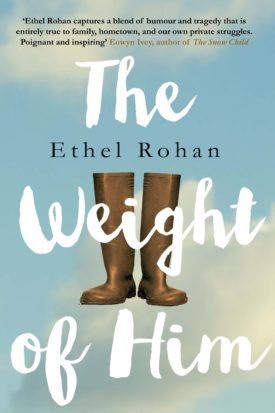
Writers Chat 20: Ethel Rohan on the writing life after her debut novel “The Weight of Him” (St. Martin’s Press (US) and Atlantic Books (UK), 2017)

For my 20th WRITERS CHAT, I’m delighted to welcome back Ethel Rohan. 

Since we last chatted in August 2017, Ethel, your debut novel The Weight of Him was an Amazon, Bustle, KOBO, and San Francisco Chronicle Best Book, and winner of a Plumeri Fellowship, Silver Nautilus Award, and the Northern California Publishers and Authors’ Award. Congratulations, and thanks for returning to Writer’s Chat.

TWOH UK Cover

SG: Can you tell us a little about the reception of The Weight of Him, and if, and how, it affected your writing? I always find that it is so difficult for writers to keep those two hats on – one in the midst of finding the way into a new creative project, and the other out and about meeting people and talking about the already published project.

ER: From my publishers’ perspective ( St. Martin’s Press and Atlantic Books), my debut novel wasn’t received well i.e. its sales were disappointing. As much as I tried to prepare myself for the challenges this book would have reaching readers (it centers on difficult subject matter, suicide, and a marginalized protagonist, 400lb Billy Brennan) I was hopeful it would succeed and was crushed when it didn’t fare better. The blow knocked my confidence and two years later I’ve only just recovered. From my own perspective, I still continue to receive a wealth of emails, messages through social media, letters (yes, handwritten letters!), and IRL responses that speak to how deeply the reader was affected by the book. This generous, heartfelt feedback has greatly buoyed me. I persist, and losing myself in writing new work has been my greatest salve.

SG: Well, if you consider why we write, alongside one of the roles of literature in society, I think it is to affect those who engage with it and to shine a mirror on society. Isn’t that the real measure of success?

In your new work, do you find yourself returning to the themes of The Weight of Him? They are themes not easily released from our psyche, I find.

ER: I never enter a story with any theme in mind, but invariably the same patterns and obsessions emerge. I think that’s true of all artists. I’ve even tried to fight it: This story will not be about food, hunger, guilt, shame, loneliness, friendship, missing parts, another “bad” parent, or one more dysfunctional marriage etc. but sure enough… I’ve made peace with my psyche at this point. My only objective is to tell the best, the most interesting and urgent, stories I can. Thus I allow whatever best serves the story to surface in freewrites and survive in revision.

SG: What a noble aim  – to tell the best, the most interesting and the most urgent stories. And, of course, holding on to that belief that the work (the writing) will prevail. Tell me, Ethel, what are you working on now?

ER: Christ, I write so much, it’s finishing that’s the challenge. I’m good at plotting stories (which is interesting because I always enter a story blind, never knowing what’s going to unfold) but beyond the beginning, middle, and end where I have to work hard is with character, giving them interiority and complexity, and allowing the reader to deeply connect with each of them and the protagonist in particular. I currently have two draft novel mss completed, and am handwriting a third. The two complete draft mss need further full revisions that focus on theme and character, and I’ll return to them when I’ve finished this handwritten novel draft.

SG: That’s a fantastic outpouring and I completely get that – I’m the same, constantly moving and working on multiple projects. What’s next for publication?

ER: Aside from hopefully publishing some short stories I’ve been working on, and returning to personal essays, I hope to next publish one of the three novel mss mentioned above, and ultimately to publish all three. I’ll lead with whichever “finished” ms I believe to be the strongest and see what happens. What’s daunting, and frankly frightening, is that the low book sales for The Weight of Him will make publishers less likely to take another chance on me and I know I’ve got to write a story powerful enough (or in their own words “big” enough) to sway them. What I won’t do, though, is pander to any trend or market need. I’m staying true to the stories that I most need to tell, those that arrive unbidden and insistent, like surprise, pressing gifts.

SG: I think that’s the most difficult part of the writing life – that industry push against the creative urge. I’ll say it again… the work will prevail!

Lastly, Ethel, some fun questions

  1. What’s next on your to-be-read-pile and and what’s last on the (same) pile? I have shelves of unread books, and a tower on my desk, and another by my bedside. From that former looming tower, I’m eager to next read Devi Laskar’s The Atlas of Reds and Blues and at the bottom of that pile (simply because I’m so behind in my consumption) is Sarah Perry’s The Essex Serpent. My first read when I return to Ireland in July with be Sinéad Gleeson’s Constellations.
  2. I have Constellations on my pile now, nearing the top and at the moment I’m reading Niamh Boyce’s wonderful Her Kind. Tell me, Ethel, where did you take your last holiday? Aside from a couple of nights recently in Portland, Oregon, the answer is Ireland (although I’m not sure it can be considered a holiday in that it’s never restful!). Since I emigrated in 1992, I’ve returned 30+ times. My husband’s also Irish and all our family members are there, so the pull is huge.
  3. And when you’re on holiday, do you bring Kindle or paperback with you? Never Kindle. Mostly paperback, sometimes hardback. And I leave every holiday with more books than I brought.
  4. Tea or coffee when writing? Barry’s tea (and way too much Cadbury’s or See’s chocolate). Always. Praise be for the several import shops here in San Francisco where we can get all our Irish favourites (albeit at a premium).
  5. Dogs or cats? Both, with a definite preference for dogs.

Thanks, once again, Ethel, for joining me in a Writers Chat session. I wish you the very best of creativity and luck with your current and new writing projects. Below is the ORIGINAL Q&A WRITERS CHAT, PUBLISHED AUGUST 2017

Author Ethel Rohan Los Res dpi 300

I am delighted to welcome Ethel Rohan for a Q&A session on her debut novel The Weight of Him. Thanks, Ethel for agreeing to be featured on my blog and many congratulations on the wonderful reviews and accolades that your novel has been getting.

READERS: See below for the chance to win a copy of The Weight of Him!

Shauna: Let’s start right away with the title and your starting point for the story. In the Dublin launch in Hodges Figgis in June, you mentioned that the idea began with an image of a snow globe in a window. I remember thinking that was a powerful image – there’s layers there – and when I read that scene where Billy looks in the shop window, I knew exactly what you meant.

‘Billy wanted to shake the globe and bring it to life…His hand pressed the side of his head, as though trying to keep the egg of himself together.’

Can you expand a little more on this initial characterisation of Billy, in particular his emotional nub.

Ethel: Thank you, Shauna, for hosting me and for your tremendous support of writers and books.

The initial spark for my novel was a conversation I overheard in a Dublin pub about an obese woman in mourning. “The grief might just kill her before her weight does.” That statement stuck in my imagination and I wondered what if this woman’s grief and weight don’t kill her, but propel her to do something extraordinary?

That’s the question that drove me to the blank page. As soon as I started writing, Big Billy Brennan appeared in the white space. The first scene I wrote was, as you mentioned, Billy standing in front of a shop window, his attention fixed on a snow globe. As you’ve quoted, he’s filled with the urge to shake the globe and bring it to life. I knew in that moment I’d hit on Billy’s emotional nub and his impossible burning desire to bring his loved one back from the dead.

I don’t plan my stories, so the novel’s first draft(s) was really just me continuing to answer questions on the page as they arose. It was a risky novel to write and to publish (thank you, St. Martin’s Press and Atlantic Books). I met many hurdles in the telling, largely fueled by self-doubt. Mostly, I struggled with whether or not I had the authority to write about a 30 stone man. I worried whether or not I could make the unlikely marriage of the difficult topics of obesity and suicide work. I felt an enormous responsibility to handle both topics with sensitivity, compassion and honesty.

Shauna: While the narrative is told from the perspective of Billy, I found we got some close insights into his wife Tricia’s point of view. Can you tell us about their relationship and how much of it is viewed through the lens of grief, loss and unanswered questions?

Ethel: Point-of-view was another major challenge. I knew I was taking yet another risk in keeping the story wholly in Billy’s perspective—he’s the camera through which everything is filtered. But after multiple drafts, I became convinced that close third point-of-view was the right choice for this story. That sense of limit and containment mirrors how trapped Billy feels in his body and his grief, and also underscores how trapped Michael felt, and to a lesser extent, Tricia. The close third point-of-view also felt true to life. We can’t get inside others’ heads in reality—we know others only by their story and what they say and do—and that’s the way I kept it on the page. Limiting, yes, but sin a bhfuil.

With the close third point of view, it’s a bigger challenge to render the other characters as fully as possible, and in particular the main secondary character, Tricia. I only had the use of backstory, Billy’s perspective, and what Tricia does and says in scene. I learn who my characters are by both interviewing them off stage and putting them in scenes, to see what they say and do and how they interact with others.

In discovering who my characters were, I learned that Billy and Tricia’s marriage was troubled long before Michael’s death and that they were merely coasting along in a largely humdrum existence. Tricia felt betrayed by Billy because early in the marriage he lost the agency and sense of empowerment he’d exhibited in their courtship—his brief sense of bravado and buoyancy was fueled by the first glow of their love. When Michael dies, their relationship inevitably unravels further and they each grieve, and try to go on, in startlingly different ways.

Leaving some questions unanswered in the novel might seem like another risk, but again I tried to best reflect life and truth. Reality can’t be wrapped up and tied with a permanent, pleasing bow and neither should story. Suicides leave behind more questions than answers and our relationships with food and our bodies is ever-evolving. There is never resolution in all things in the world, so how can there ever be complete resolution in story?

Shauna: Oh I agree. Much of life is spent searching for resolutions, and often through stories, so leaving some questions unanswered was one of the powerful elements of The Weight of Him and one that served the portrayal of Billy and Tricia’s relationship well. 

Now without giving away the plot, one of the elements of the story that stayed with me long after I’d finished the book was the emotional weight that is evoked through the work Billy puts into building his ‘other world’ made up of the imperfect miniature figures from the factory where he works. It is only in this world that he can save Michael, the son he lost to suicide, and it is only in this world he can be the ‘right son’ and the best father. Can you talk to us about the psychology of this powerful subplot.

Ethel: Thanks, Shauna, it took restraint in final revisions to keep concise and not get too caught up with the subplot of Billy’s alternate world, a wonderland that fired up my imagination.

In that first draft, I was deep in the writing, answering the question of where Billy worked, and the toy factory came to life on the page, and then the damaged toys appeared. When Billy secretly pocketed the first damaged toy, a soldier that represented Michael in his mind, the subplot developed from that pivotal moment. It was one of those rewarding, exhilarating gifts in the writing when what a character does surprises you and you know you’ve opened a rich vein.

Many of the scenes in this miniature ‘other world’ didn’t end up in the final manuscript but they did allow me to fully understand Billy’s psychology with relation to the damaged toys and the idyllic tiny village he creates for them—a perfect world where Michael is returned and the Brennan family is whole again. Of course, perfect doesn’t exist, not even in Billy’s pretend world. That was another of the lessons Billy had to learn and more of the suffering he had to withstand in this story.

 Shauna: I walked for Pieta House this year as part of their world wide appeal Darkness into Light and was really moved by the sense of community and hope. Billy walks for suicide and uses the media as a way to come to terms with his loss and also give hope to others.

In a scene where his mother takes ill, the nurse in the hospital turns to him:

Her eyes stayed on him. “You’re the father from the newspapers, aren’t you, the one doing the suicide prevention fund-raiser? I heard you on the radio too. Well done, you’re an absolute inspiration.”

Ethel, not only did you donate the net earnings from your Dublin launch to Pieta House, but much of the novel focuses on the difficulty in getting people to talk about suicide and suicide prevention, and the roles (positive and sometimes negative) the media can play in this – in other words, how do we talk about something that is so painful when often the very thing to prevent, or help heal that grief, is to talk?

Ethel: Thanks for walking, Shauna. I did too, here in San Francisco.  Suicide is preventable and one of the key ways to prevent it is to talk about it. For those suffering suicidal thoughts, it is never too early or too late to seek help and talk about your illness. For those, like me, who have overcome suicidal ideation, is it important to share our stories so others know that they are not alone and that there is great hope.

As a culture we need to educate ourselves on suicide and mental illness and lift the last of the stigma. At my most ill, I became convinced that no one would understand or care. We need to send a clear message as a culture that we do understand and we do care. Like every person suffering an illness, the suicidal should be accorded compassion, dignity, and the best of treatment.

Silence has its value, but not when it’s silence locked up by secrecy, shame and fear. That kind of silence causes enormous damage, and can be killing. So, please, just talk out the thing. I’ve found whatever it is we least want to talk about, that thing that we most want to keep in, that’s exactly what we should talk about and let out.

Shauna: Yes. And literature – storytelling – can be a way in which we can speak of these things and also the means by which conversations can be started. In The Weight of Him, despite the initial subject matter- that of an obese man who has just lost his eldest son to suicide – there is much beauty and hope.

 “He roared. Roared till the scorch inside his throat and chest made the sting of his bloodied knuckles feel like nothing. Roared till he’d nothing left. Breathless, spent, he struggled back to standing, his feet slipping about in the muck and the pain pulsing in the sides of his knees. He pushed himself to the farthest edge of the cliff and lowered the flashlight to the ground. In life, Michael would not have been able to stand here next to him on the cliff’s edge. It would be nice to think the boy’s spirit was standing alongside him now.”

I found it to be a very human story touching on identity, relationships and discovering – through Billy – that we are all, in our various ways, striving to fully embrace who we are. And that wonderful line that Billy’s younger son Ivor says: “We get reminders about dying, so we don’t forget to make the most of living.”

Ethel: Thanks for such a close and generous read, Shauna, and for these excellent questions and observations. I think all my writing is ultimately my characters and me trying to find the beauty and hope in damage and loss. It’s how we can best go on.

Shauna: And isn’t that, yet again, much of life? Finding the beauty in the cracks, the cracks that are in themselves, beautiful. Thanks again, Ethel for such wonderful, honest answers. I wish you further success with The Weight of Him and I look forward to your next novel.

And now for the opportunity to win a signed copy of The Weight of Him – Irish and UK readers only!  Simply add a comment below along with your name (first name will do) and an email address so we can contact you if you win.  The winner will be picked out of a hat on Monday 28th August at 8pm. 

Connect with Ethel here: Twitter, @ethelrohan; Facebook, @EthelRohanAuthor; Instagram, @ethelrohan. Website, http://ethelrohan.com.

Order The Weight of Him  on Amazon or your local bookshop!

If you have been affected by issues raised in this post please contact the Samaritans in confidence on 116 123

********

20170828_202633

AND THE WINNER…of Ethel’s Rohan’s debut novel The Weight of Him…is Shauna!

Congratulations and thank you for reading and commenting.  I will contact you to get details of where to send the novel.

Thanks once again to my son for doing the honours of closing his eyes and pulling out a name!

And thank you to all those who have read and/or commented and most of all to Ethel Rohan for such generous answers.

Happy reading, folks!


Writers Chat 16: Tanya Farrelly on “When Your Eyes Close” (Killer Reads/Harper Collins: London, 2018)

Tanya, You are very welcome to my WRITERS CHAT series. Congratulations on your second novel, When Your Eyes Close, which follows on from your short story collection When Black Dogs Sing (which won the Kate O’Brien Award in 2017) and The Girl Behind The Lens, another literary thriller published by Killer Reads. 

y450-274

Sam Blake, author of The Cathy Connolly Series has said that When Your Eyes Close is ‘A superbly twisty tale’ and that describes so well my reading experience of it. The first question has two parts:

It’s a fast-paced page-turner and I loved how you used multiple narrators. Can you talk a little about that, please? Did the story come to you through the characters – Nick, Michelle and Caitlin – or did you have the plot worked out and then decided to tell the story through the viewpoints of three characters?

Tell us about the title. It’s such a perfect title for the story and captures all the complex themes. Did it come before you finished the book or after?

Hi Shauna and thanks for inviting me to participate.

I knew from the beginning that the story would be told from three perspectives, the primary story being Nick’s. I was driving down the motorway one night on my way home when the concept came to me: a man is diagnosed with liver failure, he undergoes hypnosis in order to try to stop drinking, but while he is under hypnosis he is accidentally regressed to a previous life where he sees himself commit a terrible crime. I guess I had plenty to work with once I had that concept. I figured it would be interesting if Nick had died before he’d even reached middle age in his previous life, that way his daughter Caitlin would be just a little older than him in the present.

I’m not someone who plans and plots, I prefer the characters to take me on their journey, and the plot unfolds as a result of their decisions and actions. Caitlin’s story was more difficult to execute – I knew that her husband was missing, but for a long time I had no idea where he’d gone – then I came up with two options, hopefully I chose the right one! With regard to Michelle, I wanted her to play a very active role in the story, there would have been no point in giving her a voice if she’d simply been Nick’s girlfriend.

You’ve asked me about the title – titles are something I struggle with, I can write full stories with little difficulty and then I labour over titles, which sounds absurd! It was the marketing team who came up with “When Your Eyes Close”. My original title was “Out of Time” which I felt brought together the two aspects of the story – Nick’s regression and the fact that he was running out of time for his transplant. The publisher didn’t like that – so they sent me an alternative title, which I really hated – then they send on some more, and I have to admit, I love this one!

SG: Titles are hard, alright, so it’s great to have a team behind you who can help with that. Interesting about the different options you had for Caitlin’s husband – well, the one you picked definitely works! 

You explore some very topical themes in When Your Eyes Close – especially homelessness and what it means to belong (to a family, a home, or even an identity). A fitness instructor by day, at night Michelle volunteers on soup runs with the Simon Community in Dublin city centre. In one of the early chapters, Nick knows of a homeless man who literally crosses his path that “only if he were lucky would he find a shelter for the night.” It’s a very human story – as Michelle muses thinking about one of the men she helps, that he only liked tuna and cheese sandwiches: “That was the thing about volunteering, you got to know the people, their likes and dislikes.”

Can you tell us about research you did to bring this into the novel?

TF: I’d like to say that I got out on the street to research this aspect of the novel, but I didn’t. The most important skill for any writer is to be able to imagine yourself into any situation. It wasn’t difficult to think about what life must be like on the streets. This is a social problem which has been allowed to escalate unchecked until it has grown to epic proportions. The government should have seen the need for more social housing long before it resulted in families living hotels, which ironically costs the government more money. The other social issue which I’ve talked about is the shortcomings in the heath system: this is something that I have experienced first-hand. In 2010 my mother was diagnosed with Multiple Myeloma, a Cancer of the blood inside the bone marrow. The Cancer had damaged her kidneys, so she began a very intensive period of having chemotherapy and kidney dialysis, which meant having to take her to the hospital four days per week. During that time we suffered the frustrations of late prescriptions, an unavailability of doctors to see her – being batted back and forth between two hospital departments, and worst of all the consultant’s failure to either recognise or act upon the fact that the cancer had returned after she had been in remission for two years. After being fobbed off with my concerns that my mother was seriously ill, I finally had to go on the Internet to find her consultant’s email address and contact her directly. My mother died two weeks after admittance, in 2015, from septicemia. I didn’t expect my story to become Michelle’s, but it did. Traumatic and life-changing events will generally find a way into our writing, often it is unplanned.

SG: Yes, the shortcomings of the health system is very clearly explored, and I am so sorry to hear that it is based on what sounds like a traumatic experience for your mother and for you. My deepest sympathies. 

On another note, I was fascinated about what happens to Nick when he undergoes hypnosis. It raises a lot of questions about identity and ways of being in the world. How can we really – if ever – get away from our past, and past generations? How much do we carry with us? Or does it mean, as Nick says “that death was not the end.”? This is at the heart of the novel, really, isn’t it? How did you come to write about confabulation?

TF: A number of years ago I read a fascinating book entitled “Many Lives, Many Masters.” It is the true story of an American psychiatrist, Dr Brian Weiss and of how he went from being a sceptic to believing in reincarnation. Weiss was working with a patient who had been referred to him because she had a number of phobias – she was afraid of water, she had difficulty in swallowing pills etc. Weiss had been working with her for some time, they’d discussed and identified several possible reasons for her phobias and he felt that she should have been better at this stage. Thinking that perhaps there was another reason, some childhood memory that she had blocked, he decided to try hypnosis. Whilst under hypnosis, Weiss’s patient described herself in another time and place, not believing in past lives, Weiss felt there had to be some logical explanation, that perhaps his patient had interest in history, but every time he hypnotised her the same thing happened. Spookily, the patient began speaking to him in different voices- voices of the “masters” – she told Weiss things about his own life, which were confidential, things that his colleagues in the hospital were unaware of, for example the fact that he’d had a baby that died at only a few weeks old due a hole in its heart. He began to wonder if there was some truth to what the woman was describing in her sessions. Whether or not you believe in such things as reincarnation, and I’m not saying I do, but it’s a truly compelling idea. The “masters” tell Weiss through his patient that we are sent here to learn a lesson and if that lesson is not learned, we are sent back again, we have many things to learn before we reach the final stages of evolution. The book also talks about how people are reborn into the same circle, that your teacher in one life may have been your father in another and so on. I had really wanted to explore this idea in relation to Michelle and her relationship with Nick, but my editor felt that it was a step too far – she wanted the story to be based 90% in reality and only 10% about regression, so I had to pull right on the regression theme in order not to alienate readers.

SG: Oh that is so fascinating! I’d have loved more about regression as it struck me as such an unusual element in a thriller. I must look up Many Lives, Many Masters. 

You paint a very moving and at times upsetting picture of Dublin as a city, almost a character, and the novel also explores how it does – or does not – care for those who live there. Yet there is solace to be found – in the bars where live music is played (where Caitlin plays with her band), in the restaurants, and in the quietness of the night.

TF: When we create characters we have to think of them as real people – real people have likes, dislikes, hobbies, idiosyncrasies etc. I tend to enjoy writing artistic characters; after writing my second love is music, I sing, play guitar and am part of a ukulele session that meet in the Harbour Bar in Bray on a Tuesday night. One of my closest friends used to run a music night in the Ormond Wine Bar on Ormond Quay – now sadly gone – and I used to enjoy the music there on a Wednesday night. I always like to include different things that friends will recognise and be amused by, as well using these things to enrich characters and make them all the more believable.

Regarding landscape, I think it’s also an important part of a novel. Dublin is my native city and so both of my novels are set here. I wouldn’t feel comfortable setting a novel in a city or country where I hadn’t lived – there are too many potential pitfalls. Here I know the geography, I know how people speak. Interestingly, I had to change a couple of Dublin expressions I’d used in dialogue as my London editor had no idea what I meant – “you know yourself….”! 😊

SG: Oh yes, I have had experience of that myself. Hiberno English is always like another language to those outside of Ireland.

I always find that despite myself in novels with multiple narrators, I always end up favouring one narrator. In this case it was Michelle, probably because of her earnestness and wonderful curious and questioning mind. She’s great at reading people and I liked how she used all types of information in trying to figure out what happened to Nick in his past and David before he disappeared. She takes all her information, from psychics to research and uses it, believing what she sees and trusting her instinct. Was Michelle one of the first or last character to come to you? Dare I ask if you have a favourite in the cast of When Your Eyes Close?

TF: Michelle has a lot in common with me – far more so than the other two characters. Like I said before, I wanted to ensure that she was an active character – not simply Nick’s girlfriend. I experienced a painful breakup in the early stages of writing When Your Eyes Close and I used that experience in both Michelle’s bafflement at Nick’s disappearing act in the beginning of the novel, and also in Caitlin’s confoundment at David’s disappearance. Being dumped without any explanation is a horrible thing, you could drive yourself mad trying to figure out why it happened and silence is the worst kind of punishment – I’m a communicator, if something’s wrong, I like to talk it through, evasion is simply a cowardly non-action. But experiences never go to waste, not when you’re a writer!! I don’t know if I have a favourite character among the cast, they are all different -they all have their strengths and their flaws. I often enjoy writing characters that are completely dissimilar to me – in The Girl Behind the Lens, Oliver Molloy is a total cad, I had great fun writing him – I even felt sorry for him at times. Like I say, being able to inhabit another person’s mind is one of the most important things about being a writer. If you couldn’t do that, everything would be autobiographical and we would soon run out of material!

SG: Yes, I agree. It is one of the fun things of writing – inhabiting others’ lives as it were and enjoying what that feels like.

Lastly, Tanya, some fun questions:

  1. Tea or Coffee? Tea – I love coffee but have problems with an over-acidic stomach!
  2. Mountains or sea? Sea – I’d hate not to live by the coast.
  3. What’s your favourite drink when you’re writing? Hmm – Tea, I guess!
  4. Where can we find you reading from When Your Eyes Close? I’ll be reading brand new material in Books Upstairs along with my other half David Butler, and poet and writer Edward O’ Dwyer on Sunday, 17th February and I’m also at Ballycastle literary festival the weekend of 21-22nd Sept. I’m taking part in Ennis Book Festival on Sunday 3rd March along with US writer Michelle Richmond and I’m reading at “Listeners” Rathfarnham on Monday 25th March.
  5. Wow that’s a great tour around the country! So, what’s your next writing project? I’m currently working on a second short story collection – they are historical stories set in the first half of the twentieth century. These stories are very different from what I’ve done before, more in the vein of magic realism.

download

Thanks again, Tanya for participating in my Writers Chat series. It’s been lovely to talk with you.