Ethel, welcome back to my Writers Chat Series. This time we’re here to discuss your short story collection In The Event of Contact.
ER: I’m delighted to be back, thank you, Shauna. This is my first interview for In the Event of Contact and I’m so grateful for your enthusiastic response.
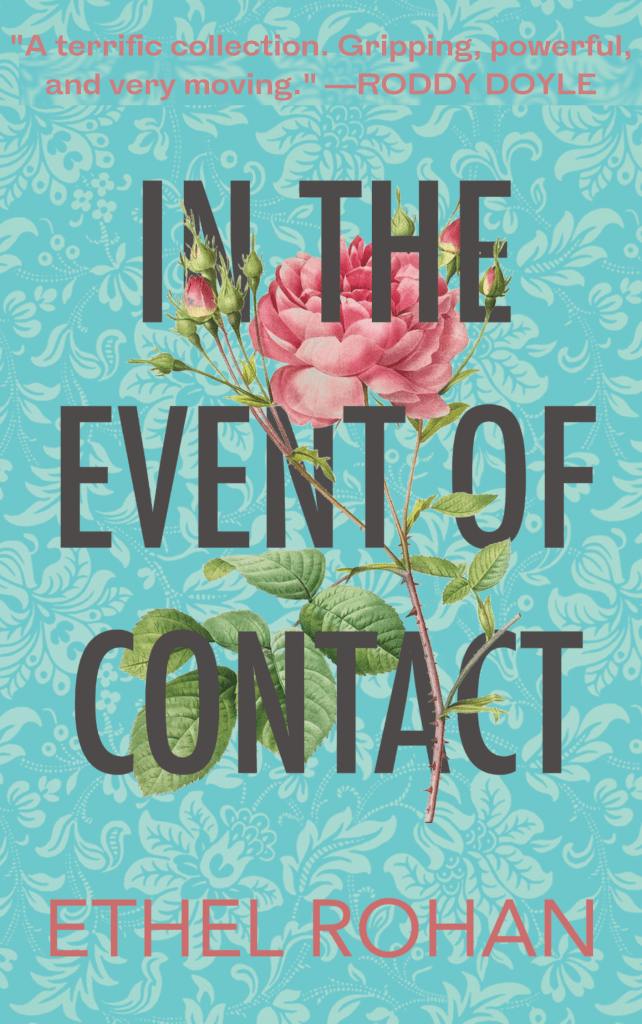
Cover of “In The Event of Contact” by Ethel Rohan
I’m honoured to learn that this is your first interview about this collection, which won the Dzanc Books Short Story Collection Prize and is due to be published in Spring 2021. We’ll therefore skate around plot spoilers as this really is a collection of tight-knit page-turning stories.
SG:The title of this collection and the opening story “In The Event of Contact” place the reader in a liminal space where instinct rules and also confuses. ‘The caged bird knew’ we are told after a series of startling events involving Ruth–who can’t bear any form of touch–her family, and the mysterious and dangerous Mr Doherty. Can you speak a little about this theme of gut and instinct in the collection and why you chose this title.
ER: These are stories of primal fears and urges, and of fight or flight responses. In the title story, menace and danger are intuited by the most attuned of the story’s characters, its narrator Elizabeth and the cockatoo, Jimmy–I’m fascinated by animals’ keen senses and highly intuitive intelligence–while other characters are not so much confused by their gut and instinct but dulled to its messages and guidance.
Our gut and instincts can keep us safe and help us make our best choices, yet too often we under-utilise this capability. I’ve found my body often knows more than my mind. When I need to make major decisions–will I emigrate? Marry? Jump careers? Keep writing?–I tune into my gut for the answers. That involves getting quiet and still and feeling out whether my dread and confusion are coming from my mind or my gut. There’s a calm that settles inside me when I listen to the knowingness of my heart and not the angst of my head.
I have strong memories as a child of intuiting tension and the sinister. I can feel threat and danger in my gut, and remember being perplexed and appalled by how adults often appeared oblivious of the same. I wish my sensitivity and instincts were duller, it makes for a lot of anxiety, but like every curse there’s an element of gift, too, and I don’t think I would be a storyteller, or nearly as empathetic, without that ability to feel deeply and see into people.
As for the title, I worked on the titular short story over years and could never get it quite right until I hit on its final title and then everything else offered itself up. The collection was also created and compiled over many years and again it didn’t come together until I fixed on the title and that gave the stories their beating heart. The title is a twist on our expectations of the familiar phrase: ‘in the event of [my death, fire, other emergency]’ and I love turning the familiar in my stories into the strange and surprising. Once I decided on the collection’s title, I knew what did and didn’t belong in the final manuscript. It’s at the centre of everything, really, isn’t it? What and who do and do not touch us. And how. These are largely stories of crises of consent.
SG: You’ve said it perfectly, Ethel. Crises of Consent. Well, I very much enjoyed how the collection explores connection and disconnection by way of the families we marry into and the countries we move to. Much of what is explored is identity and compartmentalizing – being present in body but not in mind and showing different parts of ourselves to different groups. Was this something that emerged when you gathered these stories into a collection or was it present as you wrote these stories?
ER: In storytelling we’re creating and revealing characters and worlds, but we’re also revealing ourselves, whether we like it or not. I’m guilty of serial compartmentalization–mostly as a daydreamer and sometimes as a coping tool, like I’m physically present but my mind has checked out–and clearly that tendency bleeds into the plots and characters of my stories and was very much present as I wrote each of the stories in this collection.
As an emigrant, I’m also familiar with fracture, that sense of being divided between places and people. That splitness is exacerbated by the pressure to present different versions of myself to meet various expectations (like being Dublin enough, Irish enough, good enough, humble enough, nice enough, smart enough, cool enough, and not too American). Unfortunately, our tendency is to bend ourselves in order to be accepted. Until, that is, we free ourselves of that oppression. So, yeah, these are intrinsic themes that show up repeatedly in my stories. Even before I immigrated to San Francisco, as far back as my earliest memories, I’ve suffered a feeling of never quite fitting in and belonging–always at the edge of things, looking on. So while it’s never my intention as I set out to write–I’m eager to be open to each character’s unique journey–the coerced and marginalized inevitably show up in my stories.
SG: Thank you for such an open and honest answer, Ethel. The collection is also concerned with what is known and what is hidden, and we realise how powerful the unsaid is. Your characters communicate a great deal through what they are silent about. Can you talk a little bit about how dialogue serves to reveal and hide character motivation and narrative truth?
ER: I love dialogue, and in the past year have at last written a feature script. Something I really have to work on in revision, though, is dialogue that’s too direct. As much as I hate confrontation in real life, I do tend to tell it straight, but that’s the exception rather than the rule and is therefore rarely true of my characters. Subtlety and nuance are much more truthful and powerful in storytelling, anyway, not least because they align with the universal experience of how much is left unsaid, and how much suffering these absences of aired feelings can cause. Despite our singular gift of language, we humans tend to be reticent, uncommunicative, and passive-aggressive–largely because of toxic messaging around being tender and revealing pain. That hiding, that inability to thaw and talk from deep within, causes so much damage, including the cover-up of a multitude of personal and systemic wrongs.
SG: In “Blue Hot” – with its pitch-perfect title – the narrator tells us “Boys are attracted to girls who look like they’re loads of fun, or who seem especially tragic. I’d read that in a glossy magazine. Or maybe I’d heard it on the radio, TV, or bus.” And this troubling message echoes the signals she receives from her family and friends about relationships and physicality, and with dire consequences.
When you’re creating characters, do you find yourself following character archetypes based around the era in which the story is set, or do you base them on what or who you know emotionally?
ER: Typically, I know very little going into each story. I start with some spark that urges me to the page and go word by word from there, filling in the blanks. That spark is always centred around a particular character and my process is to follow the character from scene to scene and see what they reveal about themselves and their world. So, while I don’t think of myself as writing archetypes around era, every character is affected by their who, what, when, where, how, and in particular why. Those internal and external factors colour everything about the character and their perspective. Messaging, particularly early in life, shapes us, and too often misshapes us. A central thread in “Blue Hot” is pervasive patriarchal messaging that devalues women and promotes toxic masculinity.
SG: And you tackle that central thread so well. It truly had a physical impact on me.
Place and space also feature heavily in the collection – in particular Dublin, your hometown – as well as parks. In “Wilde”, the Merrion Square park is used to springboard us into the encounter the narrator has with Oscar Wilde. In the final story in the collection, “The Great Blue Open,” we begin down on the ground in the park and finish with the narrator seeing herself from above. How important was the sense of place – and space – to you as you wrote these stories, and during the editing process with the team at Dzanc Books.
ER: Place and space get back to what shapes us and leaves its mark–imprinting, if you will. Place affects people. Enormously. Particularly our birth place, and those places we call home. As does space. I was just talking with women friends the other day about how I spent decades taking up as little space as possible, be it on buses, planes, in buildings, and on the street. I was always making way for others (particularly men) and giving them the right of way and more than their fair share of space while denying myself the space I needed and which was my due. Now I’m like, Move Over! As for parks, I love trees and woods and open spaces–anywhere with Mother Nature and all her glory. I think if we studied, valued, and emulated her more, this world would be a far better place and we humans would be a far superior and happier race.
SG: Move over, folks, and welcome Nature. I like it! So let’s finish, Ethel, with some brief questions:
What book is on your nightstand now? Shuggie Bain by Douglas Stuart.
I have it on my nightstand too (waiting!) So, mountains or Sea? Sea.
Wine or Whiskey? Both.
But not together! Do you have a favourite book of 2020? Cleanness by Garth Greenwell.
I must look that one up. Finally, what is your one writing wish for 2021? Money.
Ethel, I wish you much success with In The Event of Contact. Thank you for your generous answers and with gratitude to Dzanc Books for providing me with a copy of your stunning collection. The official publication date for Ireland and the UK is June 3, 2021, and elsewhere May 18, 2021.
Andrew, You are very welcome to my WRITERS CHAT series. Congratulations on your latest publication, a linked short story collection Sunsphere (BlazeVOX [books]: New York, 2019). A previous collection of fictions, Self-Titled Debut, won the Subito Press Prose Contest in 2009 and a novel The Big Red Herring is due in October.
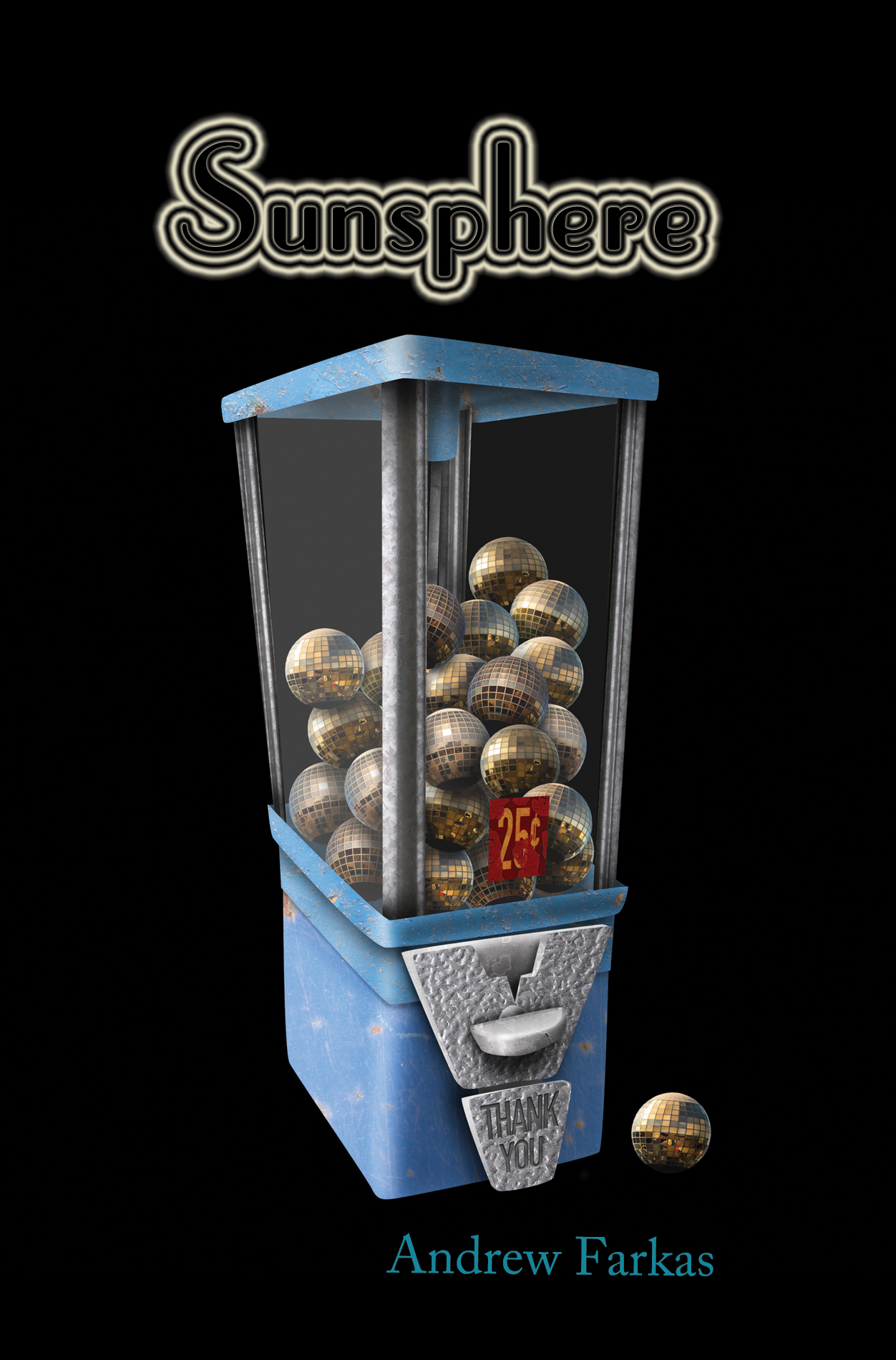
SG: Let’s start with the cover image, which, I think captures much of what Sunsphere is about: people orbiting each other, people trapped with each other, people seemingly identical but inside so very individual. It strikes me that this book also speaks to the politics of our times –whereby we are part of this increasingly homogenised society and culture and yet we often fail to identify on a national level.
AF: It seems to me that people are constantly looking for that one thing they can use to define themselves, and they want this definition to be both inclusive (so they can have someone in their corner) and exclusive (so they can point at the people who don’t belong). The problem is, we either pick ideas we’re unsuited for (like Herbert in “White Dwarf Blues” who very obviously doesn’t mesh with the drug addicts he’s hanging out with), or we’re unwilling to move on when the old ideas don’t work anymore (Trevor and Kat refusing to breakup in “Do Kids in California Dream of North Carolina?” for instance). In both cases, we cling desperately to whatever it is that defines us, even once it becomes the nightmare version of itself. I think that’s what you’re talking about with the increasingly homogenized society. We want to be able to say, “This is what it means to be an American,” when really any country is just an arbitrary set of borders on landmasses composed of people who likely ended up there by chance. When we’re willing to move on, we can tap into our individuality, but that can be as dangerous as stagnation. Yang Wie-Te in “The City of the Sunsphere,” for instance, goes off on his own, but that almost kills him. Why? Because when you remove yourself from all of the accepted groups, even the smaller groups in society, you risk being ignored by everyone. So, we’re forever on our irregular, ellipsoid orbits, but we tell everyone they’re actually perfect circles. And they agree because their irregular, ellipsoid orbits are perfect circles too.
SG: Yes, I think that we do, as you put it, “cling desperately to whatever it is that defines us” especially in these polarised times. At the core of much of your work is, as stated on the back cover blurb, “a search for humanity”. Could you talk a little about this search in relation to your writing process for Much of the collection was published in journals including “Everything Under The Sunsphere” which was nominated for a Pushcart Prize, and I’m wondering about the order in which each story is placed and how that evolved.
AF: Honestly, the search for humanity wasn’t the conscious part of the book. Instead, I’d say Sunsphere is an argument for how humanistic science, including quantum physics, is. After all, my goal was to write a collection of stories focused on the concept of energy because that was the theme of the 1982 World’s Fair in Knoxville (the Sunsphere being the symbol of that fair). I also wanted to focus on entropy in the stories because World’s Fair Park was in shambles when I lived in Tennessee, and I thought it was interesting that the exposition based on energy had reached its entropic state. And so the collection came together via different forms of energy or concepts connected to energy (“The Physics of the Bottomless Pit” being kinetic energy, “Do Kids in California” being potential energy, “Everything Under the Sunsphere” being heat energy, “I Don’t Know Why” being entropy, etc.). It wasn’t until I was done writing the stories that I realized the material had taken me on a search for humanity, I think because science is our way to help us understand the universe which includes ourselves.
As for the order the stories appear in, it’s changed over the years (since the book wasn’t published until about decade after I thought of it as done). But “Do Kids in California” was always first because it’s the potential energy story and because it introduces us to the Sunsphere. That was also the only story I didn’t have the idea for prior to beginning the book. I had this big poster with all of the titles lined up next to the type of energy the story represented, except for potential energy… Much as “California” was always first, “I Don’t Know Why” was always the penultimate story, since the first narrator in the piece references the fact that it’s second to last in the collection. “You Are Where I Am Not” doesn’t have the Sunsphere in it because I wrote it after I thought I was done with the Sunsphere stories, but then realized it’d make a good final stasis piece. The other stories were organized for rhythm, keeping “Bottomless Pit” for the center, instead of putting such a long piece at the beginning.
SG: Hmm that’s an interesting intention – to explore how humanistic science is. Again I think it brings us back to polarisation – the arts/feelings and sciences/logic, them and us, the othering of everything. At the same time place – and the concreteness of it – is central to this book – the city, the land and, at the heart, structures that symbolise achievements, and celebrate understanding of the larger questions of life and our world. As the narrator says in Everything Under The Sunsphere:
“There is sun-poisoning. Heat sickness. Heat delirium. The inflamed, demented, diseased city runs wild. Careens down streets whose names change so often they have no names at all.”
There’s an interesting thread here – if I have picked up on it correctly – that speaks about the deep divide in American history the remains revealed in stereotyping, place and food names, and in a place where everyone has air conditioning except for the narrator. At the end of this story, the narrator realises that he – and everyone – is “able to look past the city of Knoxville…look past all of it…to see the place where the roads run logically and the streets’ names never change.” Could you speak a little about the connection between place and history?
AF: I don’t know if it’s there anymore, but when I lived in Knoxville in the early 2000s, there was this giant advertisement for Philco televisions on a brick wall downtown. To my knowledge, Philco televisions went bust in the ’60s or ’70s. Since I was born in 1978, I don’t know that I ever watched a Philco TV. And yet here’s this huge sign asking you to buy something you couldn’t buy with all the money in the world. Oh, sure, you could pick one up at a junk store or an antique store, but the ad didn’t say, “Buy a beat to hell television,” or, “Get yourself some old timey technology.” No, the sign was talking about new TVs. Seeing history imbedded in place like this connects us to the past, but also forces us to deal with change (since this too shall pass). Because I was willing to confront history, being confused by a TV brand I’d never heard of before, I researched Philco and learned about the Predicta, which I later used in The Big Red Herring. In other words, by paying attention to the history found in place, I discovered something new to think about (even though it was actually something old). More often than not, though, people will look through the Philco sign, or ignore it because it doesn’t immediately make sense (either because they don’t know what it is, or because they know its time has come and gone). Gene is like this in “Everything Under the Sunsphere.” So, the old Sunsphere is falling apart, while the brand new Sterchi building, which has air conditioning, is his respite from the Southern heat. But Gene wants everything to make sense, so he’d like Knoxville to be completely rebuilt, to be completely stripped of difficult history. It’s no surprise, then, that the arsonists use names they stole from a 19th century graveyard, since they represent the chaos that scares the hell out of Gene. And it’s no surprise that Gene imagines a rebuilt Knoxville “where the roads run logically, and the streets’ names never change.” He certainly thinks of that city as perfect because it remains the same forever. A pretty dream, but it’s impossible, and shows an abject terror of the difficult knowledge of the past and the change inherent in the future. But won’t the change in the future eliminate every vestige of the past? Obviously not, since in 2002 there was still an advertisement for brand new Philco TVs right in downtown Knoxville.
SG: Oh that’s an interesting interpretation of place and history. I was actually thinking of civil war politics, race, and gender but you make link how things are placed around us to how we identify in time and history through objects, what we own and how we project those identities to the world. Following on from this, your characters often speak at each other rather than to each other in a world that is so fast moving that, it appears, we don’t notice when we grow or change, and don’t often realise when the landscape around us has become eroded. In the very amusing “The Physics of the Bottomless Pit” rumours, conspiracy theories, stories and tales abound including advice on “what to do in case”. The story also has a section which calls out for you, the author, exclaiming “If anyone can hear me, please let him know….”. Can you comment on how this collection speaks to the busyness and depersonalisation of our society?
AF: “The Physics of the Bottomless Pit” and “I Don’t Know Why” are perhaps the two stories that speak to the busyness and depersonalization in our society the most. In both stories, the characters really never stop to think about what’s going on. Instead, they either ignore what’s going on so they can grind through their endless, inconsequential tasks, or they produce great amounts of irrelevant material on either the bottomless pit (that “what to do in case” you referenced, for instance) or the KnoxVillain threat, respectively. Occasionally, characters figure out what they need to do is less, not more, but nobody is willing to interrupt their busy schedules to listen to them. In the meantime, there are characters who break down and try to reach out, but since their questions don’t make sense, or are scary because they don’t have easily prescribed answers, no one really listens. I portray this in “Bottomless Pit” by using disembodied conversations between characters who never quite understand each other. “I Don’t Know Why,” on the other hand, has stereo speakers spread throughout the entire city of Knoxville that constantly broadcast static so no one can hear what anyone else is saying. The white noise doesn’t stop anyone from talking, though; it just ensures no communication will take place. Only simple commands can be comprehended, but with no context the simple commands end up leading to absurd ends.
SG: For me you’ve touched on our shrinking attention span here, there’s so much communication – and so many ways in which to communicate – that we often end up saying nothing. Reading this collection more than once I thought of literary critics and writers such as Roland Barthes and Jacques Lacan … and of course you quote Samuel Beckett at the start of “I Don’t Know Why.” Does this collection play as much with form and content as the role of reader and writer?
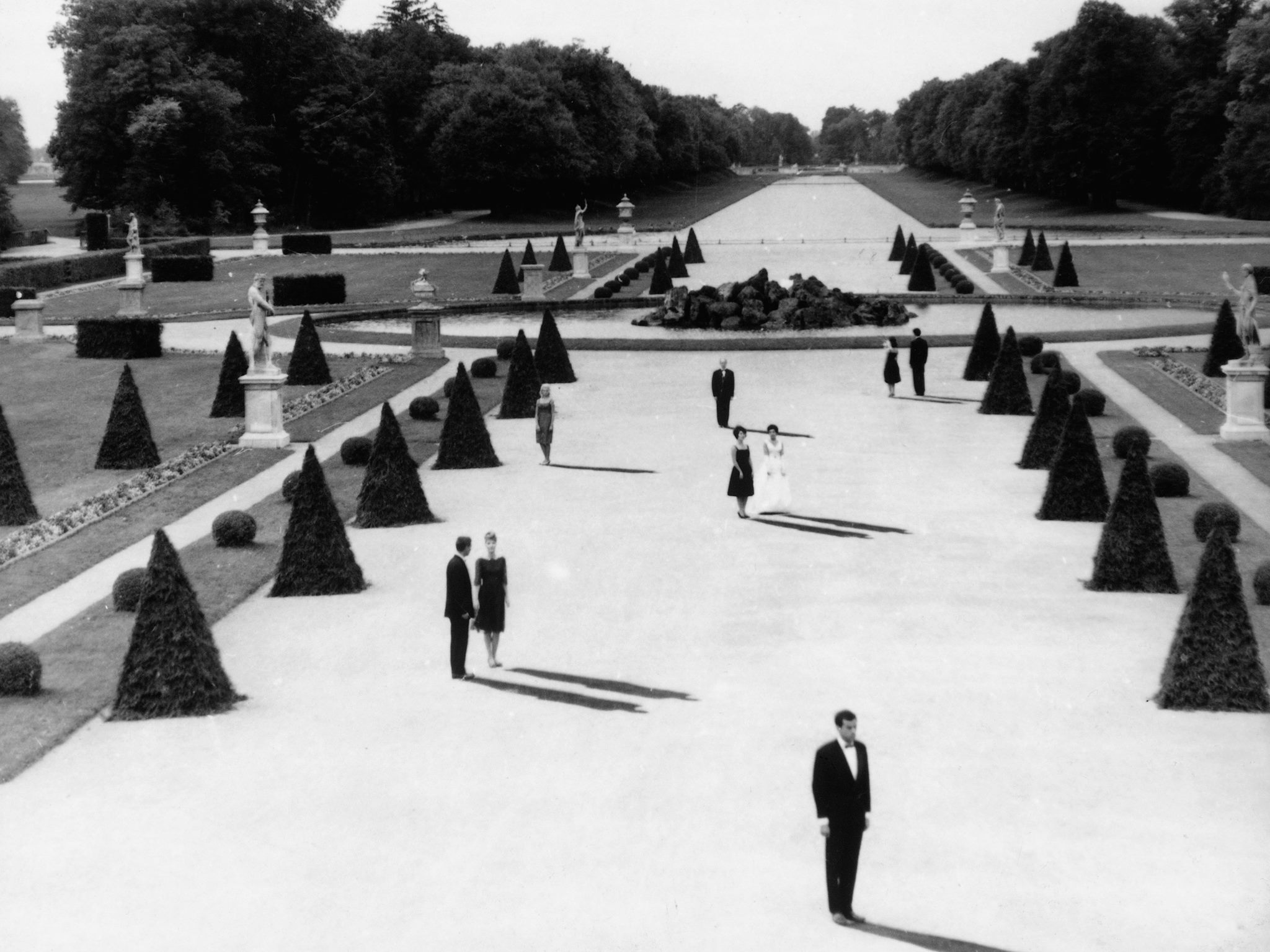
AF: When Ilana Masad interviewed me for The Other Stories podcast, she was really surprised that Sunsphere is a mixed collection, meaning it has stories of various genres and styles. So, I’m absolutely playing with form and content. But how do I play with form and content? I rarely sit down and say something like, “I want to write a science fiction story.” Instead, I have an idea or ideas, say that people erupt into destructive shock waves when they die and the Sunsphere, inexplicably, was turned into a miniature pulsar. I then ask what kind of story should I write using these ideas. After I asked that question, I began imagining the pulsar slowed way down, almost like a rotating spotlight that briefly illuminates different parts of Knoxville. In film, perhaps you’d use slow motion. In print, I decided extremely detailed descriptions of each part of the city would be best. That then reminded me of the way Alain Robbe-Grillet describes the banana plantation in Jealousy (1957) and the grounds of the resort in Last Year at Marienbad (1961), so reserved and meticulous.
An image from the film Last Year at Marienbad (provided by Andrew Farkas)
Consequently, I ended up with a Robbe-Grillet inspired science fiction story. On the other hand, “White Dwarf Blues” turned out to be a parody of what I call drug noir stories because I imagined the super deadpan, super depressing works by Hubert Selby, Jr. or Bret Easton Ellis and wondered what it’d be like if a character was really, really happy to be in one of those stories. Herbert, the happy character, keeps trying to act all burned out, but he can’t do it because he’s so excited. Now, in the collection as a whole, I did require that all (except one) of the stories had to have some version of the Sunsphere and that all of the stories had to use concepts connected to energy, but otherwise the form came from the content of each piece. Meaning the stories in Sunsphere have thematic connections, but no stylistic or generic restrictions. That’s how I ended up with a mixed collection.
SG: So, does your work as a professor in a university speak to your work as a writer? And do you believe that all writing is creative (academic and otherwise).
Much as I write metafiction, I would say I’m a meta-teacher, meaning I not only ask my students discussion questions, I then tell them why I’m asking those questions. It always drove me nuts when I was a student and a prof would take a particular position, but wouldn’t say why they were taking that position. Furthermore, I’m lucky enough to run creative writing workshops (which have always been my favourite classes). These workshops keep me asking what is this piece doing, how is it doing it, why is it doing it, and how well does it work, so I then ask myself those questions when I’m editing my own writing. Not to mention the fact that my students keep me updated (either purposely or otherwise) on what is going on in the world. For instance, I’ve taught classes where a great many students were all writing, say, fantasy, and so I end up getting familiar with what is going on in fantasy now through their writing and influences, and then by the research I do in order to help them.
And, yes, I do believe that all writing is creative. I wish we saw it that way more. Instead, we tend to approach critical papers like math problems and try to grade them accordingly. Much as there are many theorems in geometry, we try to load the students down with as many rules of writing as possible (including heaps of rules that aren’t actually rules of writing at all, but more like pet peeves a particular teacher might have). Consequently, when the students roll into my classroom, they’re terrified to write because they’re positive whatever they say will be wrong (grammar mistakes often being the greatest fear my students have). It’s then my job to get them to accept that good writing doesn’t come about in one draft. Hell, the first draft, you shouldn’t think about any rules at all, you should just get ideas down on paper. And, yes, as you move forward, there are more guidelines to follow, but they get easier to follow once you know what you’re going to say, how you’re going to structure it, and on and on. Although it often takes a while for them to believe me, they do usually come to understand that writing is easier when you’re not trying to write a perfect draft in one go. I feel like creative writers understand that. And so, I bring as much as I can from creative writing into composition in the hopes it’ll help allay those fears that only end up destroying writing (often before it even actually starts).
SG: Oh I love that you think that all writing is creative. I also think that and find, like you, that teaching is wonderful engagement with writing and reading in ways that feed into my own practice. Speaking of practice, what, if any, is your writing ritual?
AF: Although I have written in the day, I prefer to write at night. Not only am I an Indoorsman, I am also a night person. I do my best thinking and writing after the sun goes down. While writing, I can’t listen to music for some reason, but I do need noise. So, I usually have a floor fan buzzing monotonously or one of those background noise generators going. Especially when I’m working on the early stages of any piece, I pace a lot. The most difficult thing for me is to look at a blank page. If I sat there and stared at the screen, I’d never write anything at all. So, I walk back and forth, talking to myself about what I’m trying to do. Once it starts to sound good, then I sit down and type a little, then pace more, type a little, pace more, sometimes imagine other things (I’m fond of pretending that I’m a knuckleball pitcher for a baseball team), and then back to typing. Once I have pages filled up with writing, normally well-structured but poorly written, then I’m happiest because all I have to do is focus on making the sentences sound the way I want them to sound. I also take tons of notes, which is another way to generate lots of writing so I’m not dealing with an awful blank page. But, yeah, at night, fan buzzing, pacing, note-taking, occasionally typing, and as the typing increases, the pacing decreases.
SG: Here’s where we differ! I’m not a pacer – more of a procrastinator, making tea kind of person – and I’m more of a morning or late night but not into the night person. I love how we all find our own spaces and paces.
Lastly, Andrew, some fun questions:
Sea or Lake? Lake. Preferably the great ones next to Cleveland or Chicago.
Dogs or cats? Neither. Although a friend of mine had to take care of a robot dog for a while at the University of Alabama, and I thought that was pretty awesome.
A robot dog! Fabulous. Beer or wine? I never drink … wine. So definitely beer.
High Street or Mall? When I was a kid, my dad worked at the power plant for Chapel Hill Mall in Akron, Ohio. So, anytime I go into a mall, I remember going to Chapel Hill when I was a kid (although now it’s almost a dead mall). The strange thing is, I’m not especially fond of shopping in malls. I just like walking around in them sometimes for that nostalgia rush.
Inner city or suburbs? Definitely the city. I lived in Chicago for five years in the city itself. And I very briefly lived in NYC in the city itself. If I could live anywhere, I’d absolutely live in a city, not outside of the city, and certainly not way outside of the city.
What are you reading right now? Since I’m currently teaching a class on the alternate history genre, I’m reading Karen Hellekson’s The Alternate History, Philip K. Dick’s The Man in the High Castle, Ursula K. Le Guin’s “Sur,” Maureen F. McHugh’s “The Lincoln Train,” William Sanders’ “The Undiscovered,” Poul Anderson’s “Delenda Est,” Larry Niven’s “All the Myriad Ways,” Bruce Sterling and Lewis Shiner’s “Mozart in Mirrorshades,” and Lawrence Watt-Evans’ “Why I Left Harry’s All-Night Hamburgers.”
Wow, what a list! So, what’s your next writing project? I’m currently working on a collection of essays called The Great Indoorsman. The title is the title of the book and of an essay in the book that’s already appeared in Heavy Feather Review. The other essays are specifically about me exploring various indoors spaces (since I’m not much a fan of the out-of-doors). Most recently I had an essay in The Iowa Review called “Filk” that’s about filk music and old video rental stores. Also, The Big Red Herring, my novel, comes out October 28, 2019.
SG: Thanks, Andrew, for engaging so thoroughly with this Writers Chat. I wish you all the very best with your many publications and I will look out for your novel The Big Red Herring later this year.
About Andrew: Andrew Farkas is the author of two short fiction collections: Sunsphere (BlazeVOX Books) and Self-Titled Debut (Subito Press), and a novel: The Big Red Herring (KERNPUNKT Press). His work has appeared in The Iowa Review, North American Review, The Cincinnati Review, The Florida Review, Western Humanities Review, Denver Quarterly, and elsewhere. He has been thrice nominated for a Pushcart Prize, including one Special Mention in Pushcart Prize XXXV and one Notable Essay in Best American Essays 2013. He holds a Ph.D. from the University of Illinois at Chicago, an M.F.A. from the University of Alabama, an M.A. from the University of Tennessee, and a B.A. from Kent State University. He is a fiction editor for The Collagist and an Assistant Professor of English at Washburn University. He lives in Lawrence, Kansas.
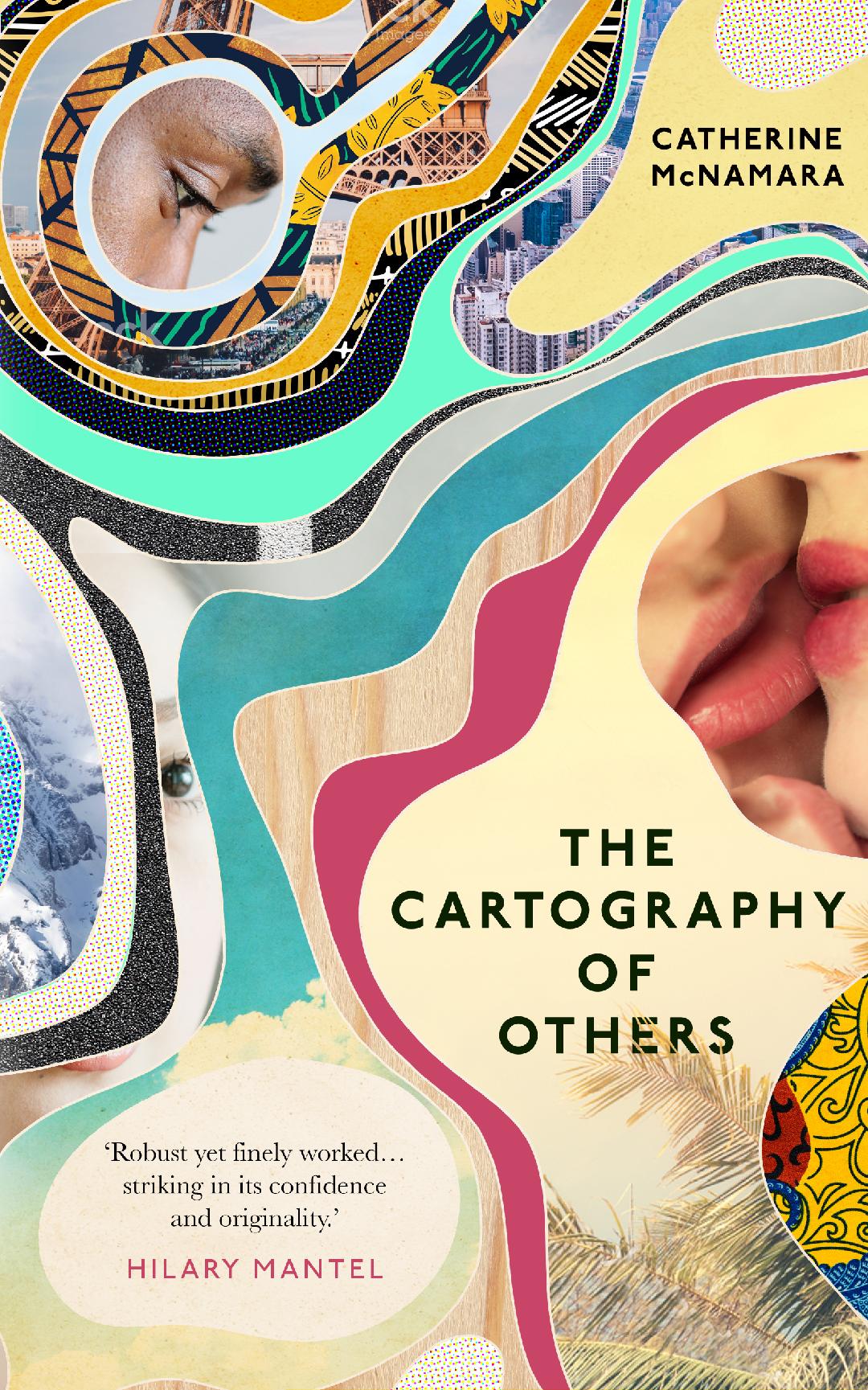
Catherine, You are very welcome to my WRITERS CHAT series. Congratulations on your second collection of short stories, The Cartography of Others (Unbound: London, 2018) ,which transported me into other worlds, as good stories do!
SG: First and foremost, tell me a little about how you went about assembling the collection. There are many award winning stories here and your stories cover a wide span of geography in terms of where they are placed yet we often feel we are in familiar territory. How important was setting for you in compiling the collection and selecting the order?
CMN: Great question! It was very complex for me to select the story order, and I had story titles on bits of paper flying everywhere. Because around half of the stories are set in West Africa, and the others mostly in Europe and Australasia, we had to keep the locations apart. It was also important to separate common themes or elements, and more titillating stories from slower, quiet ones. Rhythm was so important. Some of the stories are heavy and require breathing space, others race on and are more light-hearted. Another factor to consider in selecting story order was the gender of the protagonist – and not have the ‘female’ or ‘male’ stories bunched together – and we also needed a good distribution of first, second or third person pieces.
The main factor however was setting, as the reader needed to be gently tugged from one place to the next. My hope was that these faraway environments would feel vivid and tangible amongst more familiar settings such as London and Paris.
SG: Yes, that’s actually an element that I enjoyed – not knowing where I’d be transported to next! Some of the stories have fantastic first lines. For example, the opening of one of my favourites, “Magaly Park” begins: “There is a murderer in the new apartment block on the Point in the garage downstairs, it’s all cordoned off.”
This really sets the scene and captures the atmosphere of the whole story. The narrator, Grant, is somehow disconnected from his surroundings and yet incredibly embedded in them. He sees but does not always feel everything. Tell me how important are beginnings for you?
CMN: I cannot start writing a story unless I am curious about where the first sentence will take me. Beginnings are essential for me, and once I can ‘hear’ a first sentence I will rarely change it or the first paragraph. Like the first notes of a piece of music, the first notes must set the tone for the rest of the story, and elicit a precise response from the reader. It is the voice and the echo chamber of the work.
SG: Yes, tone is so vital to the short story in particular. Now, many of the couples in The Cartography of Others have trouble communicating what they really want to say. Some resort to silence, others let their bodies speak. It got me thinking about the power of silence and the potency of voice. I’m thinking about “Adieu, Mon Doux Rivage” and “Three Days in Hong Kong” in which the narrator Philomena M manages to be humorous in her overt sensuality. And in “Return from Salt Pond” – “even her suffering silence was dialogue, insinuating itself along the cords of his brain, snaking with his thoughts, coaxing words from him that were unwilling and unclotted.” Can you talk a little about silence and voice?
CMN: This is a really interesting point.
The dynamic of the couple can be endlessly fascinating, with the alternation between spoken and unspoken, physicality and detachment, and the search for balance and equality – rarely attained. So much of the stories of our lives take place in our heads: we are almost always viewing, measuring, recollecting, and the short story is a wonderful avenue for exploring these alleyways, and the porous skin between thought and speech.
I do like humour. And the dry, slightly-tortured-dialogue-with-self in “Three Days in Hong Kong” was a lot of fun to write, with Philomena M’s sensuality a distinct character within the piece. Flaunted at the hotel window, her body changes from a sensual device to the channel she will use to recover her sense of self. Other stories like “Return to Salt Pond” chart the plunging of a rapport into miscommunication and hardening thoughts, while events and context hover around the protagonists.
SG: You also have a great eye for detail. At times I felt I was reading lines from notebooks, where maybe you had sat in a café people watching…(It’s something that I love to do!). For example, this wonderful description of Russian girls in Moscow “The Ukrainian Girl”: “the statuesque silken women who would one day decompress into their pillowy mothers with pincushion faces and arms.” Can you tell us a little about your methods for recording the physical aspects of your characters.
CMN: Thank you, Shauna. I hate to say that I am hopeless with notetaking. I’ve tried recording details and scenes in notebooks – as I imagined a real writer should do – but I rarely look at them again! I know there are a few mostly empty Moleskins around the house.
When I have an idea for a story I become immersed in its fabric and I really enjoy creating characters from scratch. Recalling locations or perhaps people I’ve observed, and really sewing these new beings into the piece. I love the act of writing and I try to switch on as much of my brain as I can – tuning in with the subconscious where a type of magic occurs and images are thrown up, and the language takes on a pace and shape as the story progresses. I am always observing and listening to people. I’ll talk to anyone and if I’m not assessing them my subconscious probably is, storing up vital images, scents, energy.
SG: Oh how wonderful to be able to store images, scents and energy like that. I love the idea of storing an energy for a story. In this last question we return to place, and specifically, landscape. In many of the stories, the sea has a wonderful healing power and the land is stifling. In “The Bamboo Furnace”, the siblings return to “their sorrowful Eden”, literally battered and bruised by places they have lived in, and in “Astragàl” the emotions at Luna’s disappearance echoed by the view out the window (reminiscent of Hitchcock, I thought) – “He looked up in a rage at the first folds of the peak and the summit in a crust of white pleats”. Can you tell us a little about the importance of the landscape in your stories?
CMN: For me landscape is a vital part of the story, often a character itself. In the opening story, “Adieu, Mon Doux Rivage”, the sea is a balm that unblocks the wounded voice of a Japanese soprano, while soothing the pain of the narrator whose partnership may be tapering to a close. The two mountain stories – “Astragàl” and “The Kingdom of Fassa” – were written to express our belittlement before the cruel alpine environment. In a world where many of our emotions and thoughts are responses to what we read online, it is almost refreshing to feel the plain power of nature, the dramatic simplicity of an accident, or the course of the seasons and the futility of man’s efforts to tame these forces. Like everyone, I am gravely concerned by global warming and the changes I already see locally (I live in the Veneto countryside, close to the Dolomites), so these stories are an attempt to record and value these places.
Having moved around a lot, I am fascinated by the harrowing effect context and environment can have upon a person. Displacement is one of my major themes, and several of the stories explore the discomforts of being an isolated foreigner. These can span from basic communication issues to the need to accept a different climate and culture, sometimes leading to a remodelling of self within the new circumstances. Some characters adapt and survive. Others, like Santo, a Ghanaian migrant in northern Italy in “The Healing of Santo Yeboah”, do not. In the final story, “The Cliffs of Bandiagara”, the magical highland of Mali and its celestial firmament bring enlightenment and harmony to an embattled couple.
Finally, five fun questions, Catherine:
Dogs or Cats?
Dogs! I live in the countryside and have a German Shepherd called Astrid.
Paperbacks or Hardbacks?
Paperbacks from good bookshops.
Mountains or Sea?
The sea – I’m a swimmer. But I live near the Dolomites and also ski and hike.
What’s next on your ‘to read’ pile?
I’ve just started My Name is Red by Orhan Pamuk, and next up will read Watermark, a story collection by Australian Joanna Atherfold Finn.
Thanks again, Catherine, for stopping by and chatting.
Keep up to date with Catherine here: Facebook – Catherine McNamara, Twitter/Instagram – @catinitaly, Unbound – The Cartography of Others
The Cartography of Others is available at all good bookshops or online at Hive, Amazon UK

 Shauna Gilligan Writer