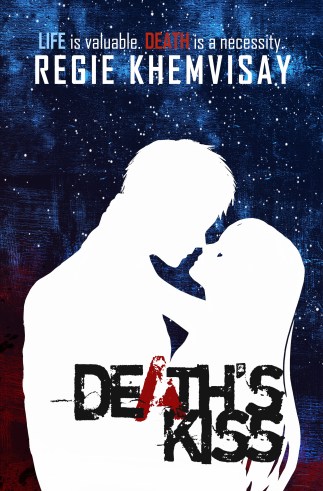
Regie, You are very welcome to my Writers Chat series. We’re going to talk about your novel Death’s Kiss aimed at Young and New Adult readers, and which you place in the category of “Dystopian (SciFi)”, as you say, along the lines of The Hunger Games or 1984.
SG: Let’s start by looking at what inspired you to write and self-publish Death’s Kiss. Can you tell us a little bit about both of those processes – the writing and the publishing?
RK: Hi Shauna! And to those reading this. First of all, I would like to thank you for giving Death’s Kiss a chance. My debut self-published novel is my baby and I’ve spent many years finishing it. I have so much to learn about writing and Death’s Kiss was such a super enjoyable and stressful story to write. But everything worked out well in the end. I first wrote Death’s Kiss in 2014, when I was 21. Hence, the reason why the virus only affected those who were 22 years old and older. I was saved, phew! Most of the writing was completed when I was deployed in Kuwait, and I would hang out at Starbucks after work to write. A very productive time in my writing career. I think I was just too excited to publish Death’s Kiss so I took the self-publishing route. Given a second chance, I would’ve taken the traditional route, I think Death’s Kiss deserved a bigger audience, but what was done is done. I am happy I had released my story to the world. The publishing process was very stressful. I had paid for the editing and publishing with an independent company and this was probably the worst decision ever. Though they completed editing, there were just so many corrections I had to still make. It was frustrating. I also paid for the cover design and website, which ended up as a massive disappointment. I ended up designing the cover and website myself because it was just frustrating to work with this company. Anyways, lessons learned and self-publishing was such a stressful but inspiring experience.
SG: It sounds like there was a lot of learning in that process, Regie, but also that you got through it and achieved what you set out to do – bring your story to readers and, most importantly for all writers, believe in your story. I loved the role Nat King Cole and Orwell’s 1984 played in the novel. The Shuffle also put me in mind of the wonderful Shirley Jackson story The Lottery. In Death’s Kiss once a citizen turns twenty-one, their name is entered into the shuffle, and thirteen individuals are selected from each age group. The scientist Lizbeth Bailey explains to The Aces that “It is so much easier to control people with fear. You’d be surprised how entertaining people are when they are scared.” What were your literary and cultural influences on writing this novel?
RK: George Orwell’s 1984, The Lottery, and the Hunger Games were my inspiration for Death’s Kiss. 1984 was my first dystopian novel I ever read, and we even had an assignment where I had to draw a 3-page comics of an important scene. The Lottery’s theme intrigued me and even though it was a short story, it had such a deep message. Then, I clearly remember reading The Hunger Games and I was just mesmerized by the writing and the story of Suzanne Collins. These three stories definitely had so much to talk about and I wanted to incorporate similar themes that were tackled in these stories to my book.
SG: And that emulation and those themes definitely shine through! So, at the heart of Death’s Kiss is a love story that runs over 53 chapters and traverses a myriad of time-zones, plots, subplots and challenges that our heroes Ryoma, Yuri, Chrystian and Samantha face in a future country called Yliria. It’s told through the eyes of Ryoma and Yuri, a dual- narrative which worked well, allowing us to get to know the characters deeply. Without giving away anything, can you tell us how difficult was it for you to keep track of all the twists and turns in this fast-paced novel?
RK: Honestly, I’ve read through Death’s Kiss that I got so tired. I had to rewrite and rewrite to make sure I’ve covered all plot holes and questions readers might think about. The characters also did whatever they wanted to do, and sometimes I just had to follow their lead. It was thanks to these four that I was able to cover everything I wanted to cover. It was a messy process, but I think it all worked out in the end.
SG: I think sometimes when the characters take over is when some of the more interesting story-lines appear! One of the themes that stood out to me was the push-pull and tension between duty/obedience and love/freedom and what it means to be part of a family. Our four heroes – their stories told through alternative narratives by Ryoma and Yuri – are Aces and one of their responsibilities is to protect the peace and “be the guardians of freedom and survival”. Their teacher warns them that “Curiosity reaps knowledge but it can also mean death.”
RK: That scene with Lizbeth was definitely one of my favourites. I would read that scene over and still get excited. The tension about the things you mentioned really added to the story, because really, we face many decisions and have to choose what’s more important and what needs to be sacrificed. It’s all about choices.
SG: Appearance is also important in the novel, and how we are marked – physically and psychologically – by the systems in which we operate. I’m thinking here, for example, of the wonderfully called The Joker System (for the justice system!), the division of the country into Space, Hearts, Diamond and Clubs and, of course, the huge historical backstory about the BlackJack virus that resonates – disturbingly! – with what we are going through now. I have to say here, also, that reading this novel whilst living through a current Pandemic (Covid-19) was a most interesting experience! Can you talk to us a little bit about the underlying motif of luck and cards?
RK: I had so much fun researching about the cards. It was very enlightening. Rather than about luck, the Cards symbolized making a choice, taking risks, and making a gamble. The Aces definitely were not lucky. They were chosen. And they had to make many choices, and sacrifices. Rather than fate, the characters themselves, walked their own path. And that’s what I was hoping the readers would think about the symbolism of cards. It represents life itself and the decisions we make that carve the body of our life stories.
SG: Yes, of course – the Aces were chosen and, as we see, this did not mean they were lucky. So this is a fast-paced novel with lots of twists and turns but it also has a philosophical element to it. In a way what Yuri and her friends discover is the power of knowledge, understanding the real meaning of immunity and protection and how betrayal “can only happen when there is trust.” Was this something that was there from the start or something that emerged through writing the novel?
RK: Many twists and turns happened along the way when I was writing. As I’ve said, the characters started making their own decisions that was different from the initial plot-lines I thought about. It was a whimsical experience because once I gave these characters lives, everything just unravelled before me. Initially, the Director was super evil who just wanted power. And I didn’t realize I ended up loving his character the most that his motivation why he does what he does had to be different. And the power he had as a Joker became the double-edged sword that he made the choice of wielding, no matter the consequences. Even the plot twist at the end came to mind almost at the final stage of the process. I had to rewrite it and made it work somehow. Like the books that inspired me to write Death’s Kiss, happy endings can’t be achieved so easily and the story continues.
SG: Yes indeed, I’m wondering if there will be a sequel! So, we’ll end our chat, Regie, with some fun questions :
Countryside or city? City
Boat or plane? Plane
Family or country? Family (That was me referring to Death’s Kiss!)
Coffee or tea? Tea
Cats or dogs? Pandas? (Good one!)
Thank you, Shauna for giving me the chance to talk about my baby, Death’s Kiss. And I hope you enjoyed reading it as much as I loved writing it.
Regie, I enjoyed our chat and the world you brought me into in Death’s Kiss and I wish you all the best with your writing and illustrating!
About Regie Khemvisay: She always loved stories and she had drawn and written two completed unpublished graphic novels. But she didn’t fall in love with writing a novel until she joined the Army and all she ever thought about is publishing her stories for more people to read. Death’s Kiss is her debut novel. She has a master’s degree in illustration and hoping to expand her audience by also publishing graphic novels and children’s book in the future. These days, Regie is often daydreaming and writing too many WIPS she hopes to publish one day.
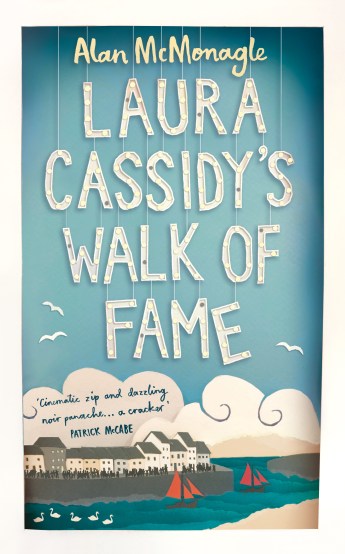
Alan, You’re very welcome to another WRITERS CHAT (readers see our last chat here). Your second novel, Laura Cassidy’s Walk of Fame, was launched to a huge crowd in Galway City Library in early March 2020 – just before the Pandemic lock-down – and has been described by The Irish Times as a “vigorous novel” and “an infectious portrayal of brazen optimism”.
SG: Can you tell us, firstly, about the genesis of the novel, which explores serious themes of grief and denial through what we might call a playacting lens?
AMcM: That’s not a bad descriptor. At the most rudimentary level it began as a voice. A voice that acquired flesh and blood. A voice that announced itself as a young woman, a burgeoning actress with a dream to pursue. A voice that swings both high and low, that flip-flops between the world of dream, invention, imagination and the more concrete world of the everyday. It was a voice that also, at times, misbehaves. And once misbehaving kicks in, things have a chance to become interesting…
SG: Yes, how messiness is always interesting – where we find the good stuff! I was particularly taken with the structure of Laura Cassidy’s Walk of Fame. It is divided into five parts and each part follows (literally!) Laura Cassidy’s “Walk of Fame” so that we feel we are walking with her. I love the titles and how each part is inspired by a different starlet and theme – for example, Part 1 Barbara Stanwyck “Just be truthful – and if you can fake that, you’ve got it made.” Seems like we should all be listening to that motto – especially the highly successful Imelda! Was this structure there from the start or did it come to you once you had the story down?
AMcM: The structure was born out of this playful lens you refer to in the previous question. And there was play aplenty involved early on, all in service to Laura’s perceived life as a famous star. I fabricated imaginary interviews which Laura conducts with various journalists she is only too happy to wind up no end and lead down the garden path. From there other features, just as unlikely, quickly arrived. Acceptance speeches, movie pitches, interactions with directors, agents, film executives. I had great fun outlining a sequence of movie parts tailor-made for Laura, I even wrote an obituary for an her. Out of all this ‘play’ it is the mini-biographies of the starlets of yore that made the final cut. (Along with the rollercoaster life of Imelda J Ebbing.) And these bios had to be drastically cut down, from an initial number of over twenty, then fifteen, and finally to five – what a wrench that was. At times, I felt I was auditioning all these brilliant actresses from the era of classic cinema for a part in my novel. And now that I am talking this out with myself it occurs to me that this might be something interesting to explore in a piece of writing.
SG: That would be so interesting – a series of interviews with stars from the era of classic cinema. It sounds like you’re not quite done with the starlets and the star system! Laura Cassidy is well-drawn – she’s feisty, snappy, funny and endearing and also, at times, a very lonely and misunderstood person. Can you tell us a little about her development and journey as you wrote the novel?
AMcM: I think the death of her father looms large in Laura’s story. She witnesses his death. She is quite young when it happens. She also witnesses it at a crucial moment in her own life – she has just bagged the lead part in the school play and the first person she wants to share the good news with is the person who has planted this acting dream inside her to begin with, her father. I think she has a very complicated reaction to his untimely death. I don’t think Laura herself is aware of how and when this reaction is going to manifest itself. But it has damaged her psyche. There’s a fair old cocktail bubbling away inside her. A combination of grief and trauma, probably some guilt, she can do a nice line in denial. It’s a heady mixture, a combination that could potentially kipple her when it matters most. And so yes, Laura becomes a pocketbook of complications and contradictions; of uncertainty and confusion. She vacillates greatly between unusual levels of self-belief and deep-set fear; between self-sabotaging hope and blind optimism.
I find weighty themes such as grief, trauma, guilt very difficult to come at straight on. And of course setting out I wasn’t aware that these weighty themes were going to become a significant part of the story. My approach has to be more angular, slanted, with twists and knots and complications and contradictions. We’re in the realm of confusion and uncertainty. Chaos. And chaos is slippery, and tricky, tricky to meet head on. I think that as a writer it’s how I find my way towards that X on the treasure map. That X being a moment of discovery or realisation or revelation. And not knowing what this X might be is what kept bringing me back to the desk every day, to spend time with Laura, unearth what was making her tick – or, more accurately, not tick.
SG: I love that notion of slipping through the chaos towards discovery and finding moments of why. This brings us neatly on to the internal and external worlds of Laura. As much time as she spends in her head, her complex and witty self is revealed when she is with other people, even though it’s difficult for her. I’m thinking here of her relationship with Fleming and with her doctor, both of whom take her as she is. For example, speaking to her doctor she says
“Doc, you’ve been saving my life for a year now and I have to say I think you’re doing a terrific job. So I have no fears on that score. If you ever need a reference you know where to come.”
Laura is, as the doctor calls her “a charmer.” Can you talk a little bit more about this charm that brings us with her on her journey?
AMcM: Essentially, Laura is an unreliable narrator. And of course, as a writer, to a certain extent you must allow the reader in on this. So there is an attempt to strongly suggest – even from the get-go – that things are not going to go according to plan for Laura. This theatre/movie stardom dream of hers is going to remain out of reach. But as a counter to this I don’t allow Laura for one minute believe, certainly not in her interaction with the world, that she is not going to make it. And so the thing becomes a balancing act, a wire walk. And as is the way of wire walks, sometimes you fall. And when you fall, you’ve got to pick yourself up and go again. When we first meet her, I think there is a gap between where Laura is and where she would like to be. And for Laura, this gap becomes a place of invention, imagination and dream. And one thing I think the novel might be trying to do is emphasise or explore the power of dream and invention and imagination for those in the world who are more vulnerable than others. Explore the fine line between the language of dreams and reality. And so there is a version of herself Laura presents to the everyday world, and to those with whom she must interact in order to get through the days or her life. This so-called charm gets switched on. The humour and the wit. Lots of colour. After all, she sees herself as an actress, performing is second-nature. But we also become privy to the goings-on inside her head, when she is alone, contemplating, reflecting, in her own way dealing with all the headstuff that gradually declares itself and does it thing, as the dream and all that it might have entailed begins to unravel.
SG: Yes, the narrative captures that slow – and almost inevitable – unravelling quite beautifully. I’d say that most readers will identify with the difficulty of family: how we are defined by it, compared within it and have expectations imposed on us by it. Sibling rivalry and relationships are explored through the lenses of presence and absence, in particular, Laura’s relationship with her sister Jennifer and her young son Juan, Laura’s nephew. Can you talk a little about how you use humour, black humour and a lightness of touch to explore these themes?
AMcM: Laura and Jennifer. Obviously there are differences in their circumstances. Jennifer gets to fly the coop and ‘save the world’. Laura remains in the home house, in the throes of a much more interior journey, a journey into fantasy & delusion. Laura is clearly wary of, suspicious of Jennifer upon her return. She is dismissive and mocking of Jennifer. She definitely displays child-minding skills that, at best, can be described as questionable. Jennifer, too, initially offers her sunny side to the neighbourhood. There are humorous stories of her time abroad, she wants to tag along to the pub, shine in the presence of everyone and anyone. But, gradually, this is undermined. Her life is not going as smoothly as she would like everyone to believe. And so I think it’s fair to say they are both deluded in their separate and very individual approaches to the world. Laura with her hi-fantasy ambitions of stardom and Jennifer seemingly convinced she is some kind of modern day miracle worker. The humour, I think, becomes an attempt to throw light on the not-so-funny aspect of all of this. That is to say, how Laura and Jennifer have chosen to enter the world, get through the days of their lives. And for all their flaws and delusions and contradictions and mishaps and missteps, these respective approaches must be recognised and acknowledged as something valid.
SG: Yes, that resonates – that, despite ourselves, we do actually chose to enter the world and, as you say, get through the days of our lives in a certain way. So finally, let’s come to the acting, the stage, and the other side of this coin – that of grief. It always strikes me that there is something similar in acting to that of writing – it’s about escaping yourself and at the same time ‘becoming’ more yourself on the stage/page than off it. As Laura says
“For a time…. I could float, drift, hover wherever I liked, when the mood took me…I could be here and not here….I used to so enjoy imagining the world around me through the eyes of others….”
Without giving anything away, in Laura’s case it seems to be true that wanting to play the leading part in Streetcar Named Desire is more than just wanting that part. Her insistence and perseverance are both tragic and funny and I found myself despairing for her and also laughing at many of the scenes with the director Stephen (of the precisely and perfectly named Khaos Theatre). Was this something that emerged through the narrative and characterisation or something you were consciously interested in exploring?
AMcM: It’s a great question, as is your observation in relation Laura’s desire to snag this leading role she so craves being more than merely wanting the part.
There is something else at stake for her here, I feel. Pursuing her dream, not matter how unlikely her chances, may cost her dearly, but I suspect she has made this reckoning with herself at a very early time in her life and has decided that, come what may, chasing after whatever it is she is after will be worth it. The journey and all that it entails, hi-fantasy, setbacks, desperation and all, is what matters to her. I suspect she may feel trapped inside her own skin, that the only way she can become who she wants to be, or at least a semblance of who she wants to be, is through whatever viable outlet presents itself to her – in this case, through a life inhabiting many ‘roles’, a life performing, a life spent stepping in and out of the everyday world.
And again, I wonder has she realized that how she sets about getting through the days of her life will fall short of her expectations. It’s a complex question you’ve asked me, at least I think it’s complex, and I’m thinking about it as I write this, and yes, it is something I’m interested in exploring, and yes I do think it’s connected to the desire to create, to the magic place it comes from, to finding a way to be in the world and at the same time at a remove from it.
SG: Let us know what Laura has to say on that – maybe we could meet her 20 years from now….So lastly, five fun questions, Alan:
Theatre or Film? Yes!
Dogs or Cats? Dogs.
Coffee or tea? Coffee.
Best ‘Coronavirus/Covid-19 Lockdown’ tip? Dance.
Oh I love that one! So, what’s next on your ‘to read’ pile? Dance Prone by David Coventry.
SG: Thanks so much, Alan, for such thoughtful answers, I’ve thoroughly enjoyed our Writers Chat.
Andrew, You are very welcome to my WRITERS CHAT series. Congratulations on your latest publication, a linked short story collection Sunsphere (BlazeVOX [books]: New York, 2019). A previous collection of fictions, Self-Titled Debut, won the Subito Press Prose Contest in 2009 and a novel The Big Red Herring is due in October.
SG: Let’s start with the cover image, which, I think captures much of what Sunsphere is about: people orbiting each other, people trapped with each other, people seemingly identical but inside so very individual. It strikes me that this book also speaks to the politics of our times –whereby we are part of this increasingly homogenised society and culture and yet we often fail to identify on a national level.
AF: It seems to me that people are constantly looking for that one thing they can use to define themselves, and they want this definition to be both inclusive (so they can have someone in their corner) and exclusive (so they can point at the people who don’t belong). The problem is, we either pick ideas we’re unsuited for (like Herbert in “White Dwarf Blues” who very obviously doesn’t mesh with the drug addicts he’s hanging out with), or we’re unwilling to move on when the old ideas don’t work anymore (Trevor and Kat refusing to breakup in “Do Kids in California Dream of North Carolina?” for instance). In both cases, we cling desperately to whatever it is that defines us, even once it becomes the nightmare version of itself. I think that’s what you’re talking about with the increasingly homogenized society. We want to be able to say, “This is what it means to be an American,” when really any country is just an arbitrary set of borders on landmasses composed of people who likely ended up there by chance. When we’re willing to move on, we can tap into our individuality, but that can be as dangerous as stagnation. Yang Wie-Te in “The City of the Sunsphere,” for instance, goes off on his own, but that almost kills him. Why? Because when you remove yourself from all of the accepted groups, even the smaller groups in society, you risk being ignored by everyone. So, we’re forever on our irregular, ellipsoid orbits, but we tell everyone they’re actually perfect circles. And they agree because their irregular, ellipsoid orbits are perfect circles too.
SG: Yes, I think that we do, as you put it, “cling desperately to whatever it is that defines us” especially in these polarised times. At the core of much of your work is, as stated on the back cover blurb, “a search for humanity”. Could you talk a little about this search in relation to your writing process for Much of the collection was published in journals including “Everything Under The Sunsphere” which was nominated for a Pushcart Prize, and I’m wondering about the order in which each story is placed and how that evolved.
AF: Honestly, the search for humanity wasn’t the conscious part of the book. Instead, I’d say Sunsphere is an argument for how humanistic science, including quantum physics, is. After all, my goal was to write a collection of stories focused on the concept of energy because that was the theme of the 1982 World’s Fair in Knoxville (the Sunsphere being the symbol of that fair). I also wanted to focus on entropy in the stories because World’s Fair Park was in shambles when I lived in Tennessee, and I thought it was interesting that the exposition based on energy had reached its entropic state. And so the collection came together via different forms of energy or concepts connected to energy (“The Physics of the Bottomless Pit” being kinetic energy, “Do Kids in California” being potential energy, “Everything Under the Sunsphere” being heat energy, “I Don’t Know Why” being entropy, etc.). It wasn’t until I was done writing the stories that I realized the material had taken me on a search for humanity, I think because science is our way to help us understand the universe which includes ourselves.
As for the order the stories appear in, it’s changed over the years (since the book wasn’t published until about decade after I thought of it as done). But “Do Kids in California” was always first because it’s the potential energy story and because it introduces us to the Sunsphere. That was also the only story I didn’t have the idea for prior to beginning the book. I had this big poster with all of the titles lined up next to the type of energy the story represented, except for potential energy… Much as “California” was always first, “I Don’t Know Why” was always the penultimate story, since the first narrator in the piece references the fact that it’s second to last in the collection. “You Are Where I Am Not” doesn’t have the Sunsphere in it because I wrote it after I thought I was done with the Sunsphere stories, but then realized it’d make a good final stasis piece. The other stories were organized for rhythm, keeping “Bottomless Pit” for the center, instead of putting such a long piece at the beginning.
SG: Hmm that’s an interesting intention – to explore how humanistic science is. Again I think it brings us back to polarisation – the arts/feelings and sciences/logic, them and us, the othering of everything. At the same time place – and the concreteness of it – is central to this book – the city, the land and, at the heart, structures that symbolise achievements, and celebrate understanding of the larger questions of life and our world. As the narrator says in Everything Under The Sunsphere:
“There is sun-poisoning. Heat sickness. Heat delirium. The inflamed, demented, diseased city runs wild. Careens down streets whose names change so often they have no names at all.”
There’s an interesting thread here – if I have picked up on it correctly – that speaks about the deep divide in American history the remains revealed in stereotyping, place and food names, and in a place where everyone has air conditioning except for the narrator. At the end of this story, the narrator realises that he – and everyone – is “able to look past the city of Knoxville…look past all of it…to see the place where the roads run logically and the streets’ names never change.” Could you speak a little about the connection between place and history?
AF: I don’t know if it’s there anymore, but when I lived in Knoxville in the early 2000s, there was this giant advertisement for Philco televisions on a brick wall downtown. To my knowledge, Philco televisions went bust in the ’60s or ’70s. Since I was born in 1978, I don’t know that I ever watched a Philco TV. And yet here’s this huge sign asking you to buy something you couldn’t buy with all the money in the world. Oh, sure, you could pick one up at a junk store or an antique store, but the ad didn’t say, “Buy a beat to hell television,” or, “Get yourself some old timey technology.” No, the sign was talking about new TVs. Seeing history imbedded in place like this connects us to the past, but also forces us to deal with change (since this too shall pass). Because I was willing to confront history, being confused by a TV brand I’d never heard of before, I researched Philco and learned about the Predicta, which I later used in The Big Red Herring. In other words, by paying attention to the history found in place, I discovered something new to think about (even though it was actually something old). More often than not, though, people will look through the Philco sign, or ignore it because it doesn’t immediately make sense (either because they don’t know what it is, or because they know its time has come and gone). Gene is like this in “Everything Under the Sunsphere.” So, the old Sunsphere is falling apart, while the brand new Sterchi building, which has air conditioning, is his respite from the Southern heat. But Gene wants everything to make sense, so he’d like Knoxville to be completely rebuilt, to be completely stripped of difficult history. It’s no surprise, then, that the arsonists use names they stole from a 19th century graveyard, since they represent the chaos that scares the hell out of Gene. And it’s no surprise that Gene imagines a rebuilt Knoxville “where the roads run logically, and the streets’ names never change.” He certainly thinks of that city as perfect because it remains the same forever. A pretty dream, but it’s impossible, and shows an abject terror of the difficult knowledge of the past and the change inherent in the future. But won’t the change in the future eliminate every vestige of the past? Obviously not, since in 2002 there was still an advertisement for brand new Philco TVs right in downtown Knoxville.
SG: Oh that’s an interesting interpretation of place and history. I was actually thinking of civil war politics, race, and gender but you make link how things are placed around us to how we identify in time and history through objects, what we own and how we project those identities to the world. Following on from this, your characters often speak at each other rather than to each other in a world that is so fast moving that, it appears, we don’t notice when we grow or change, and don’t often realise when the landscape around us has become eroded. In the very amusing “The Physics of the Bottomless Pit” rumours, conspiracy theories, stories and tales abound including advice on “what to do in case”. The story also has a section which calls out for you, the author, exclaiming “If anyone can hear me, please let him know….”. Can you comment on how this collection speaks to the busyness and depersonalisation of our society?
AF: “The Physics of the Bottomless Pit” and “I Don’t Know Why” are perhaps the two stories that speak to the busyness and depersonalization in our society the most. In both stories, the characters really never stop to think about what’s going on. Instead, they either ignore what’s going on so they can grind through their endless, inconsequential tasks, or they produce great amounts of irrelevant material on either the bottomless pit (that “what to do in case” you referenced, for instance) or the KnoxVillain threat, respectively. Occasionally, characters figure out what they need to do is less, not more, but nobody is willing to interrupt their busy schedules to listen to them. In the meantime, there are characters who break down and try to reach out, but since their questions don’t make sense, or are scary because they don’t have easily prescribed answers, no one really listens. I portray this in “Bottomless Pit” by using disembodied conversations between characters who never quite understand each other. “I Don’t Know Why,” on the other hand, has stereo speakers spread throughout the entire city of Knoxville that constantly broadcast static so no one can hear what anyone else is saying. The white noise doesn’t stop anyone from talking, though; it just ensures no communication will take place. Only simple commands can be comprehended, but with no context the simple commands end up leading to absurd ends.
SG: For me you’ve touched on our shrinking attention span here, there’s so much communication – and so many ways in which to communicate – that we often end up saying nothing. Reading this collection more than once I thought of literary critics and writers such as Roland Barthes and Jacques Lacan … and of course you quote Samuel Beckett at the start of “I Don’t Know Why.” Does this collection play as much with form and content as the role of reader and writer?
AF: When Ilana Masad interviewed me for The Other Stories podcast, she was really surprised that Sunsphere is a mixed collection, meaning it has stories of various genres and styles. So, I’m absolutely playing with form and content. But how do I play with form and content? I rarely sit down and say something like, “I want to write a science fiction story.” Instead, I have an idea or ideas, say that people erupt into destructive shock waves when they die and the Sunsphere, inexplicably, was turned into a miniature pulsar. I then ask what kind of story should I write using these ideas. After I asked that question, I began imagining the pulsar slowed way down, almost like a rotating spotlight that briefly illuminates different parts of Knoxville. In film, perhaps you’d use slow motion. In print, I decided extremely detailed descriptions of each part of the city would be best. That then reminded me of the way Alain Robbe-Grillet describes the banana plantation in Jealousy (1957) and the grounds of the resort in Last Year at Marienbad (1961), so reserved and meticulous.
An image from the film Last Year at Marienbad (provided by Andrew Farkas)
Consequently, I ended up with a Robbe-Grillet inspired science fiction story. On the other hand, “White Dwarf Blues” turned out to be a parody of what I call drug noir stories because I imagined the super deadpan, super depressing works by Hubert Selby, Jr. or Bret Easton Ellis and wondered what it’d be like if a character was really, really happy to be in one of those stories. Herbert, the happy character, keeps trying to act all burned out, but he can’t do it because he’s so excited. Now, in the collection as a whole, I did require that all (except one) of the stories had to have some version of the Sunsphere and that all of the stories had to use concepts connected to energy, but otherwise the form came from the content of each piece. Meaning the stories in Sunsphere have thematic connections, but no stylistic or generic restrictions. That’s how I ended up with a mixed collection.
SG: So, does your work as a professor in a university speak to your work as a writer? And do you believe that all writing is creative (academic and otherwise).
Much as I write metafiction, I would say I’m a meta-teacher, meaning I not only ask my students discussion questions, I then tell them why I’m asking those questions. It always drove me nuts when I was a student and a prof would take a particular position, but wouldn’t say why they were taking that position. Furthermore, I’m lucky enough to run creative writing workshops (which have always been my favourite classes). These workshops keep me asking what is this piece doing, how is it doing it, why is it doing it, and how well does it work, so I then ask myself those questions when I’m editing my own writing. Not to mention the fact that my students keep me updated (either purposely or otherwise) on what is going on in the world. For instance, I’ve taught classes where a great many students were all writing, say, fantasy, and so I end up getting familiar with what is going on in fantasy now through their writing and influences, and then by the research I do in order to help them.
And, yes, I do believe that all writing is creative. I wish we saw it that way more. Instead, we tend to approach critical papers like math problems and try to grade them accordingly. Much as there are many theorems in geometry, we try to load the students down with as many rules of writing as possible (including heaps of rules that aren’t actually rules of writing at all, but more like pet peeves a particular teacher might have). Consequently, when the students roll into my classroom, they’re terrified to write because they’re positive whatever they say will be wrong (grammar mistakes often being the greatest fear my students have). It’s then my job to get them to accept that good writing doesn’t come about in one draft. Hell, the first draft, you shouldn’t think about any rules at all, you should just get ideas down on paper. And, yes, as you move forward, there are more guidelines to follow, but they get easier to follow once you know what you’re going to say, how you’re going to structure it, and on and on. Although it often takes a while for them to believe me, they do usually come to understand that writing is easier when you’re not trying to write a perfect draft in one go. I feel like creative writers understand that. And so, I bring as much as I can from creative writing into composition in the hopes it’ll help allay those fears that only end up destroying writing (often before it even actually starts).
SG: Oh I love that you think that all writing is creative. I also think that and find, like you, that teaching is wonderful engagement with writing and reading in ways that feed into my own practice. Speaking of practice, what, if any, is your writing ritual?
AF: Although I have written in the day, I prefer to write at night. Not only am I an Indoorsman, I am also a night person. I do my best thinking and writing after the sun goes down. While writing, I can’t listen to music for some reason, but I do need noise. So, I usually have a floor fan buzzing monotonously or one of those background noise generators going. Especially when I’m working on the early stages of any piece, I pace a lot. The most difficult thing for me is to look at a blank page. If I sat there and stared at the screen, I’d never write anything at all. So, I walk back and forth, talking to myself about what I’m trying to do. Once it starts to sound good, then I sit down and type a little, then pace more, type a little, pace more, sometimes imagine other things (I’m fond of pretending that I’m a knuckleball pitcher for a baseball team), and then back to typing. Once I have pages filled up with writing, normally well-structured but poorly written, then I’m happiest because all I have to do is focus on making the sentences sound the way I want them to sound. I also take tons of notes, which is another way to generate lots of writing so I’m not dealing with an awful blank page. But, yeah, at night, fan buzzing, pacing, note-taking, occasionally typing, and as the typing increases, the pacing decreases.
SG: Here’s where we differ! I’m not a pacer – more of a procrastinator, making tea kind of person – and I’m more of a morning or late night but not into the night person. I love how we all find our own spaces and paces.
Lastly, Andrew, some fun questions:
Sea or Lake? Lake. Preferably the great ones next to Cleveland or Chicago.
Dogs or cats? Neither. Although a friend of mine had to take care of a robot dog for a while at the University of Alabama, and I thought that was pretty awesome.
A robot dog! Fabulous. Beer or wine? I never drink … wine. So definitely beer.
High Street or Mall? When I was a kid, my dad worked at the power plant for Chapel Hill Mall in Akron, Ohio. So, anytime I go into a mall, I remember going to Chapel Hill when I was a kid (although now it’s almost a dead mall). The strange thing is, I’m not especially fond of shopping in malls. I just like walking around in them sometimes for that nostalgia rush.
Inner city or suburbs? Definitely the city. I lived in Chicago for five years in the city itself. And I very briefly lived in NYC in the city itself. If I could live anywhere, I’d absolutely live in a city, not outside of the city, and certainly not way outside of the city.
What are you reading right now? Since I’m currently teaching a class on the alternate history genre, I’m reading Karen Hellekson’s The Alternate History, Philip K. Dick’s The Man in the High Castle, Ursula K. Le Guin’s “Sur,” Maureen F. McHugh’s “The Lincoln Train,” William Sanders’ “The Undiscovered,” Poul Anderson’s “Delenda Est,” Larry Niven’s “All the Myriad Ways,” Bruce Sterling and Lewis Shiner’s “Mozart in Mirrorshades,” and Lawrence Watt-Evans’ “Why I Left Harry’s All-Night Hamburgers.”
Wow, what a list! So, what’s your next writing project? I’m currently working on a collection of essays called The Great Indoorsman. The title is the title of the book and of an essay in the book that’s already appeared in Heavy Feather Review. The other essays are specifically about me exploring various indoors spaces (since I’m not much a fan of the out-of-doors). Most recently I had an essay in The Iowa Review called “Filk” that’s about filk music and old video rental stores. Also, The Big Red Herring, my novel, comes out October 28, 2019.
SG: Thanks, Andrew, for engaging so thoroughly with this Writers Chat. I wish you all the very best with your many publications and I will look out for your novel The Big Red Herring later this year.
About Andrew: Andrew Farkas is the author of two short fiction collections: Sunsphere (BlazeVOX Books) and Self-Titled Debut (Subito Press), and a novel: The Big Red Herring (KERNPUNKT Press). His work has appeared in The Iowa Review, North American Review, The Cincinnati Review, The Florida Review, Western Humanities Review, Denver Quarterly, and elsewhere. He has been thrice nominated for a Pushcart Prize, including one Special Mention in Pushcart Prize XXXV and one Notable Essay in Best American Essays 2013. He holds a Ph.D. from the University of Illinois at Chicago, an M.F.A. from the University of Alabama, an M.A. from the University of Tennessee, and a B.A. from Kent State University. He is a fiction editor for The Collagist and an Assistant Professor of English at Washburn University. He lives in Lawrence, Kansas.



 Shauna Gilligan Writer