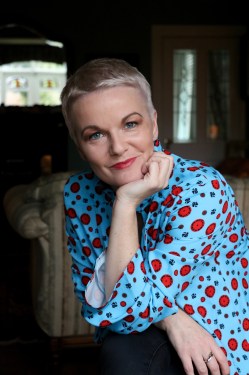
Writers Chat 12: Catherine McNamara on “The Cartography of Others” (Unbound: London, 2018)

Catherine, You are very welcome to my WRITERS CHAT series. Congratulations on your second collection of short stories, The Cartography of Others (Unbound: London, 2018) ,which transported me into other worlds, as good stories do!

CORRECT thumbnail

SG: First and foremost, tell me a little about how you went about assembling the collection. There are many award winning stories here and your stories cover a wide span of geography in terms of where they are placed yet we often feel we are in familiar territory. How important was setting for you in compiling the collection and selecting the order?

CMN: Great question! It was very complex for me to select the story order, and I had story titles on bits of paper flying everywhere. Because around half of the stories are set in West Africa, and the others mostly in Europe and Australasia, we had to keep the locations apart. It was also important to separate common themes or elements, and more titillating stories from slower, quiet ones. Rhythm was so important. Some of the stories are heavy and require breathing space, others race on and are more light-hearted. Another factor to consider in selecting story order was the gender of the protagonist – and not have the ‘female’ or ‘male’ stories bunched together – and we also needed a good distribution of first, second or third person pieces.

The main factor however was setting, as the reader needed to be gently tugged from one place to the next. My hope was that these faraway environments would feel vivid and tangible amongst more familiar settings such as London and Paris.

SG: Yes, that’s actually an element that I enjoyed – not knowing where I’d be transported to next! Some of the stories have fantastic first lines. For example, the opening of one of my favourites, “Magaly Park” begins: “There is a murderer in the new apartment block on the Point in the garage downstairs, it’s all cordoned off.”

This really sets the scene and captures the atmosphere of the whole story. The narrator, Grant, is somehow disconnected from his surroundings and yet incredibly embedded in them. He sees but does not always feel everything. Tell me how important are beginnings for you?

CMN: I cannot start writing a story unless I am curious about where the first sentence will take me. Beginnings are essential for me, and once I can ‘hear’ a first sentence I will rarely change it or the first paragraph. Like the first notes of a piece of music, the first notes must set the tone for the rest of the story, and elicit a precise response from the reader. It is the voice and the echo chamber of the work.

SG: Yes, tone is so vital to the short story in particular. Now, many of the couples in The Cartography of Others have trouble communicating what they really want to say. Some resort to silence, others let their bodies speak. It got me thinking about the power of silence and the potency of voice. I’m thinking about “Adieu, Mon Doux Rivage” and “Three Days in Hong Kong” in which the narrator Philomena M manages to be humorous in her overt sensuality. And in “Return from Salt Pond” – “even her suffering silence was dialogue, insinuating itself along the cords of his brain, snaking with his thoughts, coaxing words from him that were unwilling and unclotted.” Can you talk a little about silence and voice?

CMN: This is a really interesting point.

The dynamic of the couple can be endlessly fascinating, with the alternation between spoken and unspoken, physicality and detachment, and the search for balance and equality – rarely attained. So much of the stories of our lives take place in our heads: we are almost always viewing, measuring, recollecting, and the short story is a wonderful avenue for exploring these alleyways, and the porous skin between thought and speech.

I do like humour. And the dry, slightly-tortured-dialogue-with-self in “Three Days in Hong Kong” was a lot of fun to write, with Philomena M’s sensuality a distinct character within the piece. Flaunted at the hotel window, her body changes from a sensual device to the channel she will use to recover her sense of self. Other stories like “Return to Salt Pond” chart the plunging of a rapport into miscommunication and hardening thoughts, while events and context hover around the protagonists.

SG: You also have a great eye for detail. At times I felt I was reading lines from notebooks, where maybe you had sat in a café people watching…(It’s something that I love to do!). For example, this wonderful description of Russian girls in Moscow “The Ukrainian Girl”: “the statuesque silken women who would one day decompress into their pillowy mothers with pincushion faces and arms.” Can you tell us a little about your methods for recording the physical aspects of your characters.

CMN: Thank you, Shauna. I hate to say that I am hopeless with notetaking. I’ve tried recording details and scenes in notebooks – as I imagined a real writer should do – but I rarely look at them again! I know there are a few mostly empty Moleskins around the house.

When I have an idea for a story I become immersed in its fabric and I really enjoy creating characters from scratch. Recalling locations or perhaps people I’ve observed, and really sewing these new beings into the piece. I love the act of writing and I try to switch on as much of my brain as I can – tuning in with the subconscious where a type of magic occurs and images are thrown up, and the language takes on a pace and shape as the story progresses. I am always observing and listening to people. I’ll talk to anyone and if I’m not assessing them my subconscious probably is, storing up vital images, scents, energy.

SG: Oh how wonderful to be able to store images, scents and energy like that. I love the idea of storing an energy for a story. In this last question we return to place, and specifically, landscape. In many of the stories, the sea has a wonderful healing power and the land is stifling. In “The Bamboo Furnace”, the siblings return to “their sorrowful Eden”, literally battered and bruised by places they have lived in, and in “Astragàl” the emotions at Luna’s disappearance echoed by the view out the window (reminiscent of Hitchcock, I thought) –  “He looked up in a rage at the first folds of the peak and the summit in a crust of white pleats”. Can you tell us a little about the importance of the landscape in your stories?

CMN: For me landscape is a vital part of the story, often a character itself. In the opening story, “Adieu, Mon Doux Rivage”, the sea is a balm that unblocks the wounded voice of a Japanese soprano, while soothing the pain of the narrator whose partnership may be tapering to a close. The two mountain stories – “Astragàl” and “The Kingdom of Fassa” – were written to express our belittlement before the cruel alpine environment. In a world where many of our emotions and thoughts are responses to what we read online, it is almost refreshing to feel the plain power of nature, the dramatic simplicity of an accident, or the course of the seasons and the futility of man’s efforts to tame these forces. Like everyone, I am gravely concerned by global warming and the changes I already see locally (I live in the Veneto countryside, close to the Dolomites), so these stories are an attempt to record and value these places.

Having moved around a lot, I am fascinated by the harrowing effect context and environment can have upon a person. Displacement is one of my major themes, and several of the stories explore the discomforts of being an isolated foreigner. These can span from basic communication issues to the need to accept a different climate and culture, sometimes leading to a remodelling of self within the new circumstances. Some characters adapt and survive. Others, like Santo, a Ghanaian migrant in northern Italy in “The Healing of Santo Yeboah”, do not. In the final story, “The Cliffs of Bandiagara”, the magical highland of Mali and its celestial firmament bring enlightenment and harmony to an embattled couple.

 Finally, five fun questions, Catherine:

  1. Dogs or Cats?

Dogs! I live in the countryside and have a German Shepherd called Astrid.

  1. Paperbacks or Hardbacks?

Paperbacks from good bookshops.

  1. Mountains or Sea?

The sea – I’m a swimmer. But I live near the Dolomites and also ski and hike.

  1. What’s next on your ‘to read’ pile?

I’ve just started My Name is Red by Orhan Pamuk, and next up will read Watermark, a story collection by Australian Joanna Atherfold Finn.

portrait

Thanks again, Catherine, for stopping by and chatting.

Keep up to date with Catherine here: Facebook – Catherine McNamara, Twitter/Instagram – @catinitaly, Unbound – The Cartography of Others

The Cartography of Others is available at all good bookshops or online at Hive, Amazon UK

Writers Chat 11: Jane Clarke on “The River” (Bloodaxe Books: Hexham, June 2015) and “When the Tree Falls” (forthcoming, Bloodaxe Books: Hexham, 2019)

I’m delighted that the eleventh post in my “Writers Chat” series is with Jane Clarke where we re-visit an old chat about her debut poetry collection The River and talk a little about her forthcoming second collection, When the Tree Falls

janeclarketheriversmaller

SG: Jane, since the publication of The River in June 2015, you’ve been kept busy with one foot in the camp of creating new material and the other in continuing to give public readings, appearances and workshops.

You have also won various awards such as the Listowel Writers’ Week Poem of the Year Award (2016), Hennessy Literary Award for poetry (2016). And, of course The River was shortlisted for the Royal Society of Literature Ondaatje Literary Award. Many congratulations!

How have you found this process of managing the private creation of new writing and the public promotion of ‘old’ writing?

JC: Thanks very much, Shauna, for republishing my previous interview. It has indeed been a very busy time but well worth it to have so many opportunities to read my work, to meet readers and to perform with other poets and also musicians. The River has taken me to all kinds of interesting places and I’ve been honoured and delighted with the response to the poems. The private work of the poet entails getting new poems going and then working to get each one as good as it can possibly be. You definitely need plenty of quiet, reflective time for this. But when the poems are ready, I believe it’s really important to get them out into the world; readings, prizes, social media, youtube are all ways of doing that. I once heard Don Patterson say that poetry is a public art and I agree. Poetry, like music, needs the interaction of writer and reader/listener through live events.

I never expected such a warm response to The River. It’s a privilege to touch other people’s lives in this way. There’s nothing better than someone telling me they have The River beside their bed, or that the copy on the kitchen table is dog-eared or that they’ve given it to a friend who’s ill or that someone borrowed their copy and never gave it back or that their mother loves it. I’ve learned that when you publish your poems, you give them away and these intense little objects gain meaning and resonsance for others that has nothing to do with me personally.

SG: Yes, for a writer it is heart-warming to receive responses like that from readers. There’s a magic to how published work gains a life and meaning of its own, a beautiful exchange of a gift between the writer/writing, and the reader/reading.

Can you tell us a little about what you’re working on now and how your second collection is coming along?

JC: Yes, I’m working on my second full-length collection, When the Tree Falls. It’s due for publication with Bloodaxe Books in the autumn of 2019, which I have to say is both daunting and exciting. I feel very fortunate to have the support and imprimatur of my editor, Neil Astley and all in Bloodaxe Books. The experience of accompanying my very close friend, poet Shirley McClure, and my father in their final illnesses has deeply influenced this collection.

I know there’ll be poets reading this interview who miss Shirley very much. She was warm, generous and beautiful, a gifted creative writing tutor and a smashing poet. Her many fans will be glad to know that her publisher, Arlen House, plan to bring out a Collected Shirley McClure over the next year or so.

I’m also working with the Mary Evans Picture Library in London on a sequence of poems in response to a World War I family archive of letters and photographs. I’ve never worked on a project like this before and I’ve learnt a lot about the First World War and also the wealth of other artistic responses to the war, including poetry. It’s quite a challenge to find fresh ways of writing about the experience. I’m conscious of the dangers of over-statement and worn-out imagery and have sought an allusive, “tell it slant” approach.

One other piece of work is co-editing, with Nessa O’Mahony, the special Irish issue of the much-loved UK poetry magazine, The North. It‘ll be published late this year with a big launch in Poetry Ireland. We hope it will showcase lots of wonderful work by Irish poets and reflect the incredibly vibrant poetry scene here. I’d like to acknowledge Peter and Ann Sansom’s generosity and vision in giving us this opportunity to present and promote Irish poetry.  It is particularly valuable and resonant in the midst of the anxiety and sadness about Brexit.

SG: Jane, it sounds like you are in a powerful creative space, right now.

I love the title of your next collection, When the Tree Falls. And what a wonderful tribute to your dear friend Shirley, and your father, that the privilege, heartbreak and grief around their passing has been so carefully and lovingly tended to in poetry.

It is heartening to hear that Arlen House will bring out Collected Shirley McClure.  

The world war poems sound fascinating, I’m already intrigued by the process. Thank you for sharing that.

I really look forward to The North, and congratulations on what sounds like a brilliant project.

Now I’d love to hear about any readings or events you have coming up over the next while.

JC: I’m looking forward to going to the Lake District to run a “Writing & Dry-Stone Walling” workshop with James Rebanks, the author of The Shepherd’s Life. Both our books were shortilisted for the Ondaatje Award and we’ve kept in touch since. The workshop is part of the Rural Writer’s Institute and I’m looking forward to meeting lots of other rural/nature writers there. http://www.kathrynaalto.com/writing/rural-writing-institute/

The poet, Eileen Casey, has edited a new anthology of poems responding to the poetry of Patrick Kavanagh. As he’s one of my favourite poets, I’m honoured to have a poem included, responding to a gorgeous short poem of his, “Consider the Grass Growing.” The anthology, The Lea-Green Down, will be launched in the Irish Writers Centre on the 18th July at 6.30pm. I also have a new poem in the Arlen House/Hodges Figgis Anthology, Reading the Future. I’ll be reading at one of the series of launches planned over the coming months.

At the end of August I’ll be going on the road with the wonderful traditional and classical musicians, Eamon Sweeney and Cormac Breathnach, for a series of concerts as part of Heritage Week, 2018.  I’m giving a talk about the First World War poets and reading from my own sequence in Richmond Barracks as part of the Festival of History in October. And on the horizon, there’s another trip to the US for a number of readings.

SG: It really sounds like you have a wonderful few months ahead of you, Jane. I wish you the very best of luck and I’m sure both you and your audiences will enjoy the events very much.

Thanks, once again, for stopping by and I’d love to have back to talk more deeply about your second collection.

Below is our Q&A originally published in October 2015.


Q&A with Jane Clarke originally published in October 2015. 

First of all congratulations, Jane Clarke, on the publication in June 2015, by Bloodaxe, of your debut collection The River. It is beautifully produced with a front cover image that somehow reflects the depth of the emotions and narratives within. I’m delighted to feature you on my blog and chat about The River.

SG: I’d like to learn more about the process of ‘producing’ The River. How did you select the 50 poems that made it to the final collection and how easily or difficult did the title come to you? And finally, did you have any input to the design?

JC: I began writing poetry ten years ago and about four years later I started to think about drawing together a collection. It took another four years before I had it ready to send out to publishers. Over that period I did an MPhil in Writing in the University of South Wales where I was given invaluable help with my growing collection, including the crucial advice not to rush it and to take more time. It was relatively easy to select the poems because I was adamant that only the very best of what I had written could go in. There were a few I wasn’t sure about which got moved in and out a number of times. The collection was accepted for publication in late July 2014 but I was still editing newer poems for it right up to the day I sent the final manuscript in March 2015. The hardest part of  “making” the collection was the sequencing, which I changed many times. In ways it was like writing a poem; doing a draft, reading it, redrafting, putting it away for a while and then coming back to it and drafting again. In shaping the collection I was looking for a thread through the collection as a whole as well as variety and movement and also resonances between and among poems. My friends and colleagues, Shirley McClure, Geraldine Mitchell, Grace Wells and Yvonne O’Connor all helped me with this along the way. Meantime my workshop group was helping me with individual poems.

One of my first ideas for the title was Where the river deepens so the river was there from the start. Somewhere along the way I realized I wanted it to be The River, to reflect what I saw as the strongest poem in the collection and also to reflect the themes of change and loss and what nature offers us.

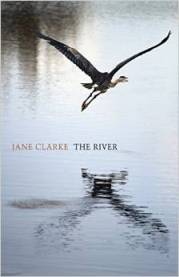
I had very little input into the design and I was more than happy to leave that to Neil Astley.  When he wrote to confirm that he would be publishing my collection, he suggested the image of the heron, inspired by a line in one of my poems, “River at Dawn”.

………………………………………… A Heron flies up

from the callows, leads river and rowers

into the day, lean in, catch, pull back, release.


I love the cover and the lay-out and I have no doubt that the beauty of the production has brought quite a few readers to the book.

SG: As a fiction writer, I am always fascinated by and in awe at how poets often seamlessly feature place so strongly in their work. In this collection we move through fields, farmyards, rivers, lighthouses – some place-specific – and cities. Parallel to place, notions of ownership and belonging seep through as themes. Was there a conscious sense of themes corresponding to places in your life as you pieced the collection together in the order that it is in, or was this something that appeared organically?

JC: When I began writing I had no idea that place would feature so strongly in my work. But the poems kept coming out of the landscape and physical surroundings of various times in my life; growing up on a farm in Roscommon, my fifteen years studying and working in Dublin, living in Wicklow since then and other places that have mattered to me along the way. I can see now that the physical details of place both carry and express the emotions in my poems. The containment of place gives me a way of exploring relationships, ambivalent emotions and themes of belonging and identity. But I did not set out intentionally to do that. I have learned from drawing together my collection that if you let it, poetry will inevitably reflect and engage with your questions and concerns at the time you are writing. Some of these are questions you will repeatedly return to and others are of a particular time. I have been amazed to find how much of the process of writing poetry is an unconscious process. That is not to say that it doesn’t involve conscious dedication and craft but there is a well of unconscious associations influencing the work that sometimes seems magical. For example I only realised that “Among the Cows” was inspired by my grandmother’s life when I put it next to another poem about her in my collection.

SG: That’s fascinating, Jane, how the themes grew organically. It’s true that place in The River also extends to the place of our hearts – and memories. I’m thinking of the first poem in the collection: ‘Honey’ or ‘Rhode Island Reds’, poems which begin in one emotional, almost sentimental place, and end, shockingly and yet movingly, in an entirely different place. Or, in contrast, the brilliantly titled, heart wrenching ‘Every life’ which grounds us in the bodily place of possibility and impossibility.

JC: Thanks Shauna, I appreciate how you express your response to my poems. For me, part of the power of poetry is how it can allow the poet to write out of and into loss, either their own or the imagined loss of others. I have these lines from Macbeth on a yellow post-it above my desk, Give sorrow words; the grief that does not speak whispers the o’er-fraught heart and bids it break. To do this without sentimentality or self-pity, you need to be available to a depth of emotion as well as being able to stand at a distance from it. The restrictions of the poetic form can contain grief that feels uncontainable. Poems can’t give resolution or consolation but I have found that they can say what seems unsayable, evoke what has been unknown and that they can accompany, comfort and sometimes sustain others. Robert Frost says it for me: “A poem begins with a lump in the throat; a homesickness or a love sickness. It is a reaching-out toward expression; an effort to find fulfillment. A complete poem is one where an emotion has found its thought and the thought has found words.”

SG: That last line by Frost could apply to any form of creative writing, actually. Now while many of the poems are solid, and grounded in the specific, there are a few that have an undercurrent of the unconscious world of dreams, where danger is at the edges waiting to be acknowledged. The magical first stanza of ‘On the boat’:

“On the boat we were mostly virgins,/We talked about who we were going to be – /waitresses, seamstresses, nurses,/we didn’t talk about why we had to leave.”

Could you tell us a little bit more about this poem, for example the use of ‘mostly’ and the sense of journey and hope.

JC: I am always a little wary of talking about what a poem means for me because I don’t want to influence the reader’ response. But I know myself how interesting it is to hear a poet write about the background to a poem. “On the Boat” was inspired by Julia Otsuka’s novel, The Buddha in the Attic, about Japanese women migrating to the US in search of husbands. It set me thinking about all the Irish women who had migrated to the States in search of a better life.  A visit to the Tenement Museum in New York’s Lower East Side also influenced the poem. The first line is the first line in Otsuka’s novel and what I liked about it was the question in “mostly” that let us imagine all the many reasons women left their home places apart from poverty or a sense of adventure, including rape, sexual abuse and pregnancy outside of marriage. I think it is what is not said as well as the strong rhythm, rhyme and repetition of the pantoum form that conveys a sense of mystery and at times menace as well as hope. There is also the intimation that regardless of getting the opportunity to start all over again, there are memories both wanted and unwanted that we carry with us.

SG: Of course, it’s a bit of a tricky question – almost like asking about inspiration! And now to my last question. Kent Haruf, one of my go-to writers who sadly passed away last year said in his last interview “The obvious thing is to read, read, read, read, read. Then write, write, write. There is no way around it.” As a poet, can you relate to this? When you are not writing, what are you reading? And what are you reading right now?

JC: I loved Kent Haruf’s Plainsong, Shauna. I hadn’t read his advice before but I totally agree with it. I find that reading both prose and poetry feeds my work. Reading sets off thoughts, memories and emotional responses. It can be a place, a time, a person that is evoked or sometimes just one word or a mood or tone sets something alight. When I haven’t been writing or when I want to get something started but can’t find a way in, it helps to take out a poetry anthology or a collection from a poet that interests me, read through it at random and just see what is sparked off.  I always have a novel on the go; at the moment is Americanah by Chimamanda Ngozi Adichie whose writing is just getting better and better. I’m reading Caitriona O’Reilly’s latest, Geis and also Philip Larkin these days as well as dipping into Richard Mabey’s Weeds. I’m also reading Colm Tóbín’s  very personal study of  Elizabeth Bishop, who is one of my favourite poets. I remember when I first read her advice  to a younger poet, “read a lot of poetry – all the time… anything at all almost that’s any good, from the past – until you find out what you really like, by yourself”. Only then should one proceed to “the great poets of our own century… and not just two or three poems of each… read ALL of somebody. Then read his or her life, and letters, and so on… Then see what happens.”

As regards the second part of Haruf’s advice, “write, write, write”, it is good to be reminded of it. The more I write, the more I need to write. There can be so much fear asscoiated with writing; fear of exposure, of failure, of coming across as ridiculous and yet we have to risk it, we have to put ourselves into words if we want to move closer to the writer we want to become. The advice I would add to that of Haruf and Bishop is to join a writing group and to set up a poetry reading group, on the lines of a book club.

SG: Thank you to Jane for such informative, and open answers. You can listen to a wonderful interview and reading with Jane on RTE Arena here and keep up with Jane’s readings and poetry on her website.

Jane165HiRes


Writers Chat 10: Justine Delaney Wilson on “Listen for the Weather” (Hachette: Ireland and Australia, 2018)

front cover

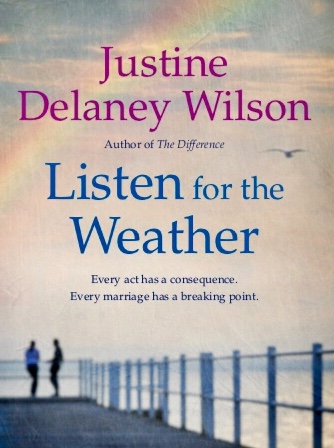
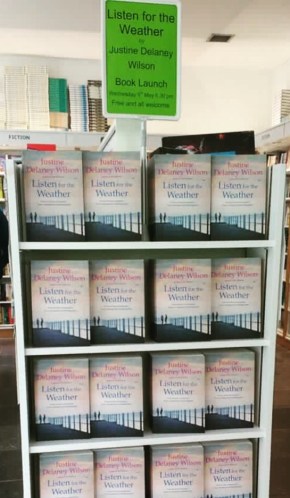
Justine, You are very welcome to WRITERS CHAT. Congratulations on your second novel Listen for the Weather which was launched in May at the wonderful Gutter bookshop in Dublin.

gutter sign

SG: Reading Listen for the Weather I found the voice of the narrator Beth combined with the short scenes really moved the story along and I just kept turning those pages! It was very much pitch and pace perfect. Can you tell us a little about how you picked the voice and the structure through which to tell the story of Beth and Steve’s marriage?

 JDW: Thanks Shauna. That’s really lovely to hear. My writing style tends to be sparse and precise, and my scenes and paragraphs always on the short and punchy side. Sometimes, I’ll make a conscious effort to let a scene breathe a bit more, to really give it some room or extra time, but it will jar with me immediately when I read it back, and I’ll end up putting a red line through everything that I added in the misguided interests of  fleshing things out.

I like to read fiction that doesn’t give me a mountain of background and isn’t heavy on set-up detail; I want to get straight into the heart of things. I appreciate writers who plate-spin throughout the text, allowing me to pick up the observations as I go. I rather fill my cup with the characters’ joy or pain, and with the truth of things. Not with a lot of front-loading about smells or the colour of the curtains.

I enjoy reading short stories for this reason – the writer’s time and space is precious, so everything superfluous has been cut away, and I find the writing is powerful as a result. I don’t know if I’m actually more of a natural editor than a writer really, in that I always want every single word to justify itself. My background is in research and writing for television, and journalism, so perhaps it comes from a learned need to keep things lean and concise for broadcast or for the allotted space.

In terms of writing in Beth’s voice, at this stage I know her character so well that I can second-guess her thoughts and actions in most situations. I understand what motivates her so I find writing in her voice feels natural.

SG: That’s the wonderful advantage of being with a character for so long, isn’t it. You really know their nuances, like a dear friend. Listen for the Weather is set mainly in New Zealand but there are scenes in Ireland. How important is place to love? Tell me about the split setting, one which you have experienced in your own life.

JDW: This book opens in New Zealand, a couple of years after the Rogers family moved there. My previous novel The Difference, which came out this month two years ago, was almost entirely set in Ireland, with the family’s move to New Zealand coming toward the end. Listen for the Weather is a mirror-image of it, in a way. Beth and Steve have moved to the other side of the world to outrun damage to their relationship and to escape the containment of their old lives. But of course, no amount of running, no matter where, will save any of us from ourselves.

Place is important, in that it informs and shapes our identity. And yet, it also isn’t; when faced with a threat to our family and the loss of everyone we love, we see that it is people who are our home.

I left Ireland early in the Autumn of 2016 to go to New Zealand, and I came back in the Spring of last year. I wrote most of this book while I was away, and then I returned home to a familiar place, and to similar weather as when I’d left – But everything just felt off.  It reminded me of the ‘Crowded House’ line; Walking ‘round the room singing stormy weather. I remember hearing Neil Finn interviewed about that song, Weather with You. He talked about how we create our own weather, how we are always making our own situations. I definitely think my feelings of dislocation and of having to make my own environment in New Zealand – a new life, new securities for my children on the other side of the world – informed my writing of this story and my depiction of the characters.

SG: Having lived away from Ireland for many years myself, I can totally understand that strangeness of being in your ‘home’ country and feeling totally out of kilter. I love what you say that it is people who are our home.

Now tell me about the role of the video calls Beth makes to her mother back in Ireland. What a great device to bring us out of Beth’s head, reminding the reader that another world, another past and indeed another present exist. It’s also a reminder that no matter how difficult the circumstances or experience you are going through, the normality of life is always continuing elsewhere. And yet, the normality often hides other depths, as we learn later in the book.

JDW: Through video calls we catch moments of what we’ve left behind, or what has left us. But, like photographs, these calls only show what’s in frame at the time. Sometimes what’s in frame can relieve and sate us, but sometimes it can also mislead.

Beth’s mother, Johanna, has been tethered to her own desperation for much of her adult life and so has only ever been available to Beth in a very limited way. That said, her familiar mannerisms and expressions during these calls do provide her daughter with some comfort when she desperately needs it. Small hints of Johanna’s hard-won insight into the reality of love, which comes much later in the book, are suggested earlier in some of her seemingly throw-away comments over Skype.

launch shelving

SG: I have to admit my opinion on Johanna changed as the story unfolded, for the very reasons you cite above. Having said that, my favourite character in Listen for the Weather was that of Mae, and how, many times, she is the only one of the family who is grounded in who she is and how she is – she is the solid comforter. For example in the scene when they are driving to the zoo, it’s Mae who asks for Beth’s hand right when Beth needs to be comforted. And in Ireland, it’s Mae who is the touchstone for Beth and her granddad. Really, she is herself, and not trying to fit into a role that society or family has created for her.

 JDW: I’m drawn to write about emotional turbulence – the power-plays in families; the betrayals within relationships; the sense of being at odds with your place in your own domestic world – these ordinary, but difficult, human things. Against this backdrop of adults feeling their way along their own jagged paths stands the character of 7 year-old Mae.

Mae wields a clear and positive power in this book. She manages to love more, but care less. She’s full of empathy – she is the emotional barometer in the house – and yet is nobody’s fool. I think she brings her entire family to life in a way that otherwise might never have happened for them. Mae’s disability allowed me to explore new jealousies in this novel – the uncomfortable envy a mother feels toward a ‘perfect’ child, a little girl who doesn’t have special needs.

Through the innate honesty of her daughter, Beth comes to see and cut through the artifice around her. And it’s from following Mae’s lead that she manages to get her head around what it is she needs to do.

SG: Throughout Beth’s journey, she gives us some beautifully poetic insights into her experience of what love is, or can be – a few of them:

“the heart has a blind spot….isn’t that the human condition? To desire what is not certain.”

 “love chooses not to see, chooses to ignore what doesn’t suit it.”

“The affair is a “tear in the fabric of life.”

“Most of love’s power is how badly it hurts.”

“Love with our eyes open. With the dark colours, as well as the bright.”

Was this a theme that you were always going to write about or did it emerge in the writing of the novel?

JDW:  From the get go, I wanted to look at love in this book. I think everything comes down to love, really. Having it, being denied it, growing up without it, learning to hold onto it, messing it up, confusing it with something else, confusing something else for it, cherishing it.

I’m intrigued by the accepted idea that love is kind, because it isn’t always. The “You are perfect as you are. You complete me” sort of thing doesn’t interest me at all. There’s a laziness in that idea of completion, of having reached some idyll. It’s not the sort of love I want to write about, or even read about. Love is active; it bowls you over, for better and worse. And it keeps pushing you back on yourself, on your own resources, into a space where you think and grow. Beth comes to realise that life is possible for her without Steve, which is the place I needed her to arrive at. Whatever way she goes after that is then a real, eyes-open decision, and not just one based on blind panic or lack of courage.

SG: Yes, I enjoyed being on that journey with Beth, as hard as it was in places, a realisation and a choice based on strength. As you say, a real decision.

Thanks for popping over to participate in my Writers Chat Series and for your generous answers, Justine. To finish off, I’ve five fun questions for you:

Mountains or Sea? The sea, most definitely. The sounds, the constant movement, the tidal changes, the sense of possibility. I had the privilege of living at the ocean in New Zealand and I must say that having half an hour in the evening to walk or sit at the water’s edge is something I’d highly recommend. Mountains are all very well but they don’t hold anything like the same fascination for me. After five minutes, I could probably give or take a mountain, to be honest. I like to be amongst things, amongst possibilities and activity, and I associate mountains with distance and seclusion. A city with a coastline would be my ideal. 

Coffee or tea? Tea. I’m a very committed tea drinker. The kettle in my house is always either on or still warm from the previous cup. I don’t like coffee, which is probably just as well because I’m not the best at things in moderation, and tea seems like the lesser of two charming evils.

Kindle or Paperback? Oh, paperback! I don’t own a kindle and I hope nobody ever buys me one. I like to feel the pages, to turn them, to flick back if I need to, and occasionally I’ll write on them. I love the physicality of books – the cover, the smell. And as décor, there’s surely nothing better than shelving full of well-read books, their spines lined up together. The fact that books don’t need charging is also glorious.

What are you writing now? In the latter stages of every manuscript, I swear that I’ll NEVER do this to myself again. But then the finished book comes out, and I see it in someone’s hands being read, and I quickly forget the pain of its birth. The faucet for the next novel is dripping away in the background here already. It’s called An Open Door and is set in present-day Dublin and 1990s New York.

What’s next on your ‘to read’ pile? My TBR pile was so high recently that I had to split it into a Pile A and a lesser Pile B. I was starting to feel some anxiety at the height of the tower glaring down at me. So on the top of pile A is The Long-Winded Lady, which I’ve already started. It’s a collection of Maeve Brennan’s columns for The New Yorker between 1954 and 1981, recently published by ‘The Stinging Fly’. Below Maeve, and currently in the following order to be read, are; White Houses by Amy Bloom, Problems by Jade Sharma, Norah Hoult’s Cocktail Bar and the just-added Calypso by David Sedaris. I’m dying to read Kudos by Rachel Cusk. She is among my favourite authors and this is the final book in her recent trilogy. I’m waiting for my copy to arrive, and it will rudely jump to the top of Pile A when it does.

JDW Nov pic 2

Connect with Justine on Twitter @justinedelw and her publishers @hachette

Look out for Justine in the media – articles and interviews coming up in The Irish Times, Daily Mail, Sunday Independent and The Gloss.