I’m delighted that my interview with Maya Sonenberg about her latest short story collection Bad Mothers, Bad Daughters has been published over on Compulsive Reader run by Magdalena Ball. Maya and I talk sensory writing, naming our characters, the importance of objects, how stories in a collection can echo each other – and more! Read the interview on Compulsive Reader here.
With thanks to Magdalena Ball at Compulsive Reader for accepting our interview for publication. Thanks also to Kristina Darling at Penelope Consulting for providing me with a proof copy of Bad Mothers, Bad Daughters, and to Maya Sonenberg for her generous, open answers.
Bernie, You are very welcome to my WRITERS CHAT series. Congratulations on This Train is For (No Alibis Press: Belfast, 2022) – a fantastic short story collection with, as Jan Carson has said, “not a word wasted or misplaced.”
Cover of “This Train is For” by Bernie McGill showing interior of a train carriage with a suitcase by a window. Light slants on the floor in front of the suitcase. The train seat is empty. (Photograph provided by author)
SG: Before we get into the details of the stories in this collection – your first since 2013 – could you tell us about how you put it together in terms of themes and order. A number of the stories have been previously published in award winning anthologies such as The Long Gaze Back and The Glass Shore and other stories debut in This Train is For.
BMcG: I was aiming for a mix of stories in the collection that reflected what I had been writing over the last few years. Some of the stories were written in response to a commission, some were not. I don’t tend to think about theme when I’m in the process of writing, but looking at the stories together, I can see that certain themes do emerge. There are concerns about the ways in which women and girls have been treated in Ireland, north and south, over the course of the last seventy years or so; stories that touch on Troubles-related violence and on the particular identity of being Northern Irish, and stories of lives that are fractured by aspects of loss. When we were ordering the stories for the collection, we tried to alternate between work that had appeared in previous publications and work that was unpublished. It seemed a good idea to open and close with new stories so we placed ‘This Train is For’ at the beginning since the collection takes its title from that story, and ‘In the Interests of Wonder’ at the end. The last line of the last story contains an allusion to mischievous intent that we liked as an ending to the collection.
SG: I love that connection. Brilliantly done! I’m particularly interested in how many of the stories explore how we inhabit places and how they inhabit us, too – from seats and windows on public transport in the opening “This Train is For” to spaces in houses that are familiar and also strange in “The House of the Quartered Door” and “The Escapologist.” Places offer opportunity for healing and hiding. Can you talk a little about this?
BMcG: I wrote the notes for ‘This Train is For’ while I was working as Writing Fellow for the Royal Literary Fund at Queen’s and I was travelling, two days a week, on the train from Coleraine to Belfast and back. I wasn’t getting much time to write so I started note-taking on the train journey, watching out the window, and it struck me how untethered an experience a train journey can be. I got interested in the idea of being transported: I could see other passengers reading or sleeping, listening to music on headphones or watching video on their devices, apparently unaware for the most part of the places we were passing through. There are no road signs when you travel by train: the only named markers are the stations. We were passing through the places in between stops without any real sense of where we’d been. So I started to trace the rail route by map, and to research the names of the townlands the train passed through, their etymologies and histories. I spent a great deal of time poring over the online maps at PRONI (the Public Records Office for Northern Ireland), and on the website for the Northern Ireland Place-Names Project at Queen’s. From that research came the voice of the main character who has worked all his life in maps, in the planning departments of local councils. That character is carrying a sense of dislocation. I was curious as to why place, or the loss of a place, might be playing on his mind.
Other stories are set abroad, in houses we’ve stayed in as a family when we’ve holidayed over the years. I’m fascinated by the clues that householders leave around. As a writer, you can’t help but begin to try and piece the lives of those absent people together, construct personalities and life stories, daily routines for the houseowners out of the paraphernalia that’s there. That’s an act of storytelling in itself, the decisions that an individual makes about what they choose to leave in their house for strangers to see or use. Some people may be consciously curating, creating an impression of a particular lifestyle by leaving a coffee grinder or a particular set of books; others may be accidentally giving something away that they’d prefer not to have divulged. ‘The Snagging List’ was inspired by a house we rented in Majorca; ‘The House of the Quartered Door’ by a friend’s house in Sardinia. It can feel quite investigative, staying in another person’s home. As soon as you have questions about the owners, stories begin to form. And I’m always curious about the reasons why a character might have gone to a particular place, so that’s where the healing and hiding comes in. Looking at the stories together, they feature quite a few people who could be said to be in transit: some are temporarily, others more permanently displaced.
SG:I think that’s what I particularly loved about the collection – it feels like stories for writers in the best possible way – and I totally pictured myself in those places and indeed, felt like in other (transient) homes too. You’re wonderful at understatement and this comes from, in part, your lyrical, poetic language – we are so lost in the descriptions and details of what surrounds the character that we almost miss the emotional heft of a moment yet we still feel it. I’m thinking about “The House of the Quartered Door” where Gina is in Sardinia mourning the passing of a relationship which didn’t happen (her biological mother) and one which did (Annie):
“The door handle from the bedroom above has left a purple bruise on her upper arm the shape of a comma, or an apostrophe: a pause, or a sign of something missing, or of something belonging, perhaps. She keeps forgetting that the door handle is there, keeps catching herself on the same spot.”
Similarly, in “A Fuss”, grief is explored without fuss where Rosa is returning home for a funeral, where “they are all practiced in the theatre of mourning” and all of her emotion is captured thus:
“The sky is a strange green hue. From behind a barn, something rises, like a handful of soil thrown high into the air, then just at the point at which it should fall, it takes shape into a flock of starlings, turns, rises higher, dissolves into the darkening sky.”
Can you talk about how you use poetic language as part of the narrative?
BMcG: Those images are born out of observation, often out of moments of quiet contemplation. If something catches my attention, I’ll note it down and squirrel it away. The story and the character are built from those small observations. They start with me and I don’t know to begin with what characters I will give them to, or how they will fit into a story. I think the act of recording them helps to commit them to memory, so they rattle about in my head for a while until they find a place. It’s no accident that many of the stories began life when I was away from home, away from the daily concerns that keep us so distracted from noticing and appreciating those small moments that can hold such significance for a character.
SG:It’s so often the small moments that turn into something significant, and they keep the story with us long after we’ve finished reading. Many of the stories here evoke in the reader a sense of the wonder – capturing a lost childhood, an open trust, a naivety that perhaps has been “grown” out of us as adults in a society where trust costs and we are taught to “other” those with perceived differences. I loved how you played with this in “The Interests of Wonder”, by inviting the reader to partake in the writing of the story by questioning –starting with the opening line “What kind of day is it, the day the magician knocks on the schoolroom door?”
BMcG: I experimented with a few narrative approaches in different drafts of that story. They didn’t all work but I did like the energy of that opening question and decided to keep it. The importance of cultivating a sense of wonder is something we often discuss in writing workshops. How do we retain or regain that impulse for exploration, the joy of discovery that we had as children, that is trained out of so many of us as adults? We seem to have lost the ability to play. We have a tendency, as adults, to think that anything worth doing has to be undertaken with great seriousness and focus and with the outcome always at the forefront of our minds. And of course you do need focus and discipline to finish a piece of writing, but it’s not what you need to start it. I often quote the writer Anne Lamott, from her book Bird by Bird where she writes about the importance of silencing the inner critical voice when setting out to write. There’s a time to listen to the editorial voice, but if that’s all you can hear when you’re beginning a piece, then you’ll never give yourself permission to write with the kind of abandon and experimentation that is required. You need to write initially like no-one need ever see or hear this but you. You can decide later what you want to do with the work, but if you don’t allow yourself to write it in the first place, you’ll never have the choice. The magician in ‘In the Interests of Wonder’ is a sort of antidote to adulting. He offers the audience at his shows – and in particular, the schoolteacher who is the focus of the story – an opportunity to escape the everyday.
SG:As well as the beauty of the writing in this collection, there is also an invitation to the reader to consider meta language and linguistical meanings behind and within what is said and unsaid. I really enjoyed how language is explored in “There is More Than One Word” where Jaynie is returning home to Belfast and struggles to remember phrases and words from her childhood, finds herself a linguistic stranger in her own home town, her language “thirty years out of date, fossilised in the 1980s.” In a way, you’re exploring not so much the multiple meanings of the English language in places and to people but the failure of language and words to capture the real, true human experience. In the end “There is more than one word for the heart but the word for her heart is sore.” Is this a theme that is important to you?
BMcG: I’ve always been interested in language and its many uses and interpretations. I’m the youngest of ten children. I grew up in a household full of talk. I can remember hearing a new word and turning it over on my tongue, trying it out for size, curious as to what it might look like on the page. My mother was once talking about a woman she knew called Celine and she pronounced the name the same way that we said ‘ceiling’ – we didn’t used to bother much with -ing endings in rural South Derry. When I asked if the woman was tall, if that’s why she had been named that, because her head scraped the ceiling, I discovered that not only was the name spelled differently but that there were people in other places who pronounced that name differently too – with the stress on the second syllable – and it sort of blew my mind. I learned that spelling and pronunciation and, I suppose, context as well, can alter meaning. In ‘There is More than One Word’, Jaynie remembers that, growing up, she had a different word for ‘kerb’. We often had words or phrases for things that were outside of standard English, expressions that were derived from Irish or Elizabethan English or Ulster Scots that we never found in books or heard repeated on the radio or television, but that were rich and layered and evocative and exact to our purposes. And yet there are times when language does fail us. When Jaynie’s sister phones her with the news that the family has been anticipating but dreading, she puts the phone down without speaking.
SG: Thank you for such a full answer – I love that story about Celine/ceiling. So, to finish up, Bernie, some fun questions:
Tea or Coffee? Coffee in the morning; tea in the afternoon.
Train or car? Train, all the way.
I should have guessed that answer! Music or quiet when writing? I can’t listen to anything with lyrics – I find it too distracting, but I listen to soundscapes on headphones to block out background noise: café sounds or rain on windows or (I do know this is sad, but it works for me) the coughy, book shuffly sounds of a library.
What’s next on your reading pile?Trespasses by Louise Kennedy. I’m saving it for a time of complete immersion.
It’s on my pile too! What’s next on your writing list? I’m working on a short story commission and there’s a longer story brewing, an historical piece, something to do with letters. I can’t talk about it, though, for fear of scaring it off.
I know what you meanabout scaring story away…
Photograph of Bernie McGill in a wood wearing a blue shirt and black trousers. (Provided by author, used with permission and with thanks)
With thanks to Bernie McGill for a great conversation, and thanks to No Alibis Press and Peter O’Connell Media for the advance copy of This Train is For.
Mia Gallagher (MG): Who do you believe were your major influences on your artistic practice?
Mario Sughi (MS): I’m not that sure Mia. Many times we confuse what we like with what might influence our work! You can like something and maybe just being influenced by something you don’t like I certainly like Francis Bacon (but I can’t see Bacon influencing my work) same for Giacometti (I went to see his exhibition today beautiful) I like his drawings and small sculptures. I like David Hockney (not everything) I prefer his early works (60 and 70), Alex Katz & Matisse (and I try to understand them! and to learn from them). I like Kafka, and Milan Kundera and I prefer Tolstoy to Dostoyesky, I like Beckett & Joyce, I like Piero della Francesca (but I can’t say they influence my work).
When it come to painting images come first but the quality of a painting (the brushes strokes and technique some time can make the difference and being the most interesting thing in the painting that is why I like some great American abstract masters, Franz Kline and even Richard Diebenkorn, and on the other side for the same reason I don’t like too much pop art. I like Fairfield Porter a lot I find Alice Neel very interesting but bit too illustrative/illustrator same for Paula Rego (I prefer Alice Neel to Rego). Hopper for me is not that interesting (voyeuristic and artificial, too illustrative). I met Alex Katz in person: I like his paintings and his writing same for Fairfield Porter (never met him of course). And what they do and write make a lot of sense (Alex Katz even more sense than Matisse at times). I like Lucien Freud for the image, not for the painting ( I don’t like his brushes strokes! not at all), and I like many many more, Manet, Chantal Joffe, Goya, Giotto….
Paul and Francesca, 2021 Image provided by and used with kind permission of Mario Sughi
MG: To what extend do you identify yourself and/or your work as Italian/European/Dublin…
MS: I’ m either on the bus or the dart and I’m looking at other people (they are Dubliners). My observation point is one that I really like (possibly one of advantage for me) – I have been here (Dublin) for so long that I can get very close to them – to that group of people – without almost being noticed, and yet I can still see them from an external point (of course) and this has nothing to do with being Italian Irish European. This has never been this my preoccupation; culturally speaking (probably) I must be Italian especially when it comes to work and European (when it comes to culture, mentality, etc) and Irish (when it comes to drinking Guinness in a pub).
Selfportait with fettuccine and Guinnesss, 2010 Image provided by and used with kind permission of Mario Sughi
SG: Mario, can you speak of your process in motion?
MS: Well…U walk the streets or seat at a bar looking at people walking or u move through town u feel attract and touched by some of the people there and you start following them with your eyes then when you paint or draw (or write) you hope you will be able to have that fleeting moment/image (as it appeared to u) present (still live) in your work. I want just to show it without having to add anything else (it has to be almost unconscious).
SG: I love the notion, Mario, of still living in the work, showing it still raw and unconscious.
MG: Mario, to what extent, if at all, you feel your Dubliners might be different to other images of the city and its people?
MS: If you draw an old lady smoking on a bench with a plastic bag in her hand alone in Stephen’s Green people will see and recognise her as a character. I would like to be able to draw her in a way that people probably will not even recognize her as a Dubliner (or not even as an old lady). As long as the image I create will maintain its optical energy and a some sort of plausible link with that lady I will be very happy with my work.
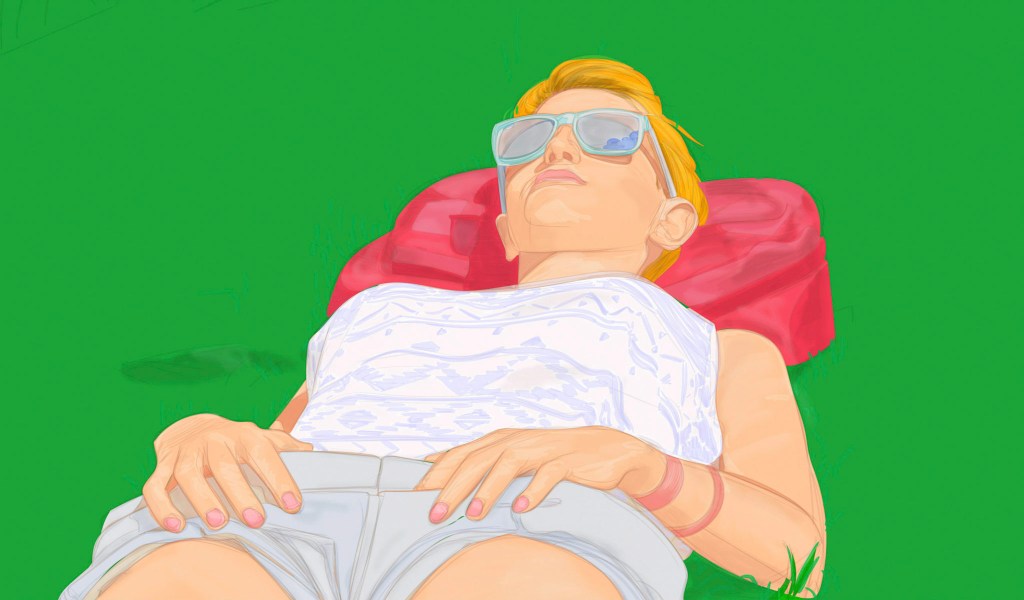
Red on green (A place to rest), 2017 Image provided by and used with kind permission of Maria Sughi
MS:…. and then there are people who say that my work is far too saturate, too colourful to be representative of real people! (so in other words is not serious!) but I think … maybe is just too colourful for them! not for me, for what I see…I think that under this regard we are quite similar as we only care to portray people the way we see them, we don’t have to be conventional!
SG: So much of what artists and writers do comes down to perspective and interpretation, doesn’t it!
Sarah and the yellow paper, 2020 Image provided by and used with kind permission of Mario Sughi
Thanks to Mia Gallagher and Mario Sughi for taking part in my Writers/Artists Chat Series and being so generous and open about their individual and collaborative processes.



 Shauna Gilligan Writer