I’ve had the fortune of working with some wonderful writers and mentors over the last week or two at The Irish Writers Centre in Dublin. I’m now at the stage where my writing needs to simmer. Writing with feedback. Writing that needs editing. Writing that needs re-writing. It’s always good to have a few projects on the go. Part of this process – for me – is to dive into reading. A few of the books that I’ll be immersing myself in over the next few weeks are pictured below:
Fishamble Firsts: An Anthology of First Plays by New Playwrights edited by Jim Culleton (New Island)
Good Behaviour by Molly Keane (Virago)
This Plague of Souls by Mike McCormack (Tramp Press)
The Inheritance by Cauvery Madhavan (Hope Road)
A Good Enough Mother by Catherine Dunne (Betimes Books)
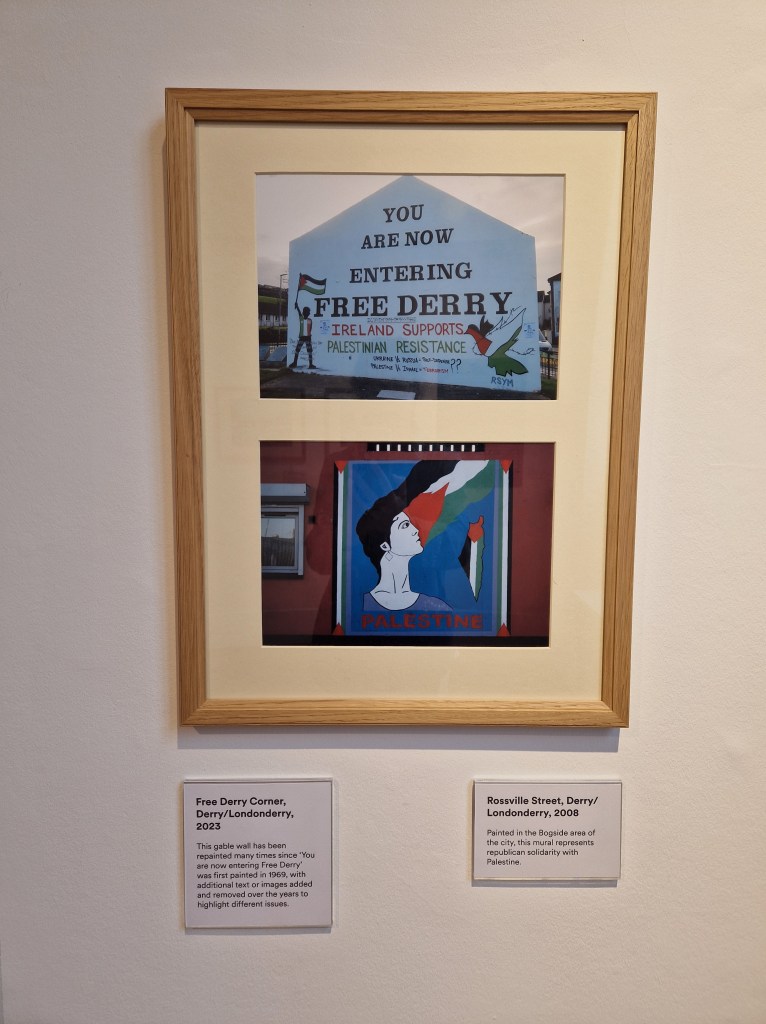
There’s always time when breaking a writing practice for browsing, considering, and pottering. This time, Botanic Gardens and Ulster Museum in Belfast. From outside to inside – journeys of family and belonging, to community expressions of oppression in murals, to documenting violence, to stretching back through time to love and betrayal.
Exhibition: The Other End of the Rainbow – Kourtney Roy Botanic Gardens, Belfast (Photo: (c) Shauna Gilligan)
Murals, Memory and Identity at the Ulster Museum (Photo: (c) Shauna Gilligan)
Caravaggio “The Taking of Christ” at the Ulster Museum (Photo: (c) Shauna Gilligan)
Threads of Empowerment: Conflict Textiles’ International Journey at The Ulster Museum (Photo: (c) Shauna Gilligan)
Writing through grief, disturbances, and uncertainty in a time of war and collective anxiety can be difficult, if not impossible. Jeanette Winterson in the New Yorker (thanks to Jeannine Ouellette for the link on her Substack post) writes that “People are frightened of not producing in this obsessed world of continuous work.”
All this uncertainty in the world – locally and internationally – can push us to give in to this fear, to believe that we are incapable of creating because we do not feel we can produce. Winterson, in the same interview, also points out that:
If you’re doing creative work, you have to move your mind out of its habitual executive function, its administrative mode, and to allow other things to come in, to allow patterns to emerge, to connect things in ways that are simply impossible when we’re just formatting stuff…
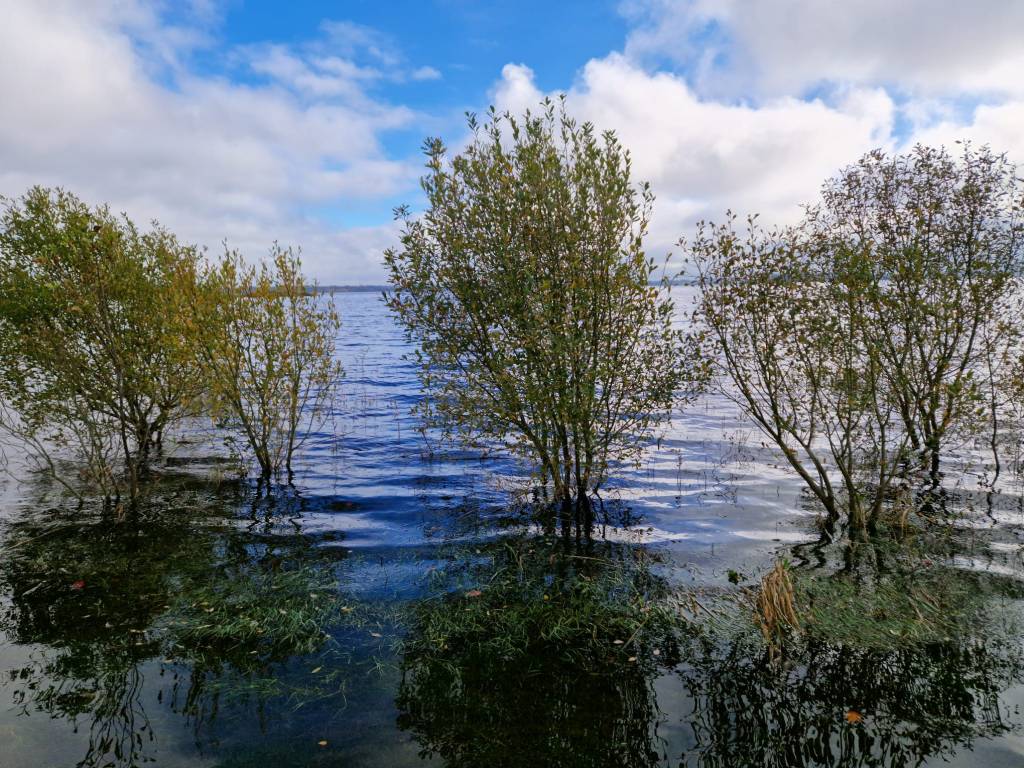
Photograph of Lough Ree by (c) Shauna Gilligan
When we are in a state of societal and political uncertainty, how do we move our mind out of its habitual executive function when it feels as if it is in a state of high alert? When even executive function can feel strained, and difficult?
Perhaps it is a matter of pausing. Of stepping back a little. Of accepting that so many things are out of our control. Remember what it is to show kindness to ourselves and to others – and especially to strangers. George Saunders has spoken of regretting his “failures of kindness”. In his convocation speech at Syracuse University, he reminded graduates that:
That luminous part of you that exists beyond personality — your soul, if you will — is as bright and shining as any that has ever been…Clear away everything that keeps you separate from this secret luminous place. Believe it exists, come to know it better, nurture it, share its fruits tirelessly.
Maybe instead of trying to create, or worrying that we are not fulfilling one of our roles – for our “produce” to mirror society – despite being too close, or everything feeling too raw – we might just think about that invisible, “secret luminous place” from which – surely?- creativity seeps.
(That is, if we are in a privileged position to have a safe space, and time, in which to do this.) Or we might pause to remind ourselves that amid – and despite – chaos, violence, and selfishness, we do, still, witness acts of kindness and selflessness. These acts of kindness shine and remind us what it is to be human. And to be human, as we all know, is to create.




 Shauna Gilligan Writer