Writers Chat 37: Nuala O’Connor on “Nora” (New Island: Dublin, 2021)

Nuala, You’re very welcome back to my Writers Chat series. This time we’re here to chat about Nora, your fifth novel, lauded by Edna O’Brien as “a lively and loving paean to the indomitable Nora Barnacle”. I read the US version published by Harper Perennial and the Ireland/UK publication with New Island was published April 10th.

Photograph of cover of NORA by Nuala O’Connor

SG: Much has been written about your lyrical, sensual prose and Nora is filled with it from when Jim and Nora leave Dublin on October 8, 1904: (“The air is salt-sweet and cool, the portholes beam light into the dusk”) to the letters and the food, which we’ll return to. But let’s start with “the indomitable Nora Barnacle” – by the end of the book I really felt I’d lived through Nora’s life with her, I felt like I knew her, I cared for her. You have managed to re-create Nora who feels real and complicated, a woman who knows her own mind and whose strength lies in her patience and openness to the human condition. Tell me about how you got to know Nora through your research.

NOC: I knew Nora Barnacle as Joyce’s strong, loyal, loving wife and muse but I was curious about how she felt about her life. Bio-fiction is about creating an interior world for people and I disliked the smudging of Nora by history. So I dug out my teenage copy of Brenda Maddox’s fantastic biography of Nora and was, once again, enthralled by her earthy dynamism, and by their love story. So I did what I often do when my interest is piqued, I wrote a short story about Nora. My story – ‘Gooseen’ – records their meeting in Dublin and their first date on 16th June 1904 – now immortalised as Bloomsday – and their flit to Europe. The story did well – it won a prize and was published in Granta – but I found I didn’t want that to be the end of my communion with Nora, I wanted to stay in her company for longer, and so I wrote on and on and on.

My aim was to illustrate that the so-called ordinary woman by Joyce’s side is, in fact, extraordinary. Nora felt, thought, lived and contributed hugely to their life, just as Joyce did. Nora helped Joyce stay grounded as she was pragmatic, optimistic, earthy, big-hearted, good humoured, forthright, and resilient – she was just what Joyce needed as a shy, sensitive, kind, loving, nervy, accusatory, opinionated intellectual. Nora flowed with Joyce, was water to his fire. They were both, like all of us, trying their best, and were under the influence of their upbringing, the prevailing mores and politics of their era, and their own personal quirks and passions – Joyce drank, he was unfaithful, he asked Nora to go with other men. Neither was a paragon – the same way we’re not – and my bio-fiction aims to show that.

SG: You have had glowing reviews and The New York Times declared that Nora is “entirely convincing in her raw sensuality, her stubborn determination, her powerful sense of grievance and her inability to stop loving a deeply erratic, wildly manipulative yet enormously talented man.

Nora is essentially about the relationship between her and James/Jim Joyce. On the one hand they are well matched physically and erotically, and on the other, Nora is always left to keep the family together, taking in dirty laundry (“I scrub away other people’s sweat, blood, piss, cack and grime with scalding, soapy water”) when they are short of money or when Joyce drinks his wages. How did you maintain that balance between the actual hardship of life – moving frequently, living through two World wars, worries about their young and then adult children – and depicting the deep physical and emotional love between Nora and Jim?

NOC: I don’t think Edwardian era Irish women expected an easy life – Nora had seen her mother, Annie Barnacle, battle through with eight kids and a drinking husband, and eventually separate from Mr Barnacle. If Nora had stayed in Galway, she most likely would have married and settled into a life like her mother’s: mass-going, having babies (lots of them), living within a State that was increasingly wedded to the church, that ruled people into submission; she would’ve been scarred by Civil War and the exodus of men to WW1 etc. By escaping to Europe, Nora was released from a strict, rigid, low expectation path. Fintan O’Toole believes Nora liberated Joyce from shame and snobbery; she certainly uplifted him by being strongminded, flexible, loyal, and direct. Nora’s head wasn’t bothered the way Joyce’s was – she was naturally optimistic, loving, and cheerful, so she could drag them both through a lot of their troubles. Her bravery hooked me into her story; her defiance of patriarchal rules, her bending away from State and church morals.

I like mavericks, women who push against societal norms. So Nora’s courage and her willingness to love the man she aligned herself with, despite his many faults, speaks well of her. She accepted, to an extent, much of what was unruly about Jim – his sensitivity, his need to drink, his discomfort with other people – because she was better able to negotiate all of that. Her love protected him and buoyed him up. In turn, his admiration of her strength, their bedroom bond, his love of her physicality and her stories, and his generosity in adorning her with furs, and tweed and jewellery, pleased them both.

SG: And all of that comes through, so very clearly, in NORA. Continuing with their relationship, you used the real Joyce letters (which you wrote about in The Paris Review ) as a basis to frame the many absences from which both Jim and Nora suffer equally. I loved the letters and how their passion contrasted greatly with the reality of ever-changing homes, circles of friends and cities. The constant is their relationship and, from your depiction, Nora is quite the scribe and knows to use words and food to keep Jim on her side! One letter opens with: “My lonely bed is tortured with desire for you, my mind leaps to disturbed places, I see you over me posed and preening, chaste, grotesque, languid…” Can you talk a little about how their use of letters opened the door for your Nora to be as much the erotic voice as Joyce (as we know and expect him to be!), as much present in her body as he is?

NOC: Joyce and Nora were in touch with their sensuality: they met as two young people who were proud of their bodies, and unafraid of sharing themselves wholly with each other. Joyce frequented prostitutes as a teenager and Nora had some experience of young men by the time she met Jim; she had walked out with at least three men that she told him about. And both Joyce and Nora enjoyed the erotic writings of Leopold Ritter von Sacher-Masoch, for whom masochism was named.

I had to rewrite Joyce’s letters as they are still in copyright – they were first published in 1975. And Nora’s half of the correspondence was not available, missing – perhaps destroyed – and I had to fill those gaps with imagined letters of my own. So I re-wrote Joyce’s letters by mimicking his real letters as closely as I could. I wrote Nora’s part of the correspondence using Joyce’s letters as a call-and-response guide. When he praised her for using certain stimulating phrases and words, I included them in her letters to him. Joyce planted the seed for the erotic letters – suggesting to Nora that there was a certain type of letter he would love to have from her while he was in Dublin and she was at home in Trieste – and she was well able to oblige.

SG: Yes, and even though she is a sensuous woman – shown though your sensory writing, the fabrics of clothes, furniture, the preparation of and eating of food – Nora is also practical. When Hitler annexes Austria in March, she tells us “I could fall apart thinking about it all – war, Lucy, Georgie – or I can get on with it. I decide to choose the latter” – which shows the strong woman she is – but at the same time, Jim is, she proclaims, “my whole life now…we have to get on with things as best we can, as a pair.” Despite his unreliability he does give her strength.

Real life events such as wars, the Rising, the Civil War in Ireland punctuate their lives and I thought you convincingly depicted some of the parallel difficulties – even for Joyce! – of the world of writing and publishing. We sometimes forget – when reading Ulysses or Dubliners, for example – that Joyce wrote from a particular place, in a specific era and, as you portray, often with serious health issues, notably his eyes. But in a way he could fall apart because Nora always understands him even when he is absent because “he needs to swallow stories many times in order to construct better ones himself”.

Thinking of the broader themes of the book I wondered if it was because their notion of home and nationhood was always changing, as well as the strength of their relationship and the financial and creative supports such as Weaver, that Joyce was able to continue writing, and write so much from the body?

NOC: They were extremely nomadic because Joyce liked novelty, but they remained loyally Irish, even if they grumbled about Ireland and Irishness. Joyce’s fiction is a prolonged love letter to Ireland. Nora liked newness too, but she understood its damage, also, and longed for a settle spot. Joyce needed tumult in order to write; in his biographer’s words, Joyce ‘throve on flurry’. Naturally, he needed stretches of quiet too, to write. As a couple, and later as a family of four, the Joyces moved house over and over, following a pattern set in Joyce’s own childhood, when his father led the family from their lodgings at night to avoid bailiffs. Uprooting home and family every few months, or years, is a sure way to have new writing fodder; in Paris alone they lived at nineteen different addresses.

You have to wonder what Joyce’s monomania about writing, as Brenda Maddox described it, cost the family as a whole. Maybe it was unfair on Nora, Giorgio and Lucia to be constantly relocated because Joyce needed discomfort in order to write, a sort of constant unsettledness, that settled him into the creative work.

SG: NORA had me wondering about that -his discomfort and creativity, the family being constantly uprooted. As well as passion there is much humour in the book. Sam Beckett, in particular, had me laughing. One of my favourite scenes was Bloomsday in Paris in 1929 where they go on an excursion and the “normally rather serene and usually very mannerly” Beckett and McGreevy sing “endless old songs like a pair of escaped lunatics.” It doesn’t help, of course, that Lucia is madly in love with Beckett, or that Jim “drinks wine until it nearly pours out of his eyes.” Once again, Nora is the rock of sense, the protector, with a wonderfully dry sense of humour. As through the novel I felt I was with them! Do you think that in narrating their lives through Nora’s viewpoint you gained greater insight and humour?

NOC: They were a humorous pair; both of them loved jokes, fun, wordplay, odd language, and silly songs, and Joyce’s letters to family and friends are full of mischief. He used humour in his work but also personally, to create levity in what were really quite difficult years to be alive, Ireland and Europe being war-torn and so on; their various health issues; the publishing challenges he faced.

The 1929 Bloomsday was celebrated that way – Joyce was feeling narky and he was envious of the youthful freedoms of Beckett and McGreevy, because they could make a show of themselves, whereas he, as famous writer and family man, was required to behave. I haven’t seen much discussion about Joyce’s drinking and the very real problems it both masked and caused. That Bloomsday Nora was fed up with it, as she must have been quite often. But she was naturally light-of-outlook and, clearly, she had a well of forgiveness to dip into too, so she was able to keep her heart out and get on with life.

SG: For our final question Nuala, I’d like to concentrate on the beautiful portrait you paint of the relationships between Nora and her children, Giorgio and Lucia. I was particularly taken with the portrait of Lucia from childhood to adulthood, Lucia who, polar opposite to Nora herself, “neither knows who she is nor cares to find out”.

On one of Lucia’s many hospitalisations as a result of her violent tendencies, both Jim and Giorgio point to the, at times, difficult relationship between Nora and Lucia, insisting that Nora not visit her in case she might be agitated. I felt you touched a little on the ‘mother blaming’ here. Nora wonders “if it’s the rearing we gave …or if it’s something that was already in her when she grew inside me. We’re born with a soul, maybe we’re born with all our faults, too?” (Later, after so many institutions and doctors and years of worry, Lucia is diagnosed with schizophrenia.) Can you talk a little about this mother-daughter relationship?

NOC: In NORA, I have great sympathy for the Joyces as parents of a child with mental illness. I have particular empathy with Nora as mother to Lucia, whereas others have demonised Nora, for her apparent lack of care about Lucy, who was diagnosed with schizophrenia in her twenties and institutionalised for fifty years. I don’t agree with this anti-Nora stance; it’s clear that Nora loved Lucia hugely and did as much as she could to help her, until Lucia’s illness became too much to handle in the home environment. Nora had Lucia’s care and, in my novel (and, I believe in life), Nora is fearful, concerned, but loving towards her daughter; crucially, she’s also pragmatic – she can see Lucia needs professional help.

Lucia hit her mother and threw furniture at her; she was volatile, unpredictable, sexually permissive, prone to disappearing for days on end, and she was sometimes catatonic, and often violent, and it fell to Nora to care for her. It’s frightening and worrying enough to have a child who suffers mentally, without being in fear of them too, and Nora bore the brunt of Lucia’s aggression. Added to that Joyce, for a long time, refused to believe there was anything seriously wrong with Lucy, which must have been an isolating experience for Nora, who could see that she was ill, out of control, and needed proper help. It was, in fact, Giorgio who first had Lucia sent to an asylum, but it is always much easier, in our patriarchal world, to blame the woman.

When Lucia was committed, Nora was often advised to stay away as she ‘excited’ Lucia. In 1936, in an institution in Ivry, Lucia tried to strangle Giorgio and Joyce when they visited. So they ‘excited’ her too, but that’s not what people choose to remember. Once, when Nora visited her daughter in a Zürich hospital, Lucia had painted her face with ink and was wearing an opera cloak. She was clearly very unwell and Nora wanted her taken care of properly. When Lucia went to Ireland to live with her cousins in Bray, she took naked sea swims; lived on a diet of champagne, cigarettes and fruit; went out without underwear and told people that; she went to pubs alone (unheard of for women); and set fires in her cousins’ house, putting them all in danger. Her condition meant she was volatile to be around and she must have found her own self troubling too. I feel strongly that Nora did her best in difficult circumstances; Lucia needed professional care and she got that.

SG: Thank you, Nuala for such insight into your process and research. We’ll end with some short questions:

What was your favourite city out of the those you visited as part of your research?Trieste was a revelation; I hadn’t been there before, so it had a shiny, newness for me. It’s a seductive place, ‘the jewel of the Adriatic’, sitting by that blue, blue sea. It’s still very ancient, with a huge piazza and winding cobbled streets, but it has wonderful food and a bright, light, cosmopolitan feel to it. We went as a family and the kids loved it too. We look forward to going back.

If you had Nora and Jim as dinner guests, what would you serve, and why? Hearty Irish food – bacon and cabbage, or some such. It’s not my kind of food (as a longterm veggie) but they would love it. Apple tart and custard for dessert – Joyce mostly preferred sweet things.

You’re very good – pandering to their choices! What are you working on now? Another bio-fictional novel about another feisty Irish woman, This one set in the 18th century. It’s been good fun, and I’m free to invent more, as there are very few hard facts about this woman. I’m enjoying it.

What are you reading now? About a gazillion things. Research books for the novel I’m writing (other novels set in the 18th C, court trials, history books) but, also, Elizabeth Bowen’s short stories for a reading group I’m in (we exclusively read Bowen). I’m also reading/reviewing Julia Parry’s The Shadowy Third about Parry’s grandfather’s affair with Bowen and it’s really, really good.

More on NORA:

NORA launches online in Galway on 23rd April in association with Cúirt International Festival of Literature where Nuala will be interviewed by Elaine Feeney. Time 5.30pm.

Nora was launched online in Dublin on 9th April at 7pm, in association with MOLI to a large audience. It was a great event.

See Nuala’s website for details of more upcoming events.

Black and White Photograph of Nuala O’Connor

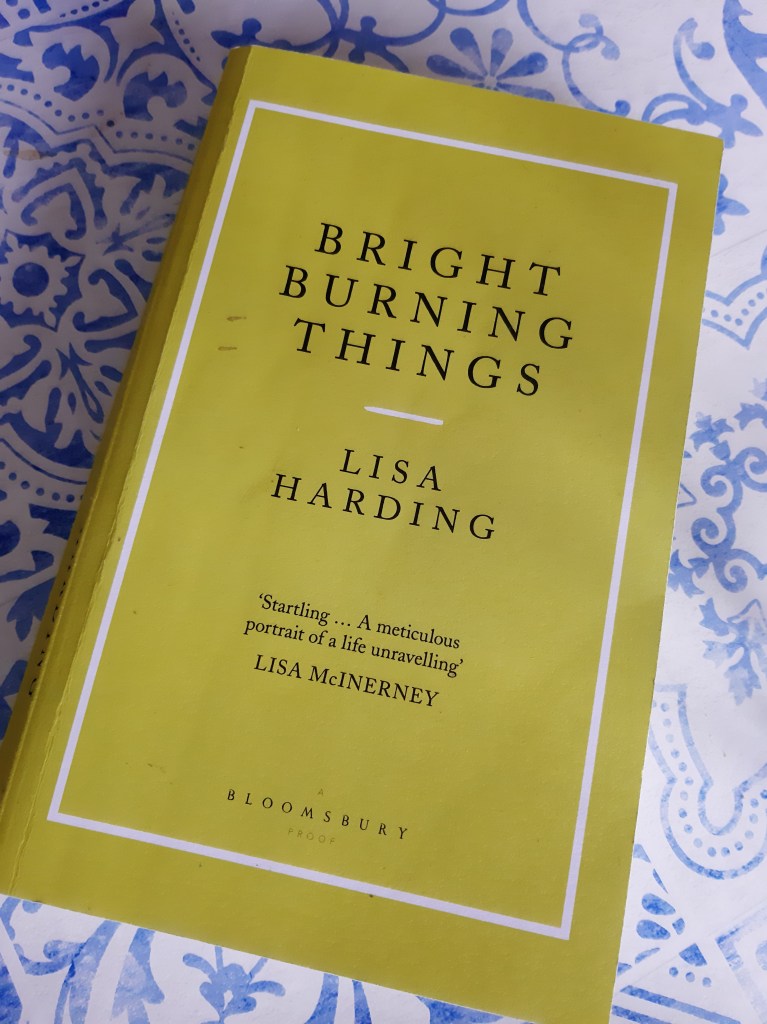
Writers Chat 36: Lisa Harding on “Bright Burning Things” (Bloomsbury: London, 2021)

Lisa, Welcome back to my Writers Chat Series. We’re here to chat about your second novel Bright Burning Things (Bloomsbury: London, 2021) which Lisa McInerney has so accurately described as ‘a meticulous portrait of a life unravelling’.

Bright Burning Things – Cover Image

SG: Let’s start with Sonya’s narrative voice. It’s through her – often unreliable – lens that we encounter those around her: her son Tommy, her father, Lara, David – as well as the unfolding of her story. Tell us about developing a narrative voice so strong that it literally pulls the reader along, turning page-after-page.

LH: Thank you for saying that. Honestly, I didn’t know whether she would just turn people off (although I fell in love with her writing her). She’s so unfiltered and raw and angry and damaged and full of contradictory feelings…and intoxicated so much of the time that I felt like I was as out of control as she was when I was writing it. I went back to my younger, wilder, drinking days and also my acting days. I let her do all the talking. It’s a bit like possession when a character like that grabs hold of you. Method-writing in a way. I improvise when I write and like to let myself be surprised by my characters. Sonya shocked me as much as I imagine a character ever could. And that has to be a good thing, right?

SG: I think it really is a good thing – it meant the story came as much from delving into her character as mining from your creative self and the authenticity shows in the wonderful flow. The title Bright Burning Things is perfect for what it represents and how it  encompasses both Sonya and Tommy – living itself, even. Did this come early or late in the process?

LH: The title changed at the very last minute. I love it now. Originally it was called OVERSPILL and stayed that way for a long time in the process, as it really is a study in intergenerational trauma and addiction. I prefer Bright Burning Things though as it’s more suggestive and allegorical in a way. The imagery of fire burns bright from the first chapter to the last – all unconscious on my part.

SG: I love when that happens – the wonderful symbols that can emerge from the process and when they work so well as they do here.

You deftly capture the strains that can exist between parents and children – in both Sonya and Tommy’s relationship but also Sonya and her dad. The strain, I felt, was also about identity – drinker, actress, mother, daughter, lover – as much as expressing emotion, as she says when her father praises her “Emotion has finally caught up with him, taken residence inside him – I wonder if this is a sign of him getting old.” Can you talk a little bit about that?

LH: Sonya’s relationship with her father and with her own self are at a moment of high tension when we meet them. As you so rightly observe, Sonya is in the grip of an identity crisis. Who is she really? She doesn’t feel a sense of belonging with her father and stepmother, she has lost her former career and she has been thrust into the role of mother with no memory of her own. I wanted to be with a complex character for whom the classic tale of recovery just won’t fit. I think Sonya faces up to all these parts of herself during the course of the novel, including unresolved grief from her childhood. She is finding some way towards managing her extreme emotions herself. Interesting how little emotion her father shows and how much she acts out of this. A cry for attention, perhaps?

SG: Much of Sonya’s troubles stem from her addiction to alcohol which exacerbates the intensity of her sensory experience in the world – including blacking out, neglecting her son and dog, but also caring too much – she worries about the suffering of animals who died to put food on our plate, and at during rehab her “night-times [are] filled with the ghosts of the orphaned children who once lived within these walls, still trapped.” Can you talk about how the world for Sonya, is “too much” but also how she cares “too much”?

LH: Yes, this heightened sensory experience is almost hallucinogenic at times for her. I think most of us know the ‘horrors’ of a bad hangover. She is either permanently intoxicated or hungover when we meet her. Being in the grip of addiction has a surreal, hyper saturated quality to it, both for the person suffering the addiction and for those around them. She has manic states that come about because she doesn’t eat properly, and her blood sugar levels are all over the place. Alcohol, obviously, plays a huge part in this. Everything is extreme with Sonya and when her acting career is removed from her life, she has nowhere to channel these impulses. She feels everything too intensely, including animal suffering, which is something her mind attaches to.

SG: That’s interesting the way you phrase that – as something her mind attaches to, part of what’s happening to her mind and body as opposed to a rational, conscious or ethical choice.

Sonya is an actress and in times of stress, she remembers roles she played – dancing in “an avant-garde production of Pride and Prejudice…wearing a corset, a crinoline-style dress, shot silk, pale blue, and suspenders” whereas now – after rehab – her “new character is called ‘Ms Sanity’ and Sanity has to hide her truth at all costs, Sanity has to smile and suppress, Sanity has to present a neatly packaged front to the world.” It struck me that her experience of the world revolves around controlling the experience she gives her ‘audience’, a skill which helps her assert herself in the face of subtle coercive control from the men in her life. Can you speak about this theme in the novel?

LH: That’s a really interesting observation, but not what I had intended!  I had wanted her moment of reckoning with David, who is a coercive controlling man, to be devoid of artifice on her part, and a time where she accesses her authentic self. I feel by the end of the novel she has found her true voice somewhat and doesn’t feel the need to hide behind masks and roles. I think she even refers to this herself: ‘I find the voice I wish I could have found with my father…’  There is a clarity and a strength to her at that moment she asks David to leave. She is not in conflict with herself and knows who she is. You are right that she is very aware of the power she exerts as an actress, but in rehab she accesses some part of her that is real, for the very first time. This is an important step for her in becoming the strong woman and mother she is meant to be.

SG: I think we are speaking here about the same thing – she has found her authentic self but she knows how to use her skills for her own advantage now. I loved the imagery associated with Sonya’s mother who it seems to me, was not unlike Sonya – the Catherine wheel, the joy of life itself – the opposite to her father’s way of living – hiding truths, not speaking of darkness – and I wondered if (and from the last line of the novel “Silence falls like a velvet curtain. Swish”) we will meet Sonya again.

LH: I feel like we’ve had enough of Sonya (or I have) for now. I love books that end on a note of ambiguity, of promise, providing a talking point for the reader. Will she manage her impulses, will she be a safe mother for Tommy, will she be safe for herself? The final line was harkening back to her actress self. I think I wanted to suggest that all parts of her could come to bear and that she could be a mother and an actress. That it really was ok to be herself, that she didn’t need to reject any part of herself. In fact, I wanted the final note to be a celebration of all that she is: extreme, electric, talented, colourful, loving, maddening!

SG: And the final note is all that because Sonya is all that – right down to the choice of the last word “swish”.

Thank you so much for such generous and insightful answers, Lisa. We’ll finish off with some fun questions:

If you had to choose – Herbie or Marmie? Herbie was one of my all -time favourite characters to write. I am dog mad.

Do you write with or without music? Both, depending on my mood and how loud my neighbours are!

Coffee or tea? Tea all the way.

What are you reading now? In The Dark by Anamaria Crowe which is being published by Turas Press in May 2021. It is an extraordinarily beautiful and moving novel about life and love during Franco’s war-time Spain. The language is lyrical and mesmerising and I am enthralled.

Bright Burning Things Advance Copy (Love the lime green colour!)

Thank you to Bloomsbury and Cormac Kinsella for sending me an advance copy of the stunning Bright Burning Things (Bloomsbury, 2021)

Purchase Bright Burning Things here and keep up with Lisa on Twitter @LisaSHarding.

Photograph of Lisa Harding


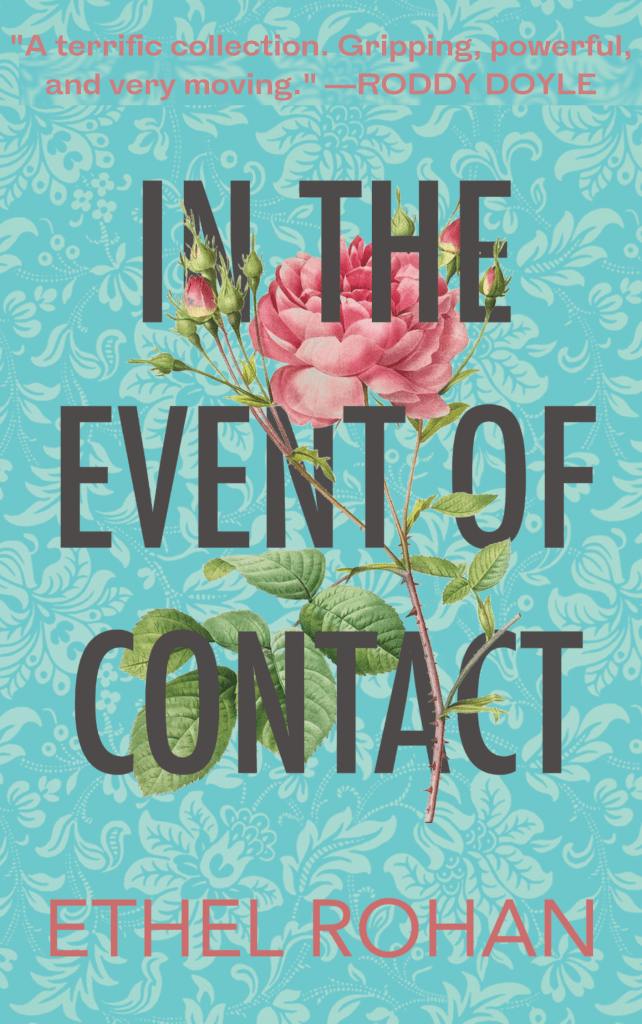
Writers Chat 35: Ethel Rohan on “In The Event of Contact” ( Dzanc Books: Michigan, 2021)

Ethel, welcome back to my Writers Chat Series. This time we’re here to discuss your short story collection In The Event of Contact.

ER: I’m delighted to be back, thank you, Shauna. This is my first interview for In the Event of Contact and I’m so grateful for your enthusiastic response.

Cover of “In The Event of Contact” by Ethel Rohan

I’m honoured to learn that this is your first interview about this collection, which won the Dzanc Books Short Story Collection Prize and is due to be published in Spring 2021. We’ll therefore skate around plot spoilers as this really is a collection of tight-knit page-turning stories.

SG: The title of this collection and the opening story “In The Event of Contact” place the reader in a liminal space where instinct rules and also confuses. ‘The caged bird knew’ we are told after a series of startling events involving Ruth–who can’t bear any form of touch–her family, and the mysterious and dangerous Mr Doherty. Can you speak a little about this theme of gut and instinct in the collection and why you chose this title.

ER: These are stories of primal fears and urges, and of fight or flight responses. In the title story, menace and danger are intuited by the most attuned of the story’s characters, its narrator Elizabeth and the cockatoo, Jimmy–I’m fascinated by animals’ keen senses and highly intuitive intelligence–while other characters are not so much confused by their gut and instinct but dulled to its messages and guidance.

Our gut and instincts can keep us safe and help us make our best choices, yet too often we under-utilise this capability. I’ve found my body often knows more than my mind. When I need to make major decisions–will I emigrate? Marry? Jump careers? Keep writing?–I tune into my gut for the answers. That involves getting quiet and still and feeling out whether my dread and confusion are coming from my mind or my gut. There’s a calm that settles inside me when I listen to the knowingness of my heart and not the angst of my head.

I have strong memories as a child of intuiting tension and the sinister. I can feel threat and danger in my gut, and remember being perplexed and appalled by how adults often appeared oblivious of the same. I wish my sensitivity and instincts were duller, it makes for a lot of anxiety, but like every curse there’s an element of gift, too, and I don’t think I would be a storyteller, or nearly as empathetic, without that ability to feel deeply and see into people.

As for the title, I worked on the titular short story over years and could never get it quite right until I hit on its final title and then everything else offered itself up. The collection was also created and compiled over many years and again it didn’t come together until I fixed on the title and that gave the stories their beating heart. The title is a twist on our expectations of the familiar phrase: ‘in the event of [my death, fire, other emergency]’ and I love turning the familiar in my stories into the strange and surprising. Once I decided on the collection’s title, I knew what did and didn’t belong in the final manuscript. It’s at the centre of everything, really, isn’t it? What and who do and do not touch us. And how. These are largely stories of crises of consent.

SG: You’ve said it perfectly, Ethel. Crises of Consent. Well, I very much enjoyed how the collection explores connection and disconnection by way of the families we marry into and the countries we move to. Much of what is explored is identity and compartmentalizing – being present in body but not in mind and showing different parts of ourselves to different groups. Was this something that emerged when you gathered these stories into a collection or was it present as you wrote these stories?

ER: In storytelling we’re creating and revealing characters and worlds, but we’re also revealing ourselves, whether we like it or not. I’m guilty of serial compartmentalization–mostly as a daydreamer and sometimes as a coping tool, like I’m physically present but my mind has checked out–and clearly that tendency bleeds into the plots and characters of my stories and was very much present as I wrote each of the stories in this collection.

As an emigrant, I’m also familiar with fracture, that sense of being divided between places and people. That splitness is exacerbated by the pressure to present different versions of myself to meet various expectations (like being Dublin enough, Irish enough, good enough, humble enough, nice enough, smart enough, cool enough, and not too American). Unfortunately, our tendency is to bend ourselves in order to be accepted. Until, that is, we free ourselves of that oppression. So, yeah, these are intrinsic themes that show up repeatedly in my stories. Even before I immigrated to San Francisco, as far back as my earliest memories, I’ve suffered a feeling of never quite fitting in and belonging–always at the edge of things, looking on. So while it’s never my intention as I set out to write–I’m eager to be open to each character’s unique journey–the coerced and marginalized inevitably show up in my stories.

SG: Thank you for such an open and honest answer, Ethel. The collection is also concerned with what is known and what is hidden, and we realise how powerful the unsaid is. Your characters communicate a great deal through what they are silent about. Can you talk a little bit about how dialogue serves to reveal and hide character motivation and narrative truth?

ER:  I love dialogue, and in the past year have at last written a feature script. Something I really have to work on in revision, though, is dialogue that’s too direct. As much as I hate confrontation in real life, I do tend to tell it straight, but that’s the exception rather than the rule and is therefore rarely true of my characters. Subtlety and nuance are much more truthful and powerful in storytelling, anyway, not least because they align with the universal experience of how much is left unsaid, and how much suffering these absences of aired feelings can cause. Despite our singular gift of language, we humans tend to be reticent, uncommunicative, and passive-aggressive–largely because of toxic messaging around being tender and revealing pain. That hiding, that inability to thaw and talk from deep within, causes so much damage, including the cover-up of a multitude of personal and systemic wrongs.

SG: In “Blue Hot” – with its pitch-perfect title – the narrator tells us “Boys are attracted to girls who look like they’re loads of fun, or who seem especially tragic. I’d read that in a glossy magazine. Or maybe I’d heard it on the radio, TV, or bus.” And this troubling message echoes the signals she receives from her family and friends about relationships and physicality, and with dire consequences.

When you’re creating characters, do you find yourself following character archetypes based around the era in which the story is set, or do you base them on what or who you know emotionally?

ER: Typically, I know very little going into each story. I start with some spark that urges me to the page and go word by word from there, filling in the blanks. That spark is always centred around a particular character and my process is to follow the character from scene to scene and see what they reveal about themselves and their world. So, while I don’t think of myself as writing archetypes around era, every character is affected by their who, what, when, where, how, and in particular why. Those internal and external factors colour everything about the character and their perspective. Messaging, particularly early in life, shapes us, and too often misshapes us. A central thread in “Blue Hot” is pervasive patriarchal messaging that devalues women and promotes toxic masculinity.

SG: And you tackle that central thread so well. It truly had a physical impact on me.

Place and space also feature heavily in the collection – in particular Dublin, your hometown – as well as parks. In “Wilde”, the Merrion Square park is used to springboard us into the encounter the narrator has with Oscar Wilde. In the final story in the collection, “The Great Blue Open,” we begin down on the ground in the park and finish with the narrator seeing herself from above. How important was the sense of place – and space – to you as you wrote these stories, and during the editing process with the team at Dzanc Books.

ER: Place and space get back to what shapes us and leaves its mark–imprinting, if you will. Place affects people. Enormously. Particularly our birth place, and those places we call home. As does space. I was just talking with women friends the other day about how I spent decades taking up as little space as possible, be it on buses, planes, in buildings, and on the street. I was always making way for others (particularly men) and giving them the right of way and more than their fair share of space while denying myself the space I needed and which was my due. Now I’m like, Move Over! As for parks, I love trees and woods and open spaces–anywhere with Mother Nature and all her glory. I think if we studied, valued, and emulated her more, this world would be a far better place and we humans would be a far superior and happier race.  

SG: Move over, folks, and welcome Nature. I like it! So let’s finish, Ethel, with some brief questions:

  • What book is on your nightstand now? Shuggie Bain by Douglas Stuart.
  • I have it on my nightstand too (waiting!) So, mountains or Sea? Sea.
  • Wine or Whiskey? Both.
  • But not together! Do you have a favourite book of 2020? Cleanness by Garth Greenwell.
  • I must look that one up. Finally, what is your one writing wish for 2021? Money.

Ethel, I wish you much success with In The Event of Contact. Thank you for your generous answers and with gratitude to Dzanc Books for providing me with a copy of your stunning collection.  The official publication date for Ireland and the UK is June 3, 2021, and elsewhere May 18, 2021.

Photo Credit: Justin Yee (Photograph also on Ethel Rohan’s website)

Keep up with Ethel by visiting her website.