Writers Chat 18: Wade Stevenson on “Songs of the Sun Amor” (BlazeVox: New York, 2019)

Wade, You are very welcome to my WRITERS CHAT series. Congratulations on your latest publication, a poetry collection Songs of the Sun Amor (Blaze Vox Books: New York, 2019). Songs of the Sun Amor can be purchased directly from BlazeVox. 

Wade19-cov-lg
The stunning cover image of Songs of the Sun Amor shows a picture of the author’s daughter balancing upside down on the beach at sunset.

SG: Your work has previously been described by critics as ‘emotionally satisfying’ and ‘profound’. 

I found myself very moved by a number of the poems, perhaps, I feel, the most personal in the collection, and, at the same time, the most universal.

In ‘About My Mother’ and ‘The Map of Elsewhere’, the early loss of your mother is explored and in ‘Black Sheep’, and ‘Sun, No Son’, the difficult relationship with your father. Could you talk about the placement of these poems in Songs of Sun Amor. They sit, almost as beacons, in between tones of humour and angst.

WS: You are right: my poems are meant to be complete in themselves and to have an immediate emotional impact. The reader may experience them as I wrote them: with the shock of recognition. There is a certain sadness of course, a lingering melancholy, but there is also the humour and the joy. My editor had suggested that my book be organized thematically. He said he found three main themes: the mother/father/child relationship, the lover/partner/wife relationship, and the relationship of the search for a going beyond or transcendence. However, I thought it would be more interesting for the reader to experience My Sun Amor poems as a progression, with certain poems as you say acting as beacons and lighting the way forward. One of the poems you refer to ends with the line: “Real Amor was on the map of elsewhere.” That marks the separation from the mother and father and the beginning of the poetic journey to find that “Real Amor.” Ultimately it leads to the conclusion or illumination if you like, of the last lines of the book, the conscious coupling with the “Sun Amor immensity.”

SG: Much of Songs of Sun Amor is concerned with the search for and hope of finding the self, and, at times, escaping this self. In “The Map of Elsewhere” we learn that ‘I discovered love in strange places/Real Amor was on the map of elsewhere’ and in “Bio Poem” the past is linked to the future

‘with a simple ampersand/Ghost floating through the hourglass of your life/Longing to break the glass, rise in the air, free’.

Can you tell us about these themes – did they emerge as the collection formed or had you those themes in mind?

WS: Let me share a secret with you: I didn’t write my “Sun Amor” book. It wrote itself. The themes emerged by themselves in an organic way. One of my first memories as a child was that of being trapped not only in my own family but in my own body. I didn’t want to be a prisoner of myself or of the accident of my birth. To do that I had to recreate myself, “to find the promise of a life reborn.” How to escape the limitations of the self, of the language that defines you? I did it from an early age by a process of carefully organized revolt. I did it through literature and poetry, I did it through travels and encounters, I did it through learning and assimilating other languages and cultures that were not my own. I made my own “elsewhere.” My Sun Amor book is the result of that search. The reader can explore that geography and find some really interesting things that will help them in their own relationships.

SG: I think that journey of escaping through immersion elsewhere really comes through in the collection. I’m also interested in the title of the collection, as on reading it for the second and third time, I found myself wanting to read many of the poems aloud and it occurred to me that they were almost hymn-like, particularly with the sparing use of punctuation. I’m thinking here, for example, of “Mirror Man”, after the great line ‘I’m the tossed back of my father’, the poem comes at the reader with each line, almost like listing off the anger points. I’m also thinking of “Amor Belief” and “The Language of Sunflowers.” And, of course, the striking “A Question of Pain”. Can you talk a little bit about this?

WS: All my books are about pain and loss and recovery and the quest for transcendence, for finding a way to heal and go beyond. As I wrote in one poem, “The good doctor Amor will repair all the broken/ With threads of solar gold.” It’s true that the collection could have been titled “Hymns to the Sun Amor.” It’s also true that the lines are constructed in such a way that they almost cry out to be read aloud. When I write them, or rather work on them, it’s as if I had another deeper voice in my head reciting them. Poetry from the beginning was an oral tradition. And it’s regained some popularity today due to the performance poetry readings. One of my favourite poems is “My Amor Belief.” In these dark times, when there are so many forms of hatred and intolerance, it would be amazing if we all could just “learn how to breathe and to be/ Relieved of belief, of religion free.”

SG: Yes, it is a beautiful line, Wade, and I wonder how we can do that, learn to breathe and be relieved of belief and religion. But God, nature, landscape and beauty also feature in Songs of the Sun Amor. They seem, to me, to be intertwined, as if a dialogue between them is running concurrently with the narrator’s life, and, at the same time, with the continuum of time – the back and forth between past, present and future. Could you tell us a little bit about your use of time in the collection? I’m thinking, specifically, of “Big blue beautiful you”, “The Language of Sunflowers” – ‘Seize the special moment that comes/Between the breathing in and the breathing out’ and ‘Spend an hour lying in the summer grass/Listening to what the yellow flowers say.’ This speaks to me of recapturing childhood. Irish writer Desmond Hogan once said that writing is about ‘keeping childhood alive’.

WS: I’ve made many trips to Japan, spending some time in a “ryokan” in Kyoto, and I feel a great affinity with the deep spiritual essence of Japanese culture. They have an obsession with nature and an obsessions with perfection in even the simplest things, like a bowl or a shadow or a cherry blossom. The Shinto religion is based on a reverence for nature. It’s interesting that in a Shinto shrine, there is no decoration, none at all. There is only an image of the sun. The sun is considered to be female, a goddess and the supreme deity (Amaterasu). And I think today, perhaps more than ever, we are all looking and thirsting for some illumination in our lives, for “the flash that stuns/ Awake from the sun god’s gun.”

SG: That is fascinating. I hadn’t connected your work to the deity. I shall have to have another read, with new eyes! After I had read the collection I found myself thinking about the stories within the poems and I wonder if you would ever return to the form of fiction again?

WS: Each poem in My Sun Amor book tells a story, and that story, like those Russian dolls, is imbricated in and part of a larger story, and it all leads back to Amor. And I have written fictions and a memoir, all about Amor with a small A by the way, in my books “One Tine in Paris” and “The Electric Affinities.” And there may be one more to come.

SG: That is lovely to hear that there may be another novel to come. Lastly, Wade, some fun questions:

  • City or countryside?  I was born in the Big Apple but I would to live in the countryside with wild horses and apple trees.
  • America or Europe? When I am in Europe I miss America. And viceversa.
  • Coffee or tea? Japanese green tea.
  • What writing project are you working on now? A book of poems entitled “Going Head to Head.” It’s about my head and your head and how we can escape from our heads and move into some other dimension.

SG: Well, Wade, thank you so much for participating in my Writers Chat series. It has been wonderful chatting with you and I wish you well with this collection and your forthcoming one Going Head to Head.

Wade Photo
Wade Stevenson in Rome on a balcony in front of the studio where Keats died.

Songs of The Sun Amor can be purchased directly from BlazeVox. 


Writers Chat 17: Neil Donnelly on his documentary about Aidan Higgins “Where Would You Like The Bullet?”

Neil, You are very welcome to my WRITERS CHAT series. 

Congratulations on the screening in the IFI (3rd March) of Where Would You Like The Bullet?, your documentary about Irish writer Aidan Higgins (1927 – 2015), edited by Seamus Callaghy.

SG: You’ve described his work as ‘beautiful prose’ and his work is admired by writers such as Annie Proulx, John Banville, and in the past, by Beckett. Can you talk a little about how and when you first came across the writing of Aidan Higgins?

ND: It was ‘Langrishe, Go Down’ which I had read in London, possibly 1970, when living there. Full of atmosphere, bad weather but extraordinary prose. Tortured, but a different suffering to that of McGahern. Both of whom spent days crafting singular sentences attempting a sort of aria, which is ironic in Aidan’s case as he had no ear for music. Then when ‘Balcony of Europe’ was published in ’71, I bought it and was again, dazzled; the opening chapter on the father is a magnificent set piece, but also frustrated by the lack of a coherent narrative. I suppose we’re all bred on plot, of forward momentum, formed by Shakespeare on the Leaving Cert curriculum. Aidan is about stasis, the present moment, Eckhart Tolle before even he had discovered the value of sitting still. But sitting still for Aidan also meant looking back, for his mantra was, “The memories of things, are they better than the things themselves?”.  I found Aidan’s phone number in the London Telephone Directory and rang a few times but he was never in. It was cheeky to attempt to offer editing advice to such a brilliant writer but that’s the innocent impetuosity of youthful ignorance. Years later in Kinsale, when Neil Murphy was re-structuring ‘Balcony’ for  the 2010 Dalkey Archive reissue, I outlined my idea to Aidan that the  book should be confined to the Nerja sections only and to drop all the Sligo stuff and all the boring letters. He fixed me with that hawk like stare and stayed silent. I assume that any suggestions I would have made to him in London in 1971 would have been met with the same hawk like stare and silence.

What an intricate relationship you have had with Aidan’s work and the man himself. You’re right about the breeding, as you put it, we’re taught to expect and accept coherence and structure and to be constantly in motion, moving on to the next….instead of sitting still. Even more so now, I fear.  I must also pause our chat to thank you for introducing me to more of Aidan’s work, and for the opportunity to discuss his prose with some fellow Kildare writers in the documentary.

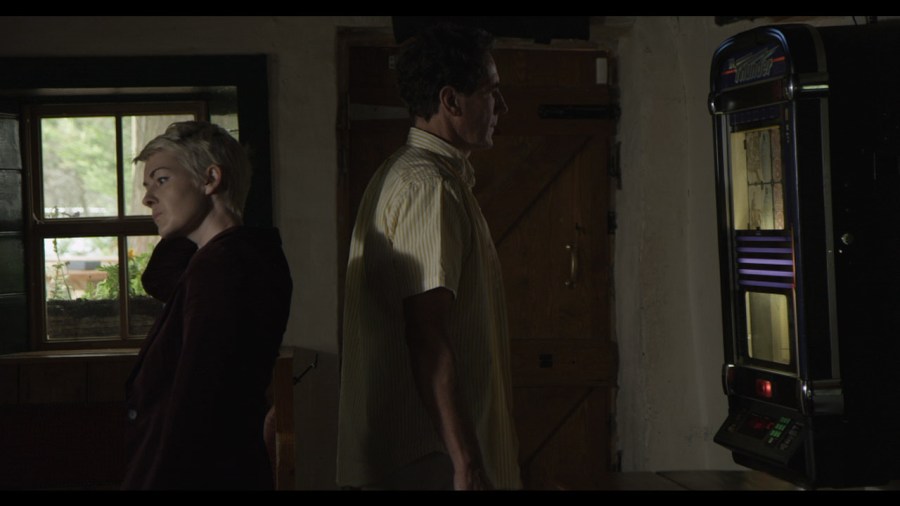
Still from Where Would You Like The Bullet?

SG: When you discussed the documentary initially with Higgins, you told him ‘if you don’t like it you can shoot me’ and he, now famously, responded, ‘where would you like the bullet?’ The title of the documentary comes from this conversation. Can you describe the process in finding scholars, academics, writers and artists who admired and were familiar with the work of Higgins? Admirably, the documentary covers a broad range of opinions and features artists, writers, actors and academics from across the globe.

ND: I had spent years working on a Theatre Play as a follow up to “The Duty           Master” only for that play, due to a multitude of reasons, not getting a Production, so as Paul Simon puts it “if an empty train in a railroad station calls its final destination, can you choose another track?” I had to find  another track in which I could apply some other skills and I realised that Aidan would be 80 years of age in 2007 so with some help from the Kildare Arts Service I produced the “Aidan Higgins at 80” Festival at Celbridge Abbey and the possibility of a documentary followed on. Initially, I tried to encourage stablished film makers, Alan Gilsenan, Donald Taylor-Black, Eamon Little, etc, who all expressed admiration for Aidan but none were willing to go where this fool eventually tip-toed.  I said to Aidan that reluctantly I would go ahead and do it and-in-a-throwaway added, “and if you don’t like it, you can shoot me” then quick as a light switch he said:- “Where would you like the bullet”.

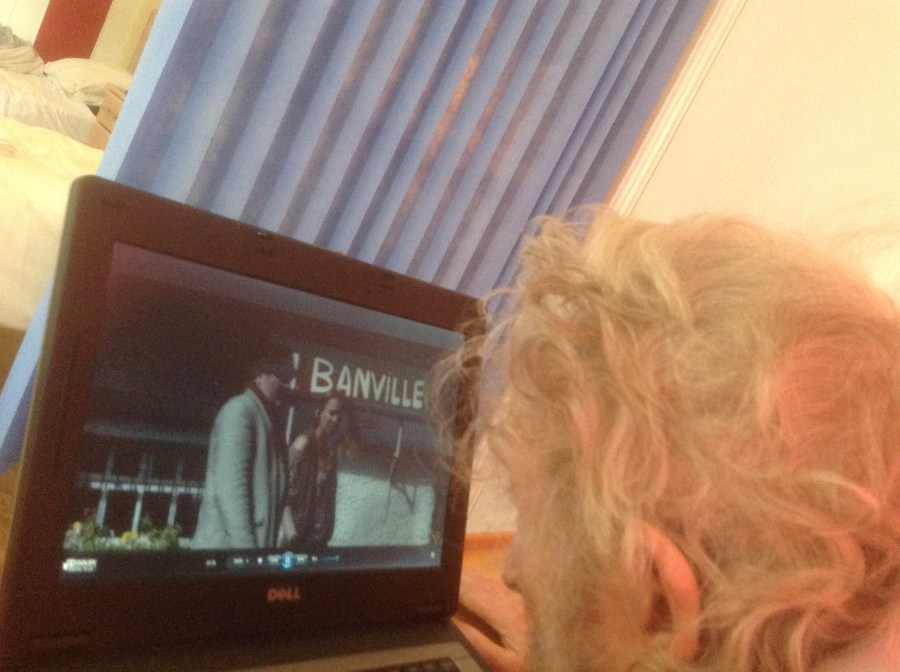
At first, Aidan himself as he was then, 83 years of age, was going to be in it, arriving at Springfield House, his birth place in Celbridge, and finally leaving and hitching a lift on the road outside the gate where he would have been picked up by a car driven by the Girl from the Banville Pub in Wexford with the real John Banville in the back seat. But John Banville would consent to an interview only. In that same ‘Banville’ section in “Dog Days” there is a reference to Seamus Heaney and I created scenes with Seamus and sent him the script which he graciously declined but wished me well. Aidan’s ill health        prevented him travelling from Kinsale and Denis Conway deputised. So that very experimental idea was abandoned and a more conventional approach with added surreal moments was settled on. The big problem was having no funding. It was decided that I would do sections with actors, technical staff, academics, writers, etc when they had free days from their career paying jobs. Everyone received something for their time and contribution but nothing remotely similar to what they would have got if we had proper funding and a time limit in which to deliver. The resulting film wasn’t going to be an external enterprise like a lecture, rather it would be as if I were in front of a room of students with the occasional nod to the power point, yet my overall aim was for them to experience Aidan’s conflicting gifts, the visual artist and the prose master, his personal contradictions, his sense of humour, his evolution as a writer from ‘High Art’ to accessibility; a man with too much talent, overlooked by popular trends where mediocrity is lauded.

Well, it is great that you tip-toed and ventured – and got past the hawk-like stare to wonderful conversations. It’s a real shame, though, that ill health prevented Aidan from travelling to star in his own documentary. Having said that, Denis Conway does a wonderful job. The film really captures something that’s hard to pin down, you see it in the writing of others, such as like Desmond Hogan; conflicting gifts and a sense of constant internal battle. It epitomizes the idea that talent can be both a gift and a curse, and, at times, society welcomes and rewards mediocrity.

SG: You’re a writer yourself, Neil. Would you say that you have been influenced by Higgins, at a conscious or unconscious level?

ND: A dramatic person, if not a dramatic writer, that’s Aidan. Though heavily          influenced by Nightwood by Djuna Barnes, of which T.S.Eliot said it would ‘appeal to readers of poetry’ which could equally apply to Aidan. He was also influenced by William Faulkner and those trembling vines on long wall sentences. Marcel Proust has a lot to answer for. Too many writers have collapsed with exhaustion from their attempts to imitate the descriptions of the path and hawthorns in ‘Swann’s Way’. Aidan was very reluctant to edit anything. I think this might come from a fear of not being appreciated.  John Calder, publisher of Samuel Beckett, would spend whole days with Aidan editing sections of ‘Balcony’ only upon Calder’s going home Aidan would return the edited sections to the manuscript. The great  novels of F.Scott Fitzgerald and Ernest Hemingway were moulded by the brilliant editing skills of Maxwell Perkins. If only Aidan had been so lucky. Less is more, always.

It’s a case of wanting to show the reader your heart and soul that have gone into the writing. The relationship between Carver and Lish also springs to mind, here. Every writer needs a good editor. You’ve answered my question, if I may say so, in a very Higginesque way!

IMG_0022
Aidan Higgins watching a cut from the film where Denis is outside the Banville pub.

SG: Like Higgins, you’re based in Kildare. How important do you think place was for Higgins? Is it important to you in your writing, and why?

ND: I’m from Tullamore, Offaly and live in Kildare. Place was important for Higgins because he never recovered from the wound of his parents loss of Springfield and having to move away. Something was cut short in him, thus his true theme was the search again for love until finding it and sanctuary in Kinsale. Kildare doesn’t deliberately feature in my writing apart from one fictional male character in the play ‘Chalk Farm Blues’ who hails from Kildare, but the County itself is not explored. In my poem, “Girl in Black Leather Coat”, set in London, the mystery Girl in question just happens to be from Kildare town. But nothing could compete with the surge I felt in a London theatre upon first hearing McCann in Act 11 of Harold Pinter’s ‘The Birthday Party’ exclaim, “Tullamore, where are you?”- the character probably calling for a refill  of Tullamore Dew Whisky, rather than calling up a memory of a town he had once stayed in, or passed through.

Our birth places always surface when we’re away. It’s like we’re more connected to them then than when we’re actually there and, you’re right, the loss of Springfield was so huge for Aidan – and all the family really, this comes across in your film, Neil – that he seemed to spend much of his life trying to recover or fill that void.

SG: So which of Higgins’s publications would you recommend to a Higgins novice?

ND: Start with Donkey’s Years then Dog Days then Langrishe, Go Down.

SG: You wouldn’t go with Balcony of Europe? Probably after those three…So, lastly, Neil, some fun questions. 

  • City or countryside? City in Winter, Country in Spring, Summer, Autumn.
  • Novel or short story? Novel = ‘Mysteries’ by Knut Hamsun ….Short Stories = ‘ Dubliners’ by James Joyce.
  • Coffee or tea? Both
  • What creative project are you working on now?  I would love to do another film but only with proper funding. I would never wish it on anyone to have to repeat an odyssey like the one I’ve been on for the last seven years. I’m working with my neighbour, Poet Donald Gardner, on a project to  celebrate his 80th year.

Thank you, Neil, for such generous answers. And I, for one, am glad you took on that odyssey. Such a fitting tribute to an undervalued writer.

Where would you like the bullet? Will be shown on Sunday May 19th @ 2pm at the Hugh Lane Gallery, Parnell Square as part of the Dublin International Literary Festival. Admission Free.

More details on the film Where Would You Like The Bullet can be found here: https://neildonnelly.ie/where-would-you-like-the-bullet/

Follow Neil’s creative projects which include film, poetry, stories, and plays.

https://neildonnelly.ie/film/

Reading, Thinking, Questioning…

20190310_163442

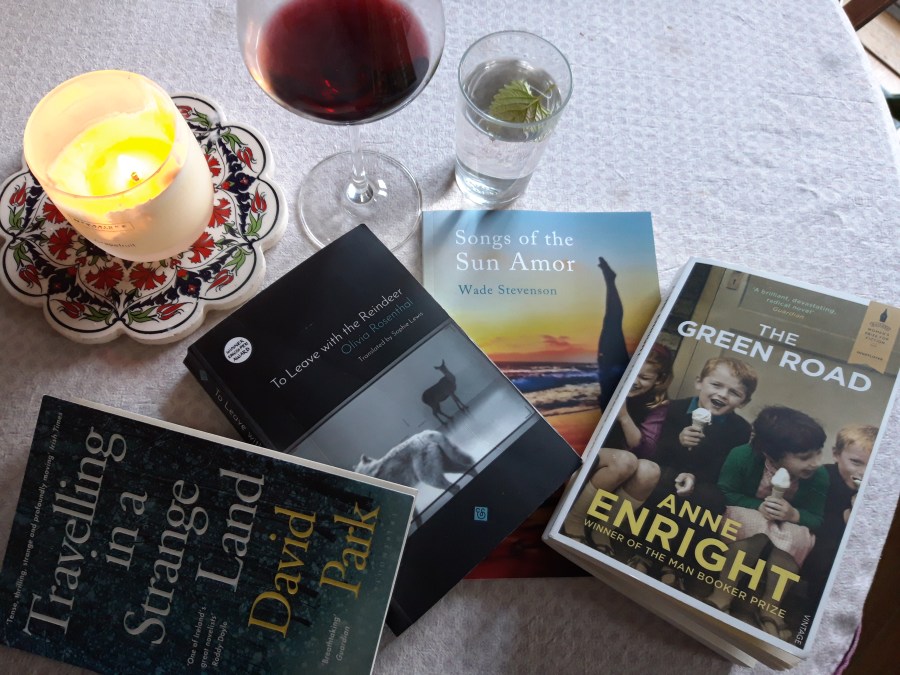
I’m currently reading Songs of the Sun Amor by Wade Stevenson (Blaze Vox: New York, 2019) and looking forward to welcoming Wade to my Writers’ Chat series shortly.

Meanwhile I’m almost done re-reading Anne Enright’s great The Green Road, at the same time I’m torn between not wanting to put To Leave with the Reindeer (by Olivia Rosenthal – &Other Stories: London, 2019) on a bookshelf as I find myself returning to it again and again, and wanting to continue reading David Park’s Travelling in a Strange Land (Bloomsbury: London, 2018). This is the joy and the pull of having wonderful books to hand.

Onwards to the words….