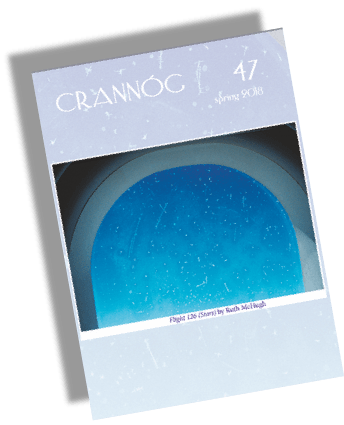
I’m delighted to hear that Mel Ulm has featured my story “Thirty-Five-A-Night” (published in Crannóg 47) on his literary blog The Reading Life.
It’s always interesting to see the gaps that appear between authorial intention, reader comprehension and then the reader’s analysis. Cultural references are also key to understanding fiction and in this case, Mel picks up on the importance of the ending – which is where the key is to the age of the protagonists.
You can read his post here and I’d recommend staying a while and browsing through Mel’s incredible collection of posts on fiction (and poetry) from all over the world.
Aoibheann, Welcome to my WRITERS CHAT series and thanks for participating so fully.
Congratulations on your debut novel Marina which Mike McCormack has described (and I’d thoroughly agree!) as a “singular enchantment” and which also has a really stunning cover:
SG: First and foremost, tell me a little about Marina’s love of the sea.
The story seems to be about a circular journey from childhood to adulthood, and from Ireland to England, yet at another level, Marina seems to be a contemplation on how disconnected we all are from the land – dry and wet ground – that we live on and in.
You’re from Donegal and now living in Galway. Did you use your own knowledge of the sea and its landscape, and also that sense of being away from home (as Marina is in London) in writing this beautiful sensory novel?
AMC: Marina’s love of the sea is a theme throughout the novel, and it has a very strong pull for her. Throughout the novel, she associates the sea with escape, be it by boat or by swimming. Though when she eventually does escape across the Irish Sea, it does not work out so well for her. I think we are all very disconnected from the earth these days and that causes us a lot of problems.
I grew up beside the sea and was brought out on boats from a very young age. My family were mariners for generations so I have a deep generational connection with the sea. Luckily I still live near the sea in Galway and can see it out of my bedroom window. The further I get from the sea the more trapped I feel, but it also utterly scares me, as a lot of my relatives died at sea.
I lived in London for a number of years, my daughter was actually born there, and I although I loved the freedom of it, I always missed the sea and had a strong urge to return to Ireland. Especially when I was pregnant for some reason. I think I actually saw a mirage on a particularly hot day just before she was born!
The sea helped me to write the book too. I was inspired to write Marina in the aquarium in Salthill in Galway. I was looking at a fish in a seawater tank, it looked miserable, and this is where Marina sprang from.
SG: What an amazing image – you by the sea gazing at fish trapped in a tank, both surrounded by seawater…But then there’s all that history and inner knowledge you have about the sea that seeps through the novel.
I loved the writing throughout In particular, I loved the poetic writing which grabs you right from the start:
“Belonging like they did when I saw them, floating in the sea, the green fronds of seaweed caressing their pale skin. They are nibbled gently, caressed by tiny fish who, bit by bit, ingest them, return them, welcome them.”
It also extends into the stuff of life – we’re told
“The piano was truly the instrument of fate”
and, when Jamie is born, he’s
“red and squashed, as if he’d come out of a shell.”
AMC: Thank you! I started off as a poet, in fact the first piece of writing I got published was a poem. Though I rarely write poetry these days, it is still there in my writing. I think the prologue and the intervals are the most poetic parts of the book, where Marina describes the world as she sees it in her very disjointed way. I was inspired to write these parts in my garden and walking by the sea. I think especially at these points I could see ordinary things from Marina’s perspective, and as she seems to be able to zone so completely into things and is so removed from social concerns, she is able to describe things more precisely or more poetically. I think poetry is about seeing things from a very different perspective.
SG: Yes! And now that you say it, that’s really what I loved about Marina – that sense of the word view being turned somewhat.
I read Marina in one sitting and gasped when I came to the end – without revealing anything – it was like I was in the sea, coming up for air, or that a wave of a life of emotions had just washed over me. For me, this is a great reading experience, when you’re taken somewhere else entirely and then when the book finishes, you’re back to the grey skies (not unlike those of Marina’s life!) and reality. How important a role do you think atmosphere plays in this story – in keeping the reader embedded in the parallel clarity and murkiness of the waters of Marina’s thoughts, compared to Jamie’s thoughts which are shown as been numbed with medication?
AMC: Again, thank you, that’s great feedback for a writer! The first draft of the story didn’t feature the parallel story of Marina in the present, which I think provides the context of her version of the ultimately tragic events and her justification for what happened. It also adds to the atmosphere, as it is clear that her thoughts are murky from the start. Dr. O’Hara provides the clear voice of reason, but can be very harsh. I often think we put labels on people so we can rationalise their actions and there isn’t always a rational explanation for why people behave as they do. We like to think we can explain people’s behaviour by looking at their childhood but I don’t think we can. Of course, Jamie never really gets a voice, so we only have Marina’s (unreliable) version of the events, so we have to take her word for it. So overall I tried to make the atmosphere like the deep water that Marina inhabits in her mind.
SG: Yes. It saddens me how labels often seek answers yet in doing so can move further from those very answers.
Marina is also about relationships. We have the one which is constant – Marina and her relationship to sea, including being at sea for most of the story – and we have the one which we, as readers, see evolving into something that isn’t quite what we would have hoped for Marina: her love for Jules, the young man she falls for at university in London. It’s really a question of like attracting like rather than opposites attract – especially if we consider that the less they verbally communicate, the less they each play their instruments. Can you talk a little about that relationship – in which Marina, at one stage, feels
“smaller than an ant”
AMC: I think Marina and Jules’ relationship is ultimately very unhealthy and obsessional. It is further exacerbated by Sandra’s influence. I think Marina tries to find a replacement for Jamie in Jules, but also she feels haunted by what she feels is a betrayal of Jamie so I think she justifies Jules’ cruelty because of this.
Jules and his mother are very controlling. I think Marina feels smothered by this but the further away from the sea and her music she gets, the more trapped she becomes, and it takes something drastic for her to return to Ireland.
SG: We’ve talked about the role of the land in Marina, but of course there’s the wider question of the environment and how we are destroying it. Can you talk about how Jules and his involvement with environmental groups adds to that theme, indeed, perhaps this being the one of the first things that Marina learns about him is also what attracts her to him.
AMC: The environmental theme was always a big part of the book, though it isn’t really part of the plot. I thought about evolution a lot when I was writing the first draft: if we are so evolved as a species, why are we destroying the environment that sustains us? If you consider this, it actually explains Marina’s destructive behaviour and why she ultimately feels humanity isn’t all it is cracked up to be. There is a strand of psychology called eco-psychology which believes that mental illnesses are caused by environmental damage; if the earth is being destroyed, then we inevitably will be too. As it suffers, so do we. Also, I thought a lot about the Buddhist Wheel of Life, which shows evolution in the form of reincarnation; the more good deeds we do, the more likely we are to ‘evolve’ into a higher life form. Again, I thought, are we really a higher life form if we are destroying ourselves like this?
As for eco-warriors, I hung around with some at college, and they were always so sure of themselves and what they were doing. Jules’ character and especially those of his friends are inspired by them. My life experience is in no way like Marina’s, but I was asked to stop eating a Kit Kat in my own house by an eco-warrior! I think Marina is so lost and scared, she latches on to Jules as he seems so sure of everything, as do his friends. They see something wrong in the world too, and are better able to articulate this than she is.
Yes – these are all questions that I asked myself as I was reading and, more so, when I’d finished the novel, and, found myself understanding Marina’s behaviour.
Lastly, Five fun questions, Aoibheann:
Dogs or Cats? Dogs. I have two!
Paperbacks or Hardbacks? Paperbacks.
What page are you on of the book you’re reading now? 89 of Echoland by Per Petterson
Describe the story in one word? Childhood
What’s next on your ‘to read’ pile?The Invisible Ones by Steph Penny
Thank you for such insight, Aoibheann and I wish you much success with Marina.
NOTE: This post was first published on my blog in October 2016
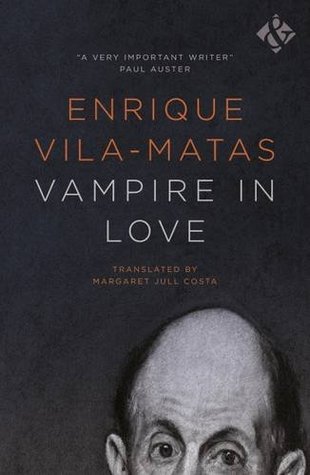
There’s a radio advert for a book festival in Dublin which tells listeners that you never know what will happen when you open a book. The selection of stories ‘Vampire in Love’ by Enrique Vila-Matas is testament to this. Translated by the great Margaret Jull Costa and published by the innovate Andotherstories this collection showcases some of Vila-Matas’ finest stories. From the opening ‘A Permanent Home’ which is as unsettling as it is disturbing, to the witty ‘I’m not going to read any more emails’, the play with language and play on words forms a thrilling part of the read. The way in which Vila-Matas uses time to keep us (as readers) on our toes puts me in mind of the work of another Catalan writer, Jaume Cabré, and, of course, Roberto Bolaño.
Vila-Matas has stated in an interview with the Paris Review that
What really interests me much more than reality is truth. I believe that fiction is the only thing that brings me closer to the truth that reality obscures…
This interest is clearly evident in ‘Vampire in Love’ where the narratives flick and flash back and forth between reality and truth, with the questioning of perception prominent throughout the collection. Yet his use of language is also poetic. In one of my favourite stories, ‘Rosa Schwarzer comes back to life’, a sinister painting comes (or seems to come) to life, creating creates an epiphany moment for Rosa who is grossly unappreciated by her family.
The coffee brought her almost savagely awake, and, for a moment, as if it were a brief foretaste of what she would experience at the museum today, she saw in her mind the remote landscapes of that dark foreign prince’s country.
It is this beautiful mix of the every day sensory experience with the dreamscape seeping into the reality of both the character and that of the reader that I found so special. In another scene in this story we are presented with a picture of Rosa’s plummeting emotions where the landscape echoes her inner state:
The sky was a grubby opaque white colour, and, in her mind, a similar opaque whiteness began erasing the memory of what she had experienced with the night owl, whom she had abandoned in the park.
These emotions are later displayed – though bluntly go unnoticed by her husband and sons:
‘What’s for supper?’ demanded her son Bernd from the sofa.
‘Death,’ she said. ‘Death.’
She said this so quietly, from the solitude of her kitchen, that they didn’t hear, just as they didn’t hear, at that same moment, a chicken having its throat slit.
Opening lines that hook you are another feature of the collection. Take this loaded first sentence (from ‘In Search of The Electrifying Double Act’):
One April afternoon some years ago, when my name was still Mempo Lesmes and I was very young and a starving, unknown actor, I got lost in the labyrinthine outskirts of San Anfiero de Granzara, and I came across a large mansion surrounded by an overgrown garden – the Villa Nemo.
Or consider the theme of memory that ripples through these stories: this from the fantastic tiny story ‘Indentifying Marks’ –
I remember nothing of that year except that elections were held, and someone, on a night that seemed to me interminable, swore blind that I was Catalan.
And the strong sense of place, from ‘Invented Memories’:
I remember that on my trip to the Azores, I visited Peter’s Bar in Horta, a café frequented by whalers near the yachting club; a mixture of inn, meeting place, information centre and post office.
For Vila-Matas, concepts of place and that never-ending search for something – in art, literature, cinema – as an integral part of the urban existence is often what drives the narrative arc. In the title story (‘Vampire in Love’) the vampire – our hero – thinks:
We look for distant people who are often to be found much closer to home; in movies, we look for the vampires that exist inside us.
The truth about people is often intertwined with history and place, as in the subtext of Franco’s Spain that runs through the chilling (yet at times amusing) ‘Greetings from Dante’ in which the father-narrator reveals his profound fear for and hate of his son whilst maintaining his fatherly role of trying to discover why the child – Tito – is mute. In conversation with a psychoanalyst the father discovers that in the sixteenth century, in their neighbourhood, a Portuguese student was revealed to be a demon when he was seen eating a bowl of flies. Unnervingly, Tito’s sister who is patient and understanding of his muteness often proclaimed ‘A shut mouth catches no flies’ and on this occasion (without knowing the history which the father has discovered) changes the proverb to ‘Tito’s mouth is full of flies.’ Violence ensues and so the story goes on – the mysterious sense of the streets taking in and then letting out evil pervades. Similarly in ‘Niño’, where the narrator/father maintains the position of the niño’s ‘attentive assistant’ despite the uncomfortable dislike for his son who, like him, in trying to survive, searches for the truth and attempts to face the void that is life (and death):
‘We’ll find out the truth about the beyond,’ he said.
‘Be careful,’ I warned. ‘Those who seek the truth deserve the punishment of finding it.’
The collection is also very much a writer’s book. I particularly loved the sense of voyeurism, obsessiveness and vanity that peppers the characters of Vila-Matas. In the fantastical ‘Modesty’ (my favourite story in the collection), we meet an occasional spy who, in this quote, is observing the No. 24 thief (so called because he operates on the No. 24 bus):
He doesn’t seem interested in any other route or any other bus. He must simply enjoy – as I do – being a regular, or perhaps he simply loves doing the same thing over and over. He’s not unlike me in a way: we are both of us thieves. Of course, he steals wallets and purses, while I only snatch phrases, faces, gestures…
In ‘Death by Suadade’, the narrator recalls – when he was nine – how the growth of curiosity about where he lived, and what made the place itself became his sole occupation:
The street began to steal a whole hour of my homework time, an hour that I recovered thanks to the simple method of cutting down the time I usually spent after supper reading great novels, until the day came when the charms of the Paseo de San Luis proved so alluring that they stole all my reading time. In other words, the Paseo replaced great novels.
I also recall spending hours – at a little older than nine though – staring through open windows, imagining the lives of others.
I read the collection from start to finish, and although many of the characters seemed to have merged into one by the time I had finished, on reflection it is the emotional weight which carries the book. Ultimately it is the re-imagining of the lives of ‘the other’ and of others that this story collection presents to the reader. ‘Vampire in Love’ is a book which gives us an escape; enabling us to dive into the pages, the minds, and the lives of characters who might well have come from our own dreams.
You can order ‘Vampire in Love’ here and see an interview with Vila-Matas and Paul Auster here.


 Shauna Gilligan Writer