Writers Chat 71: Brian Kirk on “Hare’s Breath” (Salmon Poetry: Galway, 2023)

Brian, Welcome back to Writers Chat. This time we’re talking about Hare’s Breath your latest collection published by Salmon (2023). It’s a collection that deserves to be read with care – as much care as you clearly put into the language in the poems and the shape of the collection – and one that rewards the reader with each re-read.
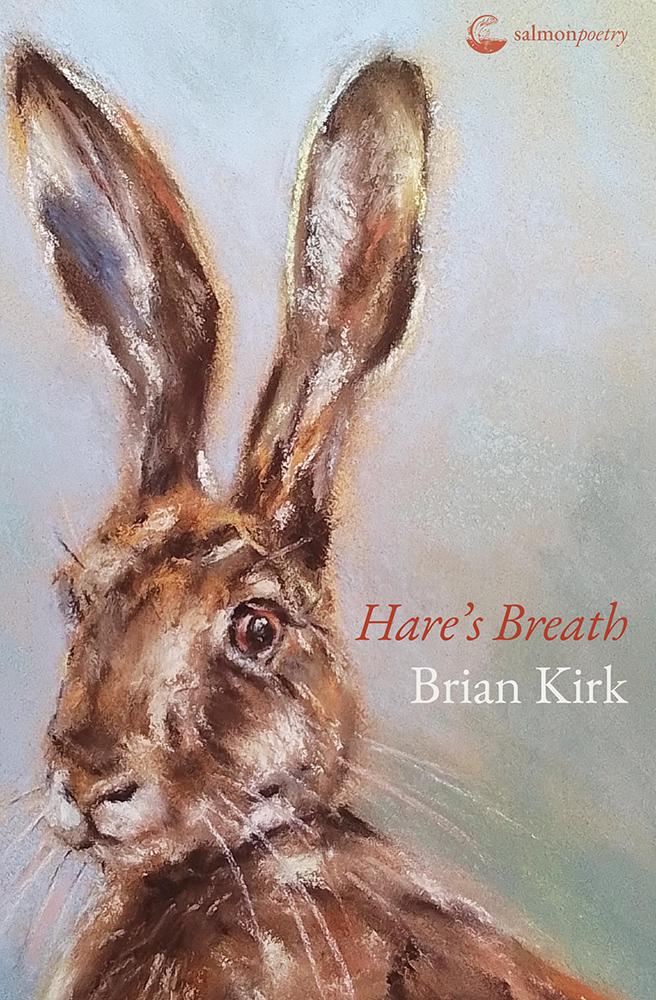
Cover of Hare’s Breath featuring a drawing of a hare (cover image artwork by Rosaleen Fleming)

SG: Let’s begin with the title poem, “Hare’s Breath”, which explores the process of living and that of creating. You wrote an early draft when you were resident in Cill Rialaig. It seems without that residency, that poem would not have been written – the landscape, literally, provided you with the theme, the images, and a way (back?) into your creative self. I’m thinking of the opening lines: “I came here to work/but needed to stop.” Could you tell us more about the writing of this poem?

BK: It’s so good to be invited back to Writers Chat, thanks, Shauna. Yes, the poem “Hare’s Breath” came relatively late to the collection and went on to provide the title, so it’s an important poem for me. I was in Cill Rialaig last February ostensibly to work on the first draft of a new novel. I was very much concerned with word count and making progress which is not always a good idea. I did do some work on other poems I was writing at the time while I was there too, but this poem came from my daily solitary walks up Bolus Head. I love walking and the landscape there is so beautiful and isolated. On one of my first walks, I encountered a hare and each day after that I would go looking for it, but only saw it again briefly on one occasion. The poem as you say is about creativity or inspiration – where art or writing comes from and how difficult it can be to grasp it and hold on to it in the world we live in now that is so full of distractions.  

SG: As with your previous collection, After The Fall, the main themes in Hare’s Breath are relationships – with family, friends, self, creativity – and time. But here it feels that you’re casting your internal eye back and focusing on the formation of a genetic line in time and place that time changes. I’m thinking of “Kingdom”

….we didn’t lick it off the ground…But we grew up and let him down…dreaming another kind of life outside the fortress that he built from duty, faith and love…His kingdom didn’t last. No kingdom does.

This is also seen in the pairing of “Belturbet Under Frost” and “Googling My Parents” which are beautiful love songs to the past. There’s an emotional weight in these poems which draws the reader back again to re-read. Could you comment on these poems?

BK: I think the past will always be a repository of ideas for me. In After The Fall I had some poems about my parents, but I think I approached them in an oblique way. In “Leave-taking” the picture of a dying father are mediated through the memories of an older brother while I was away living in London. In “The Kitchen in Winter” my mother is conjured from the memory of repeated winter mornings in the place where she held sway. In Hare’s Breath there is more of a sense of celebration of their lives I hope, certainly in the sonnet ‘Belturbet Under Frost’ which re-imagines the beginnings of their love. In poems like “Kingdom” and “Windfall” my father is portrayed as a man of his time, struggling at times in the face of a world that is changing. In some ways he is the child and his children the adults. In “Googling My Parents” I suppose I was trying and failing to reclaim my parents. They both died in the late 1980s within six months of each other while I was living in London, and there’s always a sense of things left unsaid. The closing lines of the poem came to me slowly over time. I was trying to say something, I think, about memory and the human mind, its power and its shortcomings. I was trying to liken the brain/mind to a machine (not a very original simile I know) but that wasn’t enough. I was thinking about that story in the Gospel about the Transfiguration. Peter was bumbling around talking about building tents on the mountain when a cloud appeared and a voice spoke out of it to them. I knew then that that was what I was looking for. My parents speaking to me from the cloud (even if only in dreams). It seemed apt as, after all, everything is stored in the cloud nowadays.

SG: A poignant observation indeed. “My First Infatuation”, “Sour” and “Bully” examine early love and hurt through the eyes of a knowing adult. I’m curious about both the positioning of these poems in the collection and the process of writing them – did they come (almost) fully formed, or did you need to tease them out as part of a reckoning with the past in order to move foreword?

BK: When I’m writing poems I’m not thinking in terms of a collection or where each one might appear in a collection, but when I got to the stage where I sensed I had enough good work to look at putting a book together certain poems grouped themselves. In the case of the poems “My First Infatuation”, “Sour” and “Hydra” I do remember these being written around the same time. They are of a piece in terms of style and subject matter, poems about adolescence, I suppose, being considered from a later vantage point. When I was putting the collection together, I realized that “Bully” sat well in there too and also “Sundays in June” and the most recent poem I wrote for the collection “That Last Summer”. I was concerned I think with re-visiting earlier versions of myself – some of whom I didn’t altogether recognise at first. While writing of these poems, each emerged quite quickly and were then subsequently revised, mainly in terms of the sounds. I think sound is very important in my poems and how they read aloud is key for me when revising.

SG: I can see that, alright. There were a number of your poems that I read aloud to compare the experience of reading them in my mind. I enjoyed the back-and-forth glances between past and possible futures or futures that will now never be – in “Exile”, “Dog Days”, “Multiverse”, and in “Excursion into Philosophy” where you end with that wonderful question “Are beginnings and endings the same?” There is a solid sense of regret but alongside this there is a sharp sense of hope, like you’ve focused a lens in on it. Did you find solace and clarity in writing these poems?

BK: I’m glad you’ve alluded to the future in these poems. I wouldn’t want readers to think that I’m merely obsessed by the past (but yes, I do go back a lot to work things out for myself in the now). The collection is dedicated to my kids and to the future and the book, as it progresses, opens out I hope into a meditation on how the past feeds into the future in a cyclical fashion. I think everyone harbours pain from past experience, but what is really amazing is how, every day, people, even in the most extreme straits, manage to get up again and keep going on. I tend to agree with Joan Didion in that I write to find out what I really think, so there is always a sense of discovery.

SG: Yes, a sense of discovery and a hope that opens up. Hare’s Breath also spans outwards from your life exploring other journeys, the luck of survivors – in, for example, “Hibakusha”, “The Last Days of Pompeii”, “Train Dreams”, “Small Things” – and our impact on nature – in “Houses,” “Seaside Fools” and with that punch of a line in “Gaia”:

We’re dust, and nature doesn’t give a fuck

about our self-importance or regrets:

one day our books will float away in streams

Our own concerns fade into nothing in the bigger picture you paint, and yet, you show us how we – and all that we do, and those that we love – are so fragile and that is what really matters. That acknowledgement of vulnerability and with that a lightness, like in the final poem in the collection, “The Invisible House”, where you end with laughter. Is that the cure for us all?

BK: I think living is a constant coming to terms with things. Community, family, friendships are the things that make it possible for us to continue to live. (I think Covid reminded us of that also. There are some Covid poems in here which seem to fit). In the later stages of the collection the poems begin to look outward more, away from the subjective experience to a broader sphere, taking on social, political and ecological subjects. I’m convinced that being able to laugh at ourselves is one of the most important and one the hardest things to do in life. I hope there are moments of humour in the collection too, in poems like “Seaside Fools”, “The Workshop”, “The Last Days of Pompeii” and “Out of Time.” I’d like to think people will smile from time to time as they read.

SG: We will end with a few light questions:

  • Most surprising poem from Hare’s Breath? I think perhaps “The Last Days of Pompeii” because it is the most overtly political poem in the collection. It came in a rush as a kind of ‘state of the world’ poem and on reflection I think I was channelling the late Kevin Higgins who was a great mentor to many poets and had such a wickedly humorous way of making a political point in a poem.
  • It has that sense of humour and the punch of politics, like in much of Kevin’s work alright. Coffee or Tea? It has to be tea. I do enjoy an occasional coffee but limit myself to no more than one a day.
  • Sea or Mountains? I grew up by the sea in Rush, so it has to be the sea. But I love all things rural even though I’ve spent nearly all my life living in cites or suburbs.
  • Do you have a go-to book that you frequently re-read? Yeats’ poetry and lately Derek Mahon’s collected. I do have a look at Ulysses also every few years and I tend to re-read a lot of favourite short stories.
  • Quite a wide variety of go-to genres there! Any literary events coming up for you? I’ll be reading at ‘The Listeners’ at The Revels. Main Street, Rathfarnham Village on Tuesday 6th February 2024. After that I’m hoping to get to readings and festivals around the country during the year as much as possible.

Best of luck with the readings and festivals and I wish you much continued success with the collection. Hare’s Breath may be purchased from Salmon Poetry.

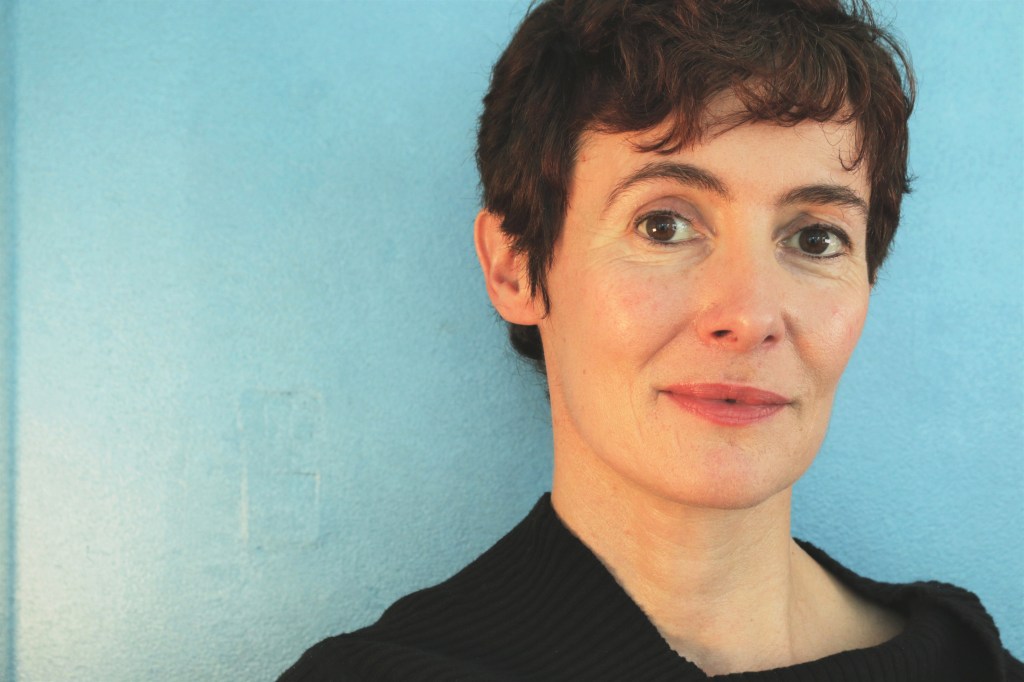
Photo of Brian Kirk in a blue shirt in front of shrubbery, courtesy of Brian Kirk.

Writers Chat 69: Mary O’Donoghue on “The Hour After Happy Hour” (The Stinging Fly: Dublin, 2023)

Mary, you are very welcome to my Writers Chat series. We’re here to discuss your short story collection The Hour After Happy Hour, a collection which has been described (rightly!) by Mike McCormack as “Measured and ceaselessly inventive.”

Cover image of The Hour After Happy Hour showing the title and author name in white writing with an illustration (of women) in shades of blue. Courtesy of The Stinging Fly.

SG: You’ve stated on Arena that The Hour After Happy Hour took ten years to write and in The Irish Times that “The book moves through waiting places and limbo states, very often situated in emigration and transit.” Can you talk about what the act of writing means to you – do you think it is in and of itself a limbo state?

MOD: Thank you for hosting me as part of your series, Shauna. I’m pleased to be in conversation with you. Yes, the stories in the book travel the course of ten years, during which time I, a Clarewoman, have lived and worked in both the southeast and northeast of the United States. The oldest story in the book is “The Sweet Forbearance in the Streets,” written in 2013; the youngest story is the closing story, “The Rakes of Mallow,” written in the early weeks of 2023. So, a decade’s worth of work. Your question accurately captures the act of writing as a limbo state. If we factor in waiting to state of limbo, then so much of writing is waiting. Waiting for a form, a voice, an image upon which the mechanism of a story, or indeed a poem, might turn. Writing might also be considered a liminal condition: transition or threshold. And honest process demands that the writer succumb to change and crossing over.

SG: Oh that’s a wonderful way into process… waiting, and then succumbing to change and crossing over. The opening and concluding stories, both titled “The Rakes of Mallow,” I thought, were brilliant. To me it felt like you distilled the essence of the emigrant experience through the lens of gender. Could you comment on this? 

MOD: The opening story “The Rakes of Mallow” was written in 2015. Not until much later did I realise I had some unfinished business with that story! In the first version I wanted to explore a small and collective emigrant experience: shared disappointments and sorrows, defiant efforts to ‘work one’s way back in’ to the country of origin, which is very clearly Ireland. The story takes its title from the 18th century song (which has had a 20th century life). In the song those rakes know themselves for “Beauing, belling, dancing, drinking/ Breaking windows, cursing, sinking.” And that “sinking” crystallized the first “Rakes” story for me: disobedient, disarrayed, disappointed Irish emigrants who were surely male and “still for Mallow waters crying.” Ten years on I wrote the story anew, this time from the perspective of women and women-identified emigrants. The second “Rakes” is more widely choral, non-protagonist centred, and in solidarity with other emigrants who are not necessarily Irish. And perhaps the biggest difference of all is that the second “Rakes” are more defiant. They decide not to go home. They come close, but they don’t give in. They will not give up their independence. I’m fond—differently fond–of both branches of the “Rakes” family.

SG: Thanks for such insight, Mary. And through the “Rakes” family you also capture the push-pull of belonging and the outsider. In “At the Super 7” – possibly my favourite story in the collection – you capture a wonderful sense of both loneliness and despair with an uncomfortable undertone. Identity, it would seem, is given by virtue of being a father, an identity which the protagonist holds onto dearly. When this is gradually eroded, he is unable to read signs, or accept his new (or non?) place in his son’s life.

“Anger teemed through him. A gale of hurt and dread.”

The lack of drama only serves to build on this anger and yet there is such sadness in the story. Can you talk about that see-saw of emotions?

MOD: I’m glad you like this story. It surfaced one evening in Boston as I walked past a hotel I’d been walking past for many years, seeing the same doorman through those years. The hotel is near a train station. I imagined this doorman taking a train as part of being in a new relationship. Those elements in play, I began to explore what a close but intense brush with parenthood might mean to him. I’m interested in parental roles that include step-parenting (I’m a stepmother), guardianship, proxy parenting. The protagonist of “At the Super 7” is ardent in his guardianship of his girlfriend’s son; he is proud of what this new role has afforded him. When his chance at that other life is ‘eroded’—I like your word here—he wishes to persist in that guardian role, and goes to extremes, and wilfully misses his ex-girlfriend’s cues and requests. I find him fueled more by love than anger. His drive from Boston to Florida is an extravagantly long, sad gesture that’s also beautiful in its commitment. Following him on those journeys allowed me to rest the fiction awhile in places I find enchanting for their melancholy: the motels, small towns, and flashy beaches he comes to know all too well over the course of his campaign to remain relevant in the boy’s life.

SG: That’s what really struck me – he is fueled more by love than anger, contrary to what we might assume of a male protagonist. Many of the characters in the collection are seeking something; many don’t know what it is that they seek. I felt that the placement of “Mavis-de-Fleur” next to “At the Super 7” made these two stories talk to each other about what it means to parent, to love, the need we have to be constantly seeking, and the sense of a widening disconnection. Can you talk about these themes?

MOD: I’m interested to hear that you found symmetry between “Mavis-de-Fleur” and “At the Super 7.” It’s not something I noticed as I placed those stories in close proximity. Now that I’m attending to what you’ve noticed, I recognise that they do share a tone, a tone that combines defiance and lonesomeness. The collection as a whole is certainly interested in failed connections—or connections that have simply grown up or given up over time. All fiction might be said to work from within the emotional breach of what is quickly said and what is truly felt. It’s a tremulous balance, and perhaps we find it especially familiar in the twenty-first century. “Mavis-de-Fleur” is my underworld story. In November 2023 I dedicated a reading of the story to my friend David Ferry, the great poet and translator who had recently died at the age of ninety-nine. I referred to having spent a lot of time “among the shades” with David (he translated the Aeneid and Gilgamesh and more). Even the shades are supplicating to be heard and known.

SG: “All fiction might be said to work from within the emotional breach of what is quickly said and what is truly felt.” Beautiful! One of the pleasures in reading this collection is your descriptive and precise language. You create a clear sense of place as well as capturing how your characters are in the given spaces – “Late Style” and “Maenads in the Terminal” are great examples, with the later bringing a wicked humour rooted in reality:

“I had passed through security in hotshot style, lights popping and voices raised high as weapons. I wore zipless, unriveted garments, and a pad that if soaked through in an hour I was to call an emergency.”

Can you comment on your writing process in relation to precise language, for example, adding in details as you edit? Using notes from notebooks?

MOD: Aren’t you’re mischievous to quote that passage from “Maenads in the Terminal”! Well, I work for accuracy—which often means not giving a damn about the proprieties. Let’s just say that that is not the only soaked pad in the collection! Accuracy is a slow, accretive process in my writing. I suspect that the word ‘unriveted’ came early in the making of that sentence; I know I was thinking about metal fixtures setting off security alarms. Maybe Erica Jong came whispering with ‘zipless.’ Thereafter the work lay in building around those words, building a stance, a condition, a psychology, and a grammar. The punctuation of ‘a pad that if soaked through in an hour I was to call an emergency’ is correct, but it makes for an intentionally bumpy reading experience. I’m devoted to grammar and all it can offer a fiction writer. I value punctuation for many of my efforts at precision. Thereafter it’s about layering version upon version upon version of a sentence, until the sentence becomes incontrovertibly itself.

SG: I’m being mischievous while also identifying! I love your explanation of your work building in, on, and around words and layering multiple versions of sentences until each one “becomes incontrovertibly itself”. A broad print for excellent writing.

Well, we will end this chat, Mary, with some short questions:

  • Bus or train? Train for the rakes and the reading. Bus for seeing a city above its subway innards.
  • Fabulous answer! Coffee or tea? Coffee: espresso and steamed milk. (Milk: whole fat.)
  • Quiet or noise when you’re writing? Some background noise when writing; quiet when revising and editing.
  • Your favourite character in The Hour After Happy Hour? A critic once said the only way they could fault Peter Carey was for loving his characters too much. My form might be a little too ruthless to have favourites. But a minor character like Rascal the dog in “S’addipana”—né Raskolnikov—I’m drawn to his simple striving “to find the last flea,” and because he “fails.”
  • What’s the next three books on your reading pile? El Llano in Flames (1950s) by Juan Rulfo, My Phantoms by Gwendoline Riley and A Shock by Keith Ridgway (one for rereading).

Thank you Mary for such insightful glimpses into your craft and congratulations again on a superb collection.

Mary will be running a seminar on Tuesday, 13th February 2024 entitled “Writing and Re-Vision” as part of The Stinging Fly Seminar Series. See here for details.

Photograph of Mary O’Donoghue courtesy of The Stinging Fly, July 2023

Thank you to The Stinging Fly for the Advance Copy of The Hour After Happy Hour and to Peter O’Connell Media for introducing me to Mary.

Order The Hour After Happy Hour here.