Writers Chat 82 Part 1: Liz McSkeane on “Aftershock ” (Turas Press: Dublin, 2025)

Liz, you are very welcome back to my Writers Chat series. This time we’re discussing your debut novel Aftershock (Turas Press, 2025), which Lisa Harding has described as “relevant and shocking.” I had so many questions for you that I have divided this Chat into two parts so that we might cover most of the areas I was interested in exploring. Writers Chat: Part 1 covers the background to writing the novel, the structure, as well as dipping into the themes of personal/ political and gender/ marriage.

Cover image of the novel “Aftershock” showing darkened ruins of old buildings against pink and orange skies.

SG: Like all good historical novels, Aftershock not only brings us right to the heart of love, power, and ambition in 18th – century Lisbon, it also speaks to our times about the brutality of power. Can you tell us about how you came to write about All Soul’s Day, November 1st, 1755 a day when both an earthquake and a tsunami almost destroys Lisbon and threatens to shatter the beliefs of the city’s inhabitants; what was the genesis of your interest?

LMcS: Thank you, Shauna. I came to this subject by way of a radio interview I heard with a historian called Mark Molesky, about his book  This Gulf of Fire. It was about the 1755 earthquake that destroyed Lisbon and was so fascinated that I sat down to listen. I already had an interest in Portugal – I studied Hispanic Studies at university, which included Portuguese – and had spent some time in Lisbon as a student, so I was keen to find out more about the subject. When I started reading about the earthquake, I became fascinated by the politics of the time, in the lead-up to and in the wake of the disaster – and especially in the character of the man who would become the Marquis of Pombal. He both rescued and enslaved the country, and I found this an irresistible paradox to unravel.

SG: And this paradox snakes throughout the novel.

“At last, the earth is still.” What a great opening sentence that immediately grabs the reader. The sense that stillness can be vast runs through the novel – in relation to the land, the city, and, in our protagonist Dom Sebastião:

“For this man’s stillness deceives. It is a stillness that absorbs everything, understands everything, forgets nothing.”

Was this always the opening sentence of Aftershock?

LMcS: I am glad you find it so arresting! That is what we want, isn’t it! But in fact, that was not always the opening sentence. I had originally planned to start the novel with a dramatic event that occurred a few weeks after the earthquake and in fact wrote what I thought would be the opening chapter around that. But as with so many things in writing, things change. As I had the title from a very early stage, the opening you mention soon superseded my original idea. In a way, it was the title that gave me my opening sentence – which, as you mentioned, plunges us into the immediate aftermath of the earthquake, seen through the eyes of the person who would become the main focus of the novel. I think that quite often, the beginning of a piece – be it a novel, story or poem – sometimes emerges through a process of discovery, in a sense, reveals itself. I do find myself rewriting beginnings – almost as though the start of the story reveals itself.

SG: Aftershock is filled with ambitious characters who strive for what they want within a tightly structured society and clear political rules around church, state, and subjects. I found the conflict between individual desire and ambition (both personal and political – power) and the greater immediate good, to be in sharp focus in the exceptionally well-developed complex character Dom Sebastião. How did you hold the personal and the political within the writing and research?

LMcS: The tension between the private and public selves you mention in many ways is at the heart of the novel and one of the themes which drew me in. I find it both fascinating and shocking how far public events, national policies, can be influenced by the private ambitions and preferences and relationship of the actors. I am sure we can think of many contemporary examples of this. I suppose I should not be surprised, as the leaders who influence or seem to direct historical events are human beings, just like us, with all the foibles and insecurities we all share.

In relation to Aftershock, as I was researching the political events of the time, I became aware of the extent to which the impact of the personal relationships and aspirations of the individual actors were intertwined with what would become historical events. It therefore seemed to make sense to try to inhabit the perspectives of the different actors, to understand why they did what they did. Hence the multiple points of view which carry the narrative.

When I was researching the subject, I found I started with the public events – the earthquake, the measures that were put in place to support the survivors, the part played by other countries (this was one of the first disasters that attracted an international relief response) – and from there, found my way into the lives of the various actors. Their ambitions, as you point out, were often both personal and political. In a way, that made the intertwining of the personal and political both logical and necessary.

SG: Aftershock has an interesting four-part structure that both keeps us with the character-narrator and within the time. I liked your use of chapter titles – “Unwelcome News and a Request Rebuffed” – that hint at what’s in the chapter and, combined with an indication of the date, time, and place, serve to keep the reader knowing where they are in this vast detailed narrative whilst also reminding us of 18th-century letters. Was this a structure you began with or did it emerge as you wrote?

LMcS: To some extent, the structure emerged as I wrote. I had originally envisaged a three-act structure, and at a fairly late stage realised that the action and the characters needed more room to breathe. This resulted in some rearranging and expansion. So the four-act structure was a development of my original plan. 

SG: Again, such a skill in being able to grow original plans as the text develops! One of the themes running through Aftershock is that of the role of gender and marriage in high society – the often-conflicting views of church and state and how they hold power over women. Power, it seems, is not only inherited but also given; Dom Sebastião has the ear of the king (“the king’s favourite. His most trusted advisor”). The king is romantically entwined with the powerful Távora family and Father Malagrida believes he “answers to a higher authority than the king” and therefore can influence the king to stop at least this extra-marital relationship.

Early in the novel we have glimpses of the internal lives of Dom Sebastião’s Austrian wife, Eleanor; Princess Maria (in line to be queen) resents the conversations about finding her a match and Dom Sebastião’s influence over the family. She is aware that for her to be queen her father will have to die and only then will Dom Sebastião “face a bitter reckoning.” After the disasters, Queen Mariana Vitória realises that “Even at this terrible time, her husband’s thoughts are elsewhere.”

Aftershock makes it clear that the women – even those in powerful positions – are seen as useful to obtaining influence and keeping power. Can you comment on this?

LMcS:  Yes, this was one of the themes that was of great interest to me. All the women in the novel – Dom Sebastião’s wife, the queen, her daughter, the marchioness of Távora, the young lover of the king – have a very significant influence on his life, for good or ill. And they all have – up to a point – significant agency in their own lives. But only up to a point, for they are all – at least, this is my interpretation – either used, or discarded (or worse) in the service of his ambition. For example, Dom Sebastião’s access to the high aristocracy was due almost entirely to his two very advantageous marriages: his first wife, who died, was a Portuguese noblewoman and his second wife, Dona Eleanor Von Daun came from one of the noblest families in Europe. So those were women with influence who contributed enormously to his ascendency. On the other hand, there is the Marchioness of Távora – a very imposing matriarch from one of the most powerful dynasties in Portugal, who disdained and mistrusted Dom Sebastião – and greatly underestimated him. For which she paid the ultimate price.

But in some cases, this is a matter of interpretation.  One interesting source I came across was a novel about Dona Teresa de Távora, who was the lover of the king, which adulterous affair was thought by some to have been the catalyst for much of the tragedy that followed. This novel, by a contemporary Portuguese writer, presents Dona Teresa as a kind of proto-feminist, who was in charge of her own destiny and making bold choices. I saw her rather as a rather naïve woman who found herself swept along by events she could not control. Which shows how similar sources can produce very different interpretations!

SG: Oh that’s very interesting. You’re so right about interpretation and similar sources. Thanks for your generosity in answering these first set of questions, Liz. I look forward to Writers Chat: Part 2 which focuses on the language of the novel, the parallels of Dom Sebastião and Father Malagrida and Lisbon-as-character and we conclude with some light quick answer questions.

Tyrone Guthrie Centre at Annaghmakerrig

I was honoured to have been awarded the Jack Harte Bursary 2025 for professional writers and am delighted to report that I had a most wonderful productive week of writing at the Tyrone Guthrie Centre at Annaghmakerrig.

To have an entire week free from everyday obligations and distractions, a week dedicated to thinking and talking about writing…and in gorgeous surrounds, with delicious and healthy food, and to be able to engage in new writing and editing is such a rarity. It was great also to connect with other creatives in a variety of disciplines, and an honour to visit some of the visual artists in their studios and see stunning work in progress. I am most grateful to Jack Harte, The Irish Writers Centre and Anna and her team at the Tyrone Guthrie Centre at Annaghmakerrig for this award – the gift of a week immersed in creativity.

Below are a few photos from walks around the house, grounds, and lake.

Photograph of the bell, wall, and flowers at the entrance to the house, the name plate to the fore. Photograph by Shauna Gilligan (c) 2025.
Photograph of the house in the evening – with some lights on in the house and grass to the fore. Photograph by Shauna Gilligan (c) 2025.
Photograph of the hallway and stairs through the mirror with a beautiful green house plant to the fore. Photograph by Shauna Gilligan (c) 2025.
Close up of a yellow (sun) flower in bloom in the gardens of the Tyrone Guthrie Centre. Photograph by Shauna Gilligan (c) 2025.
View of the beautiful Annaghmakerrig Lake from just outside the house Shauna Gilligan (c) 2025.
A glimpse of some of the treasures in the Tyrone Guthrie library, a beautiful room which overlooks the lake. Photograph by Shauna Gilligan (c) 2025.
Close up of lilac foxglove. Photograph by Shauna Gilligan (c) 2025.

Writers Chat 78: Nuala O’Connor on “Seaborne” (New Island: 2024)

Nuala, You’re very welcome back to my Writers Chat series. This time we’re here to chat about Seaborne, longlisted for the Dublin Literary Award and described by Donal Ryan as “sublimely imagined and beautifully told.”

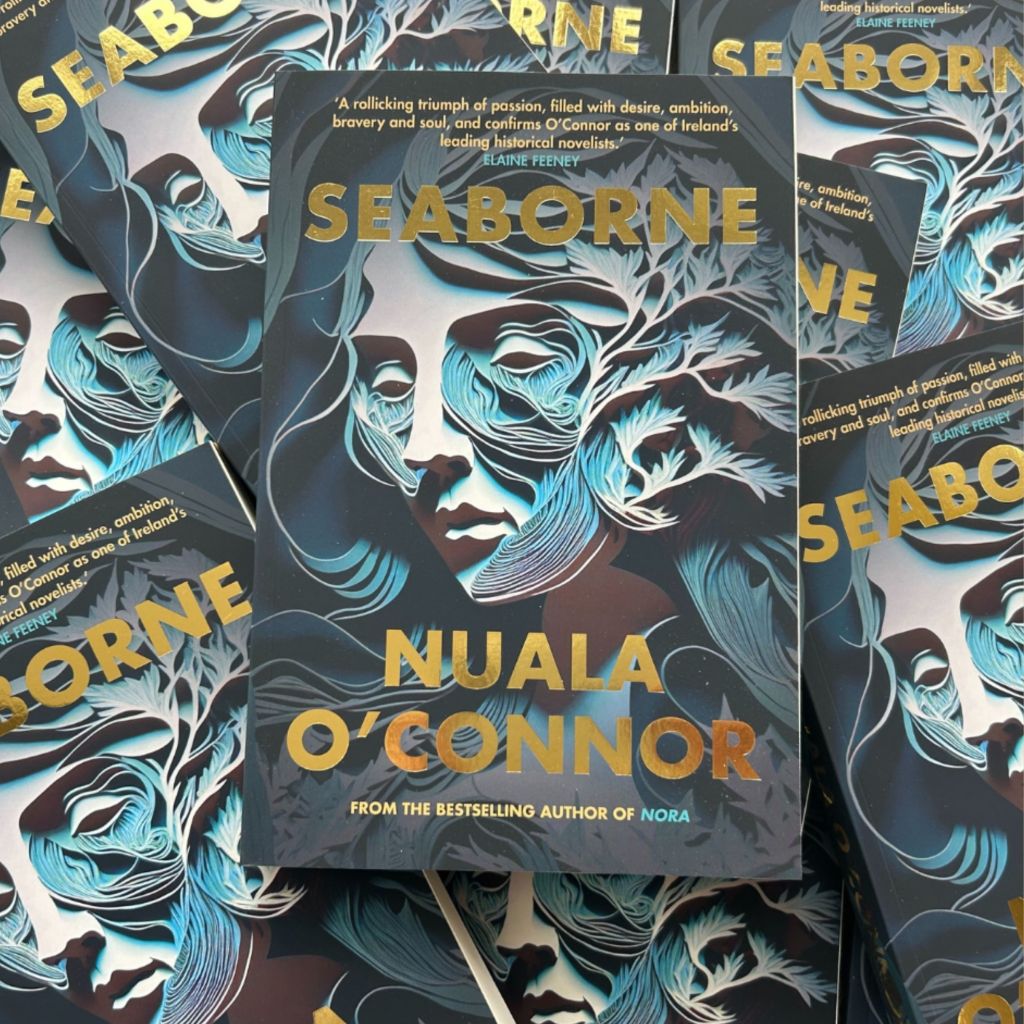
Multiple images of Seaborne by Nuala O’Connor with the title and author name in gold lettering and blue/grey art showing a woman’s face formed by seaweed.

SG: The cover art is stunning. It’s inviting without having read the book and once you’ve read it, you realise the cover totally reflects both title and the complex character of Anne Bonny. Did you have an input into the design and the title?

NOC: I did, yes. New Island are brilliantly collaborative when it comes to the cover. They asked me to make a Pinterest board of images and book covers I liked. I gathered lots of pics of swirly water, women in water, women with big hair and ships on their heads, and so on. Then Karen Vaughan, the designer, came up with loads of possibilities. The final cover image is the one we all had the biggest love for and there were many colour and font tweaks until everyone was happy. The gold foil was an added bonus and I love it. A great experience.

SG: I loved the gold foil! Stunning. It struck me that where Anne is located is a vital part of her identity as much as are people around her. How important was place to you in the writing of this epic book which follows Anne from Kinsale to Carolina?

NOC: Hugely important. There are a lot of myths that swirl around Anne Bonny, and the places she lived or hailed from are included in that. There is no solid evidence of her origins at all, but I chose to use Kinsale and the Carolinas because they were already cited. I travelled to Kinsale but the pandemic prevented my research abroad, so I had to rely on the net, archives, and books for research. Luckily, historical houses, bloggers, and archives are very generous digital sharers of their wealth and knowledge.

SG: Anne is a maverick, and you said in our Writers Chat about Nora Barnacle, another maverick, that you like “women who push against societal norms.” How did you find your research helped or hindered in the creation of the Anne Bonny we meet in Seaborne, given scant records about her illegitimacy, fluid identification with gender, and the push against the barriers of class?

NOC: Any woman who became a seafarer or pirate was considered untoward. With untowardness – in this historic, patriarchal paradigm – goes low morals, bad temper, wantonness etcetera, so Anne was perceived as a feisty dissenter, a rulebreaker and, therefore, bad. It’s not hard to jump from there to the strong-willed quester that I made of Anne. But she has her soft side too – her loving nature.

SG: And you capture her warmheartedness throughout Seaborne. I enjoyed your representations of the changing relationship Anne has with her body – from how she feels and is seen in clothes, to her interaction with men and women, and how she is driven by feeling (physical and emotional) through the book. Can you talk about how your sensory writing is such a fit for a sensuous character?

NOC: I’m an empath and, being autistic, I’m hyper-sensitive to my environment, to clothing, to sensory input and so on, so it’s really easy for me to write those kind of characters, because I live that way – I knock against the world and everything in it as I move through it. So I made Anne is like that too.

SG: Language is at the heart of this book. In the chapter “Quelling an Unsettled Heart”, speaking of Gabriel Bonny, Anne tells the reader that

“The truth stands, though I treat him with disdain, that I like Bonny’s company, I enjoy being near him, and he enjoys me – I see the kindle in his eyes when he looks at me…I like the weight my sailing outfit gives me, it makes me both strong and invisible along the wharf, and there be power to savour in that.”

How did you decide on chapter titles, and what was the process in keeping them inline with the narrative voice which is true to its era and character?

NOC: I had some of the final titles already and then Aoife Walsh, Commissioning Editor at New Island, suggested strengthening them to reflect the content more. I worked with her, and the copy editor, to pick juicy bits from the text as titles. I like all that finessing of a manuscript before it gets to be a book – the cherries on the top, so to speak. I was delighted when Aoife said I could have a map, too – I love novels with maps.

SG: Thank you for being so open about the process! One of Anne’s strengths is her openness and adaptability to linguistic expression – the changes of speech from Cork to Carolina are deftly handled, as are her imitations – while at the same time, she stays true (and firm) to her need of the sea. Was this an important element of the reimagining of Anne, for you?  

NOC: I wrote her as neurodivergent before I even knew I was autistic myself. I got my diagnosis shortly after finishing the manuscript, if memory serves. So, she blends, mimics, and adapts in order to fit in (the same thing I’ve been trying to do for all of my life). This masking/imitation includes speech patterns, ways of behaving, clothing and so on. Anne is a chameleon the way many autistic people are.

SG: And this ability to change and blend shines as a gift rather than any type of limitation. The power and strength Anne gets from some female relationships is also explored through her friendships with Hannah Spratt and Bedelia. Can you talk about the role of this trio of women in the overall narrative and how it might compare or contrast with Anne’s relationship with her mother?

NOC: Bedelia is Anne’s beloved friend. There is an imbalance – Bedelia is her servant – but Anne loves Bee fiercely, relies on her totally. Anne is wary of Hannah from the start, she seems too fond of Bedelia. But Anne learns to like her a little when she sees that Bedelia likes her. It’s an unbalanced trio and it never quite goes right, as the reader will see.

Anne’s mother Mag was steady and wise, she was Anne’s main advisor and, her early death left Anne a bit rudderless. With no steady hand to guide her, we see Anne flounder, fragment, and act chaotically.

SG: Lastly, Nuala, some fun questions:

  • Boat or plane/Sea or land? I’m not a fan of flying. Too little control. At least on a boat you can walk around. I love the sea but, if I had to choose, land.
  • What was your favourite place you visited as part of the research for this novel? Kinsale – such a beautiful, colourful, rich part of Ireland. Also, the Caribbean of my mind. I enjoyed describing tropical beaches while locked down during the pandemic.
  • The power of words! Is there an era in history you would not like to explore through historical fiction? If so, why? I’ve done 18th, 19th, & first half 20th C, so I’ve covered a fair bit. A WW2 novel is appealing, but I have no firm plans. The novel I’ve just finished writing is contemporary.
  • What are you reading now? A book of Greek poetry. And I’m back with Ferrante because I’m going to Naples this year. I’ve blurbed nine books so far this year and have one more to go, so my reading has been prescribed a lot (time to take a blurb break, I think!). I have Seán Hewitt’s new novel lined up and am also finishing some Virginia Woolf, because she comforts me, and I’m always reading Elizabeth Bowen’s stories again, because I’m in a Bowen Reading Group. I always have loads of books on the go. Plus podcasts.
  • That is a lot! Naples is stunning – in all the senses. What are you writing now? A memoir about late-diagnosed autism, writing, depression, the alcohol-free life – I’m throwing the lot at it!

As always, Nuala, thank you for your generous answers and insight into your process as well as the editorial process with New Island. Wishing you continued success with the novel and good luck with your memoir. Seaborne can be purchased directly from New Island.

Nuala O’Connor sitting on a wooden chair on a beach with the sea behind her. Photograph by Úna O’Connor. Used with permission.

Nuala O’Connor lives in Co. Galway. Her sixth novel Seaborne, about Irish-born pirate Anne Bonny, was nominated for the Dublin Literary Award and was shortlisted for Eason Novel of the Year at the 2024 An Post Irish Book Awards. Her fifth poetry collection, Menagerie, was published by Arlen House in spring 2025.