Writers Chat 76: Catherine Dunne on “A Good Enough Mother” (Betimes Books: Dublin, 2024)

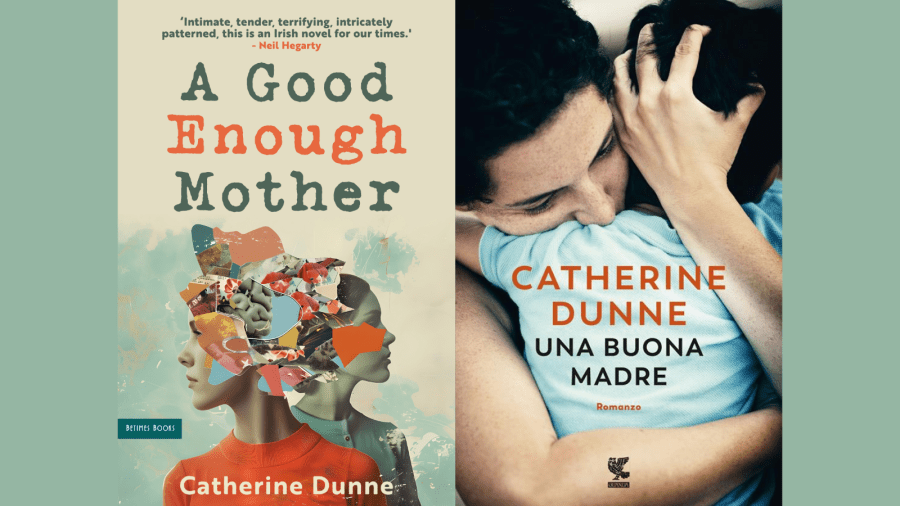
Image of covers of A Good Enough Mother and Una Buona Madre (Images used with permission of Catherine Dunne)

Catherine, You are very welcome back to my Writers Chat series. We’re here to talk about your highly successful A Good Enough Mother, for which you have won the European Rapallo BPER Banca Prize, and the Jury statement about the Italian translation Una Buona Madre (published before this English version) accurately said that in this novel you weave “together the lives of several diverse and ill-starred women” and link “a compelling present to a troubled past”.

SG: So let’s begin with the structure of A Good Enough Mother which is both a history of the treatment of women in Ireland and a beautiful, moving and gripping intergenerational story. Almost every section is dated and named according to whose story we’re immersed in. Can you talk about the mechanics of structuring this complex narrative that spans over several generations?

CD: Thank you for inviting me back, and thank you also for that very kind introduction. Structure is always a tricky issue. But it’s never something I decide on in advance – I tend to let it emerge during the writing. I love being surprised. I love the way the whole process is organic, the way the novel, including its structure, comes to life as I write.

I have always written in scenes. The patchwork quilt is the best metaphor I can come up with for the way I work. The act of sewing becomes a possibility of healing for the women in A Good Enough Mother, and it also serves as a metaphor for the writing process. In AGEM, I chose 66 scenes out of what I had drafted, reworked them endlessly and then sewed them together, like a classic patchwork quilt. I hope the seams don’t show.

The first scene I wrote involved Tess, and it was inspired – if that’s not an insensitive word – by the aftermath of the Belfast rape trial in 2018. That trial, and the not guilty verdict that resulted, convulsed the nation. The appalling public nature of that legal process, the retraumatising of the victim, and the deeply troubling attitude towards women that emerged during those horrifying days fuelled a significant public conversation. It is a toxic attitude that we’ve had to confront again and again in other high-profile cases of sexual assault.

When I began writing the trilogy of novels based on Greek myth – The Years That Followed, A Good Enough Mother, and The Way the Light Falls (to be published in 2025) – my overarching theme was motherhood.

Tess was the first character who appeared to me; and with her arrival, I wondered: what if one of her sons were accused of sexual assault? How would she feel? What would she do? How would she reconcile her unconditional love for her son with her revulsion at his alleged offence? The writer’s eternal ‘What if?’ propelled me into writing her story.

Once Tess’s character began to form, a cast of other women began to clamour to be heard. Catherine Corless’s unearthing of the secrets of Tuam’s Mother and Baby institution – they were not ‘homes’ in any meaningful sense –  fuelled my stories of Maeve and Joanie. My research for An Unconsidered People formed the inspiration for Betty and Eileen’s lives in Kilburn, and so on…Each character led me to the next – the kind of organic growth of narrative that I referred to earlier.

SG: That’s really interesting about letting the writing lead organically, and the practice of writing in scenes (and no, the seams don’t show!). This novel gives voice to that which can’t always be voiced – the violence of assault and rape – and in such a way that this narrative threads through and above each of the individual narratives. And yet each of the narrators have a very distinct narrative voice which is not an easy write. Did the movement from silence to voice come as you were stitching the novel together?

CD: Time and place were my friends in this regard. The sections of the novel move between the 1960s and the present, back and forth from Dublin to London, and to an unidentified location somewhere in rural Ireland. ‘Seeing’ each character in their distinct location, and at different times, made their individual voices begin to come alive inside my head.

I always find it interesting that the character closest to me in age/location/circumstance is always the most difficult to write. Familiarity is my enemy. I struggled in the early drafts with some of Tess’s scenes. I had to take the decision to place her on constant high alert, to make her anxious and fearful for her family. That anxiety became one of the defining features of her voice.

With Eileen, I drew on my extensive research for An Unconsidered People. Years of going back and forth to Kilburn, interviewing elderly Irish immigrants, meant that my sense of London in the fifties and sixties was already part of my imaginative landscape. And I was able to give her a passion for fabrics and sewing, all of which helped me develop the individual nuances of her voice.

This novel took me about four years to complete. During that time, the characters became my friends and I saw them as individuals. The more time I spent in their company, the more I grew to love them and the more real they became.

Writing is an act of imaginative empathy. The predicaments I created for each character were different, the challenges I gave them were demanding in different ways. Each draft of the novel meant I could stitch in more and more detail about their lives and their attitudes that made these fictional characters differ from each other.

SG: I’m glad you refer to drafts (multiple) and the process of stitching in more detail. You’ve spoken above and in The Irish Examiner  about how Tess’s narrative came to you fully formed and was then followed by Betty’s story. Tess recalls that:

Family is family, Betty used to say. You fight with them, you fight about them, but above all you fight for them. Tess stands up. She needs to find her fight again. Needs to access that spirit that will help her to reach Luke. No matter what he’s done. Then she switches off all the downstairs lights…

I loved how you anchored Tess’s story in the continuing running of a household, the shopping, the cooking, the simple turning off of lights. There was something so moving about the simple, every day actions that carried the weight of terrible violence. Can you talk about Tess and her movement through the novel?

CD: Tess has to deal with one of every parent’s worst nightmares. Luke’s challenging and dangerous behaviour, the accusation he faces, the threats to her family’s wellbeing are all emotionally draining. But despite being consumed with worry, Tess is anchored in the real world. She has a job, an absent husband whom she loves dearly, but financial realities mean that he is frequently away from home – a source of significant tension between them. Tess must manage home and family – Luke and Aengus, her two sons – on her own.

Despite the crisis facing her, Tess still has to deal with all the tasks that I believe sociologists call ‘love labour’. She needs to cook, to clean, to shop, to keep the household running so that everyone gets fed, everyone has clean clothes, that the home environment doesn’t descend into chaos…

Research tells us that most of this kind of work is still carried out by women. Whether women willingly assume responsibility for these tasks, or whether that responsibility is thrust upon them is another day’s discussion. The daily reality that I create for Tess is familiar enough, I believe, to be recognisable to most readers.

I also tend to bristle that domestic detail such as making a list for the supermarket, or picking clothes up off the floor, or trying to put a meal together under pressure, has frequently been dismissed as ‘small canvas’ stuff in women’s writing – as though the domestic is not a fit subject for fiction.

In an essay entitled Writing for My Life, I observe:  

I’ve experienced the accusation many times that women work on too narrow a canvas: that of the ‘domestic’. The wider world, that of big issues and important causes, belongs to men. It’s an argument that might also be familiar to Jane Austen.

In the Odyssey, Telemachus tells his mother, Penelope, to be quiet. He tells her: ‘talking must be the concern of men’.

In this version of the tale, she obeys; we don’t know how she feels, but she obeys.

He means, of course that talking – all the public, the weighty, significant discourse – must be carried out by men. The chatter can belong to women, tidied away into their domestic spheres among the dishes and the brushes.

And so, I like to give the dishes and the brushes their own special place in my fiction.

SG: Thank you, Catherine for such a full and brilliant response which puts me in mind of the importance and power of the domestic in the fiction of Elena Ferrante. Those dishes and brushes are witnesses.

I found Joanie’s narrative particularly heartbreaking and you voice her confusion and naivety in St Brigid’s, the Mother and Baby Home so authentically.

“Joanie imagined that the girls, the penitents, must use up every single punishment in the whole world, so that nothing was left over for the nuns.”

And then after her baby is taken away,

“Joanie’s howls filled the long corridor and ever since, she’d wandered about like a lost ghost, trapped somewhere between two worlds.”

It felt like she stayed trapped between two worlds for most of the novel. Was some of her story based on your extensive research for your non-fiction book An Unconsidered People: The Irish In London?

CD: Nottingham was one of the cities I visited briefly during the time I was researching An Unconsidered People, but my main focus was Kilburn and Cricklewood. However, in one of the many mysterious ways that ideas and memories float to the surface during the writing process, Nottingham came to me as somehow fitting for Joanie and Eddie.

As before, familiarity has its dangers for the writer, and I wanted somewhere to place Joanie that I didn’t know as well as I knew London. I wanted a place that, within the world of the novel, was special to Joanie. And Nottingham just…elbowed its way to the front of my mind. I had to research its parks; its houses close to the railway station; its hotels.  None of those places was familiar to me, and that was a gift. All of it became food for the imagination.

Maybe, like parents, novelists shouldn’t have favourite characters. But Joanie is mine. I have to confess that. Perhaps because her life experience is light years away from mine – she’s from a poor rural background; she’s treated harshly by her parents; she’s dyslexic. Her predicament elicited the most empathy from me.

Her story has so many echoes of the stories I read of some of the 56,000 women incarcerated in Ireland’s Mother and Baby institutions. I wanted to give those stories space and dignity – and so Joanie arrived in my imagination.

SG:  Maeve’s father drives her to St Brigid’s. Maeve tells us

“I don’t know which was worse: being betrayed by the boy I loved; feeling frightened about what lay ahead; or knowing that my father was lost to me for good.”

Later, she tells us (in stunning prose!):

My days began to fill up with possibility. Hope became a bright blur, the colour of sunflowers. At the same time, I kept thinking about this secret army of women. All of them – all of us – all over Ireland. Mothers of lost children.

These are themes you deftly thread through the novel – boys and men betraying and casting women into hidden spaces and places, and women together creating bonds of safety and possibility.

CD: I remember, even as a young teenager when I became aware of the power of words, that I wondered about the phrase ‘unmarried mother’. In the 1970s it was still a loaded term, redolent of shame and immorality. It was one of those phrases that filled my generation of young women with a terror of getting pregnant.

But even then, another question became insistent: what about unmarried fathers? We never heard a word about them. Did they not exist? Were these so-called ‘illegitimate’ babies the result of mass miraculous conceptions all over Ireland?

It would be years before I even began to understand the potent nature of shame as a method of social control. Years before I learned that around the time the Irish state was founded, there was the belief that the value of such new states resided in the virtue of its women. It therefore followed that if the women that populated these newly formed states were not ‘virtuous’, then they needed to be hidden away.

Hence the development of Ireland’s ‘shame-industrial complex’, as Caelainn Hogan calls it. Magdalene Laundries, Mother and Baby institutions: all of them methods of the social control of women, a system devised, developed and maintained by Church-State collusion. Photographs of the time show that the power of both the Catholic Church and the Irish State was entirely in the hands of men – a symbiotic relationship that was at the root of this country’s problematic relationship with women and women’s bodies.

In the world of the novel, I wanted to give life to what I have so often observed: the ways in which women work to strengthen social and familial ties; the way they support and nurture each other as a way of challenging the misogyny that is still such a part of modern society. 

SG: And we don’t always see these ways in which women support and nurture each other. Furthermore, you tackle difference with acceptance and tenderness through the wonderful Eileen and all that she does for women. She was my heroine of A Good Enough Mother.

Sometimes, when I look around at the three of us in the evenings, I have a powerful sense of being bound to a great circle of other women, other times. Our tasks feel ancient, full of history, the threads of connection pulling us tightly together as we work.

Can you talk about her formation and the role of material, thread, sewing and mending?

CD: I loved Eileen’s steely defiance. That’s where she came from: her refusal to bend to what was expected of her. Her character, and her life experience, came from some of the many stories I listened to in Kilburn and Cricklewood over the years.

A nurse I interviewed – who chose to remain anonymous in An Unconsidered People – told me about her uncanny ability to detect even the earliest signs of of pregnancy in the young women arriving at Euston Station, alone and terrified.

She used to meet the mailboat each morning and said that her ‘mission in life’ became helping those pregnant young Irish girls, who had been sent away lest their condition bring shame on their respectable families.

She had the insight, however, decades later, to wonder whether she would have to account for her actions on the Day of Judgement.

What actions? I asked.

In the belief that she was doing what was best, she handed over dozens of newborn babies to good, Catholic families in London – babies born to those terrified Irish girls – without any paperwork whatsoever. She did not profit from this in any way, but understood, years afterwards, that these transactions may not have been ethical.

Her ‘mission in life’ made me ask the eternal writer’s question: What if? What if Eileen had been one of those girls? What would it have been like to search for your lost child for the rest of your life?

Her name, Eileen, is in memory of my own godmother. A most beautiful human being, who had no children of her own, a grief that stayed with her all her life. My character, Eileen, is named in a loving tribute to her.

SG: That’s beautiful and what a loving – and lasting – tribute to your godmother. We will end with some short questions, Catherine:

  • Cats or dogs? Oh, dogs, every time!
  • Mountains or Sea? Sea, with mountains a close second.
  • What do you do after you’ve published a novel or a long manuscript and had a launch? Usually, mourn its absence for a bit, before diving into something new.
  • One stand-out fiction and non-fiction book of the year for you? Not sure what year it was published, but I loved Wifedom, by Anna Funder – non-fiction. A blend of so many forms of writing. And far too many novels to choose from, but if you insist, Soldier Sailor by Clare Kilroy and Our London Lives by Christine Dwyer-Hickey.
  • What are you working on now – if you can talk about it in a general sense, I know it’s not always possible to articulate what’s not yet formed.  I’m currently working on The Way the Light Falls – part of the trilogy of novels inspired by Greek myth. It has already been published in Italian and was shortlisted for the Strega Prize for Fiction. But I’m glad to have the opportunity to revise it before it’s published in English by Betimes Books sometime in 2025. But, as a little bit of superstition, after 30 years as a professional writer, I have the opening paragraph of a new novel already written…There is always the lurking fear that the writing well might run dry!

Thank you, Catherine for such enlightening answers and insights into your process. I wish you continued success and look forward to The Way the Light Falls.

Purchase A Good Enough Mother  

Follow Catherine Dunne.

Listen to Miriam O’Callaghan’s interview with Catherine Dunne on RTE
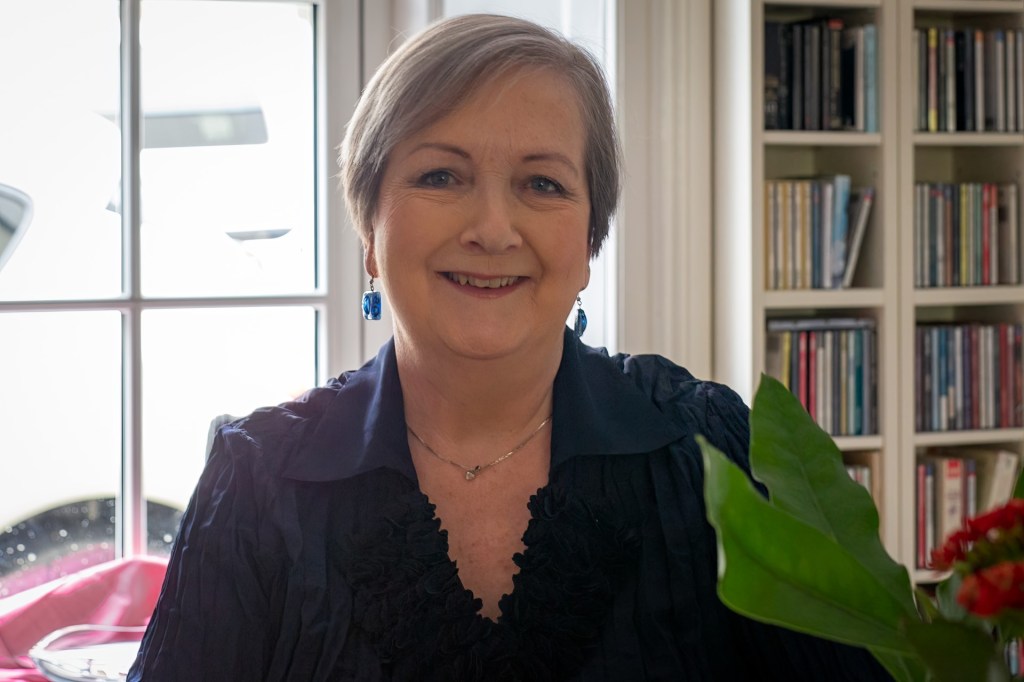
Photograph of Catherine Dunne smiling, wearing a black blouse, a window onto a street and a bookshelf with books is behind her and flowers sit to her left. Photograph by Simon Robinson, used with permission.

Writers Chat 75: Anne Tannam on “dismantle” (Salmon Poetry: Clare, 2024)

Cover of “dismantale” by Anne Tannam. Image by Darragh Murphy. Digital collage representing each of the five sections in the collection; child, man, mother, underworld and crone against a black background.

Anne, You are very welcome to my Writers Chat series. We’re here to discuss your latest poetry collection dismantle (Salmon Poetry: Clare, 2024) about which Jessica Traynor described the collection as “an moving excavation of what it means to be a woman in the world today…dismantle is both an exquisite undoing and a call to explore the wide world.” I have to say that I took so long in preparing our chat because every time I returned to dismantle I found a new theme or felt something new. Many congratulations on an outstanding collection of poetry.

SG: Let’s begin with the title dismantle, and the cover image which is so arresting, I had to wait a few days digesting all that it invited in me before opening the book. I loved how elements of the cover image brings us through each section of the collection. Could you comment on the choice of title and cover image?

AT: At a certain point in life it feels right to interrogate the roles we’ve played, to turn our lives upside down and shake them to see what falls out. I wrote this collection at such a juncture; my parents had passed, my children were adults and my body and mind were transforming through the menopause process. A new energy, that of the crone, was emerging and it felt like an invitation (or demand) to dismantle any narrow inherited sense of self I was holding onto, and to revisit past or imagined stages in my life through a fresh lens. The title came after I’d written about half of the poems and it fit my felt sense of what was happening, both archetypally and on a deeply personal level.

The cover was created by an artist, Darragh Murphy, formerly known as my youngest, whose visceral and intuitive approach to art was the perfect foil for the poems. Using the crone as his cornerstone, he worked in digital collage, layering in elements that represented each of the five sections; child, man, mother, underworld and crone. It was a collaborative process and I’m very proud of what we’ve created through image and words. As someone said to me ‘it’s not collection for the fainthearted’, and they’re right!

SG: And that’s what I love about it! It’s a collection that invited me to dive in, immerse herself, and then come out not quite sure how to name what I’d experienced. What remained – after leaving down the collection and letting it simmer – was a rake of emotions. Joy, sadness, grief, hope. Your words were felt in my body, as well, of course, as my intellectual admiration for style and form, both of which we will return to later. For now, though, can you address the connection – if any – between the organisation and order of the poems and the array of emotions that seem to echo the changing and finding of identities?  

AT: Oh, that’s a great question. There is a journey of sorts through each section, a playing out of scenarios, fantasies and memories. The final crone section is a natural end point, a catching up to where I had landed in my life (I’ve since become a grandmother and that’s an another perspective on this life stage). I felt a wide range of emotions writing the collection and each section, like a mini-playlist, evoked its own combination of complex feelings. For me, what gives the collection its emotional cohesion is the crone’s ability to feel the intensity of each emotion and paradoxically, to create compassionate distance from it. She effortlessly holds the tension of opposites and multiple viewpoints. And I’m intentionally writing about the crone as if she wrote the collection. She kind of did. It honestly felt like another voice was speaking through me and my job was to get out her way and let her get on with it.

SG: Oh, it feels with this answer that the crone may come through your words again and I look forward to that! “laid out” is such a beautiful, moving poem that pushes and prods the reader towards discomfort when identity is in question, where the narrator – and reader – grapple with who they are, the possibilities of self, the desires to be all to all but most of all to be careful . For me, it tied in with “deep time” where the narrator stayed below “long enough/to find a way back” and with “preparation for the search” where the narrator is “obedient child” “dutiful mother” “little woman.” Could you talk about the link between the carefulness with which we navigate the world of inner and outer selves and the theme of loss?

AT: It’s fair to say that the preoccupation with being careful is more likely experienced by women than men. It’s changing, but traditionally, women were valued more for being quiet, careful and obedient than for being outspoken in word and deed. ‘laid out’ explores the connection between the role of mother and how much of that experience society or cultural norms demand be kept hidden from view. That’s a loss in itself, never mind the other losses that life inevitably lays at our feet. One of the many joys and responsibilities of writing is to take what’s hidden carefully from view and, without judgement, hold it up to the light. I think the braver we can be in our writing, the braver we can be in our lives. To embrace the crone energy (which, for me, is beyond the confines of gender), is to choose to live openly and without apology in both the inner and outer worlds of the self. No more careful!

SG: Thank you for those words, Anne. I’ll carry them forward – brave in writing/brave in life. dismantle is as much about journeying inside  – finding that “milky silence” (in “one of these days”) – as a turning inside out (or dismantling) so that you can get “out of the world” – while time marches on (“first visitation”) – “ancestral seam unravelling back” (“early days”). Does (or did) the act of writing and putting together this collection stitch a version of you (and all the versions of you) together parallel to a close examination of male and female lineage?

AT: I love that idea of stitching versions of ourselves together. I do feel that the task of my fifties has been to do just that; to gather together all the various parts of who I am, the roles I’ve played, the intergenerational baggage I carry, the roads taken and not taken and stitch them together into a more inclusive and accepting version of myself. Writing dismantle has played a large part in that. It allowed fresh, wider perspectives to emerge which situated who I am into a long, unbroken chain of ancestors hunkered close to the earth.

SG: It seems that the expanse of the body of the world as much as the body of self is felt keenly throughout. “circumnavigation”, the last poem in the collection sums up my  experience:

who knew the world could be this big she says before/ you head off/ across the headland/ taking the long way round”.

It left me with a wonderful sense of hope. Could you talk a little about the hope in dismantle?

AT: I’m very glad to hear that you were left with a sense of hope after reading dismantle. After completing the manuscript, I was left feeling more grounded in a sense of purpose and direction. It echoes what the researcher Brené Brown, in her book ‘Atlas of the Heart’ says: Hope is a function of struggle we develop hope not during the easy or comfortable times, but through adversity and discomfort. What I appreciate most about the crone is her ability to face what’s in front of her and forge a path through, no matter what. It’s a turning towards, as in the final line in the poem “she finds you”, which is the antidote to the earlier a hardening/a shutting down/ a turning away. The crone doesn’t get bogged down in the present moment but sees everything within a wider context. Like in the poem “she rarely gets straight to the point’, Patience,/ she reminds you,/ her hair a tangled nest of twigs and leaves/ all the good stuff takes time’. She’s referring to geological as well as human time. I find that so reassuring.

SG: And so, to the form – your fascinating use of space, font type and style, to create what seems to be meta texts and messages within the individual poems, their dialogue with each other – in how they’re placed within the sections and again within the collection as a whole. I’m thinking here of the section openers “child as”, “man as”, “mother as”, “underworld as”, “crone as” – alongside individual poems such as “wake in the early hours”. How important is form to you in this collection? And, if I may tag another question onto this – did it come before, parallel, or after the themes and narratives emerged?

AT: Form is integral to the collection. From the beginning I wanted it to feel and look different from the previous three. I needed to stretch myself and take risks. It was the first time I’d written to a specific theme and in the second person. One of the first poems I wrote which had a very different energy to it was ‘crone as’. It felt intuitively right to place the poem in the centre of the page and, once freed from the constraints of left-side alignment and traditional punctuation, I could then play with the presentation of the words on the page to create as you call them meta texts and messages within individual poems. The decisions were made with an instinctive logic and I relied on feedback from others to assure me that the choices added to, rather than distracted from the reading experience. I know I am asking a lot of my reader. I hope the experience is worth the additional attention the text demands.

SG: And it’s that additional attention, Anne, that creates the unique dialogue between poet, text and reader. Wonderful stuff! We will end this chat with some short questions:

  1. Dart, train, bus or motorbike?  Motorbike (electric moped, actually!)
  2. Well water, river water or sea water? Sea water
  3. Favourite place in Ireland you discovered on your poetry travels? Impossible to say but the Inishowen Peninsula, a place I’d never visited before was stunning
  4. Quiet or noise when you’re writing? Quiet
  5. What’s the next three books on your reading pile? ‘The Unseen Truth’ (Sarah Lewis), ‘Traces’ (Jackie Lynam) and ‘Time of the Child (Niall Williams)

Thank you, Anne, for your generous and open answers. Readers, you can purchase dismantle here and connect with Anne on her website.

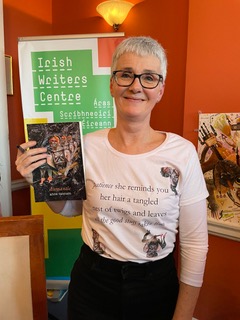
Photograph of Anne Tannam at The Irish Writers Centre for the launch of “dismantle” wearing a white t-shirt with quotes from the collection and holding the book in her right hand. Photograph courtesy of Anne Tannam.

Writers Chat 71: Brian Kirk on “Hare’s Breath” (Salmon Poetry: Galway, 2023)

Brian, Welcome back to Writers Chat. This time we’re talking about Hare’s Breath your latest collection published by Salmon (2023). It’s a collection that deserves to be read with care – as much care as you clearly put into the language in the poems and the shape of the collection – and one that rewards the reader with each re-read.

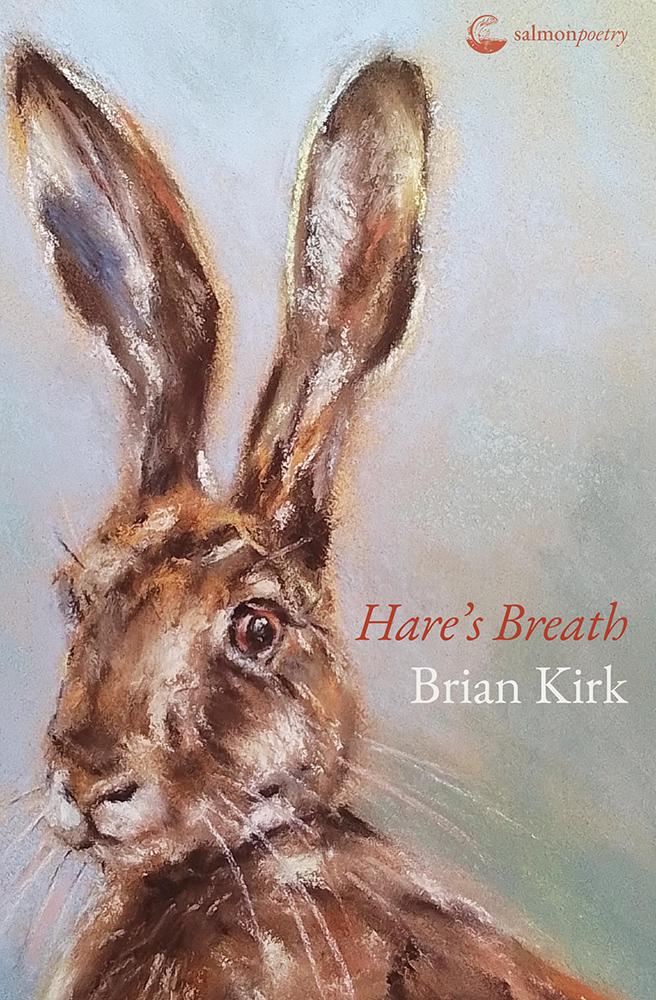
Cover of Hare’s Breath featuring a drawing of a hare (cover image artwork by Rosaleen Fleming)

SG: Let’s begin with the title poem, “Hare’s Breath”, which explores the process of living and that of creating. You wrote an early draft when you were resident in Cill Rialaig. It seems without that residency, that poem would not have been written – the landscape, literally, provided you with the theme, the images, and a way (back?) into your creative self. I’m thinking of the opening lines: “I came here to work/but needed to stop.” Could you tell us more about the writing of this poem?

BK: It’s so good to be invited back to Writers Chat, thanks, Shauna. Yes, the poem “Hare’s Breath” came relatively late to the collection and went on to provide the title, so it’s an important poem for me. I was in Cill Rialaig last February ostensibly to work on the first draft of a new novel. I was very much concerned with word count and making progress which is not always a good idea. I did do some work on other poems I was writing at the time while I was there too, but this poem came from my daily solitary walks up Bolus Head. I love walking and the landscape there is so beautiful and isolated. On one of my first walks, I encountered a hare and each day after that I would go looking for it, but only saw it again briefly on one occasion. The poem as you say is about creativity or inspiration – where art or writing comes from and how difficult it can be to grasp it and hold on to it in the world we live in now that is so full of distractions.  

SG: As with your previous collection, After The Fall, the main themes in Hare’s Breath are relationships – with family, friends, self, creativity – and time. But here it feels that you’re casting your internal eye back and focusing on the formation of a genetic line in time and place that time changes. I’m thinking of “Kingdom”

….we didn’t lick it off the ground…But we grew up and let him down…dreaming another kind of life outside the fortress that he built from duty, faith and love…His kingdom didn’t last. No kingdom does.

This is also seen in the pairing of “Belturbet Under Frost” and “Googling My Parents” which are beautiful love songs to the past. There’s an emotional weight in these poems which draws the reader back again to re-read. Could you comment on these poems?

BK: I think the past will always be a repository of ideas for me. In After The Fall I had some poems about my parents, but I think I approached them in an oblique way. In “Leave-taking” the picture of a dying father are mediated through the memories of an older brother while I was away living in London. In “The Kitchen in Winter” my mother is conjured from the memory of repeated winter mornings in the place where she held sway. In Hare’s Breath there is more of a sense of celebration of their lives I hope, certainly in the sonnet ‘Belturbet Under Frost’ which re-imagines the beginnings of their love. In poems like “Kingdom” and “Windfall” my father is portrayed as a man of his time, struggling at times in the face of a world that is changing. In some ways he is the child and his children the adults. In “Googling My Parents” I suppose I was trying and failing to reclaim my parents. They both died in the late 1980s within six months of each other while I was living in London, and there’s always a sense of things left unsaid. The closing lines of the poem came to me slowly over time. I was trying to say something, I think, about memory and the human mind, its power and its shortcomings. I was trying to liken the brain/mind to a machine (not a very original simile I know) but that wasn’t enough. I was thinking about that story in the Gospel about the Transfiguration. Peter was bumbling around talking about building tents on the mountain when a cloud appeared and a voice spoke out of it to them. I knew then that that was what I was looking for. My parents speaking to me from the cloud (even if only in dreams). It seemed apt as, after all, everything is stored in the cloud nowadays.

SG: A poignant observation indeed. “My First Infatuation”, “Sour” and “Bully” examine early love and hurt through the eyes of a knowing adult. I’m curious about both the positioning of these poems in the collection and the process of writing them – did they come (almost) fully formed, or did you need to tease them out as part of a reckoning with the past in order to move foreword?

BK: When I’m writing poems I’m not thinking in terms of a collection or where each one might appear in a collection, but when I got to the stage where I sensed I had enough good work to look at putting a book together certain poems grouped themselves. In the case of the poems “My First Infatuation”, “Sour” and “Hydra” I do remember these being written around the same time. They are of a piece in terms of style and subject matter, poems about adolescence, I suppose, being considered from a later vantage point. When I was putting the collection together, I realized that “Bully” sat well in there too and also “Sundays in June” and the most recent poem I wrote for the collection “That Last Summer”. I was concerned I think with re-visiting earlier versions of myself – some of whom I didn’t altogether recognise at first. While writing of these poems, each emerged quite quickly and were then subsequently revised, mainly in terms of the sounds. I think sound is very important in my poems and how they read aloud is key for me when revising.

SG: I can see that, alright. There were a number of your poems that I read aloud to compare the experience of reading them in my mind. I enjoyed the back-and-forth glances between past and possible futures or futures that will now never be – in “Exile”, “Dog Days”, “Multiverse”, and in “Excursion into Philosophy” where you end with that wonderful question “Are beginnings and endings the same?” There is a solid sense of regret but alongside this there is a sharp sense of hope, like you’ve focused a lens in on it. Did you find solace and clarity in writing these poems?

BK: I’m glad you’ve alluded to the future in these poems. I wouldn’t want readers to think that I’m merely obsessed by the past (but yes, I do go back a lot to work things out for myself in the now). The collection is dedicated to my kids and to the future and the book, as it progresses, opens out I hope into a meditation on how the past feeds into the future in a cyclical fashion. I think everyone harbours pain from past experience, but what is really amazing is how, every day, people, even in the most extreme straits, manage to get up again and keep going on. I tend to agree with Joan Didion in that I write to find out what I really think, so there is always a sense of discovery.

SG: Yes, a sense of discovery and a hope that opens up. Hare’s Breath also spans outwards from your life exploring other journeys, the luck of survivors – in, for example, “Hibakusha”, “The Last Days of Pompeii”, “Train Dreams”, “Small Things” – and our impact on nature – in “Houses,” “Seaside Fools” and with that punch of a line in “Gaia”:

We’re dust, and nature doesn’t give a fuck

about our self-importance or regrets:

one day our books will float away in streams

Our own concerns fade into nothing in the bigger picture you paint, and yet, you show us how we – and all that we do, and those that we love – are so fragile and that is what really matters. That acknowledgement of vulnerability and with that a lightness, like in the final poem in the collection, “The Invisible House”, where you end with laughter. Is that the cure for us all?

BK: I think living is a constant coming to terms with things. Community, family, friendships are the things that make it possible for us to continue to live. (I think Covid reminded us of that also. There are some Covid poems in here which seem to fit). In the later stages of the collection the poems begin to look outward more, away from the subjective experience to a broader sphere, taking on social, political and ecological subjects. I’m convinced that being able to laugh at ourselves is one of the most important and one the hardest things to do in life. I hope there are moments of humour in the collection too, in poems like “Seaside Fools”, “The Workshop”, “The Last Days of Pompeii” and “Out of Time.” I’d like to think people will smile from time to time as they read.

SG: We will end with a few light questions:

  • Most surprising poem from Hare’s Breath? I think perhaps “The Last Days of Pompeii” because it is the most overtly political poem in the collection. It came in a rush as a kind of ‘state of the world’ poem and on reflection I think I was channelling the late Kevin Higgins who was a great mentor to many poets and had such a wickedly humorous way of making a political point in a poem.
  • It has that sense of humour and the punch of politics, like in much of Kevin’s work alright. Coffee or Tea? It has to be tea. I do enjoy an occasional coffee but limit myself to no more than one a day.
  • Sea or Mountains? I grew up by the sea in Rush, so it has to be the sea. But I love all things rural even though I’ve spent nearly all my life living in cites or suburbs.
  • Do you have a go-to book that you frequently re-read? Yeats’ poetry and lately Derek Mahon’s collected. I do have a look at Ulysses also every few years and I tend to re-read a lot of favourite short stories.
  • Quite a wide variety of go-to genres there! Any literary events coming up for you? I’ll be reading at ‘The Listeners’ at The Revels. Main Street, Rathfarnham Village on Tuesday 6th February 2024. After that I’m hoping to get to readings and festivals around the country during the year as much as possible.

Best of luck with the readings and festivals and I wish you much continued success with the collection. Hare’s Breath may be purchased from Salmon Poetry.

Photo of Brian Kirk in a blue shirt in front of shrubbery, courtesy of Brian Kirk.