Writers Chat 69: Mary O’Donoghue on “The Hour After Happy Hour” (The Stinging Fly: Dublin, 2023)

Mary, you are very welcome to my Writers Chat series. We’re here to discuss your short story collection The Hour After Happy Hour, a collection which has been described (rightly!) by Mike McCormack as “Measured and ceaselessly inventive.”

Cover image of The Hour After Happy Hour showing the title and author name in white writing with an illustration (of women) in shades of blue. Courtesy of The Stinging Fly.

SG: You’ve stated on Arena that The Hour After Happy Hour took ten years to write and in The Irish Times that “The book moves through waiting places and limbo states, very often situated in emigration and transit.” Can you talk about what the act of writing means to you – do you think it is in and of itself a limbo state?

MOD: Thank you for hosting me as part of your series, Shauna. I’m pleased to be in conversation with you. Yes, the stories in the book travel the course of ten years, during which time I, a Clarewoman, have lived and worked in both the southeast and northeast of the United States. The oldest story in the book is “The Sweet Forbearance in the Streets,” written in 2013; the youngest story is the closing story, “The Rakes of Mallow,” written in the early weeks of 2023. So, a decade’s worth of work. Your question accurately captures the act of writing as a limbo state. If we factor in waiting to state of limbo, then so much of writing is waiting. Waiting for a form, a voice, an image upon which the mechanism of a story, or indeed a poem, might turn. Writing might also be considered a liminal condition: transition or threshold. And honest process demands that the writer succumb to change and crossing over.

SG: Oh that’s a wonderful way into process… waiting, and then succumbing to change and crossing over. The opening and concluding stories, both titled “The Rakes of Mallow,” I thought, were brilliant. To me it felt like you distilled the essence of the emigrant experience through the lens of gender. Could you comment on this? 

MOD: The opening story “The Rakes of Mallow” was written in 2015. Not until much later did I realise I had some unfinished business with that story! In the first version I wanted to explore a small and collective emigrant experience: shared disappointments and sorrows, defiant efforts to ‘work one’s way back in’ to the country of origin, which is very clearly Ireland. The story takes its title from the 18th century song (which has had a 20th century life). In the song those rakes know themselves for “Beauing, belling, dancing, drinking/ Breaking windows, cursing, sinking.” And that “sinking” crystallized the first “Rakes” story for me: disobedient, disarrayed, disappointed Irish emigrants who were surely male and “still for Mallow waters crying.” Ten years on I wrote the story anew, this time from the perspective of women and women-identified emigrants. The second “Rakes” is more widely choral, non-protagonist centred, and in solidarity with other emigrants who are not necessarily Irish. And perhaps the biggest difference of all is that the second “Rakes” are more defiant. They decide not to go home. They come close, but they don’t give in. They will not give up their independence. I’m fond—differently fond–of both branches of the “Rakes” family.

SG: Thanks for such insight, Mary. And through the “Rakes” family you also capture the push-pull of belonging and the outsider. In “At the Super 7” – possibly my favourite story in the collection – you capture a wonderful sense of both loneliness and despair with an uncomfortable undertone. Identity, it would seem, is given by virtue of being a father, an identity which the protagonist holds onto dearly. When this is gradually eroded, he is unable to read signs, or accept his new (or non?) place in his son’s life.

“Anger teemed through him. A gale of hurt and dread.”

The lack of drama only serves to build on this anger and yet there is such sadness in the story. Can you talk about that see-saw of emotions?

MOD: I’m glad you like this story. It surfaced one evening in Boston as I walked past a hotel I’d been walking past for many years, seeing the same doorman through those years. The hotel is near a train station. I imagined this doorman taking a train as part of being in a new relationship. Those elements in play, I began to explore what a close but intense brush with parenthood might mean to him. I’m interested in parental roles that include step-parenting (I’m a stepmother), guardianship, proxy parenting. The protagonist of “At the Super 7” is ardent in his guardianship of his girlfriend’s son; he is proud of what this new role has afforded him. When his chance at that other life is ‘eroded’—I like your word here—he wishes to persist in that guardian role, and goes to extremes, and wilfully misses his ex-girlfriend’s cues and requests. I find him fueled more by love than anger. His drive from Boston to Florida is an extravagantly long, sad gesture that’s also beautiful in its commitment. Following him on those journeys allowed me to rest the fiction awhile in places I find enchanting for their melancholy: the motels, small towns, and flashy beaches he comes to know all too well over the course of his campaign to remain relevant in the boy’s life.

SG: That’s what really struck me – he is fueled more by love than anger, contrary to what we might assume of a male protagonist. Many of the characters in the collection are seeking something; many don’t know what it is that they seek. I felt that the placement of “Mavis-de-Fleur” next to “At the Super 7” made these two stories talk to each other about what it means to parent, to love, the need we have to be constantly seeking, and the sense of a widening disconnection. Can you talk about these themes?

MOD: I’m interested to hear that you found symmetry between “Mavis-de-Fleur” and “At the Super 7.” It’s not something I noticed as I placed those stories in close proximity. Now that I’m attending to what you’ve noticed, I recognise that they do share a tone, a tone that combines defiance and lonesomeness. The collection as a whole is certainly interested in failed connections—or connections that have simply grown up or given up over time. All fiction might be said to work from within the emotional breach of what is quickly said and what is truly felt. It’s a tremulous balance, and perhaps we find it especially familiar in the twenty-first century. “Mavis-de-Fleur” is my underworld story. In November 2023 I dedicated a reading of the story to my friend David Ferry, the great poet and translator who had recently died at the age of ninety-nine. I referred to having spent a lot of time “among the shades” with David (he translated the Aeneid and Gilgamesh and more). Even the shades are supplicating to be heard and known.

SG: “All fiction might be said to work from within the emotional breach of what is quickly said and what is truly felt.” Beautiful! One of the pleasures in reading this collection is your descriptive and precise language. You create a clear sense of place as well as capturing how your characters are in the given spaces – “Late Style” and “Maenads in the Terminal” are great examples, with the later bringing a wicked humour rooted in reality:

“I had passed through security in hotshot style, lights popping and voices raised high as weapons. I wore zipless, unriveted garments, and a pad that if soaked through in an hour I was to call an emergency.”

Can you comment on your writing process in relation to precise language, for example, adding in details as you edit? Using notes from notebooks?

MOD: Aren’t you’re mischievous to quote that passage from “Maenads in the Terminal”! Well, I work for accuracy—which often means not giving a damn about the proprieties. Let’s just say that that is not the only soaked pad in the collection! Accuracy is a slow, accretive process in my writing. I suspect that the word ‘unriveted’ came early in the making of that sentence; I know I was thinking about metal fixtures setting off security alarms. Maybe Erica Jong came whispering with ‘zipless.’ Thereafter the work lay in building around those words, building a stance, a condition, a psychology, and a grammar. The punctuation of ‘a pad that if soaked through in an hour I was to call an emergency’ is correct, but it makes for an intentionally bumpy reading experience. I’m devoted to grammar and all it can offer a fiction writer. I value punctuation for many of my efforts at precision. Thereafter it’s about layering version upon version upon version of a sentence, until the sentence becomes incontrovertibly itself.

SG: I’m being mischievous while also identifying! I love your explanation of your work building in, on, and around words and layering multiple versions of sentences until each one “becomes incontrovertibly itself”. A broad print for excellent writing.

Well, we will end this chat, Mary, with some short questions:

  • Bus or train? Train for the rakes and the reading. Bus for seeing a city above its subway innards.
  • Fabulous answer! Coffee or tea? Coffee: espresso and steamed milk. (Milk: whole fat.)
  • Quiet or noise when you’re writing? Some background noise when writing; quiet when revising and editing.
  • Your favourite character in The Hour After Happy Hour? A critic once said the only way they could fault Peter Carey was for loving his characters too much. My form might be a little too ruthless to have favourites. But a minor character like Rascal the dog in “S’addipana”—né Raskolnikov—I’m drawn to his simple striving “to find the last flea,” and because he “fails.”
  • What’s the next three books on your reading pile? El Llano in Flames (1950s) by Juan Rulfo, My Phantoms by Gwendoline Riley and A Shock by Keith Ridgway (one for rereading).

Thank you Mary for such insightful glimpses into your craft and congratulations again on a superb collection.

Mary will be running a seminar on Tuesday, 13th February 2024 entitled “Writing and Re-Vision” as part of The Stinging Fly Seminar Series. See here for details.
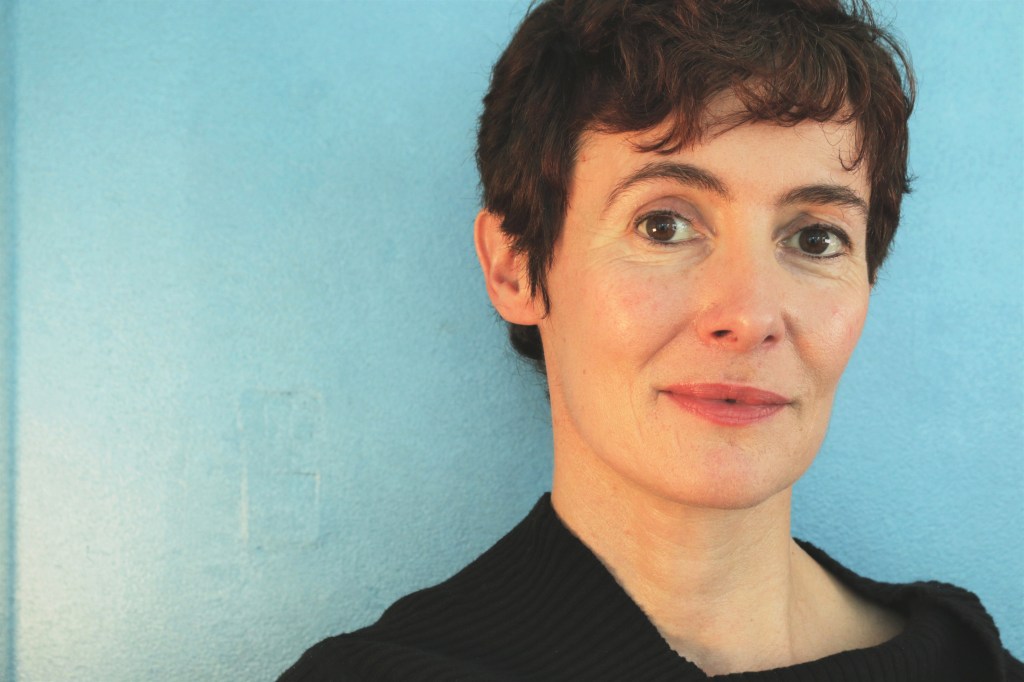
Photograph of Mary O’Donoghue courtesy of The Stinging Fly, July 2023

Thank you to The Stinging Fly for the Advance Copy of The Hour After Happy Hour and to Peter O’Connell Media for introducing me to Mary.
Order The Hour After Happy Hour here.

Margo McNulty and Luke Gibbons on Duality [Video]

In these times of restraint, lock-ins and lock-downs, it is a pleasure to revisit – albeit briefly and virtually – the exhibition Duality in which some of my writing features.

Having experienced the process of creating and working on the publication Duality, and walked through and into the exhibition, being drawn towards and inside those trees, it is enlightening to hear Margo speak of her narrative and artistic intentions. Take 4 mins, 58 seconds and enjoy this video in which Margo McNulty and Luke Gibbons speak about Duality. 

With thanks to Roscommon County Council and Kildare County Council for Arts Act Grants funding. 

IMG-20200218-WA0005

20191119_203440

Writers Chat 26 (1): Cauvery Madhavan on “The Tainted” (Hope Road: London, 2020)

Cauvery, You are very welcome to my WRITERS CHAT series. Many congratulations on your third novel, The Tainted (Hope Road: London, 2020 – Publication date 30th April 2020). Your previous novels Paddy Indian (2001) and The Uncoupling (2003) were received with acclaim with Sue Leonard declaring The Uncoupling “a gem of a novel.”

I read The Tainted over the span of a few cold days in late December in front of a fire, and was very moved. On the surface, the novel deals with the mutiny of the Connaught Rangers in India but it tackles much more than that mutiny – spanning generations we see the affects of colonialism in the form of class, caste and race on ordinary people’s lives.

This is your first public interview about The Tainted – and what an in-depth WRITERS CHAT!  We are presenting it in two parts. PART ONE, below, concentrates on your extensive – and fascinating – historical research, the timeline of The Tainted, character development and place and identity (something close to my heart!).

We also have a giveaway of two signed copies of The Tainted – – READERS: to be in with a chance of winning a copy, simply comment on this WRITERS CHAT and I’ll add your name to the draw. 

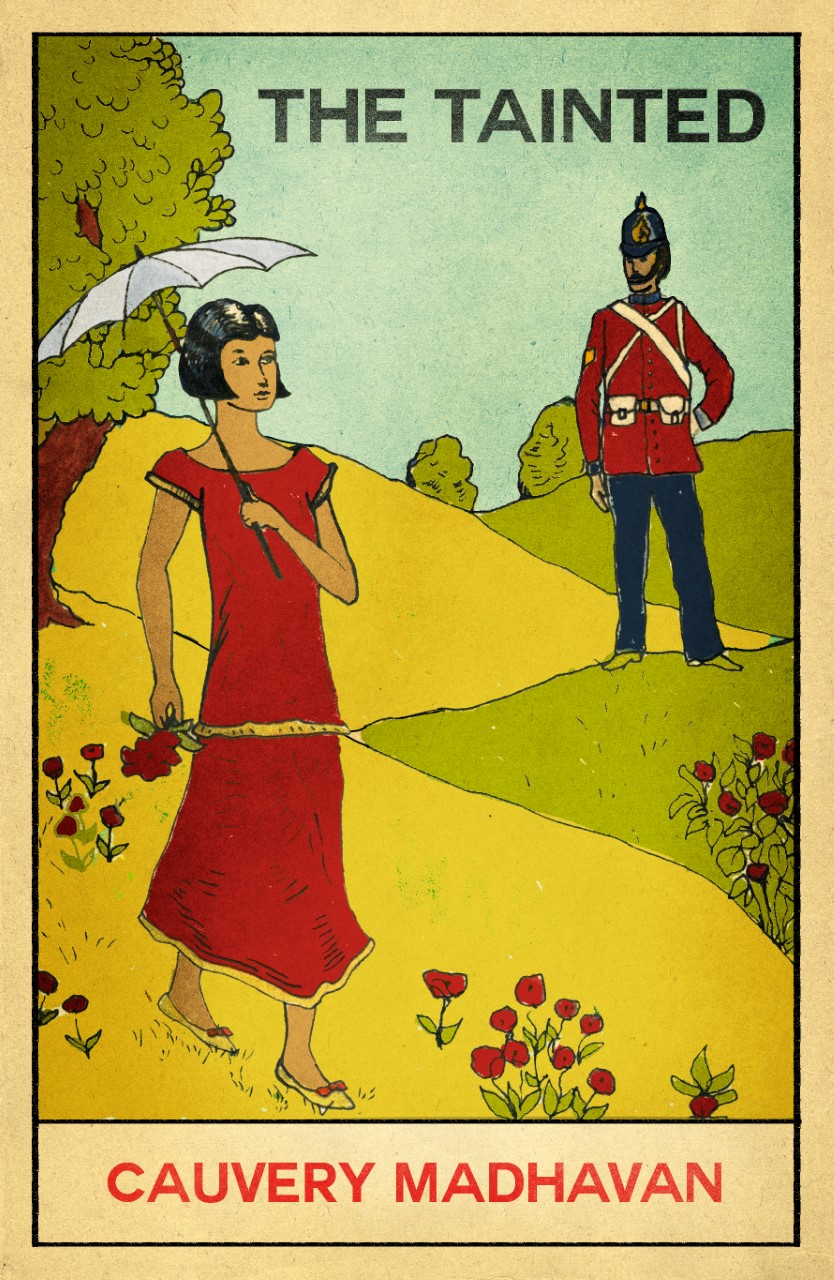
The Tainted Book Cover

Let’s start with the context and your research. You deftly entwine Indian society and politics with that of Ireland and Europe. We’re told that the twenty-seven men who died of cholera in hospital when the Regiment was first posted in 1913 were lucky because within a few years they would have died in the French trenches. Tell me about the historical research which must have been exciting. Did you travel to Nandagiri and consult archival material such as newspaper reports, hospital records, letters, birth and death records and so on?

I did Shauna. I made a decision fairly early on in the project, to completely immerse myself in the period: so I confined all of my reading to books, magazines, periodicals in the years from about 1910 up to 1947. I watched scores of movies, Hollywood and Bollywood set in the Indian sub continent and Ireland too, that spanned those years. Two films come to mind straightaway: Bhowani Junction starring Ava Gardner and Stewart Granger, and the evocative and poignant Bow Barracks Forever. If you liked The Tainted, I think these two movies will resonate too. I reconnected with books from my teenage and early twenties reading Somerset Maugham, John Masters and Ruskin Bond amongst many, many others. For an Irish perspective some of the writers I read were Sebastian Barry, JG Farrell, William Trevor, Elizabeth Bowen and Kate O’Brien. Happily, I also discovered Barbara Cleverly and her detective stories set in India during the Raj.

Sometimes while writing things would come to a complete full stop till I checked out a detail. When I began research for the chapter on the tiger hunt at Masinagudi, I ended up taking an unexpectedly long 6-month break from writing to read all of Jim Corbett’s books, in order to get my head around the intricacies of hunting big game using elephants and beaters. For a visual guide I poured over many series of  wonderful sketches and drawings in the Illustrated London News. They were big into hunting, fishing and shooting in the Tropics. A good few months later I felt I was an armchair expert and, may I add, one with a special interest in pigsticking!

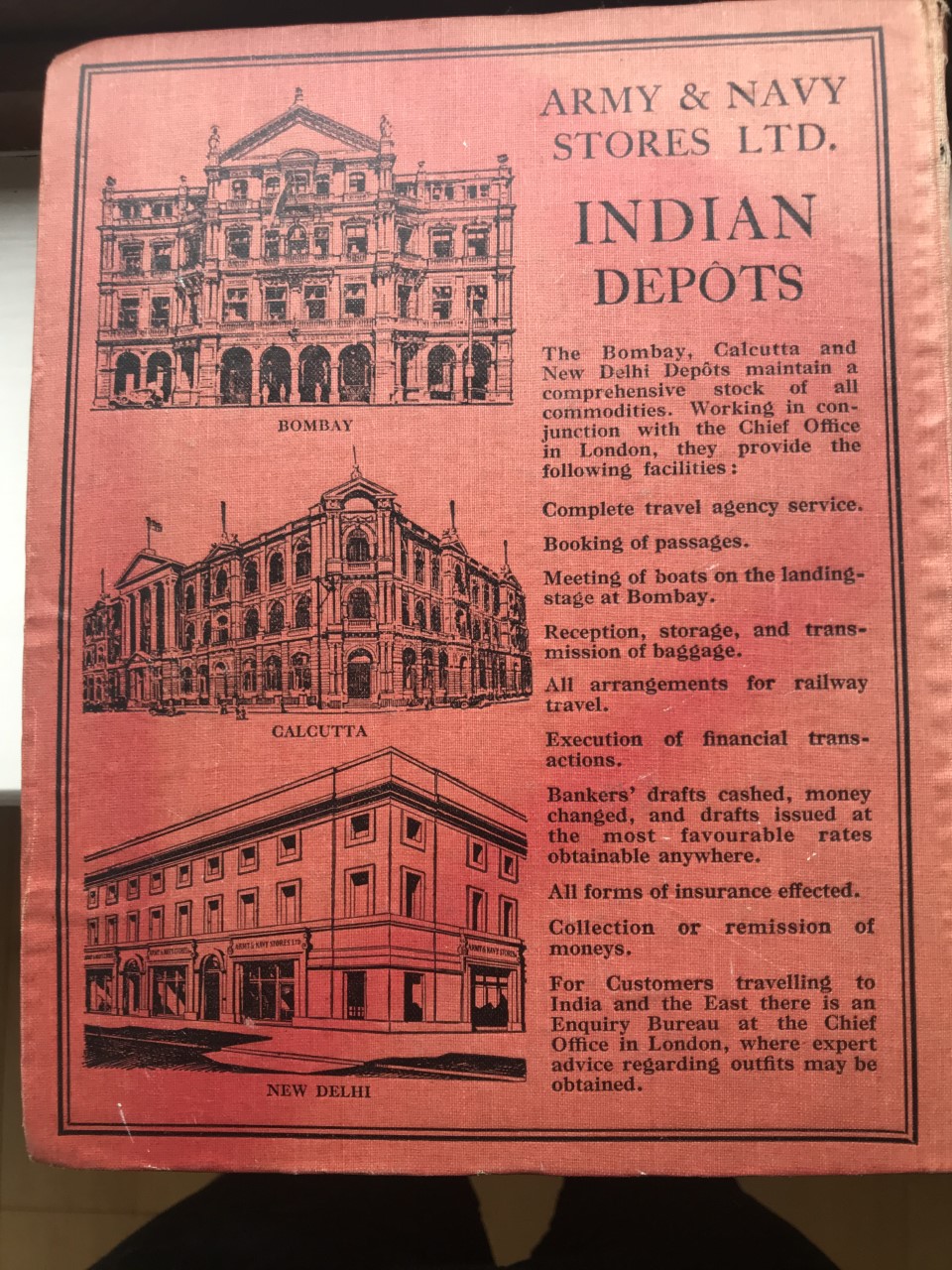
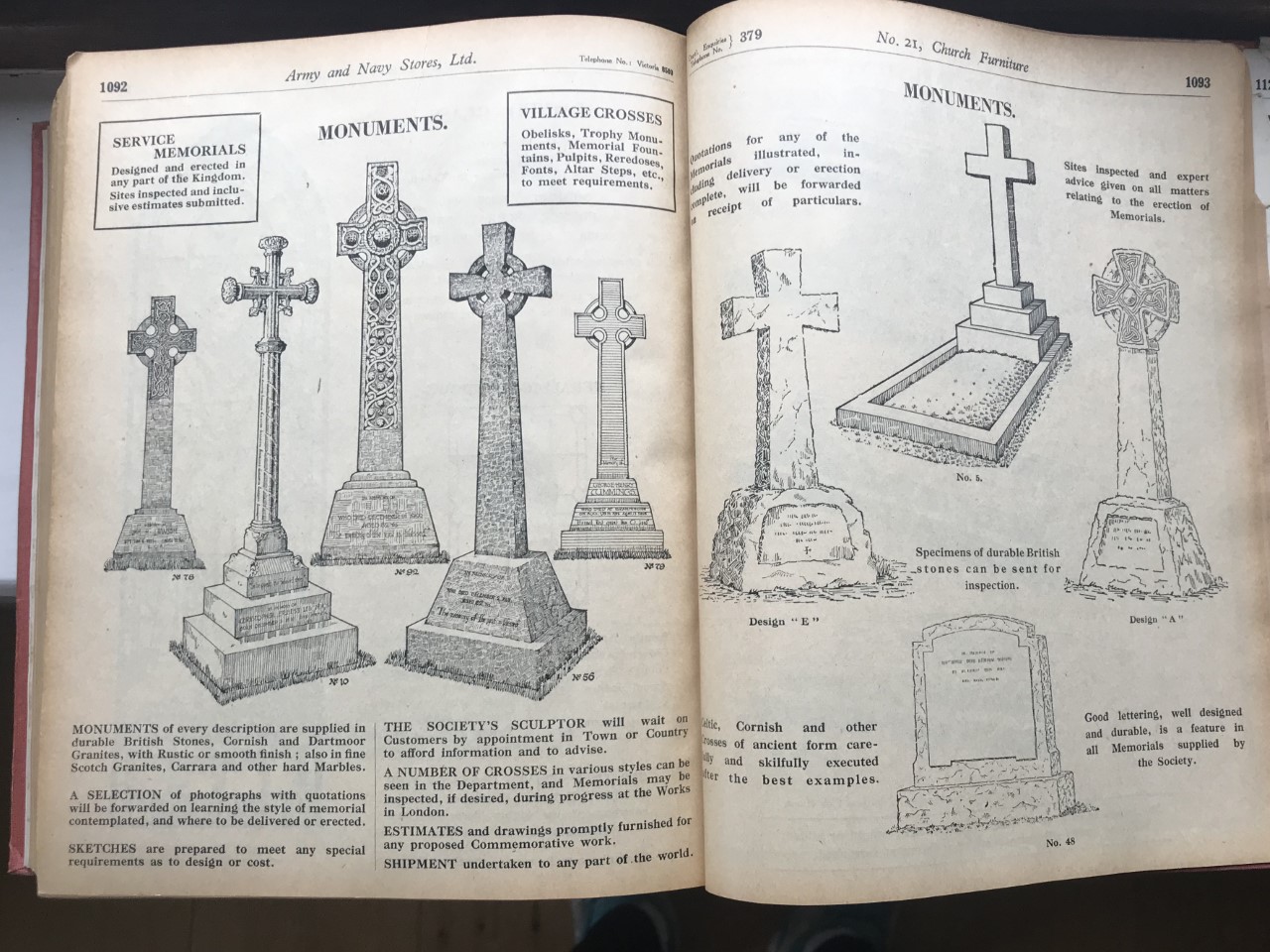
Many an evening ended leafing through The Army and Navy Catalogue from 1915 which I kept by my bedside. It definitely gave me a feel for the things that were important to people as they lived their lives thousands of miles away from home. Literally anything could be ordered from folding canvas baths to a marble angel for a headstone. The mail order catalogue was a truly fascinating window into the daily lives of every class of the European and the very wealthy Indians too.

The Army and Navy catalogue

To get an understanding of  the  contemporaneous attitude towards and the treatment of  diseases like syphilis and malaria, as well as mental health issues and conditions in mental asylums, I turned to  the work of medical historians and military archives. Additionally, I did field trips to eyeball some of the older mental hospitals in India – very many have still retained and use their old buildings.

I was forever hungry for visual references – I think many writers tend to be, for you need to have settings very clearly in your minds eye: people and places of that era that you can instantly conjure up as you write. I dug up many excellent documentaries about soldiering in the Raj and found art galleries and museums very useful, specially photographic exhibitions. Of course, the military are great at archiving every detail of their war and peacetime activities so there was a lot of material that was available between the three countries. Luckily for historians and novelists a good many young army officers were bored stiff for most of their time in India, constricted as they were for months at a time by the relentless heat or the incessant rains – they wrote extensively, books, diaries and long letters chronicling their lives and travels in the sub continent. And of course there were scores of very articulate and descriptive accounts of daily life by the women of the Raj: wives, daughters and sisters, from Vicerines living in grand splendour to hardy missionaries heroically making do in remote ‘up country’ camps. Their writings were often published in popular women’s magazines of the day and were a very good source for me. I managed to get sets of bound volumes from antiquarian dealers and even though I’ve moved on to writing my next novel, I still love reading them.

A selection of pages from the catalogue
Selection of pages from the 1915 Army and Navy Catalogue

Post Independence, the Anglo Indians diaspora who had scattered all over the world contributed to their own nostalgic newsletters and journals, full of accounts of bygone life, recipes and photographs. Collectively they were an eye opener to life attitudes and the cultural norms of that time.

So you can see Shauna, there was plenty of information to be mined. My problem was I got lost in that mine and didn’t emerge for a good few years! A lot of my research was accidentally tangential: you know I’d start looking at one thing and end up exploring something else, often in the course of the same morning. And even though it meant that so much of the research remained unused and never featured in any form or fashion in the book, it gave me such a clear picture of the period and I hope that has translated into what the reader gets from my book.

That is just incredible, Cauvery and, of course, when you describe the different types of sources you also so accurately describe many of the themes in The Tainted.

The timeline is split between 1920/45 and 1982. By using a split timeline you are able to capture the changes in Indian society and how the injuries of colonialism span generations. In a way I was reminded of the legacy of trauma that bell hooks talks about in her book Can you talk about this in relation to the generational span of the novel, in particular the Aylmers?

When I began the book, Shauna, I had planned to write a novel based on 1920 Mutiny of the Connaught Rangers. I fictionalised the regiment so I could have artistic licence and my story was to be an account of how an Irish regiment, I called them the Kildare Rangers, serving in the British army in the Raj mutinied and how their actions, in those few weeks, panned out. I was barely into writing the first three chapters when I realised that apart from the circumstances of the mutiny, there was a whole different, and indeed far more complex story waiting to be told, one that needed to be told – the aftermath of the mutiny and its ramifications on multiple generations of families in two countries on two separate continents. So I did change focus considerably and having read the book you know that much of the story takes place after the mutiny.

All three groups of characters in my novel are tainted by association and trauma that has come down through generations and it’s this baggage, and their search for identity and a final sense of belonging that has formed the basis of my book. The Anglo Irish Aylmer family had a long tradition of valiant service in the British army. When Colonel Aylmer and his wife went out to India, it was at the height of the Raj and given the observance of protocol and precedence of those days, they assumed the role of de facto King and Queen of the garrison town of Nandagiri where the regiment was stationed. In any army, ancient or modern, valour and loyalty are sacred. For the soldiers to have mutinied under the Colonels watch, amounted to loss of honour of the worst sort. It was a reflection of his abilities as the commanding officer and a huge stain on his otherwise glorious military career.

The Aylmers had the best of times in India, because not only were they the Colonel and the Memsahib ruling the roost in Nandagiri, but away from Ireland, they could also shed their Anglo-Irish identity. When they returned to Ireland, in the wake of Irish freedom, the change in their circumstances was nothing short of dramatic. The Aylmers not only had to reckon with the loss of their prestigious position but they also had to confront all the prejudice and dangers that came with them being Anglo-Irish in a newly independent Ireland. You can imagine how hard it must have been to carry the burden of an ignominious end to a military career all the while coming to terms of their changed status in Ireland. It’s a little wonder they hardly spoke of India! Their children grew up in Ireland with just a few memories that quickly faded, all mention of India was totally avoided, their personal affects from their time in the East stored away and much later even the budding romance between Alice and the Prince of Pudunagari was given short shrift. So when Richard Aylmer, the Colonel’s grandson, arrives in Nandagiri 60 years later, he finds himself playing catch up with history and the role his grandparents played in shaping the lives of people they never knew.

I thought you handled Richard’s discoveries and, as you put it, playing catch up with history, very well – as readers we feel very close to him on his journey. There is another character – Rose, an Anglo-Indian maid to Mrs Aylmer – who is ever-present. She stuck with me long after I finished reading The Tainted. Rose suffered terribly but she also knew real love and kindness. There are several moments where the kindness of strangers – Dr Swamy, for example – allow wonderful connections to happen, and, I found turned The Tainted into a novel about love. Without revealing too much, were these scenes you had planned or did they appear as you wrote? I’m thinking of that magical thing that happens in writing when the story veers off the path we think we’re on and brings us to surprisingly beautiful moments.

I’m a little embarrassed to admit that my characters have always revealed themselves as I’ve written. I’ve discovered their motivations, fears, weaknesses and strengths as one would of friends as you get to know them. The reason I’m embarrassed is because before I started writing myself, I never gave any credence to writers who said stuff like that. But I’m a fervent believer in letting the characters take over and do their ‘magical thing’ as you call it. I have never plotted any of my books in advance and The Tainted was no different, preferring to let my characters lead me where they will. I guess I was lucky too Shauna. They very quickly became so real to me it was actually quite easy once I got to know them to write their story and make all those timely links through the generations.

Sometimes details and connections came out of research and definitely Dr. Swamy was one of them. I researched and visited the Kilpauk Mental Hospital in Chennai and spent some time walking the grounds in the the oldest part of the hospital. I was effortlessly transported back a hundred years as some of the buildings that housed the female inmates dated back to the early 1900s. The ancient trees that covered the vast acreage of the Hospital provided incredible atmospherics and conjured up images that I knew would find a place in the book. Dr. Swamy popped up into the pages of my book shortly after and I didn’t even realise at that time, when he called out to Rose and Micheal from his upstairs window that he was going to play such a pivotal role. The the funny thing is he sailed through life not knowing the true repercussions of his actions! I loved that, the fact that he was drawn to Rose by his medical instincts but never knew that he actually defined her life.

I think there is something so wonderful and true to life in that, Cauvery. The Tainted of the title refers to the Anglo Indians. Neither Indian nor English, their identity, how they identify and how they are seen is difficult for them. You capture this through Gerry, and May who declares that Anglo-Indians “are a whole community strangled by dreams of what we never did have in the first place […] we’re tainted. We were never white enough then and will never be brown enough now.” (256 and 259).

Earlier in the narrative Tom warns Michael in 1920 that “When blood’s diluted, the colour will always come through…You’ll have to pick the ones to take and the ones to leave behind.” (66)

Yet despite these barriers based on race, religion and caste, your characters find that they do belong to this wonderful complex place. Can you expand on the theme of identity, belonging and land?

I’ve always been very interested in delving into the lives of people whose identities and loyalties are tainted by the social and historical limbo they are caught in: Irish Catholic soldiers in the British army, the Anglo Irish officers who commanded them and Anglo Indians (as they are known in India) – many of them the progeny of soldiers of the Raj, fathered in liaisons with Indian women and more often than not abandoned.

I was really struck by Ian Jack’s astute assessment in his book Mofussil Junction in which he writes that, as far as the Empire was concerned, the Anglo-Indians “represented no more than the shaming evidence of sexual transgression by the lower ranks”. And as you know Shauna, Indians themselves, being masters of class and caste consciousness, perceived the ancestry of Anglo-Indians combined with their drinking, beef eating, mixed sex socialising as horribly impure.

It was always assumed that when it came to the crunch, if there was trouble with the native Indians, the Anglo Indian loyalty would lie with Britain, the land of their fathers. But the loyalty that the Empire expected of them was not reciprocated and Anglo Indians never really got further than the very fringes of British colonial society. Post Independence India proved to be a real challenge for Anglo Indians. The ones who had managed to leave India for the UK, Canada and Australia struggled to fit into societies that looked down on them because they were mixed race. Many Anglo Indians who were fair skinned hid their origins and tried to assimilate under the radar. Life was hard for them as is evident in the many archived letters and diaries.

Meanwhile in India, Anglo Indians who remained, many hundred thousands of them, were left bereft. They were too poor in the main to emigrate and families had to pick and chose (sadly, often basing their decision on which child was fair enough to pass for white) who was going to get sent ‘Home’ – when Home was an unwelcoming, unknown country.

But, not surprisingly, they are one of the most resilient communities in India and from the 1960s onwards began to make huge strides in Indian public life. Their near complete domination of what were vital economic sectors like the Railways, Police, Post and Telegraph, Education and Forestry brought them to the forefront of administering the vast nation and all of this combined with their presence in the very senior ranks of the Police and Armed Forces gave them a renewed sense of belonging. I do believe that by the 1980s, the period in which my book is set, that Anglo Indian urge to go ‘Home’ was replaced with a determination to be accepted as full fledged Indians and they went about life doing just that. Most Anglo Indians had deep rooted family links to one sector or trade and they embraced it wholeheartedly. Gerry and May Twomey are typical Anglo Indians. As a Forester, Gerry regards his job primarily as a custodian, a caretaker of the flora and fauna of Nandagiri very seriously – he is far more vested in the land, the tribes and the animals that inhabit his remit than anyone else and I think that defines his identity, gives him his utter confidence in belonging to India and being Indian.

South Park Kolkata

South Park Kolkata

I think you captured that sense of belonging yet feeling outside everything very well in Gerry and May, and how this connects to the landscape and politics around them. 

So, we will leave our WRITERS CHAT for now and come back next week with PART TWO in which we examine landscape, migration, feminism and I put you to the test with some fun questions! And you so generously give our readers a list of wonderful readings and movies! 

READERS: Don’t forget, comment on this WRITERS CHAT (PART ONE or PART TWO) and I’ll add your name to the draw for a SIGNED COPY OF THE TAINTED. The draw will take place on Wednesday, 8th April. 

Advance order The Tainted at a good discount from Hope Road  and follow Cauvery Madhavan on her website and on Twitter @cauverymadhavan