Writers Chat 58: Liz McSkeane on “What To Put In A Suitcase” (Turas Press: Dublin, 2022)

Liz, You are very welcome to my WRITERS CHAT series. Congratulations on What To Put In A Suitcase (Turas Press: October 2022) – a thought-provoking collection of sixteen stories that explore our everyday interactions and how we form our world, and transform it, for better or worse. Let’s start with the intriguing title (and provoking cover artwork) – What To Put In A Suitcase – I took it to refer to the essentiality of life and living, the people, things that we cannot do without. Can you speak a little about the genesis of the collection and the title?

Cover of “What To Put In A Suitcase” by Liz McSkeane – colourful art work depicting a smiling face

LMcS: Thank you, Shauna, for inviting me to take part in your Writer’s Chat series and to reflect on What to Put in a Suitcase as a whole, and in relation to the themes you have identified. Concerning the genesis of the collection – these stories were gathered over a long period of time. Some were written more than a decade ago but about two thirds were written in the last few years. When stories in a collection span a long period of gestation, it’s perhaps inevitable that they will delve into different topics, expressed in different styles and genres that reflect the writer’s current preoccupations and interests. That’s how it was for Suitcase.  And I did find myself asking at a late stage, what was the best way to pull these apparently diverse elements together.

At that point, I had just written the most recent story – which also gave me the title for the whole collection.  The story What to Put in a Suitcase was inspired by very recent events but is obviously also relevant, on a literal level, to many other geo-political crises of past decades which have resulted in mass movements of populations. It seemed to me that that title provided a kind of thematic umbrella within which the other stories could be contained, whether in a literal, or thematic, sense.

As you suggest, the process of making very practical decisions about which material possessions to take with them when starting out on a journey into the unknown, will distil the people’s vision of what life could or should be about; and also, about how they may prepare themselves to cope with uncertainty. It is a question that I have sometimes asked myself.  I think that the question also works on a metaphorical level, for what is life, if not a journey into the unknown, where we have to decide along the way what to keep and what to leave behind?

SG: Very interesting that your most recent story became the title story and that of the collection, and, as you say, so relevant to current events. I loved how many of the stories involve chance encounters where one or other party has expectations that are not met, or misunderstood, or where there is the potential for change that could have a ripple effect. It’s those Sliding Doors moments that happen to us all – quiet regularly. I’m thinking here of “Samaritan”, “A Hot Coffee”, and the opening story “Regression Analysis”. In “A Hot Coffee” we are told “The only reason she is here, handing this person a Fairtrade coffee in a recyclable cup, is because he is there.” It’s this interconnectedness that you explore so well in the collection. Can you talk about that?

LMcS: I am interested in what you say about chance encounters and the conflicts, anxieties and challenges these present and I think you’re right, that these encounters may appear trivial, but can force the characters to review their way of thinking and perhaps, generate epiphanies. Although the stories you mention are very different in terms of the actual events they depict, thematically they push the protagonist out of a particular comfort zone into a space – physical, psychological, emotional – where previously unquestioned certainties, or even just habits, are thrown into doubt. This in turn causes the narrator to examine not only the situation, the other person or people with whom they are interacting, but also themselves, their own attitudes, prejudices, assumptions.

Of course, this potential for change is not always realised – rather, it may be held in abeyance or else avoided, ignored, so that the habitual comfort zone is reasserted, albeit with a level of discomfort. And sometimes we are not even sure if the character will make any change as a result of what they have experienced. I guess I have an inclination not to wrap things up in certainties and often prefer to leave the reader to interpret, infer, to reflect on the possible actions, or lack of them, that might ensue.

SG: Yes, I liked how you made the reader work, that many of the stories leave us thinking. Children feature in many of the stories and I felt you captured that sense of childhood where wonder is gradually or suddenly replaced by a sense of loss or disappointment – reality – that you sense, as the reader, will sit with them forever. In “Ambush” we see the cruelty of adults trying to protect their own and in the poignant “The Games”, Kate knows “All the lochs and fields and rocks as far as you could see belonged to Donald” and believes her sense of self and identity is like one of those rocks, until she dances, and the rhythm of the music is not what she expected. In this story, her tears come with the onset of kindness. Again it struck me that when the expectations of people – adults and children – are at odds with their situations, shifts of self and future occur. Does this tie in with your intentions when you wrote these stories?

LMcS: I didn’t have a conscious intention to depict primal disappointments met in childhood but in telling the stories that spoke to me, I agree with you that that is one of the most salient themes in some of the stories.  I think that the impulse to make sense of the world starts at a very young age and the children in these stories experience the multiplicity of meanings, which are sometimes in conflict, in a very intense way, which can be confusing.  

     I think that such confusion is almost inevitable, as the messages we receive from the external world about almost everything – how to live, what is right and wrong, even who we are – are fraught with contradiction and, as we learn as adults, sometimes deliberately manipulated to serve the needs of others. Obviously, the children in Suitcase don’t consciously frame their experience of the world in that way but the reader looking over their shoulder can sense it and observe their puzzlement at the often conflicting messages they receive.  And it is true, what they want and expect does not always correspond to external reality.  I get the feeling that navigating this inevitable discord will filter into how these children manage their lives as adults. In fairness, though, I can’t in all honesty say that I consciously set out to explore those themes when I sat down to write the stories. Rather, they were the ideas that emerged in the process. For me, that happens quite often, perhaps most often – that the primal concerns and themes become clearer – though not necessarily completely clear! – in the process of writing.

SG: And often what emerges in the writing can be the most interesting to the reader! You captured shifts in sense of self within the confines of different bodily spaces, and examined the chasm between internal and external selves/voices against the backdrop of gender and space particularly well in “Underground”, and “Lebenstraum” where second person narrative works brilliantly:

“Powerful forces are ranged against you. Many are arising from within: from your currently dormant best self…a distant second, good manners…and from without: the tyranny of these people in their group…”

Do you think – within the realm of these stories – that our perceptions of self have shifted with the restrictions on movement over the last few years?

LMcS: I think that they have been heightened, to a significant degree and that sometimes, a sense of urgency emerges that might have not been there before to the same extent. Before the pandemic, the character in Lebensraum would not have minded sharing a table with other people in a café. It’s the crisis that produces her outrage at the invasion of her personal space.

     I found this scenario interesting, because I think it puts the spotlight on a dynamic which existed long before the pandemic and perhaps, has always existed:  a constant negotiation, a jostling, between the self and the boundaries with other selves.  What the restrictions did, I think, was to highlight the importance of a newly scarce commodity – space – and show how this plays out in interactions with others. And in this case, as often happens, some people decide to take all of this scarce resource for themselves, or at least try to, convinced of their own entitlement by spurious justifications. This, in turn, confronts the protagonist with the question of how to  defend her space or whether she should, and even, whether she has the right to do so.  

       Although this is obviously a ‘pandemic story’ I think I could have written a very similar encounter outside the context of the pandemic, as these struggles for resources – be that space or any other valued commodity – were not created by the circumstances following the lock-downs, but were highlighted by them. That is why I called this story Lebensraum, which as you know, was one concept that underpinned the Nazis’ rationale for annexing European territory, invading other people’s countries. Tragically, we see this being repeated today in Putin’s Russa.  Competition for resources, both tangible and intangible, has always fuelled the dynamic of interaction, on a personal, societal and also, a global level. It is a struggle which this story shows being played out in impulses within the individual human heart.

     Aggressive colonisation, invasion, the story concludes,  has to be resisted, starting with how this person conducts her personal interactions. Is she going to give up her spot to keep the peace? Or should she dig her heels in and refuse to be pushed out. And if the latter,  where does this leave tolerance, compassion, simple kindness? There is a time to yield, to be kind – and a time to resist. The challenge is, knowing which is which. It’s not an easy question to answer.

SG: I think you caught the tension of that question, Liz, so well. Interestingly, the placement of “Atlanta” and “Venice” side-by-side in the collection gave a wonderful continuity to the themes of the failing body and illness, located/dislocated in place and between people. In “Venice” a friend’s embrace fills the narrator

“with yearning and overwhelmed her with loneliness and longing, not for him, but for the desire to want him and everything that being with him would bring.”

I thought the title story “What To Put In A Suitcase” tied these themes together, creating an almost filling up then emptying out of a life, and its meaning – including our relationship to time. What interested you about exploring these themes in this way?

LMcS: I think that some of the stories do explore the notion that the awareness of loss is an inevitable part of living. To arrive at an acceptance of that truth is a different, more complex journey and I am not sure that most of the characters in these stories – with the exception of the final story, Leopold’s Violin – have accomplished that yet. Perhaps they are just embarking on that journey. At least two of the characters in Suitcase are confronted with a heightened sense of mortality, their own or other people’s, which for them is a kind of rite of passage, a point beyond which things are never the same. It is an  awareness does call into question their relationships with others, their aspirations, what to keep, what to change, what to leave behind. Like packing a suitcase!  One response would be to throw in the towel, retreat to a kind of apathy that refuses to decide, as nothing matters anyway.  And yet, these characters respond to loss by giving up but rather, by re-making. We may not know what they are going to do, but I think there is a sense that they will do something, make some significant change that will integrate their life experiences into how they live their lives into the future.

     Once again, I have to confess that I didn’t consciously set out to explore these themes. Rather, they emerged within the stories I found that I wanted to tell.  Perhaps it takes some time and distance – and an attentive reader! – to process them in a systematic way.

SG: Or perhaps, readers bring their own systems and patterns to what we read! To finish up, Liz, some fun questions:

  • Tea or Coffee?  Tricky one. Tea at home, coffee when out. I used to drink gallons of coffee, especially while I was writing, and eventually decided to cut down. So I only very occasionally have a coffee at home, but when I do, I go to a bit of trouble – I have one of those old-fashioned Bialetti percolators that takes forever.
  • Mountains or Sea? Definitely the sea. I have often thought I would like to live in Madrid again for a while (I lived there when I was a student) but I know I would miss being close to the sea if I was there for any length of time.
  • Trad or Disco? Neither. For me, it’s tango all the way. An addiction.
  • Music or quiet when writing? I can’t write when there is music on as I find my attention being pulled towards the melody, but I can filter out most other noises. Except the angle grinder. There’s a construction site nearby at the moment and as soon as the angle grinder is switched on, I grab my laptop and head for a local café.
  • I would defy anyone to create with an angle grinder switched on! What’s next on your reading pile? At the moment I am reading the final volume of Knausgaard’s My Struggle and when I finish that, I have Maggie O’Farrell’s The Marriage Portrait to look forward to; then a book I know nothing about – always exciting – which I got as a present, The Italian by Shukri Mabkhout; then the new George Saunders short story collection Liberation Day. So many books, so little time!

Thank you, Liz, for engaging with my probing questions. I wish you every deserved success with this collection of stories.

Author Liz McSkeane in the Irish Writers Centre at the launch of What To Put In A Suitcase (Photograph courtesy of Liz McSkeane)

Purchase What To Put In A Suitcase

With thanks to Turas Press for the advance copy of What To Put In A Suitcase

Writers Chat 56: Tara Masih on “How We Disappear” (Press 53: North Carolina, 2022)

Tara, How lovely to feature your work again on my Writers Chat series. We last chatted in 2020, about The Bitter Kind, a flash novelette and today we’re talking about your latest publication, How We Disappear (Press 53: North Carolina, 2022), a novella and stories – a Millions Most Anticipated book!

Cover of How We Disappear showing a painting of a woman disappearing or emerging against a light turquoise background

SG: I had the sense that How We Disappear is as much about appearance, judgement and expectation as it is about how we disappear and are disappeared. I was particularly moved by the last story in the collection, “Notes to the World” where the protagonist, Grigori finds that the notes he is reading speak not just of the woman’s life but also of his own. I loved the effect of the stories mirroring – literally timeless – but also how you show the repetition of human behaviour in relationships, who lives/survives, who hunts/is hunted and that haunting last line, “let me hear your voice”. Can you explain your intentions with the collection and the title (and the beautiful cover)?

TM: The stories were written over a period of time (“Those Who Have Gone” was actually written decades ago), and there was no intent in any of them to link up. It wasn’t until I realized I had enough for a collection and started looking at the stories to order them that I saw the connection of disappearance.

I think the various ways disappearance can be examined or experienced is only partially shown in this collection, but I do think my personal relationship history together with my upbringing in the sixties as a mixed child in a very white community allows me to understand both the feeling of having been left and the feeling of not being seen. Of disappearing into the background. What most allows us to be seen? I don’t think it’s all through the visual (though there is visual judgment) as much as through auditory (I include sign language as “auditory”). I think we have a greater need to be “heard” than seen, though both are powerful, often interchangeable needs. I want readers who have always had the benefit of being seen and heard to understand what it’s like to fight to be recognized, and I want those who can relate to the themes to find themselves or find ways to make better decisions so they can function at their best. We’ve also been collectively traumatized by the covid pandemic and many have lost loved ones. I hope some of the stories allow readers to work through the grief process.

The cover image is gorgeous and designer Claire V. Foxx did a beautiful job of making the type reflect the theme. She is the one who noted that the woman could be viewed as either disappearing or emerging.

SG: I love how you bring in the senses and all types of language and communication here, Tara. In “Fleeing Gravity” you tell a story that feels like an epic fairytale, yet it is grounded in history and colonisation. Ghosts flit in and out of reality – physically and psychologically – and it seemed to me that it was their story as much as Brandy’s story of displacement, creation and destruction. He says of the female ghost Miz Annabelle Fourier, “It’s easy to love a ghost who asks nothing of you”. I also found that this story had echoes – in terms of the relationships – of “In A Sulfate Mist”. What was your thinking behind these two stories?

TM: There is no conscious connection between those two stories outside of the fact that I’m drawn to stories set in the natural world. I love placing characters into landscapes and allowing those exterior settings to influence story and behavior. “Fleeing Gravity” began with my wanting to set a character in a ghost town. What would it be like to live among ghosts on a daily basis? To be a caretaker and be the only one left there at the end of the day? I also wanted to highlight the plight of the Montana “Landless Indians,” as they called themselves, who fought for recognition from our government for decades. They were basically told they were not worthy to exist and should disappear into the landscape. I’m thrilled to report that before this book got published the Little Shell Tribe members finally achieved their goal and are now federally recognized. They have essentially become “visible.”

Which brings up other issues such as power. Who holds it, and how it’s wielded to make others powerless by making them invisible.

SG: I think you’ve done a great job of highlighting the plight of the Little Shell Tribe members and here is hoping that in now being officially “visible”, the needs and rights are upheld and the Tribe treasured. A number of the stories in the collection explore connections between environment, emotion and story. I’m thinking here, for example, of “Delight” and “Billy Said This Really Happened to Lucy.” Desire is by the sea, Lucy is by the marsh and they both have ambiguous relationships with their surrounds. I really enjoyed the characters’ realisation about themselves and the land/sea around them and the powerful role that parental stories play in forming impressions, teaching social norms, particularly in relation to gender, the body and control. Can you talk about this?

TM: While I love the natural world, I recognize its disinterest in us. And its destructive power. Nature is beautiful and restorative. Nature is full of fury and can obliterate anything in its path in seconds. There are many writers now exploring the genre of cli-fi fiction. My writing doesn’t go that far into what we are facing now, but perhaps as someone who is bicultural, I try to present the reality of both sides. The same for people. In “Delight,” we first see the father as a typical abusive parent. In the last scene, I hope readers catch something else. In the Lucy story, her mother returns in the guise of a poisonous snake. Lucy both welcomes this new interaction but is also wary of it.

We rarely see women in wilderness stories, though that is changing as well. But I still can’t tell you there is a large list of women who write about nature and place, especially in short stories. Men have long had that domain almost exclusively to themselves. My female characters are either learning to be comfortable in that male-dominated wilderness, sometimes with the help of men, or have found their own ways into the wilderness and are leading the way for the men who are following.

SG: I loved how you channelled the writing process – and formation of a writer – in the cleverly constructed “Agatha: A Life in Unauthorised Fragments”. In some ways this story feels like the spine of the collection; it is almost like a reflection on the story telling process. “Every story is an escape story.”

In a way this book helps the readers escape. Did the writing help you escape and do you think this is one of the roles of writing/reading in our lives – and in Agatha’s?  

TM: Thank you. I just loved writing that story. I had studied Christie’s disappearance decades ago in high school. Besides loving her mysteries, I was obsessed with trying to find out what happened when she disappeared. When I realized I needed another story to flesh out this collection I recalled that long ago research and took to it again with great glee. As someone who has a minor in sociology, human behavior totally intrigues me and I have my own theory about what happened. It’s not anything ground-breaking, but I did channel my own experiences as a female writer, as a crisis counsellor, and as a woman who has been cheated on.

The epigram is just something that came to me when I was writing the story. Kind of a voice over, if you will. I think that all stories we tell are either escape hatches from our own lives or attempts to escape from someone or something or even ourselves. I was thinking of all that rather than of readers escaping into the stories, but yes, that is happening as well on the other end of listening or reading a story.

SG: Yes, I think we are touching on the very powerful invisible connection and dialogue between writer and reader! In the novella An Aura Surrounds That Night, a family views the news of the assignation of JFK on the TV, a child who captures slugs that escape and leave silvery trails on the bedroom ceiling comes of age and she begins to notice the inside/outside-ness of life:

“But there was Grammy below me, now trapped inside herself, while outside Japanese beetles, lightning bugs, moths, mosquitoes, gnats were flying into the window screens, banging and buzzing.”

Like other characters in the stories, she has the gift of second sight (hence the title) yet the gift cannot stop what is going to happen to her sister. I loved this novella and I think the placement in the book worked very well – the narrative carried much of the sensibility of the early stories and was one which I found really poignant. Have you any plans to write more of this story…?

TM: Ha! You are not the first to want more. I’m afraid at this point that story is as fully told as I can make it. It did begin as a novel and I just could not take it where it needed to go. But I kept tinkering with it, not wanting to lose the sisters entirely. When I finally recast it as a flash novella, it all fell into place. The writing flowed, the scenes congealed, and so I have to say it’s in the form it’s meant to be in, no more, no less. But never say never, right?

Thanks again for noticing and appreciating what I was trying to do not only with the story but the full collection. It warms my heart and helps keep me writing!

SG: Oh so wonderful to chat with you, Tara, and your writing warms many hearts. Now lastly, some fun questions:

  • Beach or mountains? Beach for sure. Love the ocean and all things watery.
  • Silence or noise when writing? Silence. Noise stresses me out.
  • Kindle, paperback or hardback? Hardback or paperback. Nothing beats the tactile feeling of a book in hand.
  • Dogs or cats? Love cats.
  • I love cats, too! So, what is the most surprising read you’ve had this year? I found a book in a remainder bin and loved it. The Australia Stories by Todd James Pierce. I don’t know why I never heard of it. A hybrid novel that was likely ahead of its time.
Tara Masih, Photograph courtesy of Tara Masih

Connect with Tara via her website.

Thank you to Press 53 and Tara for the advance copy of How We Disappear.

Writers Chat 55: Catherine Dunne on “A Name For Himself” (Arlen Classic Literature: Dublin, 2022)

Catherine, You are very welcome to my Writers Chat series. We’re here to discuss A Name For Himself first published in 1988 and re-issued this year as part of the Arlen Classic Literature Series. I finished reading the novel on the same weekend that The Irish Times published Stolen Lives, a heart-stopping report on the “239  violent deaths of women in Ireland from 1996 to today”. It is an awful thing to say that the narrative of A Name For Himself speaks of a horrible truth still present and persistent in our society. But it also reminds us of the role novels have, as you say in your Afterword, “in exploring the texture of our daily lives in a way that can help us understand ourselves and others better.”

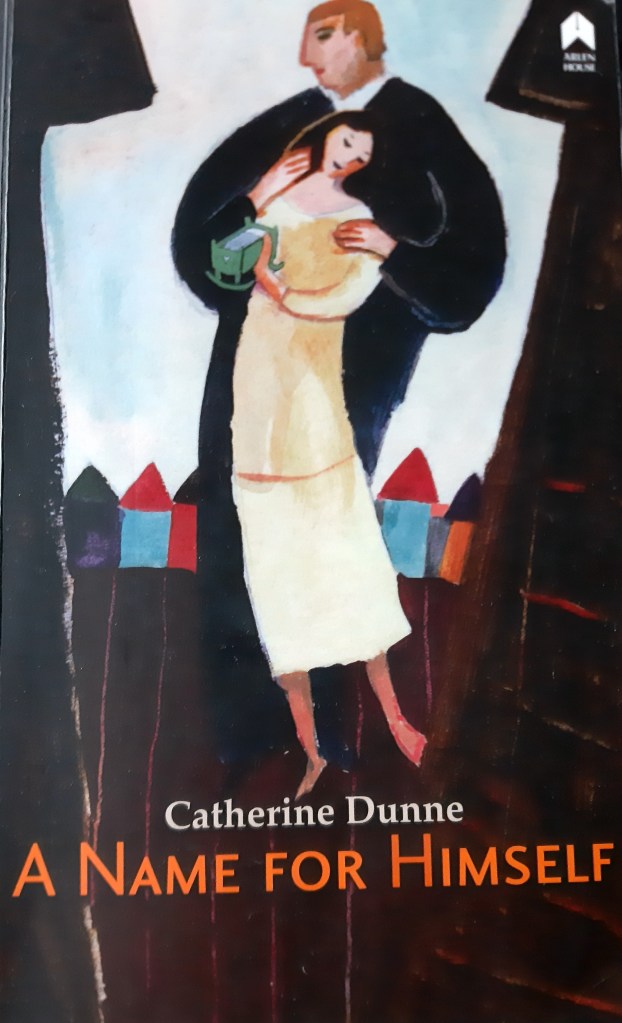
Cover of A Name For Himself showing a painting of a man in black with his arms around a woman in pale yellow against a background of houses and within wooden houses (painting by Tove Kregs Lange)

SG: So let’s begin with the title which tells us something about what motivates Farrell (one of the main protagonists) but also speaks of the role of class, money and reputation in Ireland. Can you talk about how you came to decide on this title A Name For Himself?

CD: Thank you, Shauna, for your invitation to take part in ‘Writers Chat’ and to discuss A Name for Himself on the occasion of its reissue by Arlen House.

In one way, it feels as though the writing of Farrell’s story took place a long time ago (it did) but in another, it’s a novel that still feels very recent. I continue to have a strangely intimate connection with Farrell and Grace. I think that’s partly because their story became my second novel: the one that made me believe I was on my way to becoming a writer. I say ‘becoming’ because I’d come across the view – on multiple occasions – that ‘everyone has a book in them’. And once my first book was ‘out’, I was genuinely terrified that that was it: the well had now run dry!

So, writing A Name for Himself was a very special experience. It was a complete departure from my first published work, In the Beginning, which drew on those contemporary issues and relationships that were familiar to me. But the story of Farrell and Grace – apart from one moment of inspiration, or perhaps recognition is a better word: that moment when a writer becomes aware that the spark of a new story has ignited – my second novel was a work entirely of the imagination.

During my career as a teacher, I’d spent the best part of two decades working in a disadvantaged area of Dublin. The 1980s in Ireland were a dismal time economically and socially.  It was also a decade of high emigration: more than 200,000 people left this country during those years. As teachers, we felt we were educating an entire generation for the dole queue, or the emigrant boat. Those years brought me face to face with deprivation in a way that had a huge impact on me. I saw ‘up close and personal’ the devastation caused by lack of resources, by intergenerational unemployment, by lack of opportunity and by social attitudes towards ‘the working class’.

When I began to imagine Farrell, his background came to me fully formed. I have always believed in the notion that writers don’t choose our stories: instead, our stories choose us. And when Farrell began to colonise my writer’s imagination, he emerged from a disadvantaged background, one he was determined to escape. He wanted, needed, to make a better life for himself. When his family of origin fell apart, he took every opportunity offered to him to be independent and self-sufficient. Through the kindness and solidarity of his local community, he became first a carpenter, then a master craftsman.

Everything about Farrell’s rejection of his background propelled him to create, rather than destroy. He wanted nothing to do with the violence and chaos that his father had created within the family. He rejected everything about him: appalled at the damage he had done. From an early age, Farrell even refused to call himself Vincent, or Vinny: that name belonged to his father, it was no part of him.

And so the title of the novel was born from Farrell’s determination to forge his own path, to have no connection with his hated father, to become his own, separate self.

I already knew what the trajectory of Farrell’s life would be, even before I began to write. I knew that he would behave in a way that was likely to make him infamous: he would indeed make ‘a name for himself’ in the process. And so, with that double helix of naming, the novel’s title was born.

SG: What a wonderful insight into your process and inspiration, Catherine. Thank you. Now, although A Name for Himself is not set in the present day, there is much of the way society works – the rush to secure property, the demand for tradesmen, the blooming craft businesses – that echoes in the Ireland of today. I think the Dublin that you capture is still recognisable. Are you surprised at the timelessness of place?

CD: Returning to the novel after a quarter of a century, there were many surprises: and some of the echoes, as you call them, were chilling.

I was writing in and about the mid-1990s, the period that led to the Celtic Tiger, to escalating house prices, to full employment, to the accumulation of wealth to a degree we had never experienced before. It was a heady time, for some: property became the new religion for men like P.J., and craftsmen like Farrell were in high demand.

It was a time of great economic and social change.

For Farrell and Grace, such affluent times provide them with an opportunity to be independent. But ironically, they also remind Farrell of the difference in class between him and the woman he loves.

The first time he sees Grace, in her father’s building in Merrion Square, the elegant surroundings emphasise to him – the man in the worker’s overalls, the man with a Dublin accent – that this woman is out of his league. Her father agrees, and this dangerous dynamic, this silent, subterranean tug-of-war between the two men has the potential to be every bit as damaging as the actions of Farrell’s own father.

I think we like to believe that class in Ireland is not an issue in the way it is, say, in Britain. I disagree. And along with economic prosperity, greed, and ruthless property developers, class divisions are still part of our society today.

SG: And that’s what this novel highlights I think. In Farrell, you’ve created an incredibly complex character who we come to love, as Grace does. Mia Gallagher in her excellent Foreword, outlines this reader position so well in that, similar to real life situations, we are totally taken by how he is presented, how he presents himself and how he is seen. It is only when we begin to feel what is behind his actions (or if we read carefully) – fear, inadequacy, lack of self-worth and so on – that we begin to see what he might be capable of. Can you talk about how you developed Farrell’s character?

CD: The development of Farrell’s character is just one of the chilling aspects of this novel that I referred to earlier.

I became completely obsessed by him during the writing process. I had nightmares about him. I saw the world, not through his eyes, but as though I was perched on his shoulder. I watched, sometimes horrified, at the way his character was unfolding. It all felt strangely inevitable. I followed where he led.

I know there are writers who will disagree with that last statement: who will say that the writer is always in control of her characters. And while that is true – I can kill off whomsoever I like, whenever I like, for example – it still feels deeply necessary to follow the shadowy paths that often appear to us, unbidden, in the tangled forest of the writing process.

I didn’t consciously choose what Farrell would do next, what he would ultimately become: it was much more instinctive, more intuitive than that. I went where it felt right.

And I was aware that Farrell’s fear of abandonment, his lack of self-worth, his sense of ownership when it came to Grace: all of these aspects of his emotional landscape created a powder-keg of dangerous possibilities.

But I needed the reader to feel empathy for Farrell. I knew what he was going to do – but I also knew that we tend to label people as ‘monsters’ when they perform monstrous acts that we don’t understand. It’s a way of creating distance between ‘us’ and ‘them’ – but that distance is in no way useful in helping us to understand what drives us – all of us – to do the sometimes terrible things that we do.

The term ‘coercive control’ was not in current usage in the 1990s, in the way it is now. But I had observed such behaviour in action and understood that men who were bent on controlling their wives or partners often appeared on the surface to be vulnerable, devoted, caring: ideal partners and spouses, pillars of their community.

How many times have we seen evidence of that volitional distance between ‘us’ and ‘them’ in the aftermath of a domestic tragedy? How many times have we heard the perpetrator described by others, in the wake of some violent atrocity against a woman, as a ‘lovely, quiet man’?

And although, for the purposes of the novel, I had a clear view of how Farrell and Grace’s story would end, it felt important not to portray him as a monster. At one point, I give him the chance to confront his demons and perhaps create the possibility of another life for him and Grace. But he rejects it, clinging instead to his own sense of entitlement and ownership.

SG: I think that sense of, as you put it, feeling, your way into Farrell’s actions is also felt by the reader in the atmosphere that runs through the novel. The multiple narratives work brilliantly in shining a light for the reader on the evolution of Farrell and his actions, especially the haunting present day “now” narrative that slips in, unsuspecting, and then increases with such tension until the narrative catches up (in time) with that day, that birthday. As I was reading it, a large part of me was hoping that the seemingly inevitable would not happen while knowing it would. Did these narratives come once the story and ending were cemented or did you start there and work your way back?

CD: The series of present tense scenes – one of which opens the novel – were written after the main narrative was complete. But from the beginning, I had three narrative strands in mind. The contemporary story of Farrell and Grace’s meeting and their growing relationship; seminal scenes from Farrell’s past, both childhood and adolescence; and finally, the ‘now’ scenes, scattered throughout the narrative to increase suspense and to highlight the inevitability of what is going to happen.

I began writing this novel in 1995. It’s not that I have a prodigious memory (I wish), but I was so consumed by the creative process during the two years of writing that I made copious notes about structure, about characters, about significant childhood events – I mostly used file cards, back then.  Word processing was still new and I had greater faith in pen and paper. I still like to use notebooks when I’m working on something new – something about the slower pace of handwriting makes for a more reflective process.

From 1995-1997, the writing of A Name for Himself was an experience of total immersion. I had taken a career break from work, and was acutely aware of the ticking clock. I had a limited amount of time to write this book, and it was one of the many occasions over the intervening almost 30 years that I have understood the value of deadlines.

Those two years also taught me that writing is an organic process. The act of writing in itself creates inspirational moments – the ability to see clearly those inviting paths in the forest I referred to earlier.

Turning up at the desk is the first essential. Words follow.

SG: What dedication to your craft and I love how you used the immersion and set time that you had to both write and also record how you wrote. What a wonderful thing to be able to look back on those index cards! Definitely for the archive. In relation to making, Farrell is “a maker in a most tangible craft” (Mia Gallagher) and I found it reassuring that Grace, too, is a maker, an identity denied to her by the men in her life (most notably her father) – until she meets Farrell.

I was really interested in how A Name For Himself therefore also explores the act of naming and, through this, agency. Farrell drops his first name “Vincent/Vinny” so that it is not tinged with the actions of his father and so understands Grace’s struggle to name who she is, and what she is. This enables him to literally open doors for her to make her dolls. There is, however, also the sense that Grace creates the dolls with care parallel to Farrell’s conjuring of Grace-as-possession. Can you talk a little about this aspect of the novel?

CD: Farrell does indeed understand Grace’s need to create, and to carve out an independent life for herself. In this, her needs are a reflection of his own. But his efforts to help her fulfil her dreams are, in fact, driven more by Farrell’s need to be in control than Grace’s need to be free and independent of her father.

Even at the very start of their relationship, we see Farrell’s obsession, his overwhelming need to be the ‘master craftsman’: ‘Grace held his arm tighter. Farrell thought he would explode. By the time they reached the city centre, he had planned and mapped and fashioned the rest of their lives’.

At a later stage, Farrell says to P.J. that he intends ‘to give her [Grace] a good life’ (my itlaics). As though her life is a gift that he has the power to grant her.

In many ways, Farrell is recreating the family he lost in the way he relates to Grace. It’s as though she becomes a child, someone whose whole future depends on how he crafts it – rather than an adult woman with agency of her own.

He oversees her making of dolls, Noah’s arks, toys of all kinds with a pleasure that is a complex mix of emotions, a mix designed to make the reader uneasy.

Yes, I felt that when reading it, that he was creating a child out of her, but also enabling her to create her own ‘children’ (the ones they long for) in the dolls and toys.

Lastly, Catherine, some short questions:

Do you usually have one book or numerous books on the go? If we’re talking about reading, rather than writing, then yes, I very happily have several books on the go at the same time. There are ‘upstairs books’ and ‘downstairs books’, and for Luas and bus journeys, there’s the ultimate ‘handbag book’ – my trusty Kindle. Although paper claims my affection and loyalty every time – a Kindle is for convenience.

As far as writing is concerned, I can’t focus on more than one obsession at a time. The most I can manage is, say, working on an essay at the same time as a piece of fiction.

I love the idea of upstairs and downstairs books, and that you use a Kindle (I do for travelling). So, quiet or noise when you’re writing? I used to believe I needed absolute quiet for writing. Then I spent several months in India. The only safe electrical connection in the village was in the local cafe, so I used to go there every morning.

That year, the cricket world cup was underway and the entire community for miles around came to watch the matches on the big TV screen. As you can imagine, the men’s enthusiasm was not expressed quietly. Apart from that, it’s difficult to find a quiet spot in India anyway – its large population makes sure of that. Very quickly, I learned to tune out the noise.

I still prefer quiet – but it’s good to know that I can adapt.

Generally, do you plot/plan or go where the writing takes you? I have a dreadful sense of direction. Anybody who knows me will tell you that. Even following a map, I have the capacity to get spectacularly lost. Some of my most enjoyable journeys have resulted from not knowing where I’m going.

Writing is a bit like that. I’ve always liked the comfort of having a map – a starting point and an end point: that was certainly the case with A Name for Himself and indeed, for subsequent novels.

But getting lost in the forest is also part of the joy.

Right now, as I start a new piece of work, I’m adopting a different approach. I have a vague idea about my idea – and I’m going where the process takes me.

I remember seeing children in primary school being encouraged to ‘take a line for a walk’ – just follow your crayon across the page and see what picture emerges.

That’s what I’m doing now. It’s strange, and different, and exhilarating.

I’ve no idea where I’m going next.

What freedom in just seeing what emerges! Coffee or Tea? In the morning, coffee for sure! In the afternoon, different types of tea.

What’s the next three books on your reading pile? They are all books that have been overlooked for a while, because I got carried away with so many other sources of printed temptation. So I’ve promised myself to go back to them. They are: The Nine Lives of Pakistan by Declan Walsh. Fifty Words for Snow by Nancy Campbell. No One Is Talking About This by Patricia Lockwood.

A great selection, Catherine! Thank you for such insights into your process, the thinking behind some of the characters and for your generosity in answering my probing questions.

Catherine Dunne (Photo: Noel Hillis)

Purchase A Name For Himself.

Follow Catherine Dunne.

Read Catherine Dunne’s article in The Irish Times about what inspired this novel.