Writers Chat 29:Karen Lee Street on Edgar Allan Poe and The Empire of the Dead (Oneworld: London, 2019)

Writers Chat – Edgar Allan Poe and The Empire of the Dead

Karen, you’re very welcome to my Writers Chat. We last chatted about Edgar Allan Poe and The Jewel of Peru and today we’ll discuss  Edgar Allan Poe and The Empire of the Dead which was described as “a gripping read, and a worthy homage to Poe’s genius” (Historical Novel Society). In this novel you evoke “Poe’s unique sensibility through passages of inspired prose, in a narrative that preserves the spooky penumbra surrounding Poe’s enduring legend(Tom Nolan, The Wall Street Journal) it is, as described by Mystery Scene Magazine “a brilliant historical whodunit.” In the words of yet another starred review (Booklist), it is a “superlative historical mystery, capturing the tone of the time and Poe’s lasting literary legacy” and for this Writers Chat rather than focus on the narrative and the mystery, to save ourselves from spoilers, we are going to look at themes, motifs, setting and atmosphere.

thumbnail_raven at Poe house Philly photo kls
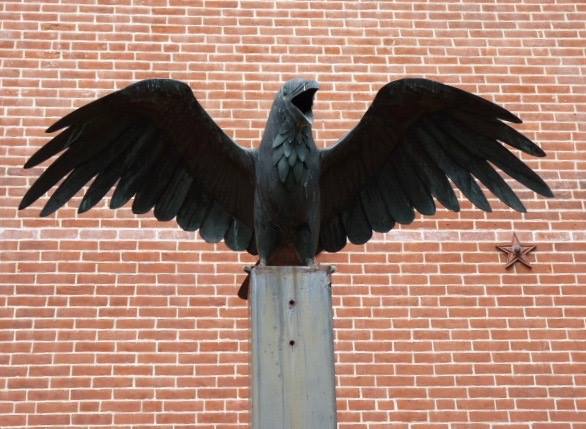
Raven sculpture from Poe Museum in Philadelphia; photo by Karen Lee Street

SG: The novel opens with one of my favourite first lines: “It began with a cat”. A simple first sentence, yet intriguing and so very gothic. I am delighted to present a short clip to our readers/viewers of you reading it. Was this the line that set you off on telling this tale or did it come later?

KLS: Thank-you, Shauna, for inviting me to talk with you again. You always ask questions that make me think about the novels in new ways. I’m pleased you like the opening line, which was in the very first draft. I thought of Edgar Allan Poe and the Empire of the Dead as a ‘gothic noir’ when outlining it and my intent was always to use a flashback structure, an homage to film noirs like Double Indemnity or Sunset Boulevard. As for the cat, Poe was very fond of his calico who was named “Catterina” and apparently used to write with her wrapped around his shoulders. It’s said that when Poe’s mother-in-law, Maria Clemm, learned that Poe had died in Baltimore, she discovered that Catterina, who was with her in New York, had also died. Given its very gothic flavour, that little tale inspired me to include Catterina in the opening and resolution.

Press Play to hear Karen Lee Street read from Edgar Allan Poe and The Empire of the Dead [duration of 6 minutes, 1 second]

SG: So, after hearing your wonderful reading – there’s always something special about hearing the author read – can you tell us a little about what helped you capture – what seems like – the narrative voice of Poe that runs throughout? We’ve talked about this before but it’s important, I think, as you capture, as the History Revealed review says “a heady mix of the macabre and enigmatic.”

KLS: To try to capture the flavour of Poe’s narrative voice, I re-read Poe’s Dupin stories, but relied more on his letters, which can be found at EAPoe-dot-org.  I was pleased when a reviewer for the British Fantasy Society noted that he really enjoyed Empire of the Dead and “found it very easy to get into (I do sometimes find period-style writing to be difficult to warm to.) ” That’s always a concern when trying to capture period voice. Accuracy does not always mean accessibility for a modern reader. Some authors choose to write period novels in a modern voice, with plenty of anachronisms, but I’m personally not as fond of that approach unless it’s comedy or YA literature.

SG: Magic and mystery- in the writing, the reading, and the plot – abound through the novel. We have Dupin’s servant Madame Morel appearing “as if by magic”, we have Virginia, Poe’s decesased weife standing or sitting before him at key points in the narrative, and indeed, advising him at times:

“Moonlight trickled into the air and coalesced into her form – she was sitting in the chair near the fireplace, glimmering and pale… stay safe.

Can you tell us about your interest in magic and how you’ve used it both to create atmosphere but also as a plot device (the scenes with The Great Berith, for example)? 

KLS: When I came up with the idea for the trilogy, I knew what would happen to Valdemar (Dupin’s nemesis) as his name is from one of Poe’s short stories: “The Facts in the Case of M. Ernest Valdemar.” It’s a story about mesmerism, which fascinated people in Poe’s day, and when the story was published, Poe insinuated that it was a factual account of a real experiment. He also mentions esoteric literature and the supernatural in some of his tales, so I wanted to play with those elements and how our ideas of what is science and what might be considered occult practices have changed. For example, things we take for granted today such as electricity, telephone communication, the internet (to name but a few), would have seemed like impossible magic in the early 1800s. On the other hand, many nineteenth century intellectuals believed in phrenology, autography, the power of mesmerism, all of which are typically dismissed by today’s scientific community. In my trilogy, the highly intellectual Dupin has a keen interest in esoteric studies such as alchemy and has a firm belief in his superior intelligence. He delights in exposing charlatans who dupe people with seances or magic shows. When Dupin encounters the Great Berith, a charismatic magician in the tradition of Victorian conjurers, he is instantly suspicious of him, particularly when Berith uses popular magic tricks of the day to impress the mob of the Île de la Cité. The analytical Dupin knows how each trick is done… until he doesn’t. That wrong-foots him and forces him to be more open-minded. Or perhaps his desperation and desire make him gullible. A mystery that deals with the magical (in the widest sense) is more than just a who-dunnit; it often forces the investigator to investigate him or herself.

d1ec27dfb59a1f4f52ff8f0723e00ae1
Mesmerist (Thanks to Karen Lee Street for providing the image which is in the Public Domain)

SG: Yes, and I think that double layer you have running through all three books is what gives them that extra edge. I love how animals serve as portals into other worlds – physical and psychological – but also as warnings. I’m thinking of Catterina the cat, the gulls “like demons” on The Independence ship that brings to Poe to France , the cobra head on Dupin’s walking stick (weapon!) and, most importantly, the carvings of owls that lead Poe and Dupin to the “mysterious world that existed beneath their very feet.” Owls, are “associated with Athena, goddess of wisdom – but the screech owl is sacred to Hades, god of the underworld.” Can you talk about the role animals play in this novel?

KLS: Certainly, as you point out, animals provide messages or act as harbingers in the book. I suppose fairy tales initially provoked my interest in animals as guides to other worlds or as messengers. Of course Poe’s poem “The Raven” uses that bird as a messenger and ornithomancy—messages from birds—is an important element in Edgar Allan Poe and the Jewel of Peru, so I felt a thread connecting the trilogy would be useful:  Charles Dickens’s pet Grip the raven in book I; all the birds in book II; and the owls in book III. Following the owls into the dark world beneath (or within) can lead to wisdom and transformation… or perhaps death.  Owls being associated with Athena and wisdom is also important as many of the owl figures in the book are associated with spaces that are or were libraries in Paris, a little puzzle in the book linked to the epigraph.

SG: One of my favourite scenes is Madame Legrand’s literary salon. Poe, Dupin, and the Prefect of Police attend the salon where Poe is accused – by the Madame also known as Undine (“who kills with a kiss”) of telling only “tales of the macabre…poetry…and ghoulish affairs of the heart”. Poe brings us right into the room with him:

“A thin male servant wearing alarming orange livery and a sour expression guided us into the salon. Crossing the threshold into the room was like stepping into a confectionery shop filled with glazed cakes, sugared candies and marzipan sweetmeats, all glistening with a surfeit of sugar.”

Here we encounter historical literary figures such as George Sand, Eugene Sue, Charles Baudelaire. How much fun was that to research and write?

KLS: It was great fun to write, particularly Undine who is all about shiny surface but has little depth as exhibited by her decorating sense, fashion, and the vapid poetry she writes. She is very loosely modelled on the Marquise de Merteuil in Pierre Choderlos de Laclos’s Les Liaisons dangereuses— a very beautiful, but narcissistic person who uses her wit to undermine others. I enjoyed bringing together some of France’s nineteenth century literary greats for a “poetry slam” as one reviewer put it and to give Baudelaire, who greatly admired Poe’s work, the chance to defend him in the flesh. During my research trip to Paris, I visited Baudelaire’s grave in Cimetière du Montparnasse, and the cemetery plays a part in the novel.  I also went to George Sand’s house; I hadn’t known until I started researching that her birth name was Amantine Lucile Aurore Dupin, which was a fun coincidence. I had to wonder if Poe borrowed her name.  Probably unlikely, but not impossible as Poe knew her work.


thumbnail_Victorian magician poster
Victorian magic poster: Carter the Great – Thanks to Karen Lee Street for the image.

SG: In all your Poe and Dupin mysteries, place and setting are characters in themselves and no less so here. The Paris that you bring us to is full of illusionists, magicians, tricksters, ruffians, even an ogress (Mother Ponisse). It’s also full of rich food and wine – hare stew, heavy red wines – as well as “ravening darkness”, elixers, poisons and, who could forget, the subterranean world of the underground tombs and tunnels. We are presented with contradictions and mysteries in just a few examples which illustrate your beautiful sensual writing:

“Golden light shimmered along the bleak walls, but our four lanterns did little to dispel the malevolent atmosphere. Sounds were amplified: pattering feet, the flutter of wings, chatters and squeaks – sounds that might fill one with the joy of nature in a woodland or some attractive city park, but evoked nothing but dread in this tomb-like space.”

“Perfume snaked through the night air, intoxicating and cloying as the scent of death, accompanied by a haunting voice raised in a song without words.”

Can you tell us about how you used 21st Century Paris to re-create 19th Century Paris?

KLS: My main inspiration in trying to give a convincing flavour of 19th century Paris to Empire of the Dead was to read some books written and set during that time, most particularly Eugene Sue’s The Mysteries of Paris and Honoré de Balzac’s Le Père Goriot as well as Poe’s Dupin stories. The descriptions of clothing and furniture and food were inspired by these works and those familiar with The Mysteries of Paris will recognise some characters and some places from the Île de la Cité, which are part of a little subplot linked to one of the book’s themes.  Prints, illustrations, and maps of Paris from the time were also incredibly useful in trying to create a convincing picture of 19th century Paris —trying to work out which streets, bridges, cemeteries, libraries, and other buildings were in existence in 1849 was not an easy task. And then there were the tunnels beneath Paris and their history. When I had most of a very rough draft in place, I did a research trip to Paris and visited key locations and areas, especially the catacombs, which I hadn’t been to previously, and took a lot of photographs.  I also visited Paris at the same time as the book is set (in July), which was useful in terms of weather, light, general atmosphere – and below you can see some of my photographs!

And now for some fun questions:

  • One cat or many cats? Two, currently. Given they are indoor cats, that’s probably enough. Probably.
  • Best book you’ve read in the last six months? The Master and Margarita by Mikhail Bulgakov, which I just finished. It was interesting to find a magic show in it, and some other familiar elements.
  • Best film you’ve seen in 2020? Probably Bong Joon-ho’s Parasite, but I also enjoyed  Lulu Wang’s The Farewell —definitely the best debut film for me.
  • What do you miss the most during this Pandemic ‘lockdown’? The trip I’d planned to make back to Europe and a research trip to New York City.  As I work from home, day to day life hasn’t changed radically during lockdown.
  • What’s next up for you in terms of novel writing? I’m working on a contemporary crime story set in New York City which deals with photography, but all the events of 2020 (so far!) are making it difficult as current events would have an effect on what happens in the novel.

Buy Edgar Allan Poe and The Empire of The Dead

Keep up to date with Karen on her website

thumbnail_9323a2_0dca27ab65b94379b32c02918b2c12a3_mv2
Karen Lee Street

Writers Chat 15: Karen Lee Street on “Edgar Allan Poe and The Jewel of Peru” (Oneworld: London, 2018)

Edgar Allan Poe and the Jewel of Peru.jpg copy

Karen, you’re very welcome to my Writers Chat. We last chatted in September 2016 upon the publication of the first in the Edgar Allan Poe trilogy Edgar Allan Poe and The London Monster. (I have re-published this chat below).

Edgar Allan Poe and The Jewel of Peru, the second in the trilogy was published in late August 2018 to critical acclaim and rave reviews including a starred review in Publishers Weekly, Shots Magazine calling it “a cleverly penned work of intrigue and enigma”, and the Historical Novel Review recommending it “for lovers of Poe’s writings, for those who enjoy the Gothic and macabre, and for all historical mystery fans.”

You are currently working on  the third novel in the trilogy:  Edgar Allan Poe and the Empire of the Dead, set in Paris 1849. Point Blank Books (Oneworld Publications) is the UK publisher; Pegasus Books, USA; AST in Russia; Vulkan in Serbia; and Paris Yayincik in Turkey. Previous publications include Writing & Selling Crime Film Screenplays and Tattoos and Motorcycles (a collection of interconnected short stories), articles on screenwriting and cross-arts collaboration, along with  a number of commissioned screenplays.

KLS: Thanks very much for chatting with me about the books, Shauna. Your insightful questions really got me thinking in a useful way as I try to finish book III: Edgar Allan Poe and the Empire of the Dead.

thumbnail_44525137_1166923883460909_5546968275876839424_n
Edgar Allan Poe’s House (Philadelphia) – Image  by Karen Lee Street

SG: That’s so difficult, isn’t it – promoting one book whilst writing the next. Well, I have to say I devoured Edgar Allan Poe and The Jewel of Peru in almost one sitting but what struck me the most was that as well as serving as a sequel to Edgar Allan Poe and The London Monster, it is also a stand alone novel. Can you talk a little bit about how the three books in the trilogy are connected yet – it seems to me – written so that they can be read independently.

KLS: I’m glad you felt the first two books in the trilogy work as stand-alone novels as that was the intention and it’s normally essential when writing a crime or mystery series. For example, I’m a real fan of James Lee Burke’s Dave Robicheaux novels, but have been reading them completely out of order, which hasn’t bothered me at all, despite the inevitable jumping around in the development of his personal life and, more subtly, his character.

My trilogy is connected by its sleuthing duo: the writer Edgar Allan Poe and his character ur-detective C. Auguste Dupin. They are presented as old friends with similar interests but rather different approaches to life, Poe being more creative and emotional and Dupin strives to be very rational. Each novel sets up a mystery that must be solved, the ‘A’ story if you like. Other story strands are introduced that are further explored in subsequent novels. For example, Helena Loddiges is mentioned in Edgar Allan Poe and the London Monster as she has hired Poe to edit an ornithology book. In Edgar Allan Poe and the Jewel of Peru, she brings Poe a mystery to solve. C. Auguste Dupin’s nemesis is introduced in book I, but he eludes Dupin until Edgar Allan Poe and the Empire of the Dead in which their attempt to apprehend him is the main story.  The duo have very personal connections to the mysteries they must solve in each book and their adventures influence subtle changes in their characters.

45281048_1174892635997367_5683740315417051136_n
Magic Lantern Slide – The Raven. Painted by Joseph Boggs Beale (Philadelphia, 1841 – 1926) Image provided by Karen Lee Street


SG: I enjoyed that personal/social/political thread running through the books. Once again you provide readers with a wonderfully intriguing opening (if not a little macabre!) inviting us into possibly the most striking element of the book – how you evoke birds, their worlds (both real and symbolic) through some wonderful sensual writing. Can you tell us a little about your research? I am sure it must have been fascinating.

KLS: I suppose the notion to write about birds was inspired by a favourite childhood book that belonged to my grandfather:  Birds of America, edited by T. Gilbert Pearson of the National Association of Audubon Societies, with colour illustrations by Louis Agassiz Fuertes. Looking at those images as a child, prompted an interest in birds, as did Brief Bird Biographies, written and illustrated by a great-Uncle, J. Fletcher Street, who was an artist and amateur ornithologist. My father included birds frequently in his paintings, which was another inspiration.

The notion to write a story featuring ornithology and ornithomancy came from living in London Fields, Hackney, which I was surprised to learn had been the site of Loddiges plant nursery, the largest exotic plant nursery in Europe in the 19th century.  I discovered that owner George Loddiges was a keen bird collector, which was a popular Victorian hobby. His famous hummingbird cabinet is held by the British Museum. This in part inspired the idea for the trilogy as Poe had gone to school in Stoke Newington, Hackney as a child and it’s quite possible he might have visited Loddiges nursery which was a tourist destination during that time. I also learned that George Loddiges hired Andrew Mathews to collect birds and plants for him in Peru, and that Mathews also did collecting for Bartram’s plant nursery in Philadelphia before he died in Peru, 1843. This connection proved a useful plot point in Jewel of Peru.

As I continued my research, odd links between Poe, Hackney and Philadelphia suggested a bird motif. Poe’s most famous poem is probably “The Raven”, allegedly inspired by Charles Dickens’s novel Barnaby Rudge, which features Dickens’ pet raven Grip. Further, Dickens had Grip stuffed when he died and he now lives in the rare books room at the Free Library of Philadelphia. Additionally, in the mid-nineteenth century, Philadelphia’s Academy of Natural Sciences had the largest and taxonomically most complete ornithological collection in the world, so certainly Poe would have been well-acquainted with the Victorian obsession for bird collecting. The sad sight of ‘collected’ birds displayed in the British Museum made me keen to include a subtle subplot regarding endangered birds. For example, when Poe lived in Philadelphia, there were still huge flocks of passenger pigeons that would literally darken the sky as they passed through the area.  Now they are extinct due to the reckless hunting of them.

Loddiges nursery hackney
Loddiges Green House (Hackney, London) Image from Karen Lee Street

SG: Isn’t it wonderful that you have, in a way, brought the birds back to life and fascinating to hear how and where the trail of research led you to the heart of the story. I enjoyed the power play and games that each of the characters bring to the narrative. In particular, Miss Helena Loddiges and Rowena Fontaine (in disguise). Given that Poe and Dupin are the main players, you manage to incorporate some incredibly strong female characters. Was this deliberate or did the story evolve this way?  

KLS: Very deliberate. Poe adored his wife Virginia and his mother-in-law ‘Muddy’ and I wanted to show that happy aspect of his life. Not much is written about Virginia’s character in the biographical material concerning Poe — she’s described as beautiful but that’s about it. I wanted to portray her as an intelligent woman Poe could have an intellectual conversation with, a woman who was very loyal to her friends and loved ones and therefore would insist on being involved in the investigation. Rowena Fontaine appears first in London Monster and uses her skills in unethical ways, but when she achieves her dream of being on stage, due to her undeniable talent, she becomes much more gracious and tries to end the vendetta between her husband and Poe. Muddy is very strong also, but in a highly practical sense; without her, Virginia and Poe would struggle to exist at all. Helena Loddiges is quite eccentric, but is an expert in her fields (ornithology and taxidermy). She has the strength of character to defy her father and leave the safety of home alone to seek justice for someone she loves.

9323a2_059b98a9ee014314b21f749133aa830f_mv2 - Copy
Owls Image courtesy of the Audubon Society, provided by Karen Lee Street       

SG: You also stay true to the politics of the day without taking the reader out of the spell of the mystery. I know part of the action is based on real riots in Philadelphia in 1844. Was it strange writing about historical riots (about immigrants) at a time when the US Government was talking about building walls to keep illegal immigrants out of America?

KLS: I decided to set Jewel of Peru in Philadelphia when I first thought of developing the Poe/ Dupin sleuthing duo into a trilogy, so that was well before the current US administration. When I started reading about the Nativist riots of 1844, I was shocked that we had never studied that part of Philadelphia history in school. (I was born in Philly and went to school in Pennsylvania.) It was strange after researching the 1844 riots when the term ‘nativist’ was suddenly (or so it seemed to me) being used in connection with current events and talk about building the wall. It was also odd for me to read feedback from a reader who felt I was referencing contemporary events too overtly in the riot scenes when actually I was writing about true events.

riot in phily
Nativist riots in Philadelphia —  July 1844, Image provided by Karen Lee Street

SG: Yes, us writers don’t always plan everything. There’s often some strange synchronicity when writing about one era and finding that the themes and even events suddenly appear in your present day. Very unnerving!

I have to confess that while I have enjoyed some of Poe’s writing, I wouldn’t be familiar with much of his works. One of the other layers to your trilogy are the subtle and clever references and nods to Poe’s own writing. How important was this part of the book for you, and would you like to comment on the intricate nature of threading references through the narrative?

The references to Poe’s works within the books, particularly Edgar Allan Poe and the London Monster, are really just meant to be fun for those who know some of Poe’s work—an extension of Poe appearing in a story with one of his own characters. It’s not necessary at all to know Poe’s stories or poems to follow the plot. It would be wonderful, though, if someone new to Poe read the book and became interested in reading some of Poe’s work.

There are other allusions and connections explored in the trilogy that I think spring from the basic nature of writing historical fiction and creating an alternative biography/ history. In researching Poe, I read about some of the events that influenced his stories—for example, the true murder that inspired his tale “The Mystery of Marie Rogêt”. Allusions to Poe’s stories play with the idea of what might trigger a writer’s imagination and inspire a creative work. When considering the idea of alternative history, odd connections I found when doing historical research provoked story ideas. Had Poe ever been taken to visit the renowned glasshouses of the Loddiges plant nursery in Hackney when he lived in Stoke Newington? Or did he ever visit the famous Bartram Gardens when he lived in Philadelphia? These ‘every day’ events might never be recorded in a biography, but might have inspired Poe in some way.

And finally, when one creates a story or a character that becomes part of the memory of its readers, it seems to take on its own life. This is relevant to Poe the reader, who was well-versed in the classics, but as an editor and a critic, also read enormous amounts of contemporary literature. In book III in particular, I explore the way characters and stories he admired might influence him, particularly in knowing that characters and narratives that live on after the writer. As Poe said:

“Ye who read are still among the living, but I who write shall have long since gone my way into the region of shadows (…) and yet a few will find much to ponder upon in the characters here graven with a stylus of iron.”

What a wonderful quotation, Karen! Now, some fun questions:

  • Surf or Turf? ‘Surf’ for food; ‘turf’ as an environment. (Too many sharks in Australia.)
  • What’s your favourite unappreciated novel? Anything by Marilynne Robinson— she can’t be appreciated enough. Also, Nelson Algren’s The Man with the Golden Arm.
  • Oh I’m a big fan of Robinson too. Now what writer – living or dead – would you invite to high tea? Perhaps Gabriel García Márquez as his books were formative reading and were so exciting and fresh when I first devoured them. (I would invite myself to high tea at Edward Gorey’s to see his amazing house and cats and to hopefully find his life matched his stories.)
  • What’s on your to-read pile now? It’s a never-diminishing pile; at it’s top are two film scripts and Victor Hugo’s Hunchback of Notre-Dame, which I really need to re-read while completing the editing of Edgar Allan Poe and the Empire of the Dead. 
  • What is the last book you read? I just finished Alice Munro’s short story collection Hateship, Friendship, Courtship, Loveship, Marriage bought at Shakespeare & Co. in Paris while on a research trip.  Munro creates such memorable characters and her descriptions are effortlessly visual and original. I’ve also been re-reading Eugène Sue’s The Mysteries of Paris — again, essential research.

Karen, Thanks, once again for being so generous with your answers. I wish you much continued success with the sleuthing duo of Poe and Dupin. 

Readers, keep up to date with Karen and check out her website www.KarenLeeStreet.com, visit/like the Poe/ Dupin trilogy Facebook page:  https://www.facebook.com/edgarallanpoecaugustedupin/  and follow her on twitter: @karenleestreet and instagram: karenleestreet

thumbnail_9323a2_0dca27ab65b94379b32c02918b2c12a3_mv2

************************************************************************

WRITERS CHAT, SEPTEMBER 2016

I’m delighted to welcome Karen Lee Street to my blog where she discusses her debut novel Edgar Allan Poe and The London Monster  (Point Blank, (Oneworld Publications)) and answers questions sent in from a Dublin Crime Book Group.

Version 2


Karen, this is the first of a trilogy which focuses on re-imagined or imagined adventures of the American author Edgar Allan Poe. Let’s start with that curiosity. Are the adventures re-imagined or imagined?

Both! The adventures of Edgar Allan Poe in London are primarily imagined; Poe did live in London as a child and I reference places and people he knew then, but Poe did not return to Europe as an adult, despite some wild tales he fabricated regarding exploits in Greece and St. Petersburg. Poe’s imagined adventures in the book are provoked by a collection of letters allegedly written by his grandparents that implicate them as the London Monster who slashed the skirts and derrières of over fifty women from 1788 – 1790; the victims, dates, and the locations of the crimes noted in the letters are based on fact, but the circumstances are heavily re-imagined. In my novel, C. Auguste Dupin, the great ‘ratiocinator’, is released from the confines of Poe’s three detective tales to investigate the letters Poe has inherited. I imagined a backstory for Dupin, extrapolating from the few details offered about his personal circumstances in Poe’s stories; this backstory sets up his own adventures in London and supports the key themes of the novel.

And they tell us backstories aren’t important! Point Blank have given you a wonderful cover and the title. Were you lucky enough to have a say in either or both?

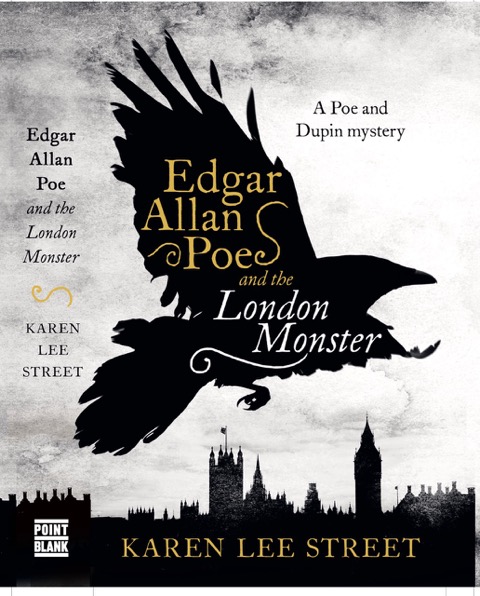
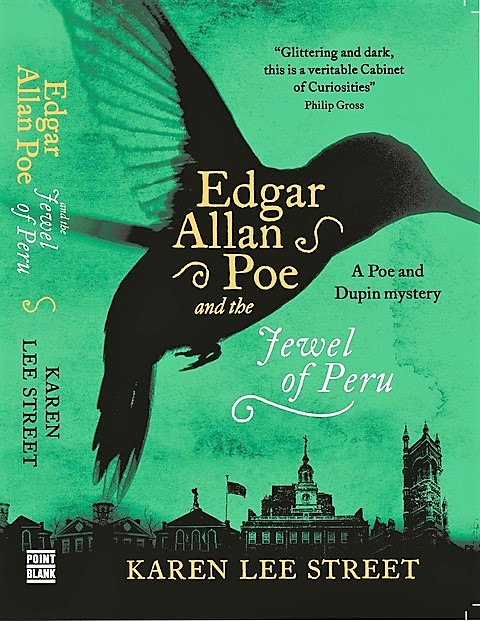
My working title for the original stand-alone novel was C. Auguste Dupin and the London Monster, but when I pitched it as a trilogy of mysteries, my agent pointed out that it would be better to mention Edgar Allan Poe in the three titles. The sequel titles (at this stage) are Edgar Allan Poe and the Jewel of Peru and Edgar Allan Poe and the Empire of the Dead.  I was forwarded the proposed dust jacket during the proofreading process and, happily, liked it very much as did friends I showed it to. I am the sort of bookshop browser who will pick up a book because I find the cover intriguing, so this was an enormous relief.

poe stamp


Yes. It touches on all the themes – the crime, the Gothic, the mystery and I love the black and white with the hint of gold. Now, you’ve previously spoken about your early introduction to Poe – what part do you think early reading plays in an author’s later writing or reading?

This is such an interesting question — I hadn’t realised how much my earliest reading material influenced this trilogy until contemplating it. I lived at my grandparents’ house for about a year and half, aged eight to nine, and spent an enormous amount of time reading my mother’s old books: the Nancy Drew mysteries, Grimm’s Fairytales, The Mother West Wind “Why” Stories, and The Book of Marvels, a collection of stories by adventurer Richard Halliburton which not only made me desperate to travel, but also inspired a subplot in Edgar Allan Poe and the Jewel of Peru. (I’ve kept my grandparents’ copy of the book.) I also devoured all the biographies and magical adventure books in the school library. There’s a bit of all of that in the trilogy. Reading Poe himself came a couple of years later, when I enjoyed giving myself nightmares.

How curious! Enjoying giving yourself nightmares. It’s that push/pull thing, isn’t it. You’re scared but just also love it. I think it’s like loving Bertha in the attic in Jane Eyre but also being scared by her. And what a reading selection you’ve given me!

Letters have often been used as a device to tell alternative stories to the ‘main’ – I’m thinking here of Pamela – and the letters of Poe’s grandparents are used to great effect in this novel. In fact they are used, really, to tell the ‘real’ story and also provide commentary on relationships, gender, and sexuality. Can you comment on this?

Les Liaisons Dangereuses by Pierre Choderlos de Laclos is an epistolary novel I admire for its depiction of the social mores of a particular time, place, and social group, but also for how a rather cruel game has emotional repercussions for its instigators. I wanted to do a similar thing with the letters exchanged by Poe’s grandparents; they reveal a secret history, but also chart the changes in their relationship and how actions driven by passion, jealousy, pride, and fear lead to a back-against-the-wall kind of choice that changes someone forever. Further, the characters’ choices are limited by their social class, financial position, and — in the case of Poe’s grandmother— gender. Indeed, many of her problems stem from the limited options she has due to being a woman and yet she proves herself to be a clever survivor who defies social conventions and twice puts love and personal independence before financial security.

the monster


A Dublin Crime Book group have read this book and loved it. They have a few questions for you:

How did you come to link the real crimes of the London Monster to Poe?

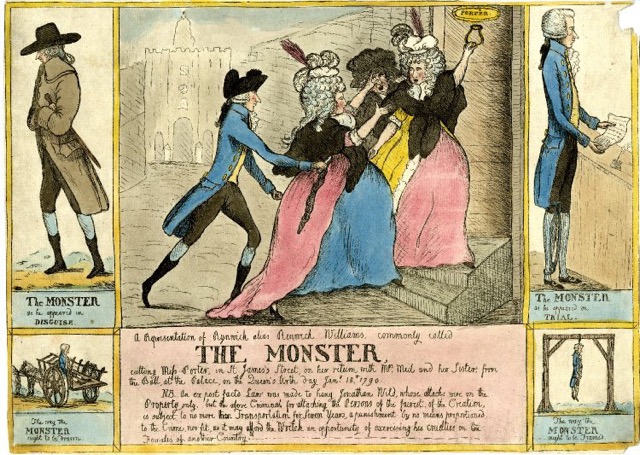
Oddly, I can’t actually remember a ‘eureka moment’ of coming to the idea of linking Edgar Allan Poe to the London Monster; I think it was a case of stored up potential story ideas coalescing into something.  When I first read about the London Monster, I was fascinated by the story and felt it could be the basis of a great film with the right framework. It seemed likely to me that the person sent to prison for the crimes had been falsely accused (for the reward offered), so who was the true culprit? I first read about the Monster in John Ashton’s Old Times, A Picture of Social Life at the End of the Eighteenth Century: Collected and Illustrated from the Satirical and Other Sketches of the Day. (John C. Nimmo, 1885). Ashton’s recounts the Monster attacks in quite a jocular way, reflecting the sardonic tone of late 18th century cartoons featuring the Monster by James Gillray and Isaac Cruikshank. Jan Bondeson adopts the same tone in his book The London Monster, a Sanguinary Tale.  I think these lighthearted approaches to the Monster’s odd crimes reminded me of some of Poe’s hoaxes and humorous works, which probably initially triggered the idea to connect the father of the detective story with the ‘cold case’ of the London Monster. Further, I remembered from a biographical preface to a collection of Poe’s works that his grandparents were actors on the London stage when the Monster was at large and there were theories at the time that an actor or actors with a facility for disguise were the true culprits behind the Monster’s crimes.

Neues_Bild_2_cropped_2


Tell us about the real timing and the fictitious story of Poe’s grandparents.

Reports of a ‘Monster’ attacking women on the streets of London began in 1788 and escalated after the Queen’s birthday celebrations late January 1790. John Julius Angerstein offered a reward for the villain’s capture and conviction in May 1790 and soon after one of the Monster’s victims accused a man of being her attacker. He was convicted after two farcical trials and served six years in  prison. Coincidentally, Poe’s grandfather disappears from records in 1790, at roughly the time the accused was imprisoned, and his grandmother and mother set sail for Boston in November 1795, arriving 3 January 1796, just when the accused was released from prison. This timing fit nicely with the idea that Poe’s grandparents might be the true culprits behind the Monster’s crimes and that his grandmother feared repercussions from the person who took the rap.

Slide1


The ping-pong of Poe and Dupin as a double act – both fact and fiction – works particularly well in the novel. Can you talk about how this evolved as you were writing the various drafts?

Of course I revisited Poe’s three Dupin tales to reacquaint myself with his character, voice, mannerisms, to try to lift him from the page and put him in new situations. I suggested that the unknown narrator in the Dupin stories is Poe himself, that he met Dupin in Paris as the narrator did in “The Murders in the Rue Morgue”. I also read a number of Poe’s letters as found on the www.EAPOE.org site, again to get a sense of his personal voice. As Dupin is the ultimate ratiocinator, highly intellectual, dispassionate, and uncannily good at deduction, I wanted to focus on Poe’s use of imagination along with logic when trying to solve a mystery, but being tripped up by his emotions and the entire issue of family. As Dupin is depicted as a genius of ratiocination, I needed a personal obstacle — something in his character — that would undermine his efforts at solving Poe’s mystery, and I settled on a desire for revenge, a key theme in the novel. When Dupin begins to crumble due to his suppressed emotions regarding his own family, Poe has to pull himself together and utilise his ratiocination skills in conjunction with his imagination.

And I think that’s what makes your book so special: how the imagination and the rational are so well entwined. Finally, Karen, after bombarding you with detailed questions, can you please whet our appetite about the next two books in the trilogy?

Edgar Allan Poe and the Jewel of Peru is set in Philadelphia, 1844, where Poe wrote some of his best known tales. Poe’s benefactress, Helena Loddiges, a bird taxidermist from the famous Loddiges plant nursery in Hackney, East London enlists Poe to solve the murder of her father’s bird collector in Peru. Poe and Dupin are drawn into a mystery involving archaeological looting, ornithomancy, a kidnapping, and treasure books, against the backdrop of Philadelphia’s Nativist riots.

Edgar Allan Poe and the Empire of the Dead will be set in 1849, after Dupin invites Poe to help him vanquish his nemesis, the man who ruined the Dupin family during the French Revolution and during the Reign of Terror. The duo are soon embroiled in a battle of wits fought within Paris’s famous necropolis, a strange underground city full of unexpected riches and secrets, assisted by Dupin’s band of  ‘Apaches’, criminals who live in the catacombs and answer to their own laws.

Thank you, Karen, for putting such thought into the myriad of questions and for making me want to re-read the book again! I am so looking forward to the next two books.

Keep up to date with Karen on her website and visit/like the Edgar Allan Poe and the London Monster Facebook page  
Karen_photo

Edgar Allan Poe and the London Monster Point Blank, (Oneworld Publications):

7 April 2016 (hardback/ kindle),

5 January 2017 (paperback)

Pegasus Books (USA): 11 October 2016 (hardback/ kindle)

On Reading: Alone and in Book Groups

This week I welcome Frances Clarke who talks about her experience of reading for pleasure, for academia and for a book group. In particular, she discusses reading the first two books in Karen Lee Street’s Edgar Allan Poe’s trilogy.

SG: Frances, Welcome to Writers Chat which, for this session should really be called Readers Chat!

So, you’re a member of a crime book group in Dublin. Can you start by telling us a little bit about the group – for example, your scope of reading in terms of how the group might define crime, and also how you might go about selecting a book to read – catering for different tastes within the group – and finally, what’s the timeframe around that?

FC: Well, the book group was started in work about 5 or so years ago. A lot of us are keen fans of crime writing, so a colleague suggested we start a book group with a crime fiction focus.

We’ve had a conveniently broad interpretation of this, so to date it’s taken in espionage (John Le Carre has been selected a few times), true crime (In Cold Blood was an early choice), new writers like Jane Harper alongside the 19th Century classics like Poe, Collins and Conan Doyle.

Selecting a book is pretty straight forward – someone pitches for a preference and if we like the look of it and think copies will be easy to locate, we go with it.

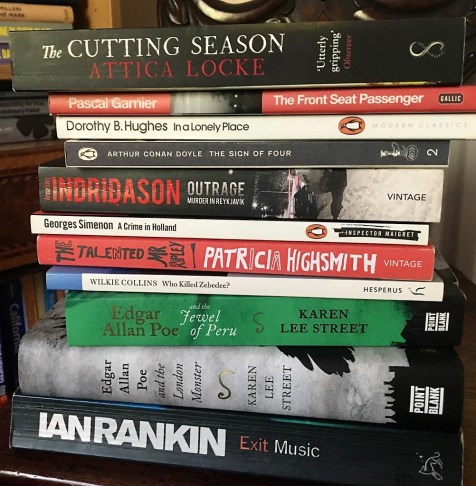
IMG-20181001-WA0001

SG: Oh that’s interesting – the fact that the look of a book and if it’s easily found comes into play. So, for writers, distribution is key! And what a great stack of books your book club has read (photo above).

Having studied English at university, I’m sure you’re familiar with the types of reading we do – for pleasure, for analysis, for critique and so on. Would you say reading a book for a book group discussion differs from reading a book on your own? And if so, how does it differ?

FC: Our group is very much about reading for pleasure. I’m a very keen reader and most (but not all) in the group are too. However we don’t take ourselves too seriously, because it’s as much about meeting up with colleagues after work as it is about the reading. So I try to keep the English lit graduate in me at bay. This works best when I’ve enjoyed the book – my enthusiasm won’t be so analytical. If I haven’t liked the book, there’s a temptation to forensically pick it apart.

SG: It’s funny, I think that once you’ve been reading with an analytical eye that type of reading (or skill, if you will) never really leaves you.

So one of the recent reads was the second in the Edgar Allan Poe trilogy by American writer Karen Lee Street – Edgar Allan Poe and The Jewel of Peru. You also read the Edgar Allan Poe and The London Monster, the first in the trilogy. How did you find reading them as part of a continuum and also, perhaps, discussing them as stand alone books?

FC: Our group did read the first two installments in Karen Lee Street’s Poe trilogy – The London Monster and The Jewel of Peru. We looked at them as stand alone works though, purely because we expanded our membership between the release of both novels and not everyone had read The London Monster.

For me, each book really works well as a stand alone piece of fiction anyway. What I liked so much about the first book, The London Monster,  is how you cut between the 18th and 19th centuries (and the tone for each is so spot on) whereas The Jewel of Peru is very much a work of Victorian Gothic.

SG: Yes, though they are both period pieces, and in many ways tick the boxes of Historical Fiction, they are quite different in tone and timeframe. So how did the group classify Edgar Allan Poe and The Jewel of Peru? The group described it as “essential reading for lovers of historical crime writing, Gothic fiction and urban noir” (on the jacket cover).

Did you find having some knowledge of Poe’s writing helped you appreciate the complexities of the characters and plot or does it matter whether readers are familiar with Poe’s works?

FC: Well, we frequently pick historical crime fiction and I think Karen’s book proved so popular with the group in part because of that. It’s a great genre – if you get it right.


Version 2

SG: How did Edgar Allan Poe and The Jewel of Peru differ from other books you have read as a group? How was it similar?

That’s interesting. We did read Murder in Rue Morgue some time before we read Karen’s reimagining of Poe’s work. So inevitably when we talked about Karen’s writing we harked back to our reading of Poe and other early crime writers. I think because Karen recreates the tone and mood of Victorian writing so well (which is not down to research alone but a certain literary or visual sensibility) we ended up talking as much about 19th century gothic writing (comparing it with Uncle Silas, The Woman in White etc) as crime fiction. The focus of the discussion went down that route.

But since that we’ve picked books that are wildly different; I think our next choice was The Neon Rain by James Lee Burke. I found that a bit of a macho read, which seemed the opposite of Karen’s vision of Poe.

SG: What a wide range of reading your book club does. I must re-read The Woman in White. 

To end our chat, Frances, some fun questions:

One favourite character in Edgar Allan Poe and The Jewel of Peru

Everyone took to Muddy. It’s a lovely portrait of someone who discreetly keeps everything ticking over.

One favourite scene in Edgar Allan Poe and The Jewel of Peru

We’re a book group of librarians, conservators and archivists so everyone had something to say on the scenes in the library, which are beautifully written. Anything to do with book theft or books of uncertain provenance would have to come up for a mention.

One favourite period detail in Edgar Allan Poe and The Jewel of Peru

It has to be Miss Loddiges’s bird jewellery. No question – we all loved that little detail. It conjures up such a bizarre image – a bit steam punk really.

What’s next on the list for the book group?

Next Up is Claire Fuller’s Bitter Orange. It’s gotten great reviews in both the Guardian and Irish Times so I’m really looking forward to getting into it.

SG: Oh I loved that book. It’s been a while since I finished a book and wanted to start reading it again. Bitter Orange did that for me. I hope you enjoy it! Thanks again for the Readers Chat, Frances. I wish your book group all the best of discussions and words!