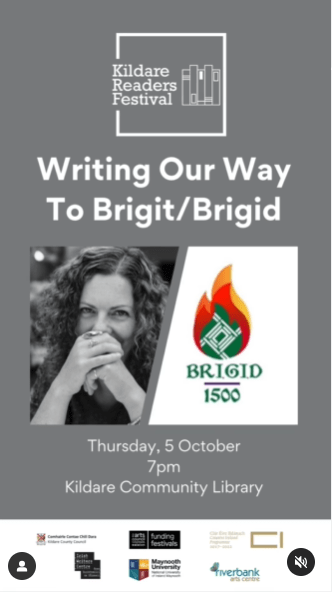
I am delighted to have facilitated a series of creative writing workshops with an amazing group of writers in Kildare Town Library as part of Kildare County Council Brigid 1500 Celebrations.
We would love for you to join us for a curated selection of poetry, prose, music and movement on Thursday, 5 October from 7pm.
Back and Front cover of “Absent Friend” showing pencil drawing of John MacKenna and Leonard Cohen. Cover image: Lucy Deegan
John, You’re very welcome to my Writers Chat series. We’re going to chat about your latest publication, Absent Friend (The Harvest Press: Carlow, 2023), a memoir and reflection on your friendship with Leonard Cohen.
SG: Let’s start with the title. It both sums up the friendship now, and how it endures despite Leonard’s death, and also the friendship as it formed and evolved over geographical distance. Did the title come easy to you?
JMacK: Thanks for the invitation. I’ve long been aware of the tradition in some religious communities of setting a place at table for absent friends – in fact it’s one we’ve adopted in our house. It’s a way of remembering those who are away from home and those who have died and it never fails to bring a moment or two of reflection on some or all of the missing people in our lives. So when I began writing this book the title, more or less, suggested itself. It seemed to sit very easily with what I had in mind as the theme of the book – the friendship and the absence of that friendship after Leonard died.
SG: That’s very moving – your writing as a table with a space for absent friends. It’s quite an incredible story, your lifelong communications with Leonard. How did you work out the structure for the memoir in terms of chronology of friendship/ your own chronological life?
JMacK: That was a challenge. I had many thoughts on how to approach it but, in the end, I thought the songs are the binding force. The songs are what drew me to Leonard when I was eighteen and the songs remain after he’s gone. So I used the songs and albums as guideposts to the journey of his life and my life and our friendship. And it seemed to work.
The parallels between events in my own living and the emotions and events gathered in his songs worked in tandem in terms of the writing. There’s one moment in the book where I’m driving and listening to If It Be Your Will (a song about the holocaust) and I come upon a car accident and that produces its own small holocaust – that’s just one moment of the parallels being shocking.
But the fact that Leonard was so open and so reflective of his own life – and by extension all our lives – makes the work incredibly accessible, moving, educational and emotionally connected.
SG: There were a few moments in the book where there were uncanny parallels and perhaps these actually connect to your own openness and reflection. You also capture the philosophy behind many of Cohen’s songs that have carried you through rough and tough times. You show us the power of his words and music. Why do you think he’s been painted so often as just writing about the underbelly of emotion?
JMacK: I had one brother who was ten years older than me and he was a wonderful guide in life. Leonard was eighteen years older than me and I thought of him as a brother, too. So the guidance, the sharing of experience and direction were important to me. But Leonard’s life was radically different from mine – he came from a wealthy, Canadian, Jewish family. And, yet, much of what he wrote about in terms of emotion was blindingly familiar to me – an innate darkness; a struggle with emotional intimacy; an interest in the spiritual.
So, yes, he does write about that dark spaces and those muddy waters. What is sometimes forgotten is his wonderful humour – it was quiet but it was always there in his songs, in chatting with him, in his letters and emails. That’s something that is often missed about his personality. And sometimes his dismissal and the dismissal of his songs as razor blade music is just lazy journalism.
SG: And that’s a gift – being able to combine dark and deep spaces with humour. You write about your own relationship to form (books, songs, poetry) as well as the impact and/or influence of teaching (the system) on your creativity. The “links” that pull you in to Leonard’s work are also what work in writing:
an idea, an experience, a phrase, an image
To what extent did you learn or work on your writing craft through exploring Leonard’s songs? (For example, your novel Once We Sang Like Other Men)
JMacK: I first heard Leonard in 1971 when I was recovering from meningitis and I can still clearly remember the shock of hearing a story I was very familiar with (the Biblical story of Isaac) retold in the song Story of Isaac but hearing it told in the voice of a nine-year-old boy. The familiar became the fascinating. That was the first step on a writing road toward the realisation that old stories, familiar characters, well-worn situations can be viewed and re-told freshly. That was inspiring.
The other thing I learned from Leonard’s work was that less is more – his ability to suggest things is powerful. There’s a line in a very late song about angels scratching at the door. That one verb is extraordinary in what it suggests and how it avoids the cliched.
The subject matter of a lot of Leonard’s work is the spiritual and that’s an area that fascinates me and, as you say, I’ve examined it in Once We Sang Like Other Men and Joseph. It’s a road we were both interested in, that place where spiritual and human collide.
SG: Yes, that verb “scratching” alongside the softness (perceived) of angels is great. Absent Friend also serves as an exploration of religion. You speak about going to a monastery church in Moone, Kildare
in search of spiritual consolation and calmness
and at length about Leonard’s time in a monastery. How important was it to Leonard and how important is it to you in your writing?
JMacK: Leonard said the monastery at Mount Baldy and his times there saved his life. He went from absolute fame and an absolute dependence on alcohol to a time (six years) of reflection and removal from the demands of the world. It got him back on an even and healthy keel.
For me the quiet times spent at Bolton Abbey are important in two ways. They reconnect me with summers in my teenage years spent working in the gardens there – a wonderful time of ideas and debates and discussions and laughter with the monks. But they also connect me to a way of life that isn’t mine but one in which I recognise the importance of silence, of contemplation, of peace, of communal spirit.
And that feeds into my writing. As I get older I find myself looking more and more (in fiction and non-fiction) at the place of the human in the world of the spiritual. Belief wise, I’d describe myself as an agnostic but I love the search, I love the things that are part of the monastic life – the internal and external landscapes in Bolton Abbey. And I get a tremendous reassurance and uplift from time spent there. The monks are good men, interesting, funny, they have a depth you don’t often find in the world.
SG: How do you think you’ll carry Leonard’s legacy forward – in music and in writing – and do you see Absent Friend as part of this process?
JMacK: I was honoured to work with Leonard on Between Your Love and Mine, a requiem for theatre that we completed in the summer before his death. That requiem has had two extremely successful tours – playing theatres across the country as well as the NCH and Aras an Uachtaráin. The requiem will be restaged next year to coincide with Leonard’s ninetieth birthday so that, I feel, is important.
I hope Absent Friend contributes, in some small way, to spreading the word of Leonard’s genius as a wordsmith and musician.
SG: I am sure your book has already contributed – we see Leonard through the eyes of a friendship that endured a lifetime. I very much look forward to experiencing the requiem next year. So we’ll finish up, John, with some short questions:
Coffee or Tea? Coffee
Silence or music as you write – and if so, what music? Music – I normally choose one CD to listen to per book – for Clare it was 19th century hymns but it could be anyone from Paul Simon to Mary Chapin Carpenter. Always there are words involved.
Longhand or laptop? Laptop – except for poems, they’re longhand
What are you reading now? Steeple Chasing by Peter Ross – a book on English churches!
What are you writing now? I’m redrafting a short novel set in my home village of Castledermot in the winters of 1963 and 2010 – the years of the big snows.
Photograph of John MacKenna wearing a white shirt, looking thoughtfully at the camera. Photo credit: Kevin Byrne used with permission
Thank you to The Harvest Press and John for the copy of Absent Friend. Purchase Absent Friend here.
Front cover of We Are All Together showing a black and white sketch of a stage with instruments lined up against a stool, waiting to be played.
SG: Richard, Welcome to my Writers Chat series. Congratulations on your second novel, We Are All Together which comes out this November 2022 with Wampus.Let’s start with the cover. As We Are All Together is so person-centric, I’m curious about the cover which is a black and white sketch of the various instruments (literally) of We Are All Together. What message/s did you want to convey with this, and how much input did you have, working with Wampus, into the cover design?
RF: One reason I love working with Wampus is that its founder and creative director Mark Doyon provides me with ample feedback on everything from marketing to editing. Ultimately, Wampus leaves the decision-making up to its artists, so I am eternally grateful for the creative freedom that I have.
The cover art was created by my brilliant partner, the painter Nan Ring. She and I discussed the concept. I wanted something fairly cynical yet simple. The bare stage: a guitar, amplifier, microphone and stool. But where are the musicians? Nan and I wanted the cover art to start a conversation. We wanted to pose several questions considering the title of the book.
The Beatles have been an enormous presence on me as a writer and on this particular novel. The book’s title is from “I Am the Walrus.” “I am he as you are he as you are me and we are all together.” The title claims, “We are all together” but in fact, the characters are not all together at the beginning of the book. In the United States, we are not united, never was, and yet we are inextricably linked nevertheless. I don’t think the irony will be lost on readers.
In addition, the edges of the image dissolve, indicating the ephemeral nature of life and art. Even as we are here together, we are all slowly leaving this world, which makes the present moment all the more intensely poignant and beautiful.
SG: Thank you for that explanation – it’s interesting to hear the story and conversations behind the cover and title. Leading on from this, it seems that We Are All Together could not have been set in any other era and any other country than the 1960s New York (and other cities). Was the era – and all the conflicts of national and individual identity – what brought you to this story?
RF: Syd Barrett and The Pink Floyd brought me to the story and the recent politics in America provided me with a blueprint.
It began as a rock and roll novel about a young musician so desperate to make it that he’s willing to do anything, even betray his best friend. I drew upon my experiences as a desperate musician, living the life of a starving artist, doubting my abilities, and unwilling to face the truth about my artistic pursuits.
For several years, I wrote about music on my blog, Riffraf. I had the opportunity to interview the great rock photographer Mick Rock who had taken some of the most iconic photos in rock and roll: David Bowie and Mick Ronson, Iggy Pop, Lou Reed and of course Syd Barrett. Syd’s story was a compelling yet strange one, and Mr. Rock shared his experiences with Syd that really piqued my interest. At the height of his musical powers, Syd just checked out. Was he an acid casualty? Was it mental illness? Or did he no longer wish to make music with the band he formed?
David Gilmour said, “Syd’s story is a sad story, romanticized by people who don’t know anything about it. They’ve made it fashionable, but it’s just not that way.” I am by no means trying to romanticize Syd’s story. Although I’ve included some of Pink Floyd’s mythology and lore. My novel resembled Syd’s story in the beginning, but eventually morphed into something more socio-political than I had anticipated. I owe a great debt to the American politics of the past decade.
SG: I thought you captured the public/private self well alright. Stephen is constantly trying to please those around him – on stage, at parties and even when he is supposed to be engrossed in his music he steps out of his reality to remember, for example, seeing the Beatles on TV. Stephen’s journey – and that of the reader – is about using others to find or create himself. Would you class this novel as a coming-of-age tale, a bildungsroman? Or is it more of a morality tale about vanity? Or does it belong to a genre at all?
RF: Whereas my first book, THERE IS NO END TO THIS SLOPE, is a coming-of-middle-age novel, this one is a more traditional bildungsroman. The novel’s protagonist, Stephen Cane, is a naive twenty-one-year old narcissist who is wrestling with his parents’ mixed messages, dreams, vocation and the belief that he is not a truly great man.
Stephen and his partner and friend, Dylan John, are young men on their own individual psychological, spiritual and moral journeys. Dylan travels in one direction as a civil rights activist, while Stephen, on a separate path, pursues his love for rock and roll. WE ARE ALL TOGETHER is also a buddy novel and a road novel. There’s even a touch of historical fiction and perhaps some thriller/mystery elements tossed in for good measure.
I suppose there are moral questions posed, but I don’t think of the novel as a morality play. At what lengths would you go to gain success? What role does the artist play in this world? Does the world need another rock star? Now that I think about it, Dylan is kind of like Everyman who is trying to justify his time on the earth.
SG: Yes, there is a touch of Dylan as the seer, and also the Everyman. While We Are All Together is, on a top level, an exploration of the lure of fame, and perhaps a commentary on a capitalist society – “My old man had been instructing me ever since I was a boy that whenever money was involved, I should seize the opportunity, no matter who gets shredded in the process, even if that person ultimately turns out to be me….” – it also sets its gaze at parent/child relationships in the formation of “character”, and “reinvention”. Early in the novel, we’re told:
“Some mothers inspire their children to aspire to greatness, to reach for the stars, like Arthur’s mother. But my mother, who was kind of musical in her own way, singing in the church choir and all, encouraged me to play it safe…the world ‘dream’ just wasn’t in her vocabulary.”
To what extent do you think Stephen’s strict religious moral upbringing with a focus on money making, is related to his constant misjudging what is expected of him in the relationships he tries to forge? I’m thinking here of the complex relationship with Emily, and then later with her as Gentle Wind (who, perhaps accurately, claims he has “never loved anyone” in his life).
RF: I’m not sure that Stephen misjudges Emily (also known as Gentle Wind). He witnesses her prejudice and bigotry on their first night together when she makes an anti-semitic remark. I think Stephen chooses to overlook Emily’s questionable, reprehensible behavior because she’s not only beautiful, but she’s also a terrific artist. He’s a young, lonely loser who just had his heart broken and is desperate in both art and love. He’s seeking the love, attention and approval that his parents failed to provide. Stephen is truly impressed with Emily’s natural talent. Wondering if he possesses greatness himself, Stephen wants to be near greatness, hoping that maybe some of Emily’s will rub off on him.
SG: I was thinking not that he misjudges her but that he misjudges the relationship. This desire to be near greatness, as you say, is also why he has John as a friend. You make great use of description, colour, and visuals to capture the clothes, atmosphere and attitudes of 1967, or the Summer of Love. From Emily’s “ratty dungarees with holes in both knees”, “yellow button down with a wide collar and large bright silver buttons”, to the “purple stairs” which Stephen and Emily descend, and a projection of a montage of “films of suburban families opening presents in front of a Christmas tree, psychedelic mushroom swirls, the conflict that was heating up in Vietnam, and police officers beating negroes with Billy clubs.” Or later the band is
“decked out in black and wearing dark shades… stunning female back-up singer, a blonde mannequin in a white leisure suit and black scarf”.
It strikes me that We Are All Together is very filmic. Could you see it as a film – or a play, given your playwriting background?
RF: I never envisioned this book as a play. Though I do think there is some fairly decent dialogue within. When I write a play, I accept the stage as my biggest challenge. I love writing dialogue, but I also consider ways to tell my story visually? Writing a novel is quite different. And for this book I attempted to write a more traditional, linear tale, but I wanted to go really big with its visuals. Let’s include a chapter with Andy Warhol and the Factory. Why not take a trip across America? I like Pete Townshend, so let’s make him a character. My vision was broad and ranging. I saw the narrative quite clearly. The Sixties provided me with color, extraordinary political events, and powerful images, so I’ve tried my best to preserve them in prose.
SG: Yes, you’re right about the vision – and it’s quite a journey you bring the reader on. We Are All Together also explores the expanding, changing world of music (and touches on the art and film world with Warhol making multiple appearances) in the 1960s, and shows the reader – through Stephen – how closely it was linked to political change. How important was it for you to track socio-political change and in doing so, echo tensions and polarisation in America of today?
RF: When I embarked on this project, my intention was to recall some of my experiences as a singer in a rock and roll band in the 80s and 90s. I set it during the Summer of Love because I wanted the protagonist to be somewhat of a precursor to punk, someone outside the mainstream. But early on it was clear to me that the character I thought was the book’s protagonist, Dylan John, was really the protagonist’s (Stephen Cane) foil.
The more research I did on the Summer of Love the more I learned about The Long, Hot Summer where more than 150 riots had taken place across America, the most notable rebellions were in Detroit and Newark.
As a white writer, I discovered that there were two narratives in the summer of ‘67. The white narrative of The Summer of Love – peace, love, and understanding, is more mainstream, while the black narrative of racial injustice, discord and the quest for equality takes a back seat.
I’m ashamed to say that I really didn’t know too much about the Long, Hot Summer until I began writing this novel. The more I wrote, the more invested I had become. Dylan John questions his role in society and decides to join the fight for civil rights. He doesn’t think the world needs another rock star. He believes the world needs soldiers in the fight for justice.
I created two narratives that parallel the socio-political events of the time. There is Stephen Cane’s story – The Summer of Love – and then there’s Dylan John’s story, The Long, Hot Summer. It was a very conscious dichotomy. While I was writing the book, America was in turmoil, mimicking the events of 1967. WE ARE ALL TOGETHER is set during the Summer of 1967, but I’m really commenting on present day America.
SG: That duality and commentary comes across really strongly, Richard. It really speaks of how our own situation as writers and the when/where we are writing from seems into our narratives. Stephen and Dylan John/Arthur Devane are polarised characters in this respect and your use of dialogue worked well in this respect. Can you talk about the relationship between Dylan John and Stephen Cane and how this asks questions about the role of the artist in society – is it to provoke? Create change? Make money? Do something “meaningful”, as Dylan says?
RF: We Are All Together addresses a nation struggling with its mythological past and the effects it has had on the integrity of the individual. Does the artist owe the world anything? Does the ailing world need another rock star? The role of the artist is to comment on the world. The artist seeks truth. The artist tries to make sense of this perplexing world. If the art is truthful it might offer a fresh point of view for the audience (or reader).
SG: Questions that are timeless. But was it difficult to incorporate real musicians and bands (The Beatles, The Velvet Underground, Mamas and Papas etc) into the fictional world of We Are All Together whilst maintaining the integrity of Stephen’s story?
RF: It was actually quite fun. I particularly enjoyed writing about George Harrison. I wanted to write about the time George was in Haight-Ashbury and how disappointed he was in the flower power counterculture. And there is Stephen Cane in the midst of it all, pleading with George to listen to the only song he has ever written.
The infamous story is that George and his wife Patti visited the Haight on August 8, 1967, but were really turned off by the culture. In his biography Dark Horse, Harrison said, “Somehow I expected them to all own their own little shops. I expected them all to be nice and clean and friendly and happy.” Instead, he said, he found the hippies “hideous, spotty little teenagers.”
SG: Again, it’s that duality – perception/ expectation/ reality. Part of Stephen’s journey is also experimenting with various class A drugs, especially heroin “his papa” which eases his guilt at
“Failing to protect my mother when my father went to town on her with his black belt and wide silver buckle. Breaking up Ghost Spider. Replacing Dylan in Red Afternoon. Sleeping with my best friend’s wife”.
There are times when our sympathy for Stephen wanes. But you pull us back with humour and bizarre horror, such as The Jolly Jokesters on their magic bus, Furthermore which bring both reader and Stephen out of his self-obsession and back into the reality of a divided society. Can you comment on the humour in the novel?
RF: I wouldn’t say WE ARE ALL TOGETHER is a particularly hilarious novel. One might find the hapless Stephen Cane somewhat amusing. Certainly Tony Campbell, the writer and entrepreneur, might make one smile. Neal Cassady has his moments too. Though even in the dark there is light. Mark Twain said, “The secret source of humor itself is not joy but sorrow. There is no humor in heaven.” Whenever I’m writing I search for the humor in the tragic. I’ve written a number of tragicomedy one-act plays, and I approach all of my writing with some levity. You can’t write from inside a casket all the time, right?
SG: Exactly! So, lastly, Richard, let’s conclude our Writers Chat session with some fun questions:
If you could be a character in your novel, who would it be? Clementine. She is a poet, a lover, a traveller, a wandering spirit, an adventurer, a good friend.
What song from We Are All Together would be its soundtrack? “Arnold Layne” by Pink Floyd influenced the psychedelic songs written by Dylan John, Red Afternoon and even Stephen Cane’s one song.
Silence or noise when writing? Noise while writing. Silence while editing.
Favourite band doing the circuit today? Wilco.
What is the most surprising read you’ve had this year? The Talented Mr. Ripley and Oh William!
Photograph of smiling Richard Fulco wearing black-rimmed glasses and a navy-blue shirt, against a background of a lake and forests.




 Shauna Gilligan Writer