Writers Chat 55: Catherine Dunne on “A Name For Himself” (Arlen Classic Literature: Dublin, 2022)

Catherine, You are very welcome to my Writers Chat series. We’re here to discuss A Name For Himself first published in 1988 and re-issued this year as part of the Arlen Classic Literature Series. I finished reading the novel on the same weekend that The Irish Times published Stolen Lives, a heart-stopping report on the “239  violent deaths of women in Ireland from 1996 to today”. It is an awful thing to say that the narrative of A Name For Himself speaks of a horrible truth still present and persistent in our society. But it also reminds us of the role novels have, as you say in your Afterword, “in exploring the texture of our daily lives in a way that can help us understand ourselves and others better.”
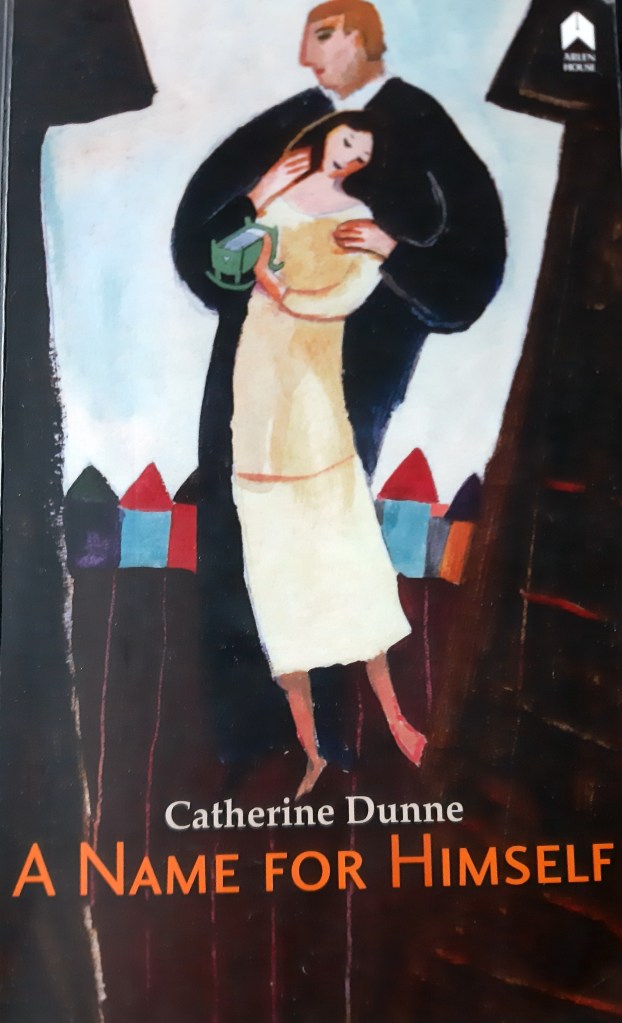
Cover of A Name For Himself showing a painting of a man in black with his arms around a woman in pale yellow against a background of houses and within wooden houses (painting by Tove Kregs Lange)

SG: So let’s begin with the title which tells us something about what motivates Farrell (one of the main protagonists) but also speaks of the role of class, money and reputation in Ireland. Can you talk about how you came to decide on this title A Name For Himself?

CD: Thank you, Shauna, for your invitation to take part in ‘Writers Chat’ and to discuss A Name for Himself on the occasion of its reissue by Arlen House.

In one way, it feels as though the writing of Farrell’s story took place a long time ago (it did) but in another, it’s a novel that still feels very recent. I continue to have a strangely intimate connection with Farrell and Grace. I think that’s partly because their story became my second novel: the one that made me believe I was on my way to becoming a writer. I say ‘becoming’ because I’d come across the view – on multiple occasions – that ‘everyone has a book in them’. And once my first book was ‘out’, I was genuinely terrified that that was it: the well had now run dry!

So, writing A Name for Himself was a very special experience. It was a complete departure from my first published work, In the Beginning, which drew on those contemporary issues and relationships that were familiar to me. But the story of Farrell and Grace – apart from one moment of inspiration, or perhaps recognition is a better word: that moment when a writer becomes aware that the spark of a new story has ignited – my second novel was a work entirely of the imagination.

During my career as a teacher, I’d spent the best part of two decades working in a disadvantaged area of Dublin. The 1980s in Ireland were a dismal time economically and socially.  It was also a decade of high emigration: more than 200,000 people left this country during those years. As teachers, we felt we were educating an entire generation for the dole queue, or the emigrant boat. Those years brought me face to face with deprivation in a way that had a huge impact on me. I saw ‘up close and personal’ the devastation caused by lack of resources, by intergenerational unemployment, by lack of opportunity and by social attitudes towards ‘the working class’.

When I began to imagine Farrell, his background came to me fully formed. I have always believed in the notion that writers don’t choose our stories: instead, our stories choose us. And when Farrell began to colonise my writer’s imagination, he emerged from a disadvantaged background, one he was determined to escape. He wanted, needed, to make a better life for himself. When his family of origin fell apart, he took every opportunity offered to him to be independent and self-sufficient. Through the kindness and solidarity of his local community, he became first a carpenter, then a master craftsman.

Everything about Farrell’s rejection of his background propelled him to create, rather than destroy. He wanted nothing to do with the violence and chaos that his father had created within the family. He rejected everything about him: appalled at the damage he had done. From an early age, Farrell even refused to call himself Vincent, or Vinny: that name belonged to his father, it was no part of him.

And so the title of the novel was born from Farrell’s determination to forge his own path, to have no connection with his hated father, to become his own, separate self.

I already knew what the trajectory of Farrell’s life would be, even before I began to write. I knew that he would behave in a way that was likely to make him infamous: he would indeed make ‘a name for himself’ in the process. And so, with that double helix of naming, the novel’s title was born.

SG: What a wonderful insight into your process and inspiration, Catherine. Thank you. Now, although A Name for Himself is not set in the present day, there is much of the way society works – the rush to secure property, the demand for tradesmen, the blooming craft businesses – that echoes in the Ireland of today. I think the Dublin that you capture is still recognisable. Are you surprised at the timelessness of place?

CD: Returning to the novel after a quarter of a century, there were many surprises: and some of the echoes, as you call them, were chilling.

I was writing in and about the mid-1990s, the period that led to the Celtic Tiger, to escalating house prices, to full employment, to the accumulation of wealth to a degree we had never experienced before. It was a heady time, for some: property became the new religion for men like P.J., and craftsmen like Farrell were in high demand.

It was a time of great economic and social change.

For Farrell and Grace, such affluent times provide them with an opportunity to be independent. But ironically, they also remind Farrell of the difference in class between him and the woman he loves.

The first time he sees Grace, in her father’s building in Merrion Square, the elegant surroundings emphasise to him – the man in the worker’s overalls, the man with a Dublin accent – that this woman is out of his league. Her father agrees, and this dangerous dynamic, this silent, subterranean tug-of-war between the two men has the potential to be every bit as damaging as the actions of Farrell’s own father.

I think we like to believe that class in Ireland is not an issue in the way it is, say, in Britain. I disagree. And along with economic prosperity, greed, and ruthless property developers, class divisions are still part of our society today.

SG: And that’s what this novel highlights I think. In Farrell, you’ve created an incredibly complex character who we come to love, as Grace does. Mia Gallagher in her excellent Foreword, outlines this reader position so well in that, similar to real life situations, we are totally taken by how he is presented, how he presents himself and how he is seen. It is only when we begin to feel what is behind his actions (or if we read carefully) – fear, inadequacy, lack of self-worth and so on – that we begin to see what he might be capable of. Can you talk about how you developed Farrell’s character?

CD: The development of Farrell’s character is just one of the chilling aspects of this novel that I referred to earlier.

I became completely obsessed by him during the writing process. I had nightmares about him. I saw the world, not through his eyes, but as though I was perched on his shoulder. I watched, sometimes horrified, at the way his character was unfolding. It all felt strangely inevitable. I followed where he led.

I know there are writers who will disagree with that last statement: who will say that the writer is always in control of her characters. And while that is true – I can kill off whomsoever I like, whenever I like, for example – it still feels deeply necessary to follow the shadowy paths that often appear to us, unbidden, in the tangled forest of the writing process.

I didn’t consciously choose what Farrell would do next, what he would ultimately become: it was much more instinctive, more intuitive than that. I went where it felt right.

And I was aware that Farrell’s fear of abandonment, his lack of self-worth, his sense of ownership when it came to Grace: all of these aspects of his emotional landscape created a powder-keg of dangerous possibilities.

But I needed the reader to feel empathy for Farrell. I knew what he was going to do – but I also knew that we tend to label people as ‘monsters’ when they perform monstrous acts that we don’t understand. It’s a way of creating distance between ‘us’ and ‘them’ – but that distance is in no way useful in helping us to understand what drives us – all of us – to do the sometimes terrible things that we do.

The term ‘coercive control’ was not in current usage in the 1990s, in the way it is now. But I had observed such behaviour in action and understood that men who were bent on controlling their wives or partners often appeared on the surface to be vulnerable, devoted, caring: ideal partners and spouses, pillars of their community.

How many times have we seen evidence of that volitional distance between ‘us’ and ‘them’ in the aftermath of a domestic tragedy? How many times have we heard the perpetrator described by others, in the wake of some violent atrocity against a woman, as a ‘lovely, quiet man’?

And although, for the purposes of the novel, I had a clear view of how Farrell and Grace’s story would end, it felt important not to portray him as a monster. At one point, I give him the chance to confront his demons and perhaps create the possibility of another life for him and Grace. But he rejects it, clinging instead to his own sense of entitlement and ownership.

SG: I think that sense of, as you put it, feeling, your way into Farrell’s actions is also felt by the reader in the atmosphere that runs through the novel. The multiple narratives work brilliantly in shining a light for the reader on the evolution of Farrell and his actions, especially the haunting present day “now” narrative that slips in, unsuspecting, and then increases with such tension until the narrative catches up (in time) with that day, that birthday. As I was reading it, a large part of me was hoping that the seemingly inevitable would not happen while knowing it would. Did these narratives come once the story and ending were cemented or did you start there and work your way back?

CD: The series of present tense scenes – one of which opens the novel – were written after the main narrative was complete. But from the beginning, I had three narrative strands in mind. The contemporary story of Farrell and Grace’s meeting and their growing relationship; seminal scenes from Farrell’s past, both childhood and adolescence; and finally, the ‘now’ scenes, scattered throughout the narrative to increase suspense and to highlight the inevitability of what is going to happen.

I began writing this novel in 1995. It’s not that I have a prodigious memory (I wish), but I was so consumed by the creative process during the two years of writing that I made copious notes about structure, about characters, about significant childhood events – I mostly used file cards, back then.  Word processing was still new and I had greater faith in pen and paper. I still like to use notebooks when I’m working on something new – something about the slower pace of handwriting makes for a more reflective process.

From 1995-1997, the writing of A Name for Himself was an experience of total immersion. I had taken a career break from work, and was acutely aware of the ticking clock. I had a limited amount of time to write this book, and it was one of the many occasions over the intervening almost 30 years that I have understood the value of deadlines.

Those two years also taught me that writing is an organic process. The act of writing in itself creates inspirational moments – the ability to see clearly those inviting paths in the forest I referred to earlier.

Turning up at the desk is the first essential. Words follow.

SG: What dedication to your craft and I love how you used the immersion and set time that you had to both write and also record how you wrote. What a wonderful thing to be able to look back on those index cards! Definitely for the archive. In relation to making, Farrell is “a maker in a most tangible craft” (Mia Gallagher) and I found it reassuring that Grace, too, is a maker, an identity denied to her by the men in her life (most notably her father) – until she meets Farrell.

I was really interested in how A Name For Himself therefore also explores the act of naming and, through this, agency. Farrell drops his first name “Vincent/Vinny” so that it is not tinged with the actions of his father and so understands Grace’s struggle to name who she is, and what she is. This enables him to literally open doors for her to make her dolls. There is, however, also the sense that Grace creates the dolls with care parallel to Farrell’s conjuring of Grace-as-possession. Can you talk a little about this aspect of the novel?

CD: Farrell does indeed understand Grace’s need to create, and to carve out an independent life for herself. In this, her needs are a reflection of his own. But his efforts to help her fulfil her dreams are, in fact, driven more by Farrell’s need to be in control than Grace’s need to be free and independent of her father.

Even at the very start of their relationship, we see Farrell’s obsession, his overwhelming need to be the ‘master craftsman’: ‘Grace held his arm tighter. Farrell thought he would explode. By the time they reached the city centre, he had planned and mapped and fashioned the rest of their lives’.

At a later stage, Farrell says to P.J. that he intends ‘to give her [Grace] a good life’ (my itlaics). As though her life is a gift that he has the power to grant her.

In many ways, Farrell is recreating the family he lost in the way he relates to Grace. It’s as though she becomes a child, someone whose whole future depends on how he crafts it – rather than an adult woman with agency of her own.

He oversees her making of dolls, Noah’s arks, toys of all kinds with a pleasure that is a complex mix of emotions, a mix designed to make the reader uneasy.

Yes, I felt that when reading it, that he was creating a child out of her, but also enabling her to create her own ‘children’ (the ones they long for) in the dolls and toys.

Lastly, Catherine, some short questions:

Do you usually have one book or numerous books on the go? If we’re talking about reading, rather than writing, then yes, I very happily have several books on the go at the same time. There are ‘upstairs books’ and ‘downstairs books’, and for Luas and bus journeys, there’s the ultimate ‘handbag book’ – my trusty Kindle. Although paper claims my affection and loyalty every time – a Kindle is for convenience.

As far as writing is concerned, I can’t focus on more than one obsession at a time. The most I can manage is, say, working on an essay at the same time as a piece of fiction.

I love the idea of upstairs and downstairs books, and that you use a Kindle (I do for travelling). So, quiet or noise when you’re writing? I used to believe I needed absolute quiet for writing. Then I spent several months in India. The only safe electrical connection in the village was in the local cafe, so I used to go there every morning.

That year, the cricket world cup was underway and the entire community for miles around came to watch the matches on the big TV screen. As you can imagine, the men’s enthusiasm was not expressed quietly. Apart from that, it’s difficult to find a quiet spot in India anyway – its large population makes sure of that. Very quickly, I learned to tune out the noise.

I still prefer quiet – but it’s good to know that I can adapt.

Generally, do you plot/plan or go where the writing takes you? I have a dreadful sense of direction. Anybody who knows me will tell you that. Even following a map, I have the capacity to get spectacularly lost. Some of my most enjoyable journeys have resulted from not knowing where I’m going.

Writing is a bit like that. I’ve always liked the comfort of having a map – a starting point and an end point: that was certainly the case with A Name for Himself and indeed, for subsequent novels.

But getting lost in the forest is also part of the joy.

Right now, as I start a new piece of work, I’m adopting a different approach. I have a vague idea about my idea – and I’m going where the process takes me.

I remember seeing children in primary school being encouraged to ‘take a line for a walk’ – just follow your crayon across the page and see what picture emerges.

That’s what I’m doing now. It’s strange, and different, and exhilarating.

I’ve no idea where I’m going next.

What freedom in just seeing what emerges! Coffee or Tea? In the morning, coffee for sure! In the afternoon, different types of tea.

What’s the next three books on your reading pile? They are all books that have been overlooked for a while, because I got carried away with so many other sources of printed temptation. So I’ve promised myself to go back to them. They are: The Nine Lives of Pakistan by Declan Walsh. Fifty Words for Snow by Nancy Campbell. No One Is Talking About This by Patricia Lockwood.

A great selection, Catherine! Thank you for such insights into your process, the thinking behind some of the characters and for your generosity in answering my probing questions.

Catherine Dunne (Photo: Noel Hillis)

Purchase A Name For Himself.

Follow Catherine Dunne.

Read Catherine Dunne’s article in The Irish Times about what inspired this novel.

Writers Chat 54: Deirdre Shanahan on “Caravan of the Lost and Left Behind” (Bluemoose Books: Hebden Bridge, 2019)

Deirdre, You’re very welcome to my WRITERS CHAT series. We’re here to talk about Caravan of the Lost and Left Behind (Bluemoose Books: Hebden Bridge, 2019).

Cover of Caravan of the lost and left behind by Deirdre Shanahan. Image shows a winding country-side road by the sea with a back-drop of a pink sky, setting sun against dark mountains.

SG: Before we get into the narrative and people in the novel, can you talk about the origins of the title and the stunning cover?

DS: This is really interesting to answer as the title is not the one I used at submission, as the publisher thought it sounded too science fictiony. So though I like it very much and initially felt unable to come up with another title- having been told this just before Xmas, I somehow went into overdrive and came up with others. This was one of them and was accepted.

I liked the word ‘caravan’ not just for the sense we have of it but for its original derivation- which I hoped, maybe in my naiveté,  gave a more universal  suggestion. In the Oxford dictionary it says:  Eastern or North African company of merchants, pilgrims etc travelling together for safety.  I love this. ‘The Lost and Left Behind’  – anyone who does not feel part of the main body  – anyone at a particular time in their lives who feels separate from the whole.

I have always been  interested, sometimes felt like this myself and really this is where the interesting stories are- on the perimeters of the mainstream – in whatever group –  for instance even  the main character in Edward St Aubyn’s Melrose novels  is ill at ease and misunderstood -does not feels be ‘belongs’   to the  aristocratic group he is born into and it is this distance which allows the sardonic tone to the novel.

You could say as much about Heathcliff, any of Jane Austen’s heroines who feel they don’ t quite fit in. Elizabeth Strout’s characters- Leila Slimani’s. I think all the interesting stories are found where people feel out of place and to be ‘looking in.’ My main characters are those who feel socially / emotionally and psychologically different – who are not immediately at home in the world.

The cover. This was not how I originally envisaged the cover, but after a series of other ideas were submitted to me, including a generic kind of landscape, I thought  the latter would  work if it was heightened, in some way, if the colours were kind of electric and weird, suggesting turbulence and displacement so that is what I pushed for. Thank you. I am glad you like it.

SG: I think the colours are gorgeous on the cover and it really draws the reader in. Now, structurally Caravan of the Lost and Left Behind is divided into four sections – places which represent hope and the possibility of belonging – and we follow Eve and her son Torin on their journey of escape. Did the structure, the story or the characters come first to you?

DS: You sensed one of my primary concerns when embarking on this novel and my initial thoughts. My  original idea was  4 first person narratives relate the story and was much influenced by Louise Erdrich’s  work–  until I found very little moved  in the development of the characters. I realised I was constricting myself within an imposed form that just did not suit the story I wanted to tell. And I had no need to do this.  So I  started again but that was a good thing.

I found that a 3rd person narrative overall but structured into four parts allowed me the breadth to convey the story and the shifts in narrative. It was an easier structural form than I was making. It impressed upon me how, for me, the story dictates how it wants to be told. Form comes after- is secondary.

There seemed to be 4 distinct movements of the story which I wanted to emphasise, and they became the four sections.

SG: That’s great to hear how you worked through what was best for the story itself – so often this happens when writing novels, our original structure needs to change when the story is clear. The search for family is one of the main themes of the novel. Absent and unknown fathers and mothers, siblings, and at the same the wonderful ease of deep understanding that exists between the characters – Torin, a stranger, is welcomed into both the site and the town, though he doesn’t quite know how to handle belonging. Both Torin and Caitlin dream of finding their fathers but as Caitlin says,

“Dreams are as delicate as the bones of a thrush, and if you grind them down like the poor bird, there will be no flight.”

Can you talk about this?

DS: I think exploring the inner life, dreams, longings, regrets, etc of characters  are what the novel is best at, and is a uniquely privileged  form to undertake this- it offers a unique opportunity to show the inner lives of people – how they are in themselves and how they are in relation to others. The novel offers the space and breadth to do so. Although in some ways the lives of my characters have been restricted they still have hopes and dreams – maybe these are all the stronger for the little material effects and wealth they have.  Their dreams have been squashed but are still present and alive in terms of what they feel.

In youth, dreams are powerful  and I wanted Caitlin to feel she had the passion and power to have ideas beyond her situation but she is wise as well and can see they could be easily snuffed out. She has lived between people, in unstable situations, enduring a greater loss as I saw it, in that she has neither parent around, but  I wanted her, as opposed to Torin, to have a strong sense of how she wanted change and recover her life. She is like a catalyst for change which Torin knocks up against and it provides the means for both of them to move on.

SG: The theme of the outsider – and how we “other” ourselves and people we don’t know – is also threaded through the novel. Torin lives in constant fear that his past will catch up on him while simultaneously confronting his mother’s alienating past; Eva returns to a person rather than a place that she calls home. Eva puts it thus:

“It was what she wanted, to be taken back to where she started and sitting in a bar with a man who would make her feel better.”

And Torin sees that “she did not fit in there, she did not fit in here.” How important is the notion of “home” to the novel, given many of the characters live their lives moving from place to place?

DS: I think we all strive for a place where we feel we fit in and belong which we might call home, whether or not it is a geographical location and can sometimes feel as if we don’t belong whether in a larger political sociological sense or in more personal relationships.  To belong to a group or to another person is, I think,  a deep human need  we strive to fulfill for better or worse.  To have a sense of ‘home,’ whether we wish to find that within the group or with one other,  is a universal concept and despite my characters sense of one being transitory and temporary, I wanted the search for one to be a central thread in the novel.

 ‘Home’ is an increasingly powerful and resonating notion as we hear daily of those who have to leave their homes, or are displaced from them whether within a country or having to flee to another. Right now, my Ukrainian friend and her mother are unlikely to see their home again, something which I find really unsettling and upsetting.

Home  is such an emotional concept. We all start from one and spend time trying to create / recreate one in latter years. Even if one rejects some of the ideas around home and how it may be restricting, I wanted my characters to have a sense of the gap in their lives but not knowing where exactly their home lay and to be searching for it.

SG: In this sense your novel really examines timeless and universal themes. Love casts shadows and lights up their lives – family, friends, strangers – and I liked how every day love and compassion is shown with a gentle pace which allows the reader some reflection. In this sense it brought to mind another Bluemoose book, Leonard and Hungry Paul by Rónán Hession. Would you agree that Caravan of the Lost and Left Behind is character and theme driven rather than plot driven?

DS: Yes, I would agree and very much hope the novel is driven by character. As explained above, the novel for me is the realm to explore human psychology – our wants and needs, dreams and fascinations. Of course the novel can do other things- it can present a puzzle in terms of crime or thriller but I wanted to examine a cast of characters and see what motivated them, follow them in their hopes and dreams. The way we are as human beings is endlessly fascinating. We are a complex mixture of emotions and it seems to me that is the most rich ground on which to work in terms of a novel. Nothing about us is straightforward and I hope I illustrate the depth and complexity of what it means to be human, to be alive.

 I hope the characters’ development provides  staging posts for the narrative to move.  I hope I portray characters who interact with each other and this provides the grit for the momentum of the novel.

SG: Lastly, the writing is lyrical, sensual and so beautifully set in the landscape of the coast which contrasts with the life in London that Eva and Torin have fled. Despite being a stranger to the natural world – seen very movingly in the scene with Caitlin where they find jellyfish – Torin has a sense of generational memory of being “from the sea” even though “this outside world overwhelmed him.” Do you think the writing is a vital part of the story?

DS: I think you must mean, do I think the way I write, which you describe as ‘lyrical, sensual’  adds to the story?  Please let me know if I have got this wrong.

SG: You’ve got it right – yes, I’m asking about how the sensual writing and your use of the senses serves to examine the feel and experience of rural/urban life.

DS: Yes I think it does at least I hope so. I hope the way I write helps convey some sense of how the characters like  Torin experience the world. I have to say though that I do not labour to create this sense. I am afraid it is the way I write. The natural world is evocative for me and I think I have transferred some of my delight with it to  Torin. I do not purposefully or consciously think, oh now I must write in a lyrical mode. This is the way the writing comes out. I know at times I have to reign myself in as it could be a distraction, and may not adhering to a characters make-up and real way of being.

Because much of the novel is set in landscape I suppose I allowed myself a freer licence to write in this way or rather, the writing came out like this. When I write about cities or other situations I can be terser in my style of writing. I try not to think about it too much.

So, to finish up, Deirdre, some fun questions:

  • City or Countryside? Countryside – ultimately after lots of indecision, I came down on this side. I love cities for all they offer – stimulation, chance to meet like-minded people etc, but to do my work, I think the quiet of the countryside offers slightly more ideal conditions. I would however keep making forays to the city to catch up.
  • River or sea swimming? Sea   every time
  • Music or quiet when writing? Quiet – definitely
  • What’s next up on your reading pile? ‘Manhatten Beach’  by  Jennifer Egan
  • What writing are you working on now? A novel set in during the Spanish Civil War as well as another longer piece of fiction and some short stories.

Thanks, Deirdre for such insight into your process and intentions.

Photograph of writer Deirdre Shanahan. Photograph courtesy of Deirdre Shanahan and used with permission.

Buy Caravan of The Lost and Left Behind here.

Buy Carrying Fire and Water (Splice) here

Follow Deirdre Shanahan on her website.

With thanks to Deirdre Shanahan and Bluemoose Books for the copy of Caravan of the Lost and Left Behind.

Writers Chat 53: Lia Mills on “Another Alice” (Arlen Classic Literature, Dublin: 2022)

Lia, You are very welcome to my Writers Chat series and I’m delighted to be talking to you about your novel Another Alice first published by Poolbeg in 1996, and reissued this year (2022) as part of the Arlen House Classic Literature Series. I spent much of the early to mid 1990s outside of Ireland so missed out on this important and impactful novel when it was first published.

Cover of Another Alice by Lia Mills (title in yellow font, author name in white font): showing a dark leafless tree against a contrasting background of green, on a shadow of a hill with the figure of a child in black silhouette in the foreground. Image is art by Carmel Benson.

SG: Let’s begin with the beautiful cover (by Carmel Benson) which captures both a loneliness and melancholy that is echoed in how Alice experiences life (internally and externally) in Another Alice. Did you have an input into the cover image and how does this new edition speak to the Ireland of 2022 just as the cover of 1996 spoke to Ireland then?

LM: I chose that image! Carmel is a friend, I love her work and this print has hung in our kitchen for years. I was very happy that she gave me permission to use it. And I have to say, Arlen House do beautiful covers. Alan Hayes, the publisher, is exceptional in the level of choice he gives to writers with regard to covers and the results work very well.

As for the 1996 cover, I’ve always disliked it. The woman whose face is depicted on the cover wears frosted lipstick. Alice is not a frosted lipstick kind of person.

SG: I love how Arlen House covers often use contemporary art to grace their covers. With regards the original, I’d agree with you about the lipstick but I do like the sea-scape as this speaks to Alice’s relationship with the coast. So, you’ve outlined in your interview with Catherine Dunne why Another Alice is being issued now – especially in relation to the central theme of gender-based violence and how Alice’s story is still relevant to today’s Ireland. I liked how you expressed that learning to see is what the novel is about. So just as

She practised forgetting what she knew, because if she didn’t know, she couldn’t tell

then as the story evolves, Alice unlearns all these practices.

Could you talk a little about how this forms the arc for Alice as a character – learning to see into herself and know that beyond the stories she has told herself, and those told about her, is where the real Alice lies?

LM: I should say at the outset thatmost of my understanding of how (I think) Another Alice works has come to me since I wrote the novel. The actual process of writing it was a long process of trial and error and feeling my way through a very murky series of confusions and reluctance.

As I mentioned in that interview with Catherine, Alice has never been able to claim childhood experiences as hers because they have been denied by everyone around her, renamed even as they happen, while she is blamed for any damage, any harm that comes to her. This is apparent to a reader from early on in the novel but it’s not clear whether Alice herself is aware of it. Later on, however, a different narrative voice surfaces, describing and expressing the process of splitting, which was Alice’s defence mechanism as a child. This new voice tells us what happened and how Alice escaped what happened. If she wants to be a fully autonomous (literally a self-naming) person, the adult woman has to rediscover, recognise and reclaim the lost parts of herself revealed by that voice and learn to trust her own perceptions. She needs to remember herself, as in: putting a shattered self back together, and become a conscious individual.

What’s important to Alice as Holly’s mother (as opposed to as an individual person) is that she learns to recognise the ways in which she was shut down when she was a child. She sees the patterns in her own reactions to Holly when she does things she regrets, and slowly learns to correct those urges to protect herself at Holly’s expense.  So, she becomes both a more integrated person, which is to her own benefit, and a better, stronger mother for Holly.

SG: You really showed this process of Alice’s change really well – as a reader it felt like I was experiencing what she was going through! Another element that made for a very emotional read was the tone in which much of the story is told.

We meet Alice through an omniscient third-person narrator and we’re told a version of her early life but beneath this is an underlying tone that both propels us to read on with a sort of subliminal knowledge of what may happen, that is felt more than known. This seems to echo Alice’s own first person voice and makes, at times, for an uncomfortable read, I think because Alice is so disassociated from her body and memory. Was this intentional or did it emerge instinctively through the writing?

LM: It took time for me to find the right voices for this story. The key, really was finding a way to write it where the reader would recognise the dysfunction in Alice’s world while also leaving room for potential ambiguity. I was interested in the mechanisms of denial, and there are scenes where I wanted to show incidents that many people might be happy to shrug off or overlook, but in the context of Alice’s overall story and the power relations within her family, it becomes clear (I hope) how destructive they are. For example, we’ve all seen – and some people may have experienced – a child being tickled when they don’t want it, begging for mercy. As the younger Alice tells it, that experience is clearly abusive. The issues here are about power (psychological and physical), consent, relative strength. As so many abusive situations are. I have to tell you that when a friend of mine read the novel back in the 1990s, she told me the character she identified with the most was Alice’s mother. Which is a whole other conversation.

In retrospect the use of a third-person, past tense narrative voice for the main story was a fairly straightforward decision but this was my first novel and I tried it in different ways.  Having decided on that, I still had to learn how to tell the story without killing it with detail. And all the time, I was being pulled into this other voice, first person, present tense, chaotic and emotional. It seems obvious now, but it took me a while to recognise that I had to make room in the narrative for that voice – and she solved a lot of problems for me when I just decided to let her get on with it.

SG: Voice is also so central to a novel, and I think using these voices, you’ve captured the power/consent/strength issues in a very subtle and unsettling way. And on Alice’s mother, well, that is another conversation as there was the definite impression of a whole backstory to her behaviour and denial.

I really enjoyed the movement – and change – in Alice’s friendships, in particular Nell, but also Kate. You show these women’s growth and struggles in terms of conformity, societal expectations and emergent motherhood. And the thing is that those challenges are still faced by women in Ireland today. There is no “dating” these themes, despite the theoretical changes in this country. Could you comment on this?

LM: I don’t think the core experiences of human life change very much over time. Becoming a mother is a prime example. It’s such a seismic shift in perspective and awareness, and so many of us are utterly unprepared for it – I know I was. Everyone’s circumstances are different, so we each have our own adjustments and negotiations to navigate, each within our own lives and whatever context we find ourselves in. It’s the contexts (social, physical, financial, historical cultural) that change and obviously they affect the nature of the emotional and physiological experience. It’s a rich seam, for fiction, because we can all find elements we recognise in a fictional mother’s story at the same time as we see issues that are foreign to us. So there’s a balance of recognition and surprise that allows us to empathise while also wondering what we might do or feel in similar circumstances.

Friendship is friendship. It’s such an immense part of our lives and I don’t think it gets enough attention in fiction. Over a lifetime our relationships with friends change, we can get closer and more distant and then closer again, we might have dramatic break-ups, reconciliations, reunion after long separations … it’s a fascinating dynamic, every bit as interesting as other relationships, with a whole spectrum of emotions running through it.

SG: I love how you express that – “a rich seam for fiction”. It was emotional seeing Alice as a young mother struggling with her own self (literally), what it means to be a mother, and how to be with her daughter, Holly. “She watched herself mothering…” I cried at two scenes – the one with car – and the one where she slaps Holly. Both of these acts – rooted in a desperation to control – end up as acts as freedom because Alice is able to name what she has done and acknowledge this anger. They also echo some of the disconnection that Alice felt with her own mother, for example, when Elaine breaks down, “She watched herself watch her mother crying at the kitchen table.” These were incredible scenes and opposite to the oppressive and stifling scenes of her younger self. I’d imagine these parts of the narrative were difficult decisions to make a writer – which way does Alice go? – and also tricky to write?

LM: These were tricky scenes to write, yes, because I think our instincts drive us to protect our characters and sometimes we just have to put them in danger, or make them do things we’d rather they wouldn’t do. But isn’t that the whole point of writing? To explore the more painful, difficult truths of human experience. If all our characters stayed on the straight and narrow path all the time and made all the right choices, there’d be no story.

Who was it who said that ‘writers write what other people think/know but can’t say’? In this novel, Alice is in trouble not just because of her childhood but because she is out of control in many ways. There’s no point in pretending that she never does anything wrong, or that she’s somehow not responsible for what she does (which is actually what her denials are all about: transferring blame to Holly, as her parents transferred blame to her). Her task is to learn how to understand and correct the mistakes she makes. Like life, for all of us. Like writing. As Beckett has it: Failing, then failing better.

SG: You’ve expressed the point of writing so succinctly, Lia “to explore more painful, difficult truths of human experience.”

LM: Of course, writing is about imagining and expressing other things too: beauty, hope, alternative worlds … yet another conversation!

SG: Yes, of course, writing is also about re-imagining…So let’s finish up with some light-hearted questions:

  • Tea or Coffee? I’m a Libran – it depends what time of day, what mood I’m in. Coffee usually comes first, tea later
  • Music or silence when writing? Silence
  • Cats or dogs? Both!
  • Sea or Mountains? Sea
  • What are the next three books on your reading pile? Thin Places by Kerri Ní Dochartaigh; Susan McKay’s Northern Protestants: An Unsettled People; and Walk Through Walls: A Memoir by Marina Abramovic.

SG: Oh you’ll love Thin Places and I have McKay’s on my tbr pile. I must look up Abramovic. Thanks for the recommendations. Thanks, Lia for such open, generous answers. I wish you many new and re-readers of Another Alice.

Follow Lia on her blog

Buy Another Alice here