Nuala, You’re very welcome back to my Writers Chat series. This time we’re here to chat about Seaborne, longlisted for the Dublin Literary Award and described by Donal Ryan as “sublimely imagined and beautifully told.”
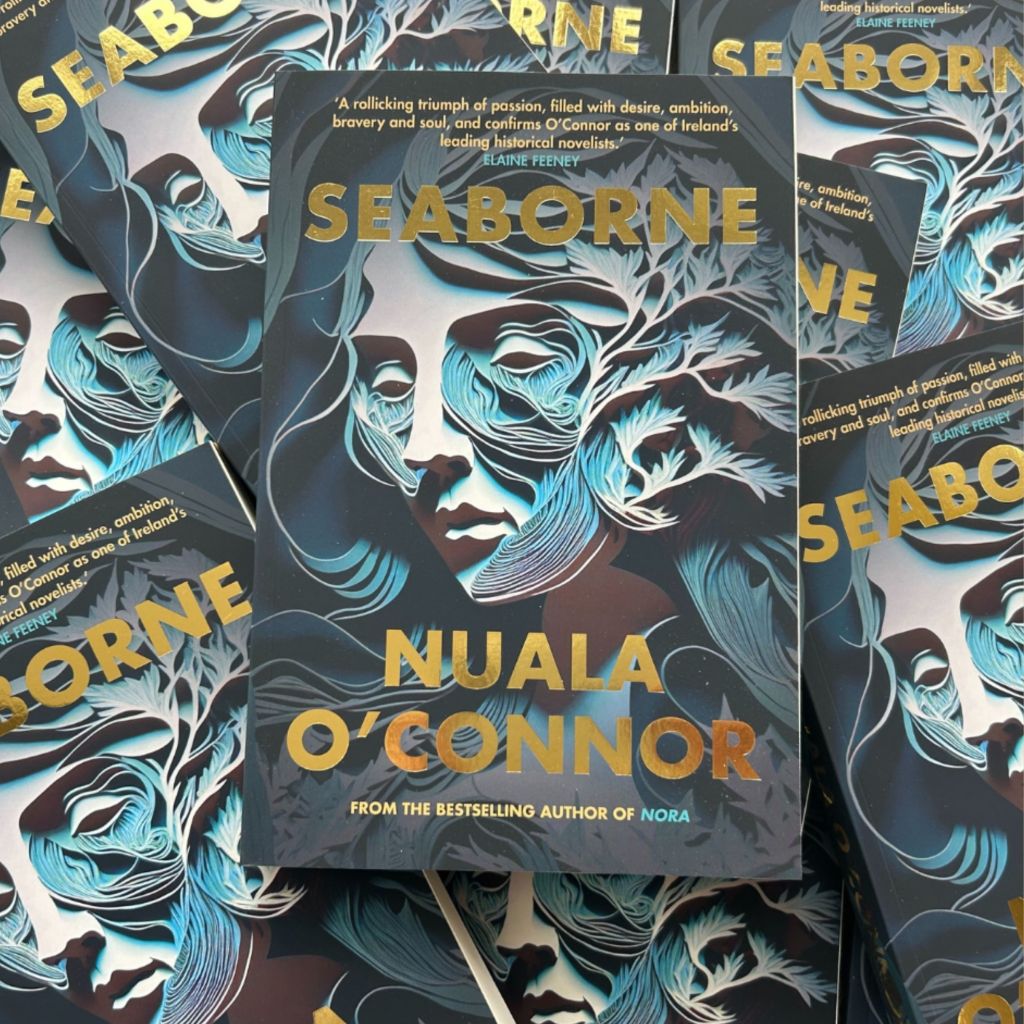
Multiple images of Seaborne by Nuala O’Connor with the title and author name in gold lettering and blue/grey art showing a woman’s face formed by seaweed.
SG: The cover art is stunning. It’s inviting without having read the book and once you’ve read it, you realise the cover totally reflects both title and the complex character of Anne Bonny. Did you have an input into the design and the title?
NOC: I did, yes. New Island are brilliantly collaborative when it comes to the cover. They asked me to make a Pinterest board of images and book covers I liked. I gathered lots of pics of swirly water, women in water, women with big hair and ships on their heads, and so on. Then Karen Vaughan, the designer, came up with loads of possibilities. The final cover image is the one we all had the biggest love for and there were many colour and font tweaks until everyone was happy. The gold foil was an added bonus and I love it. A great experience.
SG: I loved the gold foil! Stunning. It struck me that where Anne is located is a vital part of her identity as much as are people around her. How important was place to you in the writing of this epic book which follows Anne from Kinsale to Carolina?
NOC: Hugely important. There are a lot of myths that swirl around Anne Bonny, and the places she lived or hailed from are included in that. There is no solid evidence of her origins at all, but I chose to use Kinsale and the Carolinas because they were already cited. I travelled to Kinsale but the pandemic prevented my research abroad, so I had to rely on the net, archives, and books for research. Luckily, historical houses, bloggers, and archives are very generous digital sharers of their wealth and knowledge.
SG: Anne is a maverick, and you said in our Writers Chat about Nora Barnacle, another maverick, that you like “women who push against societal norms.” How did you find your research helped or hindered in the creation of the Anne Bonny we meet in Seaborne, given scant records about her illegitimacy, fluid identification with gender, and the push against the barriers of class?
NOC: Any woman who became a seafarer or pirate was considered untoward. With untowardness – in this historic, patriarchal paradigm – goes low morals, bad temper, wantonness etcetera, so Anne was perceived as a feisty dissenter, a rulebreaker and, therefore, bad. It’s not hard to jump from there to the strong-willed quester that I made of Anne. But she has her soft side too – her loving nature.
SG: And you capture her warmheartedness throughout Seaborne. I enjoyed your representations of the changing relationship Anne has with her body – from how she feels and is seen in clothes, to her interaction with men and women, and how she is driven by feeling (physical and emotional) through the book. Can you talk about how your sensory writing is such a fit for a sensuous character?
NOC: I’m an empath and, being autistic, I’m hyper-sensitive to my environment, to clothing, to sensory input and so on, so it’s really easy for me to write those kind of characters, because I live that way – I knock against the world and everything in it as I move through it. So I made Anne is like that too.
SG: Language is at the heart of this book. In the chapter “Quelling an Unsettled Heart”, speaking of Gabriel Bonny, Anne tells the reader that
“The truth stands, though I treat him with disdain, that I like Bonny’s company, I enjoy being near him, and he enjoys me – I see the kindle in his eyes when he looks at me…I like the weight my sailing outfit gives me, it makes me both strong and invisible along the wharf, and there be power to savour in that.”
How did you decide on chapter titles, and what was the process in keeping them inline with the narrative voice which is true to its era and character?
NOC: I had some of the final titles already and then Aoife Walsh, Commissioning Editor at New Island, suggested strengthening them to reflect the content more. I worked with her, and the copy editor, to pick juicy bits from the text as titles. I like all that finessing of a manuscript before it gets to be a book – the cherries on the top, so to speak. I was delighted when Aoife said I could have a map, too – I love novels with maps.
SG: Thank you for being so open about the process! One of Anne’s strengths is her openness and adaptability to linguistic expression – the changes of speech from Cork to Carolina are deftly handled, as are her imitations – while at the same time, she stays true (and firm) to her need of the sea. Was this an important element of the reimagining of Anne, for you?
NOC: I wrote her as neurodivergent before I even knew I was autistic myself. I got my diagnosis shortly after finishing the manuscript, if memory serves. So, she blends, mimics, and adapts in order to fit in (the same thing I’ve been trying to do for all of my life). This masking/imitation includes speech patterns, ways of behaving, clothing and so on. Anne is a chameleon the way many autistic people are.
SG: And this ability to change and blend shines as a gift rather than any type of limitation. The power and strength Anne gets from some female relationships is also explored through her friendships with Hannah Spratt and Bedelia. Can you talk about the role of this trio of women in the overall narrative and how it might compare or contrast with Anne’s relationship with her mother?
NOC: Bedelia is Anne’s beloved friend. There is an imbalance – Bedelia is her servant – but Anne loves Bee fiercely, relies on her totally. Anne is wary of Hannah from the start, she seems too fond of Bedelia. But Anne learns to like her a little when she sees that Bedelia likes her. It’s an unbalanced trio and it never quite goes right, as the reader will see.
Anne’s mother Mag was steady and wise, she was Anne’s main advisor and, her early death left Anne a bit rudderless. With no steady hand to guide her, we see Anne flounder, fragment, and act chaotically.
SG: Lastly, Nuala, some fun questions:
Boat or plane/Sea or land? I’m not a fan of flying. Too little control. At least on a boat you can walk around. I love the sea but, if I had to choose, land.
What was your favourite place you visited as part of the research for this novel? Kinsale – such a beautiful, colourful, rich part of Ireland. Also, the Caribbean of my mind. I enjoyed describing tropical beaches while locked down during the pandemic.
The power of words! Is there an era in history you would not like to explore through historical fiction? If so, why? I’ve done 18th, 19th, & first half 20th C, so I’ve covered a fair bit. A WW2 novel is appealing, but I have no firm plans. The novel I’ve just finished writing is contemporary.
What are you reading now? A book of Greek poetry. And I’m back with Ferrante because I’m going to Naples this year. I’ve blurbed nine books so far this year and have one more to go, so my reading has been prescribed a lot (time to take a blurb break, I think!). I have Seán Hewitt’s new novel lined up and am also finishing some Virginia Woolf, because she comforts me, and I’m always reading Elizabeth Bowen’s stories again, because I’m in a Bowen Reading Group. I always have loads of books on the go. Plus podcasts.
That is a lot! Naples is stunning – in all the senses. What are you writing now? A memoir about late-diagnosed autism, writing, depression, the alcohol-free life – I’m throwing the lot at it!
As always, Nuala, thank you for your generous answers and insight into your process as well as the editorial process with New Island. Wishing you continued success with the novel and good luck with your memoir. Seaborne can be purchased directly from New Island.
Nuala O’Connor sitting on a wooden chair on a beach with the sea behind her. Photograph by Úna O’Connor. Used with permission.
Nuala O’Connor lives in Co. Galway. Her sixth novel Seaborne, about Irish-born pirate Anne Bonny, was nominated for the Dublin Literary Award and was shortlisted for Eason Novel of the Year at the 2024 An Post Irish Book Awards. Her fifth poetry collection, Menagerie, was published by Arlen House in spring 2025.
Cover of Washing Windows Too Edited by Alan Hayes and Nuala O’Connor
I’m delighted to be taking part in this year’s Strokestown International Poetry Festival. I will be reading my poem “1922” alongside other women poets published in Washing Windows Too: Irish Women Write Poetry edited by Alan Hayes and Nuala O’Connor (Arlen House).
This event will feature readings from: Sorcha de Brún, Mary Rose Callaghan, Louise G. Cole, Sonya Gildea, Shauna Gilligan, Phyl Herbert, Susan Knight, Jackie Lynam, Noelle Lynskey, Jennifer Matthews, Triona McMorrow, Elizabeth Murtough, Denise Nagle, Úna Ní Cheallaigh, Margaret Nohilly, Margaret O’Brien, Margaret O’Driscoll, Siofra O’Meara, Ruth O’Shea & Janet Pierce.
Do join us in The Percy French Hotel on Saturday 30th April at 3.30pm!
With thanks to Alan Hayes and Strokestown International Poetry Festival for the invitation.
Nuala, You’re very welcome back to my Writers Chat series. This time we’re here to chat about Nora, your fifth novel, lauded by Edna O’Brien as “a lively and loving paean to the indomitable Nora Barnacle”. I read the US version published by Harper Perennial and the Ireland/UK publication with New Island was published April 10th.
Photograph of cover of NORA by Nuala O’Connor
SG: Much has been written about your lyrical, sensual prose and Nora is filled with it from when Jim and Nora leave Dublin on October 8, 1904: (“The air is salt-sweet and cool, the portholes beam light into the dusk”) to the letters and the food, which we’ll return to. But let’s start with “the indomitable Nora Barnacle” – by the end of the book I really felt I’d lived through Nora’s life with her, I felt like I knew her, I cared for her. You have managed to re-create Nora who feels real and complicated, a woman who knows her own mind and whose strength lies in her patience and openness to the human condition. Tell me about how you got to know Nora through your research.
NOC: I knew Nora Barnacle as Joyce’s strong, loyal, loving wife and muse but I was curious about how she felt about her life. Bio-fiction is about creating an interior world for people and I disliked the smudging of Nora by history. So I dug out my teenage copy of Brenda Maddox’s fantastic biography of Nora and was, once again, enthralled by her earthy dynamism, and by their love story. So I did what I often do when my interest is piqued, I wrote a short story about Nora. My story – ‘Gooseen’ – records their meeting in Dublin and their first date on 16th June 1904 – now immortalised as Bloomsday – and their flit to Europe. The story did well – it won a prize and was published in Granta – but I found I didn’t want that to be the end of my communion with Nora, I wanted to stay in her company for longer, and so I wrote on and on and on.
My aim was to illustrate that the so-called ordinary woman by Joyce’s side is, in fact, extraordinary. Nora felt, thought, lived and contributed hugely to their life, just as Joyce did. Nora helped Joyce stay grounded as she was pragmatic, optimistic, earthy, big-hearted, good humoured, forthright, and resilient – she was just what Joyce needed as a shy, sensitive, kind, loving, nervy, accusatory, opinionated intellectual. Nora flowed with Joyce, was water to his fire. They were both, like all of us, trying their best, and were under the influence of their upbringing, the prevailing mores and politics of their era, and their own personal quirks and passions – Joyce drank, he was unfaithful, he asked Nora to go with other men. Neither was a paragon – the same way we’re not – and my bio-fiction aims to show that.
SG: You have had glowing reviews and The New York Times declared that Nora is “entirely convincing in her raw sensuality, her stubborn determination, her powerful sense of grievance and her inability to stop loving a deeply erratic, wildly manipulative yet enormously talented man.“
Nora is essentially about the relationship between her and James/Jim Joyce. On the one hand they are well matched physically and erotically, and on the other, Nora is always left to keep the family together, taking in dirty laundry (“I scrub away other people’s sweat, blood, piss, cack and grime with scalding, soapy water”) when they are short of money or when Joyce drinks his wages. How did you maintain that balance between the actual hardship of life – moving frequently, living through two World wars, worries about their young and then adult children – and depicting the deep physical and emotional love between Nora and Jim?
NOC: I don’t think Edwardian era Irish women expected an easy life – Nora had seen her mother, Annie Barnacle, battle through with eight kids and a drinking husband, and eventually separate from Mr Barnacle. If Nora had stayed in Galway, she most likely would have married and settled into a life like her mother’s: mass-going, having babies (lots of them), living within a State that was increasingly wedded to the church, that ruled people into submission; she would’ve been scarred by Civil War and the exodus of men to WW1 etc. By escaping to Europe, Nora was released from a strict, rigid, low expectation path. Fintan O’Toole believes Nora liberated Joyce from shame and snobbery; she certainly uplifted him by being strongminded, flexible, loyal, and direct. Nora’s head wasn’t bothered the way Joyce’s was – she was naturally optimistic, loving, and cheerful, so she could drag them both through a lot of their troubles. Her bravery hooked me into her story; her defiance of patriarchal rules, her bending away from State and church morals.
I like mavericks, women who push against societal norms. So Nora’s courage and her willingness to love the man she aligned herself with, despite his many faults, speaks well of her. She accepted, to an extent, much of what was unruly about Jim – his sensitivity, his need to drink, his discomfort with other people – because she was better able to negotiate all of that. Her love protected him and buoyed him up. In turn, his admiration of her strength, their bedroom bond, his love of her physicality and her stories, and his generosity in adorning her with furs, and tweed and jewellery, pleased them both.
SG: And all of that comes through, so very clearly, in NORA. Continuing with their relationship, you used the real Joyce letters (which you wrote about in The Paris Review) as a basis to frame the many absences from which both Jim and Nora suffer equally. I loved the letters and how their passion contrasted greatly with the reality of ever-changing homes, circles of friends and cities. The constant is their relationship and, from your depiction, Nora is quite the scribe and knows to use words and food to keep Jim on her side! One letter opens with: “My lonely bed is tortured with desire for you, my mind leaps to disturbed places, I see you over me posed and preening, chaste, grotesque, languid…” Can you talk a little about how their use of letters opened the door for your Nora to be as much the erotic voice as Joyce (as we know and expect him to be!), as much present in her body as he is?
NOC: Joyce and Nora were in touch with their sensuality: they met as two young people who were proud of their bodies, and unafraid of sharing themselves wholly with each other. Joyce frequented prostitutes as a teenager and Nora had some experience of young men by the time she met Jim; she had walked out with at least three men that she told him about. And both Joyce and Nora enjoyed the erotic writings of Leopold Ritter von Sacher-Masoch, for whom masochism was named.
I had to rewrite Joyce’s letters as they are still in copyright – they were first published in 1975. And Nora’s half of the correspondence was not available, missing – perhaps destroyed – and I had to fill those gaps with imagined letters of my own. So I re-wrote Joyce’s letters by mimicking his real letters as closely as I could. I wrote Nora’s part of the correspondence using Joyce’s letters as a call-and-response guide. When he praised her for using certain stimulating phrases and words, I included them in her letters to him. Joyce planted the seed for the erotic letters – suggesting to Nora that there was a certain type of letter he would love to have from her while he was in Dublin and she was at home in Trieste – and she was well able to oblige.
SG: Yes, and even though she is a sensuous woman – shown though your sensory writing, the fabrics of clothes, furniture, the preparation of and eating of food – Nora is also practical. When Hitler annexes Austria in March, she tells us “I could fall apart thinking about it all – war, Lucy, Georgie – or I can get on with it. I decide to choose the latter” – which shows the strong woman she is – but at the same time, Jim is, she proclaims, “my whole life now…we have to get on with things as best we can, as a pair.” Despite his unreliability he does give her strength.
Real life events such as wars, the Rising, the Civil War in Ireland punctuate their lives and I thought you convincingly depicted some of the parallel difficulties – even for Joyce! – of the world of writing and publishing. We sometimes forget – when reading Ulysses or Dubliners, for example – that Joyce wrote from a particular place, in a specific era and, as you portray, often with serious health issues, notably his eyes. But in a way he could fall apart because Nora always understands him even when he is absent because “he needs to swallow stories many times in order to construct better ones himself”.
Thinking of the broader themes of the book I wondered if it was because their notion of home and nationhood was always changing, as well as the strength of their relationship and the financial and creative supports such as Weaver, that Joyce was able to continue writing, and write so much from the body?
NOC: They were extremely nomadic because Joyce liked novelty, but they remained loyally Irish, even if they grumbled about Ireland and Irishness. Joyce’s fiction is a prolonged love letter to Ireland. Nora liked newness too, but she understood its damage, also, and longed for a settle spot. Joyce needed tumult in order to write; in his biographer’s words, Joyce ‘throve on flurry’. Naturally, he needed stretches of quiet too, to write. As a couple, and later as a family of four, the Joyces moved house over and over, following a pattern set in Joyce’s own childhood, when his father led the family from their lodgings at night to avoid bailiffs. Uprooting home and family every few months, or years, is a sure way to have new writing fodder; in Paris alone they lived at nineteen different addresses.
You have to wonder what Joyce’s monomania about writing, as Brenda Maddox described it, cost the family as a whole. Maybe it was unfair on Nora, Giorgio and Lucia to be constantly relocated because Joyce needed discomfort in order to write, a sort of constant unsettledness, that settled him into the creative work.
SG: NORA had me wondering about that -his discomfort and creativity, the family being constantly uprooted. As well as passion there is much humour in the book. Sam Beckett, in particular, had me laughing. One of my favourite scenes was Bloomsday in Paris in 1929 where they go on an excursion and the “normally rather serene and usually very mannerly” Beckett and McGreevy sing “endless old songs like a pair of escaped lunatics.” It doesn’t help, of course, that Lucia is madly in love with Beckett, or that Jim “drinks wine until it nearly pours out of his eyes.” Once again, Nora is the rock of sense, the protector, with a wonderfully dry sense of humour. As through the novel I felt I was with them! Do you think that in narrating their lives through Nora’s viewpoint you gained greater insight and humour?
NOC: They were a humorous pair; both of them loved jokes, fun, wordplay, odd language, and silly songs, and Joyce’s letters to family and friends are full of mischief. He used humour in his work but also personally, to create levity in what were really quite difficult years to be alive, Ireland and Europe being war-torn and so on; their various health issues; the publishing challenges he faced.
The 1929 Bloomsday was celebrated that way – Joyce was feeling narky and he was envious of the youthful freedoms of Beckett and McGreevy, because they could make a show of themselves, whereas he, as famous writer and family man, was required to behave. I haven’t seen much discussion about Joyce’s drinking and the very real problems it both masked and caused. That Bloomsday Nora was fed up with it, as she must have been quite often. But she was naturally light-of-outlook and, clearly, she had a well of forgiveness to dip into too, so she was able to keep her heart out and get on with life.
SG: For our final question Nuala, I’d like to concentrate on the beautiful portrait you paint of the relationships between Nora and her children, Giorgio and Lucia. I was particularly taken with the portrait of Lucia from childhood to adulthood, Lucia who, polar opposite to Nora herself, “neither knows who she is nor cares to find out”.
On one of Lucia’s many hospitalisations as a result of her violent tendencies, both Jim and Giorgio point to the, at times, difficult relationship between Nora and Lucia, insisting that Nora not visit her in case she might be agitated. I felt you touched a little on the ‘mother blaming’ here. Nora wonders “if it’s the rearing we gave …or if it’s something that was already in her when she grew inside me. We’re born with a soul, maybe we’re born with all our faults, too?” (Later, after so many institutions and doctors and years of worry, Lucia is diagnosed with schizophrenia.) Can you talk a little about this mother-daughter relationship?
NOC: In NORA, I have great sympathy for the Joyces as parents of a child with mental illness. I have particular empathy with Nora as mother to Lucia, whereas others have demonised Nora, for her apparent lack of care about Lucy, who was diagnosed with schizophrenia in her twenties and institutionalised for fifty years. I don’t agree with this anti-Nora stance; it’s clear that Nora loved Lucia hugely and did as much as she could to help her, until Lucia’s illness became too much to handle in the home environment. Nora had Lucia’s care and, in my novel (and, I believe in life), Nora is fearful, concerned, but loving towards her daughter; crucially, she’s also pragmatic – she can see Lucia needs professional help.
Lucia hit her mother and threw furniture at her; she was volatile, unpredictable, sexually permissive, prone to disappearing for days on end, and she was sometimes catatonic, and often violent, and it fell to Nora to care for her. It’s frightening and worrying enough to have a child who suffers mentally, without being in fear of them too, and Nora bore the brunt of Lucia’s aggression. Added to that Joyce, for a long time, refused to believe there was anything seriously wrong with Lucy, which must have been an isolating experience for Nora, who could see that she was ill, out of control, and needed proper help. It was, in fact, Giorgio who first had Lucia sent to an asylum, but it is always much easier, in our patriarchal world, to blame the woman.
When Lucia was committed, Nora was often advised to stay away as she ‘excited’ Lucia. In 1936, in an institution in Ivry, Lucia tried to strangle Giorgio and Joyce when they visited. So they ‘excited’ her too, but that’s not what people choose to remember. Once, when Nora visited her daughter in a Zürich hospital, Lucia had painted her face with ink and was wearing an opera cloak. She was clearly very unwell and Nora wanted her taken care of properly. When Lucia went to Ireland to live with her cousins in Bray, she took naked sea swims; lived on a diet of champagne, cigarettes and fruit; went out without underwear and told people that; she went to pubs alone (unheard of for women); and set fires in her cousins’ house, putting them all in danger. Her condition meant she was volatile to be around and she must have found her own self troubling too. I feel strongly that Nora did her best in difficult circumstances; Lucia needed professional care and she got that.
SG: Thank you, Nuala for such insight into your process and research. We’ll end with some short questions:
What was your favourite city out of the those you visited as part of your research?Trieste was a revelation; I hadn’t been there before, so it had a shiny, newness for me. It’s a seductive place, ‘the jewel of the Adriatic’, sitting by that blue, blue sea. It’s still very ancient, with a huge piazza and winding cobbled streets, but it has wonderful food and a bright, light, cosmopolitan feel to it. We went as a family and the kids loved it too. We look forward to going back.
If you had Nora and Jim as dinner guests, what would you serve, and why? Hearty Irish food – bacon and cabbage, or some such. It’s not my kind of food (as a longterm veggie) but they would love it. Apple tart and custard for dessert – Joyce mostly preferred sweet things.
You’re very good – pandering to their choices! What are you working on now? Another bio-fictional novel about another feisty Irish woman, This one set in the 18th century. It’s been good fun, and I’m free to invent more, as there are very few hard facts about this woman. I’m enjoying it.
What are you reading now? About a gazillion things. Research books for the novel I’m writing (other novels set in the 18th C, court trials, history books) but, also, Elizabeth Bowen’s short stories for a reading group I’m in (we exclusively read Bowen). I’m also reading/reviewing Julia Parry’s The Shadowy Third about Parry’s grandfather’s affair with Bowen and it’s really, really good.
More on NORA:
NORA launches online in Galway on 23rd April in association with Cúirt International Festival of Literature where Nuala will be interviewed by Elaine Feeney. Time 5.30pm.
Nora was launched online in Dublin on 9th April at 7pm, in association with MOLI to a large audience. It was a great event.
See Nuala’s website for details of more upcoming events.



 Shauna Gilligan Writer