
Noel, You’re very welcome back to my Writers Chat series. Last time we talked, we discussed your collection On Light and Carbon which we re-publish at the end of this chat. Today, however, we are focusing on your fourth collection, the wonderfully titled Street Light Amber. Launched by writer David Butler in Kindle format in April 2020, it was published in paperback in the summer of 2020.
Street Light Amber is bookended by a repeated poem in which the narrator, a nocturnal worker, at “The Department of Dead Letters” sorts through undelivered letters, having left behind the “question mark” of a woman still sleeping. He is a “a man among us who knows secrets” and he treats the letters with a tenderness that reflects how deeply he is moved by the love he encounters in an undelivered letter with cursive script “the love so carefully expressed, now his and his only.” Between this leaving and returning to love we have 33 poems. Was this structure there from the start or did it evolve with ordering the collection?
The repetition of the first poem at the end came later in the process as I had a different end poem that will be in (and inspired) the book I’m working on now. The first draft of this manuscript had a complex plot, but I realised people just didn’t get it. When I simplified the structure somewhat, the ideas and themes I thought I had lost actually came through more strongly, I realised. But the circular structure hints how we keep striving for things in life, in this case love, and will do so over and over despite the loss involved. (There is an echo of the Orphean myth in this which I explored in a short poem in my second collection called “Return” which could almost be read as a synopsis of this one, “I just never learned to not look back / to know for sure it was her hand I was holding…) In any case, somehow, it seemed very haunting to me to go back to the postal worker at the end. I don’t want to force an interpretation, but you might wonder if he is also the author of these ‘love letters’ (the poems) and is sending them to himself – or perhaps to his ex-lover who has moved houses so his letters find their way to him in the ‘Department of Dead Letters’ yet he continues to send them. Or maybe he is just a voyeur of their relationship hinting at his own need for love. This repetition and close of the book are not meant to be comforting in any way. The poem, I think, has a very different impact when encountered a second time. There is a greater sadness in it, for me, given the story expressed in-between. The ‘lover’ has been replaced rather coolly by ‘the woman’ in the bed ‘a question mark against the sheets’ as you quoted. Is his chance of love gone forever, whoever this postal worker might be? I should point out there is one word that is different in the repeated version which no one notices. It’s in the last line, that’s all I’ll say.
Yes, I had spotted that – but it’s interesting because what it does, at least for this reader, was send me right back to the start, to re-view and re-read the love and the loss. Many of the poems feature lightness and darkness and explore how perception and memories are formed and change as time passes. You use the senses to examine the role of observer, voyeur, capturer of moments which is common to nearly all the poems. I’m thinking here of “the grey in-between” and “the coupled lights of cars” in “After a Long Absence, She Returns”. I’m also thinking of “the oyster shell grey” in “Eclipse”, and the evocative movement “Girl in Window” in which the girl “casually raises her hand to her red-streaked hair,/frozen to a moment in the monochrome of film.” And, of course, in the title poem “Street Light Amber”, the memories return “when you least expect them…”, as the image of “you” standing by the window looking out as the rain falls in amber street light to the sound of “Ella’s deep falsetto falling/to stillness…” Can you talk a little about the visual in your poetry?
Many years ago, I came across A. Alvarez’s anthology of post-war British poetry (published in the late 60s) and I discovered a poet called Lee Harwood who had written a sequence called ‘Imaginary Love Poems’ with each poem taking the simple title ‘First Imaginary Love poem’ or ‘Seventh Imaginary Love Poem’ etc. This seeded in me the idea to write a sequence of poems called “12 Imaginary Postcards”. The concept was that each poem would be two halves: the first, a visual description of a place; and the second, an abstract reflection on that place. I had this notion for years but finally, in an idle period after writing my third collection, I decided to just test the concept and try to write very visually by deliberate intent. So, the visual aesthetic very much came from those early considerations. What started as a small experiment took on a bigger form as events in my life somewhat dictated it must, though I stuck to the first part of the imaginary postcard method. I should say, I think, in the most general sense, poets can be ascribed to two different camps: those who create striking images and those who create striking language and rhetoric. You might call these ‘image’ poets and ‘language’ poets. Neither is better than the other, but I have usually strived to create memorable images over memorable lines in my poetry. This collection pushed that further and made the idea of ‘looking’ – and specifically photography a key leitmotif for the entire work – central. Each ‘imaginary postcard’ creates an incremental movement through the relationship at the heart of the book until we come circle to that repeated poem. I should say, the book is written as a narrative sequence and is best experienced read in the order it appears.
I felt the collection touched upon a type of every man/woman and the essence of human existence – that of living through time and trying again and again to capture moments of love that expire right as you are trying to preserve them. The experience of the individual is also and at once universal – that of loneliness, loss and love. “All Souls’ Day”, “The Forest”, “Sodium Orange” and in “Then” where the narrator “is a man searching for silver coins in the sands,/ lost in the confusion of his own hands.” In “Moon-Man”, the narrator realises “You weren’t special…moon-man,/ blind stenographer of what-might-have-been,/ combing the darkness for signs.” In the beautiful “The Fading Smile” we learn that “The future hasn’t happened yet./ For a moment time is held back in a smile.”
Yes, I totally agree with your assessment. The relationship at the heart of the book is meant to be heightened to the level of archetype. There is a man and woman trying to reclaim lost love. I deliberately never described either character physically in a pen-portrait in the way you might expect in, say, a novel. So whatever image people see in them is projected onto them. So, it operates in a way that is both very specific and very universal at the same time. And the essence of this relationship is captured though small, arrested moments, like photos, rather than through a ‘dramatic’ plot as such, though it is, as I mentioned, written to be read as a narrative collection. The lovers exist in a kind of bubble (as lovers often do) with the city a vivid backdrop to their story. Yet, their relationship is both ‘special’ and yet ‘not special’ at the same time, as “Moon-Man” suggests. It is meant to be typical, on some level. Most of all, though, I wanted to write a collection of poetry about love that didn’t rely too heavily on the tropes we might expect to find in such a collection. I hope I have achieved that, in some way with this work. As William Carlos Williams famously said, the challenge with any form is to ‘Make it New’!
Yes, I think you have indeed, made it new here. The city, of course, is also a character in this collection and moves with an invisible camera – or not so invisible in the preciseness of “Darkroom Notes” – capturing snapshots of love. In the Botanical Gardens (“Botanical Gardens”), beneath a Dublin statue (“In the Shadow of a Patriot”), before a shopfront (in “Shopfront”) where the narrator is lost in the beauty of Dublin’s geography and balance and turns, suddenly to be faced with a shopfront “in a splay of colour” with TV screens filled with actors “stealing our darkest desires in a simulacrum of pleasure.” In “Stations” the railway station is “the meeting place of all our love and longing,” and in “Postcard from Nowhere” the narrator contrasts the brightness of travel with how the “routine of our daily logics unveiled to a blurred snapshot”. Can you speak a little about the city and how it is weaved throughout the poems?
There is a great – indeed almost obsessive – tradition, in Irish poetry of ‘place naming’, let’s call it. You see this in the work of Kavanagh, Heaney, Montague and many others, where often poems are attempts at a negotiation between the poet and the environment, but one where the negotiation is one imbued with a sense of the historical/mythological context. For these poets, the natural world is not just place but place and collective memory; a memory that moves down through the strata of location and personal history, forming a dialogue between geography and the lives of those who have inhabited it. That is fascinating, of course, but I wanted to try to do something different and dislocate place from collective memory in a certain way, so that while the city is filled with landmarks and buses and churches and people, it ‘belongs’ to the lovers alone, in a sense. It is a participant in their particular time together, and the challenge in writing about it as such, is to not to simply name places but to find their numen instead, rather in the way the lovers are trying to do so with each other. So, the city is unnamed by design and, rather like the two characters is, I hope, likewise raised to the level of archetype in the process, like a juxtaposition of the very particular and very abstract. But there are also moments, like in “Shopfront” as you pointed out, were the crassness of modern life crashes into the narrator’s world turning us all into voyeurs of a kind, and there is also a sense of seeping suburban disturbia that grows as the story progresses, reflecting his increasingly disintegrating inner state of the speaker, perhaps best exemplified in the poems ‘Triage’ and ‘Crime Scene’. Anyway, most people who have read the book very clearly visualise the city as Dublin. I do wonder what others might see who have never been here?
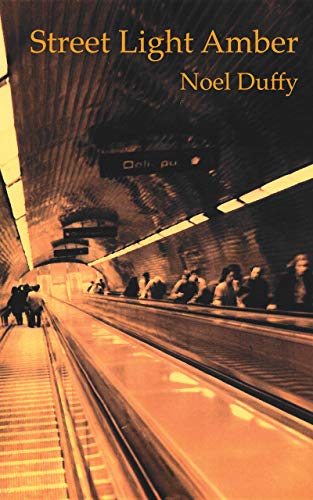
Let’s do as we’re told to at the end – “Erase. Rewind. Start Again.” So going back to the title and cover image which go so well together and immediately bring the reader into the atmosphere that you create in this collection. Can you talk a little bit about the title and cover image?
As I was working on the collection and had assigned the title a friend pointed out that I have used the idea of ‘amber’ as a metaphor for memory at some place in all my collections. Given that this collection is highly preoccupied with that theme it made sense to keep it. I also hope it sounds intriguing. I’ve only ever had one hobby in my life and that was photography. For my 21st birthday my brothers bought me a beautiful manual camera, a Nikon if I remember correctly. Unfortunately that camera gave up the ghost some years ago and though I continued on using a digital SLR for some time, I really hated having to go into ‘screens’ to make adjustments to focus and light etc., so in the end I’m no longer interested in taking pictures. In any case, for the cover, I wanted to create something that strongly suggested an urban landscape. The photo is of an underground (taken on my old camera some years ago) in a city I won’t name, though if anyone can guess the answer they probably deserve a free copy/Kindle of the book. Hint: it’s not London. The picture was titled ‘Descent’ and I suppose I was slightly hinting there that the suite of poems that follows is a kind of descent into the underworld, so there are again shades of the Orphean myth in that as I mentioned earlier and takes us back to the earlier observation I made about the book operating on an archetypal level as well as a bricks and windows one. It’s a kind of double-exposure of the real and the hidden at the same time: the story of the lovers; the place it happens. I hope the cover image and title help reflect that.
Yes, I think both image and title do reflect that intention. Gosh, I will have to study the photo closely to try and figure out where it was taken! Lastly, Noel, some fun questions:
Kindle or paperback – paperback, though the collection first came out on Kindle and I actually don’t have one so that was a little strange. Anyway, the book is now available in both versions so something for everyone’s reading preferences!
Painting or photograph – Given the preoccupation of photography in this collection I will have to go with photography on this occasion.
Coffee or tea – tea, most definitely tea!
Boat or plane – Boat though it’s been a very long time since I was on one. I remember a very memorably boat trip I took from Seattle to Vancouver some years ago. For my upcoming fiftieth birthday, I’d love to go on a cruise in Scandinavia.
Sandwich or salad – I do love a good Caesar Salad!
Thanks, so much Shauna for reading the book so closely and your very perceptive questions about it. It was really excellent to get the opportunity to speak at such length about it.
Thanks, Noel for such engaging and honest answers. Readers can purchase Street Light Amber direct from Ward Wood Publishing.

ORIGINALLY PUBLISHED IN OCTOBER 2013 – Noel Duffy on his second collection, On Carbon & Light.
Noel, congratulations on your second poetry collection On Carbon & Light. Tell me a little about the title and cover, they are both intriguing.
Well, I had the title for a poem called ‘On Light & Carbon’ for maybe ten years. I imagined it would be a kind of technical poem about photosynthesis and while it would crop up every now and then, I never managed to write it. When I started this collection in summer 2010, I finally approached it and the poem that resulted was totally different than one I envisaged, written in counterpoint and a naïve voice. That said, photosynthesis still made it in there. It struck me as I went on with the book and wrote quite a few science poems about light, as well as another about carbon, that this would be a good title for the whole book. In a way, the poem also poses the central question of the collection, as it moves between religious notions of the nature of life and scientific ones that sometimes seem to override those. So, it may seem like a strange title, but it suits somehow. The cover idea really came from talking to artist friend and he had planned to do the cover image by organically imposing the equation for photosynthesis onto actual leaves. In the end, we didn’t get around to it, but when I spoke to Mike at Ward Wood about the cover, I suggested we try do something along those lines. So the leaves in sunlight and the equation came from that discussion. I think it’s quite striking.
In what way do you feel your second collection links to your first, In the Library of Lost Objects, which was nominated for the Strong Award?
This book connects in some ways to In the Library of Lost Objects, exploring the intimate dramas of life against the backdrop of science. Here though, I’ve replaced Natural History with human history and anthropology for the most part, also exploring the role and meaning of myth and art in all this. So there is some cross-over, but I feel the tone is less lyrical and more metaphysical. I’ve also tried to push deeper into certain scientific ideas, but hopefully in a way that I bring the reader with me – whether they know much about science or not. That was part of the challenge.
Having read parts of the collection, it is, I feel, a challenge that you meet, Noel. Can you talk about your general approach to writing poems in the book, perhaps revealing a little about your process?
In the Library of Lost Objects had taken a long time to write as I often wrote fragments of poems and would add a bit and then leave it for months and then add something more. It was a very slow process, though oddly the three longer poems were written quite quickly in a kind of sprint over three or four days, and didn’t change that much after that. So, with this collection, it struck me to try that approach and see what might come out of it. One thing I found was when an idea or mood came it would immediately seem to suggest a title, but I also quickly realized I had to write a few lines down. This acted as a kind of key and a way back into the poem. Then, often the next day, I just riffed on the idea and wrote fragments down in a notebook.
At a certain point, when I felt a poem was beginning to suggest itself, I would move all this into the computer and generally very quickly find the shape and structure for the piece. I would then try complete a decent draft on that day. Working this fast somehow led to the poems being not over-thought and often the results took me by surprise. I discovered that once I started this process, other ideas presented themselves and I would gather momentum.
So I wrote like this for, say, three months at a time and would then stand back. Over three such (intense) spells of writing over a three year period, I produced the poems in the book – and a good deal more, I should add, that just didn’t quite fit the themes that came through most strongly over that time.
Noel, following on this, I’d like to focus on some of the poems. I am interested, in particular, in ‘Timepieces’. Tell me about the genesis of this long poem.
You know, there are a lot of poems about love or death or other subjects (I’ve written about them myself, of course) but very few about friendship, which is a bit odd when you consider the importance of friends in our lives. So this piece is about a friendship my dad struck up with a labourer at Dublin Bus, then known as CIE, where he worked in the late 70s. This man, PJ, turned out to be a respected amateur antiquarian and coin collector and drew my dad into his interests and they formed a great friendship through this, going to coin fares at the weekend or PJ coming over to teach my dad Ogham, which I explore in one section. Another crucial element to the poem is my perspective. It is really an initiation into both the adult world of male friendship, as well as how it awoke in me the excitement of the imagined past. I think it’s ultimately saying something about the power of art – both in terms of my dad and PJs story and my attempt to tell it.
So, I wanted this poem to be, in a sense, a kind of intimate epic, playing the ‘everyday’ notion of friendship against seemingly grand historical backdrops, such as Viking Dublin, or Imperial Rome. I’m reminded of Patrick Kavanagh’s great poem ‘Epic’, which centres on a dispute between two farmers over a land boundary and how Homer ghosts whispers to him “I made the Iliad from such / A local row…”. This sentiment is central to the poem and is echoed in the final lines of the Viking section where my dad and PJ had found a Viking child’s leather show in the waste ground where the city council were dumping the soil removed from the Wood Quay site:
It was to me as this frail object found, opened
a clearing in my mind: the prow of a longship
approached from the horizon with its cargo
of stories. I leaned down close and listened.
So the events are first real-life ones, made epic in the telling – even if the language in this case is not what you might expect in an ‘epic’. So it is a narrative poem, certainly, but a fractured narrative reflecting the nature of memory, both personal and collective.
Did the writing of ‘Timepieces’ evolve as you wrote it or did the idea come to you as a whole? I’m particularly interested in the back and forth of memory, imagined and real.
Well, this was the one poem in the collection not written in the way I describe last week. For a start it’s a long piece of 300 lines, so that put it on a different footing. In a way, the approach was similar to two long poems in sections from my first collection. I tried to come at the subject matter in a non-linear way and attack it from several angles, with jumps in perspective across sections. I found the shape of the poem came quite quickly, say within three or four weeks. This poem does something similar to those earlier long pieces, creating a fractured narrative of sorts that moves backwards and forward in time – both in the historical settings and the timeframe of the friendship itself. So its jumps and shimmies about us, mixing the history and the story of the friendship.
But by attempting to create this intimacy between the local and the historical, I also tried to use a quite casual, yet intimate, tone and the nature of the poetry had to reflect that. So much of the poem is written in a relaxed conversational and invitational voice. So is that poetry or prose? Some would say the latter, but I’d argue that I’m using a – let’s call it – flat-footed line, where the rhythm isn’t strident (for the most part) and the music of the piece is quiet and muted, though certainly still poetry. The challenge of rewriting this kind of ‘casual’ line, is that it is extremely tricky to get just right and, indeed, for it not to drift into prose. So, it actually took a long time to achieve that effect, massaging the music rather than imposing it. That really was quite a challenge. The other major issue was that with such rich subject-matter, there was so much more detail I included early on but had to cut in rewriting so that the poem didn’t get weighed down with too much narrative information. It’s long, but I knew I needed to keep it moving also. So, it took time to get that balance right also.
How do you feel a long poem like this fits into the collection as a whole?
At about the mid-way point in writing the collection I had a lot of poems and started gathering them into some kind of coherent collection, which gave writing after that point a clearer focus. ‘Timepieces’ was actually one of the last poems to be written and accounts for nearly a quarter of the entire collection. As I said earlier, this work is less lyrical than that in my first collection, but I realized ‘Timepieces’ is the poem that grounds the book in some important way. It is key in that sense, so I wanted that grounding to occur in the first half of the book, bringing us to the midpoint before moving into the second half, which mostly deals with hitting forty and the questions that also asks of you, both personally and philosophically. So Timepieces is a poem, in the end, that contains so many ideas and motifs explored elsewhere in the collection, that it feels very central to the effect of the whole book.
Thanks so much, Shauna, for asking such interesting questions. It was especially nice to get to talk at length about ‘Timepieces’. I really hope you, and others, will enjoy that poem, and the collection as a whole.
You’re welcome, Noel and I wish you all the best with the collection. On Carbon & Light will be published 10th October 2013 by Ward Wood Publishing and launched by Theo Dorgan in November. See www.noelduffy.net for further details.




 Shauna Gilligan Writer