
I’m delighted to publish – on Bloomsday! – the first of a Two-Part Writers/Artists Chat about “Dubliners”, by writer Mia Gallagher and artist Margio Sughi.
Mia and Mario, Congratulations on Dubliners (Marinonibooks, Italy: 2022) – a most beautifully produced collaboration between words and visual art, essentially, a capturing of stories of Dubliners from 2018 to 2022 but actually their imagined lives beyond and before these times.

SG: Before we get into the details of the stories and images in this collection – can you talk about your experience of the process of this collaborative work, that dance between both art forms and then again, the re-creation of new stories in the way the prose and images are set out together in the book?
MG: Hey Shauna – thanks a million for having us onto your series and many thanks too for your kind words about the book.
Collaborations, in my experience, succeed on three things. There needs to be resonance between myself and the artist/s I’m collaborating with, a feeling that deep down, we are after something similar. There needs to be enough difference to make for real dialogue. And the third element, possibly the most important, is excellent communication.
Mario has lived in Dublin for over 30 years. He and I are roughly the same age, and we move in similar circles, so I can recognise his places – his Dublins – and his people. There is a congruence between his and my Dubliners but they’re not exactly mappable– which is great for collaboration, it sets up a necessary tension, a dynamic.
Mario’s concept for this book was to place his existing images near my existing texts so a play would happen in the reader/viewer, allowing for new connections and meanings. I write in a montagey way, piecing together meaning as it comes, and it’s always exciting to see how my work can be recontextualised. So that concept also felt right to me on a deep level.
But Mario and I were only the starting points. We worked with a team: curator (Melania Gazzotti), publisher (Antonio Marinoni), translator (Silvana d’Angelo), and designers (Maia and Claude at studio òbelo). This triangulated the collaboration process. With every new person there was more dialogue, more room to refine the vision, add dimension.
In any collaborative project things can go wrong fast. A simple misunderstanding can lead to a shitfest in hours. Factor in different countries and languages and the risk snowballs. But Mario and Antonio were extraordinarily skilful in how they managed the process. This enabled each of us to be involved as much as we wanted – or needed – to.
For example, I’m a book-making hound. I love the process of editing, typesetting, layout – turning a Story into a Thing, and I am very grateful to Mario & Antonio for letting me get stuck into that. However, I can get bogged down in details too, and I’ve always appreciated the person – in this case, Melania – who says ‘Okay, Mia, hands off the wheel, it’s grand’. As long as you’re talking with your collaborative partners, asking questions, listening, making suggestions, being heard, you can figure out anything.
I want to give a special mention to Silvana the translator. She’s a writer herself and as well as offering her own contained and graceful interpretation of the text, she was the person who selected the texts, came up with the underlying concept of character studies for the tinier fragments and proposed the narrative spine. This – along with the more granular writing joys of working out together how to translate the possibly untranslatable, e.g., how do you turn gerunds into Italian? – was an aspect of the collaboration I hadn’t envisaged and which was deeply rewarding.
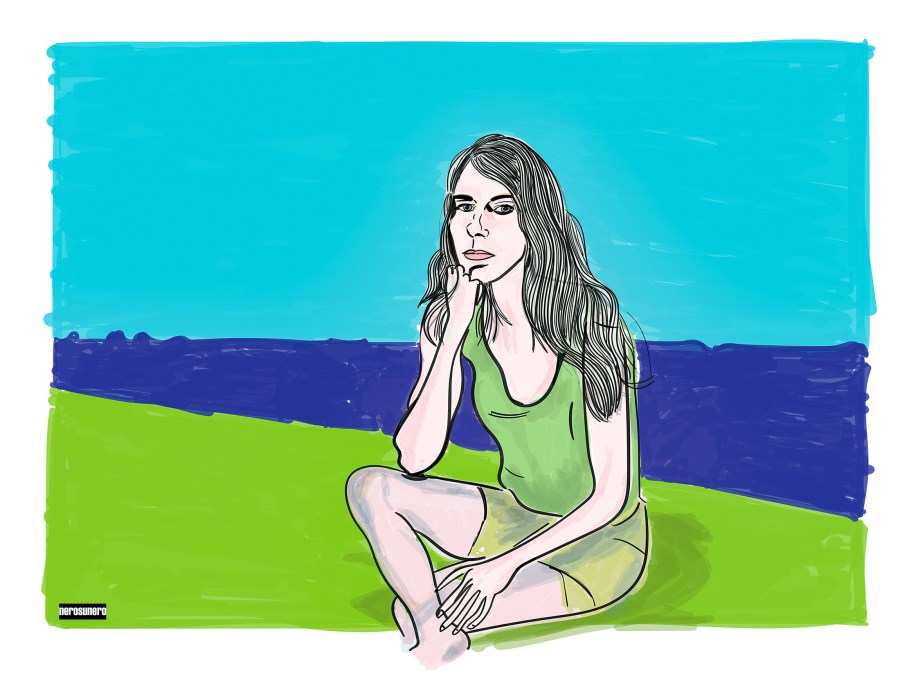
Image provided by and used with kind permission of Mario Sughi
SG: I’m loving those details about translation and interpretation and it’s so fascinating to hear about the all the people who were involved and the support structure that seemed to work so well for you all. I’m particularly interested in how all of the stories and visual art explore how we inhabit places and how they inhabit us, too – with a particular focus on our relationship with the coast and parks, nature in the city – can you talk a little about your relationship to these themes?
MG: I rarely think of a character in isolation – oh there’s an angry man – and write from there. My characters usually come to me in situations – oh there’s an angry guy who’s a driving instructor. The situation often sets up an initial conflict (how can you be angry and a driving instructor, yikes). But it’s not just an emotional situation, it is material too. Where is this angry guy from? That’s often answered in the voice of the character, which in some cases I hear before I see. Then other questions follow: Where is he doing the instruction? How long has he done it? What did he do before it? When did he do the other thing? What happened to him doing the other thing – why did he stop?
I often start a story from the first person and this beg questions about time, which is in itself a form of Place. When is the story happening? What is the relationship between that When and the narrator’s When, the place they are telling the story from? These questions then beg other questions – and then, if I’m lucky, I’ve got a story.
For me, Mario’s work is all about people in place and place in people. You catch a glimpse of an image, which in his works is always a situation – someone doing something somewhere at some time – and you start asking yourself: how does that woman’s voice sound, what do those shorts feel like on those legs, where are those girls going after they’ve got their coffees? So perhaps we’re coming at similar hooks but from different directions.
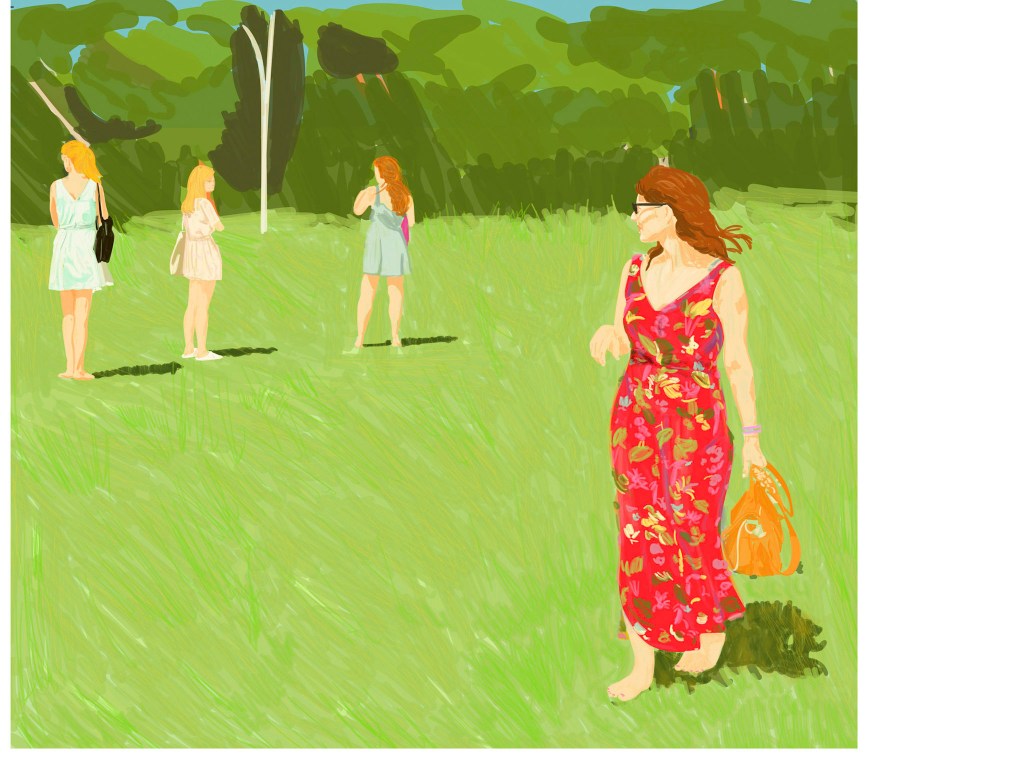
Image provided by and used with kind permission of Mario Sughi
SG: I really think you are – and this book, Dubliners, really shows this. I also love how you play with understatement, Mia, and how parallel to this, Mario plays with colour and seemingly simple lines in his work. Meaning is deep under the page. I’m thinking of, for example, “VII Slip, 2020” where you use humour to bring depth to the narrator and the story – there’s both naiveté and unease played out through the act of swimming in adverse conditions. Many of the stories and images explore transformation in some way – how bodies in nature – in the sea and lying on grass – as well as bodies in clothes – change and become another and other. Does this ring true for you in terms of intention and interest?
MG: Yes, you’re absolutely right, I think transformation underlines all of my work. Human beings are always changing – time works through our bodies and our selves from moment to moment, constantly expanding, shrinking, twisting, tweaking us into new shapes. Nothing is fixed. In my twenties I remember being very freed by the idea that I didn’t have to be consistent. That the point of life wasn’t to arrive at a fixed point at 21, or whatever, and then go around presenting that to the world. For me, change is growth and learning and pain and all those things make life interesting. But I don’t consciously set out to write change, it’s just one of my obsessions.
People are very surprising and capable of doing ‘uncharacteristic’ things. It’s fun to me to shove a character into a situation they wouldn’t ordinarily choose and see what happens. Often the stress puts so much pressure on them they are forced to change their shape. Sometimes literally, like the water demon kelpie in Lure.
On a quantum level everything is connected. We are the universe. The ultimate transformation is from life into death and whatever happens – or doesn’t – then.
With Mario’s work, I feel there is always something happening. A character is always doing something, even if it’s ‘just’ watching. This is action. But action equates change in the fabric of spacetime. Mario’s people are captured for a nano-second in the ever-changing process of being. The next moment, they will be different as their neurons fire, their senses land on a new stimulus, they remember their dinner, they see someone they want to avoid. It’s like looking at a star. What we see has already changed because the light had to travel so far across the universe. The people Mario has captured are now gone, forever. I think there is a very moving quality to that.

Image provided by and used with kind permission of Mario Sughi
SG: It feels like you’ve encapsulated Mario’s work here, Mia! Dubliners also captures chance encounters, such as that in “IX: Found Wanting, 2018” and Mario’s image, “TCD Cafeteria, 2017” fits the story so well:
“…the edges of his consonants stroked the back of my neck…Pressing closer to share confidences, touching an elbow to make a point, accidentally – oops, sorry! – moving our pint glasses together so we’d have to brush each other’s hands when we went to take a sip.”
Can you talk about how the stories and images are informed by the urban setting?
MG: I’ve lived in Dublin all my life, with the exception of 9 months in Germany after leaving school. It was years before I had a car and now, because of climate change, I’ve chosen to no longer drive very much. As a result, I’ve walked, cycled, bussed, DARTed (and later Luas’ed) through huge swathes of the city as it’s undergone many, often fundamental, changes. I’m increasingly drawn to being in the countryside – my garden, the allotment, the forests, rivers, mountains, sea – but I rarely write about those places. If my work isn’t set in Dublin, it tends to be small-town Irish, or urban settings in other countries.
Even now, as I’m getting more exercised about climate catastrophe and injustice and more irritated by the way we plan (or don’t) our cities – my gut response, if someone asks me what I feel about Dublin, is to say I love it. And, in general, I love the idea of a city as a place of encounters, difference and growth. If a city is planned well, it can also be more sustainable as a place to live – so who knows?
Over the decades, I feel Dublin has made its way into me. It is me, in some way. When I walk it, I sense memories of older selves, older relationships. It can be a shock to see a street changed or gone – have my memories gone too? Maybe they’re still there, lying underneath the new build. For me, Dublin isn’t so much a setting, it is the story. Writing a story of Dublin is like writing a story of a particular part of me. The story you quoted from, Found Wanting, was written first in 2002, and set in the mid-late 1990s, when Dublin, and my life there, felt very exciting.
Mario’s work, to me, also has the quality of a flâneur’s vision. The urban observer. Mario captures moments that, by being captured, become significant. Look long enough at his work and I start doing the same thing, framing the everyday as an artwork. I think that’s a beautiful thing he offers the world.
SG: It strikes me that the book could also have been titled “Dubliners in Moments”….Yet behind the bright sun there’s also undertones of darkness, in “X Fairview 2022” and “XIII Polyfilla, 2018” and, for me, how they bounced off Mario’s “Lockdown and Breakdown Series”, the juxtaposition of every day objects and the unspoken – the power of steam from a cup of coffee. Could you talk about the synchronicity of theme and interest in both art forms and perhaps even if this was a surprise to you both?
MG: I am intrigued by materials, the textures of things. Buildings, earth, trees, fabric, food, skin, cars. I worked as an actor and movement artist and I never feel happier than when I’m involved in some tactile activity. The challenge for me as a writer is to convey some of that sensation. How can I get a reader to sense, to feel, as opposed to think? I like to use sensation as a trigger for my characters’ actions. This happens in real life all the time. I’ll smell a person and suddenly I hate or love them – though I don’t know them from Adam – because the smell is calling up some ancient memory I may not even have words for.
In terms of synchronicity between my and Mario’s themes, his work resonates with me in lots of ways. It’s urban, it’s new, it’s off-kilter. I also see a similar preoccupation with textures and surfaces. At first glance I think Oh my god his Dublin is so bright and glowy and sunshiney and gorgeous, he makes Irish people look so sexy. But then I look deeper and there’s something else going on. An awkwardness in conversation, yawning gaps between people, uneasy isolation on a city street – which he emphasises very subtly in his Lockdown series. Under the gleam, something darker is at play.
I like how you pick up on our objects, e.g., the coffee cup. Objects are magical to me. They have a totemic value, and in literature I think they can reveal more about people than any amount of description about that person’s emotional toolkit. They ask questions too:
Who made that cup of coffee for the woman at the table? What is she going to say next?
And from there, you get Story.
SG: Yes and from story, life, and so we circle. To finish up, Mia, some fun questions:
- Tea or Coffee? I love coffee but get very hyper on it. Usually for me: green tea before midday, infusions after that. Occasionally a teatime Earl Gray with a slice of lemon, no milk.
- River or sea swimming? Both. The sea for the salt, the buoyancy, the space, the depth. The river for the tanny brown, the push of the current, the mystery, the trees. Both for the danger & the invaluable lesson to respect what’s bigger than me.
- Beach or park? A forest park with a river or lake, amazing. But a beach, a strand, a shore, also amazing.
- Music or quiet when writing? Quiet unless I’m in total flow, writing longhand with no inner editor switched on – in those moments I can have anything playing around me, it won’t bother me. Some music for when I’m musing but not physically writing.
- What’s next up on your reading pile? What’s next up on your reading pile? Currently reading ‘Dschinns’, a book in German by Fatma Aydemir about Kurdish immigrants in Germany. Superb and engrossing – hopefully it’ll soon appear in English translation. Recently I finished Claire-Louise Bennett’s brilliant ‘Checkout 19’, and I am slowly working through Henning Mankell’s unsettling and profound memoir ‘Quicksand’. Next up: George Saunders’ ‘The Tenth of December’.
More coverage of Dubliners:
- Dublin Inquirer review
- Totally Dublin mention
- La Lettura (relates to an article by Catherine Dunne in their magazine):
- LiteratureIreland: (Instagram) The sun is out in Dublin and the togs and swims will soon follow! This is a brilliant and bright bilingual Italian / English publication called Dubliners, by Mia Gallagher and Mario Sughi.
- Dubliner’s Italian publisher’s website
- Buy Dubliners here
With thanks to Gráinne Killeen PR, and to Mia Gallagher and Mario Sughi for being so generous in taking part in my Writers/Artists Chat Series.
PART TWO, featuring a three-way conversation between Mario Sughi, Mia Gallagher and Shauna Gilligan, and featuring art by Sughi, will publish next week.

 Shauna Gilligan Writer