Writers Chat 51: Bernie McGill on “This Train is For”(No Alibis Press: Belfast, 2022)

Bernie, You are very welcome to my WRITERS CHAT series. Congratulations on This Train is For (No Alibis Press: Belfast, 2022) – a fantastic short story collection with, as Jan Carson has said, “not a word wasted or misplaced.”

Cover of “This Train is For” by Bernie McGill showing interior of a train carriage with a suitcase by a window. Light slants on the floor in front of the suitcase. The train seat is empty. (Photograph provided by author)

SG: Before we get into the details of the stories in this collection – your first since 2013 – could you tell us about how you put it together in terms of themes and order.  A number of the stories have been previously published in award winning anthologies such as The Long Gaze Back and The Glass Shore and other stories debut in This Train is For.

BMcG: I was aiming for a mix of stories in the collection that reflected what I had been writing over the last few years. Some of the stories were written in response to a commission, some were not. I don’t tend to think about theme when I’m in the process of writing, but looking at the stories together, I can see that certain themes do emerge. There are concerns about the ways in which women and girls have been treated in Ireland, north and south, over the course of the last seventy years or so; stories that touch on Troubles-related violence and on the particular identity of being Northern Irish, and stories of lives that are fractured by aspects of loss. When we were ordering the stories for the collection, we tried to alternate between work that had appeared in previous publications and work that was unpublished. It seemed a good idea to open and close with new stories so we placed ‘This Train is For’ at the beginning since the collection takes its title from that story, and ‘In the Interests of Wonder’ at the end. The last line of the last story contains an allusion to mischievous intent that we liked as an ending to the collection.

SG: I love that connection. Brilliantly done! I’m particularly interested in how many of the stories explore how we inhabit places and how they inhabit us, too – from seats and windows on public transport in the opening “This Train is For” to spaces in houses that are familiar and also strange in “The House of the Quartered Door” and “The Escapologist.” Places offer opportunity for healing and hiding. Can you talk a little about this?

BMcG: I wrote the notes for ‘This Train is For’ while I was working as Writing Fellow for the Royal Literary Fund at Queen’s and I was travelling, two days a week, on the train from Coleraine to Belfast and back. I wasn’t getting much time to write so I started note-taking on the train journey, watching out the window, and it struck me how untethered an experience a train journey can be. I got interested in the idea of being transported: I could see other passengers reading or sleeping, listening to music on headphones or watching video on their devices, apparently unaware for the most part of the places we were passing through. There are no road signs when you travel by train: the only named markers are the stations. We were passing through the places in between stops without any real sense of where we’d been. So I started to trace the rail route by map, and to research the names of the townlands the train passed through, their etymologies and histories. I spent a great deal of time poring over the online maps at PRONI (the Public Records Office for Northern Ireland), and on the website for the Northern Ireland Place-Names Project at Queen’s. From that research came the voice of the main character who has worked all his life in maps, in the planning departments of local councils. That character is carrying a sense of dislocation. I was curious as to why place, or the loss of a place, might be playing on his mind.

Other stories are set abroad, in houses we’ve stayed in as a family when we’ve holidayed over the years. I’m fascinated by the clues that householders leave around. As a writer, you can’t help but begin to try and piece the lives of those absent people together, construct personalities and life stories, daily routines for the houseowners out of the paraphernalia that’s there. That’s an act of storytelling in itself, the decisions that an individual makes about what they choose to leave in their house for strangers to see or use. Some people may be consciously curating, creating an impression of a particular lifestyle by leaving a coffee grinder or a particular set of books; others may be accidentally giving something away that they’d prefer not to have divulged. ‘The Snagging List’ was inspired by a house we rented in Majorca; ‘The House of the Quartered Door’ by a friend’s house in Sardinia. It can feel quite investigative, staying in another person’s home. As soon as you have questions about the owners, stories begin to form. And I’m always curious about the reasons why a character might have gone to a particular place, so that’s where the healing and hiding comes in. Looking at the stories together, they feature quite a few people who could be said to be in transit: some are temporarily, others more permanently displaced.

SG: I think that’s what I particularly loved about the collection – it feels like stories for writers in the best possible way – and I totally pictured myself in those places and indeed, felt like in other (transient) homes too. You’re wonderful at understatement and this comes from, in part, your lyrical, poetic language – we are so lost in the descriptions and details of what surrounds the character that we almost miss the emotional heft of a moment yet we still feel it. I’m thinking about “The House of the Quartered Door” where Gina is in Sardinia mourning the passing of a relationship which didn’t happen (her biological mother) and one which did (Annie):

“The door handle from the bedroom above has left a purple bruise on her upper arm the shape of a comma, or an apostrophe: a pause, or a sign of something missing, or of something belonging, perhaps. She keeps forgetting that the door handle is there, keeps catching herself on the same spot.”

Similarly, in “A Fuss”, grief is explored without fuss where Rosa is returning home for a funeral, where “they are all practiced in the theatre of mourning” and all of her emotion is captured thus:

“The sky is a strange green hue. From behind a barn, something rises, like a handful of soil thrown high into the air, then just at the point at which it should fall, it takes shape into a flock of starlings, turns, rises higher, dissolves into the darkening sky.”

Can you talk about how you use poetic language as part of the narrative?  

BMcG: Those images are born out of observation, often out of moments of quiet contemplation. If something catches my attention, I’ll note it down and squirrel it away. The story and the character are built from those small observations. They start with me and I don’t know to begin with what characters I will give them to, or how they will fit into a story. I think the act of recording them helps to commit them to memory, so they rattle about in my head for a while until they find a place. It’s no accident that many of the stories began life when I was away from home, away from the daily concerns that keep us so distracted from noticing and appreciating those small moments that can hold such significance for a character.

SG: It’s so often the small moments that turn into something significant, and they keep the story with us long after we’ve finished reading. Many of the stories here evoke in the reader a sense of the wonder – capturing a lost childhood, an open trust, a naivety that perhaps has been “grown” out of us as adults in a society where trust costs and we are taught to “other” those with perceived differences. I loved how you played with this in “The Interests of Wonder”, by inviting the reader to partake in the writing of the story by questioning –starting with the opening line “What kind of day is it, the day the magician knocks on the schoolroom door?”

BMcG: I experimented with a few narrative approaches in different drafts of that story. They didn’t all work but I did like the energy of that opening question and decided to keep it. The importance of cultivating a sense of wonder is something we often discuss in writing workshops. How do we retain or regain that impulse for exploration, the joy of discovery that we had as children, that is trained out of so many of us as adults? We seem to have lost the ability to play. We have a tendency, as adults, to think that anything worth doing has to be undertaken with great seriousness and focus and with the outcome always at the forefront of our minds. And of course you do need focus and discipline to finish a piece of writing, but it’s not what you need to start it. I often quote the writer Anne Lamott, from her book Bird by Bird where she writes about the importance of silencing the inner critical voice when setting out to write. There’s a time to listen to the editorial voice, but if that’s all you can hear when you’re beginning a piece,  then you’ll never give yourself permission to write with the kind of abandon and experimentation that is required. You need to write initially like no-one need ever see or hear this but you. You can decide later what you want to do with the work, but if you don’t allow yourself to write it in the first place, you’ll never have the choice. The magician in ‘In the Interests of Wonder’ is a sort of antidote to adulting. He offers the audience at his shows – and in particular, the schoolteacher who is the focus of the story – an opportunity to escape the everyday.

SG: As well as the beauty of the writing in this collection, there is also an invitation to the reader to consider meta language and linguistical meanings behind and within what is said and unsaid. I really enjoyed how language is explored in “There is More Than One Word” where Jaynie is returning home to Belfast and struggles to remember phrases and words from her childhood, finds herself a linguistic stranger in her own home town, her language “thirty years out of date, fossilised in the 1980s.” In a way, you’re exploring not so much the multiple meanings of the English language in places and to people but the failure of language and words to capture the real, true human experience. In the end “There is more than one word for the heart but the word for her heart is sore.” Is this a theme that is important to you?

BMcG: I’ve always been interested in language and its many uses and interpretations. I’m the youngest of ten children. I grew up in a household full of talk. I can remember hearing a new word and turning it over on my tongue, trying it out for size, curious as to what it might look like on the page. My mother was once talking about a woman she knew called Celine and she pronounced the name the same way that we said ‘ceiling’ – we didn’t used to bother much with -ing endings in rural South Derry. When I asked if the woman was tall, if that’s why she had been named that, because her head scraped the ceiling, I discovered that not only was the name spelled differently but that there were people in other places who pronounced that name differently too – with the stress on the second syllable – and it sort of blew my mind. I learned that spelling and pronunciation and, I suppose, context as well, can alter meaning. In ‘There is More than One Word’, Jaynie remembers that, growing up, she had a different word for ‘kerb’. We often had words or phrases for things that were outside of standard English, expressions that were derived from Irish or Elizabethan English or Ulster Scots that we never found in books or heard repeated on the radio or television, but that were rich and layered and evocative and exact to our purposes. And yet there are times when language does fail us. When Jaynie’s sister phones her with the news that the family has been anticipating but dreading, she puts the phone down without speaking.

SG: Thank you for such a full answer – I love that story about Celine/ceiling. So, to finish up, Bernie, some fun questions:

  • Tea or Coffee? Coffee in the morning; tea in the afternoon.
  • Train or car? Train, all the way.
  • I should have guessed that answer! Music or quiet when writing? I can’t listen to anything with lyrics – I find it too distracting, but I listen to soundscapes on headphones to block out background noise: café sounds or rain on windows or (I do know this is sad, but it works for me) the coughy, book shuffly sounds of a library.
  • What’s next on your reading pile? Trespasses by Louise Kennedy. I’m saving it for a time of complete immersion.
  • It’s on my pile too! What’s next on your writing list? I’m working on a short story commission and there’s a longer story brewing, an historical piece, something to do with letters. I can’t talk about it, though,  for fear of scaring it off.
  • I know what you mean about scaring story away…
Photograph of Bernie McGill in a wood wearing a blue shirt and black trousers. (Provided by author, used with permission and with thanks)

With thanks to Bernie McGill for a great conversation, and thanks to No Alibis Press and Peter O’Connell Media for the advance copy of This Train is For.
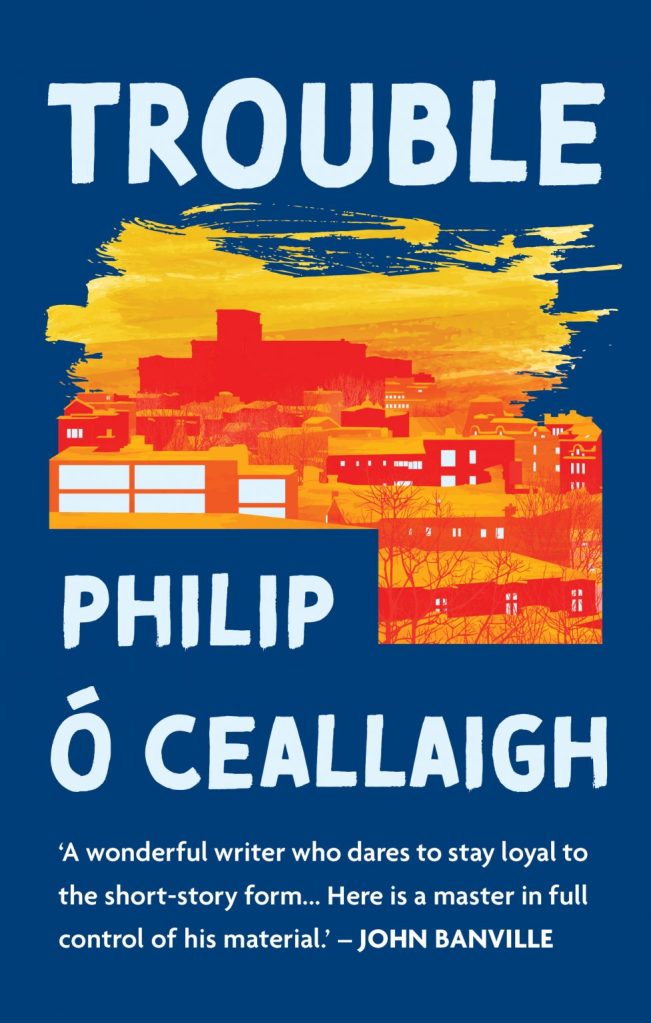
Writers Chat 41: Philip Ó Ceallaigh on “Trouble” (Stinging Fly: Dublin, 2021)

You’re very welcome to my Writers Chat series. We’re going to chat about Trouble (Stinging Fly: Dublin, 2021), your new short story collection which, in John Banville’s words, shows you as “a wonderful writer…a master in full control of his material.” I have to agree – the prose is tight and illuminating, the stories gritty and surreal.

I

SG: Let’s start with the form of the short story. You were awarded the Rooney Prize in 2006 for Notes from a Turkish Whorehouse. In an interview with the Irish Times you said “…all life is material you just don’t always know when it’s happening what you want to write about.” Tell me what draws you to and keeps you with the form of the short story – is it easier to write direct from life?

POC: I’m not sure what you mean by “direct from life”. But I’ve found that short narratives suit my way of writing, which is intuitive in the first draft, not guided by any great conception of what I’m doing in terms of ideas or where I’m going. I may be guided by an image or a mood or a situation. Anything that gets me writing the next line. After I have a draft, then I’ll start to see what I’m about. This resembles life a bit, in that we generally don’t know what’s happening to us while it’s happening, because we’re usually busy reacting to what’s thrown at us. Maybe later we figure things out and apply retrospective meaning. We’re creatures that feel things, and we create narrative sense as a way of dealing with what befalls us. So I’m guessing that what appeals to some readers in my stories – a sense of strangeness, disorientation, things happening – is what appeals to me in the writing, that nothing’s quite fixed or settled. And yet the written story needs to interesting enough, as a problem, that it remains afterwards, like a puzzle. At least this is how I experience films and stories that have some depth. I prefer not to feel that I’m being forced by forced by the director or author to feel something. You know, when it’s really blatant in a film, and the music tells you, feel sad now. If something is well put together you don’t have to resort to such cues, and the process isn’t finished when you leave the cinema or close the book. The story resembles something you take with you and needs to be absorbed, digested. Like an experience from real life.

SG: I love that you’re at ease with nothing’s fixed or settled as you write, as in life, and that you can still wrestle with the form – once the draft is down. And does writing in the short form tie in with your work as a translator (I’m thinking, here of For Two Thousand Years)?

POC: No. Except that it involves sentences, one at a time, trying to find the most elegant and concise rendering in one language of what appears in another.

SG: As a Part B to this question – There were a number of stories (“My Life in the Movies” and “My life in the City”) in which the same characters and places appear. I wondered if these could be the beginnings or middles of a novel – are you interested in the long form, at all?

POC: Of course I am, as an experiment, a challenge. I don’t feel limited in what I can do in the short form, but I have been curious to know what I can do, what happens if I push myself and try things I’m not immediately inclined to do. So I’ve written a couple of novels, but the experiment has not been successful, and it’s time consuming so it’s not an experiment that tempts me much now. I think that in a longer narrative you can’t – or I can’t – write at that unconscious level that excites me and makes the process worthwhile. If I have to plot things out I get bored and frustrated. Yes, My Life in the Movies and My Life in the City are cut from a novel-length story that I struggled with for years, and in the end rebelled against. Not only did I chop it to pieces, I discarded the profound conclusions the central character reached at the end! In the new version I leave him scratching his head, confounded by his own emotional and intellectual shortcomings. Which seems right. Since that’s what happened to the author.

SG: You have me smiling here. Maybe we’re all still confounded. What struck me most about Trouble, a collection of 13 stories, is the atmosphere that you create. It could be called voice but I think it’s more than just the writer’s voice. It feels like something more fundamental within the stories – a tone of deep yearning, for example in “Smoke”, that is reflected in the tautness of your prose, it pushes against the edges of the readers’ emotions. Can you comment on this?

POC: I don’t know about the yearning but I can talk about the tautness. It’s a matter of technique and it’s what should distinguish a page of a short story from that of a novel. A novel can afford to be loose. You can’t have a page or a paragraph of a short story that’s superfluous or where not much is happening. The short story should ask more of the reader’s attention, but it can only do this if it rewards the increased attention.

SG: Thank you for that precise distinction, one which is not always easy to articulate. Many of your narrators are philosophical and offer the reader wonderful witty asides. Take the narrator in the title story “Trouble”. He tells us that Garrity’s problem with sleep “had also turned him into a reader and provoked tremendous mid-life bouts of thoughtfulness”. “Relaxing into money is an art. It takes centuries to learn.”

In the poignant and gritty “London” we learn that “When his first child was born and he had held him in his arms he had learned what his own strength was for. The lesson was that strength existed to protect the defenceless. It was a simple trick nature played on the strong…”

In “The Book of Love” Sol tells us to “stop trying to nail happiness!”

Was this great mix of wit and philosophy intentional as part of the narrative drive or did it come from the characterisation?

POC: The tendency to get what you call philosophical. I have to watch it, to reign it in. It’s a matter of balance, you don’t want to load a narrative with meaning. There’s a natural weight that can be borne, that comes off as natural, as flowing from the action and the character.

SG: And these stories do have the balance you speak of. Dislocation, disconnection, disinterest come into many of the stories – movement from place to place, relationship to relationship, a sense that the narrators are often spectators in their own lives, on the edge of place and self. At times they appear to be actually living the life of others or not feeling at all, supressing everything. People all, of course, in search for connections.

In “The Island” the narrator, escaping his perceived reality, encounters an ever-growing band of copulating and arousing monkeys with their own social strata, realises that “every creature is tortured in its dreams, the lowest and the highest, always running, pursued by phantoms, even when stretched out unconscious on the ground…all my heavy flesh wished for was to wish for nothing, to lie there, kissed by nothingness.”

In “Graceland” the narrator, feeling his almost-ex-partner is “using” their child to get at him, “hushed the violence. He whispered to it and caressed it like you would a cat to gain its trust then he gripped the loose skin of the nape and removed it squirming from the room. No, nothing unpleasant was going to happen.”

Was this a theme that emerged as you put the collection together?

POC: Anything you can call a theme emerges after the writing. But the stories are more interesting gathered together, maybe less perplexing. The collection isn’t something that was plotted out in advance. It was one story at a time. But it’s the same mind coming at the same problems, obsessions, from different angles, different styles.

SG: Much of the writing is cinematic – take the opening of “My Life in the Movies” – “Opening scene: a bar in the old town”, which itself is about a man who makes movies and spends much of his time in a bar where

Around us, the new species of male that was invading the planet – skinny, blow-dried, finicky about attire and grooming. Aliens, hunched into the screens of laptops and hand-held devices, attentive as lovers, faces palely illumined in the hypnotic masturbatory glow.

In “My life in the City”, our narrator is often “quietly angry” and is finally “glad that the terrible dream city was not real, that I did not have to undergo its trials. My sole regret was I had lost the reels of film I had never shot.”

“The Book of Love” opens:

I was staring out through the plate-glass restaurant window at pensioners bearing cargoes of purchases and a young thug swearing into his phone, and a millionaire was telling me about the importance of cunnilingus.

Can you talk a little about the link between cinema and writing – if you think there is one.

POC: About ten years ago a Romanian director talked me into writing a screenplay. It was a terrible experience. This director knew nothing about telling stories and I knew nothing about writing screenplays. But I felt she was listening to my ideas and I could work with her. Except that she was a liar and the relationship deteriorated and she went on to make a crappy film. The mad thing is that making a film involves a lot of money and people and work, even if the product is a failure, or nonsense. I earned a lot of money from this shameful episode, relative to what I’ve earned for any of my books. It was a strange experience for me on another level too, because I think of storytelling as a way to make sense of experience. Here I was in a realm where the writing got garbled through the miscommunication between me and the director, her misreading of what I’d written. I envisaged the story as a comedy with a smart, thoughtful ending. The director made it serious, serious, serious – no relief, no contrast. Four top-class actors, they couldn’t save it. Lighting, editing, music, special effects – in vain. It was still crap. I didn’t attend the premiere, like Vali in the story; I slunk into a cinema in the afternoon and slunk out again. Writing for the cinema is not writing for the page and much depends on the relationship with the director. Even then, you have to be detached about the result. It doesn’t belong to you. I’ll be very happy if I can sell the rights of any of my stories for film. But wary of getting involved in screenwriting. Anyway, I got to write my story about Vali, who bumbles his way through these things as cluelessly as I did.

SG: It sounds like all this miscommunication was such a pity but as you say, a story came from this experience. Changing direction now, I was particularly moved and shocked by the genius story “First Love”. It is a semi-fictionalised rewriting of the diary of Felix Landau (1910 – 1983), recounting some activities as Judengeneral in 1941/2. “First Love” came as a shock – the title like a bitter taste as you read the disturbingly convincing narrator express so eloquently how love sick he is at the same time as he crisply recalls duties performed. In July he writes:

A precarious light, a mood, a few tinkling notes at the end of a melody. Sky oozing colour like those Bosnian cakes drip syrup. For the personal to assume such proportions now, when the world is being remade – madness….Reds didn’t know what hit them. Salvaged what we needed from what they left behind as the Jews scurried about, cleaning up. I have so many thoughts, impressions, but it is almost midnight and they’re all for Trude. I speak to her in my head, constantly. 

He also recounts his frustrations of not being immersed in combat: “I desire combat, end up shooting unarmed people. 23, including two women” and follows a detailed description of the shooting with this reflection: “It was mid-morning, I was exhausted but the usual administrative work followed.” 

“First Love” also stands out as being so different in style (diary entries) and context from the stories either side of it. As I read the stories in the order in which they’re presented, this came to me like a palate cleansing story. How did you decide on the placement of it in the collection?

POC: It’s a disruptive story so I wanted it somewhere in the middle. I have noticed in the past that what some readers dislike about some of my stories is that the narrators are strange or nasty or both. And some readers draw back from this challenge, because they think that they’re being asked to be complicit in the thoughts and acts of the narrator. And I suppose you inevitable identify with a first-person narrator or a central character. I like this kind of tension in a story, that such demands are made. We aren’t all nice all the time and fiction gives us a way of facing this complexity. So maybe there’s some slyness in the introduction of this narrator in the book, because the things he does are so categorically, criminally terrible, and I didn’t make them up. They’re a matter of historical fact. In a way, it allowed me to declare something about my technique for those who fail to get it. And to put the other characters in the book in some kind of perspective, morally.

SG: Oh that’s interesting. I hadn’t thought of how acceptable some of the behaviour/attitudes of other characters felt after this story. Very clever placement. The body and all its functions and the desire to escape its limitations and entrapments is to the fore in this collection.

In “The Book of Love” Sol, a “scientific wonder,” a man with “an animal head”, pays women to let him pleasure them, has “delicate hands for such a short, heavy man” but “he carried his bulk gracefully”. The body echoes our problems, “like memories,” and cars “shimmered and wobbled in the heat”, the same cars that allow us to actively enter the dream state.

Can you talk about the body – human, animal, mechanical, and the body of story – and how it both serves to contain and also offers escape.

POC: That’s what Leonard Cohen asked God, and God said unto Leonard:

He said I locked you in this body

I meant it as a kind of trial

You can use it for a weapon

Or to make some woman smile

Can’t beat that.

SG: Ha! You can’t beat that, not Leonard! So, we’ll end this Writers Chat, Philip, with some short questions:

  • City or Countryside?  Alternating.
  • Sounds like the best sort of life. And to drink? Carafe of red wine or bottle of beer?  Yes, but beer before wine.
  • Specific order! Music or silence when you write, and, if music, what type?  I often kick-start the writing with a song, and then listen to the same song each time I start a new writing session. But I’ll turn off the music once I get going, there’s a point at which it’s distracting. Nearly always something lyric-heavy. For example, for Island it was Dylan’s Thunder on the Mountain.
  • Yes, I can relate to the kick-starting and returning back to that point again. So, what are you reading now? Solzhenitsyn’s Gulag Archipelago. One of the most important books of the 20th century. I don’t know why we weren’t given it to read at school. Instead of Shakespeare.
  • Yes to Solzhenitsyn. He’s someone I need to return to. All the Russians. What are you writing now? A story about an academic, a historian of religion, whose career goes into a tailspin when it transpires that he transpires that he’s written somewhere, in a social media discussion, of Greta Thunberg: “The kid’s retarded!”

Wow. I can see why his career is in a tailspin, he sounds like he’d fit in with some of the characters in Trouble. So, thanks, Philip for taking part and engaging with this Writers Chat session. I want to go back to Trouble and re-read it now! Wishing you much further success with the collection.

Order Trouble directly from The Stinging Fly.

Thank you to Declan Meade, The Stinging Fly and Peter O’Connell Media for the advance copy of Trouble.

Writers Chat 38: Louise Kennedy on “The End of The World is a Cul de Sac” (Bloomsbury: London, 2021)

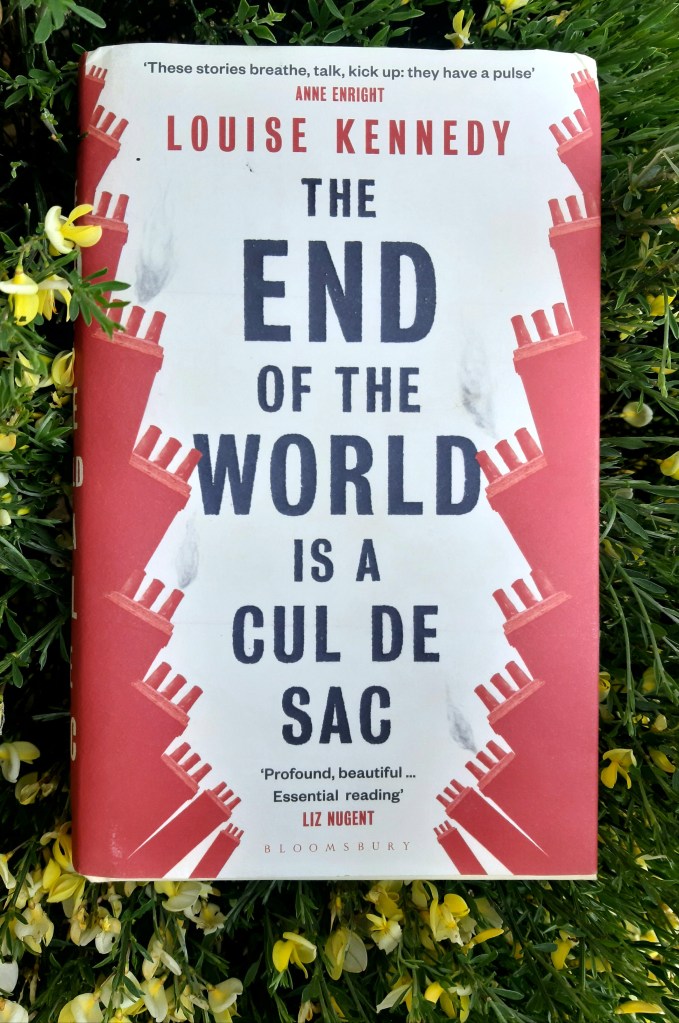
Louise, You’re very welcome to my Writers Chat series where we’re going to chat about your critically acclaimed short story collection The End of the World is a Cul De Sac (Bloomsbury: London, 2021).

You’ve had many accolades about your stories but I particularly like Anne Enright’s description. She says your stories “breath, talk, kick up: they have a pulse.” For me not only do they “ have a pulse” but they sink into your subconscious, and stick with you. It is not surprising that “In Silhouette” and “Sparing the Heather” were shortlisted for the The Sunday Times Audible Short Story Award in 2019 and 2020.

Photograph of The End of The World is a Cul de Sac by Louise Kennedy – resting on a green shrub with yellow flowers

SG: Let’s start with the form of the short story. In an interview with Rosita Boland, you spoke about your path to writing – a night class with a friend. What attracted you or drew you to the form of the short story rather than, let’s say, flash fiction, poetry, or novel?

LK: As I explained in that interview, I joined a writing group almost by accident. At the first meeting it was agreed that each week one of us would submit a short story of roughly 2000 words, although I don’t think I contributed much to the conversation. I suppose the form is a relatively achievable unit of fiction and suits the workshop model of writing groups and creative writing programmes. I was fifth to submit. My story was an attempt at dramatising a family anecdote about the time my grandmother, a teenage wannabe flapper, put Rudolf Valentino’s name on the November dead list in Holy Cross Church in Ardoyne beneath that of her father, who had been killed in World War 1. We managed to stick pretty strictly to that rota, which meant I was producing a new piece of work every few weeks. Within a year I had begun attempting fiction.  

I had always read short stories, beginning with Sinéad de Valera’s Irish Fairy Tales, and the Puffin Book of Princesses and as a teenager loved Roald Dahl’s Tales of the Unexpected. I think Exploring English 1, which I enjoyed much more than the novel we were assigned, made me keeping reading them, so in bookshops and libraries I often picked up collections and anthologies. The ones that were important to me in my twenties and thirties were The Way-Paver by Anne Devlin, The Stories of Eva Luna by Isabelle Allende and everything I could get my hands on by Ellen Gilchrist. As readers we take in not just story but craft elements such as structure and tone, so perhaps when I began trying to write my own stories I had a subconscious understanding of how the form works.

For the first few months all my stories were coming in at 2000 words or so, which is the length required by many competitions. A few shortlistings and wins encouraged me to keep going, but I found that some ideas required rather more words and some required fewer. That felt like a departure, letting the stories take the shape and space they needed, learning that each idea required a distinct approach. Much as I love reading poetry I was never inclined to attempt it myself, but attended a class once, out of curiosity. In response to a prompt, everyone else produced a poem and I left with a piece of flash fiction. I am finishing work on a novel and have found the process very different from working in the short form: big machinery is required to keep the story moving. Short stories are tricky wee articles, but I  love the precision they demand, the tone that must be found from the first word and held to the end. Written well, they can offer devastating glimpses of how we are in the world and what we do to each other.  

SG: I love the sound of that story about your grandmother! I’d agree with what you say about reading – read well/write well. And I like what you say about letting the stories take the shape and space they needed.

In all of these stories, setting is key. In the title story the narrative shifts because of the transient, unsettled nature of the setting: the ghost housing estate, the empty feel of rooms. What is absent is as important as what is present. In the hilarious but poignant “Beyond Carthage”, Noreen and Therese are in the wrong place at the wrong time. How important is setting to you as a writer?   

LK: The germ of an idea is often a vague, almost elusive thing. Story only begins to generate for me when I place it somewhere. So yes, setting is hugely important to me. The End of the World is a Cul de Sac is set in the north west, sometimes obviously so, sometimes in a more liminal sense, particularly in the border stories. I suppose my approach to place is always that of a stranger. Until I was twelve, I lived near Belfast. Since then I have lived in various places in Ireland and elsewhere. Maybe this perspective makes me look deeply at where I am. When I go for walks I take photographs of wildflowers and birds and go home and look them up. I read about archaeology, history, mythology. At the time of writing I was not necessarily conscious of what I was doing, but can see now that perhaps these interests added layers. I am interested in the built environment too, the marks that humans have left on landscape. In the north west, this is could be a fairy fort or a ghost estate. Domestic spaces are important to me too: the objects with which we surround ourselves, the food we eat, the way we decorate our homes. I am not confident about giving the reader access to a character’s inner thoughts and perhaps I try to circumvent that by showing how people interact with where they are. It is possible that this is effective in the short story, where economy is everything; each element has to work its arse off.  

SG: Thanks for that honesty, Louise, that the story can’t grow for you until you place it somewhere – whether it’s a kitchen, a fairy fort, a ghost estate. Much of your writing is sensory and I love how you pay attention to the details of where each character is at – what they see, where they step, what they hear and so on. For example, in “Sparing The Heather”, Mairead’s foot “bounced off something sleek that made a tight, high sound like a baby’s toy. A crow from an earlier cull, squeaking with maggots.” We don’t see Mairead’s reaction which allows us to react and as disgusting as the image is, it is also thrilling. Can you talk about your use of the senses?

LK: Thank you for saying that image is thrilling. You might be interested to know where it came from. I was once given a pheasant which had been hung for too long. I pressed my hand to its breast and it literally squeaked. In fact, a flurry of blue bottles flew from its dead mouth, a detail I spared the reader when I used it in the story. Lovely, huh?

(SG: Yeah!!)

I sometimes wonder if I have an overdeveloped sensory system. I think part of the reason for this is that in my previous life I was a chef and the kitchen is a highly sensory environment. When we cook we use touch, taste, sight, sound, smell, and it is natural to me to describe these things. I suppose we have a common sense of what is pleasant or unpleasant, so it didn’t occur to me to say how Mairead felt about that sensation, because most of us would find it horrifying; fictional characters should not be so very different from real people. And I think that being human is about how we experience our environment, so for me there is a connection between the senses and place.     

SG: Hmm, yes, because we are and exist where we are. Many of the stories in this collection also centre around the complexities of family. I was particularly moved by your tender portrait of the young family in “Brittle Things” and how Dan, the father, is so consumed by self-deception that he can’t see that his young son needs more than the care he’s being so lovingly given by Ciara who, in turn, muses:

The girls asked around Ferdia, never about him…When she talked about him they listened and smiled…It seemed to her that ‘you’re amazing’ meant ‘how do you tolerate your life?’

I think part of the what good writers do is not place judgement or values on their characters and their lives and this is a great example of that. This story strikes me as a study in human behaviour where every person, and not just Ferdia, exists in their own social construction, their own creation of reality. Was family a conscious theme in the collection or did it emerge through your selection of your stories?  

LK: We are all part of families, in one way or another, those we grew up in and those we try to make. These are our most important relationships, but can be so fraught. In order to live with people we have to make accomodations every single day, and some of us are better at that than others. Each of us carries the hurt and disappointment of previous failed connections; we are like human velcro, all that pain sticking to us. I think it is hard to move through the world with that burden. I like what you said about each of my characters living in their own social construction. There can be, I think, a particular sort of loneliness in being surrounded by people that is almost exquisite. Ferdia is living in his own world and Ciara is no less lonely, craving connection with her boy and understanding from his father. But although her marriage is under terrible strain, there is still love and loyalty and desire. People are so complex, and I wanted the stories to reflect that.

I tried to approach all the characters with empathy. Even in ‘Imbolc’, in which Liam behaves abominably, it was Elaine who brought the money men into their lives. And far from seeing Stacey Rainey as a seductress, I think she’s just a vulnerable kid who is being used by Liam to exact revenge on both her brother and Elaine. So to answer your question, I didn’t deliberately write about family and relationships, but what else is there?

SG: Yes, I felt so sad for all three – Liam, Elaine and Stacey – trapped in this horrible cycle. Yet the women in your stories, while often trapped by circumstances – place, economics, health – are very much connected to their bodies and their environment. In the wonderfully structured “Gibraltar”, we have this sentence which hit me hard:

Shona looks tired, her pregnant belly only a little fuller than her mother’s distended abdomen.

In “Imbolc” after she discovers one of her worst fears to be true, Elaine is unable to see her feet because the

blue of the fields seemed to drain the air of light…Her feet sank deep in the snow and each step was exhausting. A sob was bulging at the back of her throat.

In “Garland Sunday” a steady, stark study of emotional and physical mending you have such a close and realistic description of Orla’s skincare routine before bed: 

Upstairs, she took off her make-up and smeared night cream across her face, over her loose jawline and the rucks between her eyes.

Your use of language, whether it’s strong verbs (drain/bulging/smeared) or precise adjectives is what brings us into the body of the both the story and these women. Can you talk about this?

LK: The language I use is, I guess, plain, although when I’m writing about the natural world I do indulge myself. A bit. And plain words are blunt, which is perhaps powerful. I try to allow myself to write ardently in early drafts and I think in the editing process, which for me is very long, what is left still has some of that energy. I avoid using adverbs and therefore have to rely on verbs to do the heavy lifting; it is vital that these are the right words, so quite a bit of time goes into that. Also, I am working from a few different lexicons: the formal English I have taken in as a reader; the language I heard as a child in the north that is peppered with Ulster Scots; the demotic, a type of Hiberno-English, I suppose, that is used where I live now.

Again, it is also about the precison demanded by the short story form. I am so happy you think the words I chose took you into the body of the stories. Thank you.

I am fascinated with what it is to occupy a female body and all the ways in which it can betray us – lust, fertility, sickness ageing. I think our bodies are wondrous – we can carry life! – but also terrifying. Many of the things that are supposedly natural are actually barbaric, especially many women’s experience of childbirth. And of course the female body has been so objectified that all this is complicated by ideas of beauty. With regard to the language I use, maybe calling things what they are is powerful.   

SG: Oh I’d love to talk more about lexicons and even how identity is linked to language. Perhaps for our next chat?

For now, Louise, tell us about the titles of your stories. There wasn’t one in this collection that I didn’t think was exactly the right title for the story. “Hands”, for example, was such a perfect title and created an atmosphere of both disappointment and yearning that it is still with me and I think of that power of our hands and that of parental and filial love.

LK: Thank you, I’m delighted you think the titles are appropriate. Most of them arrived quickly. The title story came from something my sister said when we were children: she asked if the end of the world is a cul de sac. I felt that, for Sarah, Hawthorn Close is the end of the world.  ‘Huntergathers’ came to me before I wrote a single word of the story; all I knew was that a man, who fancied himself as being ‘at one’ with nature, was going to kill a hare his partner loved. ‘Once Upon a Pair of Wheels’ is a line from a Paul Simon song, ‘Baby Driver’. I had an image of teenage Aidan behind a steering wheel, and the words ‘once upon’ made it sound like a fucked up fairy tale. In ‘What the Birds Heard’ I like to think that Doireann was having some kind of sensuous awakening of which she was not fully conscious, while the birds and insects were alert to what was happening to her. ‘Belladonna’ is Italian for beautiful woman, but also the name of a poison. I stole ‘Powder’ from Tobias Wolf, although his was about snow. ‘Sparing the Heather’ is from an old Irish saying about meanness; heather is plentiful, so there is no need to be miserable with it. I suppose I hoped they would all operate on a couple of levels. The one I was least sure about was ‘In Silhouette’- it was only ever meant tot be a working title – but it got kind of stuck there and seems to be doing the job. And isn’t ‘silhouette’ a gorgeous word?  

SG: And that’s why I felt the titles worked – they all operate on a number of levels both as entry points into the stories and as hooks for us to hold onto when we’ve finished. ‘In Silhouette’ is particularly powerful. We’ll end this Writers Chat, Louise with some short fun questions:

  • If you had to pick a favourite story from this collection which story would it be? ‘In Silhouette’ is my favourite. I used the second person point of view for the first time in that story and it is structurally and temporally different from anything I’d tried before. The writing of it also helped me find my way with ‘Sparing the Heather’, so if I had not given myself permission to muck around I would have written neither of them. And in terms of my career it changed my life. Within a year of it being published in The Tangerine, it had got me Eleanor Birne, my brilliant agent, a shortlisting for the Sunday Times Audible Short Story Award and a publishing contract.
  • Mountains or sea? I live very near the sea and possibly take it for granted, which I realise is terrible. I love the softer landscapes of lakes and woods, neither of which you gave as options. So maybe mountains?
  • I’ll have to expand my options from two to four! So, music or silence when you write, and, if music, what type? I don’t play music as I write, but when I am working on something there is usually a playlist, a sort of sonic mood board. While working on the novel I’ve been listening to Sister Rosetta Thorpe, Horslips, the Bay City Rollers, Ottolie Patterson, Steve Harley and Cockney Rebel. Which probably sounds nuts.
  • I listened to Sister Rosetta Thorpe when writing my first novel and she ended up in it! What are you reading now? My tbr pile is a disgrace at the moment, and I honestly don’t know where to start. I’ve recently finished two great books: Easter Rising, by the Irish-American writer Michael Patrick MacDonald, and Deborah Levy’s Real Estate.

Thank you, Louise, for taking part in my Writers Chat Series and for providing us with such considered answers. I wish you much continued success with The End of The World is a Cul de Sac and look forward to your novel.

Hear Louise in conversation on May 13th with Lucy Caldwell at the Seamus Heaney Centre (QUB)

Keep in touch with Louise:

Twitter @KennedyLoulou 

Instagram louise.kennedyy

Photograph of Louise Kennedy