Writers Chat 49: Eamon Somers on “Dolly Considine’s Hotel” (Unbound: London, 2021)

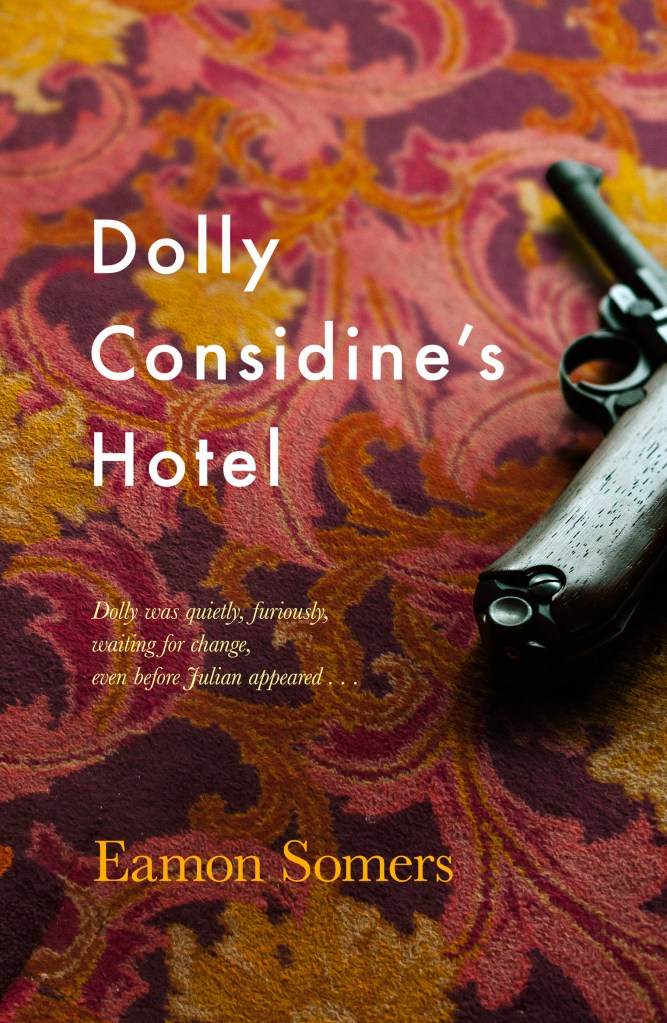
Cover image of Dolly Considine’s Hotel by Eamon Somers – colourful carpet with a black pistol on the floor

Eamon, You are very welcome to my WRITERS CHAT series. Congratulations on Dolly Considine’s Hotel which was published by Unbound in 2021. I must thank you for taking the time to do a reading as part of this WRITERS CHAT – readers, you’ll find the reading mid-way through this chat so treat it like an interval!

SG: Before we get into the details of the characters, history, politics and love in Dolly Considine’s Hotel, I was struck by the honesty with which you describe the writing journey and path to publication. I think it’s very refreshing. Can you talk a little about this and your experience with Unbound and may I, in the same breath, comment on the perfect cover. I just love that patterned carpet and the revolver. It captures so much of what the novel is about.

ES: Hi Shauna, it’s an absolute pleasure and a privilege to be invited onto your famous writers chat. Let me start with the cover which was designed by book designers Mecob and has received a lot of praise. I tracked down the patterned carpet photo on Shutterstock, it was taken by Irish photographer Julie A Lynch and she called it “creepy old hotel in ireland carpet”. If anyone knows Julie, please pass on my gratitude to her for such a great image.

I submitted an earlier novel to over 100 agents and publishers. One agent was interested, and we worked for months to get it ready to send out. But without success. He told me to put that novel in my bottom drawer and to write another. I resurrected something I had previously worked on, and Dolly was born. But by the time I had an acceptable draft, the agent had moved on, and I started the submission business again. Eventually, just as I was about to give up and self-publish, Unbound said ”yes”.   

Unbound operates like a traditional publisher, except that their financial model requires publication costs to be raised through a crowdfunding campaign, run by the author on the Unbound website. That was hard work, but very rewarding especially because it introduced me to the world of promotion via social media. With so many books being published it appears that unknown and debut novelists have little chance of finding readers (and as, importantly, reviews) unless they embrace the world of Twitter and Instagram.  

SG: Yes, these days as well as writing the novel writers are expected to promote their work across multiple social media platforms – hard work when you need to be writing! But now let’s talk about the structure of Dolly Considine’s Hotel. There’s a split timeline for most of the book – between 1950s and 1980s – and it’s through the two stories, running along almost like parallel tracks that we come to understand the significance of the Dolly’s hotel as the main character. Coupled with the wonderful chapter titles (for example, “No Time To Be Squeamish”, “Julian Remembers the smell of chocolate that encircled the Cadbury girls”, “A visit to the theatre”) and the short, snappy chapters, the novel is a surprisingly fast read at over 500 pages. Did the structure play as important a part in writing as it does in the reading experience?

ES: I didn’t start out to write anything complex. I wanted to set the story in a version of an hotel I had briefly worked in when I was in my early twenties. And because I was very disillusioned with Ireland after the pro-life referendum was passed and the possibility of divorce was rejected, I wanted to portray life in the early ‘80s. I admit to wanting to write something a bit different from the usual linear story: hero/heroine overcoming obstacles to find themselves or love. More importantly I wanted to play with readers, to upset their trust a little, hint at unspoken complexities, cast doubt on the certainties they expected, give them shaky ground, like a fairground ride. At the time of writing, experimental writers were beginning to play with multimedia things and to give readers some power to control the story. But that wasn’t for me, instead I tried to give entertaining variety from which readers could choose what to believe and what to just laugh at. This may not answer your question, but the hotel building has been around for two hundred years, and I wanted to share the histories that made it the complex entity that it is today. History doesn’t happen overnight; it is built up and built upon over many years. Ghosts have to come from somewhere. And Dolly has lived/is living through periods. She chose her path (or it chose her) in the ‘50s, when she moved into the hotel, taking with her own family’s history.

SG: I found there was a lot to laugh, disbelieve, and wonder… but alongside this playing with the reader, one of the main themes is that of identity and gender; the names we call each other, the names we call ourselves, the limitations and expectations of society and of ourselves. Dolly’s hotel is a type of refuge for those who want to step outside the norms of 1950s/1980s Ireland. And of course, Dolly Considine – and through the hotel – plays with notions of power and politics, from her seduction of GI and Cathal, to her hold over the staff. Can you talk about Dolly, identity and gender?

ES: Identity is very important to me. I was married at 22 and was the father of two children by the time I found out/acknowledged I was gay and my marriage broke up. Often when I meet new people it is the fact that I have children that emerges rather than the fact that for nearly forty years I have lived in a committed relationship with another man. So (as a committed zealot) I feel obliged to correct any assumptions.  Less frequently, but equally, I feel obliged not to deny my children when I make new gay friends. This is who I am, as is my Irishness, and my confused class heritage.

If Dolly or other characters defy expectations, then I am pleased. The female characters perhaps try to control their environments, but I think they have to reduce their expectations, so they are in line with what is possible. And although it was Julian that was the inspiration, I had wanted more for Dolly than she got. So, in that sense I let her down and allowed the lion’s share of attention go to the male protagonist.

SG: And to be honest that is probably why I picked her out for that question! I wanted more for her too!

I loved how the meta-narrative of the novel that Julian is writing – “The Summer of Unrequited Love” – evolves with the main narrative (that of the hotel) in such a way that we have trouble distinguishing between the action in Julian’s notebooks and those in the hotel, just as Julian himself does. At one stage, “It had only been seven or eight hours, but his fingers were twitching as if they’d never hold a pen again.” And, for example, we’re in a scene in which Julian’s lover, Bláthín, has had most of the wine:

‘The wine was gone. She’d had the most of it.’ He whispered the words to fix them in his head. It would be a springboard line for his journal. He leaned into the low table to search for blank paper she wouldn’t miss; even his own mother kept scraps for shopping lists. His pen already in his hand, twisting like a divining rod tuned to blank paper.

How important to you were these parallel stories which reflect and talk to each other to what you wanted to say through the novel about the acts of perceiving, recording, and writing?

ES:  The parallel stories confront the reader with a messy, erotic, unashamed version of Ireland. In the extract you choose, Julian is writing his fictional Summer of Unrequited Love, while also participating in the real-life events of Dolly Considine’s Hotel.

Julian is a young idealist, and a “real” artist, ready to “suffer” for his art. But equally there is the serious work of how a writer portrays their characters. Which aspects of their behaviour will best represent them? Julian wants only meaningful characteristics, the ones (perhaps just one) that will resonate instantly with his readers; he wants to ignore those that merely pad out the portrait.

But Josie’s story, Sylvia’s story, Dolly’s father’s story, Brendan’s story all explore, and as you say, talk to the main and ostensibly more reliable/truthful narrative, and hopefully in their own way, produce a more meaningful truth and deeper feelings in the mind of the reader.

Eamon reads two short extracts featuring Dolly and Julian

(total time: 4 mins, 10 seconds)

Eamon Somers reading two short extracts which focus on Dolly and Julian

SG: Thank you for such a wonderful reading, Eamon. So, following on from that reading, we can say that much of Dolly Considine’s Hotel examines bodies and terminations – ideological, political, literary – through acting and enacting, writing and reading, interpreting and imagining. It’s a slow build – starting with Mikhail Mayakovsky/ the Mother Ireland scene and returning to it later – and continuing with the series of “Terminations” in Julian’s notebook – whilst following the adventures of Julian’s body in the hotel and beyond. I also couldn’t help feeling that the side exploration of urban/rural – for example, when Bláthín tells Julian in Cavan to “listen to the babies…you can’t come down here and trample anywhere you like. You have to respect the established order.” – also echoed this theme of bodies. I thought it was an interesting way to explore choice. Can you comment on this?

ES: Although it is not foregrounded except perhaps in Cathal’s naming, and Julian’s frustration at not understanding the history of the state’s inception, I was conscious of the civil war all the time I was writing the book. As a nationalism sceptic I don’t want to big up too much the “idealism” of 1916 and the war of independence, but for me the civil war marked the termination of those aspirations embodied in the Irish Literary Renaissance of the 19th century, and which were then fetishised and mythologised in the new state. Mother Ireland and her pregnancy reminds us of the loss of idealism and choice that the pro-life victory represents. Many of us who grew up in cities (but especially Dublin) under Eamonn De Valera and Bishop John Charles McQuaid were made to feel that the authentic Irish lived in the country. Dubliners are Jackeens, they took the king’s shilling, they were not to be trusted. Bláthín has absorbed the myths and is retelling them in her radio work, but she also recognises that Julian might have his own working class inner-city naive truth.

SG: Yes, of course, there’s the theme and voice of class running through the novel too. Now, we’ve discussed some of the themes and narratives but I can’t leave this Writers Chat without mentioning the humour and the chance encounter (or was it a chance!?) between Paddy/ Julian and the mysterious Malone in Busárus that sets Julian on the road to Dolly’s hotel. You really capture that era (1983), one in which the world outside Ireland was full of possibilities but an Ireland which was closed in on itself in every way (economically, sexually and so on). Can you talk about the genesis of this beginning?

ES: The people of Ireland’s 26 counties often get criticised for ignoring and/or completely misunderstanding what life is like for people who live in the North of Ireland. I wanted to play with the complexities and to allow Julian to have what he considered to be reasonable (but were often conspiratorial) interpretations for the things he witnessed/imagined about Malone, and about Dolly and GI – viz the safe house. But I also wanted a cross border romantic interest, even if the erotic only went as far as Julian wearing Malone’s pants and underwear.

SG: And speaking of pants and underwear, the erotic – particularly, male – is key to the novel and yet is not the only theme that defines it. How would you categorise Dolly Considine’s Hotel – if it can be categorised or boxed?

ES: I think of Dolly Considine’s Hotel as a post-gay novel, a book where the issue of sexuality is taken for granted.  This doesn’t make characters nicer or less nice or even more worked out, but their sexuality is just a fact, like their eye colour. Recent years have seen a market opening up for gay fiction across all genres, however in my writing I seem to have been regarded as either too gay for mainstream publishers or not gay enough for niche publishers.  And although it was not my intention when writing the book, I’d love to think that Dolly can bridge that divide.

SG: To finish up, Eamon, some fun questions

  • Countryside or city? Except for three months when I was eleven (on a Gael Linn scholarship in Connemara) I have always lived in cities. Like many city dwellers I secretly think I would love the countryside, but in reality, suspect I will always prefer to visit rather than live there.
  • Tea or Coffee?  I am definitely a coffee person. But have very little time for fussy machinery, or coffee shops, and except for weekends, will settle for instant. I switch to decaf at noon.
  • Bus or train?  I love trains, especially for long journeys. But in the city I like buses, so much better for linking London’s villages. And during covid, somehow safer than the underground.
  • First draft handwritten or typed? Typed, onto my old Amstrad in 1998, although I was also very fond of a notebook, but mainly for late night drunken ramblings.
  • What’s next on your reading pile? I supported my fellow Unbound author Patrick McCabe’s crowdfunding campaign for his latest book, Poguemathone and I’m looking forward to getting stuck into that.

With thanks to Eamon Somers and Unbound for the copy of Dolly Considine’s Hotelpurchase the book here

Photograph of Eamon Somers (courtesy of Justin David)

Exciting Book Post: Future Writers/Artists Chats

Photograph of stacked books. From bottom to top the titles are: Dubliners; Murder in the Monto/ The Geometer Lobachevsky; This Train is For: Keepsakes; Seven Steeples; Dolly Considine’s Hotel.

As followers of this blog will know, much of what I love doing is chatting to other writers, artists and readers. This week some beautiful book post arrived and I hope to chat to some of the creators on this blog soon…..Here is a little taste of what is to come as over the next few weeks there are exciting launches by Arlen House. Watch this space!

The second photograph above: Margo McNulty, Keepsakes; Mia Gallagher and Mario Sughi, Dubliners; Sara Baume, Seven Steeples

The third photograph below: Tony O’Reilly, Murder in the Monto; Bernie McGill, This Train is For; Adrian Duncan, The Geometer Lobachevsky.

LEFT TO RIGHT: Tony O’Reilly, Murder in the Monto; Bernie McGill, This Train is For; Adrian Duncan, The Geometer Lobachevsky.

Writers Chat 48: Laura McVeigh on “Lenny” (New Island: Dublin, 2022)

Laura, You are very welcome to my WRITERS CHAT series. Congratulations on your second novel, Lenny (New Island, 2022) which I thoroughly enjoyed.

Cover image of Lenny by Laura McVeigh with a drawing of a canopy of trees with hanging foliage and blue skies lit up by stars

SG: Let’s start with the dual narratives in Lenny – that of the mysterious pilot in the Ubari Sand Sea in 2011 and that of Lenny in Louisiana in 2012. The narrative structure not only allows the narratives to converse with each other but, as they converge and the themes of home and belonging really come to the fore, they form a third, beautifully unifying story. Can you talk about your structural decisions when writing Lenny?

LMcV: I am always very interested in notions of time, memory, how we experience moments – and like to examine that in my writing, both in the substance and structurally. And one of the main themes within the novel for me in the writing was our relationship to time and reality, so a lot of the structure explores that in various ways. The dual narratives allowed me to create a sort of mirroring within the storylines – as you suggest, a kind of conversation – but also opened up the sense of time more broadly, allowing the reader to travel with that feeling in different ways.  I wanted to stretch and bend narrative time in the storytelling, just as Jim, Lenny’s father suggests is possible later in the story.

When I write, I write fairly instinctively.  So I don’t work out a structural scheme beforehand – I write into the story, and I find multiple narrative streams gives a depth and resonance to the writing, helping create echoes, connections – as you say, unifying.  I pull the threads together as I go.

SG: I think your instinctual writing is very much reflected in the tone of Lenny, as it carries the reader in a sort of wonderworld. Something that stayed with me long after I’d read Lenny, was the feeling that somehow, we are ageless, or that age does not matter when we zoom out and consider the world as a universe. While characters such as Miss Julie and Lucy and indeed Lenny’s mother, Mari-Rose, find themselves limited or restricted by age, the cumulative impact of the thread of The Little Prince (referenced throughout) and narratives of the pilot and Lenny was that I was left really pondering how we limit ourselves in so many ways in opposition to our world rather than in harmony with it. Lenny remembers Mari-Rose telling him that sometimes

“A story can end all sorts of ways…sometimes it doesn’t end at all, it’s just beginning.”

And towards the end of the novel, we find Lenny is “stretching time all around him.” Was this playing with time something that you had consciously or unconsciously woven into the novel?

LMcV: I love this question. And the idea that we are ageless! But it’s true, why don’t we look at life in harmony with nature and time, and see that we are part of something much more beautiful, infinite and mysterious.  In the story, we see Lenny’s watch that doesn’t work, the elastic band on Mari-Rose’s wrist, both symbols of how we try to hold on to the impossible. We tend to fear aging, fear death, decay. We are always fighting life, struggling – it’s in the very language we put upon ourselves constantly.  

So within the novel, yes, I was very consciously playing with time and our understanding of time and the universe, and the part we play within it.  In life we often look for narrative coherence – a story – a way of understanding a situation.  We explain everything to ourselves via story. But of course stories, like time, don’t travel in straight lines, simply from one point to another. So I wanted to explore and play with all of that, and push against those limits. I hope the novel reflects that desire for openness and possibility.

SG: Yes, I think Lenny reflects your desire for openness and possibilities and I think it comes out also in the relationships Lenny has with Miss Julie and Lucy and how though they both play mothering roles in the book, it’s Lenny who brings the women out of themselves, and opens the world to them. He starts off thinking that “believing is for adults” he comes to understand that to change the world and people, “you just had to believe”. It is such a beautiful message of hope. Did you feel you were writing a novel of hope when you were writing it or did this emerge through the writing process?

LMcV: Yes, that connection between Lenny and Miss Julie, or as the novel progresses with Lucy too. It’s so important for Lenny I think, at this point in his life to have someone looking out for him, someone who cares, but of course, it’s his spirit that is bringing healing and renewed purpose to them.  I suppose it’s that sense that we gain when we give – that in caring for Lenny they are opening up to being more caring towards themselves too, becoming more forgiving, more open-hearted.  I love that childhood sentiment of how life could be anything at all, so long as you believed it.  I think we lose that sense along the way sometimes, and yet life is such a gift – even with all its hardship and pain – so how do we navigate that with grace and love?  When I was writing Lenny, yes, I was seeking – whether consciously or unconsciously –  to write a story full of hope and love, because I think sometimes we forget, we lose sight of hope. Our better angels, I think Miss Julie might call it.

SG: Oh yes, our better angels! I love it. Places (and worlds) are in themselves characters in the novel. I really enjoyed how you played around with the individual experience of place and how this bleeds into human connection at all levels. We’re all connected by place as the Imuhar way states:

A man who wanders is free…he is not tethered, neither to place nor possessions

You touch on the magic of place and I thought this came out in the relationship between the pilot who falls from the sky in Libya, a seemingly empty canvas, but also later in the budding relationship between Lenny’s father Jim (who “looked like all he wanted to do was to walk away from himself”) and Lucy (who “knew her heart was full with joy around him.”). Can you talk about Lucy, the lonely librarian/activist with her lovely cat?

LMcV: With Lucy, at first we discover her really as others might see her – and I wanted to capture that sense of how much there is beneath the surface view – for all of us.  It’s not just the shorthand, the glance, the first impression.  Lucy is a work in progress, and she recognises that about herself I think.  She’s trying to heal after a lot of loss and hurt, and a sense of always feeling out of place. So I think Lucy is searching for ‘her place’ and in the novel she seems to find that in Jim.  I love that there are lots of contradictions alive within Lucy – I find that very human.  She’s caring and yet scared to open up her heart and life and let others in, she’s fearful of many things yet wants to live a bigger, fearless life.  In the novel, she has to ask herself if she’s willing to stand up for the things she cares about, if she’s willing to put herself out there – I love that vulnerability and uncertainty coupled with her determination.

SG: And I think it’s both ways – for Jim also finds an idea of home in Lucy. Lenny experiences life by interpreting place and time through senses and memory. He imagines what life would be like if his mama had not left him, if his daddy had not learnt to fly, and if the chemical companies hadn’t come…

“Lenny, half reading, half daydreaming, blinked into the dust imagining other planets, similar to his own, yet different all the same.”

In Lenny you capture that uncanny ability children have, to inhabit the world and at the same time understand wholly that there exists an alternative reality. In what way is Lenny an exploration of this – the what if question?

LMcV: Absolutely. In the novel I wanted to explore that possibility.  Science tells us it’s possible, indeed almost a certainty. And of course, in so far as life is perceived as experiential and experience is subjective, then we can accept that multiplicity of perception at the very least.  In childhood we live in dreams, but what if that is actually closer to understanding the mysteries of life? Again, the novel, on one level, is really an invitation to think differently, to move outside of our daily preoccupations and take a longer, wider view of life.

SG: Big business (and big countries) and the impact on the environment is one of the strong themes in Lenny. I loved that as an author you don’t preach, and that the theme fit so well into the story of who Lenny is and where he’s from. Can you talk about the importance of this theme and how Lenny with his warmth and lovability is the perfect character to encourage readers to consider the environmental destruction?   

LMcV: Within the novel I wanted to show how these things can affect a lifetime, a community, a place, land, and how what happens in one part of the world, impacts what happens in another. The novel really explores the ways in which war, big business, political interests all interconnect – so how do we stand up to that systemic challenge?  How do we start to really understand that a problem for Libya, for example, (water shortage/land degradation/conflict/migration/political instability) or for Louisiana (land loss/climate uncertainty/environmental pollution/over-industrialisation/home instability) is also a wider, interconnected, global problem. 

While the novel explores the idea of other possible worlds, it is also true that we all share this one planet – sadly unequally, often destructively. So how do we do better? What can we change?

The story therefore looks at the power of the individual to affect change, and that is where Lenny’s sense of ‘believing’ is essential.  With hope, everything is possible.

SG: Again, we’re back to hope. But war changes land, and people. Miss Julie hangs on to Stanley, Mari-Rose tries to believe in Jim, Goose wants to believe in what Tayri and Izil offer him – and all of them are in denial about their own part in destruction, and their inability to protect. Yet Lenny, because he is a child, he still finds hope and can still see the stars and possibilities, even when his town is literally sinking. Can you talk about the impact of war on the story? It feels especially relevant given what’s happening in our world right now.

LMcV: I have always had a deep interest in writing about war, conflict and its impacts on individual lives and communities.  I think this is born out of growing up in the North of Ireland in the 1980s in the Troubles’ years.  Even as a young child, of around Lenny’s age, I would have been very interested in the idea of peace, of the importance of peace.  So it’s a theme I continue to explore in writing.  

In Lenny we see Lenny’s father Jim return from the war, broken, suffering from Post Traumatic Stress Disorder (PTSD), taking refuge in alcohol.  Part of the structure of the novel is in a way a reflection of that mental state – the short chapters, the jumping from image to image, idea to idea, the forgetting and remembering within the story.  But of course it’s not just Jim who is suffering – it affects his whole family, and all of his connections with other people. Miss Julie’s life too has been shaped by a war – with the absence of her husband Stanley since 1952.  So there is that sense of a life’s possibilities taken. Izil and his family are surrounded by conflict and the impacts of conflict and are trying to navigate that all too dangerous reality in the desert sands.  So the ‘what if’ questions become important and give us a way through to hope.

There are so many parts of our world where conflict and war is a daily lived reality for millions – Ukraine, Libya, Yemen, just a few that currently come to mind. Take a map of the world and colour in the countries where war or armed conflict is happening. Look at the history books and we see that war has always been with us. Does that mean we should surrender hope or look the other way?  Or can we, even through small acts of hope and love, make for a better reality?

SG: And in a way, that is one of the important roles of literature in the world – to get us thinking, to ask questions, and to give a sense of hope and possibility. Thank you for your generous answers, Laura and we’ll now end with five short, fun questions.

  • Southern or Northern hemisphere? Wherever the story takes me.
  • Ha! A very writerly answer. Woods or Beach? Ideally a hike in the mountain woods with a view down to the water. Having grown up by the Mourne Mountains next to Carlingford Lough I love both, forest and sea.
  • I’ve been on a few hikes in the Mourne Mountains – stunning. Music or silence while you write? Both, silence for thinking, music for feeling.
  • What are you reading now?  Io non ho paura (I’m not scared) by Italian writer Niccolò Ammaniti and Ursula K. Le Guin’s The Dispossessed but in Catalan – Els Desposseïts.
  • I loved I’m not scared when I read it a few years ago. And I must read more Le Guin! So, Laura, what are you writing now? I’m finishing a children’s novel for my daughter, writing the screenplay of Lenny, writing a collection of travel stories, and working on a new novel.

Well, that’s an astonishing amount of writing at once – your daughter’s a lucky girl! I especially look forward to the screenplay of Lenny and hope – and trust – Lenny will continue to reach many readers!

Black and White Photograph of author Laura McVeigh courtesy of Laura McVeigh

With thanks to Peter O’Connell Media and New Island Books for the advance copy of Lenny.