Writers Chat 68: Phyl Herbert on “The Price of Silence” (Menma Books: Cork, 2023)

Phyl, You are very welcome to my Writers Chat series. We’re here to discuss The Price of Silence,  A Memoir published in 2023 by Memna Books, Cork and launched, in Danner Hall, Unitarian Church in Stephen’s Green, Dublin in November to a packed room. Congratulations!

SG: Let’s begin with the title which tells us something perhaps about one of the themes of this memoir, and of your life, The Price of Silence. Can you talk about how you came to decide on this title?

PH: After searching through a number of titles, I knew that the motif of Silence was embedded in the storyline ranging from the young girl losing her tongue in the beginning of the book to the fact that there was a total lack of vocabulary to talk about the  abuses she experienced.  Such experiences had no words then.  The final experience of becoming pregnant by a married man which in itself was not a topic for discussion but in l960’s Ireland to become pregnant outside of marriage was not only socially unacceptable but the pregnant woman was treated as a pariah and an outcast.  So Silence was the defence mode of existence.
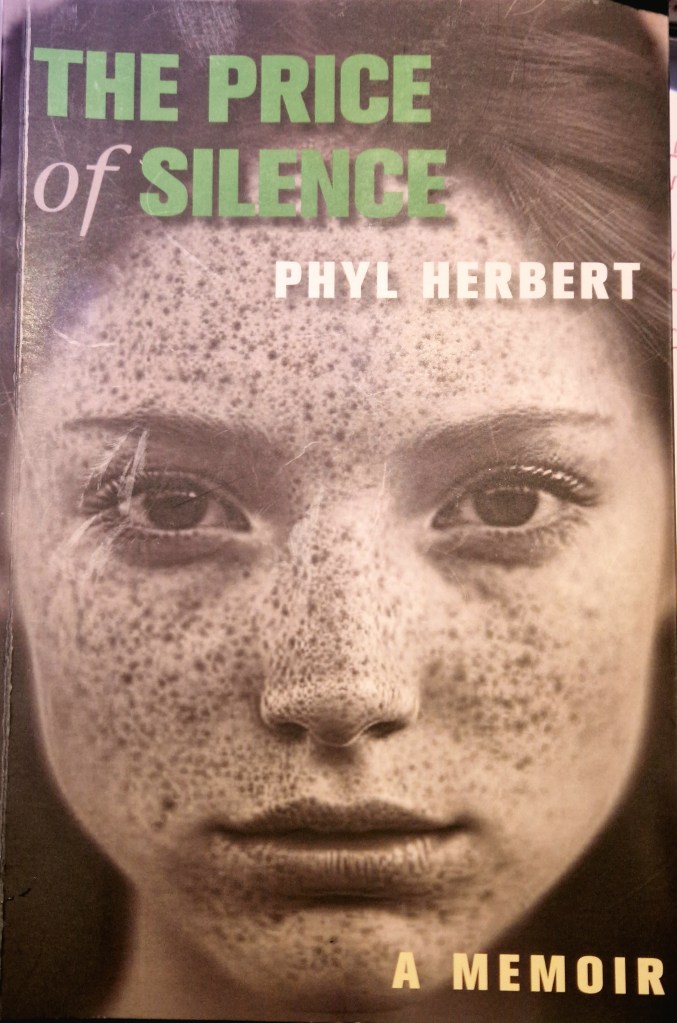
Cover of The Price of Silence: A Memoir showing a close up sepia image of a young girl’s face.

SG: The Price of Silence speaks eloquently, not just of your own existence, or story, but of what it was like to be a woman in Ireland during these years – the late ‘50s. ‘60s ad beyond – and, in particular, how the body, desires, ambition were silenced and controlled, and how language was used to silence and name. Were you conscious of the power of social history when writing your own story – in other words, aren’t we all formed by place and time? 

PH:  Yes, I was conscious of the power of social history and that is more or less why I wrote the memoir.  I wanted to write myself into existence and by so doing attempt to analyse those decades that I lived through.  Men ruled the institutions, and the voices of women had not as yet emerged, but there was the beginning of movements such as The Womens’ Liberation Movement that were creating platforms where women could express their grievances.  But there was a long way to go. 

SG: The Price of Silence is divided into four sections, and the opening section “Tree Rings” brings us through your childhood by way of sharp memories, many of them sensory, that seem to relate to you as a creative person – writer, actor, teacher – and very much in touch with your surrounds. Can you talk about the importance of where you grew up – that pull between Dublin and Wexford?

PH:  The pull between Dublin and Wexford was deeply felt.  It represented also the pull between my mother and father.  My mother never liked Dublin or the house where she reared her family of eleven children.  But she never rebelled, she never expressed her desires because then a woman didn’t know how to talk about such things.  I felt her lack of expression at a deep level and I think I was always conscious of the need to develop my own language, my own identity.  I was a dreamer at that young age and sought means for escape. Drama and the imagination helped me though.  I wanted to be able to express in words what I felt.  To put a name on a feeling, on a thought.

SG: That deep need to express feeling and thought comes through very clearly in this memoir. Alongside your creative outlets, your teaching career took you around the city of Dublin in secondary education, further education, and prison education with the common thread of your approach to education as what we might call a Freirean approach (echoing Brazilian educator Paulo Freire’s belief that educators need to meet people where they are at, rather than the “banking” method of education whereby teachers “feed” information to students and they regurgitate it back again). Do you think this linked in with your approaches to acting and drama and the importance of those in your own life?

PH:  Yes, I believe that our whole lives are about ‘Negotiating into Meaning’ a phrase used by Dorothy Heathcote, Newcastle Upon Tyne University where I studied for an M.Ed. In Drama in Education.  Her philosophy was to provide a mantle enabling the child to find his/her voice.  In the Stanislavski Method of acting, the truth of the character was plumbed into the depths of your own existence, your own humanity.

SG: What pulses and aches right through The Price of Silence is your experience with pregnancy, birth, and motherhood. This is your memoir – not that of the man with whom you had a daughter, and nor that of your daughter – but they are both there, with you, even in their absences. Was it a difficult process ensuring that The Price of Silence told your story only?

PH: What a great question.  Yes, it was difficult because I had to protect the identity of my daughter.  She has her own story and that is not mine to tell.  I still didn’t manage to achieve that in that there were times that her voice was necessary to present the story. The birth father is deceased but his children live on.  I’m sure I’ve made some mistakes here also but of course I didn’t reveal their identity.

SG: Lastly, Phyl, the pacing and storytelling of The Price of Silence coupled with how the memoir is structured added such an emotional push to the book that I read it in one enthralled sitting. What advice would you give to those hoping to write their own memoir?
PH: 
Everybody is different.  People say to be truthful.  But there is a high-wire balance to be achieved.  It’s not good to be too truthful, there has to be a distancing perspective but at the same time I think an immediacy has to be achieved.  E.G. I wrote some of my memoir in the present tense.  Ivy Bannister says, ‘Think of your life as a train journey, what station will you get on and what is your destination.’  That sort of worked for me.

That’s a great piece of advice from Ivy and yourself. Lastly, Phyl, some short questions:

  1. Quiet or noise when you’re writing?  Quiet.  Or quiet music in background.
  2. Mountains or sea?   Both.  I spent some time in The Tyrone Guthrie Centre.  Bliss.
  3. Coffee or Tea?  Coffee. But not many cups.
  4. What’s the next three books on your reading pile?   Just finished Christine Dwyer Hickey’s ‘The Narrow Land.’  Superb.   ‘The Strange Case of the Pale Boy and other mysteries.’ by Susan Knight. ‘In the Foul Rag-And-Bone Shop’ by Jack Harte. ‘The Deep End’ A memoir. By Mary Rose Callaghan.
  5. A great reading list, thank you! What’s next for your writing?  A One woman stage show about a nun who leaves the convent before her 50th birthday and discovers Tango Dancing as a way into unlocking her repressed emotional life.

That sounds intriguing, Phyl, I very much look forward to it. Thank you for your generous engagement with my questions and I wish you every continued success with The Price of Silence.

Phyl Herbert smiling in a cafe. Photograph by Emer Sweeney used with permission.

Purchase The Price of Silence from Menma Books or from Books Upstairs, D’Olier Street and Alan Hanna’s in Rathmines,  Charlie Byrne’s in Galway.

Phyl Herbert, Mary Rose Callaghan and Liz McManus will feature in Books Upstairs in an interview about memoir writing on Sunday afternoon 28th January, 2024.

Writers Chat 66: Alison Wells on “Random Acts of Optimism” (wordsonthestreet: Galway, 2023)

Cover of Random Acts of Optimism showing painting of a desert landscape with a ticking clock in the foreground and a red-leaved tree with a woman’s face peering at the clock. Image by Beatrice Mecking, courtesy of wordsonthestreet.

Alison, You are very welcome to my Writers Chat series. We’re here to discuss your short story collection Random Acts of Optimism which has been described by Billy O’Callaghan as “a genuinely marvellous collection”. Published by Galway based wordsonthestreet, it was launched in dlr Lexicon on September 20th. Many congratulations.

SG: Let’s begin with the title Random Acts of Optimism, which is a theme that runs through each story – despite the diverse forms within the collection – and, in my experience, optimism is the feeling with which are left with when we’ve read each story. Can you talk about how you came to decide on this title?

AW: When I came to write the title story I recognised that for Cynthia and Tom and for many of the other characters in my stories they were often taking action in spite of or in defiance of the constraints of their circumstances. The acts of optimism we take in our lives can run from stand out courageous acts to the everyday doggedness that so many people display as they push through difficult periods of life, as losses mount up over time or as we all faced during the pandemic years. Personally, I am also fascinated by psychology and how we convince ourselves of things, we can be courageously optimistic but sometimes optimism becomes delusion and that has been the subject of several of my novels as well as the stories in the book. For me, also, Random Acts of Optimism also relates to my own long journey as a writer, and also for every writer, trying to find the right words, reach people and hopefully get published. I’ve explored these themes in my writing blog Head above Water and hope to work with people to support them to maintain optimism in their writing lives.

SG: That’s very moving – working to help people maintain optimism in their writing lives. Something so very much needed. I really loved the opening title story – the characters, the narrative but also how you used the page to communicate some of the clinical ways our society was run during the Covid-19 Pandemic. It’s a heart warming story of connection blooming in adverse conditions. In particular the use of humour to fill communication gaps:

He doesn’t know what else to say so he tells her about a woman who returned a book two years too late. The book was called Successful Time Management for Dummies.

Can you talk about the origins and writing of this story?

AW: This story was rooted in my real experiences of the surreal and poignant experience of being one of a few library staff members sending books out to ‘cocooners’ during the Covid19 pandemic from a vast empty library. (The Lexicon library, currently the largest library in Ireland). Many conversations were stark but often a joke was shared and the topic of books always engaged and entertained us.

I also wanted to explore how a male character who is bewildered by his marriage breakup and fallen prey to the anxieties of the modern world  and not really able to make sense of it might begin to find answers through his unlikely connection with an older lady through the libraries and through books themselves. I’ve written (a yet unpublished novel) about a man who loses his way in life but in that case does not find a path back.

I still feel very moved when I think about the “cocooners” at home under often very lonely and vulnerable circumstances. What happened in the pandemic underlines the importance of real human connection (which, by the way, is one of the positives of public libraries with their events, social groups and book clubs) and the power of books and writing to help us feel that connection, understand ourselves and others and just be plain entertained and carried away, even in dire circumstances.

I think writing this story, more than any, allowed me to really depict the stoicism, humour and camaraderie that so many ordinary people have while negotiating everyday challenges. I went on to write several thousand more words of the developing relationship between the characters, so we will see where that goes.

SG: Well that sounds very intriguing, Alison, I really liked those characters and would love to read more. In “There’s a Café in This Story”, you tell the tale of connections breaking down, the importance of place and how necessary it is to keep hope in relationships. I loved the entwining of the inner character with the exterior of the cafe:

There are details that build up over time, the first, shyly uncertain pleasantries, umbrellas under the table, ankles knocking against the metal legs and then against each other. He wonders…. Will the cafes all merge, with all their combined sensations of exhilaration and regret?

Tell me about the structure of this story and how it came about? 

AW: We can use signs around us as scaffolding to reinforce the stories we are telling ourselves. This man, captivated by the idea of this illicit romance, sees the scene and objects around him as part of a rarefied and lovely story. Meanwhile, for his wife, sitting under the infant at home, the discarded coffee cup, her own tea out of reach, the immutable reality of domesticity, objects give a different flavour. Working in Dun Laoghaire, I often walked out on the pier. The sound and scent of the sea, the clanging of the anchors, the gulls were all very vivid, sensation laden images which I used to set the scene and evoke that sense uplift and freedom that the man feels his rendezvous give him.

I liked juxtaposing the man’s reality, his illusion of freedom, movement and magic with the more solid reality of the woman’s life in the alongside their joint memories/experiences of the past. These conflicting juxtapositions are reflected in the images of the servers’ arms criss-crossing,  the struts of the bridge, reaching up to put the star on the Christmas tree.  I think the to-ing and fro-ing between the man and wife’s realities allow us to see two sides to the story.

SG: I liked how seeing the two sides worked. I’m curious as to the order of the collection. I liked how “Sad about the Plumber’s Uncle” worked next to “All that Thinking”, in that the light relief and humour in the first story sets the reader up for the deep thinking in the second. How did you settle on the order?
AW: As you say, the stories in the collection are quite diverse in tone and mood and also what you might call genre, running from realistic to more speculative and fantastical. And as you say, occasionally there was a pretty stark reversal of tone. In other cases, one humorous story follows another but then a reflective element to that story might be echoed in the next. There are some stories about writing or having written (told from the point of view of a letter) and they are close together. To me, the process was similar to the rightness of feeling I felt listening to my favourite albums in the 80s, an instinctive feeling towards tone, poignancy, energy and pause. Sometimes evenness of tone is preserved and at other times the symbols or drums break the preceding silence. I like how the first story throws you right in and how the last story refers to a moment of coming home.

SG: I loved your use of sensory detail and pause in “The Spaceman Has His Tea”. The story has a straight-forward premise yet you created a narrative that is, in its underbelly, a philosophical consideration of the nature of our existence.

Unleashed from the world is not to be free of it, it is to be put in charge of the last egg in the basket, it is to be six years old have your mother put the egg into your hand and say ‘Don’t break that.’ And the earth is as blue as a bird’s egg, as precious as Fabergé, as fragile as Arctic ice. It is to be six years old and afraid of forgetting.

I love that it also concerns the lovely act of drinking tea and “meringue, light, delicious; clouds dissolving on his tongue.” How important are the senses to you when you write?

AW: Like many writers, I’m always pained by the gap between the richness and impact of reality, especially that of the natural world and how well I am getting it down on the page. I can be carried away by ideas and competing narratives, but I think what short work can do best and what I would like my writing to develop into is being more spare, precise, immediate and evocative. The senses are key to that. I grew up in the countryside, was immersed in it, reeds, wind, frogspawn, moss. The natural world evokes a strong feeling and I hope I can put some of that across through different sense impression. Recently I read the writing of Darragh McKeown for the first time and loved the clarity of it. The key to writing is specificity, we know the world through everyday things, what they evoke through senses and memory, what they mean to us. 

We will end this chat, Alison, with some short questions:

  1. Beach or mountains? Beach by a small margin but I grew up in Kerry near the sea with a mountain at my back and now live in Wicklow which also has both!
  2. Dart, train or bus? Definitely DART these days though I spent my college years on the train between Dublin and Kerry leading to many fascinating glimpses of characters.
  3. Do you usually have one book or numerous books on the go? Both writing and reading wise, the answer to this is always many, no matter how much I fight against it. I am endlessly, pathologically curious. I read for my own pleasure, for research for both writing projects and, currently for my dissertation for an MSc in Library and Information Science, I am also fascinated by neuropsychology and creative resilience.
  4. I love the idea of being pathologically curious! Quiet or noise when you’re writing? Quiet. Not easy to find. I used to get up at 5am when the children were young and we built a writing cabin in the garden but once the world gets going, quiet is never easy to find and the noise in my head hard to dodge.
  5. What’s the next three books on your reading pile? I just went to check and counted 50 books stacked up beside the bed! One of the perils of being a public librarian is constant temptations. I am about to read Books on Fire – The Tumultuous Story of the World’s Great Libraries by Lucien x. Polastron, The Creativity Code – how AI is learning to write, paint and think. These will inform future writing projects. I also have Poetry Unbound – 50 Poems to Open Your World by Pádraig ó Tuama put by – his selection of poems and what they mean to him. Just now, with work, study, family life and book launches, this selection is something to steady me, give me pause and interest and settle me down in the moment.  

Thank you, Alison, for such a generous and open attitude to and answering of my questions. I wish you every success with Random Acts of Optimism.

Order Random Acts of Optimism here and follow Alison here.

Photograph of Alison Wells, blonde hair and blue eyes, smiling directly at the camera, wearing a denim-blue cardigan. Photo courtesy of Alison Wells.

Thank you to wordsonthestreet for the Advance Copy of Random Acts of Optimism.

Writers Chat 65: John MacKenna on “Absent Friend” (Harvest Press: Carlow, 2023)

Back and Front cover of “Absent Friend” showing pencil drawing of John MacKenna and Leonard Cohen. Cover image: Lucy Deegan

John, You’re very welcome to my Writers Chat series. We’re going to chat about your latest publication, Absent Friend (The Harvest Press: Carlow, 2023), a memoir and reflection on your friendship with Leonard Cohen. 

SG: Let’s start with the title. It both sums up the friendship now, and how it endures despite Leonard’s death, and also the friendship as it formed and evolved over geographical distance. Did the title come easy to you? 

JMacK: Thanks for the invitation. I’ve long been aware of the tradition in some religious communities of setting a place at table for absent friends – in fact it’s one we’ve adopted in our house. It’s a way of remembering those who are away from home and those who have died and it never fails to bring a moment or two of reflection on some or all of the missing people in our lives. So when I began writing this book the title, more or less, suggested itself. It seemed to sit very easily with what I had in mind as the theme of the book – the friendship and the absence of that friendship after Leonard died.

SG: That’s very moving – your writing as a table with a space for absent friends. It’s quite an incredible story, your lifelong communications with Leonard. How did you work out the structure for the memoir in terms of chronology of friendship/ your own chronological life? 

JMacK: That was a challenge. I had many thoughts on how to approach it but, in the end, I thought the songs are the binding force. The songs are what drew me to Leonard when I was eighteen and the songs remain after he’s gone. So I used the songs and albums as guideposts to the journey of his life and my life and our friendship. And it seemed to work. 

The parallels between events in my own living and the emotions and events gathered in his songs worked in tandem in terms of the writing.  There’s one moment in the book where I’m driving and listening to If It Be Your Will (a song about the holocaust) and I come upon a car accident and that produces its own small holocaust – that’s just one moment of the parallels being shocking. 

But the fact that Leonard was so open and so reflective of his own life – and by extension all our lives – makes the work incredibly accessible, moving, educational and emotionally connected.

SG: There were a few moments in the book where there were uncanny parallels and perhaps these actually connect to your own openness and reflection. You also capture the philosophy behind many of Cohen’s songs that have carried you through rough and tough times. You show us the power of his words and music. Why do you think he’s been painted so often as just writing about the underbelly of emotion? 

JMacK: I had one brother who was ten years older than me and he was a wonderful guide in life. Leonard was eighteen years older than me and I thought of him as a brother, too. So the guidance, the sharing of experience and direction were important to me. But Leonard’s life was radically different from mine – he came from a wealthy, Canadian, Jewish family. And, yet, much of what he wrote about in terms of emotion was blindingly familiar to me –  an innate darkness; a struggle with emotional intimacy; an interest in the spiritual. 

So, yes, he does write about that dark spaces and those muddy waters. What is sometimes forgotten is his wonderful humour – it was quiet but it was always there in his songs, in chatting with him, in his letters and emails. That’s something that is often missed about his personality. And sometimes his dismissal and the dismissal of his songs as razor blade music is just lazy journalism.

SG: And that’s a gift – being able to combine dark and deep spaces with humour. You write about your own relationship to form (books, songs, poetry) as well as the impact and/or influence of teaching (the system) on your creativity. The “links” that pull you in to Leonard’s work are also what work in writing:

an idea, an experience, a phrase, an image

To what extent did you learn or work on your writing craft through exploring Leonard’s songs? (For example, your novel Once We Sang Like Other Men)

JMacK: I first heard Leonard in 1971 when I was recovering from meningitis and I can still clearly remember the shock of hearing a story I was very familiar with (the Biblical story of Isaac) retold in the song Story of Isaac but hearing it told in the voice of a nine-year-old boy. The familiar became the fascinating. That was the first step on a writing road toward the realisation that old stories, familiar characters, well-worn situations can be viewed and re-told freshly. That was inspiring. 

The other thing I learned from Leonard’s work was that less is more – his ability to suggest things is powerful. There’s a line in a very late song about angels scratching at the door. That one verb is extraordinary in what it suggests and how it avoids the cliched. 

The subject matter of a lot of Leonard’s work is the spiritual and that’s an area that fascinates me and, as you say, I’ve examined it in Once We Sang Like Other Men and Joseph. It’s a road we were both interested in, that place where spiritual and human collide.

SG: Yes, that verb “scratching” alongside the softness (perceived) of angels is great. Absent Friend also serves as an exploration of religion. You speak about going to a monastery church in Moone, Kildare

in search of spiritual consolation and calmness

and at length about Leonard’s time in a monastery. How important was it to Leonard and how important is it to you in your writing?

JMacK: Leonard said the monastery at Mount Baldy and his times there saved his life. He went from absolute fame and an absolute dependence on alcohol to a time (six years) of reflection and removal from the demands of the world. It got him back on an even and healthy keel.

For me the quiet times spent at Bolton Abbey are important in two ways. They reconnect me with summers in my teenage years spent working in the gardens there – a wonderful time of ideas and debates and discussions and laughter with the monks. But they also connect me to a way of life that isn’t mine but one in which I recognise the importance of silence, of contemplation, of peace, of communal spirit. 

And that feeds into my writing. As I get older I find myself looking more and more (in fiction and non-fiction) at the place of the human in the world of the spiritual. Belief wise, I’d describe myself as an agnostic but I love the search, I love the things that are part of the monastic life – the internal and external landscapes in Bolton Abbey. And I get a tremendous reassurance and uplift from time spent there. The monks are good men, interesting, funny, they have a depth you don’t often find in the world. 

SG: How do you think you’ll carry Leonard’s legacy forward – in music and in writing – and do you see Absent Friend as part of this process? 

JMacK: I was honoured to work with Leonard on Between Your Love and Mine, a requiem for theatre that we completed in the summer before his death. That requiem has had two extremely successful tours – playing theatres across the country as well as the NCH and Aras an Uachtaráin. The requiem will be restaged next year to coincide with Leonard’s ninetieth birthday so that, I feel, is important. 

I hope Absent Friend contributes, in some small way, to spreading the word of Leonard’s genius as a wordsmith and musician.

SG: I am sure your book has already contributed – we see Leonard through the eyes of a friendship that endured a lifetime. I very much look forward to experiencing the requiem next year. So we’ll finish up, John, with some short questions:

  • Coffee or Tea? Coffee
  • Silence or music as you write – and if so, what music?  Music – I normally choose one CD to listen to per book – for Clare it was 19th century hymns but it could be anyone from Paul Simon to Mary Chapin Carpenter. Always there are words involved.
  • Longhand or laptop? Laptop – except for poems, they’re longhand
  • What are you reading now? Steeple Chasing by Peter Ross – a book on English churches!
  • What are you writing now? I’m redrafting a short novel set in my home village of Castledermot in the winters of 1963 and 2010 – the years of the big snows.
Photograph of John MacKenna wearing a white shirt, looking thoughtfully at the camera. Photo credit: Kevin Byrne used with permission

Thank you to The Harvest Press and John for the copy of Absent Friend. Purchase Absent Friend here.