Owen, You’re very welcome to my Writers Chat Series. We’re here to discuss your debut novel Trading Time (London: RedDoorBooks, 2020).
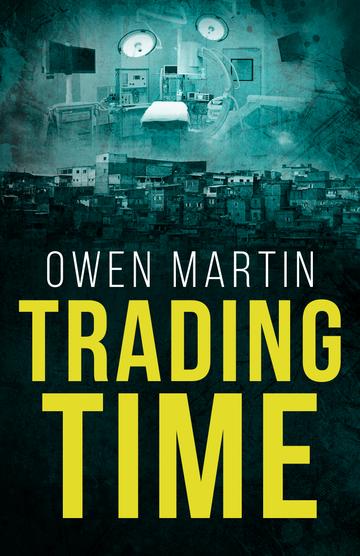
Cover image of “Trading Time” courtesy of RedDoorBooks
SG: Let’s start with the title and the premise – both of which leave the reader with much to think about. In Trading Time, we enter a world where time is a commodity to be bought and sold – but who gains, and how moral and ethical is this new practice? Can you talk about how the premise came about?
OM: I was sitting down in my parent’s house and RTE news announced the death of a very wealthy individual. It occurred to me that this person who owned villas, planes and islands could have purchased almost anything. But he had now passed. What if he could have purchased more time? I started to think more about this and I became fascinated by the subject. If he could buy more time where would he get it? And that is where the idea and title started.
SG: Great to hear that, Owen. Inspiration can come from anywhere and as writers we have to be alert and open to it!
The split narrative – between Brazil (in a favela in Rio) and USA (NYC) works well to build up the narrative tension and you paint a picture of two very different families and places: Gabriel’s mother worries “about bringing home unexplained amounts of money, because experience told her that for people like them there were only a few ways for that to happen: stealing, selling drugs or selling sex.” Julia’s family in “the affluent suburb of Bloomsbury” throw a send-off party because she is jumping “off the career ladder in her father’s law firm to work for a charity in Rio for a year”. How did you research the settings and social strata?
OM: I have been very fortunate in my life and through work and vacation I was able to travel a lot and experience many things. I spent some short time in the Favelas in Rio on vacation and work brought me to the affluent areas on the east coast of the United States. While it would be untrue for me to say that I have experience in either community I have exposure to both and the contrast awakes one senses to how the world does or does not work. I suppose my research was done through life’s experiences.
SG: I particularly enjoyed the Father-Daughter relationship between Geoff and Julia – it’s a relationship that grows and deepens as the tension develops between Geoff and his old friend Larry (who wants to patent the technology to extract time from those willing to give/ sell it to those willing to pay). Can you talk a little about these two characters and their development?
OM: It was easy for me to characterise Geoff, the professional gentleman with a long history of dedication to his profession and family. A very capable, honourable, reticent member of polite society. Julia on the other hand was much more difficult for me. I had to know where the story was going from the start to position her as the best daughter her parents could hope for. She is bright, social, talented and like many daughters, loves her dad. Their relationship grows but is strong from the start.
SG: Trading Time is a real page turner. It moves along at quite a narrative pace: can you talk a little about the writing techniques you used to keep up the pace – such as chapter length, your use of dialogue, narrative hooks at the end of chapters and so on – and your editorial process with RedDoorBooks.
OM: One hopes to engage the reader. Chapter length takes second place to the story and fall naturally into place. The first and last line of a chapter must carry the reader on. Dialogue can be over played but enables the formation of the characters. The editorial process is slow and hard work. Fortunately, I could rely on RedDoorBooks to carry out much of this work for me.
SG: Good to hear that you had such a great editorial team at RedDoorBooks.
One of the other themes in this novel is the question of change – what does it mean to make change for good? Can “Big Industry” change the world for profit and good? Can individuals make a difference? Here we have the power of the story of Gabriel and Isabella being harnessed by Julia and Geoff for change.
“The laws of ownership are what change everything” Geoff tells Julia. Geoff, we’re told “loved the law because there were rules and precedents to follow and argue over. There were no such rules and precedes for the ethical and spiritual questions like the ones going round and round his head now.”
Carol states that “not all rich people can be useful.” Can you comment on the theme of change for good?
OM: I tried to steer a middle ground in the book and let the reader be the judge of right and wrong. Change is inevitable and maybe even necessary and is generally a force for good – otherwise we would not be here. Societies have learned that certain change must be governed. I suppose one of the themes of the book is governance.
SG: Yes, indeed, governance and power and how they are used/misused are themes throughout Trading Time.
Lastly, Owen, some fun questions:
Lake or bog? Lake. I live beside one and I love it.
New York or Rio? New York I guess.
Coffee or tea? Either. It depends on circumstances.
What book are you reading at the moment?Back to Work – Bill Clinton
What are you writing right now? Nothing – I am consumed with work
Thanks for your time and energy in participating in my Writers Chat Series, Owen. I wish you the very best with Trading Time.
Photograph of author Owen Martin by Vierwaldstatter See in Switzerland, with a mask pulled down around his chin. He is smiling. Photograph courtesy of Owen Martin.
With thanks to Antoinette Rock and RedDoorBooks for providing me with a copy of Trading Time. With thanks to Nessa O’Mahony for the introduction.
Louise, You’re very welcome to my Writers Chat series where we’re going to chat about your critically acclaimed short story collection The End of the World is a Cul De Sac (Bloomsbury: London, 2021).
You’ve had many accolades about your stories but I particularly like Anne Enright’s description. She says your stories “breath, talk, kick up: they have a pulse.” For me not only do they “ have a pulse” but they sink into your subconscious, and stick with you. It is not surprising that “In Silhouette” and “Sparing the Heather” were shortlisted for the The Sunday Times Audible Short Story Award in 2019 and 2020.
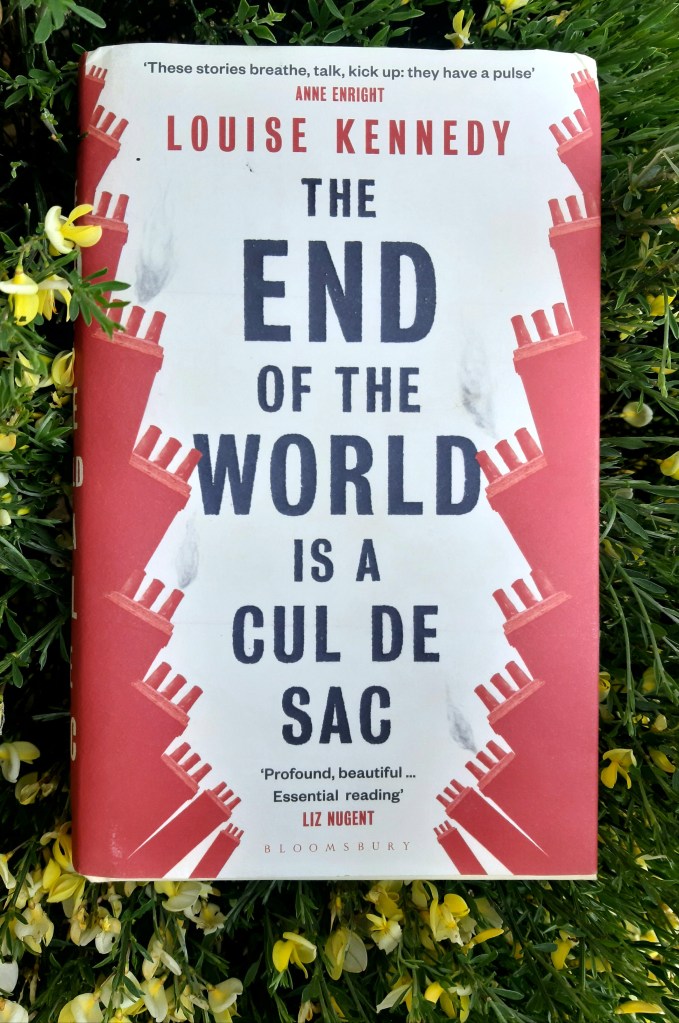
Photograph of The End of The World is a Cul de Sac by Louise Kennedy – resting on a green shrub with yellow flowers
SG: Let’s start with the form of the short story. In an interview with Rosita Boland, you spoke about your path to writing – a night class with a friend. What attracted you or drew you to the form of the short story rather than, let’s say, flash fiction, poetry, or novel?
LK: As I explained in that interview, I joined a writing group almost by accident. At the first meeting it was agreed that each week one of us would submit a short story of roughly 2000 words, although I don’t think I contributed much to the conversation. I suppose the form is a relatively achievable unit of fiction and suits the workshop model of writing groups and creative writing programmes. I was fifth to submit. My story was an attempt at dramatising a family anecdote about the time my grandmother, a teenage wannabe flapper, put Rudolf Valentino’s name on the November dead list in Holy Cross Church in Ardoyne beneath that of her father, who had been killed in World War 1. We managed to stick pretty strictly to that rota, which meant I was producing a new piece of work every few weeks. Within a year I had begun attempting fiction.
I had always read short stories, beginning with Sinéad de Valera’s Irish Fairy Tales, and the Puffin Book of Princesses and as a teenager loved Roald Dahl’s Tales of the Unexpected. I think Exploring English 1, which I enjoyed much more than the novel we were assigned, made me keeping reading them, so in bookshops and libraries I often picked up collections and anthologies. The ones that were important to me in my twenties and thirties were The Way-Paver by Anne Devlin, The Stories of Eva Luna by Isabelle Allende and everything I could get my hands on by Ellen Gilchrist. As readers we take in not just story but craft elements such as structure and tone, so perhaps when I began trying to write my own stories I had a subconscious understanding of how the form works.
For the first few months all my stories were coming in at 2000 words or so, which is the length required by many competitions. A few shortlistings and wins encouraged me to keep going, but I found that some ideas required rather more words and some required fewer. That felt like a departure, letting the stories take the shape and space they needed, learning that each idea required a distinct approach. Much as I love reading poetry I was never inclined to attempt it myself, but attended a class once, out of curiosity. In response to a prompt, everyone else produced a poem and I left with a piece of flash fiction. I am finishing work on a novel and have found the process very different from working in the short form: big machinery is required to keep the story moving. Short stories are tricky wee articles, but I love the precision they demand, the tone that must be found from the first word and held to the end. Written well, they can offer devastating glimpses of how we are in the world and what we do to each other.
SG: I love the sound of that story about your grandmother! I’d agree with what you say about reading – read well/write well. And I like what you say about letting the stories take the shape and space they needed.
In all of these stories, setting is key. In the title story the narrative shifts because of the transient, unsettled nature of the setting: the ghost housing estate, the empty feel of rooms. What is absent is as important as what is present. In the hilarious but poignant “Beyond Carthage”, Noreen and Therese are in the wrong place at the wrong time. How important is setting to you as a writer?
LK: The germ of an idea is often a vague, almost elusive thing. Story only begins to generate for me when I place it somewhere. So yes, setting is hugely important to me. The End of the World is a Cul de Sac is set in the north west, sometimes obviously so, sometimes in a more liminal sense, particularly in the border stories. I suppose my approach to place is always that of a stranger. Until I was twelve, I lived near Belfast. Since then I have lived in various places in Ireland and elsewhere. Maybe this perspective makes me look deeply at where I am. When I go for walks I take photographs of wildflowers and birds and go home and look them up. I read about archaeology, history, mythology. At the time of writing I was not necessarily conscious of what I was doing, but can see now that perhaps these interests added layers. I am interested in the built environment too, the marks that humans have left on landscape. In the north west, this is could be a fairy fort or a ghost estate. Domestic spaces are important to me too: the objects with which we surround ourselves, the food we eat, the way we decorate our homes. I am not confident about giving the reader access to a character’s inner thoughts and perhaps I try to circumvent that by showing how people interact with where they are. It is possible that this is effective in the short story, where economy is everything; each element has to work its arse off.
SG: Thanks for that honesty, Louise, that the story can’t grow for you until you place it somewhere – whether it’s a kitchen, a fairy fort, a ghost estate. Much of your writing is sensory and I love how you pay attention to the details of where each character is at – what they see, where they step, what they hear and so on. For example, in “Sparing The Heather”, Mairead’s foot “bounced off something sleek that made a tight, high sound like a baby’s toy. A crow from an earlier cull, squeaking with maggots.” We don’t see Mairead’s reaction which allows us to react and as disgusting as the image is, it is also thrilling. Can you talk about your use of the senses?
LK: Thank you for saying that image is thrilling. You might be interested to know where it came from. I was once given a pheasant which had been hung for too long. I pressed my hand to its breast and it literally squeaked. In fact, a flurry of blue bottles flew from its dead mouth, a detail I spared the reader when I used it in the story. Lovely, huh?
(SG: Yeah!!)
I sometimes wonder if I have an overdeveloped sensory system. I think part of the reason for this is that in my previous life I was a chef and the kitchen is a highly sensory environment. When we cook we use touch, taste, sight, sound, smell, and it is natural to me to describe these things. I suppose we have a common sense of what is pleasant or unpleasant, so it didn’t occur to me to say how Mairead felt about that sensation, because most of us would find it horrifying; fictional characters should not be so very different from real people. And I think that being human is about how we experience our environment, so for me there is a connection between the senses and place.
SG: Hmm, yes, because we are and exist where we are. Many of the stories in this collection also centre around the complexities of family. I was particularly moved by your tender portrait of the young family in “Brittle Things” and how Dan, the father, is so consumed by self-deception that he can’t see that his young son needs more than the care he’s being so lovingly given by Ciara who, in turn, muses:
The girls asked around Ferdia, never about him…When she talked about him they listened and smiled…It seemed to her that ‘you’re amazing’ meant ‘how do you tolerate your life?’
I think part of the what good writers do is not place judgement or values on their characters and their lives and this is a great example of that. This story strikes me as a study in human behaviour where every person, and not just Ferdia, exists in their own social construction, their own creation of reality. Was family a conscious theme in the collection or did it emerge through your selection of your stories?
LK: We are all part of families, in one way or another, those we grew up in and those we try to make. These are our most important relationships, but can be so fraught. In order to live with people we have to make accomodations every single day, and some of us are better at that than others. Each of us carries the hurt and disappointment of previous failed connections; we are like human velcro, all that pain sticking to us. I think it is hard to move through the world with that burden. I like what you said about each of my characters living in their own social construction. There can be, I think, a particular sort of loneliness in being surrounded by people that is almost exquisite. Ferdia is living in his own world and Ciara is no less lonely, craving connection with her boy and understanding from his father. But although her marriage is under terrible strain, there is still love and loyalty and desire. People are so complex, and I wanted the stories to reflect that.
I tried to approach all the characters with empathy. Even in ‘Imbolc’, in which Liam behaves abominably, it was Elaine who brought the money men into their lives. And far from seeing Stacey Rainey as a seductress, I think she’s just a vulnerable kid who is being used by Liam to exact revenge on both her brother and Elaine. So to answer your question, I didn’t deliberately write about family and relationships, but what else is there?
SG: Yes, I felt so sad for all three – Liam, Elaine and Stacey – trapped in this horrible cycle. Yet the women in your stories, while often trapped by circumstances – place, economics, health – are very much connected to their bodies and their environment. In the wonderfully structured “Gibraltar”, we have this sentence which hit me hard:
Shona looks tired, her pregnant belly only a little fuller than her mother’s distended abdomen.
In “Imbolc” after she discovers one of her worst fears to be true, Elaine is unable to see her feet because the
blue of the fields seemed to drain the air of light…Her feet sank deep in the snow and each step was exhausting. A sob was bulging at the back of her throat.
In “Garland Sunday” a steady, stark study of emotional and physical mending you have such a close and realistic description of Orla’s skincare routine before bed:
Upstairs, she took off her make-up and smeared night cream across her face, over her loose jawline and the rucks between her eyes.
Your use of language, whether it’s strong verbs (drain/bulging/smeared) or precise adjectives is what brings us into the body of the both the story and these women. Can you talk about this?
LK: The language I use is, I guess, plain, although when I’m writing about the natural world I do indulge myself. A bit. And plain words are blunt, which is perhaps powerful. I try to allow myself to write ardently in early drafts and I think in the editing process, which for me is very long, what is left still has some of that energy. I avoid using adverbs and therefore have to rely on verbs to do the heavy lifting; it is vital that these are the right words, so quite a bit of time goes into that. Also, I am working from a few different lexicons: the formal English I have taken in as a reader; the language I heard as a child in the north that is peppered with Ulster Scots; the demotic, a type of Hiberno-English, I suppose, that is used where I live now.
Again, it is also about the precison demanded by the short story form. I am so happy you think the words I chose took you into the body of the stories. Thank you.
I am fascinated with what it is to occupy a female body and all the ways in which it can betray us – lust, fertility, sickness ageing. I think our bodies are wondrous – we can carry life! – but also terrifying. Many of the things that are supposedly natural are actually barbaric, especially many women’s experience of childbirth. And of course the female body has been so objectified that all this is complicated by ideas of beauty. With regard to the language I use, maybe calling things what they are is powerful.
SG: Oh I’d love to talk more about lexicons and even how identity is linked to language. Perhaps for our next chat?
For now, Louise, tell us about the titles of your stories. There wasn’t one in this collection that I didn’t think was exactly the right title for the story. “Hands”, for example, was such a perfect title and created an atmosphere of both disappointment and yearning that it is still with me and I think of that power of our hands and that of parental and filial love.
LK: Thank you, I’m delighted you think the titles are appropriate. Most of them arrived quickly. The title story came from something my sister said when we were children: she asked if the end of the world is a cul de sac. I felt that, for Sarah, Hawthorn Close is the end of the world. ‘Huntergathers’ came to me before I wrote a single word of the story; all I knew was that a man, who fancied himself as being ‘at one’ with nature, was going to kill a hare his partner loved. ‘Once Upon a Pair of Wheels’ is a line from a Paul Simon song, ‘Baby Driver’. I had an image of teenage Aidan behind a steering wheel, and the words ‘once upon’ made it sound like a fucked up fairy tale. In ‘What the Birds Heard’ I like to think that Doireann was having some kind of sensuous awakening of which she was not fully conscious, while the birds and insects were alert to what was happening to her. ‘Belladonna’ is Italian for beautiful woman, but also the name of a poison. I stole ‘Powder’ from Tobias Wolf, although his was about snow. ‘Sparing the Heather’ is from an old Irish saying about meanness; heather is plentiful, so there is no need to be miserable with it. I suppose I hoped they would all operate on a couple of levels. The one I was least sure about was ‘In Silhouette’- it was only ever meant tot be a working title – but it got kind of stuck there and seems to be doing the job. And isn’t ‘silhouette’ a gorgeous word?
SG: And that’s why I felt the titles worked – they all operate on a number of levels both as entry points into the stories and as hooks for us to hold onto when we’ve finished. ‘In Silhouette’ is particularly powerful. We’ll end this Writers Chat, Louise with some short fun questions:
If you had to pick a favourite story from this collection which story would it be? ‘In Silhouette’ is my favourite. I used the second person point of view for the first time in that story and it is structurally and temporally different from anything I’d tried before. The writing of it also helped me find my way with ‘Sparing the Heather’, so if I had not given myself permission to muck around I would have written neither of them. And in terms of my career it changed my life. Within a year of it being published in The Tangerine, it had got me Eleanor Birne, my brilliant agent, a shortlisting for the Sunday Times Audible Short Story Award and a publishing contract.
Mountains or sea? I live very near the sea and possibly take it for granted, which I realise is terrible. I love the softer landscapes of lakes and woods, neither of which you gave as options. So maybe mountains?
I’ll have to expand my options from two to four! So, music or silence when you write, and, if music, what type? I don’t play music as I write, but when I am working on something there is usually a playlist, a sort of sonic mood board. While working on the novel I’ve been listening to Sister Rosetta Thorpe, Horslips, the Bay City Rollers, Ottolie Patterson, Steve Harley and Cockney Rebel. Which probably sounds nuts.
I listened to Sister Rosetta Thorpe when writing my first novel and she ended up in it! What are you reading now? My tbr pile is a disgrace at the moment, and I honestly don’t know where to start. I’ve recently finished two great books: Easter Rising, by the Irish-American writer Michael Patrick MacDonald, and Deborah Levy’s Real Estate.
Thank you, Louise, for taking part in my Writers Chat Series and for providing us with such considered answers. I wish you much continued success with The End of The World is a Cul de Sac and look forward to your novel.
Nuala, You’re very welcome back to my Writers Chat series. This time we’re here to chat about Nora, your fifth novel, lauded by Edna O’Brien as “a lively and loving paean to the indomitable Nora Barnacle”. I read the US version published by Harper Perennial and the Ireland/UK publication with New Island was published April 10th.
Photograph of cover of NORA by Nuala O’Connor
SG: Much has been written about your lyrical, sensual prose and Nora is filled with it from when Jim and Nora leave Dublin on October 8, 1904: (“The air is salt-sweet and cool, the portholes beam light into the dusk”) to the letters and the food, which we’ll return to. But let’s start with “the indomitable Nora Barnacle” – by the end of the book I really felt I’d lived through Nora’s life with her, I felt like I knew her, I cared for her. You have managed to re-create Nora who feels real and complicated, a woman who knows her own mind and whose strength lies in her patience and openness to the human condition. Tell me about how you got to know Nora through your research.
NOC: I knew Nora Barnacle as Joyce’s strong, loyal, loving wife and muse but I was curious about how she felt about her life. Bio-fiction is about creating an interior world for people and I disliked the smudging of Nora by history. So I dug out my teenage copy of Brenda Maddox’s fantastic biography of Nora and was, once again, enthralled by her earthy dynamism, and by their love story. So I did what I often do when my interest is piqued, I wrote a short story about Nora. My story – ‘Gooseen’ – records their meeting in Dublin and their first date on 16th June 1904 – now immortalised as Bloomsday – and their flit to Europe. The story did well – it won a prize and was published in Granta – but I found I didn’t want that to be the end of my communion with Nora, I wanted to stay in her company for longer, and so I wrote on and on and on.
My aim was to illustrate that the so-called ordinary woman by Joyce’s side is, in fact, extraordinary. Nora felt, thought, lived and contributed hugely to their life, just as Joyce did. Nora helped Joyce stay grounded as she was pragmatic, optimistic, earthy, big-hearted, good humoured, forthright, and resilient – she was just what Joyce needed as a shy, sensitive, kind, loving, nervy, accusatory, opinionated intellectual. Nora flowed with Joyce, was water to his fire. They were both, like all of us, trying their best, and were under the influence of their upbringing, the prevailing mores and politics of their era, and their own personal quirks and passions – Joyce drank, he was unfaithful, he asked Nora to go with other men. Neither was a paragon – the same way we’re not – and my bio-fiction aims to show that.
SG: You have had glowing reviews and The New York Times declared that Nora is “entirely convincing in her raw sensuality, her stubborn determination, her powerful sense of grievance and her inability to stop loving a deeply erratic, wildly manipulative yet enormously talented man.“
Nora is essentially about the relationship between her and James/Jim Joyce. On the one hand they are well matched physically and erotically, and on the other, Nora is always left to keep the family together, taking in dirty laundry (“I scrub away other people’s sweat, blood, piss, cack and grime with scalding, soapy water”) when they are short of money or when Joyce drinks his wages. How did you maintain that balance between the actual hardship of life – moving frequently, living through two World wars, worries about their young and then adult children – and depicting the deep physical and emotional love between Nora and Jim?
NOC: I don’t think Edwardian era Irish women expected an easy life – Nora had seen her mother, Annie Barnacle, battle through with eight kids and a drinking husband, and eventually separate from Mr Barnacle. If Nora had stayed in Galway, she most likely would have married and settled into a life like her mother’s: mass-going, having babies (lots of them), living within a State that was increasingly wedded to the church, that ruled people into submission; she would’ve been scarred by Civil War and the exodus of men to WW1 etc. By escaping to Europe, Nora was released from a strict, rigid, low expectation path. Fintan O’Toole believes Nora liberated Joyce from shame and snobbery; she certainly uplifted him by being strongminded, flexible, loyal, and direct. Nora’s head wasn’t bothered the way Joyce’s was – she was naturally optimistic, loving, and cheerful, so she could drag them both through a lot of their troubles. Her bravery hooked me into her story; her defiance of patriarchal rules, her bending away from State and church morals.
I like mavericks, women who push against societal norms. So Nora’s courage and her willingness to love the man she aligned herself with, despite his many faults, speaks well of her. She accepted, to an extent, much of what was unruly about Jim – his sensitivity, his need to drink, his discomfort with other people – because she was better able to negotiate all of that. Her love protected him and buoyed him up. In turn, his admiration of her strength, their bedroom bond, his love of her physicality and her stories, and his generosity in adorning her with furs, and tweed and jewellery, pleased them both.
SG: And all of that comes through, so very clearly, in NORA. Continuing with their relationship, you used the real Joyce letters (which you wrote about in The Paris Review) as a basis to frame the many absences from which both Jim and Nora suffer equally. I loved the letters and how their passion contrasted greatly with the reality of ever-changing homes, circles of friends and cities. The constant is their relationship and, from your depiction, Nora is quite the scribe and knows to use words and food to keep Jim on her side! One letter opens with: “My lonely bed is tortured with desire for you, my mind leaps to disturbed places, I see you over me posed and preening, chaste, grotesque, languid…” Can you talk a little about how their use of letters opened the door for your Nora to be as much the erotic voice as Joyce (as we know and expect him to be!), as much present in her body as he is?
NOC: Joyce and Nora were in touch with their sensuality: they met as two young people who were proud of their bodies, and unafraid of sharing themselves wholly with each other. Joyce frequented prostitutes as a teenager and Nora had some experience of young men by the time she met Jim; she had walked out with at least three men that she told him about. And both Joyce and Nora enjoyed the erotic writings of Leopold Ritter von Sacher-Masoch, for whom masochism was named.
I had to rewrite Joyce’s letters as they are still in copyright – they were first published in 1975. And Nora’s half of the correspondence was not available, missing – perhaps destroyed – and I had to fill those gaps with imagined letters of my own. So I re-wrote Joyce’s letters by mimicking his real letters as closely as I could. I wrote Nora’s part of the correspondence using Joyce’s letters as a call-and-response guide. When he praised her for using certain stimulating phrases and words, I included them in her letters to him. Joyce planted the seed for the erotic letters – suggesting to Nora that there was a certain type of letter he would love to have from her while he was in Dublin and she was at home in Trieste – and she was well able to oblige.
SG: Yes, and even though she is a sensuous woman – shown though your sensory writing, the fabrics of clothes, furniture, the preparation of and eating of food – Nora is also practical. When Hitler annexes Austria in March, she tells us “I could fall apart thinking about it all – war, Lucy, Georgie – or I can get on with it. I decide to choose the latter” – which shows the strong woman she is – but at the same time, Jim is, she proclaims, “my whole life now…we have to get on with things as best we can, as a pair.” Despite his unreliability he does give her strength.
Real life events such as wars, the Rising, the Civil War in Ireland punctuate their lives and I thought you convincingly depicted some of the parallel difficulties – even for Joyce! – of the world of writing and publishing. We sometimes forget – when reading Ulysses or Dubliners, for example – that Joyce wrote from a particular place, in a specific era and, as you portray, often with serious health issues, notably his eyes. But in a way he could fall apart because Nora always understands him even when he is absent because “he needs to swallow stories many times in order to construct better ones himself”.
Thinking of the broader themes of the book I wondered if it was because their notion of home and nationhood was always changing, as well as the strength of their relationship and the financial and creative supports such as Weaver, that Joyce was able to continue writing, and write so much from the body?
NOC: They were extremely nomadic because Joyce liked novelty, but they remained loyally Irish, even if they grumbled about Ireland and Irishness. Joyce’s fiction is a prolonged love letter to Ireland. Nora liked newness too, but she understood its damage, also, and longed for a settle spot. Joyce needed tumult in order to write; in his biographer’s words, Joyce ‘throve on flurry’. Naturally, he needed stretches of quiet too, to write. As a couple, and later as a family of four, the Joyces moved house over and over, following a pattern set in Joyce’s own childhood, when his father led the family from their lodgings at night to avoid bailiffs. Uprooting home and family every few months, or years, is a sure way to have new writing fodder; in Paris alone they lived at nineteen different addresses.
You have to wonder what Joyce’s monomania about writing, as Brenda Maddox described it, cost the family as a whole. Maybe it was unfair on Nora, Giorgio and Lucia to be constantly relocated because Joyce needed discomfort in order to write, a sort of constant unsettledness, that settled him into the creative work.
SG: NORA had me wondering about that -his discomfort and creativity, the family being constantly uprooted. As well as passion there is much humour in the book. Sam Beckett, in particular, had me laughing. One of my favourite scenes was Bloomsday in Paris in 1929 where they go on an excursion and the “normally rather serene and usually very mannerly” Beckett and McGreevy sing “endless old songs like a pair of escaped lunatics.” It doesn’t help, of course, that Lucia is madly in love with Beckett, or that Jim “drinks wine until it nearly pours out of his eyes.” Once again, Nora is the rock of sense, the protector, with a wonderfully dry sense of humour. As through the novel I felt I was with them! Do you think that in narrating their lives through Nora’s viewpoint you gained greater insight and humour?
NOC: They were a humorous pair; both of them loved jokes, fun, wordplay, odd language, and silly songs, and Joyce’s letters to family and friends are full of mischief. He used humour in his work but also personally, to create levity in what were really quite difficult years to be alive, Ireland and Europe being war-torn and so on; their various health issues; the publishing challenges he faced.
The 1929 Bloomsday was celebrated that way – Joyce was feeling narky and he was envious of the youthful freedoms of Beckett and McGreevy, because they could make a show of themselves, whereas he, as famous writer and family man, was required to behave. I haven’t seen much discussion about Joyce’s drinking and the very real problems it both masked and caused. That Bloomsday Nora was fed up with it, as she must have been quite often. But she was naturally light-of-outlook and, clearly, she had a well of forgiveness to dip into too, so she was able to keep her heart out and get on with life.
SG: For our final question Nuala, I’d like to concentrate on the beautiful portrait you paint of the relationships between Nora and her children, Giorgio and Lucia. I was particularly taken with the portrait of Lucia from childhood to adulthood, Lucia who, polar opposite to Nora herself, “neither knows who she is nor cares to find out”.
On one of Lucia’s many hospitalisations as a result of her violent tendencies, both Jim and Giorgio point to the, at times, difficult relationship between Nora and Lucia, insisting that Nora not visit her in case she might be agitated. I felt you touched a little on the ‘mother blaming’ here. Nora wonders “if it’s the rearing we gave …or if it’s something that was already in her when she grew inside me. We’re born with a soul, maybe we’re born with all our faults, too?” (Later, after so many institutions and doctors and years of worry, Lucia is diagnosed with schizophrenia.) Can you talk a little about this mother-daughter relationship?
NOC: In NORA, I have great sympathy for the Joyces as parents of a child with mental illness. I have particular empathy with Nora as mother to Lucia, whereas others have demonised Nora, for her apparent lack of care about Lucy, who was diagnosed with schizophrenia in her twenties and institutionalised for fifty years. I don’t agree with this anti-Nora stance; it’s clear that Nora loved Lucia hugely and did as much as she could to help her, until Lucia’s illness became too much to handle in the home environment. Nora had Lucia’s care and, in my novel (and, I believe in life), Nora is fearful, concerned, but loving towards her daughter; crucially, she’s also pragmatic – she can see Lucia needs professional help.
Lucia hit her mother and threw furniture at her; she was volatile, unpredictable, sexually permissive, prone to disappearing for days on end, and she was sometimes catatonic, and often violent, and it fell to Nora to care for her. It’s frightening and worrying enough to have a child who suffers mentally, without being in fear of them too, and Nora bore the brunt of Lucia’s aggression. Added to that Joyce, for a long time, refused to believe there was anything seriously wrong with Lucy, which must have been an isolating experience for Nora, who could see that she was ill, out of control, and needed proper help. It was, in fact, Giorgio who first had Lucia sent to an asylum, but it is always much easier, in our patriarchal world, to blame the woman.
When Lucia was committed, Nora was often advised to stay away as she ‘excited’ Lucia. In 1936, in an institution in Ivry, Lucia tried to strangle Giorgio and Joyce when they visited. So they ‘excited’ her too, but that’s not what people choose to remember. Once, when Nora visited her daughter in a Zürich hospital, Lucia had painted her face with ink and was wearing an opera cloak. She was clearly very unwell and Nora wanted her taken care of properly. When Lucia went to Ireland to live with her cousins in Bray, she took naked sea swims; lived on a diet of champagne, cigarettes and fruit; went out without underwear and told people that; she went to pubs alone (unheard of for women); and set fires in her cousins’ house, putting them all in danger. Her condition meant she was volatile to be around and she must have found her own self troubling too. I feel strongly that Nora did her best in difficult circumstances; Lucia needed professional care and she got that.
SG: Thank you, Nuala for such insight into your process and research. We’ll end with some short questions:
What was your favourite city out of the those you visited as part of your research?Trieste was a revelation; I hadn’t been there before, so it had a shiny, newness for me. It’s a seductive place, ‘the jewel of the Adriatic’, sitting by that blue, blue sea. It’s still very ancient, with a huge piazza and winding cobbled streets, but it has wonderful food and a bright, light, cosmopolitan feel to it. We went as a family and the kids loved it too. We look forward to going back.
If you had Nora and Jim as dinner guests, what would you serve, and why? Hearty Irish food – bacon and cabbage, or some such. It’s not my kind of food (as a longterm veggie) but they would love it. Apple tart and custard for dessert – Joyce mostly preferred sweet things.
You’re very good – pandering to their choices! What are you working on now? Another bio-fictional novel about another feisty Irish woman, This one set in the 18th century. It’s been good fun, and I’m free to invent more, as there are very few hard facts about this woman. I’m enjoying it.
What are you reading now? About a gazillion things. Research books for the novel I’m writing (other novels set in the 18th C, court trials, history books) but, also, Elizabeth Bowen’s short stories for a reading group I’m in (we exclusively read Bowen). I’m also reading/reviewing Julia Parry’s The Shadowy Third about Parry’s grandfather’s affair with Bowen and it’s really, really good.
More on NORA:
NORA launches online in Galway on 23rd April in association with Cúirt International Festival of Literature where Nuala will be interviewed by Elaine Feeney. Time 5.30pm.
Nora was launched online in Dublin on 9th April at 7pm, in association with MOLI to a large audience. It was a great event.
See Nuala’s website for details of more upcoming events.




 Shauna Gilligan Writer