Writers Chat 18: Wade Stevenson on “Songs of the Sun Amor” (BlazeVox: New York, 2019)

Wade, You are very welcome to my WRITERS CHAT series.Ā Congratulations on your latest publication, a poetry collection Songs of the Sun Amor (Blaze Vox Books: New York, 2019). Songs of the Sun AmorĀ can be purchased directly from BlazeVox.Ā 

Wade19-cov-lg
The stunning cover image of Songs of the Sun Amor shows a picture of the author’s daughter balancing upside down on the beach at sunset.

SG: Your work has previously been described by critics as ā€˜emotionally satisfying’ and ā€˜profound’.Ā 

I found myself very moved by a number of the poems, perhaps, I feel, the most personal in the collection, and, at the same time, the most universal.

In ā€˜About My Mother’ and ā€˜The Map of Elsewhere’, the early loss of your mother is explored and in ā€˜Black Sheep’, and ā€˜Sun, No Son’, the difficult relationship with your father. Could you talk about the placement of these poems in Songs of Sun Amor. They sit, almost as beacons, in between tones of humour and angst.

WS: You are right: my poems are meant to be complete in themselves and to have an immediate emotional impact. The reader may experience them as I wrote them: with the shock of recognition. There is a certain sadness of course, a lingering melancholy, but there is also the humour and the joy. My editor had suggested that my book be organized thematically. He said he found three main themes: the mother/father/child relationship, the lover/partner/wife relationship, and the relationship of the search for a going beyond or transcendence. However, I thought it would be more interesting for the reader to experience My Sun Amor poems as a progression, with certain poems as you say acting as beacons and lighting the way forward. One of the poems you refer to ends with the line: ā€œReal Amor was on the map of elsewhere.ā€ That marks the separation from the mother and father and the beginning of the poetic journey to find that ā€œReal Amor.ā€ Ultimately it leads to the conclusion or illumination if you like, of the last lines of the book, the conscious coupling with the ā€œSun Amor immensity.ā€

SG: Much of Songs of Sun Amor is concerned with the search for and hope of finding the self, and, at times, escaping this self. In ā€œThe Map of Elsewhereā€ we learn that ā€˜I discovered love in strange places/Real Amor was on the map of elsewhere’ and in ā€œBio Poemā€ the past is linked to the future

ā€˜with a simple ampersand/Ghost floating through the hourglass of your life/Longing to break the glass, rise in the air, free’.

Can you tell us about these themes – did they emerge as the collection formed or had you those themes in mind?

WS:Ā Let me share a secret with you: I didn’t write my ā€œSun Amorā€ book. It wrote itself. The themes emerged by themselves in an organic way. One of my first memories as a child was that of being trapped not only in my own family but in my own body. I didn’t want to be a prisoner of myself or of the accident of my birth. To do that I had to recreate myself, ā€œto find the promise of a life reborn.ā€ How to escape the limitations of the self, of the language that defines you? I did it from an early age by a process of carefully organized revolt. I did it through literature and poetry, I did it through travels and encounters, I did it through learning and assimilating other languages and cultures that were not my own. I made my own ā€œelsewhere.ā€ My Sun Amor book is the result of that search. The reader can explore that geography and find some really interesting things that will help them in their own relationships.

SG:Ā I think that journey of escaping through immersion elsewhere really comes through in the collection. I’m also interested in the title of the collection, as on reading it for the second and third time, I found myself wanting to read many of the poems aloud and it occurred to me that they were almost hymn-like, particularly with the sparing use of punctuation. I’m thinking here, for example, of ā€œMirror Manā€, after the great line ā€˜I’m the tossed back of my father’, the poem comes at the reader with each line, almost like listing off the anger points. I’m also thinking of ā€œAmor Beliefā€ and ā€œThe Language of Sunflowers.ā€ And, of course, the striking ā€œA Question of Painā€. Can you talk a little bit about this?

WS: All my books are about pain and loss and recovery and the quest for transcendence, for finding a way to heal and go beyond. As I wrote in one poem, ā€œThe good doctor Amor will repair all the broken/ With threads of solar gold.ā€ It’s true that the collection could have been titled ā€œHymns to the Sun Amor.ā€ It’s also true that the lines are constructed in such a way that they almost cry out to be read aloud. When I write them, or rather work on them, it’s as if I had another deeper voice in my head reciting them. Poetry from the beginning was an oral tradition. And it’s regained some popularity today due to the performance poetry readings. One of my favourite poems is ā€œMy Amor Belief.ā€ In these dark times, when there are so many forms of hatred and intolerance, it would be amazing if we all could just ā€œlearn how to breathe and to be/ Relieved of belief, of religion free.ā€

SG:Ā Yes, it is a beautiful line, Wade, and I wonder how we can do that, learn to breathe and be relieved of belief and religion. But God, nature, landscape and beauty also feature in Songs of the Sun Amor. They seem, to me, to be intertwined, as if a dialogue between them is running concurrently with the narrator’s life, and, at the same time, with the continuum of time – the back and forth between past, present and future. Could you tell us a little bit about your use of time in the collection? I’m thinking, specifically, of ā€œBig blue beautiful youā€, ā€œThe Language of Sunflowersā€ – ā€˜Seize the special moment that comes/Between the breathing in and the breathing out’ and ā€˜Spend an hour lying in the summer grass/Listening to what the yellow flowers say.’ This speaks to me of recapturing childhood. Irish writer Desmond Hogan once said that writing is about ā€˜keeping childhood alive’.

WS:Ā I’ve made many trips to Japan, spending some time in a ā€œryokanā€ in Kyoto, and I feel a great affinity with the deep spiritual essence of Japanese culture. They have an obsession with nature and an obsessions with perfection in even the simplest things, like a bowl or a shadow or a cherry blossom. The Shinto religion is based on a reverence for nature. It’s interesting that in a Shinto shrine, there is no decoration, none at all. There is only an image of the sun. The sun is considered to be female, a goddess and the supreme deity (Amaterasu). And I think today, perhaps more than ever, we are all looking and thirsting for some illumination in our lives, for ā€œthe flash that stuns/ Awake from the sun god’s gun.ā€

SG:Ā That is fascinating. I hadn’t connected your work to the deity. I shall have to have another read, with new eyes! After I had read the collection I found myself thinking about the stories within the poems and I wonder if you would ever return to the form of fiction again?

WS: Each poem in My Sun Amor book tells a story, and that story, like those Russian dolls, is imbricated in and part of a larger story, and it all leads back to Amor. And I have written fictions and a memoir, all about Amor with a small A by the way, in my books ā€œOne Tine in Parisā€ and ā€œThe Electric Affinities.ā€ And there may be one more to come.

SG:Ā That is lovely to hear that there may be another novel to come. Lastly, Wade, some fun questions:

  • City or countryside?Ā  I was born in the Big Apple but I would to live in the countryside with wild horses and apple trees.
  • America or Europe? When I am in Europe I miss America. And viceversa.
  • Coffee or tea? Japanese green tea.
  • What writing project are you working on now? A book of poems entitled ā€œGoing Head to Head.ā€ It’s about my head and your head and how we can escape from our heads and move into some other dimension.

SG:Ā Well, Wade, thank you so much for participating in my Writers Chat series. It has been wonderful chatting with you and I wish you well with this collection and your forthcoming one Going Head to Head.

Wade Photo
Wade Stevenson in Rome on a balcony in front of the studio where Keats died.

Songs of The Sun AmorĀ can be purchased directly from BlazeVox.Ā 


Reading, Thinking, Questioning…

20190310_163442

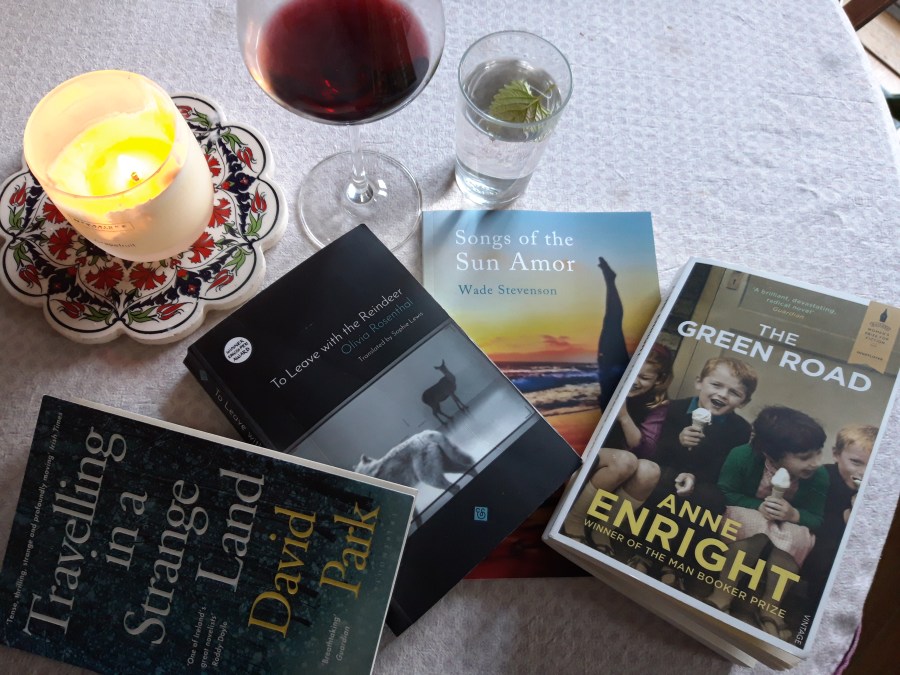
I’m currently readingĀ Songs of the Sun AmorĀ by Wade Stevenson (Blaze Vox: New York, 2019) and looking forward to welcoming Wade to my Writers’ Chat series shortly.

Meanwhile I’m almost done re-reading Anne Enright’s greatĀ The Green Road,Ā at the same time I’m torn between not wanting to putĀ To Leave with the ReindeerĀ (by Olivia Rosenthal – &Other Stories: London, 2019) on a bookshelf as I find myself returning to it again and again, and wanting to continue reading David Park’sĀ Travelling in a Strange Land (Bloomsbury: London, 2018). This is the joy and the pull of having wonderful books to hand.

Onwards to the words….

Writers Chat 16: Tanya Farrelly on “When Your Eyes Close” (Killer Reads/Harper Collins: London, 2018)

Tanya,Ā You are very welcome to my WRITERS CHAT series. Congratulations on your second novel, When Your Eyes Close, which follows on from your short story collection When Black Dogs Sing (which won the Kate O’Brien Award in 2017) and The Girl Behind The Lens, another literary thriller published by Killer Reads.Ā 

y450-274

Sam Blake, author of The Cathy Connolly Series has said that When Your Eyes Close is ā€˜A superbly twisty tale’ and that describes so well my reading experience of it. The first question has two parts:

It’s a fast-paced page-turner and I loved how you used multiple narrators. Can you talk a little about that, please? Did the story come to you through the characters – Nick, Michelle and Caitlin – or did you have the plot worked out and then decided to tell the story through the viewpoints of three characters?

Tell us about the title. It’s such a perfect title for the story and captures all the complex themes. Did it come before you finished the book or after?

Hi Shauna and thanks for inviting me to participate.

I knew from the beginning that the story would be told from three perspectives, the primary story being Nick’s. I was driving down the motorway one night on my way home when the concept came to me: a man is diagnosed with liver failure, he undergoes hypnosis in order to try to stop drinking, but while he is under hypnosis he is accidentally regressed to a previous life where he sees himself commit a terrible crime. I guess I had plenty to work with once I had that concept. I figured it would be interesting if Nick had died before he’d even reached middle age in his previous life, that way his daughter Caitlin would be just a little older than him in the present.

I’m not someone who plans and plots, I prefer the characters to take me on their journey, and the plot unfolds as a result of their decisions and actions. Caitlin’s story was more difficult to execute – I knew that her husband was missing, but for a long time I had no idea where he’d gone – then I came up with two options, hopefully I chose the right one! With regard to Michelle, I wanted her to play a very active role in the story, there would have been no point in giving her a voice if she’d simply been Nick’s girlfriend.

You’ve asked me about the title – titles are something I struggle with, I can write full stories with little difficulty and then I labour over titles, which sounds absurd! It was the marketing team who came up with ā€œWhen Your Eyes Closeā€. My original title was ā€œOut of Timeā€ which I felt brought together the two aspects of the story – Nick’s regression and the fact that he was running out of time for his transplant. The publisher didn’t like that – so they sent me an alternative title, which I really hated – then they send on some more, and I have to admit, I love this one!

SG: Titles are hard, alright, so it’s great to have a team behind you who can help with that. Interesting about the different options you had for Caitlin’s husband – well, the one you picked definitelyĀ works!Ā 

You explore some very topical themes in When Your Eyes Close – especially homelessness and what it means to belong (to a family, a home, or even an identity). A fitness instructor by day, at night Michelle volunteers on soup runs with the Simon Community in Dublin city centre. In one of the early chapters, Nick knows of a homeless man who literally crosses his path that ā€œonly if he were lucky would he find a shelter for the night.ā€ It’s a very human story – as Michelle muses thinking about one of the men she helps, that he only liked tuna and cheese sandwiches: ā€œThat was the thing about volunteering, you got to know the people, their likes and dislikes.ā€

Can you tell us about research you did to bring this into the novel?

TF: I’d like to say that I got out on the street to research this aspect of the novel, but I didn’t. The most important skill for any writer is to be able to imagine yourself into any situation. It wasn’t difficult to think about what life must be like on the streets. This is a social problem which has been allowed to escalate unchecked until it has grown to epic proportions. The government should have seen the need for more social housing long before it resulted in families living hotels, which ironically costs the government more money. The other social issue which I’ve talked about is the shortcomings in the heath system: this is something that I have experienced first-hand. In 2010 my mother was diagnosed with Multiple Myeloma, a Cancer of the blood inside the bone marrow. The Cancer had damaged her kidneys, so she began a very intensive period of having chemotherapy and kidney dialysis, which meant having to take her to the hospital four days per week. During that time we suffered the frustrations of late prescriptions, an unavailability of doctors to see her – being batted back and forth between two hospital departments, and worst of all the consultant’s failure to either recognise or act upon the fact that the cancer had returned after she had been in remission for two years. After being fobbed off with my concerns that my mother was seriously ill, I finally had to go on the Internet to find her consultant’s email address and contact her directly. My mother died two weeks after admittance, in 2015, from septicemia. I didn’t expect my story to become Michelle’s, but it did. Traumatic and life-changing events will generally find a way into our writing, often it is unplanned.

SG: Yes, the shortcomings of the health system is very clearly explored, and I am so sorry to hear that it is based on what sounds like a traumatic experience for your mother and for you. My deepest sympathies.Ā 

On another note, I was fascinated about what happens to Nick when he undergoes hypnosis. It raises a lot of questions about identity and ways of being in the world. How can we really – if ever – get away from our past, and past generations? How much do we carry with us? Or does it mean, as Nick says ā€œthat death was not the end.ā€? This is at the heart of the novel, really, isn’t it? How did you come to write about confabulation?

TF: A number of years ago I read a fascinating book entitled ā€œMany Lives, Many Masters.ā€ It is the true story of an American psychiatrist, Dr Brian Weiss and of how he went from being a sceptic to believing in reincarnation. Weiss was working with a patient who had been referred to him because she had a number of phobias – she was afraid of water, she had difficulty in swallowing pills etc. Weiss had been working with her for some time, they’d discussed and identified several possible reasons for her phobias and he felt that she should have been better at this stage. Thinking that perhaps there was another reason, some childhood memory that she had blocked, he decided to try hypnosis. Whilst under hypnosis, Weiss’s patient described herself in another time and place, not believing in past lives, Weiss felt there had to be some logical explanation, that perhaps his patient had interest in history, but every time he hypnotised her the same thing happened. Spookily, the patient began speaking to him in different voices- voices of the ā€œmastersā€ – she told Weiss things about his own life, which were confidential, things that his colleagues in the hospital were unaware of, for example the fact that he’d had a baby that died at only a few weeks old due a hole in its heart. He began to wonder if there was some truth to what the woman was describing in her sessions. Whether or not you believe in such things as reincarnation, and I’m not saying I do, but it’s a truly compelling idea. The ā€œmastersā€ tell Weiss through his patient that we are sent here to learn a lesson and if that lesson is not learned, we are sent back again, we have many things to learn before we reach the final stages of evolution. The book also talks about how people are reborn into the same circle, that your teacher in one life may have been your father in another and so on. I had really wanted to explore this idea in relation to Michelle and her relationship with Nick, but my editor felt that it was a step too far – she wanted the story to be based 90% in reality and only 10% about regression, so I had to pull right on the regression theme in order not to alienate readers.

SG: Oh that is so fascinating! I’d have loved more about regression as it struck me as such an unusualĀ element in a thriller. I must look upĀ Many Lives, Many Masters.Ā 

You paint a very moving and at times upsetting picture of Dublin as a city, almost a character, and the novel also explores how it does – or does not – care for those who live there. Yet there is solace to be found – in the bars where live music is played (where Caitlin plays with her band), in the restaurants, and in the quietness of the night.

TF: When we create characters we have to think of them as real people – real people have likes, dislikes, hobbies, idiosyncrasies etc. I tend to enjoy writing artistic characters; after writing my second love is music, I sing, play guitar and am part of a ukulele session that meet in the Harbour Bar in Bray on a Tuesday night. One of my closest friends used to run a music night in the Ormond Wine Bar on Ormond Quay – now sadly gone – and I used to enjoy the music there on a Wednesday night. I always like to include different things that friends will recognise and be amused by, as well using these things to enrich characters and make them all the more believable.

Regarding landscape, I think it’s also an important part of a novel. Dublin is my native city and so both of my novels are set here. I wouldn’t feel comfortable setting a novel in a city or country where I hadn’t lived – there are too many potential pitfalls. Here I know the geography, I know how people speak. Interestingly, I had to change a couple of Dublin expressions I’d used in dialogue as my London editor had no idea what I meant – ā€œyou know yourself….ā€! 😊

SG: Oh yes, I have had experience of that myself. Hiberno English is always like another language to those outside of Ireland.

I always find that despite myself in novels with multiple narrators, I always end up favouring one narrator. In this case it was Michelle, probably because of her earnestness and wonderful curious and questioning mind. She’s great at reading people and I liked how she used all types of information in trying to figure out what happened to Nick in his past and David before he disappeared. She takes all her information, from psychics to research and uses it, believing what she sees and trusting her instinct. Was Michelle one of the first or last character to come to you? Dare I ask if you have a favourite in the cast of When Your Eyes Close?

TF: Michelle has a lot in common with me – far more so than the other two characters. Like I said before, I wanted to ensure that she was an active character – not simply Nick’s girlfriend. I experienced a painful breakup in the early stages of writing When Your Eyes Close and I used that experience in both Michelle’s bafflement at Nick’s disappearing act in the beginning of the novel, and also in Caitlin’s confoundment at David’s disappearance. Being dumped without any explanation is a horrible thing, you could drive yourself mad trying to figure out why it happened and silence is the worst kind of punishment – I’m a communicator, if something’s wrong, I like to talk it through, evasion is simply a cowardly non-action. But experiences never go to waste, not when you’re a writer!! I don’t know if I have a favourite character among the cast, they are all different -they all have their strengths and their flaws. I often enjoy writing characters that are completely dissimilar to me – in The Girl Behind the Lens, Oliver Molloy is a total cad, I had great fun writing him – I even felt sorry for him at times. Like I say, being able to inhabit another person’s mind is one of the most important things about being a writer. If you couldn’t do that, everything would be autobiographical and we would soon run out of material!

SG: Yes, I agree. It is one of the fun things of writing – inhabiting others’ lives as it were and enjoying what that feels like.

Lastly, Tanya, some fun questions:

  1. Tea or Coffee? Tea – I love coffee but have problems with an over-acidic stomach!
  2. Mountains or sea? Sea – I’d hate not to live by the coast.
  3. What’s your favourite drink when you’re writing? Hmm – Tea, I guess!
  4. Where can we find you reading from When Your Eyes Close? I’ll be reading brand new material in Books Upstairs along with my other half David Butler, and poet and writer Edward O’ Dwyer on Sunday, 17th February and I’m also at BallycastleĀ literary festival the weekend of 21-22nd Sept.Ā I’m taking part in Ennis Book Festival on Sunday 3rd March along with US writer Michelle Richmond and I’m readingĀ at “Listeners” Rathfarnham on Monday 25th March.
  5. Wow that’s a great tour around the country! So, what’s your next writing project? I’m currently working on a second short story collection – they are historical stories set in the first half of the twentieth century. These stories are very different from what I’ve done before, more in the vein of magic realism.

download

Thanks again, Tanya for participating in my Writers Chat series. It’s been lovely to talk with you.