Nuala, You’re very welcome back to my Writers Chat series. This time we’re here to chat about Seaborne, longlisted for the Dublin Literary Award and described by Donal Ryan as “sublimely imagined and beautifully told.”
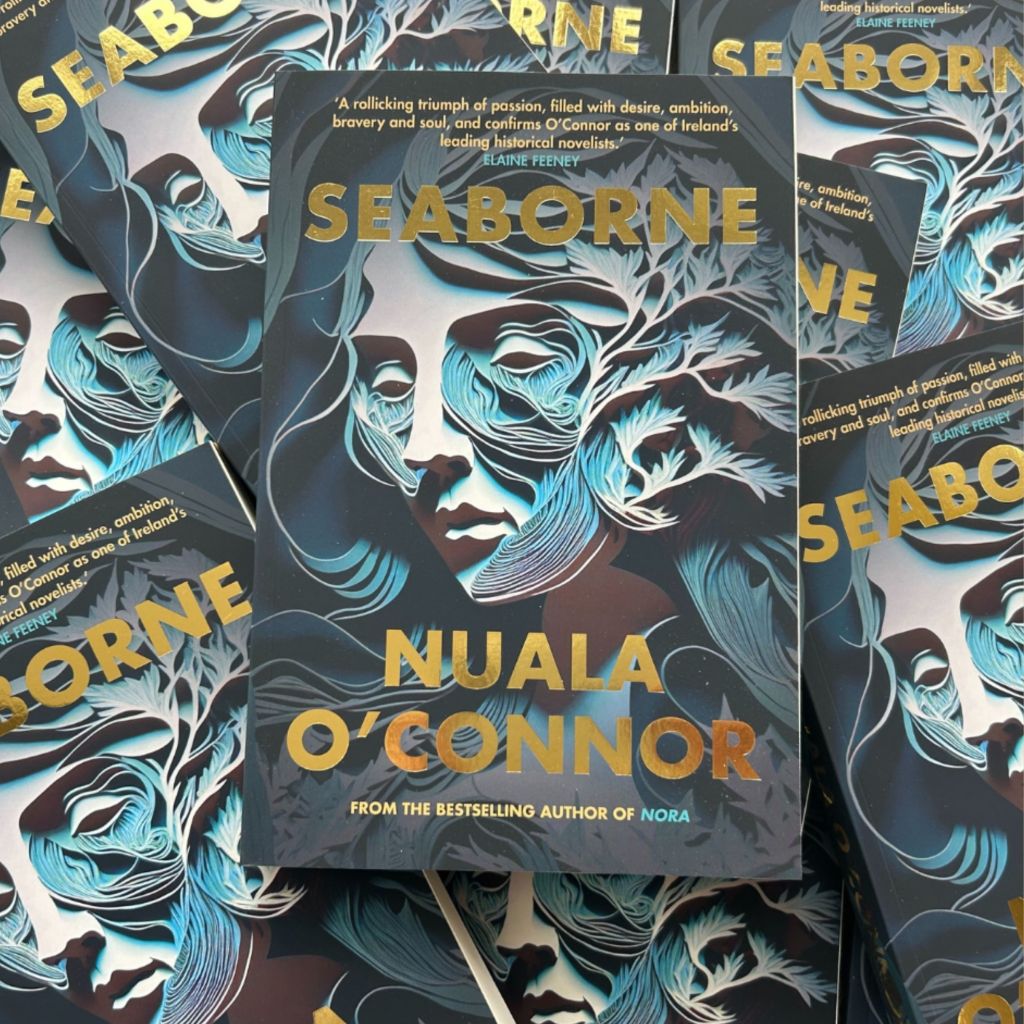
Multiple images of Seaborne by Nuala O’Connor with the title and author name in gold lettering and blue/grey art showing a woman’s face formed by seaweed.
SG: The cover art is stunning. It’s inviting without having read the book and once you’ve read it, you realise the cover totally reflects both title and the complex character of Anne Bonny. Did you have an input into the design and the title?
NOC: I did, yes. New Island are brilliantly collaborative when it comes to the cover. They asked me to make a Pinterest board of images and book covers I liked. I gathered lots of pics of swirly water, women in water, women with big hair and ships on their heads, and so on. Then Karen Vaughan, the designer, came up with loads of possibilities. The final cover image is the one we all had the biggest love for and there were many colour and font tweaks until everyone was happy. The gold foil was an added bonus and I love it. A great experience.
SG: I loved the gold foil! Stunning. It struck me that where Anne is located is a vital part of her identity as much as are people around her. How important was place to you in the writing of this epic book which follows Anne from Kinsale to Carolina?
NOC: Hugely important. There are a lot of myths that swirl around Anne Bonny, and the places she lived or hailed from are included in that. There is no solid evidence of her origins at all, but I chose to use Kinsale and the Carolinas because they were already cited. I travelled to Kinsale but the pandemic prevented my research abroad, so I had to rely on the net, archives, and books for research. Luckily, historical houses, bloggers, and archives are very generous digital sharers of their wealth and knowledge.
SG: Anne is a maverick, and you said in our Writers Chat about Nora Barnacle, another maverick, that you like “women who push against societal norms.” How did you find your research helped or hindered in the creation of the Anne Bonny we meet in Seaborne, given scant records about her illegitimacy, fluid identification with gender, and the push against the barriers of class?
NOC: Any woman who became a seafarer or pirate was considered untoward. With untowardness – in this historic, patriarchal paradigm – goes low morals, bad temper, wantonness etcetera, so Anne was perceived as a feisty dissenter, a rulebreaker and, therefore, bad. It’s not hard to jump from there to the strong-willed quester that I made of Anne. But she has her soft side too – her loving nature.
SG: And you capture her warmheartedness throughout Seaborne. I enjoyed your representations of the changing relationship Anne has with her body – from how she feels and is seen in clothes, to her interaction with men and women, and how she is driven by feeling (physical and emotional) through the book. Can you talk about how your sensory writing is such a fit for a sensuous character?
NOC: I’m an empath and, being autistic, I’m hyper-sensitive to my environment, to clothing, to sensory input and so on, so it’s really easy for me to write those kind of characters, because I live that way – I knock against the world and everything in it as I move through it. So I made Anne is like that too.
SG: Language is at the heart of this book. In the chapter “Quelling an Unsettled Heart”, speaking of Gabriel Bonny, Anne tells the reader that
“The truth stands, though I treat him with disdain, that I like Bonny’s company, I enjoy being near him, and he enjoys me – I see the kindle in his eyes when he looks at me…I like the weight my sailing outfit gives me, it makes me both strong and invisible along the wharf, and there be power to savour in that.”
How did you decide on chapter titles, and what was the process in keeping them inline with the narrative voice which is true to its era and character?
NOC: I had some of the final titles already and then Aoife Walsh, Commissioning Editor at New Island, suggested strengthening them to reflect the content more. I worked with her, and the copy editor, to pick juicy bits from the text as titles. I like all that finessing of a manuscript before it gets to be a book – the cherries on the top, so to speak. I was delighted when Aoife said I could have a map, too – I love novels with maps.
SG: Thank you for being so open about the process! One of Anne’s strengths is her openness and adaptability to linguistic expression – the changes of speech from Cork to Carolina are deftly handled, as are her imitations – while at the same time, she stays true (and firm) to her need of the sea. Was this an important element of the reimagining of Anne, for you?
NOC: I wrote her as neurodivergent before I even knew I was autistic myself. I got my diagnosis shortly after finishing the manuscript, if memory serves. So, she blends, mimics, and adapts in order to fit in (the same thing I’ve been trying to do for all of my life). This masking/imitation includes speech patterns, ways of behaving, clothing and so on. Anne is a chameleon the way many autistic people are.
SG: And this ability to change and blend shines as a gift rather than any type of limitation. The power and strength Anne gets from some female relationships is also explored through her friendships with Hannah Spratt and Bedelia. Can you talk about the role of this trio of women in the overall narrative and how it might compare or contrast with Anne’s relationship with her mother?
NOC: Bedelia is Anne’s beloved friend. There is an imbalance – Bedelia is her servant – but Anne loves Bee fiercely, relies on her totally. Anne is wary of Hannah from the start, she seems too fond of Bedelia. But Anne learns to like her a little when she sees that Bedelia likes her. It’s an unbalanced trio and it never quite goes right, as the reader will see.
Anne’s mother Mag was steady and wise, she was Anne’s main advisor and, her early death left Anne a bit rudderless. With no steady hand to guide her, we see Anne flounder, fragment, and act chaotically.
SG: Lastly, Nuala, some fun questions:
Boat or plane/Sea or land? I’m not a fan of flying. Too little control. At least on a boat you can walk around. I love the sea but, if I had to choose, land.
What was your favourite place you visited as part of the research for this novel? Kinsale – such a beautiful, colourful, rich part of Ireland. Also, the Caribbean of my mind. I enjoyed describing tropical beaches while locked down during the pandemic.
The power of words! Is there an era in history you would not like to explore through historical fiction? If so, why? I’ve done 18th, 19th, & first half 20th C, so I’ve covered a fair bit. A WW2 novel is appealing, but I have no firm plans. The novel I’ve just finished writing is contemporary.
What are you reading now? A book of Greek poetry. And I’m back with Ferrante because I’m going to Naples this year. I’ve blurbed nine books so far this year and have one more to go, so my reading has been prescribed a lot (time to take a blurb break, I think!). I have Seán Hewitt’s new novel lined up and am also finishing some Virginia Woolf, because she comforts me, and I’m always reading Elizabeth Bowen’s stories again, because I’m in a Bowen Reading Group. I always have loads of books on the go. Plus podcasts.
That is a lot! Naples is stunning – in all the senses. What are you writing now? A memoir about late-diagnosed autism, writing, depression, the alcohol-free life – I’m throwing the lot at it!
As always, Nuala, thank you for your generous answers and insight into your process as well as the editorial process with New Island. Wishing you continued success with the novel and good luck with your memoir. Seaborne can be purchased directly from New Island.
Nuala O’Connor sitting on a wooden chair on a beach with the sea behind her. Photograph by Úna O’Connor. Used with permission.
Nuala O’Connor lives in Co. Galway. Her sixth novel Seaborne, about Irish-born pirate Anne Bonny, was nominated for the Dublin Literary Award and was shortlisted for Eason Novel of the Year at the 2024 An Post Irish Book Awards. Her fifth poetry collection, Menagerie, was published by Arlen House in spring 2025.
Paul, you’re very welcome back to my Writers Chat series. We last talked about The Garden(New Island, 2021). Today we’re delving into Paradise House (Somerville Press, 2025), named as one of The Irish Times’ most anticipated books of the year and which Dermot Bolger describes as “an intriguing feat of deft imaginative power.” I thoroughly enjoyed the gripping narrative which gave me lots of “aha!” moments.
Photograph of the book Paradise House with a black and white cover image of James Joyce and Nora Barnacle by the coast, and on the back cover, a black and white photograph of the author Paul Perry. Photograph by Paul Perry and used with permission.
SG: Let’s start with the origin story of this astounding novel, which I’m guessing stems from your love of Dublin, James Joyce, and F. Scott Fitzgerald? PP: Yes, that’s absolutely right. Paradise House began, I suppose, as an act of literary trespass. I’ve always been fascinated by Dublin as a city shaped by absences—Joyce’s being the most mythic of all. But rather than following him into exile, I wanted to imagine what might have happened had he stayed. What if Stephen Dedalus never set sail, but instead opened a cinema—one filled with ghosts, flickering dreams, and revolution in the air?
The Fitzgerald influence came later. There’s a Gatsby-like energy to Kinch—his flair for performance, his aching desire to reshape the world around him, and, of course, the parties. The novel became, in a way, a meeting place between Joyce’s lyric interiority and Fitzgerald’s doomed glitter.
SG:Like The Garden, your writing in Paradise House deftly captures place and its people. Through atmospheric writing you evoke, at times, a sense of magic realism, and, at others, Joyce’s own Dublin writings.Dublin, here is a city:
whose streets were busy, and dirty with impish, innocent and smiling children. Dublin with its trams, and their reassuring, but lonely clicks…a city of half-truth, and half-light. A city of ash-pits, old weeds, and offal
We re-discover Dublin through the eyes of narrator-hero Jacob Moonlight he, working for Kinch (Joyce) as a projectionist in his cinema Paradise, wanders, often with Greta, around the city during a hot summer. Someone saying a Latin Mass passes them by alongside a child holding a doll like a baby. Another scene involves “the last lobster in the Monto.” Another again, on a Saturday night in July, Kinch turns the upstairs bar “into a kind of tropical misted atrium with bowls of fruit, flowers, sugared water, and live butterflies.”
How much fun did you have writing scenes such as these? PP: Far too much. There’s something liberating about slipping the leash of strict realism and leaning into the surreal textures of a city already halfway to myth. Those scenes—the lobster, the butterflies, the tropical mist—all emerged quite naturally once I gave myself permission to let Paradise House become not just a setting but a living metaphor.
I was interested in the kind of Dublin that could exist if it were dreamed rather than remembered. And Moonlight, as a newcomer, sees the city with fresh eyes—it gives everything a slightly enchanted, uncertain quality. Writing those passages often felt like walking through fog with a torch: you only see a little ahead, but it’s enough.
SG:What a great description of the writing process – one which actually echoes this reader’s experience. Kinch declares that “Dublin is a city of memory… Sometimes, I feel like I am going to bump into myself walking around the corner of Dame Street.” Paradise House is essentially an homage to a Dublin that could have been. Writing the novel, did you find yourself following ghosts and what-if trails? Did you enjoy writing the Great Gatsby-style parties where people laugh so hard, they sneeze champagne? PP: I absolutely followed the ghosts. That’s really how the novel evolved—through a series of hauntings. The ghosts of Joyce and Nora, of lost causes and unmade films, of streets that change but never entirely forget. Dublin is wonderfully suited to that kind of spectral layering.
The Gatsby-style parties were pure joy to write. They allowed me to explore Kinch’s performative side—the grand gestures, the theatre of it all—but also the melancholy behind the music. The champagne sneezes were fun, of course, but there’s always something bruised beneath the glitter. Kinch is a man building illusions while the world burns just outside the velvet curtain.
SG:In the characters of Kinch and Stuart, you cast the cold eye of hindsight on early twentieth-century revolutionary politics and hope. Paradise House doesn’t shy away from the laughter, the wily jibe, and the seditious joke of history. How important for you was this narrative thread? PP: Vital. I think we’re often given the binary of solemn revolution or frivolous art—as if you can’t laugh while marching, or paint while fighting. But in truth, laughter and creativity are deeply political. They’re forms of resistance.
Kinch and Stuart offer contrasting ways of navigating the shifting Ireland of the time—one through spectacle and ambiguity, the other through ideology and action. But neither escapes the mess of history. What mattered to me was honouring the spirit of the time, which was full of talk, wit, song, irreverence. These were not cardboard heroes—they were people, with all the contradictions that entails.
SG:Yes, the honouring of wit within a tumultuous time is a stand-out feature of the novel. There is also a wonderful crossover and reimagining of history, literature, fact, and fiction in Paradise House. Can you talk about your research for this novel? PP: The research was layered—part historical, part literary, and part intuitive. I read widely around the period: Joyce’s biographies, the Rising, WWI recruitment, cinema history in Dublin. But I didn’t want to be trapped by footnotes.
The novel plays fast and loose with history—it’s speculative, playful. So, while the bones of it are grounded in fact, the spirit is more dreamlike. I also revisited Calvino, Chekhov, Gatsby, and of course Joyce. I wasn’t quoting them as much as listening to their rhythms—trying to capture their ghosts in the room without needing to say their names aloud.
SG: “Life is…for enjoying, not just surviving.” Can you discuss how this reflects what you wanted to explore in the novel? PP: That line sits at the heart of the book, I think. It speaks to Moonlight’s slow awakening, and to Kinch’s failed promise. The novel is about joy—not as escapism, but as a defiant act. In a world full of dislocation and dread, moments of beauty, intimacy, absurdity… they matter.
Kinch dreams of miracles happening in Paradise House, but ultimately it’s the human moments—walking through the city, falling in love, sharing a drink—that offer salvation. For me, writing the novel was a way of reclaiming those small, luminous moments in a city—and a literature—so often shadowed by survival.
SG:Rather than “love,” it seems to this reader that it is art—and the expression of it—that brings people together in Paradise House. Would you care to comment on this? PP: Yes, I think that’s beautifully put. Art in Paradise House is a kind of currency—it’s how people connect when language or politics or emotion fail. The act of creating, performing, or even just witnessing something together offers the characters a fragile sense of belonging.
For Kinch, art is both mask and mirror. For Moonlight, it becomes a way of understanding the world—and himself. And for Norah, perhaps, it’s a refuge. So yes, while love is a force in the novel, it’s often filtered through, or made possible by, the sharing of art. Maybe that’s my way of suggesting they’re the same thing in different clothes.
SG:Indeed! We’ll end this Writers Chat, Paul, with some short questions:
• Dublin or Wicklow? Dublin for ghosts, Wicklow for breath.
• Oh lovely! Cinema or theatre? Cinema. The flicker, the dark, the possibility.
• Whiskey or Champagne? Whiskey in winter. Champagne for the parties Kinch throws.
• What’s the last film you saw in a cinema (and what cinema)? The Zone of Interest at the Lighthouse — chilling, brilliant, unforgettable.
• My favourite cinema (right back to the early beginnings!). What are you writing now? A new novel, Nine Days from Heaven, about Samuel Beckett in the French Resistance. It’s about silence, betrayal, and the long pause between action and meaning.
Headshot of author Paul Perry, provided by Paul Perry and used with permission.
Professor Paul Perry is the award-winning and critically acclaimed author of several books of poetry and prose. A winner of the Hennessy Prize for Irish Literature, he is a poet, novelist, and screen-writer, and Professor of Creative Writing at University College Dublin where he directs the Creative Writing Programme.
Thank you to Somerville Press for the advance copy of Paradise House.
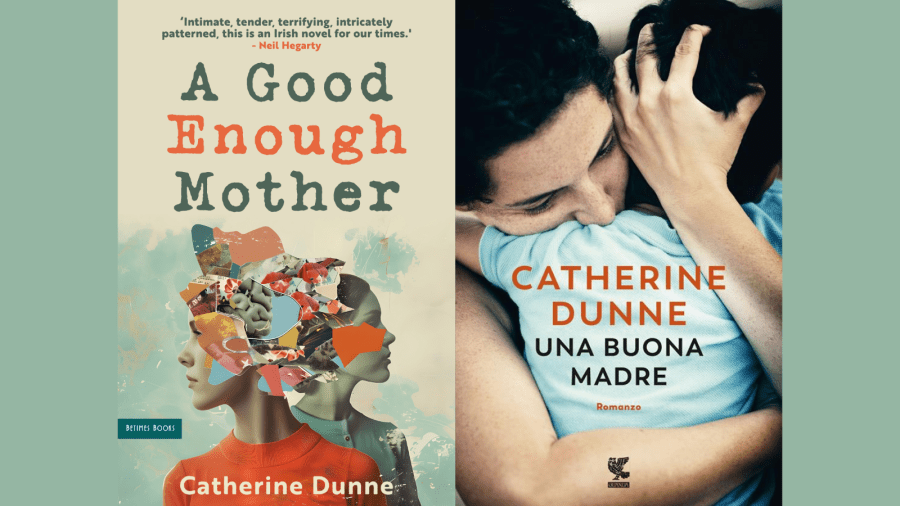
Image of covers of A Good Enough Mother and Una Buona Madre (Images used with permission of Catherine Dunne)
Catherine, You are very welcome back to my Writers Chat series. We’re here to talk about your highly successful A Good Enough Mother, for which you have won the European Rapallo BPER Banca Prize, and the Jury statement about the Italian translation Una Buona Madre (published before this English version) accurately said that in this novel you weave “together the lives of several diverse and ill-starred women” and link “a compelling present to a troubled past”.
SG:So let’s begin with the structure of A Good Enough Mother which is both a history of the treatment of women in Ireland and a beautiful, moving and gripping intergenerational story. Almost every section is dated and named according to whose story we’re immersed in. Can you talk about the mechanics of structuring this complex narrative that spans over several generations?
CD: Thank you for inviting me back, and thank you also for that very kind introduction. Structure is always a tricky issue. But it’s never something I decide on in advance – I tend to let it emerge during the writing. I love being surprised. I love the way the whole process is organic, the way the novel, including its structure, comes to life as I write.
I have always written in scenes. The patchwork quilt is the best metaphor I can come up with for the way I work. The act of sewing becomes a possibility of healing for the women in A Good Enough Mother, and it also serves as a metaphor for the writing process. In AGEM, I chose 66 scenes out of what I had drafted, reworked them endlessly and then sewed them together, like a classic patchwork quilt. I hope the seams don’t show.
The first scene I wrote involved Tess, and it was inspired – if that’s not an insensitive word – by the aftermath of the Belfast rape trial in 2018. That trial, and the not guilty verdict that resulted, convulsed the nation. The appalling public nature of that legal process, the retraumatising of the victim, and the deeply troubling attitude towards women that emerged during those horrifying days fuelled a significant public conversation. It is a toxic attitude that we’ve had to confront again and again in other high-profile cases of sexual assault.
When I began writing the trilogy of novels based on Greek myth – The Years That Followed, A Good Enough Mother, and The Way the Light Falls (to be published in 2025) – my overarching theme was motherhood.
Tess was the first character who appeared to me; and with her arrival, I wondered: what if one of her sons were accused of sexual assault? How would she feel? What would she do? How would she reconcile her unconditional love for her son with her revulsion at his alleged offence? The writer’s eternal ‘What if?’ propelled me into writing her story.
Once Tess’s character began to form, a cast of other women began to clamour to be heard. Catherine Corless’s unearthing of the secrets of Tuam’s Mother and Baby institution – they were not ‘homes’ in any meaningful sense – fuelled my stories of Maeve and Joanie. My research for An Unconsidered People formed the inspiration for Betty and Eileen’s lives in Kilburn, and so on…Each character led me to the next – the kind of organic growth of narrative that I referred to earlier.
SG: That’s really interesting about letting the writing lead organically, and the practice of writing in scenes (and no, the seams don’t show!). This novel gives voice to that which can’t always be voiced – the violence of assault and rape – and in such a way that this narrative threads through and above each of the individual narratives. And yet each of the narrators have a very distinct narrative voice which is not an easy write. Did the movement from silence to voice come as you were stitching the novel together?
CD: Time and place were my friends in this regard. The sections of the novel move between the 1960s and the present, back and forth from Dublin to London, and to an unidentified location somewhere in rural Ireland. ‘Seeing’ each character in their distinct location, and at different times, made their individual voices begin to come alive inside my head.
I always find it interesting that the character closest to me in age/location/circumstance is always the most difficult to write. Familiarity is my enemy. I struggled in the early drafts with some of Tess’s scenes. I had to take the decision to place her on constant high alert, to make her anxious and fearful for her family. That anxiety became one of the defining features of her voice.
With Eileen, I drew on my extensive research for An Unconsidered People. Years of going back and forth to Kilburn, interviewing elderly Irish immigrants, meant that my sense of London in the fifties and sixties was already part of my imaginative landscape. And I was able to give her a passion for fabrics and sewing, all of which helped me develop the individual nuances of her voice.
This novel took me about four years to complete. During that time, the characters became my friends and I saw them as individuals. The more time I spent in their company, the more I grew to love them and the more real they became.
Writing is an act of imaginative empathy. The predicaments I created for each character were different, the challenges I gave them were demanding in different ways. Each draft of the novel meant I could stitch in more and more detail about their lives and their attitudes that made these fictional characters differ from each other.
SG: I’m glad you refer to drafts (multiple) and the process of stitching in more detail. You’ve spoken above and in The Irish Examiner about how Tess’s narrative came to you fully formed and was then followed by Betty’s story. Tess recalls that:
Family is family, Betty used to say. You fight with them, you fight about them, but above all you fight for them. Tess stands up. She needs to find her fight again. Needs to access that spirit that will help her to reach Luke. No matter what he’s done. Then she switches off all the downstairs lights…
I loved how you anchored Tess’s story in the continuing running of a household, the shopping, the cooking, the simple turning off of lights. There was something so moving about the simple, every day actions that carried the weight of terrible violence. Can you talk about Tess and her movement through the novel?
CD: Tess has to deal with one of every parent’s worst nightmares. Luke’s challenging and dangerous behaviour, the accusation he faces, the threats to her family’s wellbeing are all emotionally draining. But despite being consumed with worry, Tess is anchored in the real world. She has a job, an absent husband whom she loves dearly, but financial realities mean that he is frequently away from home – a source of significant tension between them. Tess must manage home and family – Luke and Aengus, her two sons – on her own.
Despite the crisis facing her, Tess still has to deal with all the tasks that I believe sociologists call ‘love labour’. She needs to cook, to clean, to shop, to keep the household running so that everyone gets fed, everyone has clean clothes, that the home environment doesn’t descend into chaos…
Research tells us that most of this kind of work is still carried out by women. Whether women willingly assume responsibility for these tasks, or whether that responsibility is thrust upon them is another day’s discussion. The daily reality that I create for Tess is familiar enough, I believe, to be recognisable to most readers.
I also tend to bristle that domestic detail such as making a list for the supermarket, or picking clothes up off the floor, or trying to put a meal together under pressure, has frequently been dismissed as ‘small canvas’ stuff in women’s writing – as though the domestic is not a fit subject for fiction.
In an essay entitled Writing for My Life, I observe:
I’ve experienced the accusation many times that women work on too narrow a canvas: that of the ‘domestic’. The wider world, that of big issues and important causes, belongs to men. It’s an argument that might also be familiar to Jane Austen.
In the Odyssey, Telemachus tells his mother, Penelope, to be quiet. He tells her: ‘talking must be the concern of men’.
In this version of the tale, she obeys; we don’t know how she feels, but she obeys.
He means, of course that talking – all the public, the weighty, significant discourse – must be carried out by men. The chatter can belong to women, tidied away into their domestic spheres among the dishes and the brushes.
And so, I like to give the dishes and the brushes their own special place in my fiction.
SG: Thank you, Catherine for such a full and brilliant response which puts me in mind of the importance and power of the domestic in the fiction of Elena Ferrante. Those dishes and brushes are witnesses.
I found Joanie’s narrative particularly heartbreaking and you voice her confusion and naivety in St Brigid’s, the Mother and Baby Home so authentically.
“Joanie imagined that the girls, the penitents, must use up every single punishment in the whole world, so that nothing was left over for the nuns.”
And then after her baby is taken away,
“Joanie’s howls filled the long corridor and ever since, she’d wandered about like a lost ghost, trapped somewhere between two worlds.”
It felt like she stayed trapped between two worlds for most of the novel. Was some of her story based on your extensive research for your non-fiction book An Unconsidered People: The Irish In London?
CD: Nottingham was one of the cities I visited briefly during the time I was researching An Unconsidered People, but my main focus was Kilburn and Cricklewood. However, in one of the many mysterious ways that ideas and memories float to the surface during the writing process, Nottingham came to me as somehow fitting for Joanie and Eddie.
As before, familiarity has its dangers for the writer, and I wanted somewhere to place Joanie that I didn’t know as well as I knew London. I wanted a place that, within the world of the novel, was special to Joanie. And Nottingham just…elbowed its way to the front of my mind. I had to research its parks; its houses close to the railway station; its hotels. None of those places was familiar to me, and that was a gift. All of it became food for the imagination.
Maybe, like parents, novelists shouldn’t have favourite characters. But Joanie is mine. I have to confess that. Perhaps because her life experience is light years away from mine – she’s from a poor rural background; she’s treated harshly by her parents; she’s dyslexic. Her predicament elicited the most empathy from me.
Her story has so many echoes of the stories I read of some of the 56,000 women incarcerated in Ireland’s Mother and Baby institutions. I wanted to give those stories space and dignity – and so Joanie arrived in my imagination.
SG:Maeve’s father drives her to St Brigid’s. Maeve tells us
“I don’t know which was worse: being betrayed by the boy I loved; feeling frightened about what lay ahead; or knowing that my father was lost to me for good.”
Later, she tells us (in stunning prose!):
My days began to fill up with possibility. Hope became a bright blur, the colour of sunflowers. At the same time, I kept thinking about this secret army of women. All of them – all of us – all over Ireland. Mothers of lost children.
These are themes you deftly thread through the novel – boys and men betraying and casting women into hidden spaces and places, and women together creating bonds of safety and possibility.
CD: I remember, even as a young teenager when I became aware of the power of words, that I wondered about the phrase ‘unmarried mother’. In the 1970s it was still a loaded term, redolent of shame and immorality. It was one of those phrases that filled my generation of young women with a terror of getting pregnant.
But even then, another question became insistent: what about unmarried fathers? We never heard a word about them. Did they not exist? Were these so-called ‘illegitimate’ babies the result of mass miraculous conceptions all over Ireland?
It would be years before I even began to understand the potent nature of shame as a method of social control. Years before I learned that around the time the Irish state was founded, there was the belief that the value of such new states resided in the virtue of its women. It therefore followed that if the women that populated these newly formed states were not ‘virtuous’, then they needed to be hidden away.
Hence the development of Ireland’s ‘shame-industrial complex’, as Caelainn Hogan calls it. Magdalene Laundries, Mother and Baby institutions: all of them methods of the social control of women, a system devised, developed and maintained by Church-State collusion. Photographs of the time show that the power of both the Catholic Church and the Irish State was entirely in the hands of men – a symbiotic relationship that was at the root of this country’s problematic relationship with women and women’s bodies.
In the world of the novel, I wanted to give life to what I have so often observed: the ways in which women work to strengthen social and familial ties; the way they support and nurture each other as a way of challenging the misogyny that is still such a part of modern society.
SG:And we don’t always see these ways in which women support and nurture each other. Furthermore, you tackle difference with acceptance and tenderness through the wonderful Eileen and all that she does for women. She was my heroine of A Good Enough Mother.
Sometimes, when I look around at the three of us in the evenings, I have a powerful sense of being bound to a great circle of other women, other times. Our tasks feel ancient, full of history, the threads of connection pulling us tightly together as we work.
Can you talk about her formation and the role of material, thread, sewing and mending?
CD: I loved Eileen’s steely defiance. That’s where she came from: her refusal to bend to what was expected of her. Her character, and her life experience, came from some of the many stories I listened to in Kilburn and Cricklewood over the years.
A nurse I interviewed – who chose to remain anonymous in An Unconsidered People – told me about her uncanny ability to detect even the earliest signs of of pregnancy in the young women arriving at Euston Station, alone and terrified.
She used to meet the mailboat each morning and said that her ‘mission in life’ became helping those pregnant young Irish girls, who had been sent away lest their condition bring shame on their respectable families.
She had the insight, however, decades later, to wonder whether she would have to account for her actions on the Day of Judgement.
What actions? I asked.
In the belief that she was doing what was best, she handed over dozens of newborn babies to good, Catholic families in London – babies born to those terrified Irish girls – without any paperwork whatsoever. She did not profit from this in any way, but understood, years afterwards, that these transactions may not have been ethical.
Her ‘mission in life’ made me ask the eternal writer’s question: What if? What if Eileen had been one of those girls? What would it have been like to search for your lost child for the rest of your life?
Her name, Eileen, is in memory of my own godmother. A most beautiful human being, who had no children of her own, a grief that stayed with her all her life. My character, Eileen, is named in a loving tribute to her.
SG: That’s beautiful and what a loving – and lasting – tribute to your godmother. We will end with some short questions, Catherine:
Cats or dogs? Oh, dogs, every time!
Mountains or Sea? Sea, with mountains a close second.
What do you do after you’ve published a novel or a long manuscript and had a launch? Usually, mourn its absence for a bit, before diving into something new.
One stand-out fiction and non-fiction book of the year for you? Not sure what year it was published, but I loved Wifedom, by Anna Funder – non-fiction. A blend of so many forms of writing. And far too many novels to choose from, but if you insist, Soldier Sailor by Clare Kilroy and Our London Lives by Christine Dwyer-Hickey.
What are you working on now – if you can talk about it in a general sense, I know it’s not always possible to articulate what’s not yet formed. I’m currently working on The Way the Light Falls – part of the trilogy of novels inspired by Greek myth. It has already been published in Italian and was shortlisted for the Strega Prize for Fiction. But I’m glad to have the opportunity to revise it before it’s published in English by Betimes Books sometime in 2025. But, as a little bit of superstition, after 30 years as a professional writer, I have the opening paragraph of a new novel already written…There is always the lurking fear that the writing well might run dry!
Thank you, Catherine for such enlightening answers and insights into your process. I wish you continued success and look forward to The Way the Light Falls.
Listen to Miriam O’Callaghan’s interview with Catherine Dunne on RTE
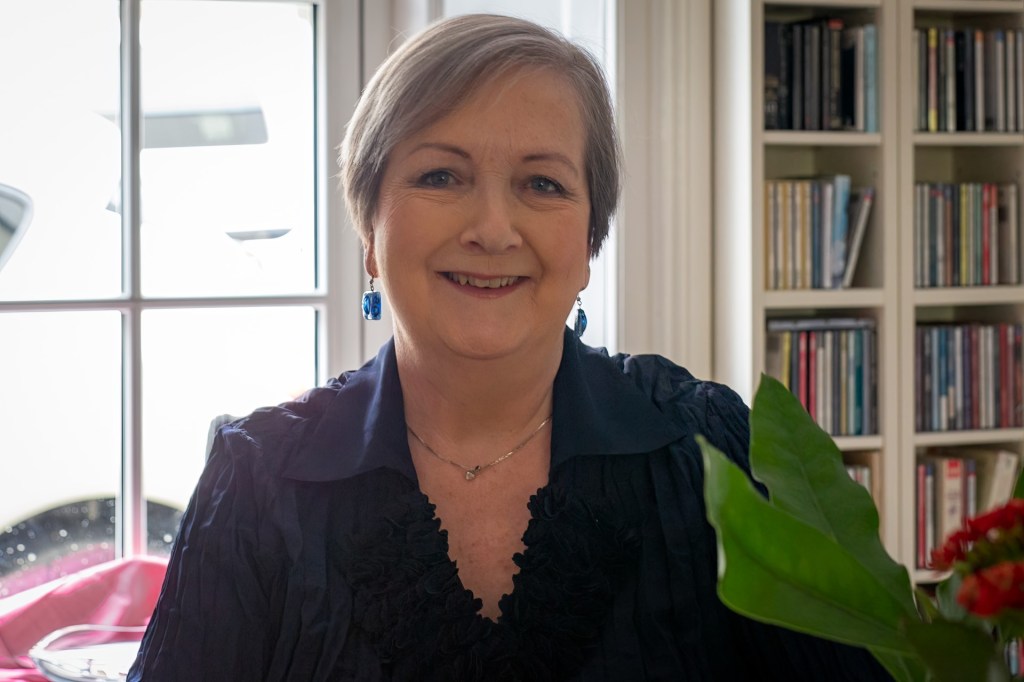
Photograph of Catherine Dunne smiling, wearing a black blouse, a window onto a street and a bookshelf with books is behind her and flowers sit to her left. Photograph by Simon Robinson, used with permission.




 Shauna Gilligan Writer