Writers Chat 59: Maureen Gallagher on “Limbo” (Poolbeg Crimson: Dublin, 2022)

Maureen, You are very welcome to my WRITERS CHAT series. Congratulations on your debut novel Limbo: A Kate Frances Mystery (Poolbeg Crimson: Dublin, 2022).

It’s a real page-turner of a thriller that reminds us of how far we’ve come in terms of equality and bodily autonomy but also how far the reality has still to go.
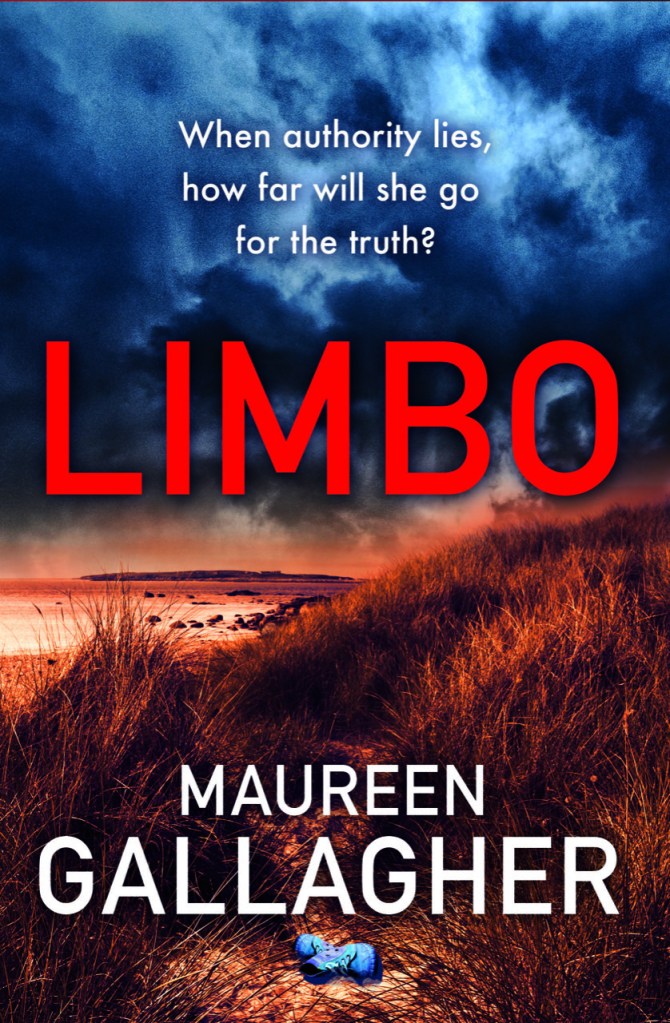
Cover of Limbo featuring seascape and sand dunes with an abandoned pair of child’s boots. This photograph is of Port Arthur in Gweedore, taken by Peter Trant.

Limbo is the first in a series featuring the brilliantly complicated and humanly flawed Detective Kate Francis whom we get to know as Frankie. Tell me about the cover, the title and the series.

MG: Thank you very much for inviting me to WRITERS CHAT, Shauna. The front cover image of Limbo depicts the dunes at Port Arthur strand in northwest Donegal – marram grass and patches of bright sand in the foreground with a view out to sea and the islands in the distance. The image was taken by my brother-in-law – Peter Trant – an accomplished photographer, who is very familiar with the beaches in Gweedore, and took many photographs of the dunes for me to choose from.  The final image is enhanced by David Prendergast, Poolbeg’s designer, who darkened the sky, and skilfully coated the entire landscape with a thrilling orange hue. When it came to choosing a title, Limbo came to me pretty easily, for the layers of meaning that inhabit the word, not least the state of babies souls and the fact that Roche can’t give them a Christian burial. In addition,  Frankie’s indecision and paralysis about what she wants out of life career or family is an important aspect in the novel. The title is also in tune with the tone of the book, which is an attempt to imbue the story with a whiff of incense, given the dominance of the Catholic Church at that time. Limbo is a the first of three. My plan is to set the series at ten-year intervals, so that it charts Frankie’s growth and development personally and professionally, and also gives some idea of the way Ireland has changed in the past 35 years. 

SG: Very interesting to hear about the ten-year intervals. I love that idea and because I really liked Frankie who is very much of her time but is also an everywoman, can you talk about how Frankie developed both as protagonist and character within the framework of the storyline?  

MG: Detective Kate Francis aka Frankie works in a male dominated workplace in  nineteen eighties Ireland. Sexism is rife. In the very first paragraph, sergeant Brannigan, ruminates:

‘To think, godammit, the reinforcements they’re sending from the city, includes a woman. A battle-axe, no doubt, built like a barn.’

So from very early on, we see Frankie dealing with the hostility of Brannigan, while at the same time fending off the unwanted attentions of her married boss, and trying to placate her boyfriend, resentful at her long hours at work. As she struggles to advance the investigation, these personal challenges deepen. Her boyfriend asks her: What do you want out of life? To be the best sleuth? To settle down and become a mother? Frankie is conflicted. She doesn’t see why she can’t do both. When she’s left to solve the case on her own, we see Frankie’s professional confidence grow, as she stands up to the corrupt sergeant and follows her own instinct for finding the killer. Alongside this confidence comes an insight into how she will address the apparent contradictions in her life. In the end we see a changed Frankie, one who has grown personally over the course of solving the murder, and who is grounded and at peace with herself.

SG:  Limbo is set in 1989 in Donegal, with the stunning landscape key to both the mystery and the reading experience. Your descriptions are beautiful and even more impactful as they are set against the investigation of two murdered babies, from Port Arthur Strand, Gweedore to Errigal Mountain and the River Claddy is “the warm colour of tea”, “On the horizon, Frankie can see the islands floating in the Atlantic, surrounded by thousands of foaming white horses fringing the waves: Gola, Inishmaan, Inisheer.” How important was the setting to the novel and to the series?

MG: I spent most summers as a child in Gweedore in Donegal, where my parents grew up. My father taught in Ranafast, and the family simply decamped to the Gaeltacht for July and August. So many images from childhood mean Gweedore to me: Errigal mountain, salmon fishing, snuff, the bitter winter I spent there with its howling storms; sea and sand and picnics on the strand. Summer seemed to go on forever back then and we spent much of it in one or other of the three glorious beaches, including Port Arthur, which features prominently in the novel. I was fascinated with juxtaposing a horrible crime like the murder of a baby against a backdrop of such exquisite beauty. The idea for the novel came from an assignment at a workshop to write a 300-wordpitch for a crime thriller. The writer,  John Fowles, once said that he usually started with a powerful image, and then tried to work out what the story behind it was and how it developed, The French Lieutenant’s Woman being the most obvious example. The image of the mysterious woman at the coast staring out to sea is not so far away from the image of a baby found on the beach. So my novel opens with the most awful crime imaginable. Just as south eastern Sicily is like a character in Andrea Camilleri’s Montelbano thrillers, I wanted Gweedore to feature almost as a character in the story, with the mountain Errigal a touchstone for everything.

SG: Lovely to hear your authorial intention, Maureen, and I do think that comes through to the reader. Over the course of the investigation, Frankie realises how the patriarchal systems of power are skewed towards men, from the hospitals – early on in Limbo a matron exclaims, as if there were no men involved in procreation “these young girls, you’d feel so sorry for them” – to the force which employs her as a detective – she figures out which battles to fight with Brannigan, how to negotiate her desire with Moran (“there’ll be none of that she tells herself”) and her future, whatever that might be, with Rory. Can you talk about your exploration of gender in the Ireland of 1989?

MG: The action takes place in 1989, ten years after the pope’s visit, an era when people’s mindset had not changed much at all from the 50’s and 60’s. I wanted to explore what we were like as an nation back then, and ultimately what that led to: women vilified for no greater crime than becoming pregnant. At one point the protagonist, Frankie, asks: “Do we not value pregnancy and birth in this country?” So you could say my focus was the treatment of women in late 20th century Ireland. When it came to naming my female protagonist, I had to think long and hard. My main reason for giving my female character a name that is somewhat androgynous was because I didn’t want her to be referred to by her first name while all the men in Limbo were referred to by their surnames – Moran, Brannigan, O’Toole etc. I felt that would have rendered her somewhat inferior, in a situation where she is already facing prejudice. But neither did I want to distance her from the reader. So I set about finding a surname that sounded like a first name. Even though there are female Frankie’s, there is the intentional false assumption that Frankie is a male name. At the very least it is gender neutral, androgynous. My intention was to give my protagonist a modicum of gravitas in a male world.

SG: And Frankie as a name for this character works so well. So, part of Frankie’s initial investigations lead her to Umfin Island to meet with members of followers of the Brigid, Goddess of Fertility. She finds

“she’s conflicted. On the one hand, she’s impressed with the back-to-nature self-sufficient element of the lifestyle she’s observed….on the other, at the very least there was a level of violence in the ritual she’s just witnessed that was disturbing.”

In a way, this experience also sums up Frankie’s view of Irish society and politics, and the power of the Catholic Church. It appears to be one thing but actually – including and especially figures in authority – is another. Can you talk about how these themes influenced the story line (or was it vice-versa?).

MG: What was an eye-opener for me when I started to write Limbo, was that the structure of the crime novel – you could say its limitation – allowed me to explore social issues, something dear to my heart. The very nature of the genre frees up the imagination. The two underlying themes I had in mind when starting the novel, was the power of the Catholic Church in Irish society and the subordinate position of women. Someone once coined the phrase ‘the Catholic Taliban’, to describe the hold the Catholic Church had on the lives of women in Ireland all down the century since independence. Throughout the thirties, forties and fifties, and even up to the eighties women’s bodies were a battleground. I wanted to show how the Catholic Church dominated the whole narrative, how it was woven into the very fabric of society, and for this to inform the tone of Limbo. The backdrop to the story is a misogynistic state hand in glove with a powerful church and its impact on women. But I was conscious too that exploring social context should not mean long passages of exposition. The bottom line is that the novel has to be entertaining – people want to know what happens next.  Crime writing, like all fictional writing, is best done through scene setting, dialogue, believable characterisation. Or as the late great John McGahern would say, told slant.  

SG: Yes indeed – ‘told slant’ – a lesson in writing fiction! Lastly, in Limbo, as in our history, those who don’t confirm to prescribed behaviours and identities are locked up or hide themselves away – claiming their voice as their own by not speaking, for example Hannah. Part of what Frankie has to do is to listen to what is behind the stories that people tell, see what is beyond the land and within the houses. In this way, as Frankie “feels resentful at how the Church has commandeered all the major events in people’s lives”, Limbo is as much about agency and power as it about a thrilling story. Was this your intention?  

MG: Limbo is very much about the struggle women have to gain autonomy within the suffocating limitations imposed on them. Hannah’s response to the violent strictures visited on her is to choose not to speak, to metaphorically lock herself away. Her daughter Sarah, in contrast, determinedly manages to rise above her awful experiences and leaves Ireland to embrace a new life. Frankie addresses head-on the challenges she faces and in so doing gains insight into her own personal predicament and how to resolve it. The novel is very much about agency and power. It charts both the tragic predicament of the women who are crushed by their oppression, but also the empowerment and joy of the women who transcend it.

SG: To finish up, Maureen, some fun questions

  • Sandy or Stony Beach?  Sandy. Definitely not stony – I value my ankles!
  • Tea or Coffee? Mostly tea. But when my daughter – who now lives in Spain – visits, I bring her to Tigh Neachtain in Galway, which serves an excellent coffee.
  • Music or quiet when writing? I love music but not when I’m writing. I like total silence when I’m writing.
  • What’s next on your reading pile? I’m re-reading of Lajos Egri’s superb The Art of Dramatic Writing as research for Book 2, and for leisure reading I’ve started Maggie O’Farrell’s The Marriage Portrait, which I’m enjoying very much.
  • What are you working on or thinking about now? Now that the launch of Limbo is behind me, I’m picking up where I left off on Book 2 in early summer. The book’s premise is ‘Misogyny Fuels Femicide’, an idea I’m very engaged with and I can’t wait to get stuck back in.

Thank you, Maureen, for such engaging and thorough answers. I very much look forward to the next two books in the series and to seeing more of Frankie!

Readers can order Limbo here
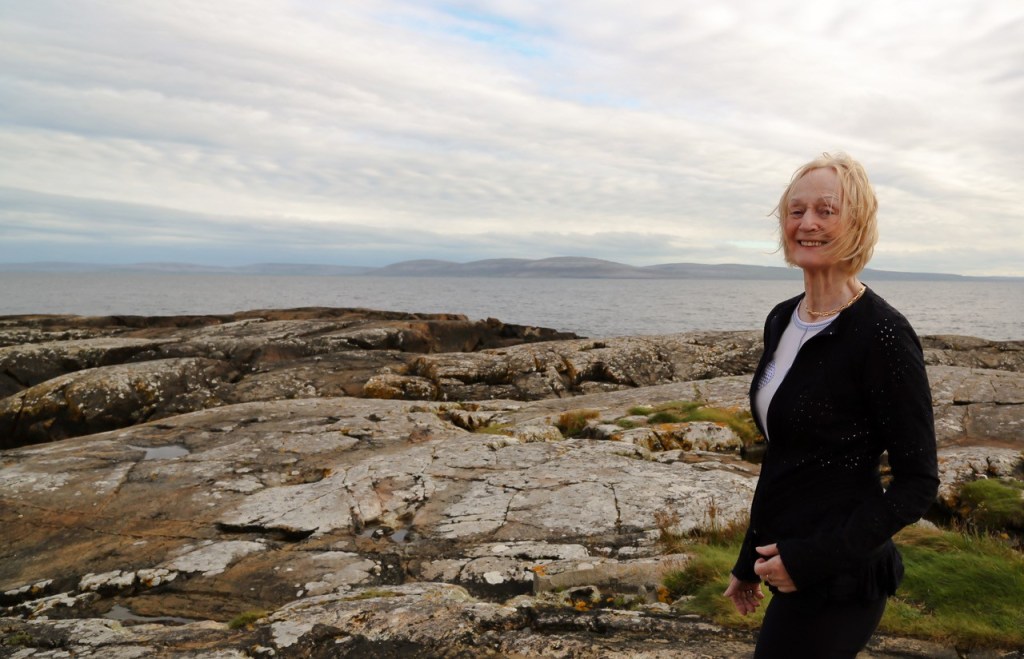
Author Maureen Gallagher. Photo courtesy of author.

With thanks also to Poolbeg Crimson for the advance copy of Limbo

Writers Chat 58: Liz McSkeane on “What To Put In A Suitcase” (Turas Press: Dublin, 2022)

Liz, You are very welcome to my WRITERS CHAT series. Congratulations on What To Put In A Suitcase (Turas Press: October 2022) – a thought-provoking collection of sixteen stories that explore our everyday interactions and how we form our world, and transform it, for better or worse. Let’s start with the intriguing title (and provoking cover artwork) – What To Put In A Suitcase – I took it to refer to the essentiality of life and living, the people, things that we cannot do without. Can you speak a little about the genesis of the collection and the title?

Cover of “What To Put In A Suitcase” by Liz McSkeane – colourful art work depicting a smiling face

LMcS: Thank you, Shauna, for inviting me to take part in your Writer’s Chat series and to reflect on What to Put in a Suitcase as a whole, and in relation to the themes you have identified. Concerning the genesis of the collection – these stories were gathered over a long period of time. Some were written more than a decade ago but about two thirds were written in the last few years. When stories in a collection span a long period of gestation, it’s perhaps inevitable that they will delve into different topics, expressed in different styles and genres that reflect the writer’s current preoccupations and interests. That’s how it was for Suitcase.  And I did find myself asking at a late stage, what was the best way to pull these apparently diverse elements together.

At that point, I had just written the most recent story – which also gave me the title for the whole collection.  The story What to Put in a Suitcase was inspired by very recent events but is obviously also relevant, on a literal level, to many other geo-political crises of past decades which have resulted in mass movements of populations. It seemed to me that that title provided a kind of thematic umbrella within which the other stories could be contained, whether in a literal, or thematic, sense.

As you suggest, the process of making very practical decisions about which material possessions to take with them when starting out on a journey into the unknown, will distil the people’s vision of what life could or should be about; and also, about how they may prepare themselves to cope with uncertainty. It is a question that I have sometimes asked myself.  I think that the question also works on a metaphorical level, for what is life, if not a journey into the unknown, where we have to decide along the way what to keep and what to leave behind?

SG: Very interesting that your most recent story became the title story and that of the collection, and, as you say, so relevant to current events. I loved how many of the stories involve chance encounters where one or other party has expectations that are not met, or misunderstood, or where there is the potential for change that could have a ripple effect. It’s those Sliding Doors moments that happen to us all – quiet regularly. I’m thinking here of “Samaritan”, “A Hot Coffee”, and the opening story “Regression Analysis”. In “A Hot Coffee” we are told “The only reason she is here, handing this person a Fairtrade coffee in a recyclable cup, is because he is there.” It’s this interconnectedness that you explore so well in the collection. Can you talk about that?

LMcS: I am interested in what you say about chance encounters and the conflicts, anxieties and challenges these present and I think you’re right, that these encounters may appear trivial, but can force the characters to review their way of thinking and perhaps, generate epiphanies. Although the stories you mention are very different in terms of the actual events they depict, thematically they push the protagonist out of a particular comfort zone into a space – physical, psychological, emotional – where previously unquestioned certainties, or even just habits, are thrown into doubt. This in turn causes the narrator to examine not only the situation, the other person or people with whom they are interacting, but also themselves, their own attitudes, prejudices, assumptions.

Of course, this potential for change is not always realised – rather, it may be held in abeyance or else avoided, ignored, so that the habitual comfort zone is reasserted, albeit with a level of discomfort. And sometimes we are not even sure if the character will make any change as a result of what they have experienced. I guess I have an inclination not to wrap things up in certainties and often prefer to leave the reader to interpret, infer, to reflect on the possible actions, or lack of them, that might ensue.

SG: Yes, I liked how you made the reader work, that many of the stories leave us thinking. Children feature in many of the stories and I felt you captured that sense of childhood where wonder is gradually or suddenly replaced by a sense of loss or disappointment – reality – that you sense, as the reader, will sit with them forever. In “Ambush” we see the cruelty of adults trying to protect their own and in the poignant “The Games”, Kate knows “All the lochs and fields and rocks as far as you could see belonged to Donald” and believes her sense of self and identity is like one of those rocks, until she dances, and the rhythm of the music is not what she expected. In this story, her tears come with the onset of kindness. Again it struck me that when the expectations of people – adults and children – are at odds with their situations, shifts of self and future occur. Does this tie in with your intentions when you wrote these stories?

LMcS: I didn’t have a conscious intention to depict primal disappointments met in childhood but in telling the stories that spoke to me, I agree with you that that is one of the most salient themes in some of the stories.  I think that the impulse to make sense of the world starts at a very young age and the children in these stories experience the multiplicity of meanings, which are sometimes in conflict, in a very intense way, which can be confusing.  

     I think that such confusion is almost inevitable, as the messages we receive from the external world about almost everything – how to live, what is right and wrong, even who we are – are fraught with contradiction and, as we learn as adults, sometimes deliberately manipulated to serve the needs of others. Obviously, the children in Suitcase don’t consciously frame their experience of the world in that way but the reader looking over their shoulder can sense it and observe their puzzlement at the often conflicting messages they receive.  And it is true, what they want and expect does not always correspond to external reality.  I get the feeling that navigating this inevitable discord will filter into how these children manage their lives as adults. In fairness, though, I can’t in all honesty say that I consciously set out to explore those themes when I sat down to write the stories. Rather, they were the ideas that emerged in the process. For me, that happens quite often, perhaps most often – that the primal concerns and themes become clearer – though not necessarily completely clear! – in the process of writing.

SG: And often what emerges in the writing can be the most interesting to the reader! You captured shifts in sense of self within the confines of different bodily spaces, and examined the chasm between internal and external selves/voices against the backdrop of gender and space particularly well in “Underground”, and “Lebenstraum” where second person narrative works brilliantly:

“Powerful forces are ranged against you. Many are arising from within: from your currently dormant best self…a distant second, good manners…and from without: the tyranny of these people in their group…”

Do you think – within the realm of these stories – that our perceptions of self have shifted with the restrictions on movement over the last few years?

LMcS: I think that they have been heightened, to a significant degree and that sometimes, a sense of urgency emerges that might have not been there before to the same extent. Before the pandemic, the character in Lebensraum would not have minded sharing a table with other people in a café. It’s the crisis that produces her outrage at the invasion of her personal space.

     I found this scenario interesting, because I think it puts the spotlight on a dynamic which existed long before the pandemic and perhaps, has always existed:  a constant negotiation, a jostling, between the self and the boundaries with other selves.  What the restrictions did, I think, was to highlight the importance of a newly scarce commodity – space – and show how this plays out in interactions with others. And in this case, as often happens, some people decide to take all of this scarce resource for themselves, or at least try to, convinced of their own entitlement by spurious justifications. This, in turn, confronts the protagonist with the question of how to  defend her space or whether she should, and even, whether she has the right to do so.  

       Although this is obviously a ‘pandemic story’ I think I could have written a very similar encounter outside the context of the pandemic, as these struggles for resources – be that space or any other valued commodity – were not created by the circumstances following the lock-downs, but were highlighted by them. That is why I called this story Lebensraum, which as you know, was one concept that underpinned the Nazis’ rationale for annexing European territory, invading other people’s countries. Tragically, we see this being repeated today in Putin’s Russa.  Competition for resources, both tangible and intangible, has always fuelled the dynamic of interaction, on a personal, societal and also, a global level. It is a struggle which this story shows being played out in impulses within the individual human heart.

     Aggressive colonisation, invasion, the story concludes,  has to be resisted, starting with how this person conducts her personal interactions. Is she going to give up her spot to keep the peace? Or should she dig her heels in and refuse to be pushed out. And if the latter,  where does this leave tolerance, compassion, simple kindness? There is a time to yield, to be kind – and a time to resist. The challenge is, knowing which is which. It’s not an easy question to answer.

SG: I think you caught the tension of that question, Liz, so well. Interestingly, the placement of “Atlanta” and “Venice” side-by-side in the collection gave a wonderful continuity to the themes of the failing body and illness, located/dislocated in place and between people. In “Venice” a friend’s embrace fills the narrator

“with yearning and overwhelmed her with loneliness and longing, not for him, but for the desire to want him and everything that being with him would bring.”

I thought the title story “What To Put In A Suitcase” tied these themes together, creating an almost filling up then emptying out of a life, and its meaning – including our relationship to time. What interested you about exploring these themes in this way?

LMcS: I think that some of the stories do explore the notion that the awareness of loss is an inevitable part of living. To arrive at an acceptance of that truth is a different, more complex journey and I am not sure that most of the characters in these stories – with the exception of the final story, Leopold’s Violin – have accomplished that yet. Perhaps they are just embarking on that journey. At least two of the characters in Suitcase are confronted with a heightened sense of mortality, their own or other people’s, which for them is a kind of rite of passage, a point beyond which things are never the same. It is an  awareness does call into question their relationships with others, their aspirations, what to keep, what to change, what to leave behind. Like packing a suitcase!  One response would be to throw in the towel, retreat to a kind of apathy that refuses to decide, as nothing matters anyway.  And yet, these characters respond to loss by giving up but rather, by re-making. We may not know what they are going to do, but I think there is a sense that they will do something, make some significant change that will integrate their life experiences into how they live their lives into the future.

     Once again, I have to confess that I didn’t consciously set out to explore these themes. Rather, they emerged within the stories I found that I wanted to tell.  Perhaps it takes some time and distance – and an attentive reader! – to process them in a systematic way.

SG: Or perhaps, readers bring their own systems and patterns to what we read! To finish up, Liz, some fun questions:

  • Tea or Coffee?  Tricky one. Tea at home, coffee when out. I used to drink gallons of coffee, especially while I was writing, and eventually decided to cut down. So I only very occasionally have a coffee at home, but when I do, I go to a bit of trouble – I have one of those old-fashioned Bialetti percolators that takes forever.
  • Mountains or Sea? Definitely the sea. I have often thought I would like to live in Madrid again for a while (I lived there when I was a student) but I know I would miss being close to the sea if I was there for any length of time.
  • Trad or Disco? Neither. For me, it’s tango all the way. An addiction.
  • Music or quiet when writing? I can’t write when there is music on as I find my attention being pulled towards the melody, but I can filter out most other noises. Except the angle grinder. There’s a construction site nearby at the moment and as soon as the angle grinder is switched on, I grab my laptop and head for a local café.
  • I would defy anyone to create with an angle grinder switched on! What’s next on your reading pile? At the moment I am reading the final volume of Knausgaard’s My Struggle and when I finish that, I have Maggie O’Farrell’s The Marriage Portrait to look forward to; then a book I know nothing about – always exciting – which I got as a present, The Italian by Shukri Mabkhout; then the new George Saunders short story collection Liberation Day. So many books, so little time!

Thank you, Liz, for engaging with my probing questions. I wish you every deserved success with this collection of stories.

Author Liz McSkeane in the Irish Writers Centre at the launch of What To Put In A Suitcase (Photograph courtesy of Liz McSkeane)

Purchase What To Put In A Suitcase

With thanks to Turas Press for the advance copy of What To Put In A Suitcase

Writers Chat 57: Richard Fulco on “We Are All Together” (Wampus: 2022)

Front cover of We Are All Together showing a black and white sketch of a stage with instruments lined up against a stool, waiting to be played.

SG: Richard, Welcome to my Writers Chat series. Congratulations on your second novel, We Are All Together which comes out this November 2022 with Wampus. Let’s start with the cover. As We Are All Together is so person-centric, I’m curious about the cover which is a black and white sketch of the various instruments (literally) of We Are All Together. What message/s did you want to convey with this, and how much input did you have, working with Wampus, into the cover design?

RF: One reason I love working with Wampus is that its founder and creative director Mark Doyon provides me with ample feedback on everything from marketing to editing. Ultimately, Wampus leaves the decision-making up to its artists, so I am eternally grateful for the creative freedom that I have.

The cover art was created by my brilliant partner, the painter Nan Ring. She and I discussed the concept. I wanted something fairly cynical yet simple. The bare stage: a guitar, amplifier, microphone and stool. But where are the musicians? Nan and I wanted the cover art to start a conversation. We wanted to pose several questions considering the title of the book.

The Beatles have been an enormous presence on me as a writer and on this particular novel. The book’s title is from “I Am the Walrus.” “I am he as you are he as you are me and we are all together.” The title claims, “We are all together” but in fact, the characters are not all together at the beginning of the book. In the United States, we are not united, never was, and yet we are inextricably linked nevertheless. I don’t think the irony will be lost on readers.

In addition, the edges of the image dissolve, indicating the ephemeral nature of life and art. Even as we are here together, we are all slowly leaving this world, which makes the present moment all the more intensely poignant and beautiful.

SG: Thank you for that explanation – it’s interesting to hear the story and conversations behind the cover and title. Leading on from this, it seems that We Are All Together could not have been set in any other era and any other country than the 1960s New York (and other cities).  Was the era – and all the conflicts of national and individual identity – what brought you to this story?

RF: Syd Barrett and The Pink Floyd brought me to the story and the recent politics in America provided me with a blueprint.

It began as a rock and roll novel about a young musician so desperate to make it that he’s willing to do anything, even betray his best friend. I drew upon my experiences as a desperate musician, living the life of a starving artist, doubting my abilities, and unwilling to face the truth about my artistic pursuits.

For several years, I wrote about music on my blog, Riffraf. I had the opportunity to interview the great rock photographer Mick Rock who had taken some of the most iconic photos in rock and roll: David Bowie and Mick Ronson, Iggy Pop, Lou Reed and of course Syd Barrett. Syd’s story was a compelling yet strange one, and Mr. Rock shared his experiences with Syd that really piqued my interest. At the height of his musical powers, Syd just checked out. Was he an acid casualty? Was it mental illness? Or did he no longer wish to make music with the band he formed?

David Gilmour said, “Syd’s story is a sad story, romanticized by people who don’t know anything about it. They’ve made it fashionable, but it’s just not that way.” I am by no means trying to romanticize Syd’s story. Although I’ve included some of Pink Floyd’s mythology and lore. My novel resembled Syd’s story in the beginning, but eventually morphed into something more socio-political than I had anticipated. I owe a great debt to the American politics of the past decade.

SG: I thought you captured the public/private self well alright. Stephen is constantly trying to please those around him – on stage, at parties and even when he is supposed to be engrossed in his music he steps out of his reality to remember, for example, seeing the Beatles on TV. Stephen’s journey – and that of the reader – is about using others to find or create himself. Would you class this novel as a coming-of-age tale, a bildungsroman? Or is it more of a morality tale about vanity? Or does it belong to a genre at all?

RF: Whereas my first book, THERE IS NO END TO THIS SLOPE, is a coming-of-middle-age novel, this one is a more traditional bildungsroman. The novel’s protagonist, Stephen Cane, is a naive twenty-one-year old narcissist who is wrestling with his parents’ mixed messages, dreams, vocation and the belief that he is not a truly great man.

Stephen and his partner and friend, Dylan John, are young men on their own individual psychological, spiritual and moral journeys. Dylan travels in one direction as a civil rights activist, while Stephen, on a separate path, pursues his love for rock and roll. WE ARE ALL TOGETHER is also a buddy novel and a road novel. There’s even a touch of historical fiction and perhaps some thriller/mystery elements tossed in for good measure.

I suppose there are moral questions posed, but I don’t think of the novel as a morality play. At what lengths would you go to gain success? What role does the artist play in this world? Does the world need another rock star? Now that I think about it, Dylan is kind of like Everyman who is trying to justify his time on the earth.

SG: Yes, there is a touch of Dylan as the seer, and also the Everyman. While We Are All Together is, on a top level, an exploration of the lure of fame, and perhaps a commentary on a capitalist society – “My old man had been instructing me ever since I was a boy that whenever money was involved, I should seize the opportunity, no matter who gets shredded in the process, even if that person ultimately turns out to be me….” – it also sets its gaze at parent/child relationships in the formation of “character”, and “reinvention”. Early in the novel, we’re told:

“Some mothers inspire their children to aspire to greatness, to reach for the stars, like Arthur’s mother. But my mother, who was kind of musical in her own way, singing in the church choir and all, encouraged me to play it safe…the world ‘dream’ just wasn’t in her vocabulary.”

To what extent do you think Stephen’s strict religious moral upbringing with a focus on money making, is related to his constant misjudging what is expected of him in the relationships he tries to forge? I’m thinking here of the complex relationship with Emily, and then later with her as Gentle Wind (who, perhaps accurately, claims he has “never loved anyone” in his life).

RF: I’m not sure that Stephen misjudges Emily (also known as Gentle Wind). He witnesses her prejudice and bigotry on their first night together when she makes an anti-semitic remark. I think Stephen chooses to overlook Emily’s questionable, reprehensible behavior because she’s not only beautiful, but she’s also a terrific artist. He’s a young, lonely loser who just had his heart broken and is desperate in both art and love. He’s seeking the love, attention and approval that his parents failed to provide. Stephen is truly impressed with Emily’s natural talent. Wondering if he possesses greatness himself, Stephen wants to be near greatness, hoping that maybe some of Emily’s will rub off on him.

SG: I was thinking not that he misjudges her but that he misjudges the relationship. This desire to be near greatness, as you say, is also why he has John as a friend. You make great use of description, colour, and visuals to capture the clothes, atmosphere and attitudes of 1967, or the Summer of Love. From Emily’s “ratty dungarees with holes in both knees”, “yellow button down with a wide collar and large bright silver buttons”, to the “purple stairs” which Stephen and Emily descend, and a projection of a montage of “films of suburban families opening presents in front of a Christmas tree, psychedelic mushroom swirls, the conflict that was heating up in Vietnam, and police officers beating negroes with Billy clubs.” Or later the band is

“decked out in black and wearing dark shades… stunning female back-up singer, a blonde mannequin in a white leisure suit and black scarf”.

It strikes me that We Are All Together is very filmic. Could you see it as a film – or a play, given your playwriting background?

RF: I never envisioned this book as a play. Though I do think there is some fairly decent dialogue within. When I write a play, I accept the stage as my biggest challenge. I love writing dialogue, but I also consider ways to tell my story visually? Writing a novel is quite different. And for this book I attempted to write a more traditional, linear tale, but I wanted to go really big with its visuals. Let’s include a chapter with Andy Warhol and the Factory. Why not take a trip across America? I like Pete Townshend, so let’s make him a character. My vision was broad and ranging. I saw the narrative quite clearly. The Sixties provided me with color, extraordinary political events, and powerful images, so I’ve tried my best to preserve them in prose.

SG: Yes, you’re right about the vision – and it’s quite a journey you bring the reader on. We Are All Together also explores the expanding, changing world of music (and touches on the art and film world with Warhol making multiple appearances) in the 1960s, and shows the reader – through Stephen – how closely it was linked to political change. How important was it for you to track socio-political change and in doing so, echo tensions and polarisation in America of today?

RF: When I embarked on this project, my intention was to recall some of my experiences as a singer in a rock and roll band in the 80s and 90s. I set it during the Summer of Love because I wanted the protagonist to be somewhat of a precursor to punk, someone outside the mainstream. But early on it was clear to me that the character I thought was the book’s protagonist, Dylan John, was really the protagonist’s (Stephen Cane) foil.

The more research I did on the Summer of Love the more I learned about The Long, Hot Summer where more than 150 riots had taken place across America, the most notable rebellions were in Detroit and Newark.

As a white writer, I discovered that there were two narratives in the summer of ‘67. The white narrative of The Summer of Love – peace, love, and understanding, is more mainstream, while the black narrative of racial injustice, discord and the quest for equality takes a back seat.

I’m ashamed to say that I really didn’t know too much about the Long, Hot Summer until I began writing this novel. The more I wrote, the more invested I had become. Dylan John questions his role in society and decides to join the fight for civil rights. He doesn’t think the world needs another rock star. He believes the world needs soldiers in the fight for justice.

I created two narratives that parallel the socio-political events of the time. There is Stephen Cane’s story – The Summer of Love – and then there’s Dylan John’s story, The Long, Hot Summer. It was a very conscious dichotomy. While I was writing the book, America was in turmoil, mimicking the events of 1967. WE ARE ALL TOGETHER is set during the Summer of 1967, but I’m really commenting on present day America.

SG: That duality and commentary comes across really strongly, Richard. It really speaks of how our own situation as writers and the when/where we are writing from seems into our narratives. Stephen and Dylan John/Arthur Devane are polarised characters in this respect and your use of dialogue worked well in this respect. Can you talk about the relationship between Dylan John and Stephen Cane and how this asks questions about the role of the artist in society – is it to provoke? Create change? Make money? Do something “meaningful”, as Dylan says?

RF: We Are All Together addresses a nation struggling with its mythological past and the effects it has had on the integrity of the individual. Does the artist owe the world anything? Does the ailing world need another rock star? The role of the artist is to comment on the world. The artist seeks truth. The artist tries to make sense of this perplexing world. If the art is truthful it might offer a fresh point of view for the audience (or reader).

SG: Questions that are timeless. But was it difficult to incorporate real musicians and bands (The Beatles, The Velvet Underground, Mamas and Papas etc) into the fictional world of We Are All Together whilst maintaining the integrity of Stephen’s story?

RF: It was actually quite fun. I particularly enjoyed writing about George Harrison. I wanted to write about the time George was in Haight-Ashbury and how disappointed he was in the flower power counterculture. And there is Stephen Cane in the midst of it all, pleading with George to listen to the only song he has ever written.

The infamous story is that George and his wife Patti visited the Haight on August 8, 1967, but were really turned off by the culture. In his biography Dark Horse, Harrison said, “Somehow I expected them to all own their own little shops. I expected them all to be nice and clean and friendly and happy.” Instead, he said, he found the hippies “hideous, spotty little teenagers.”

SG: Again, it’s that duality – perception/ expectation/ reality. Part of Stephen’s journey is also experimenting with various class A drugs, especially heroin “his papa” which eases his guilt at

“Failing to protect my mother when my father went to town on her with his black belt and wide silver buckle. Breaking up Ghost Spider. Replacing Dylan in Red Afternoon. Sleeping with my best friend’s wife”.

There are times when our sympathy for Stephen wanes. But you pull us back with humour and bizarre horror, such as The Jolly Jokesters on their magic bus, Furthermore which bring both reader and Stephen out of his self-obsession and back into the reality of a divided society. Can you comment on the humour in the novel?

RF: I wouldn’t say WE ARE ALL TOGETHER is a particularly hilarious novel. One might find the hapless Stephen Cane somewhat amusing. Certainly Tony Campbell, the writer and entrepreneur, might make one smile. Neal Cassady has his moments too. Though even in the dark there is light. Mark Twain said, “The secret source of humor itself is not joy but sorrow. There is no humor in heaven.” Whenever I’m writing I search for the humor in the tragic. I’ve written a number of tragicomedy one-act plays, and I approach all of my writing with some levity. You can’t write from inside a casket all the time, right?

SG: Exactly! So, lastly, Richard, let’s conclude our Writers Chat session with some fun questions:

  • If you could be a character in your novel, who would it be? Clementine. She is a poet, a lover, a traveller, a wandering spirit, an adventurer, a good friend.
  • What song from We Are All Together would be its soundtrack? “Arnold Layne” by Pink Floyd influenced the psychedelic songs written by Dylan John, Red Afternoon and even Stephen Cane’s one song.
  • Silence or noise when writing? Noise while writing. Silence while editing.
  • Favourite band doing the circuit today? Wilco.
  • What is the most surprising read you’ve had this year? The Talented Mr. Ripley and Oh William! 
Photograph of smiling Richard Fulco wearing black-rimmed glasses and a navy-blue shirt, against a background of a lake and forests.

Purchase We Are All Together at Barnes and Noble, Amazon or AppleBooks

Learn more about Richard Fulco at Wampus.

With thanks to Richard Fulco and Wampus for an advance copy of We Are All Together.