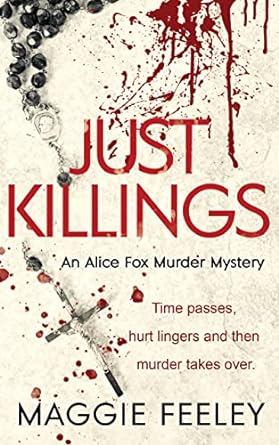
Writers Chat 67: Maggie Feeley on “Just Killings”(Alice Fox Murder Mysteries Book 2) (Poolbeg Crimson, 2022)

Congratulations on the second book in the Alice Fox Murder Mysteries. We last chatted about the first book in the series, Murder in the Academy (Alice Fox Murder Mysteries Book 1) (Poolbeg, 2021) and it’s great to be back with Alice and Caro in a slightly changed Belfast setting.

SG: Let’s go back to your writing, now that you’re deep into a series of novels – or is it a trilogy? Tell us about character development from book to book, in particular, our heroine Alice. I feel she’s grown in insight and confidence in the second book, (or maybe I know her a bit more). Does this relate at all to your experience in writing Just Killings?

MF: You’re right Shauna. The third Alice Fox mystery Wrestling with Demons was published by Poolbeg in August 2023, so I’ve got as far as a trilogy for the moment. Alice and I, and the other characters that carry forward from the first book, are all developing together, I’d say. I can’t claim to fully understand how that growth in each character comes about but I am coming to know each of them in an instinctive way and to understand how they will react and behave in each new context. I don’t feel that I am manipulating them to suit the plot rather that the context comes first and then they become more and more fully themselves against that backdrop. In this case, confronted by the distinctive signature murder of two men of the cloth, the Murder Squad with the help of Alice Fox, begin to investigate why these particular victims might have been murdered.

I’m influenced by reader feedback to some extent and think now about the amount of explanation I include. I’ve learned that readers don’t always want to know a lot of the detail I might serve up and so I’m more inclined now to withhold some of what I know about the people in the books. People like to create their own version of characters and I need to leave space for that to happen. At the same time, I’m not a pushover and when someone says they don’t want to read about social justice issues then I think, you’d better read someone else’s books because for me absolutely everything is about some form of in/equality.

In Just Killings Alice has settled into life in Belfast. She has links in Dublin and her work with young people in West Belfast fills the space left by her work in the College. As the work with the EXIT youth group deepens so do the relationships she makes there and we learn incidentally through these lives about the past and present in Belfast with the special legacy issues that the Troubles have bequeathed to people there. Individuals, families and communities have been coloured in by their particular history with the war and Alice, as the outsider, allows us to observe the detail of that in the day-to-day present. For the same reason there will always be an all-island element to the books as although some people identify almost entirely with one jurisdiction, others are constantly balancing the awkward reality of belonging in both places.

SG: I love the notion that you are growing with and as your characters grow and develop! Just Killings, unlike Murder in the Academy is framed not so much by Alice Fox’s own story but by differing government and societal responses north and south of the border to the revelations of institutional abuse by priests in the Catholic Church, and the Murphy and Ferns reports. We open with a rather gruesome description of a murder – I felt like I was in the Netflix series Criminal Minds – which firmly connects these threads. From our last Writers Chat, I know you like the story to lead you, rather than have it plotted out. Did this opening scene come at the start of the drafting process and then lead on to the second murder or did you work out the details at a later stage? 

MF: I’m always surprised when people say they are taken aback by the way that I can produce such gruesome murder scenes that don’t match their understanding of me. In the first book I found the murder hard to create but it’s becoming easier with practice! I’m not sure what that means for the future…  In the case of Just Killings I actually began with the murder that is discovered in the church in Belfast and added what becomes the initial Wicklow scene some time afterwards when I began to incorporate the Ryan report findings into the story. The structure unfolds gradually as the plot develops and I move pieces around to suit that.

You are right that I always see the structural framework behind individual and community social practice. The connection between clerical abuse in parishes and institutional abuse in Irish industrial schools has always been clear to me. The abuse by clerics of women and girls, boys and vulnerable young men was widespread for much of the last century and fictionalising those events, or their consequences absorbed me. I am familiar both personally and academically with the minutiae of how the patriarchal church and state behaved when those abuses took place and how they responded as the subsequent inquiries proceeded. I remain unconvinced by their acts of contrition and incorporating that into a murder mystery allows for the personal impact of those criminal events to become imagined and elaborated.

SG: Thanks again for the great insight into your writing self, Maggie, how a certain type of writing might be difficult at first, but with practice becomes more manageable, or familiar. A key theme in this book, for me, was family and society’s definition and denial of it. I really enjoyed how various characters’ experiences of this were shown in parallel narratives. We see-sawed from Jed’s search for answers to his family’s hidden history to Alice and Caro’s open making of their own history. This threading of the individual/ communal as much as Alice Fox links all your books. Can you talk about these links?

MF: In the 1980s, feminist Barbara Demming published We Are All Part Of One Another and cemented for me the belief in our irrevocable interconnectedness. I see feminism as the antithesis of all things patriarchal and families in their diversity are another site of that struggle. The Irish church made use of the family structure and women’s role in it to support its own power and influence at the same time as it was covertly causing havoc in individual lives. Those individual hurts and harms that were perpetrated by members of the clergy against vulnerable people placed in their care were inexcusable. As were the behaviours against those who trusted the holy personna they projected and then betrayed. The survivors of these abuses became communities of the wronged whose damage extends across generations and who, with their allies, have struggled to get some kind of recognition of how the patriarchal church has offended against them. In Just Killings I take the liberty of hitting out against the hypocrisy of the church and imagining what would happen if the victim claimed some measure of personal justice. I do believe strongly that it is solidarity that can take down oppression and Alice and Hugo as well as the survivor communities north and south are the expression of this in Just Killings.

SG: Yes, this sense of solidarity is what Alice hones and fosters in both herself and those she works with. Just Killings not only takes place in Belfast but spans the island – from the second murder site, to discussions of institutions in the West of Ireland. While this is a work of fiction, it feels that many of the fictitious institutions are based on real places. Are you at liberty to discuss your research and reading, besides the influence of your other publications such as Learning Care Lessons, on the societal structure, class and disadvantage.  

MF: Just Killings is a form of historical fiction in that it is based on the reality shared with me by survivors of abuse. From 2002-2007 I carried out an ethnographic study in the community of survivors of abuses in Irish industrial schools. I was particularly interested in their memories of the learning of literacy in those institutions and how the absence of care impacted on the capacity to learn. It is not by accident that there is a literacy thread in all my books. I have been involved in adult literacy learning for most of my working life and am clear that literacy is a real barometer of in/equality in society. From my immersion in the survivor community I gathered stories and details of experiences that allowed me to write Learning Care Lessons: Literacy, love, care and solidarity. Having unmet literacy needs is directly linked to all forms of inequality and disadvantage. In my research, care was uncovered as a vital element in learning and it is ironic then that those taken from their families into the care of the state were deprived of the most minimal level of literacy learning.  Those who preserved even some small element of familial affection were much more likely to learn than those who didn’t. These small loves emerged as hugely significant and always strike me as an undervalued source of social sustenance.

Far beyond the impoverished educational elements of life in these institutions, people shared deeply personal memories of family circumstances, of the isolation a child experienced when deprived of the company of siblings, of physical neglects in terms of hunger and emotional trauma brought about by the constant fear of corporal punishment, humiliation, sexual grooming and repeated assault. Much of what is written in Just Killings is rooted in those and other recollections of adults who survived their time in the care of the state and have bravely shared their truth about what happened behind those closed doors.

What is totally shocking is that the fictional revenge sought in Just Killings is the only detail that isn’t informed by my first hand experience and research. For the most part, survivors were avid adult learners, solidary supporters of their fellow survivors and focussed on making the best life for themselves and their families. Causing hurt to others was not on their agenda.

SG: That is most shocking indeed, Maggie. Thank you for sharing these insights into your research and most caring work. This leads us to our final focus which is the title – Just Killings. Alice reflects on this

It was a very different role to be facilitating the detection and capture of someone, maybe himself a victim, who had decided to punish acts that had incurred little or no punishment inside the legal system. Did that reluctance within the system to bring these abusers to book make it okay for someone to take the law into their own hands? Should those who are wronged be expected to behave more morally than their leaders?

I like how you, and the story, leave the reader to also reflect, without providing answers. Can you talk a little about this, for example, were you tempted to expand on these questions or even answer them for the reader?

MF: Justice is a slippery concept and I’m struck by the way the people that tend to fall foul of the law are often those that the social structures have treated most unequally. Literacy levels are lower in prison than in outside society and the two-tier Irish education system is allowed to persist and perpetuate these inequalities. It often seems as if state systems are constructed to protect the powerful, even when they behave in a negligent and harmful manner and at the same time to find the least influential at fault for even minor misdemeanours. Childhood institutional abuse, state sanctioned mother and baby homes, Direct Provision for those seeking assylum and protection from torture and ill-treatment in their country of origin are examples of systems exposed as critically flawed yet where the damage experienced is slow to be acknowledged and reform comes far too late for many users. Those who are harmed in these structures past and present are not known for fighting back.

In Just Killings I was imagining what revenge might look like in the context of institutional and clerical abuses. I am not a believer in violence as a means of tackling injustice. War is an extreme example of how physical fighting does not resolve disputes and where justice is easily dropped from the agenda. Nevertheless in fiction and especially in crime fiction I think there is room to raise the hypothesis of a ‘just killing’ in order to bring the underlying contextual factors into question. I leave the questions unanswered because the important issue is always social inequality of some kind and reconfiguring that is the only action that can lead to just and lasting solutions.

SG: Well, I would love to see, instead of just killings, a just society! Lastly, Maggie, some fun questions:

  1. Coffee or Tea? I have always preferred coffee to tea but now a chronic bladder condition prevents me from having either unless all caffeine is removed which seems a bit pointless. My current favourite herbal tea is liquorice.
  2. Dogs or Cats? I admire the self-centreredness of cats however my wife Ann is allergic to both so my admiration has to be from afar.
  3. Most surprising reader reaction to your Alice Fox Murder Mysteries? After reading Murder in the Academy someone went on a weekend mission to Belfast and did an Alice Fox tour retracing all Alice’s movements. That surprised me quite a lot!
  4. I love that! What writer would you most like to have afternoon tea with? I’d like Claire Keegan to let me into her secret of writing short, rich and absorbing stories.
  5. What are you writing now? I’m having a break while moving house, incubating Alice Fox 4 and dabbling in some short story writing.
Photograph courtesy of Maggie Feeley, showing Maggie, seated in a garden with daisies behind her. She smiles with a blue-eyed gaze to the camera wearing a blue shirt.

Thank you to Maggie for her insightful answers, particularly about her writing processes, research and passion for social justice that lie behind many of her novels. I wish her much continued success and many more eager readers!

Writers Chat 61: Katherine O’Donnell on “Slant” (New Island: Dublin, 2023)

Cover image of “Slant” showing three women standing in front of bookshelves, and smiling directly at the camera.

Katherine, You’re very welcome to my Writers Chat series. We’re going to chat about your debut Slant (New Island: Dublin, 2023) which I devoured, and loved, though it did make me cry.

SG: Let’s start with the title – taken from the Emily Dickinson poem “tell all the truth but tell it slant” – which, to me, seemed to describe Ro McCarthy’s life experience. She’s on the outside, spectoring her own life. Can you talk about this theme of not being able to face or talk about the truth head on, at always having to tackle it at a slant?

KOD: Dickinson’s line for me is a perfect summary of the super-power of fiction – which has the potential to make a world for a reader but only when it resonates as ‘true’. Fiction is created through sentences running across pages – slantwise – yet when fiction works for an audience it is not received as ‘fake’ or ‘false’ but as illuminating the real world – all the truth.

Ro McCarthy appears as a reliable narrator but we also experience her as a young, naïve woman; as foolish, duplicitous at times, unaware of danger, inexperienced, and sometimes cowardly. I wanted to write a young voice that we see mature. The older Ro sees more – but as you point out, both young and older Ro have their own particular turning into and away from the environments in which they find themselves in. Their perspective is framed by their orientation to the world and is always partial – just like all of our perspectives. In seeing how the experiences and hence the characters of Ro younger and older are shaped by their environment, readers get a taste of a fundamental truth – we are all formed in and through the contexts in which we move or remain stuck.

SG: Of course, the narrative of Slant is not only the communal story of life for Irish emigrants in Boston in the mid-eighties but is also a looking back novel, that of the formation of self, and ones place in the world. Towards the end of the novel Ro, sitting at her window, muses (quite movingly, I felt):

I feel a type of loneliness, a singular aloneness, that makes me feel secure and that the world I am in is full of possibilities. I know myself by my loneliness. This is me. This is me.

It struck me that she is right – despite the parties, the craic, the people, all with the wonder and grief of life – Ro is comfortable in her own skin and, in her fifties, is finally content enough to allow herself to feel that singular aloneness. Can you talk a little about the individual/ communal support in the community (especially the Lesbian community) that she seeks and finds in Boston in the mid-eighties?

KOD: I am very gratified to see how deeply you’ve connected with Ro and Slant. I am so glad that Slant has found such an engaged first reader! When I wrote those lines about Ro’s loneliness I was drawing on that wonderful poem by Adrienne Rich “Song” where the speaker is responding to the question ‘Are you lonely’. She answers ‘yes’ in four short, intensely lyrical and visual verses and she describes her loneliness as a sense of journeying, independence and expanding freedom. She answers that yes, she’s a plane riding lonely over the Rockies aiming for ‘blue-strung aisles/of an airfield on the ocean’; she’s a woman driving across country; she’s the first person awake in a house full of sleeping people, at dawn in a city; she’s lonely like a frozen rowboat at a lake at the end of December, ‘that knows what it is, that knows it’s neither/ice nor mud nor winter light/but wood, with a gift for burning.’ I have always loved that poem and it was a touchstone for developing the character of the older Ro.

Ro’s ‘ singular aloneness’ is buoyed by her deep experience of community so that she remains confident that world is still alive with possibilities. When she threw herself into the tribe of lesbians in 80s Boston, she had no idea where she would land – we remember that she didn’t want to describe herself as ‘coming out’ but ‘coming in’ – she came into herself, into a lesbian life and was caught in a safety-net of connection with Eily, Mels, the Boys, ACT-UP. We see her in her later life among deep friendships and in a ritual calendar of dyke activities that continue to structure her days and support her in joyful connection.

SG: Yes, “joyful connection” really sums it up. Ro also finds community through social activism – in the 80s she throws herself into AIDS activism and in the 2000s she’s marching the streets of Cork and remembering that in the 80s she

was part of a tribe moving as wind: sometimes salty, sometimes rain-drenched, sometimes howling, then playful, tickling, a gentle breeze; but always bringing more oxygen and possibility to the world, changing the atmosphere and dappling the light.

All of those times “were already an overlooked history” and she feels “the dissonance of that time” with her life as she now lives it. These sentiments echo not only the passing of time but also the huge changes in Irish society and attitudes towards sexuality and identification. And yet, going door-to-door, Ro finds that not much has changed at all. Can you talk about how the personal echoes the social throughout Slant?

KOD: Ro McCarthy’s personal trials and tribulations have allowed me to write a micro-history of Ireland from the last two decades of the twentieth century into the first two decades of this twenty-first century. It surprises me that fiction and film have not focussed much on the tens of thousands of Irish ‘illegals’ who lived in the 80s and 90s in cities across the USA. Even in more recent years the figure of Irish illegal aliens in America is reliably estimated to be about 50,000. The Irish ‘illegals’ are embedded in distinct communities and I wanted to write about that culture, particularly as I imagined it existing in the 1980s. I hope that acknowledging Ireland’s very recent history as a strong exporter of economic migrants during our dire economic recessions in the 1980s that we might remain sensitive and sympathetic to economic migrants living and working and enriching Ireland today.

Ro’s other community in Boston is her queer community who lived through the battle of the AIDS crisis – Ro remembers it as a war and her shell shock is reactivated in her experience of the Marriage Equality campaign. I wanted the reader to be able to witness the cumulative trauma-toll of social marginalisation and oppression on one individual who doesn’t quite understand herself that she has PTSD. In the reader’s empathetic experience of Ro’s life, I hope to inculcate an understanding of the undue suffering of all those whose social identities leave them vulnerable to prejudice and exclusion.   

SG: And you capture this cumulative trauma subtly, and well. Russ declares to Ro “I don’t know if fags and dykes will ever get to write the history, dear Rose Marie, but we will certainly make the art.” There’s a meta-narrative in Slant that of creativity allowing people to be more themselves – for some it’s through singing/dancing/ music and for Ro it’s through writing. Like many writers, Ro writes to make sense of the world, she often wakes with “a wisp of a story” in her head and she tries to chase it down. Can you talk about how writing, for Ro, is about (as she says) “re-membering” herself, reclaiming her body, trauma, grief and from always having “to be brave facing the public world”.

KOD: Yes, the central claim of Slant is that creativity allows us to connect with empathy and understanding, and kindness, and maybe even joy, both to our own experience and that of strangers. I hope that the ending reveals how readers as much as writers of fiction play their part in fostering these enriching connections.

SG: I loved the tone of Slant; Ro’s humour and wry observations of the world around her. She likes American people despite the fact that they “were astonishingly, uniformly intent on amplifying happiness…all that positivity was the perfect antidote to being Irish.” Despite the horror and devastation AIDS brings to many of Ro’s circle, it’s this humour – often self-deprecating – that allows her to be honest, and this can be seen in the wonderful employee/employer relationship she has with the elderly spirited Clara as well as the great friendship groups she has – the misfits – and Eily and Mels. Did this voice come for you through characterisation or theme?

KOD: What another lovely observation and question! The humour came from both the character and the theme – groups that struggle collectively to resist social prejudice and oppression can only survive if they routinely create spaces for joy and laughter. And Ro is simply very funny.

SG: Without plot spoiling, Slant manages also to cover power, abuse, control and silence in close relationships. Again, this seemed to me to echo society as a whole. I’m thinking here of two central relationships to the story – that of Jenny and that of Terri. Can you talk about this theme? 

KOD: In writing the dynamic of the ‘bad’ lesbian relationship I was inspired by In the Dream House by Carmen Maria Machado (2019) but also definitely prompted by that line in the glorious Lesbian Avengers Dyke Manifesto (1993) – “Lesbian Avengers are old fashioned: pine, long, whine stay in bad relationships”. That line – amidst the juicy rhapsody on LESBIAN SEX – has always made me laugh. I feel a bit apologetic to lesbian readers – as we are so starved of cultural representation – that I wrote a lesbian character who was so controlling and manipulative – but, dear reader, she was a complete delight to write and I remain very fond of her. I gave her a happy ending.

It is interesting that you also think that Jenny was in a similar relationship of control, I hadn’t quite realised that. I think that we are so culturally used to the conventional dynamic of traditional heterosexual relationships that we can be blind to their overtly transactional nature.

SG: Yes, for me, Ro and Jenny had a type of echo and call with each other from within their unhealthy relationships. And Machado’s Dream House is such an impactful read. So, we’ll end this Writers Chat, Katherine, with some short questions:

  • New York or Boston? Provincetown.
  • Sorry, I should have offered Provincetown as an option! So, coffee or tea? I need coffee, I enjoy tea.
  • Mountains or sea? Always, always the Sea. In, on, under, or within sight or smell of it.
  • What are you writing now? Reworking a novella entitled Close/Close and also working on developing more picture-book stories for infants (with my friend Soren Mayes) based on Buddhist teachings.
  • I love the title of your novella, and interesting that you’re also working on stories for infants. Tell me, what are you reading now? Couplets: A Love Story by Maggie Millner (Faber 2023) and about to start Lara by Bernardine Evaristo (1999) – I missed it the first time around
Photograph of Katherine O’Donnell seated at a table resting her face on her hand, looking directly at the camera. Photo provided by the author Photo Credit: Emma Jervis.

Thank you to New Island and Peter O’Connell for the advance copy of Slant.

Thanks to Katherine for such an engaging Writers Chat – I wish her much success with this novel. Readers can purchase Slant directly from New Island.

Writers Chat 59: Maureen Gallagher on “Limbo” (Poolbeg Crimson: Dublin, 2022)

Maureen, You are very welcome to my WRITERS CHAT series. Congratulations on your debut novel Limbo: A Kate Frances Mystery (Poolbeg Crimson: Dublin, 2022).

It’s a real page-turner of a thriller that reminds us of how far we’ve come in terms of equality and bodily autonomy but also how far the reality has still to go.

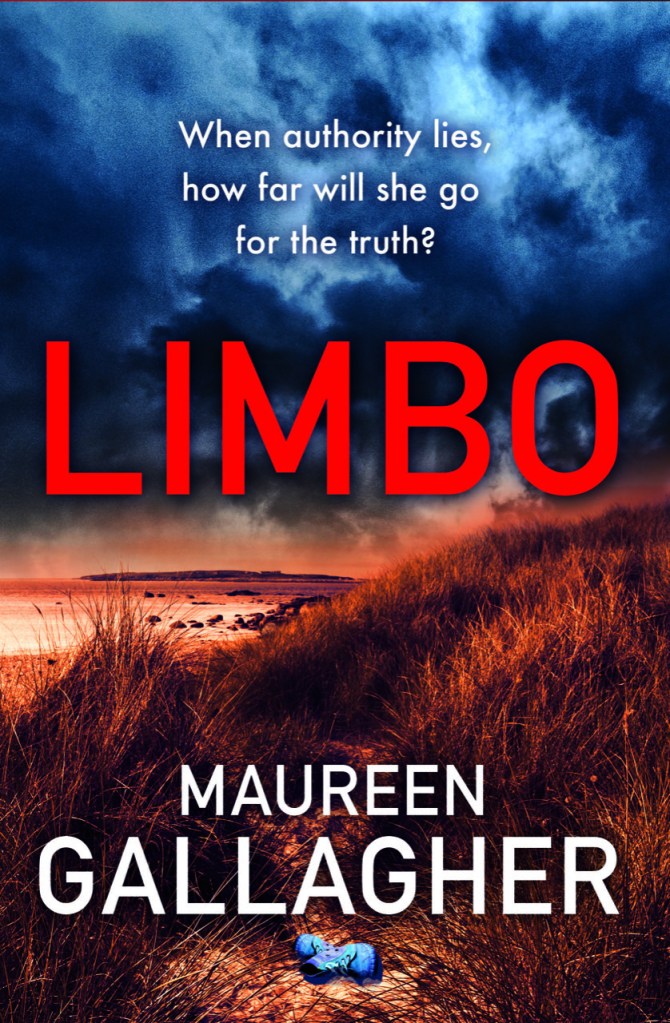
Cover of Limbo featuring seascape and sand dunes with an abandoned pair of child’s boots. This photograph is of Port Arthur in Gweedore, taken by Peter Trant.

Limbo is the first in a series featuring the brilliantly complicated and humanly flawed Detective Kate Francis whom we get to know as Frankie. Tell me about the cover, the title and the series.

MG: Thank you very much for inviting me to WRITERS CHAT, Shauna. The front cover image of Limbo depicts the dunes at Port Arthur strand in northwest Donegal – marram grass and patches of bright sand in the foreground with a view out to sea and the islands in the distance. The image was taken by my brother-in-law – Peter Trant – an accomplished photographer, who is very familiar with the beaches in Gweedore, and took many photographs of the dunes for me to choose from.  The final image is enhanced by David Prendergast, Poolbeg’s designer, who darkened the sky, and skilfully coated the entire landscape with a thrilling orange hue. When it came to choosing a title, Limbo came to me pretty easily, for the layers of meaning that inhabit the word, not least the state of babies souls and the fact that Roche can’t give them a Christian burial. In addition,  Frankie’s indecision and paralysis about what she wants out of life career or family is an important aspect in the novel. The title is also in tune with the tone of the book, which is an attempt to imbue the story with a whiff of incense, given the dominance of the Catholic Church at that time. Limbo is a the first of three. My plan is to set the series at ten-year intervals, so that it charts Frankie’s growth and development personally and professionally, and also gives some idea of the way Ireland has changed in the past 35 years. 

SG: Very interesting to hear about the ten-year intervals. I love that idea and because I really liked Frankie who is very much of her time but is also an everywoman, can you talk about how Frankie developed both as protagonist and character within the framework of the storyline?  

MG: Detective Kate Francis aka Frankie works in a male dominated workplace in  nineteen eighties Ireland. Sexism is rife. In the very first paragraph, sergeant Brannigan, ruminates:

‘To think, godammit, the reinforcements they’re sending from the city, includes a woman. A battle-axe, no doubt, built like a barn.’

So from very early on, we see Frankie dealing with the hostility of Brannigan, while at the same time fending off the unwanted attentions of her married boss, and trying to placate her boyfriend, resentful at her long hours at work. As she struggles to advance the investigation, these personal challenges deepen. Her boyfriend asks her: What do you want out of life? To be the best sleuth? To settle down and become a mother? Frankie is conflicted. She doesn’t see why she can’t do both. When she’s left to solve the case on her own, we see Frankie’s professional confidence grow, as she stands up to the corrupt sergeant and follows her own instinct for finding the killer. Alongside this confidence comes an insight into how she will address the apparent contradictions in her life. In the end we see a changed Frankie, one who has grown personally over the course of solving the murder, and who is grounded and at peace with herself.

SG:  Limbo is set in 1989 in Donegal, with the stunning landscape key to both the mystery and the reading experience. Your descriptions are beautiful and even more impactful as they are set against the investigation of two murdered babies, from Port Arthur Strand, Gweedore to Errigal Mountain and the River Claddy is “the warm colour of tea”, “On the horizon, Frankie can see the islands floating in the Atlantic, surrounded by thousands of foaming white horses fringing the waves: Gola, Inishmaan, Inisheer.” How important was the setting to the novel and to the series?

MG: I spent most summers as a child in Gweedore in Donegal, where my parents grew up. My father taught in Ranafast, and the family simply decamped to the Gaeltacht for July and August. So many images from childhood mean Gweedore to me: Errigal mountain, salmon fishing, snuff, the bitter winter I spent there with its howling storms; sea and sand and picnics on the strand. Summer seemed to go on forever back then and we spent much of it in one or other of the three glorious beaches, including Port Arthur, which features prominently in the novel. I was fascinated with juxtaposing a horrible crime like the murder of a baby against a backdrop of such exquisite beauty. The idea for the novel came from an assignment at a workshop to write a 300-wordpitch for a crime thriller. The writer,  John Fowles, once said that he usually started with a powerful image, and then tried to work out what the story behind it was and how it developed, The French Lieutenant’s Woman being the most obvious example. The image of the mysterious woman at the coast staring out to sea is not so far away from the image of a baby found on the beach. So my novel opens with the most awful crime imaginable. Just as south eastern Sicily is like a character in Andrea Camilleri’s Montelbano thrillers, I wanted Gweedore to feature almost as a character in the story, with the mountain Errigal a touchstone for everything.

SG: Lovely to hear your authorial intention, Maureen, and I do think that comes through to the reader. Over the course of the investigation, Frankie realises how the patriarchal systems of power are skewed towards men, from the hospitals – early on in Limbo a matron exclaims, as if there were no men involved in procreation “these young girls, you’d feel so sorry for them” – to the force which employs her as a detective – she figures out which battles to fight with Brannigan, how to negotiate her desire with Moran (“there’ll be none of that she tells herself”) and her future, whatever that might be, with Rory. Can you talk about your exploration of gender in the Ireland of 1989?

MG: The action takes place in 1989, ten years after the pope’s visit, an era when people’s mindset had not changed much at all from the 50’s and 60’s. I wanted to explore what we were like as an nation back then, and ultimately what that led to: women vilified for no greater crime than becoming pregnant. At one point the protagonist, Frankie, asks: “Do we not value pregnancy and birth in this country?” So you could say my focus was the treatment of women in late 20th century Ireland. When it came to naming my female protagonist, I had to think long and hard. My main reason for giving my female character a name that is somewhat androgynous was because I didn’t want her to be referred to by her first name while all the men in Limbo were referred to by their surnames – Moran, Brannigan, O’Toole etc. I felt that would have rendered her somewhat inferior, in a situation where she is already facing prejudice. But neither did I want to distance her from the reader. So I set about finding a surname that sounded like a first name. Even though there are female Frankie’s, there is the intentional false assumption that Frankie is a male name. At the very least it is gender neutral, androgynous. My intention was to give my protagonist a modicum of gravitas in a male world.

SG: And Frankie as a name for this character works so well. So, part of Frankie’s initial investigations lead her to Umfin Island to meet with members of followers of the Brigid, Goddess of Fertility. She finds

“she’s conflicted. On the one hand, she’s impressed with the back-to-nature self-sufficient element of the lifestyle she’s observed….on the other, at the very least there was a level of violence in the ritual she’s just witnessed that was disturbing.”

In a way, this experience also sums up Frankie’s view of Irish society and politics, and the power of the Catholic Church. It appears to be one thing but actually – including and especially figures in authority – is another. Can you talk about how these themes influenced the story line (or was it vice-versa?).

MG: What was an eye-opener for me when I started to write Limbo, was that the structure of the crime novel – you could say its limitation – allowed me to explore social issues, something dear to my heart. The very nature of the genre frees up the imagination. The two underlying themes I had in mind when starting the novel, was the power of the Catholic Church in Irish society and the subordinate position of women. Someone once coined the phrase ‘the Catholic Taliban’, to describe the hold the Catholic Church had on the lives of women in Ireland all down the century since independence. Throughout the thirties, forties and fifties, and even up to the eighties women’s bodies were a battleground. I wanted to show how the Catholic Church dominated the whole narrative, how it was woven into the very fabric of society, and for this to inform the tone of Limbo. The backdrop to the story is a misogynistic state hand in glove with a powerful church and its impact on women. But I was conscious too that exploring social context should not mean long passages of exposition. The bottom line is that the novel has to be entertaining – people want to know what happens next.  Crime writing, like all fictional writing, is best done through scene setting, dialogue, believable characterisation. Or as the late great John McGahern would say, told slant.  

SG: Yes indeed – ‘told slant’ – a lesson in writing fiction! Lastly, in Limbo, as in our history, those who don’t confirm to prescribed behaviours and identities are locked up or hide themselves away – claiming their voice as their own by not speaking, for example Hannah. Part of what Frankie has to do is to listen to what is behind the stories that people tell, see what is beyond the land and within the houses. In this way, as Frankie “feels resentful at how the Church has commandeered all the major events in people’s lives”, Limbo is as much about agency and power as it about a thrilling story. Was this your intention?  

MG: Limbo is very much about the struggle women have to gain autonomy within the suffocating limitations imposed on them. Hannah’s response to the violent strictures visited on her is to choose not to speak, to metaphorically lock herself away. Her daughter Sarah, in contrast, determinedly manages to rise above her awful experiences and leaves Ireland to embrace a new life. Frankie addresses head-on the challenges she faces and in so doing gains insight into her own personal predicament and how to resolve it. The novel is very much about agency and power. It charts both the tragic predicament of the women who are crushed by their oppression, but also the empowerment and joy of the women who transcend it.

SG: To finish up, Maureen, some fun questions

  • Sandy or Stony Beach?  Sandy. Definitely not stony – I value my ankles!
  • Tea or Coffee? Mostly tea. But when my daughter – who now lives in Spain – visits, I bring her to Tigh Neachtain in Galway, which serves an excellent coffee.
  • Music or quiet when writing? I love music but not when I’m writing. I like total silence when I’m writing.
  • What’s next on your reading pile? I’m re-reading of Lajos Egri’s superb The Art of Dramatic Writing as research for Book 2, and for leisure reading I’ve started Maggie O’Farrell’s The Marriage Portrait, which I’m enjoying very much.
  • What are you working on or thinking about now? Now that the launch of Limbo is behind me, I’m picking up where I left off on Book 2 in early summer. The book’s premise is ‘Misogyny Fuels Femicide’, an idea I’m very engaged with and I can’t wait to get stuck back in.

Thank you, Maureen, for such engaging and thorough answers. I very much look forward to the next two books in the series and to seeing more of Frankie!

Readers can order Limbo here

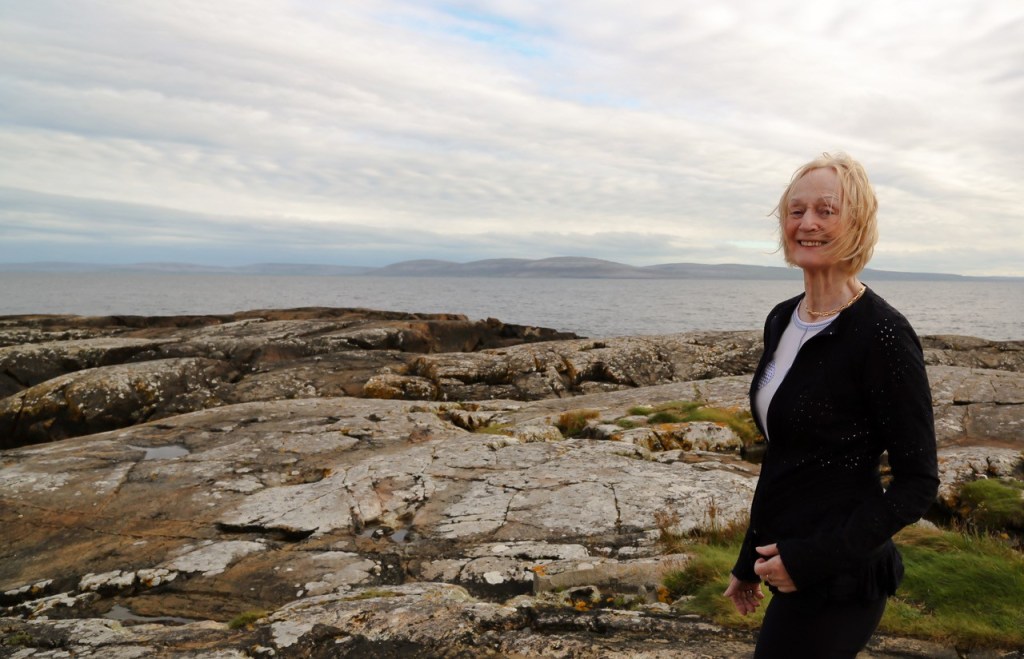
Author Maureen Gallagher. Photo courtesy of author.

With thanks also to Poolbeg Crimson for the advance copy of Limbo