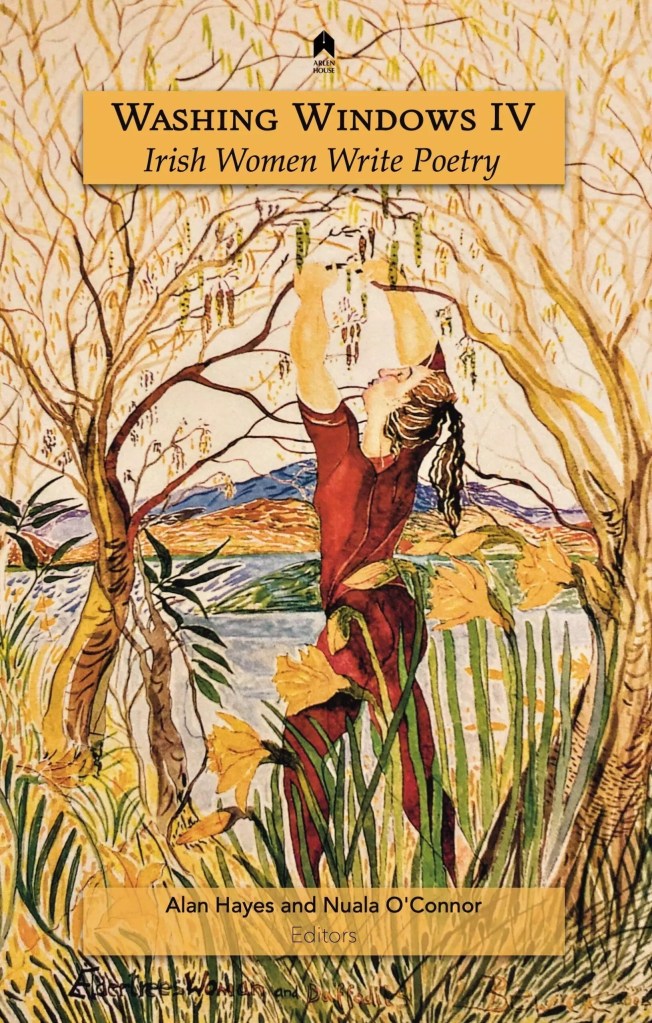
Cover of Washing Windows IV featuring artwork showing a woman by a lake reaching up to a tree surrounded by wild flowers, daffodils, and reeds
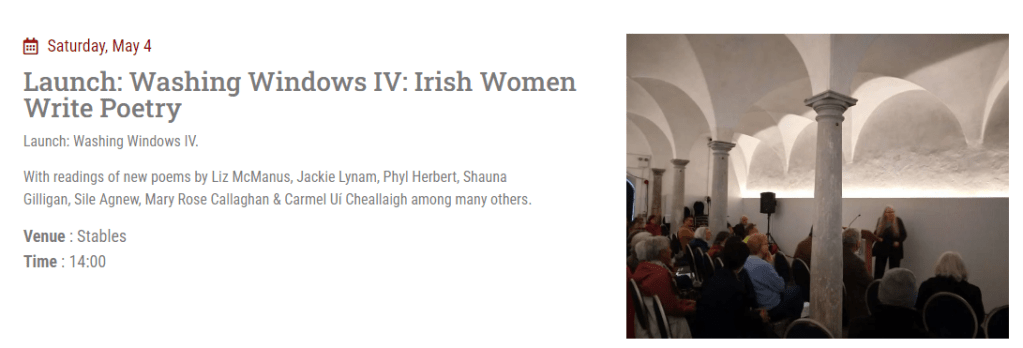
Washing Windows IV: Irish Women Write Poetry will be launched with readings by contributors on Saturday May 4th at the brilliant Strokestown International Poetry Festival.
Thanks to editors Alan Hayes and Nuala O’Connor for including my poem “I Left My Womb In Napoli” in Washing Windows IV: Irish Women Write Poetry.
Maeve, Welcome to Writers Chat. We’re going to discuss your poetry pamphlet Body as a Home for This Darkness (Book Hub: 2023) which, although a personal tender and moving homage to your late father, is also a consideration on the passage of time and grief. I might add also a congratulations on being placed as a finalist in the 2023 Gregory O’Donoghue poetry prize!
SG: Firstly, tell me about the title which seems to encompass the entirety of the collection – notions of body, ageing, time, belonging, family, and the darkness of grief. In the process of putting the collection together, where did the title come?
MMcK: Thank you, Shauna, for your kind words. Yes, you are right, Body as a Home for This Darkness encompasses all you say of body, ageing, belonging and family and is also a reflection on the loneliness of loss and grief. Both are constants in life and yet are something we tend to shy away from. The title of the pamphlet came from a haibun poem I wrote four years before my dad passed away. Dad was no longer the man we once knew yet he became the only man we had left and the title spoke to me of that reality and how dementia strips away the very essence of a person.
Cover of Body as a Home for This Darkness by Maeve McKenna (Photograph provided by Maeve McKenna)
SG: Body as a Home for This Darkness opens with the poem “Him” which introduces us, character-like, to your father. I love your use of lists that paint photographic stills of the man, living, giving, enjoying life until his hands are “grey as putty. In ours.” Could you talk a little about the placement of this poem and its formation?
MMcK: It was important to me during the proof-reading and editing process to begin this book with a memory of my father as the man he was before his diagnosis. Dad was a vital man in our world. He was loved dearly, by his family and friends. He was important to so many. While many poems focus on his later life; ten years in the care home as we lost him slowly, my siblings and I remembered our younger lives and the happiness of those times. Dad was a man of his time, the provider who worked hard and never complained, the one we looked to for advice, the person who made everything ok. The poem ‘Him’ attempts to capture and give the reader an insight into the younger man, the father, the worker and the everyday things that made him who he once was.
SG: And I think it captures all of those things about your dear father. Nature features in your collection, as a harbingers of news. In “Rain knows of Waking”, “Blades of grass are scissors wielding tears”, disturbingly (but accurately), “sadness amputates mind from the thinker” until at the end, “raindrops preen in the reflection of your surrender.” You capture something profound about illness and the loss of control. Do you think that when we’re going through events like this that our powers of observation become more focused on the immediate surrounds, that blades of grass, for instance, take on a deeper meaning and significance, and that in writing these experiences into poetry we are already starting the healing process?
MMcK: Nature features in many of my poems. Something about the temporality of nature, how it comes and goes and regenerates itself year after year, allows me to better understand our human existence. An autumn morning spent in a forest observing the acceptance of an oak tree as it slowly retreats and to return there in spring to watch foliage sprout and burst with colour reminds me of life, the brief time we are here and whilst here there is joy but also challenges that we must accept. I am happiest lost in the woods or strolling along a beach listening, touching and absorbing all the elements around me. Of course to write we must observe keenly, and the image you refer to, ‘blades of grass are scissors wielding tear’ came from an early morning walk in late November near the care home as my father entered the last days of his life. I stopped to watch dew rest on blades of grass and they were tears, mine, but this was the order of nature and the blades of grass bore the weight of the dew with stoicism.
SG: Yes, we can take so much from the order of nature. In the devastating “Leaving”, you capture the solitude of grief, where you get lost on the M50 with your family including
three almost/grown children, tight, really tight…fast asleep
leaving you alone in and with your grief, and leaving you to find your way home. In the title poem, “Body as a Home for This Darkness”, we have more movement, of body, of task, of help as well as dropping back into memory and connection.
Once, you made raspberry jelly when my throat/hurt I’ll ask if I can bring you some…
These poems really stuck with me and I’m curious about your stylistic choice of form. Can you talk about this?
MMcK: Poems often choose their own form. I like to experiment with different forms in second or third drafts. In the case of ‘Leaving’, I felt the form I settled on, a justified block of text, allowed the poem to give the sense of claustrophobia I felt that day driving home from my dad’s funeral. It was in lockdown, we were allowed just ten mourners at the funeral and because of restrictions we had to leave immediately after. The loneliness of that journey home, even though my family were with me in the car, will remain with me forever. Similarly, in ‘Body as a Home for This Darkness’, I wanted the poem to appear solid on the page, that the reader would not be distracted by the format. It is a haibun and I wanted the haiku at the end to convey my dad as a younger, working man, a panel-beater and sprayer, who worked so hard to provide for us.
SG: Thank you for such insight into your process, and your terrible grief. The theme of clothes, how they sit on the body, and how we people are mere movements of clothes is threaded through the collection. I’m thinking here of “Listening for My Dad’s Clothes” and “Three Piece Suit in Rome” which ends with the question so many of us have to ask “Which shirt and tie will we bury him in?” Was this intentional or did this theme emerge when you went to put the collection together?
MMcK: A friend who I share work with pointed this out to me after reading a draft copy of the manuscript. I hadn’t noticed it prior to that. My dad was a dapper man, I never saw him in jeans or a tracksuit! He was neat and tidy and always colour coordinated. Subliminally, this came through in the poems. Many readers have remarked on this and I am glad as this sense of my father always being well-groomed would have delighted him.
SG: That’s lovely – as it also reveals something light and yet shows us the care your dad took not only with his family but himself. There is a nostalgia – through the grief – that your poems also capture, alongside the stark reality of death. For example, the sequence of action in “Breathe” that ends with the heartfelt “What sadness/you taught us to count”, or the visceral “Fortuity” or “Unprotected” where your father’s hands don’t know your hands have released his. In the wonderful “I Want To Go Home”, you capture an almost universal desire that many of us feel at some stage, that we want, not just to go “home”, but that we want to go back to the past, or rather a past without difficult feelings, without loss, without the responsibility of death. Have you – or could you ever? – read these poems aloud? I felt tearful reading them with the rawness.
MMcK: I’ve read ‘I Want To Go Home’ a few times. It is a long prose poem, but is always well received. Audiences seem to like the detail and many have said how the images in the poem resonate with them. As a Dubliner who moved to rural Ireland many years ago, when I visit now I see the city so vividly while also remembering the Dublin of my childhood. And you are right, the poem is about wanting a time that is gone, however good or bad that time was, before the realities of life as we age emerge. I’ve also read ‘Protected’ many times and it is a favourite poem of mine to read. I haven’t read ‘Fortuity’ or ‘Breathe’, two short poems, but look forward to in the future.
SG: We will end with a few light questions:
Coffee or Tea? Tea, but no more than two cups a day. Water mostly.
Sea or Mountains? Sea.
Longhand or straight typing? Both, I write on the hoof in jotters, and at home on the laptop.
Cats or Dogs? Dogs. Our two much-loved dogs, Buddy and Pablo passed away in 2020 and 2022. Both aged 15, they had a great and long life. We miss them still.
What are you working on now? I am currently working on my first full collection which will be part of my dissertation for the MA in Poetry I am currently undertaking at Queens University, Belfast. I am also exploring a long poem book. I have an early draft of a ten-page poem I would like to develop into a full book.
Thank you for your generous answers, Maeve and I wish you continued healing and much success in your MA in Poetry. I look forward to reading more of your work – especially the full collection, when it is published.
Photograph of Maeve McKenna wearing a patterned dress and smiling holding up a copy of Body as a Home for This Darkness with numerous copies of the book in the foreground. (Photograph provided by Maeve McKenna)
Tony, You’re very welcome to Writers Chat. We’re talking about Off Guard first published by Bradshaw Books (2003) and now re-issued by Wordsonthestreet (2024). It’s a beautifully produced collection, a real advocate for anyone tempted by ebooks to resist. I would echo Patricia Burke Brogan’s description that the “writing is sensitive, perceptive, sensuous and emotional…opens our eyes to a new way of seeing, a new imaginative experience.”
Cover image of poetry collection Off Guard with a black and white image of the author Tony O’Dwyer looking off in the distance in contemplation in front of a bookcase of books.
SG: Let’s begin with the title Off Guard which is taken from a Seamus Heaney poem. Do you think the aim of poetry is to catch those moments of the ordinary that then become extraordinary through memory and interpretation through the act of writing?
TOD: Yes I do. I remember my philosophy professor in college once saying that creativity occurs when two ideas spark off each other and create a third. So I think it is when our minds and hearts are open to suggestion that a spark of creativity occurs. This suggestion is usually something quite small and ordinary, a leaf, a look, a touch. This can then start a flame which may burn into a poem. The title Off Guard is from the last line of Postscript by Seamus Heaney. An earlier line in that poem goes “When the wind and the light are working off each other”. This spark of wind and light “working off each other” creates the scene which he wants to capture but knows he can’t because he’s only passing through. But the heart is caught off guard and blown open. I think that is the moment of creativity, the moment when a poem is conceived and something ordinary begins to grow into something extraordinary. I think all my poems, maybe all poems indeed, begin as tiny seeds, or even prior to that as desires, and grow from there.
SG: I love that idea of poems as desires first, then tiny seeds, and then moving words. I was also curious about and taken with your explanation of the role of form when writing “A House of Make Believe.” The form of the villanelle helped tame the original “overly emotional poem”. It speaks to the wonderful restraint that serves to heighten the reader experience that comes through in this collection. Would you recommend this process and practice of using form to shape the emotions?
TOD: The paradox of form is that it constrains and it frees. I think if the emotion is strongly felt putting it in the constraints of form can result in a better poem. Form can sometimes guide as well, almost like a road map for the poem. If I’m getting lost in writing a poem or I can’t seem to find a way in to the poem I’ll use form, rigidly or loosely, and usually I get where I want to go. I say rigidly or loosely because it can be a strict form like a sonnet or villanelle or merely a self-imposed rhyming scheme. I also like the challenge of writing to form. It can have the thrill of solving a puzzle so that for the reader the poem becomes a solution to a puzzle which the poem created for them. But some poems need to be free of the constraints of form. I don’t think I know whether a poem needs that freedom until I begin to write it. Maybe the poem decides for itself. Some poems can be trusted to wander while others need boundaries.
SG: Again, such jewells! Wandering poems versus bound poems. Thank you, Tony for such insight. Much of this collection contains wonderful examples of the importance of precise language and naming, and musicality in your poetry. I’m thinking here of “Skating” with it’s very specific landscape vocabulary that evokes almost physical sensations:
The poems “Cascades” and “Someday” move with a great flow when read aloud and in the mind. Can you give us an idea of your process in terms of editing – do you read aloud? Count the syllables? Use a thesaurus?
TOD: I read aloud. I tap out the rhythm. Sometimes I count syllables when I’m not sure if I’m getting the rhythm right. But English is an accentual language so sticking to a number of syllables doesn’t always sound the best and it is better to be guided by sound. Reading aloud and tapping out the beats ensures the poem flows more easily and gives it musicality. It doesn’t always have to be about beats either. I sometimes like to write in longer lines that rise and fall in cadences that carry the reader along as if surfing waves. This is especially pleasing in longer narrative type poems. As for a thesaurus I find it rarely useful. Its suggestions tend to be too prosaic and too precise. A poet’s thesaurus needs to brainstorm or be a type of mind-mapper. The best place to find a suitable word for a poem is not in a thesaurus but in other poems. This is why I like to read poems while I’m writing my own. Some people say the opposite, that it interferes with their creativity. I find that it boosts mine.
SG: That’s similar to my process with prose – I love to dip into and out of writing that I admire, reading slowly, seeing how the sentences work alone and together. In your poetry Mothers and Fathers feature – both yourself as a father, and your own father – and I was particularly drawn to the great exploration of the every day of life in “My Mother Prepares Strawberries” and “Stella Maris.” You take non-dramatic events, on the surface, and find in them tenderness, loss, and love. It feels like your razor-sharp eye, and microscopic observation brings us deeper into emotion. Could you comment on this?
TOD: That’s a difficult one to answer or comment on. It probably goes back to being off guard. The mind and heart must be completely open, in a state of total relaxation, almost hypnotic, where the sub-conscious reacts to the ordinary. It is not really something you can control (in fact that’s probably the point). It usually works though. But you must be in that relaxed almost dreamlike state. Then the words and images will come and somehow align themselves with the emotion. We are much more observant as children and the poem about my mother, which is mainly about the action of the can-opener is a result of my observation of her from childhood. I have a long and vivid memory and can remember not just sights and sounds but touch as well. When you couple that childhood or childlike observation with long memory you can get deep into the subconscious. The action of the can-opener became an extended metaphor for the vicissitudes of life, although I’m sure I didn’t consciously set out to make it that way.
SG: I think you’ve answered the question exceptionally well, Tony – it is that sharp eye, the slowing down of action (that of the can-opener) and the observations, through emotions. Much of the poetry is visual, like paintings and again, this comes from your precise use of language and stunning descriptions. In “Seven Figures” we see family members caught on camera in “a shorn field of pale stubble,” pictured with “a blanket of amnesiac sky” behind them, captured in “innocent sepia” and the of photographer, your father, only a shadow “stretching across a golden childhood meadow.” Directly after this moving poem we have the excellent pairing of “Son” and “Roots,” whereby time and perspective have moved on, you are the father now, memories and moments captured poems. Is this, somehow, the role of the poet – similar to that of the photographer – to preserve relationships in their environment before they’re gone?
TOD: I have always believed the role of any artist is foremost to strive to create a thing of beauty. After that whatever happens in the poem happens. Writing, especially writing poetry, is not about “self expression” as some people think; it is about creating a beautiful object. If you set out with too specific an aim there is a danger the content will eclipse the object and that can ruin the poem. The three poems you mention are all different to me. Seven Figures is really an ekphrastic. It is a description of a photograph taken by my father when we were visiting our cousins in the country. As he has his back to the sun his shadow cuts into the photograph. The word “absent” in this poem plays with the concept of the “absent father”. In most childhood photographs my father is present as the photographer but absent from the photograph. In this particular photograph he is both present in his shadow and absent. A type of shadowy presence. Which actually is quite apt in one way. Son is about the senses, especially touch. As I said I have a good memory for textures. I can still feel the touch of my children’s clothes on my fingertips as I dressed them. I can feel the weight they were when I carried them. I wanted to capture this sensual memory in the poem. Roots is about planting a stick of willow with my son. Willows grow very quickly and so it became a metaphor for how quickly children grow up but also how their roots are well established. It’s interesting that you pair the poems Son and Roots. I would pair Roots with the poem on the next page, Wings. There’s a saying that we give our children roots and we give them wings. The Wings poem is about the first fleeing of the nest as I leave my son to the airport and the connection that this departure paradoxically creates between us. So I guess those poems are about the desire to preserve relationships.
SG: And perhaps in preserving relationships, you are, as you say, fulfilling the role of the artist by creating and preserving this thing of beauty. You also hold myths and stories up against the everyday. In “Translated from the fabulous” and “Furniture City: Saturday Afternoon” (what a great title – and one of my favourite poems in the collection), we’re shown life and the waywardness of emotions through the lenses of familiar children’s fairytales. Furthermore, in “Night watchers,” “Testament” and “Vertices” we’re brought into the realm of the unseen through (possible) memories, places, and the senses. Time and the desire to pause it, or capture moments, links these particular poems. Did you place them in the collection with this in mind?
TOD: I hadn’t thought of them being connected in that way but capturing moments is a good way to put it. The end of love of course is not a momentary thing but something that happens over time. Yet the realisation of that loss can be sudden and indeed frightening. Back again to being off guard and what sparks a poem. The initial spark can happen in an instant. The spark of desire to write Testament was seeing the signatures of my great-grand parents on an old legal document. I traced the signatures with my finger in order to make a connection with them across the generations, to touch what they had touched. A signature is such a personal thing I got a particular frisson doing that. So probably then the desire is to capture that instant emotion in a complete poem. And that’s not an easy thing to do. At least I don’t find it easy. There’s the whole question of craft involved as well. It’s not just about the content of the poem. I think of it as a smithy forging a piece of iron into the shape of a beautiful object. It takes a lot of fire and a lot of hammering and twisting and bending to make an object appear as if it always looked like that!
SG: And of course, behind the writing that appears as if it always looked like that is, as us writers know, the craft and toil. We will end this Writers Chat with a few light questions:
Silence or noise when writing and/or editing? Absolute silence.
Coffee or Tea? Sparkling water!
Oh sparkling water. Haven’t had that one yet! Sea or Mountains? The sea. But a mountain with a view of the sea would be good too.
What are you working on now? I’m writing a memoir mainly about the presence that poetry has been over the course of my life.
Oh that sounds intriguing. Any literary events coming up for you? There’s the launch of issue 60 of Crannóg in early April and the awarding of the inaugural Crannóg bursary which we are excited about.
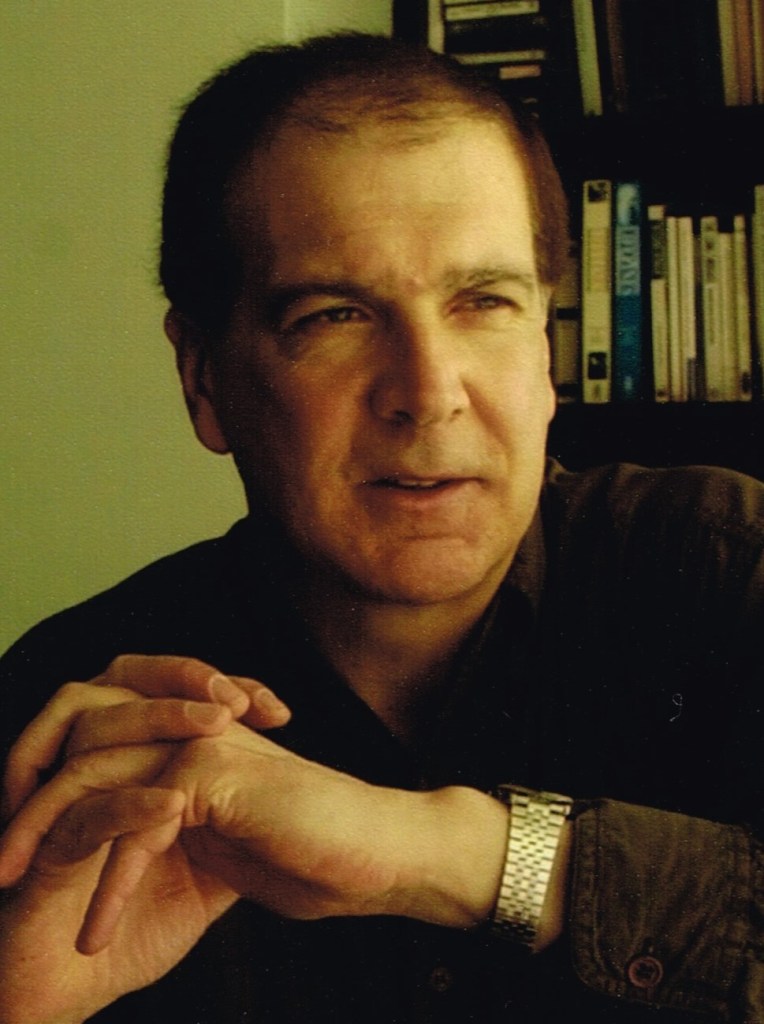
Colour image of Tony O’Dwyer looking to the right, with hands clasped, and in front of a bookshelf. Image by Clare Champion newspaper and provided with permission by Tony O’Dwyer.