Catherine, Welcome back to my WRITERS CHAT series. Today we’re discussing Love Stories for Hectic People, a slim volume of thirty-three charged flash fictions which recently won the Saboteur Award for Best Short Story Collection (congratulations!)
Cover image of Love Stories for Hectic People
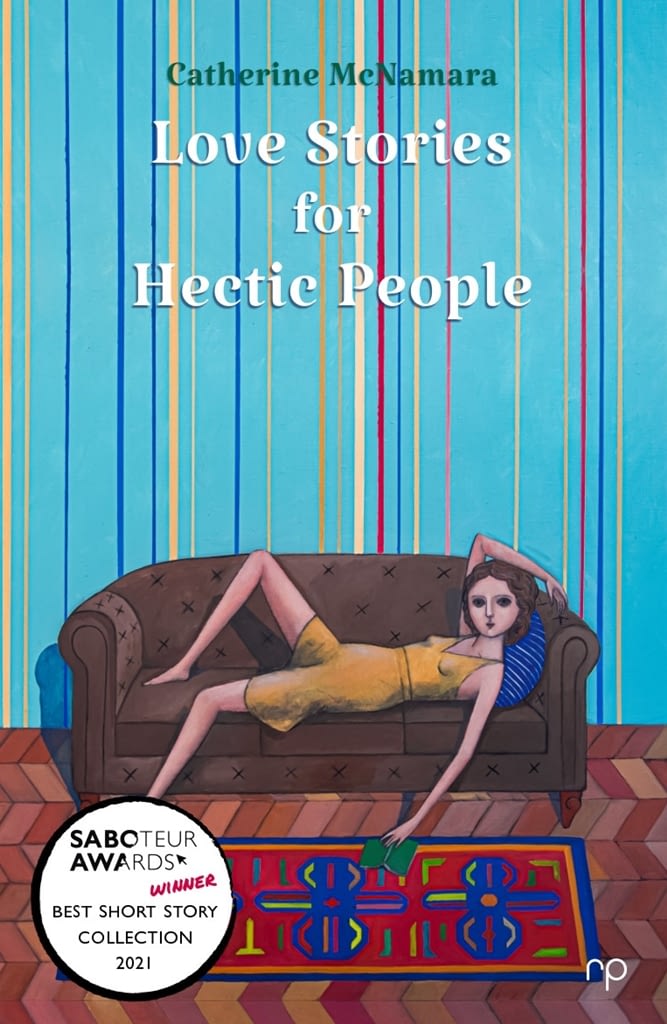
SG: Firstly, let’s discuss the title and cover. It seems that these stories are not just for hectic people, they are about hectic people though much of what is explored in this collection is reflected by the cover image of a woman in a yellow dress pausing in her reading with the sense that she is full of feeling.
CMN: To be honest this title came about for another collection that outgrew its intention and vibe. I knew with the very first story – ‘As Simple as Water’ written first and barely edited – that I would be addressing the many shapes of love, so that would involve an array of people immersed in different lives. So Love Stories for Hectic People very quickly glued itself to the story series, which was written over the course of six months, until I reached the final piece – ‘Love Is an Infinite Victory’ – when I knew it was complete.
The cover image came afterwards, once the book had been accepted by Reflex Press. Before the pandemic I was in Venice for an opening, where I met an old friend who is a painter in Florence. I told him about the book of short fiction I’d had accepted, and he said why don’t you have a look at some of my works? This image spoke to me from the start and I can’t say how happy I am with it.
SG: What a lovely story about obtaining the image – so full of artistic synchronicity!
I love your use of brackets to bring the reader into the other side of the narrative. In “As Simple As Water” we meet Vasilis K and Marj B in Athens train station after the moment when Marj has fainted. As a woman – a stranger – helps Marj, Vasilis stands apart, watching:
Vasilis who has been making love to Marj most of the night (except when she wept in a corner of the bed and he waited) wonders about the pelvic cavern of all women which is filled with jostling organs and squelching tubes and lengthy orifices like vivid botanical sections drawn into slithering life.
So much is captured here – the stretch of time, of physicality, of distance and the point in which Vasilis removes himself from Marj. Can you talk about how you capture the depths of character and narrative in these short tales?
CMN: It’s going to sound very crazy but when I am in the zone and writing cleanly, it’s almost as though I am hearing a voice dictating the scene in my head, and I have to get it down quickly, and then halt before it turns to jibberish. Half of the time I am trying to slow and clarify what comes to mind, and make sure I am being faithful to the tract of the story, with some sort of carrot dangling ahead. Maybe it is madness. But I prefer to think of it as magical composition. Almost musical. Of course the downside is that sometimes it is irrelevant and nonsensical, or doesn’t piece together, but for me, this sort of freestyle writing sometimes brings me to the brink of lucid swimming ideas directly from the subconscious, which can be surprising and powerful. I do think writing is very much a practice, so one needs to find out what works best to produce some sort of truth or an honest portrait of some aspect of humanity. The brilliance of flash fiction is that you have zero time to get to the point, so you have to know the core of your story from the outset – and deliver! It’s a great, risky form.
All of the above said, I know that with this story I wanted to include the reader in the events leading up to Marj’s dramatic fainting at the train station, through the lens of Vasilis’s recollection. I don’t think the use of bracketed, almost-overview inserts works for every piece of work but in this case it seemed to fit with the raconteur style of voice. I think it helps us feel Vasilis’s discomfort and detachment within the fluid rush of action as it occurs, showing how the lover with whom he had been intimate is now a collapsed woman on a metro station floor and, later, a patient in a hospital, away from whom he walks back into his own life.
I think that to capture any sort of depth or truth you have be the character and be wholly faithful to how this person might act and react – even if this means changing the course of the story or using a certain voice or language style. Flash is brilliant for the shifting and intensity that it both allows and demands.
SG: You mention risky and flash together and I think with this collection you do take risks and even as you say, in the way you experience the dictation of the story and you get it down without letting the rational critic emerge.
As with much of your writing, it is through the senses that we get to know the characters. “Genitalia” captures the lived experience of periods, the messiness of our organs and the desire – by some – to tidy it all up, and in doing so, make women neater.
I loved the recollection of the unnamed woman painting “a line of hieroglyphics …on the yellow wall” of a hotel and that by now “the piece of mortar she painted would be lying in a pile of rubble along the river. Where it gleams at night” and how, at the end of this story, by becoming pregnant, all is calm again.
Can you talk a about how many of the stories here explore the power of the female body?
CMN: I really wanted to celebrate female blood in this story – a celebration of our moon-guided, timeless cycles and our power to reproduce. For me, the guy is almost irrelevant, in that he is so poorly informed about the wonders of the female body, and he has been grafted onto this young woman’s wondrous existence. I wanted to show that he would learn from and be enriched by her. Men are sometimes a little repulsed by the force and power of our bodies, and how we have this intrinsic connection to the tides, and even the gods if you like. I wanted to take up that thread and show this woman as a wild modern goddess.
SG: Yes! Many of the stories use sensory memories – or the creation of these memories, in “Citrus”, for example – to connect the child-self with the adult-self in the way that power permeates experience. Here the narrator – suffering abuse – notes that “Everything is fury, everything is rivalry.”
In “Slaughter of the Innocents”, power and police abuse of it simmers dangerously, represented by the “insignias on their shirts”, “a stitched leather holster nursing a gun” which make the narrator realise that she hates her father more than she loves her own life.
Can you talk about this theme of power and control?
CMN: I have experienced something of the violence of men and how this can filter down as a refracted code through a family. It’s something I know I will write about more. Probably anyone who has ever lived through violence is always one step away from this terror. So I think it is something I listen for when I am fishing for ideas, or when people tell stories.
The other thing I find is that we see so much violence on-screen that we are anaesthetised, so I think that my job as a writer is to strip back domestic violence to its daily tension and core dynamic, more than an orchestrated, visual drama. I wanted to get inside of violence with words and make the reader respond in a visceral way, perhaps striking familiar cords, but certainly in a more subtle way than televised or cinematic violence.
SG: That story deftly captures the refracted code of familial violence.
Languages and travel – and the liminal spaces between understanding and comprehension – add to the sense of surreal (and humour) in these stories. Often bodies and minds experience love separately.
In “Tokyo Frieze” Tanja and Kurt “always spoke freely; he with his accent and she with hers. Perhaps because of the zigzag through languages they were emboldened when addressing each other’s eyes.” Later Tanja recalls when she was younger and “had felt porous, hyper-human, tied to a common energy or saturation. But now she knew she was confined within the body around her and went no further. Her history was a stream of dioramas like this.”
I thought your use of language and travel as a way to delve into aging and the body was interesting. What are your thoughts on this?
CMN: It’s so true and curious the way that bodies and minds experience love separately. I love this zone!
‘Tokyo Frieze’ is one of my favourite stories in the collection and was originally published in Rowan Pelling’s The Amorist magazine. My interest in language and the languages of love stems from the fact that I left Sydney at 21 and though I speak English a lot of the time, I have lived in countries where other languages are spoken, and have learnt French and Italian, and am now studying Greek. So the characters in my life have mostly been European or West African, and I am fascinated by accents and attitudes and words. Travel too, as well as living in a foreign context and feeling at home within it, also figure in my experience so these aspects have become reference points for my stories.
In this way, utilising language and travel to address aging and the body, has been a natural modus operandi, in that my reservoir of story material comes directly from these areas. As I grow older as a female, a mother, a lover, a writer, a traveller, it’s not so much about recounting experience, as using the emotions generated by certain experiences in order to give authenticity to the stories that come about.
SG: I love how you express that, Catherine.
Using emotions generated by certainexperiences in order to give authenticity to the stories that come about.
In essence, writing from what you know into what you don’t know.
Let’s end with five fun questions.
Coffee or Tea? Coffee – espresso!
Sandals or runners? Sandals
Sparkling water or non-carbonated? Non-carbonated
What are you reading now? Gina Frangella – Burn Down the House
What are you writing now? Novel rewrite and some budding flash stories
CMN: Thank you for having me again Shauna!
SG: Thank you, Catherine, for the joy reading your collection brought me and for your generous answers in our Writers Chat. I wish you much continued success with the collection.
Photograph of Catherine MacNamara
Thanks to Catherine McNamara and Reflex Press for providing me with a copy of Love Stories for Hectic People.
Paul, You’re very welcome to my Writers Chat series. We’re going to chat about The Garden (New Island: Dublin, 2021), your new novel which, in the words of Mia Gallagher is “vividly compelling.” I’d agree with Mia – and the critical praise that The Garden is receiving – it is a novel that compels you to keep reading and at the same time makes you pause and contemplate the land around us and how we treat it.
Cover image of The Garden
SG: Can you tell us a little about the origins of the setting and the place of The Garden? In interviews you’ve referred to your own experience of working in Florida some years ago but I wonder if recent climate change and world events had any influence on the narrative at all?
PP: I lived in the states in the 1990s, and in Florida for 3 of those years. I was captivated by the place; its tropical beauty, the palm trees, the flowers, the rich and diverse landscape. And the diversity of the people too – from Cuba, South and Central America, and all over the US and the world. And of course, the never-ending sunshine. I was really stimulated by the place – it felt almost hyper-real to me; and the vibrancy and the literature too from the Caribbean impressed me. You know it’s such a contrast to the dark and the rain-sodden streets I grew up on in Dublin. Florida to me felt like life on the edge, in many different, wonderful, and dangerous ways. It’s an exciting place. I guess that all came together in the novel, The Garden; and as you say the environmental crises that the everglades in particular face was in mind; that this place, a sanctuary for birds, reptiles, and endangered species was under threat seemed to be a suitable arena for the human drama that enfolds in the novel.
SG: To this reader it really felt like the perfect arena for the drama in The Garden. The novel moves at a pace but through the Irish narrator Swallow, also provides introspection. What struck me most about the novel is the atmosphere – at once foreboding and idyllic – that you create and how we’re brought into this. For example, when we’re with Swallow as he drinks his bitter coffee in the morning, we really feel we’re there with him:
Waking the senses. First the sounds of birds and men shuffling. The smell of earth, and the greenness starting to take back, or the swamp beneath us trying to reclaim what belonged to it – without human interference, all elemental.
It seems you have taken the advice of your creative writing mentor Lester Goran andgone for (at least) one beautiful phrase per page. Can you speak a little about your use of language and description?
PP: I’m a writer – in prose – who does not like long winded description or exposition. I don’t like novels that seem too long, and are full of filler, or writers who spell out what is at stake or say, this is the plot. I aim for a purposeful narrative with pace, and menace that allows for the left-field, and the meaningful digressionary moment or scene; so many novels I read have the most artificial dialogue like the two characters talking with one another are actually listening to each other. That’s not my experience. I like also the short novel. And I like writing to get to the point without any puff. That being said – I also aspire to balances, cadenced sentence where the rhythm of the language is honoured, and there is a control of tone. These things are very important to me as a writer and a reader. In terms of description, I like Mark Doty’s definition of description as being encoded desire. My background in poetry means that I rely on motif, image, and metaphor in my prose, or that I go to them at least – in subliminal, subtextual fashion, so that you are creating grooves, and patterns in the reader’s mind, so that one phrase – however inconsequentially sounding can detonate something impactful in the reader’s mind.
SG: I love how you put that, creating grooves and patterns. Mark Doty has some really interesting things to say about description. I love his book The Art of Description.
The Garden could be described as a fable, and the journey the characters are on echoes the journey of ‘the ghost’ the orchid at the centre of this tale; they are precious, illegal, homeless and all struggle with identity – many of them, including Swallow, try to find themselves in the power the Garden seems to offer, escaping from memories. As he says swinging in the hammock, “I was seeking answers but all I had was starlight.” Others, such as the visually blind (but all seeing) Harper, and his marking of the map (“circling with the pencil, spiralling inwards”) know the real perils. Can you talk about the fable and, at times, the moral element to the narrative?
PP: It’s not something I planned or set out to do; the fable like quality of the novel emerged as I was writing; and in terms of a moral element, yes one could read the novel as a warning and such, but if you look at the characters’ lives and the messy relationships between them, I think it’s fair to say that the moral code of the novel is complex. If someone wants to read a moral into the novel, I say, be my guest; but there’s probably different and contradictory ways to read the novel; and the moral code of its characters is complicated. Certainly, I think when you write a novel, you want it to be more than just a yarn. For a novel to last or linger in the memory, or for it provoke questions in the reader’s mind, I think there does have to a kind of sub-soil of searching about all sorts of moral questions. So writing it, I thought about Camus – and his stranger – justice divine and civil, and I thought again about Gatsby and what he devoted his life to, and the small scenes where a whole moral world was revealed.
SG: I’m nodding at this – the connections with Camus and Fitzgerald – how “small” scenes reveal a whole moral and complex world.
The men who live in the barracks in the Garden co-exist with brotherly love infused with marine/army rules. This comes from both Swallow’s influence as an ex-marine as Blanchard’s right-hand man and from the men’s invisible place in the official world. It can be seen in the friendship – and rivalry – between Swallow and Romeo who appears with a “muted swagger” and “looked as if he didn’t know how to shake the shadow of a malaise”. Yet it’s also evident in those outside of the Garden, looking for financial gain from those inside (drug money, the ghost orchid). Their names – such as Black Fox, Catfish – tie them to ancestry, land and deeds.
Did the theme of male friendship and rivalry emerge as story developed or was this a theme that you began with?
PP: Well, the whole writing of the novel was a exploration in the dark – that’s what my subconscious came up with after I had written in a kind of fever dream; so yes, male friendship and rivalry is important to me, but I did not set out to write about those themes; I followed the story, thoughts and feelings of Swallow; it’s his story after all, but male friendship and rivalry does, as it happens, interest me; in a way, how could it not; shifting allegiances, friendship, brotherly love all of these things as a boy, and a man I have grappled with, embraced, and otherwise, but again that’s not to say the novel is a didactic playground to explore in a scientific way; human impulses, male or otherwise, are full of the irrational, the impulsive, and the passionate. And the novels is such an elastic form it allows you to unpack these things, but that’s got nothing to do with the writing of a story; the story is what matters, not its themes when one comes to write. As ee cummings wrote, ‘since feeling is first, who pays any attention to the syntax of things.’ You see, I even contradict myself.
SG: How fascinating to learn that the whole writing of the novel was an exploration in the dark!
Moving on to another theme that interested me as I read and, like masculinity, appeared like a shiny thread. Swallow is aware of his privilege as a white male and often muses about this – including questioning Meribel about how she stays with a racist like Blanchard. She tells him that he (Blanchard) thinks her “white”. Swallow’s privilege is also seen through Lola’s plight as a precarious worker/lover/female. Towards the end of The Garden Swallow realises “The desperate lengths people will go to for beauty”.
These parallel threads seemed very current and I wondered, given that in many waysThe Garden is timeless, if race and gender formed part of the wider commentary on the structures of society and power, or if they emerged through the characterisation?
PP: Again, I wasn’t writing a novel to make a wider commentary on anything. There are better ways to do that, I think. Critics, and reviewers can put these kind of labels on the book, and so be it, but I’d like to get a way from the kind of reading of the novel, this novel, as a commentary, or vehicle for anything other than what it in itself – a story. If a writer sets out with a message it will damage the writing and the book. So, I think it would almost be disingenuous of me to say yes, this novel is a commentary on whatever. It is, of course, or could be seen as such, but I also think the novel is so various in contemporary letters and allows a writer so much freedom – that I welcome different readings of the novel, but I am hesitant to even suggest what themes readers should look for; race and gender are centrally central to how the story unfolds, but I also think of course they are – when Swallow looks around him this is what he sees. And it’s a brutally unequal, unfair world he lives in.
SG: Isn’t it wonderful how such depth of themes emerge when you are faithful to the characters and the story?
Nature as a character is the main driver of story and back story. I am thinking here of Swallow’s back story about his brother and of Lola’s brother who drowned. It feels that the more the characters try to get back what was taken from them (identity, agency, power), the more they fight for and with each other (for the illusion of profit and gain), and the more natural disasters such as dreadful hurricanes happen. As nature is disrupted, people become more vicious. Nature, like God, is “wrathful”.
Three events spring to mind as examples of the beauty of connection turning into the ugliness of pain – the beach scene with Romeo, one of the visits to the swap where a gator makes itself known and one of the final scenes involving Swallow and another man’s ears.
“Each season,” Swallow comments, “I wondered what it was we were doing…Sometimes I wondered whose dream I was in.” Later he says “Part of me thought I was going out of my mind, as if we were existing on some foreign orb, living out the game-time of another species, playing our roles badly, with violent and careless glee.”
It seems as if the knowledge of how land and people are all connected is almost within reach of Swallow’s consciousness but then it slips away. In the swamp he says, “Something in my physical being knew this was a trespass of sorts.”
What are your thoughts on this?
PP: I think Swallow is struggling with the reality which has manifested itself about him; he’s wondering like a lot of people how he got to where he’s at. He’s displaced, confused, and paralysed to a certain extent. I like your reading of the novel above, and I agree with it; I’ve dramatised those tensions. [Thank you!] I think the novel is interested in that notion of trespass – literal and otherwise; what transgression has been committed, and what of it. Does it keep the reader wanting to know what happens next. Much of my efforts in writing are in the compositional domain however; it’s like make the thing first, and then see what it means, if it means anything. It goes back to the writer writing without full knowledge; the writing is on a journey too, if they knew what message and themes they wanted to explore exactly, the game would be up. Better to work in ignorance, or partial ignorance; I feel now that the book is published that my guess is a good as yours. There’s a notion in lit crit of Intentional fallacy, a term used to describe the problem inherent in trying to judge a work of art by assuming the intent or purpose of the artist who created it. I kind of agree with this.
SG: Oh we could get into a whole Writers Chat about intentionality and purpose – and we could also talk about the death of the author (Barthes) and what the reader brings/re-writes.
I totally agree with what you say about the writer writing – make the thing first, then see what you’ve made. In a way, the writers job is not to make the meaning, it’s to allow the meaning to emerge.
On a personal note, I have to say I really connected with Swallow as both a character and narrator. Besides wanting to have a whole discussion on his name and back story, I’d love to see what happens next to the Garden. Will there be a follow on book or do you think you’ll return to the character of Swallow in another form or genre?
PP: I’m working on a new novel – but I’m loathe to get into it; I’m a little superstitious about talking or writing about something I’m writing; rather work in silence, in order not to break the spell.
SG: I totally understand that – I’m sure what emerges will emerge – and be as intriguing and magical as The Garden.
We’ll end this Writers Chat, Paul, with some short questions:
Mountains or beach? Beach
Swamp or bog? Swamp
Coffee or tea? Both
What flowers are in your garden now (if you have one!)? I’m working on some bamboo
Oh! Bamboo! I can hear it in the wind! Lastly, what are you reading now? Damon Galgut’s The Promise
SG: Thank you for your deep engagement with our Writers Chat, Paul and I wish you continued success with The Garden.
Photograph of Paul Perry (Courtesy of the author)
Paul Perry is an award-winning poet and novelist. He has published several collections of poetry, most recently Blindsight (above / ground press, 2020). He also co-authored four international bestselling novels as Karen Perry, including The Innocent Sleep with Penguin Random House. He directs the Creative Writing Programme at University College Dublin. The Garden is his debut novel as Paul Perry.
Thanks to New Island and Peter O’Connell Media for providing an advance copy of The Garden.
Noel, You’re very welcome back to my Writers Chat series. Last time we talked, we discussed your collection On Light and Carbon which we re-publish at the end of this chat. Today, however, we are focusing on your fourth collection, the wonderfully titled Street Light Amber. Launched by writer David Butler in Kindle format in April 2020, it was published in paperback in the summer of 2020.
Street Light Amber is bookended by a repeated poem in which the narrator, a nocturnal worker, at “The Department of Dead Letters” sorts through undelivered letters, having left behind the “question mark” of a woman still sleeping. He is a “a man among us who knows secrets” and he treats the letters with a tenderness that reflects how deeply he is moved by the love he encounters in an undelivered letter with cursive script “the love so carefully expressed, now his and his only.” Between this leaving and returning to love we have 33 poems. Was this structure there from the start or did it evolve with ordering the collection?
The repetition of the first poem at the end came later in the process as I had a different end poem that will be in (and inspired) the book I’m working on now. The first draft of this manuscript had a complex plot, but I realised people just didn’t get it. When I simplified the structure somewhat, the ideas and themes I thought I had lost actually came through more strongly, I realised. But the circular structure hints how we keep striving for things in life, in this case love, and will do so over and over despite the loss involved. (There is an echo of the Orphean myth in this which I explored in a short poem in my second collection called “Return” which could almost be read as a synopsis of this one, “I just never learned to not look back / to know for sure it was her hand I was holding…) In any case, somehow, it seemed very haunting to me to go back to the postal worker at the end. I don’t want to force an interpretation, but you might wonder if he is also the author of these ‘love letters’ (the poems) and is sending them to himself – or perhaps to his ex-lover who has moved houses so his letters find their way to him in the ‘Department of Dead Letters’ yet he continues to send them. Or maybe he is just a voyeur of their relationship hinting at his own need for love. This repetition and close of the book are not meant to be comforting in any way. The poem, I think, has a very different impact when encountered a second time. There is a greater sadness in it, for me, given the story expressed in-between. The ‘lover’ has been replaced rather coolly by ‘the woman’ in the bed ‘a question mark against the sheets’ as you quoted. Is his chance of love gone forever, whoever this postal worker might be? I should point out there is one word that is different in the repeated version which no one notices. It’s in the last line, that’s all I’ll say.
Yes, I had spotted that – but it’s interesting because what it does, at least for this reader, was send me right back to the start, to re-view and re-read the love and the loss. Many of the poems feature lightness and darkness and explore how perception and memories are formed and change as time passes. You use the senses to examine the role of observer, voyeur, capturer of moments which is common to nearly all the poems. I’m thinking here of “the grey in-between” and “the coupled lights of cars” in “After a Long Absence, She Returns”. I’m also thinking of “the oyster shell grey” in “Eclipse”, and the evocative movement “Girl in Window” in which the girl “casually raises her hand to her red-streaked hair,/frozen to a moment in the monochrome of film.” And, of course, in the title poem “Street Light Amber”, the memories return “when you least expect them…”, as the image of “you” standing by the window looking out as the rain falls in amber street light to the sound of “Ella’s deep falsetto falling/to stillness…” Can you talk a little about the visual in your poetry?
Many years ago, I came across A. Alvarez’s anthology of post-war British poetry (published in the late 60s) and I discovered a poet called Lee Harwood who had written a sequence called ‘Imaginary Love Poems’ with each poem taking the simple title ‘First Imaginary Love poem’ or ‘Seventh Imaginary Love Poem’ etc. This seeded in me the idea to write a sequence of poems called “12 Imaginary Postcards”. The concept was that each poem would be two halves: the first, a visual description of a place; and the second, an abstract reflection on that place. I had this notion for years but finally, in an idle period after writing my third collection, I decided to just test the concept and try to write very visually by deliberate intent. So, the visual aesthetic very much came from those early considerations. What started as a small experiment took on a bigger form as events in my life somewhat dictated it must, though I stuck to the first part of the imaginary postcard method. I should say, I think, in the most general sense, poets can be ascribed to two different camps: those who create striking images and those who create striking language and rhetoric. You might call these ‘image’ poets and ‘language’ poets. Neither is better than the other, but I have usually strived to create memorable images over memorable lines in my poetry. This collection pushed that further and made the idea of ‘looking’ – and specifically photography a key leitmotif for the entire work – central. Each ‘imaginary postcard’ creates an incremental movement through the relationship at the heart of the book until we come circle to that repeated poem. I should say, the book is written as a narrative sequence and is best experienced read in the order it appears.
I felt the collection touched upon a type of every man/woman and the essence of human existence – that of living through time and trying again and again to capture moments of love that expire right as you are trying to preserve them. The experience of the individual is also and at once universal – that of loneliness, loss and love. “All Souls’ Day”, “The Forest”, “Sodium Orange” and in “Then” where the narrator “is a man searching for silver coins in the sands,/ lost in the confusion of his own hands.” In “Moon-Man”, the narrator realises “You weren’t special…moon-man,/ blind stenographer of what-might-have-been,/ combing the darkness for signs.” In the beautiful “The Fading Smile” we learn that “The future hasn’t happened yet./ For a moment time is held back in a smile.”
Yes, I totally agree with your assessment. The relationship at the heart of the book is meant to be heightened to the level of archetype. There is a man and woman trying to reclaim lost love. I deliberately never described either character physically in a pen-portrait in the way you might expect in, say, a novel. So whatever image people see in them is projected onto them. So, it operates in a way that is both very specific and very universal at the same time. And the essence of this relationship is captured though small, arrested moments, like photos, rather than through a ‘dramatic’ plot as such, though it is, as I mentioned, written to be read as a narrative collection. The lovers exist in a kind of bubble (as lovers often do) with the city a vivid backdrop to their story. Yet, their relationship is both ‘special’ and yet ‘not special’ at the same time, as “Moon-Man” suggests. It is meant to be typical, on some level. Most of all, though, I wanted to write a collection of poetry about love that didn’t rely too heavily on the tropes we might expect to find in such a collection. I hope I have achieved that, in some way with this work. As William Carlos Williams famously said, the challenge with any form is to ‘Make it New’!
Yes, I think you have indeed, made it new here. The city, of course, is also a character in this collection and moves with an invisible camera – or not so invisible in the preciseness of “Darkroom Notes” – capturing snapshots of love. In the Botanical Gardens (“Botanical Gardens”), beneath a Dublin statue (“In the Shadow of a Patriot”), before a shopfront (in “Shopfront”) where the narrator is lost in the beauty of Dublin’s geography and balance and turns, suddenly to be faced with a shopfront “in a splay of colour” with TV screens filled with actors “stealing our darkest desires in a simulacrum of pleasure.” In “Stations” the railway station is “the meeting place of all our love and longing,” and in “Postcard from Nowhere” the narrator contrasts the brightness of travel with how the “routine of our daily logics unveiled to a blurred snapshot”. Can you speak a little about the city and how it is weaved throughout the poems?
There is a great – indeed almost obsessive – tradition, in Irish poetry of ‘place naming’, let’s call it. You see this in the work of Kavanagh, Heaney, Montague and many others, where often poems are attempts at a negotiation between the poet and the environment, but one where the negotiation is one imbued with a sense of the historical/mythological context. For these poets, the natural world is not just place but place and collective memory; a memory that moves down through the strata of location and personal history, forming a dialogue between geography and the lives of those who have inhabited it. That is fascinating, of course, but I wanted to try to do something different and dislocate place from collective memory in a certain way, so that while the city is filled with landmarks and buses and churches and people, it ‘belongs’ to the lovers alone, in a sense. It is a participant in their particular time together, and the challenge in writing about it as such, is to not to simply name places but to find their numen instead, rather in the way the lovers are trying to do so with each other. So, the city is unnamed by design and, rather like the two characters is, I hope, likewise raised to the level of archetype in the process, like a juxtaposition of the very particular and very abstract. But there are also moments, like in “Shopfront” as you pointed out, were the crassness of modern life crashes into the narrator’s world turning us all into voyeurs of a kind, and there is also a sense of seeping suburban disturbia that grows as the story progresses, reflecting his increasingly disintegrating inner state of the speaker, perhaps best exemplified in the poems ‘Triage’ and ‘Crime Scene’. Anyway, most people who have read the book very clearly visualise the city as Dublin. I do wonder what others might see who have never been here?
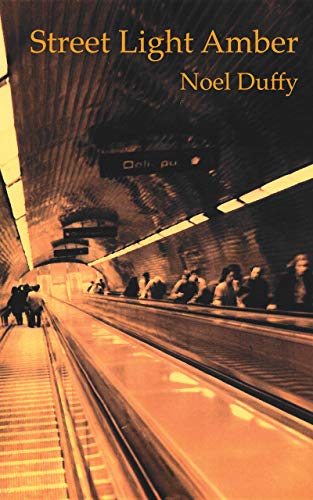
Let’s do as we’re told to at the end – “Erase. Rewind. Start Again.” So going back to the title and cover image which go so well together and immediately bring the reader into the atmosphere that you create in this collection. Can you talk a little bit about the title and cover image?
As I was working on the collection and had assigned the title a friend pointed out that I have used the idea of ‘amber’ as a metaphor for memory at some place in all my collections. Given that this collection is highly preoccupied with that theme it made sense to keep it. I also hope it sounds intriguing. I’ve only ever had one hobby in my life and that was photography. For my 21st birthday my brothers bought me a beautiful manual camera, a Nikon if I remember correctly. Unfortunately that camera gave up the ghost some years ago and though I continued on using a digital SLR for some time, I really hated having to go into ‘screens’ to make adjustments to focus and light etc., so in the end I’m no longer interested in taking pictures. In any case, for the cover, I wanted to create something that strongly suggested an urban landscape. The photo is of an underground (taken on my old camera some years ago) in a city I won’t name, though if anyone can guess the answer they probably deserve a free copy/Kindle of the book. Hint: it’s not London. The picture was titled ‘Descent’ and I suppose I was slightly hinting there that the suite of poems that follows is a kind of descent into the underworld, so there are again shades of the Orphean myth in that as I mentioned earlier and takes us back to the earlier observation I made about the book operating on an archetypal level as well as a bricks and windows one. It’s a kind of double-exposure of the real and the hidden at the same time: the story of the lovers; the place it happens. I hope the cover image and title help reflect that.
Yes, I think both image and title do reflect that intention. Gosh, I will have to study the photo closely to try and figure out where it was taken! Lastly, Noel, some fun questions:
Kindle or paperback – paperback, though the collection first came out on Kindle and I actually don’t have one so that was a little strange. Anyway, the book is now available in both versions so something for everyone’s reading preferences!
Painting or photograph – Given the preoccupation of photography in this collection I will have to go with photography on this occasion.
Coffee or tea – tea, most definitely tea!
Boat or plane – Boat though it’s been a very long time since I was on one. I remember a very memorably boat trip I took from Seattle to Vancouver some years ago. For my upcoming fiftieth birthday, I’d love to go on a cruise in Scandinavia.
Sandwich or salad – I do love a good Caesar Salad!
Thanks, so much Shauna for reading the book so closely and your very perceptive questions about it. It was really excellent to get the opportunity to speak at such length about it.
ORIGINALLY PUBLISHED IN OCTOBER 2013 – Noel Duffy on his second collection, On Carbon & Light.
Noel, congratulations on your second poetry collection On Carbon & Light. Tell me a little about the title and cover, they are both intriguing.
Well, I had the title for a poem called ‘On Light & Carbon’ for maybe ten years. I imagined it would be a kind of technical poem about photosynthesis and while it would crop up every now and then, I never managed to write it. When I started this collection in summer 2010, I finally approached it and the poem that resulted was totally different than one I envisaged, written in counterpoint and a naïve voice. That said, photosynthesis still made it in there. It struck me as I went on with the book and wrote quite a few science poems about light, as well as another about carbon, that this would be a good title for the whole book. In a way, the poem also poses the central question of the collection, as it moves between religious notions of the nature of life and scientific ones that sometimes seem to override those. So, it may seem like a strange title, but it suits somehow. The cover idea really came from talking to artist friend and he had planned to do the cover image by organically imposing the equation for photosynthesis onto actual leaves. In the end, we didn’t get around to it, but when I spoke to Mike at Ward Wood about the cover, I suggested we try do something along those lines. So the leaves in sunlight and the equation came from that discussion. I think it’s quite striking.
In what way do you feel your second collection links to your first, In the Library of Lost Objects, which was nominated for the Strong Award?
This book connects in some ways to In the Library of Lost Objects, exploring the intimate dramas of life against the backdrop of science. Here though, I’ve replaced Natural History with human history and anthropology for the most part, also exploring the role and meaning of myth and art in all this. So there is some cross-over, but I feel the tone is less lyrical and more metaphysical. I’ve also tried to push deeper into certain scientific ideas, but hopefully in a way that I bring the reader with me – whether they know much about science or not. That was part of the challenge.
Having read parts of the collection, it is, I feel, a challenge that you meet, Noel. Can you talk aboutyour general approach to writing poems in the book, perhaps revealing a little about your process?
In the Library of Lost Objects had taken a long time to write as I often wrote fragments of poems and would add a bit and then leave it for months and then add something more. It was a very slow process, though oddly the three longer poems were written quite quickly in a kind of sprint over three or four days, and didn’t change that much after that. So, with this collection, it struck me to try that approach and see what might come out of it. One thing I found was when an idea or mood came it would immediately seem to suggest a title, but I also quickly realized I had to write a few lines down. This acted as a kind of key and a way back into the poem. Then, often the next day, I just riffed on the idea and wrote fragments down in a notebook.
At a certain point, when I felt a poem was beginning to suggest itself, I would move all this into the computer and generally very quickly find the shape and structure for the piece. I would then try complete a decent draft on that day. Working this fast somehow led to the poems being not over-thought and often the results took me by surprise. I discovered that once I started this process, other ideas presented themselves and I would gather momentum.
So I wrote like this for, say, three months at a time and would then stand back. Over three such (intense) spells of writing over a three year period, I produced the poems in the book – and a good deal more, I should add, that just didn’t quite fit the themes that came through most strongly over that time.
Noel, following on this, I’d like to focus on some of the poems. I am interested, in particular, in ‘Timepieces’. Tell me about the genesis of this long poem.
You know, there are a lot of poems about love or death or other subjects (I’ve written about them myself, of course) but very few about friendship, which is a bit odd when you consider the importance of friends in our lives. So this piece is about a friendship my dad struck up with a labourer at Dublin Bus, then known as CIE, where he worked in the late 70s. This man, PJ, turned out to be a respected amateur antiquarian and coin collector and drew my dad into his interests and they formed a great friendship through this, going to coin fares at the weekend or PJ coming over to teach my dad Ogham, which I explore in one section. Another crucial element to the poem is my perspective. It is really an initiation into both the adult world of male friendship, as well as how it awoke in me the excitement of the imagined past. I think it’s ultimately saying something about the power of art – both in terms of my dad and PJs story and my attempt to tell it.
So, I wanted this poem to be, in a sense, a kind of intimate epic, playing the ‘everyday’ notion of friendship against seemingly grand historical backdrops, such as Viking Dublin, or Imperial Rome. I’m reminded of Patrick Kavanagh’s great poem ‘Epic’, which centres on a dispute between two farmers over a land boundary and how Homer ghosts whispers to him “I made the Iliad from such / A local row…”. This sentiment is central to the poem and is echoed in the final lines of the Viking section where my dad and PJ had found a Viking child’s leather show in the waste ground where the city council were dumping the soil removed from the Wood Quay site:
It was to me as this frail object found, opened
a clearing in my mind: the prow of a longship
approached from the horizon with its cargo
of stories. I leaned down close and listened.
So the events are first real-life ones, made epic in the telling – even if the language in this case is not what you might expect in an ‘epic’. So it is a narrative poem, certainly, but a fractured narrative reflecting the nature of memory, both personal and collective.
Did the writing of ‘Timepieces’ evolve as you wrote it or did the idea come to you as a whole? I’m particularly interested in the back and forth of memory, imagined and real.
Well, this was the one poem in the collection not written in the way I describe last week. For a start it’s a long piece of 300 lines, so that put it on a different footing. In a way, the approach was similar to two long poems in sections from my first collection. I tried to come at the subject matter in a non-linear way and attack it from several angles, with jumps in perspective across sections. I found the shape of the poem came quite quickly, say within three or four weeks. This poem does something similar to those earlier long pieces, creating a fractured narrative of sorts that moves backwards and forward in time – both in the historical settings and the timeframe of the friendship itself. So its jumps and shimmies about us, mixing the history and the story of the friendship.
But by attempting to create this intimacy between the local and the historical, I also tried to use a quite casual, yet intimate, tone and the nature of the poetry had to reflect that. So much of the poem is written in a relaxed conversational and invitational voice. So is that poetry or prose? Some would say the latter, but I’d argue that I’m using a – let’s call it – flat-footed line, where the rhythm isn’t strident (for the most part) and the music of the piece is quiet and muted, though certainly still poetry. The challenge of rewriting this kind of ‘casual’ line, is that it is extremely tricky to get just right and, indeed, for it not to drift into prose. So, it actually took a long time to achieve that effect, massaging the music rather than imposing it. That really was quite a challenge. The other major issue was that with such rich subject-matter, there was so much more detail I included early on but had to cut in rewriting so that the poem didn’t get weighed down with too much narrative information. It’s long, but I knew I needed to keep it moving also. So, it took time to get that balance right also.
How do you feel a long poem like this fits into the collection as a whole?
At about the mid-way point in writing the collection I had a lot of poems and started gathering them into some kind of coherent collection, which gave writing after that point a clearer focus. ‘Timepieces’ was actually one of the last poems to be written and accounts for nearly a quarter of the entire collection. As I said earlier, this work is less lyrical than that in my first collection, but I realized ‘Timepieces’ is the poem that grounds the book in some important way. It is key in that sense, so I wanted that grounding to occur in the first half of the book, bringing us to the midpoint before moving into the second half, which mostly deals with hitting forty and the questions that also asks of you, both personally and philosophically. So Timepieces is a poem, in the end, that contains so many ideas and motifs explored elsewhere in the collection, that it feels very central to the effect of the whole book.
Thanks so much, Shauna, for asking such interesting questions. It was especially nice to get to talk at length about ‘Timepieces’. I really hope you, and others, will enjoy that poem, and the collection as a whole.
You’re welcome, Noel and I wish you all the best with the collection.On Carbon & Light will be published 10th October 2013 by Ward Wood Publishing and launched by Theo Dorgan in November. See www.noelduffy.net for further details.