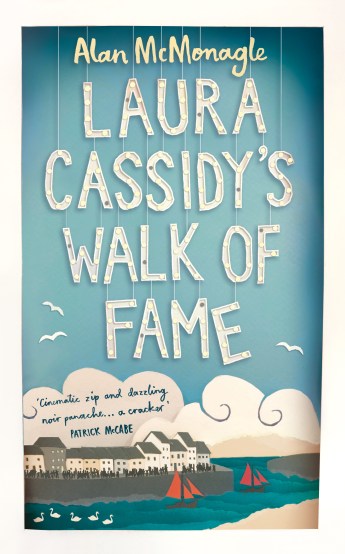
Writers Chat 27: Alan McMonagle on “Laura Cassidy’s Walk of Fame” (Picador: London, 2020)

Alan, You’re very welcome to another WRITERS CHAT (readers see our last chat here). Your second novel, Laura Cassidy’s Walk of Fame, was launched to a huge crowd in Galway City Library in early March 2020 – just before the Pandemic lock-down – and has been described by The Irish Times as a “vigorous novel” and “an infectious portrayal of brazen optimism”. Laura Cassidy high res jpeg(with Quote)
SG: Can you tell us, firstly, about the genesis of the novel, which explores serious themes of grief and denial through what we might call a playacting lens?

AMcM: That’s not a bad descriptor. At the most rudimentary level it began as a voice. A voice that acquired flesh and blood. A voice that announced itself as a young woman, a burgeoning actress with a dream to pursue. A voice that swings both high and low, that flip-flops between the world of dream, invention, imagination and the more concrete world of the everyday. It was a voice that also, at times, misbehaves. And once misbehaving kicks in, things have a chance to become interesting…

SG: Yes, how messiness is always interesting – where we find the good stuff! I was particularly taken with the structure of Laura Cassidy’s Walk of Fame. It is divided into five parts and each part follows (literally!) Laura Cassidy’s “Walk of Fame” so that we feel we are walking with her. I love the titles and how each part is inspired by a different starlet and theme – for example, Part 1 Barbara Stanwyck “Just be truthful – and if you can fake that, you’ve got it made.” Seems like we should all be listening to that motto – especially the highly successful Imelda! Was this structure there from the start or did it come to you once you had the story down?

AMcM: The structure was born out of this playful lens you refer to in the previous question. And there was play aplenty involved early on, all in service to Laura’s perceived life as a famous star. I fabricated imaginary interviews which  Laura conducts with various journalists she is only too happy to wind up no end and lead down the garden path. From there other features, just as unlikely, quickly arrived. Acceptance speeches, movie pitches, interactions with directors, agents, film executives. I had great fun outlining a sequence of movie parts tailor-made for Laura, I even wrote an obituary for an her. Out of all this ‘play’ it is the mini-biographies of the starlets of yore that made the final cut. (Along with the rollercoaster life of Imelda J Ebbing.) And these bios had to be drastically cut down, from an initial number of over twenty, then fifteen, and finally to five – what a wrench that was. At times, I felt I was auditioning all these brilliant actresses from the era of classic cinema for a part in my novel. And now that I am talking this out with myself it occurs to me that this might be something interesting to explore in a piece of writing.

SG: That would be so interesting – a series of interviews with stars from the era of classic cinema. It sounds like you’re not quite done with the starlets and the star system! Laura Cassidy is well-drawn – she’s feisty, snappy, funny and endearing and also, at times, a very lonely and misunderstood person. Can you tell us a little about her development and journey as you wrote the novel?

AMcM: I think the death of her father looms large in Laura’s story. She witnesses his death. She is quite young when it happens. She also witnesses it at a crucial moment in her own life – she has just bagged the lead part in the school play and the first person she wants to share the good news with is the person who has planted this acting dream inside her to begin with, her father. I think she has a very complicated reaction to his untimely death. I don’t think Laura herself is aware of how and when this reaction is going to manifest itself. But it has damaged her psyche. There’s a fair old cocktail bubbling away inside her. A combination of grief and trauma, probably some guilt, she can do a nice line in denial. It’s a heady mixture, a combination that could potentially kipple her when it matters most. And so yes, Laura becomes a pocketbook of complications and contradictions; of uncertainty and confusion. She vacillates greatly between unusual levels of self-belief and deep-set fear; between self-sabotaging hope and blind optimism.

I find weighty themes such as grief, trauma, guilt very difficult to come at straight on. And of course setting out I wasn’t aware that these weighty themes were going to become a significant part of the story. My approach has to be more angular, slanted, with twists and knots and complications and contradictions. We’re in the realm of confusion and uncertainty. Chaos. And chaos is slippery, and tricky, tricky to meet head on. I think that as a writer it’s how I find my way towards that X on the treasure map. That X being a moment of discovery or realisation or revelation. And not knowing what this X might be is what kept bringing me back to the desk every day, to spend time with Laura, unearth what was making her tick – or, more accurately, not tick.

SG: I love that notion of slipping through the chaos towards discovery and finding moments of why. This brings us neatly on to the internal and external worlds of Laura. As much time as she spends in her head, her complex and witty self is revealed when she is with other people, even though it’s difficult for her. I’m thinking here of her relationship with Fleming and with her doctor, both of whom take her as she is. For example, speaking to her doctor she says

“Doc, you’ve been saving my life for a year now and I have to say I think you’re doing a terrific job. So I have no fears on that score. If you ever need a reference you know where to come.”

Laura is, as the doctor calls her “a charmer.” Can you talk a little bit more about this charm that brings us with her on her journey?

AMcM: Essentially, Laura is an unreliable narrator. And of course, as a writer, to a certain extent you must allow the reader in on this. So there is an attempt to strongly suggest – even from the get-go – that things are not going to go according to plan for Laura. This theatre/movie stardom dream of hers is going to remain out of reach. But as a counter to this I don’t allow Laura for one minute believe, certainly not in her interaction with the world, that she is not going to make it. And so the thing becomes a balancing act, a wire walk. And as is the way of wire walks, sometimes you fall. And when you fall, you’ve got to pick yourself up and go again. When we first meet her, I think there is a gap between where Laura is and where she would like to be. And for Laura, this gap becomes a place of invention, imagination and dream. And one thing I think the novel might be trying to do is emphasise or explore the power of dream and invention and imagination for those in the world who are more vulnerable than others. Explore the fine line between the language of dreams and reality. And so there is a version of herself Laura presents to the everyday world, and to those with whom she must interact in order to get through the days or her life. This so-called charm gets switched on. The humour and the wit. Lots of colour. After all, she sees herself as an actress, performing is second-nature. But we also become privy to the goings-on inside her head, when she is alone, contemplating, reflecting, in her own way dealing with all the headstuff that gradually declares itself and does it thing, as the dream and all that it might have entailed begins to unravel.

SG: Yes, the narrative captures that slow – and almost inevitable – unravelling quite beautifully. I’d say that most readers will identify with the difficulty of family: how we are defined by it, compared within it and have expectations imposed on us by it. Sibling rivalry and relationships are explored through the lenses of presence and absence, in particular, Laura’s relationship with her sister Jennifer and her young son Juan, Laura’s nephew. Can you talk a little about how you use humour, black humour and a lightness of touch to explore these themes?

AMcM: Laura and Jennifer. Obviously there are differences in their circumstances. Jennifer gets to fly the coop and ‘save the world’. Laura remains in the home house, in the throes of a much more interior journey, a journey into fantasy & delusion. Laura is clearly wary of, suspicious of Jennifer upon her return. She is dismissive and mocking of Jennifer. She definitely displays child-minding skills that, at best, can be described as questionable. Jennifer, too, initially offers her sunny side to the neighbourhood. There are humorous stories of her time abroad, she wants to tag along to the pub, shine in the presence of everyone and anyone. But, gradually, this is undermined. Her life is not going as smoothly as she would like everyone to believe. And so I think it’s fair to say they are both deluded in their separate and very individual approaches to the world. Laura with her hi-fantasy ambitions of stardom and Jennifer seemingly convinced she is some kind of modern day miracle worker. The humour, I think, becomes an attempt to throw light on the not-so-funny aspect of all of this. That is to say, how Laura and Jennifer have chosen to enter the world, get through the days of their lives. And for all their flaws and delusions and contradictions and mishaps and missteps, these respective approaches must be recognised and acknowledged as something valid.

SG: Yes, that resonates – that, despite ourselves, we do actually chose to enter the world and, as you say, get through the days of our lives in a certain way. So finally, let’s come to the acting, the stage, and the other side of this coin – that of grief. It always strikes me that there is something similar in acting to that of writing – it’s about escaping yourself and at the same time ‘becoming’ more yourself on the stage/page than off it. As Laura says

“For a time…. I could float, drift, hover wherever I liked, when the mood took me…I could be here and not here….I used to so enjoy imagining the world around me through the eyes of others….”

Without giving anything away, in Laura’s case it seems to be true that wanting to play the leading part in Streetcar Named Desire is more than just wanting that part. Her insistence and perseverance are both tragic and funny and I found myself despairing for her and also laughing at many of the scenes with the director Stephen (of the precisely and perfectly named Khaos Theatre). Was this something that emerged through the narrative and characterisation or something you were consciously interested in exploring?

AMcM: It’s a great question, as is your observation in relation Laura’s desire to snag this leading role she so craves being more than merely wanting the part.

There is something else at stake for her here, I feel. Pursuing her dream, not matter how unlikely her chances, may cost her dearly, but I suspect she has made this reckoning with herself at a very early time in her life and has decided that, come what may, chasing after whatever it is she is after will be worth it. The journey and all that it entails, hi-fantasy, setbacks, desperation and all, is what matters to her. I suspect she may feel trapped inside her own skin, that the only way she can become who she wants to be, or at least a semblance of who she wants to be, is through whatever viable outlet presents itself to her – in this case, through a life inhabiting many ‘roles’, a life performing, a life spent stepping in and out of the everyday world.

And again, I wonder has she realized that how she sets about getting through the days of her life will fall short of her expectations. It’s a complex question you’ve asked me, at least I think it’s complex, and I’m thinking about it as I write this, and yes, it is something I’m interested in exploring, and yes I do think it’s connected to the desire to create, to the magic place it comes from, to finding a way to be in the world and at the same time at a remove from it.

SG: Let us know what Laura has to say on that – maybe we could meet her 20 years from now….So lastly, five fun questions, Alan: 

  1. Theatre or Film? Yes!
  2. Dogs or Cats? Dogs.
  3. Coffee or tea? Coffee.
  4. Best ‘Coronavirus/Covid-19 Lockdown’ tip? Dance.
  5. Oh I love that one! So, what’s next on your ‘to read’ pile? Dance Prone by David Coventry.

SG: Thanks so much, Alan, for such thoughtful answers, I’ve thoroughly enjoyed our Writers Chat. 

Readers, hear and watch Alan read: at Cuirt Festival  at The Live Network and at The Holding Cell

alanCtrib2020

Readers can purchase Laura Cassidy’s Walk of Fame from all good bookshops and keep updated with Alan on his website.
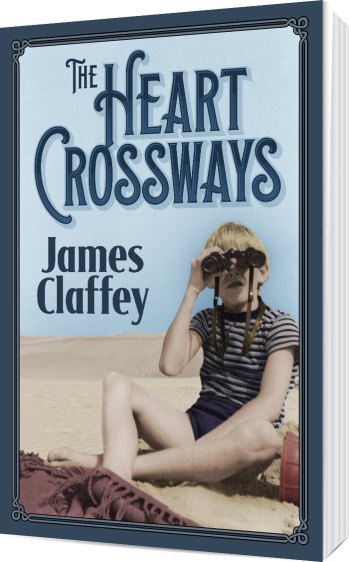


Writers Chat 23: James Claffey on “The Heart Crossways” (Thrice Publishing: USA, 2018)

James, You’re very welcome back to my Writers Chat series. The last time we chatted, in 2012, we focused on Blood a Cold Blue a collection of short fiction. This time we’re chatting about your wonderful debut novel The Heart Crossways where you bring us into an Ireland that’s hardly recognisable today.Print

So, let’s start with language. As a tool it is very much part of the narrative of the The Heart Crossways. Take the wonderful opening section:

“On rainy days the time passes slowly. Trance-like, I tongue my bedroom window and lick the condensation from the glass. My nose smushes against the cold pane. The seagulls glower below, on the roof of the coal shed…”

How much of these wonderful verbs came to you on the first few drafts or was it when you edited the novel that they emerged? I am thinking of what Sheenagh Pugh once said – that great writing is in the editing.

JC: So, interestingly enough, Thrice Fiction Magazine published three short pieces in their March, 2012 issue, and one of those pieces was “Dublin On a Wet Day,” which was remarkably close to the opening beat of the novel. Over multiple drafts the frame of the book shifted considerably, and in several drafts the opening pages were completely different and set at a far different time in Patrick’s life. The image came to me in a memory of my childhood in Rathgar, and how on rainy days my brothers and I would stand at the windows, noses pressed against the glass, cursing the weather that forced us indoors. I went over and over different variations of that opening, changing tense, point of view, at least three to four times, and ended up with a first person narrator that finally seemed to work.

SG: It really is an arresting opening. I love that throughout the novel the power of books comes through. From the old blue ledger the Old Man uses to record transgressions and the books (from Mark Twain to Tennyson) our hero, Patrick, reads to escape. Was this one of those hidden symbols that emerged when you’d finished writing the book?

JC: Yes, I think the books as symbolism emerged through the drafting process, and the ledger idea came to me from an actual ledger from my father’s business, filled with the incoming and outgoing monies for quite a few years, in fact. In several places in the ledger are crude drawings we did of dinosaurs and lions when we were probably bored on rainy days! Further, I wanted to seed Patrick’s world in the literature and drama of the time, the importance that books played in young children’s lives, long before iPhones and Fortnite. I grew up in a house filled with books, drama, literature, and as kids my brothers and I would sprawl in front of the coal fire reading comics, books, and newspaper cartoons, composting that love of books and all things literary.

SG: What beautiful memories, James. The Heart Crossways is set in an era (mid-seventies) when appearances – that you are perceived as good in the eyes of the neighbours and the church – still count for everything. As the Mam says, “All you have in this life is your good name.” Patrick – not unlike Stephen in Joyce’s Portrait of the Artist as a young man – negotiates appearances and tracks his way through his father’s alcoholism, his mother’s worries and lusting after both Cathy and Mrs Prendergast by using humour. “Seducing Mrs. Prendergast is the mission I have accepted and in silence I try to plan how this will happen. Maybe she will wear a velvet cloak and come running to me like Maria in The Sound of Music?” Patrick is both teenage and reflective in his self-analysis. Can you talk about the development of Patrick’s character?

JC: Patrick began in those early stories as a lonely boy with time on his hands and parents too consumed with keeping hearth and home together to pay him much attention. I suppose there’s a part of him that’s living in his own head, thinking and overthinking life, and there’s a part of him that’s a small boy, desperate for his parents’, particularly his father’s attention. As the book unfolds, he moves from a more simplistic worldview, to one more complex, where he gains some understanding of the complicated nature of life in a Catholic and repressed Ireland. His use of humor as a compass to guide him through the fog of his life is, in my opinion, particularly Irish, in that we use humor to decode, to defuse, and to deflect the missiles life fires at us. And the sex. As a child of the seventies, Patrick is mired in the repression of the time, cosseted by his parents, stifled by the overshadowing Catholic hierarchy that divided the schools into same sex institutions where sex was what Kavanagh called the “wink-and-elbow language of delight.”

SG: A great phrase from Kavanagh! Yes, it is a particularly Irish trait, the use of humour. Continuing with this –  there are many laugh-out-loud incidents, for example, when De Valera (the aptly named three-legged greyhound that serves as a pet) chews on the Old Man’s false teeth, or when Patrick gets a bowl cut when the Old Man thinks the barber didn’t take enough off – are any of these taken from real life situations?

JC: Well, we never had a three-legged dog, but some years ago I was in Solvang, near Santa Barbara, for breakfast and there was a American Greyhound Society event taking place in the town. One of the greyhounds was three-legged, and that stuck with me as something that might become part of a story one day. As for haircuts, most of us growing up in Dublin have had our run-ins with the local barber, and mine was with Mr. Roche, whose son was in my class in primary school. We’d tramp up to Terenure Village and enter the barber shop with its red-and-white striped pole, wait for “Skinner” Roche to cut us to shreds, and appear at school the next day to bear the brunt of the insults. Eventually, my mother started taking us to the Peter Mark Salon, a more contemporary place to get one’s “hair did,” than at the “Skinner’s.” My dad always threatened us with the scissors and bowl if we didn’t behave, and my oldest brother grew a ponytail and drew the ire of our Old Man on many occasions.

SG: Oh I remember Peter Mark Salon – still going – it was the height of sophistication! One of the themes I picked up on was that of emigration, and with it, the importance of place – of leaving and returning – creating and re-creating new identities with each new ‘start’. Although the Old Man is a difficult character in every sense of the word, and plays the role of too-little-too-late father (or, as Patrick puts it “a one-man wrecking ball”), I can’t help but think that working on the oil rigs (if that is where he goes to – there is a sense, connected to his drinking, that he frequently disappears) can’t have been easy for him. This must do with economics; the Brogan’s aren’t well-off but they have food on the table and go on holidays. Can you comment on this theme and what it might mean to you, an emigrant yourself?

JC: The Old Man spends three weeks away working the oil rigs in the North Sea at a time, and the work is gruelling and tremendously hard on his body. Patrick’s dad, of course, isn’t used to graft and his body shuts down over time, leading to physical issues that emerge in the latter stages of the novel. Everything the Brogans experience in their lives, scrimping and saving, getting groceries on credit at the local store, are moments from my own childhood. We didn’t have much in terms of financial wherewithal, but we had food, shelter, clothing and warmth, those critical components of Maslow’s hierarchy of needs. Money for the Brogans is tight, and Patrick’s mother is adept at stretching the pounds, shillings, and pence to make their home as comfortable as possible. For me, as both an immigrant and a child who grew up with not enough money to go around, the theme of economics rings loud, knowing how in my early years in America, I worked a bunch of retail jobs, barely getting by, and only really found my feet financially when I graduated from university and became a high school teacher. Even now, decades later, my greatest fear is running out of money, and I go into a panic mode if our bank account ever gets too close to the bone. I feel my parents’ desperation in those moments and return to those fraught childhood days, until I remind myself I am not my parents and I can make different decisions than they may have.

SG: While religion snakes through the story I found that the sense of loss overtook it. While Patrick imagines “God as a bitter, angry one who takes delight as he metes out punishment to ordinary sinners” he also prays for his own sorrow and torments to end- his relationship with his father. Not wanting to give any of the plot away, the ending of The Heart Crossways was fitting and poignant.

JC: The Church looms large in the story, and the strict Catholic childhood I grew up in shaped me in many ways. I walked away from the whole Mass on Sunday world and found my own way of navigating faith and belief over the years. Today, I identify as a Unitarian Universalist, cleaving to the ideas of Jefferson, Emerson and the Transcendentalists. There’s a freedom, a breath of relief when I’m at a service, with no sense of guilt or shame. As for loss, it defines my life. My father lived his life grieving for the business he lost in the 1960s, never letting it go. He reached his dying day filled with regret, loss and anger towards those he perceived did wrong by him. Being Irish, for me at least, means embracing loss, finding comfort in that feeling, knowing that one cannot be happy every day of one’s life, and that loss is as big a part of life as love, or happiness. Emotions are our weather patterns and there’s a beauty to all seasons, even those that bring devastation to our door. I know this too well, having lived through recent wildfires and debris flows in the area I’ve settled in Southern California.

SG: That’s very poetic – embracing loss. Finally, James, a little on the character of the mother and the Bird. There’s something familiar in both of these and it was lovely to return to them after meeting them briefly in your short stories. Could you talk a little about how characters can re-appear in our writing in different guises, under different circumstances and across genre?

JC: The Bird is a character I brought to life from early flash fictions I wrote about growing up in Ireland. He was a real person, a customer in my father’s pub in Moate, Co. Westmeath. The reappearance of the Bird is timely, after a project I did with Matt Potter of “Pure Slush,”—A Year in Stories. I wrote twelve stories revolving around the Bird, and one of my favorite ones appeared in Causeway/Cabhsair a few years back. In January I returned to the rich vein of material the Bird springs from, and am working on a project where I write a page a day about his life. He never was my mother’s beau, but I remember her commiserating with my father one morning as he read the obituaries in the “Irish Independent,” and announced, “The Bird is dead. The poor auld hoor.” I love how characters ebb and flow in our work, receding for years at a time, only for a re-emergence years later as the tidal patterns of our creativity shift.

SG: I think you’ve just captured the real essence of creativity – the flow and ebb of characters in tandem with our own tidal patterns of creativity. So, to finish up, James, let’s have some fun questions: 

  • Kindle or paperback? Paperback
  • Novel or short story? Novel
  • Short story or flash? Flash
  • What’s the last sentence you read? “An aliveness that lit up the world,” Michelle Elvy’s The Everrumble.
  • Great sentence! What’s the last sentence you wrote? “Oh, poor man. The center of his universe hollowed out and collapsed.”
  • Another great sentence! The best jam in the world? Our family’s business is Red Hen Cannery, and we make the most delicious Boysenberry Jam.

Thanks, James for an engaging chat. The Heart Crossways can be purchased direct from the publisher or on amazon.  Connect with James on his website

Below is our chat from January 2012. 

*****************

WRITERS CHAT – JANUARY 2012 – ON “BLOOD A COLD BLUE”

Blood_a_Cold_Blue_cover

Welcome to James Claffey, originally from County Westmeath but now living in Carpinteria, CA, USA with his wife, writer and artist Maureen Foley. James is a prolific writer and his most recent full-length publication is Blood a Cold Blue, a collection of short fiction.

James, tell me about the title and cover of your collection Blood a Cold Blue. Was the title one you had in mind or one that emerged once you had the collection completed and formed? Tell me also about the photograph on the collection, I know you had trouble tracking down the photographer for permissions but was that image of a bird in snow with a crumb an image that you had in mind?

Yes, I submitted the collection to several places and it was always titled Blood a Cold Blue. I chose the title from a line in one of the stories that also bore the same name (I’ve got this habit of titling my stories with fragments from the text). As for the photograph, the publisher, Press 53, sent a couple of early cover suggestions that I didn’t like at all, and then they sent the bird photograph and I loved it straight away. It turned out to have been taken by an Icelandic photographer and he was unresponsive to the publisher’s attempts to contact him. We waited a week or two and there was no word so Kevin at Press 53 said we might want to look at other options including a new title completely, so I went on the hunt for the photographer. All the usual social media avenues were fruitless and on the verge of giving in, I did a last Google search and found an old LiveJournal blog he’d had years ago. It had an Icelandic email address and I sent a message asking him to contact Press 53 about the image and the next day he got in touch with Kevin and agreed to let us use the photograph.

Great to hear it all worked out! You’ve stated that “Skull of a Sheep” is your favourite story in the collection. Can you expand on the idea of having a favourite story?

“Skull of a Sheep” is a fictionalized version of a family vacation in Mayo when I was a kid, and the unpunctuated stream-of-consciousness mirrors the breathlessness of the drive down the country and back again, I found the story stirred my sense of hiraeth, that Welsh word that suggests nostalgia for home, but with some sense of longing for those departed. My father passed away in 2000 and the piece was written right before my mentor and friend, Jeanne Leiby, died in a car crash in Louisiana, so there’s a sense of this story having more weight because of these events. Also, the piece ran in the New Orleans Review, and that is a publication that means a great deal to me, having spent three years in the South, learning the ropes of what being a writer means.

There’s a great sense of compassion, compression and a long breath of emotion in that piece. You capture so much in it – all that lies beneath the landscape and landmarks.

I’d like to hear about how you get into character. Do you have a favourite character in the collection? If not, why not, if so, whom?

I do. The Bird, a character in a couple of stories I’ve written, is close to home for me. My father, if I recall correctly, who used to run a pub/grocery in the Midlands, had a customer who was called by the same name, The Bird, so I found myself putting myself in this man’s head and imagining what it would have been like to wander the streets and fields of my old hometown. I’m currently working on a year of stories for Pure Slush, an Australian publication edited by Matt Potter, with this same character. I find great latitude in taking on the task of creating a life from so few details.

That’s interesting to hear, James, as The Bird is one of the characters that stood out for me. Now tell me about settings. You have some wonderful ones that seep through via the use of names, the turn of phrase (for example “Fragments of the Bird”), from the absurd to the very real and named (for example “Fryday, June 17th, in the year 1681” or “Hurried Departure”). Do the settings come first, or come to you as you write? Or are they sometimes somewhat peripheral?

Thank you. Place is incredibly important to me, and I tend to write with almost reverence about certain locations—New Mexico, Ireland, Louisiana, California. “Fryday, June 17th…” came out of an old print of an Elephant’s skeleton and the story of its death, and I reimagined the actual events of the disaster, which actually took place in Dublin back in the 15th Century. As for “Hurried Departure,” it’s almost a fantastical world slightly based on the area surrounding our house in the avocado trees. Detail, even as liminal as the light over a stand of trees, is terrifically important to give a piece of writing an anchor in the world and as I’ve gotten less naïve as a writer, I find myself noticing the small details of objects and places much more than before.

I think, for me, anyhow, that’s what is so great about this collection. The myriad of different experiences in different settings that you (re)imagine/capture.

On writing, if you’re willing to reveal, what are you working on now?

Well, the year in stories project at Pure Slush, for one. Also, I’m working on an untitled novel with Thrice Publishing, and that’s about a small boy growing up in Dublin with a father who works away on the oil rigs in the North Sea and a mother who struggles at home to raise her son and deal with her own aging mother who lives with them. I’ve also got a novella project I’m collaborating on with another wonderful writer, and I’m very excited about that opportunity. On top of all that I’ve returned to teaching high school English, so I’m having to really be creative in terms of finding time to write, what with my wife and two kids to devote time to, and a dog that needs walking!

That’s a pretty full and creative life!  Finally, James, what three books are on your bedside table and what three books are on your ‘to read’ list.

Varieties of Disturbance by Lydia Davis, Bound in Blue, by Meg Tuite, and Gears by Alex Pruteanu, are on my bedside table, and to read are The Goldfinch by Donna Tartt, Transatlantic by Colm Toibin, and A Place to Stand by Jimmy Santiago Baca (a re-read).

Thanks, James, for such insightful and fascinating answers.You can find out more about James and his writing on his website and blog: www.jamesclaffey.com


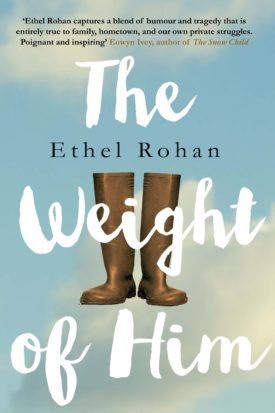
Writers Chat 20: Ethel Rohan on the writing life after her debut novel “The Weight of Him” (St. Martin’s Press (US) and Atlantic Books (UK), 2017)

For my 20th WRITERS CHAT, I’m delighted to welcome back Ethel Rohan. 

Since we last chatted in August 2017, Ethel, your debut novel The Weight of Him was an Amazon, Bustle, KOBO, and San Francisco Chronicle Best Book, and winner of a Plumeri Fellowship, Silver Nautilus Award, and the Northern California Publishers and Authors’ Award. Congratulations, and thanks for returning to Writer’s Chat.

TWOH UK Cover

SG: Can you tell us a little about the reception of The Weight of Him, and if, and how, it affected your writing? I always find that it is so difficult for writers to keep those two hats on – one in the midst of finding the way into a new creative project, and the other out and about meeting people and talking about the already published project.

ER: From my publishers’ perspective ( St. Martin’s Press and Atlantic Books), my debut novel wasn’t received well i.e. its sales were disappointing. As much as I tried to prepare myself for the challenges this book would have reaching readers (it centers on difficult subject matter, suicide, and a marginalized protagonist, 400lb Billy Brennan) I was hopeful it would succeed and was crushed when it didn’t fare better. The blow knocked my confidence and two years later I’ve only just recovered. From my own perspective, I still continue to receive a wealth of emails, messages through social media, letters (yes, handwritten letters!), and IRL responses that speak to how deeply the reader was affected by the book. This generous, heartfelt feedback has greatly buoyed me. I persist, and losing myself in writing new work has been my greatest salve.

SG: Well, if you consider why we write, alongside one of the roles of literature in society, I think it is to affect those who engage with it and to shine a mirror on society. Isn’t that the real measure of success?

In your new work, do you find yourself returning to the themes of The Weight of Him? They are themes not easily released from our psyche, I find.

ER: I never enter a story with any theme in mind, but invariably the same patterns and obsessions emerge. I think that’s true of all artists. I’ve even tried to fight it: This story will not be about food, hunger, guilt, shame, loneliness, friendship, missing parts, another “bad” parent, or one more dysfunctional marriage etc. but sure enough… I’ve made peace with my psyche at this point. My only objective is to tell the best, the most interesting and urgent, stories I can. Thus I allow whatever best serves the story to surface in freewrites and survive in revision.

SG: What a noble aim  – to tell the best, the most interesting and the most urgent stories. And, of course, holding on to that belief that the work (the writing) will prevail. Tell me, Ethel, what are you working on now?

ER: Christ, I write so much, it’s finishing that’s the challenge. I’m good at plotting stories (which is interesting because I always enter a story blind, never knowing what’s going to unfold) but beyond the beginning, middle, and end where I have to work hard is with character, giving them interiority and complexity, and allowing the reader to deeply connect with each of them and the protagonist in particular. I currently have two draft novel mss completed, and am handwriting a third. The two complete draft mss need further full revisions that focus on theme and character, and I’ll return to them when I’ve finished this handwritten novel draft.

SG: That’s a fantastic outpouring and I completely get that – I’m the same, constantly moving and working on multiple projects. What’s next for publication?

ER: Aside from hopefully publishing some short stories I’ve been working on, and returning to personal essays, I hope to next publish one of the three novel mss mentioned above, and ultimately to publish all three. I’ll lead with whichever “finished” ms I believe to be the strongest and see what happens. What’s daunting, and frankly frightening, is that the low book sales for The Weight of Him will make publishers less likely to take another chance on me and I know I’ve got to write a story powerful enough (or in their own words “big” enough) to sway them. What I won’t do, though, is pander to any trend or market need. I’m staying true to the stories that I most need to tell, those that arrive unbidden and insistent, like surprise, pressing gifts.

SG: I think that’s the most difficult part of the writing life – that industry push against the creative urge. I’ll say it again… the work will prevail!

Lastly, Ethel, some fun questions

  1. What’s next on your to-be-read-pile and and what’s last on the (same) pile? I have shelves of unread books, and a tower on my desk, and another by my bedside. From that former looming tower, I’m eager to next read Devi Laskar’s The Atlas of Reds and Blues and at the bottom of that pile (simply because I’m so behind in my consumption) is Sarah Perry’s The Essex Serpent. My first read when I return to Ireland in July with be Sinéad Gleeson’s Constellations.
  2. I have Constellations on my pile now, nearing the top and at the moment I’m reading Niamh Boyce’s wonderful Her Kind. Tell me, Ethel, where did you take your last holiday? Aside from a couple of nights recently in Portland, Oregon, the answer is Ireland (although I’m not sure it can be considered a holiday in that it’s never restful!). Since I emigrated in 1992, I’ve returned 30+ times. My husband’s also Irish and all our family members are there, so the pull is huge.
  3. And when you’re on holiday, do you bring Kindle or paperback with you? Never Kindle. Mostly paperback, sometimes hardback. And I leave every holiday with more books than I brought.
  4. Tea or coffee when writing? Barry’s tea (and way too much Cadbury’s or See’s chocolate). Always. Praise be for the several import shops here in San Francisco where we can get all our Irish favourites (albeit at a premium).
  5. Dogs or cats? Both, with a definite preference for dogs.

Thanks, once again, Ethel, for joining me in a Writers Chat session. I wish you the very best of creativity and luck with your current and new writing projects. Below is the ORIGINAL Q&A WRITERS CHAT, PUBLISHED AUGUST 2017

Author Ethel Rohan Los Res dpi 300

I am delighted to welcome Ethel Rohan for a Q&A session on her debut novel The Weight of Him. Thanks, Ethel for agreeing to be featured on my blog and many congratulations on the wonderful reviews and accolades that your novel has been getting.

READERS: See below for the chance to win a copy of The Weight of Him!

Shauna: Let’s start right away with the title and your starting point for the story. In the Dublin launch in Hodges Figgis in June, you mentioned that the idea began with an image of a snow globe in a window. I remember thinking that was a powerful image – there’s layers there – and when I read that scene where Billy looks in the shop window, I knew exactly what you meant.

‘Billy wanted to shake the globe and bring it to life…His hand pressed the side of his head, as though trying to keep the egg of himself together.’

Can you expand a little more on this initial characterisation of Billy, in particular his emotional nub.

Ethel: Thank you, Shauna, for hosting me and for your tremendous support of writers and books.

The initial spark for my novel was a conversation I overheard in a Dublin pub about an obese woman in mourning. “The grief might just kill her before her weight does.” That statement stuck in my imagination and I wondered what if this woman’s grief and weight don’t kill her, but propel her to do something extraordinary?

That’s the question that drove me to the blank page. As soon as I started writing, Big Billy Brennan appeared in the white space. The first scene I wrote was, as you mentioned, Billy standing in front of a shop window, his attention fixed on a snow globe. As you’ve quoted, he’s filled with the urge to shake the globe and bring it to life. I knew in that moment I’d hit on Billy’s emotional nub and his impossible burning desire to bring his loved one back from the dead.

I don’t plan my stories, so the novel’s first draft(s) was really just me continuing to answer questions on the page as they arose. It was a risky novel to write and to publish (thank you, St. Martin’s Press and Atlantic Books). I met many hurdles in the telling, largely fueled by self-doubt. Mostly, I struggled with whether or not I had the authority to write about a 30 stone man. I worried whether or not I could make the unlikely marriage of the difficult topics of obesity and suicide work. I felt an enormous responsibility to handle both topics with sensitivity, compassion and honesty.

Shauna: While the narrative is told from the perspective of Billy, I found we got some close insights into his wife Tricia’s point of view. Can you tell us about their relationship and how much of it is viewed through the lens of grief, loss and unanswered questions?

Ethel: Point-of-view was another major challenge. I knew I was taking yet another risk in keeping the story wholly in Billy’s perspective—he’s the camera through which everything is filtered. But after multiple drafts, I became convinced that close third point-of-view was the right choice for this story. That sense of limit and containment mirrors how trapped Billy feels in his body and his grief, and also underscores how trapped Michael felt, and to a lesser extent, Tricia. The close third point-of-view also felt true to life. We can’t get inside others’ heads in reality—we know others only by their story and what they say and do—and that’s the way I kept it on the page. Limiting, yes, but sin a bhfuil.

With the close third point of view, it’s a bigger challenge to render the other characters as fully as possible, and in particular the main secondary character, Tricia. I only had the use of backstory, Billy’s perspective, and what Tricia does and says in scene. I learn who my characters are by both interviewing them off stage and putting them in scenes, to see what they say and do and how they interact with others.

In discovering who my characters were, I learned that Billy and Tricia’s marriage was troubled long before Michael’s death and that they were merely coasting along in a largely humdrum existence. Tricia felt betrayed by Billy because early in the marriage he lost the agency and sense of empowerment he’d exhibited in their courtship—his brief sense of bravado and buoyancy was fueled by the first glow of their love. When Michael dies, their relationship inevitably unravels further and they each grieve, and try to go on, in startlingly different ways.

Leaving some questions unanswered in the novel might seem like another risk, but again I tried to best reflect life and truth. Reality can’t be wrapped up and tied with a permanent, pleasing bow and neither should story. Suicides leave behind more questions than answers and our relationships with food and our bodies is ever-evolving. There is never resolution in all things in the world, so how can there ever be complete resolution in story?

Shauna: Oh I agree. Much of life is spent searching for resolutions, and often through stories, so leaving some questions unanswered was one of the powerful elements of The Weight of Him and one that served the portrayal of Billy and Tricia’s relationship well. 

Now without giving away the plot, one of the elements of the story that stayed with me long after I’d finished the book was the emotional weight that is evoked through the work Billy puts into building his ‘other world’ made up of the imperfect miniature figures from the factory where he works. It is only in this world that he can save Michael, the son he lost to suicide, and it is only in this world he can be the ‘right son’ and the best father. Can you talk to us about the psychology of this powerful subplot.

Ethel: Thanks, Shauna, it took restraint in final revisions to keep concise and not get too caught up with the subplot of Billy’s alternate world, a wonderland that fired up my imagination.

In that first draft, I was deep in the writing, answering the question of where Billy worked, and the toy factory came to life on the page, and then the damaged toys appeared. When Billy secretly pocketed the first damaged toy, a soldier that represented Michael in his mind, the subplot developed from that pivotal moment. It was one of those rewarding, exhilarating gifts in the writing when what a character does surprises you and you know you’ve opened a rich vein.

Many of the scenes in this miniature ‘other world’ didn’t end up in the final manuscript but they did allow me to fully understand Billy’s psychology with relation to the damaged toys and the idyllic tiny village he creates for them—a perfect world where Michael is returned and the Brennan family is whole again. Of course, perfect doesn’t exist, not even in Billy’s pretend world. That was another of the lessons Billy had to learn and more of the suffering he had to withstand in this story.

 Shauna: I walked for Pieta House this year as part of their world wide appeal Darkness into Light and was really moved by the sense of community and hope. Billy walks for suicide and uses the media as a way to come to terms with his loss and also give hope to others.

In a scene where his mother takes ill, the nurse in the hospital turns to him:

Her eyes stayed on him. “You’re the father from the newspapers, aren’t you, the one doing the suicide prevention fund-raiser? I heard you on the radio too. Well done, you’re an absolute inspiration.”

Ethel, not only did you donate the net earnings from your Dublin launch to Pieta House, but much of the novel focuses on the difficulty in getting people to talk about suicide and suicide prevention, and the roles (positive and sometimes negative) the media can play in this – in other words, how do we talk about something that is so painful when often the very thing to prevent, or help heal that grief, is to talk?

Ethel: Thanks for walking, Shauna. I did too, here in San Francisco.  Suicide is preventable and one of the key ways to prevent it is to talk about it. For those suffering suicidal thoughts, it is never too early or too late to seek help and talk about your illness. For those, like me, who have overcome suicidal ideation, is it important to share our stories so others know that they are not alone and that there is great hope.

As a culture we need to educate ourselves on suicide and mental illness and lift the last of the stigma. At my most ill, I became convinced that no one would understand or care. We need to send a clear message as a culture that we do understand and we do care. Like every person suffering an illness, the suicidal should be accorded compassion, dignity, and the best of treatment.

Silence has its value, but not when it’s silence locked up by secrecy, shame and fear. That kind of silence causes enormous damage, and can be killing. So, please, just talk out the thing. I’ve found whatever it is we least want to talk about, that thing that we most want to keep in, that’s exactly what we should talk about and let out.

Shauna: Yes. And literature – storytelling – can be a way in which we can speak of these things and also the means by which conversations can be started. In The Weight of Him, despite the initial subject matter- that of an obese man who has just lost his eldest son to suicide – there is much beauty and hope.

 “He roared. Roared till the scorch inside his throat and chest made the sting of his bloodied knuckles feel like nothing. Roared till he’d nothing left. Breathless, spent, he struggled back to standing, his feet slipping about in the muck and the pain pulsing in the sides of his knees. He pushed himself to the farthest edge of the cliff and lowered the flashlight to the ground. In life, Michael would not have been able to stand here next to him on the cliff’s edge. It would be nice to think the boy’s spirit was standing alongside him now.”

I found it to be a very human story touching on identity, relationships and discovering – through Billy – that we are all, in our various ways, striving to fully embrace who we are. And that wonderful line that Billy’s younger son Ivor says: “We get reminders about dying, so we don’t forget to make the most of living.”

Ethel: Thanks for such a close and generous read, Shauna, and for these excellent questions and observations. I think all my writing is ultimately my characters and me trying to find the beauty and hope in damage and loss. It’s how we can best go on.

Shauna: And isn’t that, yet again, much of life? Finding the beauty in the cracks, the cracks that are in themselves, beautiful. Thanks again, Ethel for such wonderful, honest answers. I wish you further success with The Weight of Him and I look forward to your next novel.

And now for the opportunity to win a signed copy of The Weight of Him – Irish and UK readers only!  Simply add a comment below along with your name (first name will do) and an email address so we can contact you if you win.  The winner will be picked out of a hat on Monday 28th August at 8pm. 

Connect with Ethel here: Twitter, @ethelrohan; Facebook, @EthelRohanAuthor; Instagram, @ethelrohan. Website, http://ethelrohan.com.

Order The Weight of Him  on Amazon or your local bookshop!

If you have been affected by issues raised in this post please contact the Samaritans in confidence on 116 123

********

20170828_202633

AND THE WINNER…of Ethel’s Rohan’s debut novel The Weight of Him…is Shauna!

Congratulations and thank you for reading and commenting.  I will contact you to get details of where to send the novel.

Thanks once again to my son for doing the honours of closing his eyes and pulling out a name!

And thank you to all those who have read and/or commented and most of all to Ethel Rohan for such generous answers.

Happy reading, folks!