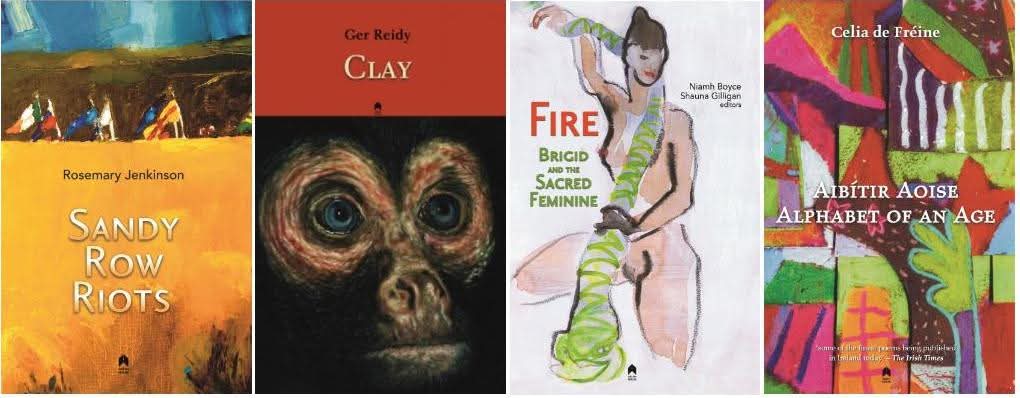
I am delighted to be the MC for an afternoon of fine readings as part of Arlen House’s 50th Anniversary celebrations in Dublin’s Books Upstairs this coming Sunday, 5th October at 4pm sharp.
Writers Rosemary Jenkinson, Ger Reidy, and Celia de Fréine will be launching their latest publications and Alison Wells and TC Arkle (travelling from the UK for the event) will read from Fire: Brigid and The Sacred Feminine. We would be delighted if you could join us!
Celia, You’re very welcome to my Writers Chat series. We’re here to talk about Even Still (Arlen House, 2025) your debut short story collection in English which also includes “The Story of Elizabeth”, your short story shortlisted for Short Story of the Year Award at the An Post Irish Book Awards. The collection has been described as having “compelling” prose with “characters’ voices pitch perfect” and a “unique, characteristically stark, witty perspective on the lives of women and girls.”
SG: Even Still invites the reader into the emotional heart of each narrator – over a range of ages – and stays with some of them as they create life-paths out of places of poverty, away from damaged families and through schooling and employment that only echo where they’ve come from. Did these themed threads dictate the title and running order of the collection?
CdF: Thank you for the invitation, Shauna. I’m delighted to take part in the Writers Chat series. The word ‘debut’ seems strange applied to me at this stage of my life and so late in my literary career, but Even Still is indeed a debut collection of stories that were written on the side, over many years, while I worked in other genres. The title was chosen at the last minute, and with difficulty. I feel it suits the collection, however, as it suggests the possibility of alternatives. As for the running order, I thought it best to place the three stories that feature the character, Veronica, in chronological order. “My Sister Safija”, “Vive La Révolution” and “Irma” grouped themselves together. It seemed appropriate to place “La Cantatrice Muette” and “Félicité” between later stories, some of which have characters common to them. As you say, many of the stories explore the lives of characters who emerge from disadvantaged backgrounds, then attend schools / are employed by institutions in which they are challenged as a result of that background; the question as to how they manage to improve their lot is one that intrigues me, not only in this book, but in general.
Cover image of Even Still showing part image of the painting ‘Fitzwilliam Square’ by Pauline Bewick – side profile of a woman on a balcony in Dublin looking down on a road on which seven cars move along.
SG: The collection is as much about place as people – starting with the cover art (‘Fitzwilliam Square’ by Pauline Bewick) – and the opening story “Pink Remembered Streets.” In these stories villages, towns, cities, and the buildings that form them rescue and trap their inhabitants. Can you comment on the importance of place in your stories?
CdF: The cover art, suggested by publisher, Alan Hayes, with its buildings, winding street and traffic, viewed by a woman from a height, is indeed appropriate. This is the first time I’ve been asked about place in my work and am happy to provide answers, insofar as they relate to this book. The buildings, in which the stories are set, are imagined, apart from the brief mention of a boarding school in “These Boots were Made for Me” and the houses described in “Pink Remembered Streets” and “The Accident”. Both of these houses were places in which I spent time; both were places of insecurity. The former is a flat in a house in Rathmines where I lived with my family during my early years, and from which we could have been evicted at a moment’s notice; the latter is my grandmother’s house in a seaside town in Northern Ireland where I spent my childhood summers, knowing the fun and happiness would end when summer drew to a close. Both houses have appeared in other work, as has security of tenure and the buying and selling of property. Another place that permeates the stories is the past, L.P. Hartley’s ‘another country’ where, in this case, there were few opportunities for girls and women.
SG: You tackle themes (such as domestic abuse, gun running, suicide, the poverty trap, cruelty) that could be weighty with, at times, a narrative voice that is wry and humorous. I’m thinking of the voices of Stella in “Panda Bears” and Eithne in “His Ice Creamio is the Bestio”. Was that a conscious, writerly decision or did those narrative voices emerge through the writing of the characters?
CdF: I tend to see the absurd in many situations and this is reflected in the stories “Panda Bears” and “His Ice Creamio is the Bestio”. In the former, Stella feels she must marry, not least on account of the urging of her friend, Eileen. The fact that both men she sleeps with wear hideous underwear and are poor lovers emerged naturally, as did the time in which the story is set: the opening occurs in late 1969, as suggested by the Mary Quant lipstick and the Beatles’ song; the fact that the timing of the gunrunning, set during the following Whit Weekend, coincides with the 1970 Arms Trial, was serendipitous. “His Ice Creamio is the Bestio” began life as a play in which I examined the lives of three generations of women from the same family, each of whom spent their formative years in different circumstances: grandmother, Eithne, from Northern Ireland, worked as a shorthand-typist during World War 11; her daughter, Francesca, an academic, grew up during the fifties in Dublin; Francesca’s daughter, Alannah, grew up in the Connemara Gaeltacht during the eighties. I found it bizarre, though credible, that three generations of one family could emerge from such different backgrounds on the same small island, and set out to explore how those differences impacted the characters.
SG: I’d love read a novel with these three generations! The stories often hold their power in the unsaid – or shown at a slant – whereby they rely on the readers’ close attention and intelligence to know or feel the real truth. Veronica’s stories, in particular, are great at this (the absence of Clara, for example). We know what happened to her – or we use what the narrative has stoked in our imagination. This makes it feel like these stories are a dialogue between writer/narrator and reader. Can you comment on this?
CdF: The subtlety probably spills over from my poetry where the number of words is more measured and the point never hammered home. I feel this approach works well in the Veronica stories, each of which focuses on the fate of a child: Clara, who falls prey to a paedophile in “Pink Remembered Streets”; the baby, Elizabeth, born of incest in “The Story of Elizabeth”; the unnamed boy, illegally adopted in “These Boots Were Made for Me”. I hadn’t planned that the common denominator in these stories would be the ‘child as victim’, as seen through the eyes of Veronica. Perhaps, because they are told at a slant, the stories demand the reader’s close attention, creating, as you say, an additional element to the usual dialogue between writer and reader; if this is the case, it was unintentional.
SG: And the unintentional is often the magic of the work! War, gender, and displacement are also explored in these stories, overtly in “Irma” and “My Sister Safija” which, as they’re bookmarked between other stories, seem to echo concepts of the outsider, whether it’s ideas of blow-ins, internal movement within the island of Ireland, or belonging through marriage. Did you set out to explore these themes or did they emerge through the stories?
CdF: War, gender, and displacement feature regularly in my poetry and it comes as no surprise that they have spilled over into Even Still. In addition, I should mention that some situations and characters in the collection are inspired by real events, though said situations and characters have been changed out of all recognition. The theme of the outsider, insofar as that person is from Northern Ireland, is one that worked its way into these stories. Having been born in the North and grown up in Dublin, I’ve always struggled to find out where I’m from, a question which drives much of my writing. I used to question whether I was entitled to explore my ‘Northerness’ as I hadn’t lived in the North during the Troubles but, more recently have come to better understand how the fallout from the conflict reaches beyond the Border. Though I didn’t set out to write stories populated by Northerners, these characters presented themselves and exerted their influence to varying degrees on the situations in which they became involved. As for belonging through marriage, Stella in “Panda Bears” is a young woman from Dublin who ends up marrying a Kerryman and moving to Tralee. This idea was also triggered by personal circumstances: I worked for some years in the Civil Service where the vast majority of colleagues were from the country and cast me, the Dubliner, as outsider – even though when I finished work and went home in the evening I was cast, alongside my family, as outsider because we were from the North.
SG: Much of your writing has the poet’s eye for detail, the dramatist’s narrative curve, and the prose writer’s depth. Your descriptions and visual take on lives also has the film maker’s sensibility. Could you see any of these stories as short films? (I’m thinking of “The Short of It”, for example).
CdF: It has already been suggested to me that some of the stories would work on screen. As soon as someone gets back to me with a firm proposal, I shall give it my serious consideration! “The Short of It” is the only story I set out to write as part of an agenda. Some years ago I was devastated when my work was plagiarised and exploited on a very public platform. One of my sons suggested I write a revenge story in the style of Michael Crichton: Crichton finds novel way to exact revenge on critic | The Independent | The Independent. Although my son’s suggestion triggered “The Short of It”, the story changed out of all recognition once I got going and now bears no resemblance to the travesty which gave it its initial impetus. I like the juxtaposition between the narrator’s circumstances when young, cash-strapped and working in the Civil Service, she adapts sewing patterns to recreate dresses featured on the catwalk, and her response, years later, when she realises her writing has been plagiarised.
SG: You are a bilingual writer. Were any of these stories first written in Irish, and, if so, how did you find the translation process in terms of idioms, flow, and narrative voice? If not, would you consider translating any of them into Irish?
CdF: “My Sister Safija” was originally written in Irish and is published as “MoDheirfiúr Maja” in Bláth na dTulach (Éabhlóid, 2021) an anthology of work by Northern writers. As such, I had to transpose it to Donegal Irish and needed editorial assistance. You can listen to it, beautifully read by Áine Ní Dhíoraí, here: Mo Dheirfiúr Maja le Celia de Fréine – Bláth na dTulach (podcast) | Listen Notes. I would consider translating any of the stories in Even Still into Irish for a film script or play.
SG: We will end this Writers Chat, Celia, with some fun questions:
Bus or train? Tram. I love the LUAS. For longer journeys, I prefer the train but find myself travelling more by bus as bus stops are more accessible than railway stations.
Marmalade or jam? Marmalade. Thick cut.
Coffee or tea? An cupán tae, always.
What are you reading now? When I’m writing I read little other than newspapers (at the weekend) and research / fact-checking articles. As well as the above, at present I’m dipping into There Lives a Young Girl in Me Who Will Not Die (Penguin UK, 2025) the selected poems of Danish writer, Tove Ditlevsen. Recently I read The Forgotten Girls: An American Story (Allen Lane, 2023) by Monica Potts; and You Could Make This Place Beautiful (Canongate, 2023) by Maggie Smith (not the actor). All three books explore themes covered in Even Still.
These sound like great recommendations (I love Ditlevsen’s work!) What are you writing now? I’m about to sign off on the second edition of my poetry collection Aibítir Aoise : Alphabet of an Age (Arlen House, 2025); I’m also reworking my play Cóirín na dTonn with the team from An Taibhdhearc. Cóirín nadTonn was originally published as part of the collection Mná Dána (Arlen House, 2009 / 2019) and is recommended as an optional text on the Leaving Certificate Syllabus. I also have two projects on Louise Gavan Duffy, inspired by my biography Ceannródaí (LeabhairCOMHAR, 2018), on the back burner. As all these projects are based on, or inspired by, earlier work, I long to clear space for new poems, and get back to a YA novel in Irish which I began a couple of months ago.
Thank you, Celia, for such insight into your writing life and process. Here’s to finding clear space over the coming months and continued success with Even Stillwhich can be purchased in Books Upstairs.
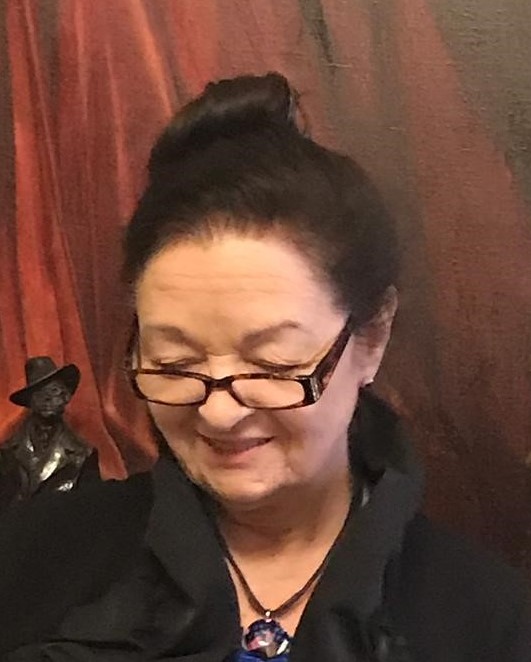
Photograph of Celia de Fréine, Princess Grace Library, by Judith Gantley used with permission.
Nuala, You’re very welcome back to my Writers Chat series. This time we’re here to chat about Seaborne, longlisted for the Dublin Literary Award and described by Donal Ryan as “sublimely imagined and beautifully told.”
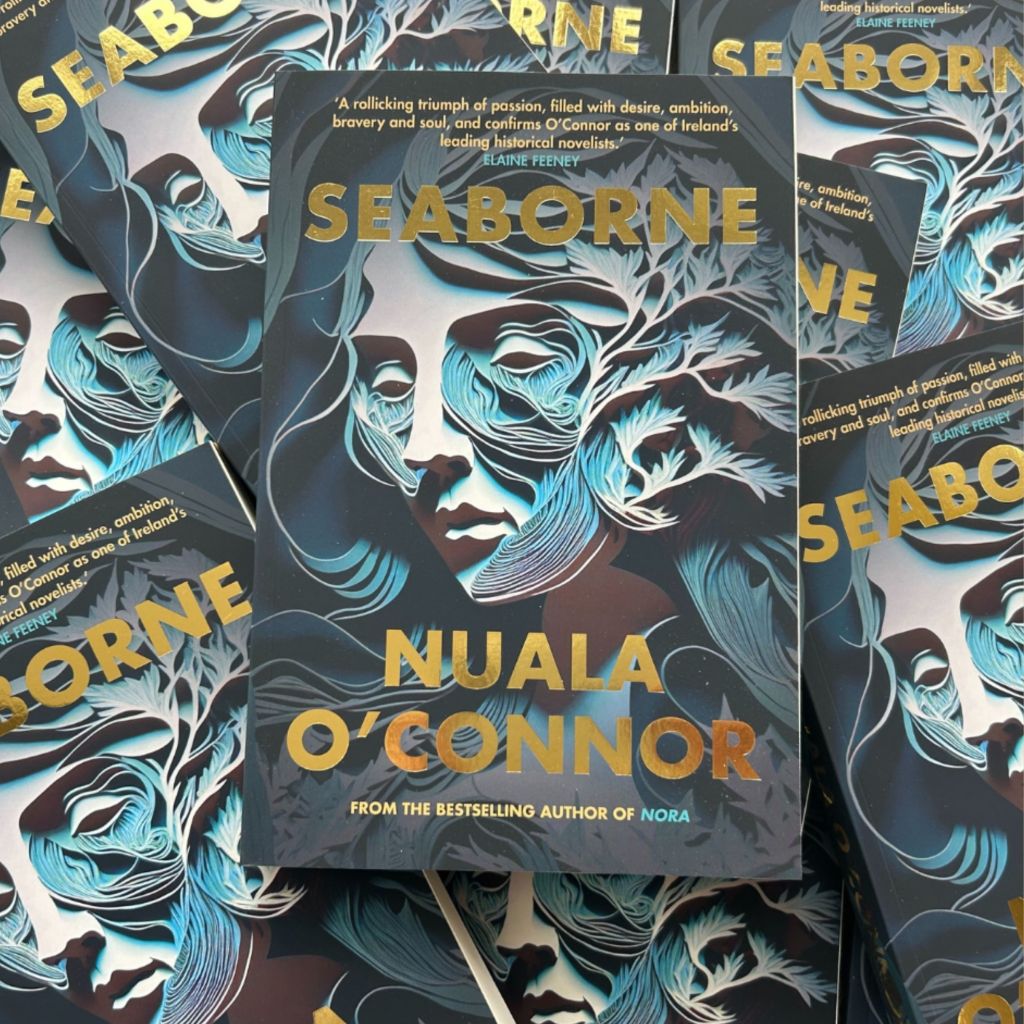
Multiple images of Seaborne by Nuala O’Connor with the title and author name in gold lettering and blue/grey art showing a woman’s face formed by seaweed.
SG: The cover art is stunning. It’s inviting without having read the book and once you’ve read it, you realise the cover totally reflects both title and the complex character of Anne Bonny. Did you have an input into the design and the title?
NOC: I did, yes. New Island are brilliantly collaborative when it comes to the cover. They asked me to make a Pinterest board of images and book covers I liked. I gathered lots of pics of swirly water, women in water, women with big hair and ships on their heads, and so on. Then Karen Vaughan, the designer, came up with loads of possibilities. The final cover image is the one we all had the biggest love for and there were many colour and font tweaks until everyone was happy. The gold foil was an added bonus and I love it. A great experience.
SG: I loved the gold foil! Stunning. It struck me that where Anne is located is a vital part of her identity as much as are people around her. How important was place to you in the writing of this epic book which follows Anne from Kinsale to Carolina?
NOC: Hugely important. There are a lot of myths that swirl around Anne Bonny, and the places she lived or hailed from are included in that. There is no solid evidence of her origins at all, but I chose to use Kinsale and the Carolinas because they were already cited. I travelled to Kinsale but the pandemic prevented my research abroad, so I had to rely on the net, archives, and books for research. Luckily, historical houses, bloggers, and archives are very generous digital sharers of their wealth and knowledge.
SG: Anne is a maverick, and you said in our Writers Chat about Nora Barnacle, another maverick, that you like “women who push against societal norms.” How did you find your research helped or hindered in the creation of the Anne Bonny we meet in Seaborne, given scant records about her illegitimacy, fluid identification with gender, and the push against the barriers of class?
NOC: Any woman who became a seafarer or pirate was considered untoward. With untowardness – in this historic, patriarchal paradigm – goes low morals, bad temper, wantonness etcetera, so Anne was perceived as a feisty dissenter, a rulebreaker and, therefore, bad. It’s not hard to jump from there to the strong-willed quester that I made of Anne. But she has her soft side too – her loving nature.
SG: And you capture her warmheartedness throughout Seaborne. I enjoyed your representations of the changing relationship Anne has with her body – from how she feels and is seen in clothes, to her interaction with men and women, and how she is driven by feeling (physical and emotional) through the book. Can you talk about how your sensory writing is such a fit for a sensuous character?
NOC: I’m an empath and, being autistic, I’m hyper-sensitive to my environment, to clothing, to sensory input and so on, so it’s really easy for me to write those kind of characters, because I live that way – I knock against the world and everything in it as I move through it. So I made Anne is like that too.
SG: Language is at the heart of this book. In the chapter “Quelling an Unsettled Heart”, speaking of Gabriel Bonny, Anne tells the reader that
“The truth stands, though I treat him with disdain, that I like Bonny’s company, I enjoy being near him, and he enjoys me – I see the kindle in his eyes when he looks at me…I like the weight my sailing outfit gives me, it makes me both strong and invisible along the wharf, and there be power to savour in that.”
How did you decide on chapter titles, and what was the process in keeping them inline with the narrative voice which is true to its era and character?
NOC: I had some of the final titles already and then Aoife Walsh, Commissioning Editor at New Island, suggested strengthening them to reflect the content more. I worked with her, and the copy editor, to pick juicy bits from the text as titles. I like all that finessing of a manuscript before it gets to be a book – the cherries on the top, so to speak. I was delighted when Aoife said I could have a map, too – I love novels with maps.
SG: Thank you for being so open about the process! One of Anne’s strengths is her openness and adaptability to linguistic expression – the changes of speech from Cork to Carolina are deftly handled, as are her imitations – while at the same time, she stays true (and firm) to her need of the sea. Was this an important element of the reimagining of Anne, for you?
NOC: I wrote her as neurodivergent before I even knew I was autistic myself. I got my diagnosis shortly after finishing the manuscript, if memory serves. So, she blends, mimics, and adapts in order to fit in (the same thing I’ve been trying to do for all of my life). This masking/imitation includes speech patterns, ways of behaving, clothing and so on. Anne is a chameleon the way many autistic people are.
SG: And this ability to change and blend shines as a gift rather than any type of limitation. The power and strength Anne gets from some female relationships is also explored through her friendships with Hannah Spratt and Bedelia. Can you talk about the role of this trio of women in the overall narrative and how it might compare or contrast with Anne’s relationship with her mother?
NOC: Bedelia is Anne’s beloved friend. There is an imbalance – Bedelia is her servant – but Anne loves Bee fiercely, relies on her totally. Anne is wary of Hannah from the start, she seems too fond of Bedelia. But Anne learns to like her a little when she sees that Bedelia likes her. It’s an unbalanced trio and it never quite goes right, as the reader will see.
Anne’s mother Mag was steady and wise, she was Anne’s main advisor and, her early death left Anne a bit rudderless. With no steady hand to guide her, we see Anne flounder, fragment, and act chaotically.
SG: Lastly, Nuala, some fun questions:
Boat or plane/Sea or land? I’m not a fan of flying. Too little control. At least on a boat you can walk around. I love the sea but, if I had to choose, land.
What was your favourite place you visited as part of the research for this novel? Kinsale – such a beautiful, colourful, rich part of Ireland. Also, the Caribbean of my mind. I enjoyed describing tropical beaches while locked down during the pandemic.
The power of words! Is there an era in history you would not like to explore through historical fiction? If so, why? I’ve done 18th, 19th, & first half 20th C, so I’ve covered a fair bit. A WW2 novel is appealing, but I have no firm plans. The novel I’ve just finished writing is contemporary.
What are you reading now? A book of Greek poetry. And I’m back with Ferrante because I’m going to Naples this year. I’ve blurbed nine books so far this year and have one more to go, so my reading has been prescribed a lot (time to take a blurb break, I think!). I have Seán Hewitt’s new novel lined up and am also finishing some Virginia Woolf, because she comforts me, and I’m always reading Elizabeth Bowen’s stories again, because I’m in a Bowen Reading Group. I always have loads of books on the go. Plus podcasts.
That is a lot! Naples is stunning – in all the senses. What are you writing now? A memoir about late-diagnosed autism, writing, depression, the alcohol-free life – I’m throwing the lot at it!
As always, Nuala, thank you for your generous answers and insight into your process as well as the editorial process with New Island. Wishing you continued success with the novel and good luck with your memoir. Seaborne can be purchased directly from New Island.
Nuala O’Connor sitting on a wooden chair on a beach with the sea behind her. Photograph by Úna O’Connor. Used with permission.
Nuala O’Connor lives in Co. Galway. Her sixth novel Seaborne, about Irish-born pirate Anne Bonny, was nominated for the Dublin Literary Award and was shortlisted for Eason Novel of the Year at the 2024 An Post Irish Book Awards. Her fifth poetry collection, Menagerie, was published by Arlen House in spring 2025.