We are looking for personal responses to the theme of the sacred feminine, Brigid and the heritage of Kildare. The anthology will be published by Arlen House and launched at Kildare Readers Festival October 2024 as part of Brigid 1500 Celebrations. We hope this anthology will become a source book and a tonic. All genres of writing and visual art welcome. Collaborative submissions also welcome.
Be honest; tell your truth. Crash the clichés! Surprise us.
Submission Guidelines: Please read and follow the below guidelines carefully!
How to submit:
Submit unpublished work (online or otherwise) by email to HolyCowsRedBook@gmail.com as an attachment.
All submissions are read anonymously so please do not have any personal identifiers on your manuscript or art work.(any work that does can not be considered for the anthology)
Please put Poetry or Prose or Visual Art in the subject title – as appropriate to your work.
Include a brief 50-word biography in the body of your email.
What to submit:
Prose: up to 2,000 words, in .doc, .docx, or pdf.
Poetry: up to 3 poems (no longer than 40 lines, excluding title) in .doc, .docx, or pdf.
Visual Art: submissions in jpeg. 2MB; 300 dpi; minimum 2000 pixels in width and height.
When to submit: Submissions will be accepted between Monday 22nd January and Monday 12th February 2024 only. No work can be considered outside these dates.
Submissions Response:
All submissions will be acknowledged by email.
Successful applicants will be informed by email before Friday 15th March 2024.
The decision of the editorial panel is final.
The editorial panel is not in a position to enter into correspondence about submissions or to give any feedback.
Successful applicants will receive a small fee for their work and one paperback copy of the anthology.
Mary, you are very welcome to my Writers Chat series. We’re here to discuss your short story collection The Hour After Happy Hour, a collection which has been described (rightly!) by Mike McCormack as “Measured and ceaselessly inventive.”
Cover image of The Hour After Happy Hour showing the title and author name in white writing with an illustration (of women) in shades of blue. Courtesy of The Stinging Fly.
SG:You’ve stated on Arena that The Hour After Happy Hour took ten years to write and in The Irish Timesthat “The book moves through waiting places and limbo states, very often situated in emigration and transit.” Can you talk about what the act of writing means to you – do you think it is in and of itself a limbo state?
MOD: Thank you for hosting me as part of your series, Shauna. I’m pleased to be in conversation with you. Yes, the stories in the book travel the course of ten years, during which time I, a Clarewoman, have lived and worked in both the southeast and northeast of the United States. The oldest story in the book is “The Sweet Forbearance in the Streets,” written in 2013; the youngest story is the closing story, “The Rakes of Mallow,” written in the early weeks of 2023. So, a decade’s worth of work. Your question accurately captures the act of writing as a limbo state. If we factor in waiting to state of limbo, then so much of writing is waiting. Waiting for a form, a voice, an image upon which the mechanism of a story, or indeed a poem, might turn. Writing might also be considered a liminal condition: transition or threshold. And honest process demands that the writer succumb to change and crossing over.
SG:Oh that’s a wonderful way into process… waiting, and then succumbing to change and crossing over. The opening and concluding stories, both titled “The Rakes of Mallow,” I thought, were brilliant. To me it felt like you distilled the essence of the emigrant experience through the lens of gender. Could you comment on this?
MOD: The opening story “The Rakes of Mallow” was written in 2015. Not until much later did I realise I had some unfinished business with that story! In the first version I wanted to explore a small and collective emigrant experience: shared disappointments and sorrows, defiant efforts to ‘work one’s way back in’ to the country of origin, which is very clearly Ireland. The story takes its title from the 18th century song (which has had a 20th century life). In the song those rakes know themselves for “Beauing, belling, dancing, drinking/ Breaking windows, cursing, sinking.” And that “sinking” crystallized the first “Rakes” story for me: disobedient, disarrayed, disappointed Irish emigrants who were surely male and “still for Mallow waters crying.” Ten years on I wrote the story anew, this time from the perspective of women and women-identified emigrants. The second “Rakes” is more widely choral, non-protagonist centred, and in solidarity with other emigrants who are not necessarily Irish. And perhaps the biggest difference of all is that the second “Rakes” are more defiant. They decide not to go home. They come close, but they don’t give in. They will not give up their independence. I’m fond—differently fond–of both branches of the “Rakes” family.
SG: Thanks for such insight, Mary. And through the “Rakes” family you also capture the push-pull of belonging and the outsider. In “At the Super 7” – possibly my favourite story in the collection – you capture a wonderful sense of both loneliness and despair with an uncomfortable undertone. Identity, it would seem, is given by virtue of being a father, an identity which the protagonist holds onto dearly. When this is gradually eroded, he is unable to read signs, or accept his new (or non?) place in his son’s life.
“Anger teemed through him. A gale of hurt and dread.”
The lack of drama only serves to build on this anger and yet there is such sadness in the story. Can you talk about that see-saw of emotions?
MOD: I’m glad you like this story. It surfaced one evening in Boston as I walked past a hotel I’d been walking past for many years, seeing the same doorman through those years. The hotel is near a train station. I imagined this doorman taking a train as part of being in a new relationship. Those elements in play, I began to explore what a close but intense brush with parenthood might mean to him. I’m interested in parental roles that include step-parenting (I’m a stepmother), guardianship, proxy parenting. The protagonist of “At the Super 7” is ardent in his guardianship of his girlfriend’s son; he is proud of what this new role has afforded him. When his chance at that other life is ‘eroded’—I like your word here—he wishes to persist in that guardian role, and goes to extremes, and wilfully misses his ex-girlfriend’s cues and requests. I find him fueled more by love than anger. His drive from Boston to Florida is an extravagantly long, sad gesture that’s also beautiful in its commitment. Following him on those journeys allowed me to rest the fiction awhile in places I find enchanting for their melancholy: the motels, small towns, and flashy beaches he comes to know all too well over the course of his campaign to remain relevant in the boy’s life.
SG: That’s what really struck me – he is fueled more by love than anger, contrary to what we might assume of a male protagonist. Many of the characters in the collection are seeking something; many don’t know what it is that they seek. I felt that the placement of “Mavis-de-Fleur” next to “At the Super 7” made these two stories talk to each other about what it means to parent, to love, the need we have to be constantly seeking, and the sense of a widening disconnection. Can you talk about these themes?
MOD: I’m interested to hear that you found symmetry between “Mavis-de-Fleur” and “At the Super 7.” It’s not something I noticed as I placed those stories in close proximity. Now that I’m attending to what you’ve noticed, I recognise that they do share a tone, a tone that combines defiance and lonesomeness. The collection as a whole is certainly interested in failed connections—or connections that have simply grown up or given up over time. All fiction might be said to work from within the emotional breach of what is quickly said and what is truly felt. It’s a tremulous balance, and perhaps we find it especially familiar in the twenty-first century. “Mavis-de-Fleur” is my underworld story. In November 2023 I dedicated a reading of the story to my friend David Ferry, the great poet and translator who had recently died at the age of ninety-nine. I referred to having spent a lot of time “among the shades” with David (he translated the Aeneid and Gilgamesh and more). Even the shades are supplicating to be heard and known.
SG: “All fiction might be said to work from within the emotional breach of what is quickly said and what is truly felt.” Beautiful! One of the pleasures in reading this collection is your descriptive and precise language. You create a clear sense of place as well as capturing how your characters are in the given spaces – “Late Style” and “Maenads in the Terminal” are great examples, with the later bringing a wicked humour rooted in reality:
“I had passed through security in hotshot style, lights popping and voices raised high as weapons. I wore zipless, unriveted garments, and a pad that if soaked through in an hour I was to call an emergency.”
Can you comment on your writing process in relation to precise language, for example, adding in details as you edit? Using notes from notebooks?
MOD: Aren’t you’re mischievous to quote that passage from “Maenads in the Terminal”! Well, I work for accuracy—which often means not giving a damn about the proprieties. Let’s just say that that is not the only soaked pad in the collection! Accuracy is a slow, accretive process in my writing. I suspect that the word ‘unriveted’ came early in the making of that sentence; I know I was thinking about metal fixtures setting off security alarms. Maybe Erica Jong came whispering with ‘zipless.’ Thereafter the work lay in building around those words, building a stance, a condition, a psychology, and a grammar. The punctuation of ‘a pad that if soaked through in an hour I was to call an emergency’ is correct, but it makes for an intentionally bumpy reading experience. I’m devoted to grammar and all it can offer a fiction writer. I value punctuation for many of my efforts at precision. Thereafter it’s about layering version upon version upon version of a sentence, until the sentence becomes incontrovertibly itself.
SG: I’m being mischievous while also identifying! I love your explanation of your work building in, on, and around words and layering multiple versions of sentences until each one “becomes incontrovertibly itself”. A broad print for excellent writing.
Well, we will end this chat, Mary, with some short questions:
Bus or train? Train for the rakes and the reading. Bus for seeing a city above its subway innards.
Fabulous answer! Coffee or tea? Coffee: espresso and steamed milk. (Milk: whole fat.)
Quiet or noise when you’re writing? Some background noise when writing; quiet when revising and editing.
Your favourite character in The Hour After Happy Hour? A critic once said the only way they could fault Peter Carey was for loving his characters too much. My form might be a little too ruthless to have favourites. But a minor character like Rascal the dog in “S’addipana”—né Raskolnikov—I’m drawn to his simple striving “to find the last flea,” and because he “fails.”
What’s the next three books on your reading pile?El Llano in Flames (1950s) by Juan Rulfo, My Phantoms by Gwendoline Riley and A Shock by Keith Ridgway (one for rereading).
Thank you Mary for such insightful glimpses into your craft and congratulations again on a superb collection.
Mary will be running a seminar on Tuesday, 13th February 2024 entitled “Writing and Re-Vision” as part of The Stinging Fly Seminar Series. See here for details.
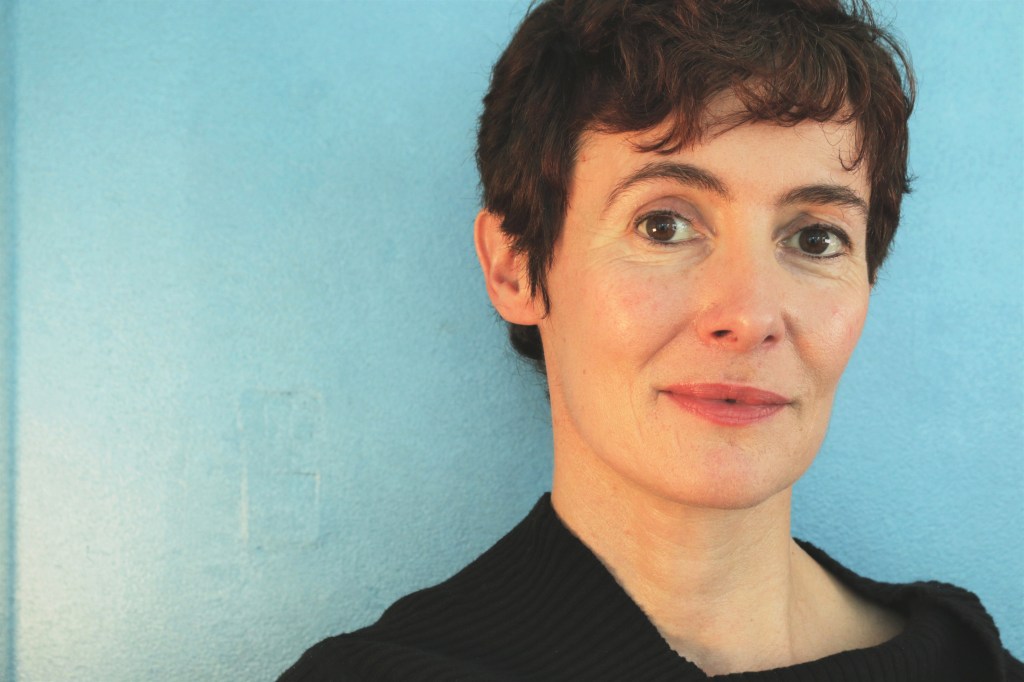
Photograph of Mary O’Donoghue courtesy of The Stinging Fly, July 2023
Thank you to The Stinging Fly for the Advance Copy of The Hour After Happy Hour and to Peter O’Connell Media for introducing me to Mary.
I am delighted to have facilitated a series of creative writing workshops with an amazing group of writers in Kildare Town Library as part of Kildare County Council Brigid 1500 Celebrations.
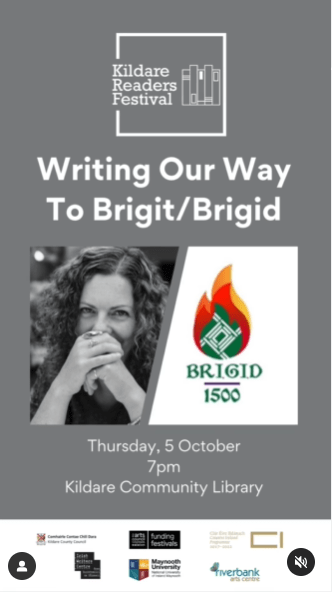
We would love for you to join us for a curated selection of poetry, prose, music and movement on Thursday, 5 October from 7pm.