Writers Chat 75: Anne Tannam on “dismantle” (Salmon Poetry: Clare, 2024)

Cover of “dismantale” by Anne Tannam. Image by Darragh Murphy. Digital collage representing each of the five sections in the collection; child, man, mother, underworld and crone against a black background.

Anne, You are very welcome to my Writers Chat series. We’re here to discuss your latest poetry collection dismantle (Salmon Poetry: Clare, 2024) about which Jessica Traynor described the collection as “an moving excavation of what it means to be a woman in the world today…dismantle is both an exquisite undoing and a call to explore the wide world.” I have to say that I took so long in preparing our chat because every time I returned to dismantle I found a new theme or felt something new. Many congratulations on an outstanding collection of poetry.

SG: Let’s begin with the title dismantle, and the cover image which is so arresting, I had to wait a few days digesting all that it invited in me before opening the book. I loved how elements of the cover image brings us through each section of the collection. Could you comment on the choice of title and cover image?

AT: At a certain point in life it feels right to interrogate the roles we’ve played, to turn our lives upside down and shake them to see what falls out. I wrote this collection at such a juncture; my parents had passed, my children were adults and my body and mind were transforming through the menopause process. A new energy, that of the crone, was emerging and it felt like an invitation (or demand) to dismantle any narrow inherited sense of self I was holding onto, and to revisit past or imagined stages in my life through a fresh lens. The title came after I’d written about half of the poems and it fit my felt sense of what was happening, both archetypally and on a deeply personal level.

The cover was created by an artist, Darragh Murphy, formerly known as my youngest, whose visceral and intuitive approach to art was the perfect foil for the poems. Using the crone as his cornerstone, he worked in digital collage, layering in elements that represented each of the five sections; child, man, mother, underworld and crone. It was a collaborative process and I’m very proud of what we’ve created through image and words. As someone said to me ‘it’s not collection for the fainthearted’, and they’re right!

SG: And that’s what I love about it! It’s a collection that invited me to dive in, immerse herself, and then come out not quite sure how to name what I’d experienced. What remained – after leaving down the collection and letting it simmer – was a rake of emotions. Joy, sadness, grief, hope. Your words were felt in my body, as well, of course, as my intellectual admiration for style and form, both of which we will return to later. For now, though, can you address the connection – if any – between the organisation and order of the poems and the array of emotions that seem to echo the changing and finding of identities?  

AT: Oh, that’s a great question. There is a journey of sorts through each section, a playing out of scenarios, fantasies and memories. The final crone section is a natural end point, a catching up to where I had landed in my life (I’ve since become a grandmother and that’s an another perspective on this life stage). I felt a wide range of emotions writing the collection and each section, like a mini-playlist, evoked its own combination of complex feelings. For me, what gives the collection its emotional cohesion is the crone’s ability to feel the intensity of each emotion and paradoxically, to create compassionate distance from it. She effortlessly holds the tension of opposites and multiple viewpoints. And I’m intentionally writing about the crone as if she wrote the collection. She kind of did. It honestly felt like another voice was speaking through me and my job was to get out her way and let her get on with it.

SG: Oh, it feels with this answer that the crone may come through your words again and I look forward to that! “laid out” is such a beautiful, moving poem that pushes and prods the reader towards discomfort when identity is in question, where the narrator – and reader – grapple with who they are, the possibilities of self, the desires to be all to all but most of all to be careful . For me, it tied in with “deep time” where the narrator stayed below “long enough/to find a way back” and with “preparation for the search” where the narrator is “obedient child” “dutiful mother” “little woman.” Could you talk about the link between the carefulness with which we navigate the world of inner and outer selves and the theme of loss?

AT: It’s fair to say that the preoccupation with being careful is more likely experienced by women than men. It’s changing, but traditionally, women were valued more for being quiet, careful and obedient than for being outspoken in word and deed. ‘laid out’ explores the connection between the role of mother and how much of that experience society or cultural norms demand be kept hidden from view. That’s a loss in itself, never mind the other losses that life inevitably lays at our feet. One of the many joys and responsibilities of writing is to take what’s hidden carefully from view and, without judgement, hold it up to the light. I think the braver we can be in our writing, the braver we can be in our lives. To embrace the crone energy (which, for me, is beyond the confines of gender), is to choose to live openly and without apology in both the inner and outer worlds of the self. No more careful!

SG: Thank you for those words, Anne. I’ll carry them forward – brave in writing/brave in life. dismantle is as much about journeying inside  – finding that “milky silence” (in “one of these days”) – as a turning inside out (or dismantling) so that you can get “out of the world” – while time marches on (“first visitation”) – “ancestral seam unravelling back” (“early days”). Does (or did) the act of writing and putting together this collection stitch a version of you (and all the versions of you) together parallel to a close examination of male and female lineage?

AT: I love that idea of stitching versions of ourselves together. I do feel that the task of my fifties has been to do just that; to gather together all the various parts of who I am, the roles I’ve played, the intergenerational baggage I carry, the roads taken and not taken and stitch them together into a more inclusive and accepting version of myself. Writing dismantle has played a large part in that. It allowed fresh, wider perspectives to emerge which situated who I am into a long, unbroken chain of ancestors hunkered close to the earth.

SG: It seems that the expanse of the body of the world as much as the body of self is felt keenly throughout. “circumnavigation”, the last poem in the collection sums up my  experience:

who knew the world could be this big she says before/ you head off/ across the headland/ taking the long way round”.

It left me with a wonderful sense of hope. Could you talk a little about the hope in dismantle?

AT: I’m very glad to hear that you were left with a sense of hope after reading dismantle. After completing the manuscript, I was left feeling more grounded in a sense of purpose and direction. It echoes what the researcher Brené Brown, in her book ‘Atlas of the Heart’ says: Hope is a function of struggle we develop hope not during the easy or comfortable times, but through adversity and discomfort. What I appreciate most about the crone is her ability to face what’s in front of her and forge a path through, no matter what. It’s a turning towards, as in the final line in the poem “she finds you”, which is the antidote to the earlier a hardening/a shutting down/ a turning away. The crone doesn’t get bogged down in the present moment but sees everything within a wider context. Like in the poem “she rarely gets straight to the point’, Patience,/ she reminds you,/ her hair a tangled nest of twigs and leaves/ all the good stuff takes time’. She’s referring to geological as well as human time. I find that so reassuring.

SG: And so, to the form – your fascinating use of space, font type and style, to create what seems to be meta texts and messages within the individual poems, their dialogue with each other – in how they’re placed within the sections and again within the collection as a whole. I’m thinking here of the section openers “child as”, “man as”, “mother as”, “underworld as”, “crone as” – alongside individual poems such as “wake in the early hours”. How important is form to you in this collection? And, if I may tag another question onto this – did it come before, parallel, or after the themes and narratives emerged?

AT: Form is integral to the collection. From the beginning I wanted it to feel and look different from the previous three. I needed to stretch myself and take risks. It was the first time I’d written to a specific theme and in the second person. One of the first poems I wrote which had a very different energy to it was ‘crone as’. It felt intuitively right to place the poem in the centre of the page and, once freed from the constraints of left-side alignment and traditional punctuation, I could then play with the presentation of the words on the page to create as you call them meta texts and messages within individual poems. The decisions were made with an instinctive logic and I relied on feedback from others to assure me that the choices added to, rather than distracted from the reading experience. I know I am asking a lot of my reader. I hope the experience is worth the additional attention the text demands.

SG: And it’s that additional attention, Anne, that creates the unique dialogue between poet, text and reader. Wonderful stuff! We will end this chat with some short questions:

  1. Dart, train, bus or motorbike?  Motorbike (electric moped, actually!)
  2. Well water, river water or sea water? Sea water
  3. Favourite place in Ireland you discovered on your poetry travels? Impossible to say but the Inishowen Peninsula, a place I’d never visited before was stunning
  4. Quiet or noise when you’re writing? Quiet
  5. What’s the next three books on your reading pile? ‘The Unseen Truth’ (Sarah Lewis), ‘Traces’ (Jackie Lynam) and ‘Time of the Child (Niall Williams)

Thank you, Anne, for your generous and open answers. Readers, you can purchase dismantle here and connect with Anne on her website.
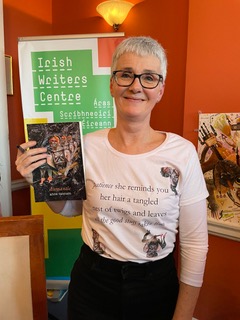
Photograph of Anne Tannam at The Irish Writers Centre for the launch of “dismantle” wearing a white t-shirt with quotes from the collection and holding the book in her right hand. Photograph courtesy of Anne Tannam.

Writers Chat 74: Cauvery Madhavan on “The Inheritance” (Hope Road: London, 2024)

Cauvery, You are very welcome back to my WRITERS CHAT series. Many congratulations on the upcoming September publication of your fourth novel The Inheritance (Hope Road: London, 2024). Your previous novels The Tainted (2020), Paddy Indian (2001) and The Uncoupling (2003) were received with acclaim with Sue Leonard declaring The Uncoupling “a gem of a novel.”

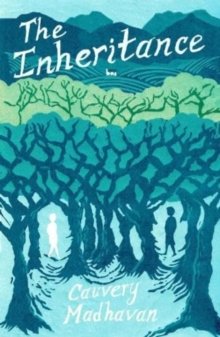
Cover image of The Inheritance showing rows of blue mountains with a white cottage in the middle; below the cottage are layers of green and blue trees in which stand figures of two children, white and blue.

SG: Let’s start with the stunning cover image (shown above) which captures the dual storylines – that of Marlo in 1986 and a child narrator, Coichin, in 1602 – as well one of the main themes running through The Inheritance that creative expression (writing, painting) can provide safe ways to name identity and belonging. Can you talk about the cover image, the design and origin? Did you have input and choice?

CM: I was very lucky to have the same cover designer, James Nunn, who designed the cover for The Tainted, work on the cover for The Inheritance. James read the book and incorporated the physical features of the Beara Penninsula and very cleverly used the two little boys in the story as well. When I saw the design I was so struck with the fact that one of the children was ghostly white and I loved it instantly. My only brief to him had been I wanted a cottage on the cover! So I was really happy at the way he had interpreted the theme of the book. The cover design is hugely influenced by what the sales team think. And as an author you have to trust that they know their business.

SG: Much of The Inheritance explores how the familiar is made strange and how the strange is made familiar through the notion of the outsider – Marlo is brought up in England and moves to rural Cork when he inherits a cottage. Of course, this inheritance is also, as he discovers, as much about identity and home as landscape and place. There’s a lovely scene where Marlo is overcome by the landscape:

He stood for a while letting it soak in then walked to the very large ancient vault, circling it several times, examining the monumental stones placed on top of each other before wandering around the fallen tombs, running his fingers across the weathered slabs, the names and dates ravaged and erased over many centuries. He wondered if he was directly descended from any of the people buried here.

Were these themes important to you as you wrote the novel or did they emerge after you’d written the narrative?

CM: Since I don’t plot my novels more than a page or two ahead as I am writing, I must admit that these themes emerged as I was writing but quite unbeknownst to me. It wasn’t even clear to me till much after I had finished the manuscript, on rereading it and reading the comments from my editor Sue Cook, that I realized landscape and place was so central to the book. I guess that is because I feel that the landscape of Beara is imprinted on my soul and I hardly even knew I was writing about it!

SG: And in a way, that’s what we see in The Inheritance: the landscape of Beara imprinting itself on Marlo’s soul. The dialogue in its unapologetic Hiberno-English stands out and brought out in this reader considerations of language, how we communicate through oral and written words (Marlo), non-verbal language, and through visual art and senses (Sully). Marlo observes, realising how death changes everything:

Imperceptible lifts of the chin and little sideways twitches of the head meant everything when the men had nothing left to say…The women on the other hand were all taking at the same time.

In contrast, Coichin tells us in his narrative – echoing young Sully who also appears mute while also reflecting on how Marlo experiences Beara – “I’ve always been a watcher. What else could you be if you couldn’t speak?” (113).

The Inheritance encouraged me to pause and watch both people and landscape around meCould you comment on listening and watching in The Inheritance?

CM: Such a fantastic question Shauna. It has made me realize that I am actually a proper watcher myself: a watcher-listener of inflections, in the way language is delivered, silently or spoken. When it comes to language and how it is conveyed Beara is the best teacher. In Beara language is not just speech – it’s the tilt of the head, the shrug of shoulder, a kick of a stone. Of course this is a universal thing with languages but in Beara the subtilties are ever so subtle.

As far as landscape is concerned I have never tired and will never tire of observing what Beara has to offer. I find I drive slowly, walk slowly and whether you’re looking at the grand picture of an entire range of mountains or a little micro world of flora and fauna on a stone wall there is so much to observe and absorb. Every season, the time of the day, your own mood at that moment determines and colours what you see.

And Marlo himself, when he is on the bus and out and about on his business I imagine him to be no different. The landscape, and knowing that some of it belongs to him, definitely has a profound effect on him.

SG: Really interesting connecting the mood with what you see. I loved the humour in The Inheritance which comes out in Marlo’s narrative. I particularly liked the blind calf that Marlo looks after. At one stage he asks himself “Of course, I must the only man in the world who needs to feed a blind calf before a first date.”

Without any spoilers, could you talk about the motif of seeing and not seeing/ knowing and not knowing that this blind calf represents – there are a lot of secrets which stem from shame imposed by a judgemental society and church that emerge in the novel.

CM: A friend of mine, who lives at the very tip of the Beara peninsula, had many years ago told me about a blind calf that she had been allowed to keep as a pet when she was a child. For these last 20 years while I planned and plotted this book I was determined to include a blind calf!

I guess sometimes as a writer you project your own aspirations and expectations on to your characters and for me to love Marlo and be invested in his character meant he absolutely had to love animals.

At the at the back of my mind I was of course telling the story of how disability of any kind was looked upon as something that needed to be hidden and how the trauma of that shame affected even the most loving of families. If you look at the character of Dolores she was in her own way disabled by her sheer physical size as it did not conform to what a woman should look like. So nonconformity is itself viewed as a disability.

SG: Alongside these serious and essential themes, The Inheritance is the story of love. Again, without spoilers could you outline your development – as you wrote the various drafts – of Kitty and her relationship to both her son Sully and new-comer Marlo.

CM: I had initially planned that Kitty would be a kind of modern day female druid into the healing arts and shamanic traditions – someone who Marlo would find fascinating! But very quickly her voice made itself quite clear to me: she was a strong, pragmatic woman dealing with grief by losing herself in the upbringing of her son Sully. Her life was one of practical needs, of how to keep going financially and how to sort out help for Sully. She was not looking for a man in her life. I think outside of the narrative in the book she consults John Bosco and asks his opinion of Marlo. I’m quite certain of this! I absolutely loved the way Marlo fell head over heels for her versus Kitty’s reaction – she considers his interest with greater care – her son comes first!

SG: I love how you know what Kitty did outside of the narrative! Finally, Cauvery, some fun questions:

  • Is Beara your favourite part of County Cork? Not just Cork, in all of Ireland.
  • Forest or mountains? Forest
  • Silence or music when writing? Silence
  • Can you name two books you’ve read over the last year that stand out for you? Christ on a Bike by Orla Owen. Ghost Mountain by Ronan Hession.
  • Wonderful choices! Lastly, what are you reading right now? I’m writing my next book and for it I’m reading historian Ramachandra Guha’s India after Gandhi.

Thanks so much, Cauvery, for your generous answers and I wish you much success with The Inheritance which publishes in September 2024.

Photograph of author Cauvery Madhavan in a colourful patterned blouse looking straight at the camera. Photograph by Ger Holland. Photograph used courtesy of author and photographer.

You can order The Inheritance directly from Hope Road Publishing here.

Thank you to Cauvery Madhavan and Hope Road Publishing for the advance copy of The Inheritance.

Writers Chat 73: Maeve McKenna on “Body as a Home for This Darkness” (Book Hub: 2023)

Maeve, Welcome to Writers Chat. We’re going to discuss your poetry pamphlet Body as a Home for This Darkness (Book Hub: 2023) which, although a personal tender and moving homage to your late father, is also a consideration on the passage of time and grief. I might add also a congratulations on being placed as a finalist in the 2023 Gregory O’Donoghue poetry prize!

SG: Firstly, tell me about the title which seems to encompass the entirety of the collection – notions of body, ageing, time, belonging, family, and the darkness of grief. In the process of putting the collection together, where did the title come?

MMcK: Thank you, Shauna, for your kind words. Yes, you are right, Body as a Home for This Darkness encompasses all you say of body, ageing, belonging and family and is also a reflection on the loneliness of loss and grief.  Both are constants in life and yet are something we tend to shy away from. The title of the pamphlet came from a haibun poem I wrote four years before my dad passed away. Dad was no longer the man we once knew yet he became the only man we had left and the title spoke to me of that reality and how dementia strips away the very essence of a person.

Cover of Body as a Home for This Darkness by Maeve McKenna (Photograph provided by Maeve McKenna)

SG: Body as a Home for This Darkness opens with the poem “Him” which introduces us, character-like, to your father. I love your use of lists that paint photographic stills of the man, living, giving, enjoying life until his hands are “grey as putty. In ours.” Could you talk a little about the placement of this poem and its formation?

MMcK: It was important to me during the proof-reading and editing process to begin this book with a memory of my father as the man he was before his diagnosis. Dad was a vital man in our world. He was loved dearly, by his family and friends. He was important to so many. While many poems focus on his later life; ten years in the care home as we lost him slowly, my siblings and I remembered our younger lives and the happiness of those times. Dad was a man of his time, the provider who worked hard and never complained, the one we looked to for advice, the person who made everything ok. The poem ‘Him’ attempts to capture and give the reader an insight into the younger man, the father, the worker and the everyday things that made him who he once was.

SG: And I think it captures all of those things about your dear father. Nature features in your collection, as a harbingers of news. In “Rain knows of Waking”, “Blades of grass are scissors wielding tears”, disturbingly (but accurately), “sadness amputates mind from the thinker” until at the end, “raindrops preen in the reflection of your surrender.” You capture something profound about illness and the loss of control. Do you think that when we’re going through events like this that our powers of observation become more focused on the immediate surrounds, that blades of grass, for instance, take on a deeper meaning and significance, and that in writing these experiences into poetry we are already starting the healing process?

MMcK: Nature features in many of my poems. Something about the temporality of nature, how it comes and goes and regenerates itself year after year, allows me to better understand our human existence. An autumn morning spent in a forest observing the acceptance of an oak tree as it slowly retreats and to return there in spring to watch foliage sprout and burst with colour reminds me of life, the brief time we are here and whilst here there is joy but also challenges that we must accept. I am happiest lost in the woods or strolling along a beach listening, touching and absorbing all the elements around me. Of course to write we must observe keenly, and the image you refer to, ‘blades of grass are scissors wielding tear’ came from an early morning walk in late November near the care home as my father entered the last days of his life. I stopped to watch dew rest on blades of grass and they were tears, mine, but this was the order of nature and the blades of grass bore the weight of the dew with stoicism.

SG: Yes, we can take so much from the order of nature. In the devastating “Leaving”, you capture the solitude of grief, where you get lost on the M50 with your family including

three almost/grown children, tight, really tight…fast asleep

leaving you alone in and with your grief, and leaving you to find your way home. In the title poem, “Body as a Home for This Darkness”, we have more movement, of body, of task, of help as well as dropping back into memory and connection.

Once, you made raspberry jelly when my throat/hurt I’ll ask if I can bring you some…

These poems really stuck with me and I’m curious about your stylistic choice of form. Can you talk about this?

MMcK: Poems often choose their own form. I like to experiment with different forms in second or third drafts. In the case of ‘Leaving’, I felt the form I settled on, a justified block of text, allowed the poem to give the sense of claustrophobia I felt that day driving home from my dad’s funeral. It was in lockdown, we were allowed just ten mourners at the funeral and because of restrictions we had to leave immediately after. The loneliness of that journey home, even though my family were with me in the car, will remain with me forever. Similarly, in ‘Body as a Home for This Darkness’, I wanted the poem to appear solid on the page, that the reader would not be distracted by the format. It is a haibun and I wanted the haiku at the end to convey my dad as a younger, working man, a panel-beater and sprayer, who worked so hard to provide for us.

SG: Thank you for such insight into your process, and your terrible grief. The theme of clothes, how they sit on the body, and how we people are mere movements of clothes is threaded through the collection. I’m thinking here of “Listening for My Dad’s Clothes” and “Three Piece Suit in Rome” which ends with the question so many of us have to ask “Which shirt and tie will we bury him in?” Was this intentional or did this theme emerge when you went to put the collection together?

MMcK: A friend who I share work with pointed this out to me after reading a draft copy of the manuscript. I hadn’t noticed it prior to that. My dad was a dapper man, I never saw him in jeans or a tracksuit! He was neat and tidy and always colour coordinated. Subliminally, this came through in the poems. Many readers have remarked on this and I am glad as this sense of my father always being well-groomed would have delighted him.

SG: That’s lovely – as it also reveals something light and yet shows us the care your dad took not only with his family but himself. There is a nostalgia – through the grief – that your poems also capture, alongside the stark reality of death. For example, the sequence of action in “Breathe” that ends with the heartfelt “What sadness/you taught us to count”, or the visceral “Fortuity” or “Unprotected” where your father’s hands don’t know your hands have released his. In the wonderful “I Want To Go Home”, you capture an almost universal desire that many of us feel at some stage, that we want, not just to go “home”, but that we want to go back to the past, or rather a past without difficult feelings, without loss, without the responsibility of death. Have you – or could you ever? – read these poems aloud? I felt tearful reading them with the rawness. 

MMcK: I’ve read ‘I Want To Go Home’ a few times. It is a long prose poem, but is always well received. Audiences seem to like the detail and many have said how the images in the poem resonate with them. As a Dubliner who moved to rural Ireland many years ago, when I visit now I see the city so vividly while also remembering the Dublin of my childhood. And you are right, the poem is about wanting a time that is gone, however good or bad that time was, before the realities of life as we age emerge. I’ve also read ‘Protected’ many times and it is a favourite poem of mine to read. I haven’t read ‘Fortuity’ or ‘Breathe’, two short poems, but look forward to in the future.

SG: We will end with a few light questions:

  • Coffee or Tea? Tea, but no more than two cups a day. Water mostly.
  • Sea or Mountains? Sea.
  • Longhand or straight typing? Both, I write on the hoof in jotters, and at home on the laptop.
  • Cats or Dogs? Dogs. Our two much-loved dogs, Buddy and Pablo passed away in 2020 and 2022. Both aged 15, they had a great and long life. We miss them still.
  • What are you working on now? I am currently working on my first full collection which will be part of my dissertation for the MA in Poetry I am currently undertaking at Queens University, Belfast. I am also exploring a long poem book. I have an early draft of a ten-page poem I would like to develop into a full book.

Thank you for your generous answers, Maeve and I wish you continued healing and much success in your MA in Poetry. I look forward to reading more of your work – especially the full collection, when it is published.

Readers can purchase Body as a Home for This Darkness (Book Hub: 2023) here.

Photograph of Maeve McKenna wearing a patterned dress and smiling holding up a copy of Body as a Home for This Darkness with numerous copies of the book in the foreground. (Photograph provided by Maeve McKenna)