
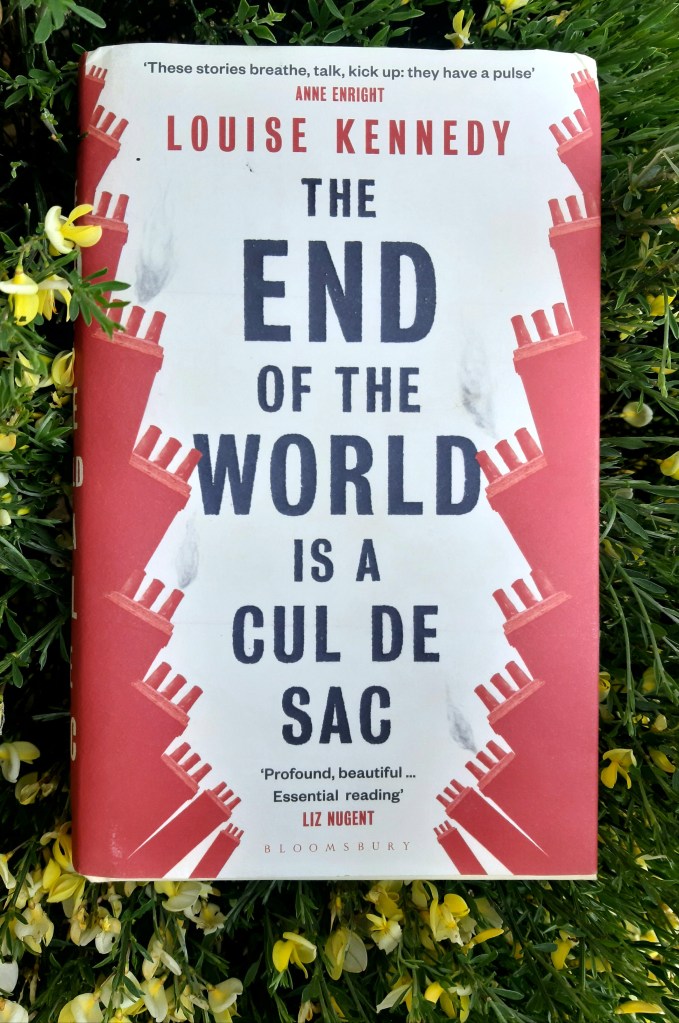
Louise, You’re very welcome to my Writers Chat series where we’re going to chat about your critically acclaimed short story collection The End of the World is a Cul De Sac (Bloomsbury: London, 2021).
You’ve had many accolades about your stories but I particularly like Anne Enright’s description. She says your stories “breath, talk, kick up: they have a pulse.” For me not only do they “ have a pulse” but they sink into your subconscious, and stick with you. It is not surprising that “In Silhouette” and “Sparing the Heather” were shortlisted for the The Sunday Times Audible Short Story Award in 2019 and 2020.
SG: Let’s start with the form of the short story. In an interview with Rosita Boland, you spoke about your path to writing – a night class with a friend. What attracted you or drew you to the form of the short story rather than, let’s say, flash fiction, poetry, or novel?
LK: As I explained in that interview, I joined a writing group almost by accident. At the first meeting it was agreed that each week one of us would submit a short story of roughly 2000 words, although I don’t think I contributed much to the conversation. I suppose the form is a relatively achievable unit of fiction and suits the workshop model of writing groups and creative writing programmes. I was fifth to submit. My story was an attempt at dramatising a family anecdote about the time my grandmother, a teenage wannabe flapper, put Rudolf Valentino’s name on the November dead list in Holy Cross Church in Ardoyne beneath that of her father, who had been killed in World War 1. We managed to stick pretty strictly to that rota, which meant I was producing a new piece of work every few weeks. Within a year I had begun attempting fiction.
I had always read short stories, beginning with Sinéad de Valera’s Irish Fairy Tales, and the Puffin Book of Princesses and as a teenager loved Roald Dahl’s Tales of the Unexpected. I think Exploring English 1, which I enjoyed much more than the novel we were assigned, made me keeping reading them, so in bookshops and libraries I often picked up collections and anthologies. The ones that were important to me in my twenties and thirties were The Way-Paver by Anne Devlin, The Stories of Eva Luna by Isabelle Allende and everything I could get my hands on by Ellen Gilchrist. As readers we take in not just story but craft elements such as structure and tone, so perhaps when I began trying to write my own stories I had a subconscious understanding of how the form works.
For the first few months all my stories were coming in at 2000 words or so, which is the length required by many competitions. A few shortlistings and wins encouraged me to keep going, but I found that some ideas required rather more words and some required fewer. That felt like a departure, letting the stories take the shape and space they needed, learning that each idea required a distinct approach. Much as I love reading poetry I was never inclined to attempt it myself, but attended a class once, out of curiosity. In response to a prompt, everyone else produced a poem and I left with a piece of flash fiction. I am finishing work on a novel and have found the process very different from working in the short form: big machinery is required to keep the story moving. Short stories are tricky wee articles, but I love the precision they demand, the tone that must be found from the first word and held to the end. Written well, they can offer devastating glimpses of how we are in the world and what we do to each other.
SG: I love the sound of that story about your grandmother! I’d agree with what you say about reading – read well/write well. And I like what you say about letting the stories take the shape and space they needed.
In all of these stories, setting is key. In the title story the narrative shifts because of the transient, unsettled nature of the setting: the ghost housing estate, the empty feel of rooms. What is absent is as important as what is present. In the hilarious but poignant “Beyond Carthage”, Noreen and Therese are in the wrong place at the wrong time. How important is setting to you as a writer?
LK: The germ of an idea is often a vague, almost elusive thing. Story only begins to generate for me when I place it somewhere. So yes, setting is hugely important to me. The End of the World is a Cul de Sac is set in the north west, sometimes obviously so, sometimes in a more liminal sense, particularly in the border stories. I suppose my approach to place is always that of a stranger. Until I was twelve, I lived near Belfast. Since then I have lived in various places in Ireland and elsewhere. Maybe this perspective makes me look deeply at where I am. When I go for walks I take photographs of wildflowers and birds and go home and look them up. I read about archaeology, history, mythology. At the time of writing I was not necessarily conscious of what I was doing, but can see now that perhaps these interests added layers. I am interested in the built environment too, the marks that humans have left on landscape. In the north west, this is could be a fairy fort or a ghost estate. Domestic spaces are important to me too: the objects with which we surround ourselves, the food we eat, the way we decorate our homes. I am not confident about giving the reader access to a character’s inner thoughts and perhaps I try to circumvent that by showing how people interact with where they are. It is possible that this is effective in the short story, where economy is everything; each element has to work its arse off.
SG: Thanks for that honesty, Louise, that the story can’t grow for you until you place it somewhere – whether it’s a kitchen, a fairy fort, a ghost estate. Much of your writing is sensory and I love how you pay attention to the details of where each character is at – what they see, where they step, what they hear and so on. For example, in “Sparing The Heather”, Mairead’s foot “bounced off something sleek that made a tight, high sound like a baby’s toy. A crow from an earlier cull, squeaking with maggots.” We don’t see Mairead’s reaction which allows us to react and as disgusting as the image is, it is also thrilling. Can you talk about your use of the senses?
LK: Thank you for saying that image is thrilling. You might be interested to know where it came from. I was once given a pheasant which had been hung for too long. I pressed my hand to its breast and it literally squeaked. In fact, a flurry of blue bottles flew from its dead mouth, a detail I spared the reader when I used it in the story. Lovely, huh?
(SG: Yeah!!)
I sometimes wonder if I have an overdeveloped sensory system. I think part of the reason for this is that in my previous life I was a chef and the kitchen is a highly sensory environment. When we cook we use touch, taste, sight, sound, smell, and it is natural to me to describe these things. I suppose we have a common sense of what is pleasant or unpleasant, so it didn’t occur to me to say how Mairead felt about that sensation, because most of us would find it horrifying; fictional characters should not be so very different from real people. And I think that being human is about how we experience our environment, so for me there is a connection between the senses and place.
SG: Hmm, yes, because we are and exist where we are. Many of the stories in this collection also centre around the complexities of family. I was particularly moved by your tender portrait of the young family in “Brittle Things” and how Dan, the father, is so consumed by self-deception that he can’t see that his young son needs more than the care he’s being so lovingly given by Ciara who, in turn, muses:
The girls asked around Ferdia, never about him…When she talked about him they listened and smiled…It seemed to her that ‘you’re amazing’ meant ‘how do you tolerate your life?’
I think part of the what good writers do is not place judgement or values on their characters and their lives and this is a great example of that. This story strikes me as a study in human behaviour where every person, and not just Ferdia, exists in their own social construction, their own creation of reality. Was family a conscious theme in the collection or did it emerge through your selection of your stories?
LK: We are all part of families, in one way or another, those we grew up in and those we try to make. These are our most important relationships, but can be so fraught. In order to live with people we have to make accomodations every single day, and some of us are better at that than others. Each of us carries the hurt and disappointment of previous failed connections; we are like human velcro, all that pain sticking to us. I think it is hard to move through the world with that burden. I like what you said about each of my characters living in their own social construction. There can be, I think, a particular sort of loneliness in being surrounded by people that is almost exquisite. Ferdia is living in his own world and Ciara is no less lonely, craving connection with her boy and understanding from his father. But although her marriage is under terrible strain, there is still love and loyalty and desire. People are so complex, and I wanted the stories to reflect that.
I tried to approach all the characters with empathy. Even in ‘Imbolc’, in which Liam behaves abominably, it was Elaine who brought the money men into their lives. And far from seeing Stacey Rainey as a seductress, I think she’s just a vulnerable kid who is being used by Liam to exact revenge on both her brother and Elaine. So to answer your question, I didn’t deliberately write about family and relationships, but what else is there?
SG: Yes, I felt so sad for all three – Liam, Elaine and Stacey – trapped in this horrible cycle. Yet the women in your stories, while often trapped by circumstances – place, economics, health – are very much connected to their bodies and their environment. In the wonderfully structured “Gibraltar”, we have this sentence which hit me hard:
Shona looks tired, her pregnant belly only a little fuller than her mother’s distended abdomen.
In “Imbolc” after she discovers one of her worst fears to be true, Elaine is unable to see her feet because the
blue of the fields seemed to drain the air of light…Her feet sank deep in the snow and each step was exhausting. A sob was bulging at the back of her throat.
In “Garland Sunday” a steady, stark study of emotional and physical mending you have such a close and realistic description of Orla’s skincare routine before bed:
Upstairs, she took off her make-up and smeared night cream across her face, over her loose jawline and the rucks between her eyes.
Your use of language, whether it’s strong verbs (drain/bulging/smeared) or precise adjectives is what brings us into the body of the both the story and these women. Can you talk about this?
LK: The language I use is, I guess, plain, although when I’m writing about the natural world I do indulge myself. A bit. And plain words are blunt, which is perhaps powerful. I try to allow myself to write ardently in early drafts and I think in the editing process, which for me is very long, what is left still has some of that energy. I avoid using adverbs and therefore have to rely on verbs to do the heavy lifting; it is vital that these are the right words, so quite a bit of time goes into that. Also, I am working from a few different lexicons: the formal English I have taken in as a reader; the language I heard as a child in the north that is peppered with Ulster Scots; the demotic, a type of Hiberno-English, I suppose, that is used where I live now.
Again, it is also about the precison demanded by the short story form. I am so happy you think the words I chose took you into the body of the stories. Thank you.
I am fascinated with what it is to occupy a female body and all the ways in which it can betray us – lust, fertility, sickness ageing. I think our bodies are wondrous – we can carry life! – but also terrifying. Many of the things that are supposedly natural are actually barbaric, especially many women’s experience of childbirth. And of course the female body has been so objectified that all this is complicated by ideas of beauty. With regard to the language I use, maybe calling things what they are is powerful.
SG: Oh I’d love to talk more about lexicons and even how identity is linked to language. Perhaps for our next chat?
For now, Louise, tell us about the titles of your stories. There wasn’t one in this collection that I didn’t think was exactly the right title for the story. “Hands”, for example, was such a perfect title and created an atmosphere of both disappointment and yearning that it is still with me and I think of that power of our hands and that of parental and filial love.
LK: Thank you, I’m delighted you think the titles are appropriate. Most of them arrived quickly. The title story came from something my sister said when we were children: she asked if the end of the world is a cul de sac. I felt that, for Sarah, Hawthorn Close is the end of the world. ‘Huntergathers’ came to me before I wrote a single word of the story; all I knew was that a man, who fancied himself as being ‘at one’ with nature, was going to kill a hare his partner loved. ‘Once Upon a Pair of Wheels’ is a line from a Paul Simon song, ‘Baby Driver’. I had an image of teenage Aidan behind a steering wheel, and the words ‘once upon’ made it sound like a fucked up fairy tale. In ‘What the Birds Heard’ I like to think that Doireann was having some kind of sensuous awakening of which she was not fully conscious, while the birds and insects were alert to what was happening to her. ‘Belladonna’ is Italian for beautiful woman, but also the name of a poison. I stole ‘Powder’ from Tobias Wolf, although his was about snow. ‘Sparing the Heather’ is from an old Irish saying about meanness; heather is plentiful, so there is no need to be miserable with it. I suppose I hoped they would all operate on a couple of levels. The one I was least sure about was ‘In Silhouette’- it was only ever meant tot be a working title – but it got kind of stuck there and seems to be doing the job. And isn’t ‘silhouette’ a gorgeous word?
SG: And that’s why I felt the titles worked – they all operate on a number of levels both as entry points into the stories and as hooks for us to hold onto when we’ve finished. ‘In Silhouette’ is particularly powerful. We’ll end this Writers Chat, Louise with some short fun questions:
- If you had to pick a favourite story from this collection which story would it be? ‘In Silhouette’ is my favourite. I used the second person point of view for the first time in that story and it is structurally and temporally different from anything I’d tried before. The writing of it also helped me find my way with ‘Sparing the Heather’, so if I had not given myself permission to muck around I would have written neither of them. And in terms of my career it changed my life. Within a year of it being published in The Tangerine, it had got me Eleanor Birne, my brilliant agent, a shortlisting for the Sunday Times Audible Short Story Award and a publishing contract.
- Mountains or sea? I live very near the sea and possibly take it for granted, which I realise is terrible. I love the softer landscapes of lakes and woods, neither of which you gave as options. So maybe mountains?
- I’ll have to expand my options from two to four! So, music or silence when you write, and, if music, what type? I don’t play music as I write, but when I am working on something there is usually a playlist, a sort of sonic mood board. While working on the novel I’ve been listening to Sister Rosetta Thorpe, Horslips, the Bay City Rollers, Ottolie Patterson, Steve Harley and Cockney Rebel. Which probably sounds nuts.
- I listened to Sister Rosetta Thorpe when writing my first novel and she ended up in it! What are you reading now? My tbr pile is a disgrace at the moment, and I honestly don’t know where to start. I’ve recently finished two great books: Easter Rising, by the Irish-American writer Michael Patrick MacDonald, and Deborah Levy’s Real Estate.
Thank you, Louise, for taking part in my Writers Chat Series and for providing us with such considered answers. I wish you much continued success with The End of The World is a Cul de Sac and look forward to your novel.
Hear Louise in conversation on May 13th with Lucy Caldwell at the Seamus Heaney Centre (QUB)
Keep in touch with Louise:
Twitter @KennedyLoulou
Instagram louise.kennedyy



 Shauna Gilligan Writer