Writers Chat 10: Justine Delaney Wilson on “Listen for the Weather” (Hachette: Ireland and Australia, 2018)

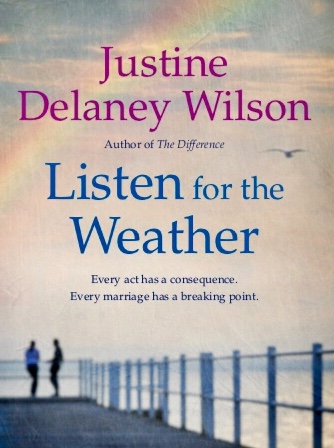
front cover

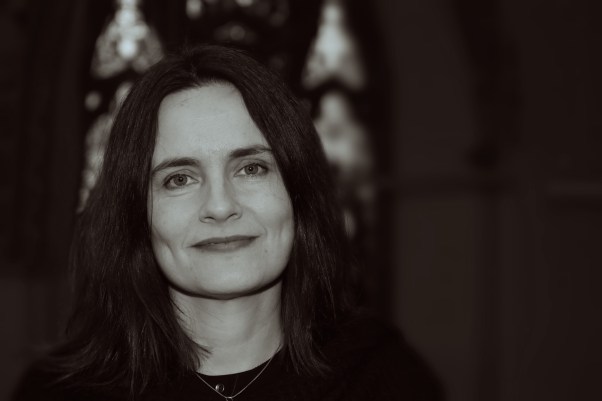
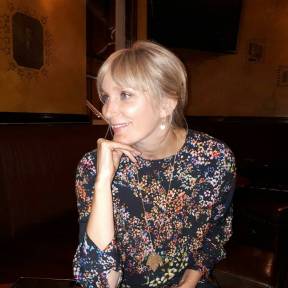
Justine, You are very welcome to WRITERS CHAT. Congratulations on your second novel Listen for the Weather which was launched in May at the wonderful Gutter bookshop in Dublin.
gutter sign

SG: Reading Listen for the Weather I found the voice of the narrator Beth combined with the short scenes really moved the story along and I just kept turning those pages! It was very much pitch and pace perfect. Can you tell us a little about how you picked the voice and the structure through which to tell the story of Beth and Steve’s marriage?

 JDW: Thanks Shauna. That’s really lovely to hear. My writing style tends to be sparse and precise, and my scenes and paragraphs always on the short and punchy side. Sometimes, I’ll make a conscious effort to let a scene breathe a bit more, to really give it some room or extra time, but it will jar with me immediately when I read it back, and I’ll end up putting a red line through everything that I added in the misguided interests of  fleshing things out.

I like to read fiction that doesn’t give me a mountain of background and isn’t heavy on set-up detail; I want to get straight into the heart of things. I appreciate writers who plate-spin throughout the text, allowing me to pick up the observations as I go. I rather fill my cup with the characters’ joy or pain, and with the truth of things. Not with a lot of front-loading about smells or the colour of the curtains.

I enjoy reading short stories for this reason – the writer’s time and space is precious, so everything superfluous has been cut away, and I find the writing is powerful as a result. I don’t know if I’m actually more of a natural editor than a writer really, in that I always want every single word to justify itself. My background is in research and writing for television, and journalism, so perhaps it comes from a learned need to keep things lean and concise for broadcast or for the allotted space.

In terms of writing in Beth’s voice, at this stage I know her character so well that I can second-guess her thoughts and actions in most situations. I understand what motivates her so I find writing in her voice feels natural.

SG: That’s the wonderful advantage of being with a character for so long, isn’t it. You really know their nuances, like a dear friend. Listen for the Weather is set mainly in New Zealand but there are scenes in Ireland. How important is place to love? Tell me about the split setting, one which you have experienced in your own life.

JDW: This book opens in New Zealand, a couple of years after the Rogers family moved there. My previous novel The Difference, which came out this month two years ago, was almost entirely set in Ireland, with the family’s move to New Zealand coming toward the end. Listen for the Weather is a mirror-image of it, in a way. Beth and Steve have moved to the other side of the world to outrun damage to their relationship and to escape the containment of their old lives. But of course, no amount of running, no matter where, will save any of us from ourselves.

Place is important, in that it informs and shapes our identity. And yet, it also isn’t; when faced with a threat to our family and the loss of everyone we love, we see that it is people who are our home.

I left Ireland early in the Autumn of 2016 to go to New Zealand, and I came back in the Spring of last year. I wrote most of this book while I was away, and then I returned home to a familiar place, and to similar weather as when I’d left – But everything just felt off.  It reminded me of the ‘Crowded House’ line; Walking ‘round the room singing stormy weather. I remember hearing Neil Finn interviewed about that song, Weather with You. He talked about how we create our own weather, how we are always making our own situations. I definitely think my feelings of dislocation and of having to make my own environment in New Zealand – a new life, new securities for my children on the other side of the world – informed my writing of this story and my depiction of the characters.

SG: Having lived away from Ireland for many years myself, I can totally understand that strangeness of being in your ‘home’ country and feeling totally out of kilter. I love what you say that it is people who are our home.

Now tell me about the role of the video calls Beth makes to her mother back in Ireland. What a great device to bring us out of Beth’s head, reminding the reader that another world, another past and indeed another present exist. It’s also a reminder that no matter how difficult the circumstances or experience you are going through, the normality of life is always continuing elsewhere. And yet, the normality often hides other depths, as we learn later in the book.

JDW: Through video calls we catch moments of what we’ve left behind, or what has left us. But, like photographs, these calls only show what’s in frame at the time. Sometimes what’s in frame can relieve and sate us, but sometimes it can also mislead.

Beth’s mother, Johanna, has been tethered to her own desperation for much of her adult life and so has only ever been available to Beth in a very limited way. That said, her familiar mannerisms and expressions during these calls do provide her daughter with some comfort when she desperately needs it. Small hints of Johanna’s hard-won insight into the reality of love, which comes much later in the book, are suggested earlier in some of her seemingly throw-away comments over Skype.
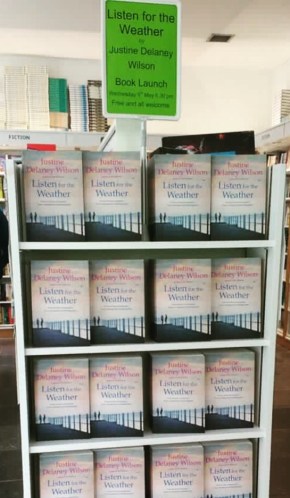
launch shelving

SG: I have to admit my opinion on Johanna changed as the story unfolded, for the very reasons you cite above. Having said that, my favourite character in Listen for the Weather was that of Mae, and how, many times, she is the only one of the family who is grounded in who she is and how she is – she is the solid comforter. For example in the scene when they are driving to the zoo, it’s Mae who asks for Beth’s hand right when Beth needs to be comforted. And in Ireland, it’s Mae who is the touchstone for Beth and her granddad. Really, she is herself, and not trying to fit into a role that society or family has created for her.

 JDW: I’m drawn to write about emotional turbulence – the power-plays in families; the betrayals within relationships; the sense of being at odds with your place in your own domestic world – these ordinary, but difficult, human things. Against this backdrop of adults feeling their way along their own jagged paths stands the character of 7 year-old Mae.

Mae wields a clear and positive power in this book. She manages to love more, but care less. She’s full of empathy – she is the emotional barometer in the house – and yet is nobody’s fool. I think she brings her entire family to life in a way that otherwise might never have happened for them. Mae’s disability allowed me to explore new jealousies in this novel – the uncomfortable envy a mother feels toward a ‘perfect’ child, a little girl who doesn’t have special needs.

Through the innate honesty of her daughter, Beth comes to see and cut through the artifice around her. And it’s from following Mae’s lead that she manages to get her head around what it is she needs to do.

SG: Throughout Beth’s journey, she gives us some beautifully poetic insights into her experience of what love is, or can be – a few of them:

“the heart has a blind spot….isn’t that the human condition? To desire what is not certain.”

 “love chooses not to see, chooses to ignore what doesn’t suit it.”

“The affair is a “tear in the fabric of life.”

“Most of love’s power is how badly it hurts.”

“Love with our eyes open. With the dark colours, as well as the bright.”

Was this a theme that you were always going to write about or did it emerge in the writing of the novel?

JDW:  From the get go, I wanted to look at love in this book. I think everything comes down to love, really. Having it, being denied it, growing up without it, learning to hold onto it, messing it up, confusing it with something else, confusing something else for it, cherishing it.

I’m intrigued by the accepted idea that love is kind, because it isn’t always. The “You are perfect as you are. You complete me” sort of thing doesn’t interest me at all. There’s a laziness in that idea of completion, of having reached some idyll. It’s not the sort of love I want to write about, or even read about. Love is active; it bowls you over, for better and worse. And it keeps pushing you back on yourself, on your own resources, into a space where you think and grow. Beth comes to realise that life is possible for her without Steve, which is the place I needed her to arrive at. Whatever way she goes after that is then a real, eyes-open decision, and not just one based on blind panic or lack of courage.

SG: Yes, I enjoyed being on that journey with Beth, as hard as it was in places, a realisation and a choice based on strength. As you say, a real decision.

Thanks for popping over to participate in my Writers Chat Series and for your generous answers, Justine. To finish off, I’ve five fun questions for you:

Mountains or Sea? The sea, most definitely. The sounds, the constant movement, the tidal changes, the sense of possibility. I had the privilege of living at the ocean in New Zealand and I must say that having half an hour in the evening to walk or sit at the water’s edge is something I’d highly recommend. Mountains are all very well but they don’t hold anything like the same fascination for me. After five minutes, I could probably give or take a mountain, to be honest. I like to be amongst things, amongst possibilities and activity, and I associate mountains with distance and seclusion. A city with a coastline would be my ideal. 

Coffee or tea? Tea. I’m a very committed tea drinker. The kettle in my house is always either on or still warm from the previous cup. I don’t like coffee, which is probably just as well because I’m not the best at things in moderation, and tea seems like the lesser of two charming evils.

Kindle or Paperback? Oh, paperback! I don’t own a kindle and I hope nobody ever buys me one. I like to feel the pages, to turn them, to flick back if I need to, and occasionally I’ll write on them. I love the physicality of books – the cover, the smell. And as décor, there’s surely nothing better than shelving full of well-read books, their spines lined up together. The fact that books don’t need charging is also glorious.

What are you writing now? In the latter stages of every manuscript, I swear that I’ll NEVER do this to myself again. But then the finished book comes out, and I see it in someone’s hands being read, and I quickly forget the pain of its birth. The faucet for the next novel is dripping away in the background here already. It’s called An Open Door and is set in present-day Dublin and 1990s New York.

What’s next on your ‘to read’ pile? My TBR pile was so high recently that I had to split it into a Pile A and a lesser Pile B. I was starting to feel some anxiety at the height of the tower glaring down at me. So on the top of pile A is The Long-Winded Lady, which I’ve already started. It’s a collection of Maeve Brennan’s columns for The New Yorker between 1954 and 1981, recently published by ‘The Stinging Fly’. Below Maeve, and currently in the following order to be read, are; White Houses by Amy Bloom, Problems by Jade Sharma, Norah Hoult’s Cocktail Bar and the just-added Calypso by David Sedaris. I’m dying to read Kudos by Rachel Cusk. She is among my favourite authors and this is the final book in her recent trilogy. I’m waiting for my copy to arrive, and it will rudely jump to the top of Pile A when it does.
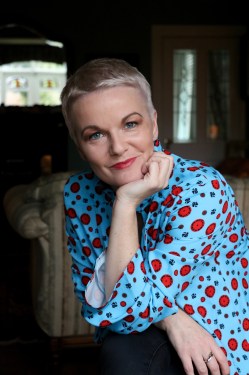
JDW Nov pic 2

Connect with Justine on Twitter @justinedelw and her publishers @hachette

Look out for Justine in the media – articles and interviews coming up in The Irish Times, Daily Mail, Sunday Independent and The Gloss.

Writers Chat 7: Aoibheann McCann on “Marina” (WordsOnTheStreet: Galway, 2018)

Aoibheann, Welcome to my WRITERS CHAT series and thanks for participating so fully.

Congratulations on your debut novel Marina which Mike McCormack has described (and I’d thoroughly agree!) as a “singular enchantment” and which also has a really stunning cover:

wp4a2c4ee8_05_06
Cover of Marina Purchase Direct from Publishers http://www.wordsonthestreet.com/

SG: First and foremost, tell me a little about Marina’s love of the sea.

The story seems to be about a circular journey from childhood to adulthood, and from Ireland to England, yet at another level, Marina seems to be a contemplation on how disconnected we all are from the land – dry and wet ground – that we live on and in.

You’re from Donegal and now living in Galway. Did you use your own knowledge of the sea and its landscape, and also that sense of being away from home (as Marina is in London) in writing this beautiful sensory novel?

AMC: Marina’s love of the sea is a theme throughout the novel, and it has a very strong pull for her. Throughout the novel, she associates the sea with escape, be it by boat or by swimming. Though when she eventually does escape across the Irish Sea, it does not work out so well for her. I think we are all very disconnected from the earth these days and that causes us a lot of problems.

I grew up beside the sea and was brought out on boats from a very young age. My family were mariners for generations so I have a deep generational connection with the sea. Luckily I still live near the sea in Galway and can see it out of my bedroom window. The further I get from the sea the more trapped I feel, but it also utterly scares me, as a lot of my relatives died at sea.

I lived in London for a number of years, my daughter was actually born there, and I although I loved the freedom of it, I always missed the sea and had a strong urge to return to Ireland. Especially when I was pregnant for some reason. I think I actually saw a mirage on a particularly hot day just before she was born!

The sea helped me to write the book too. I was inspired to write Marina in the aquarium in Salthill in Galway. I was looking at a fish in a seawater tank, it looked miserable, and this is where Marina sprang from.

SG: What an amazing image – you by the sea gazing at fish trapped in a tank, both surrounded by seawater…But then there’s all that history and inner knowledge you have about the sea that seeps through the novel. 

I loved the writing throughout In particular, I loved the poetic writing which grabs you right from the start:

“Belonging like they did when I saw them, floating in the sea, the green fronds of seaweed caressing their pale skin. They are nibbled gently, caressed by tiny fish who, bit by bit, ingest them, return them, welcome them.”

It also extends into the stuff of life – we’re told 

“The piano was truly the instrument of fate” 

and, when Jamie is born, he’s

“red and squashed, as if he’d come out of a shell.”

AMC: Thank you! I started off as a poet, in fact the first piece of writing I got published was a poem. Though I rarely write poetry these days, it is still there in my writing. I think the prologue and the intervals are the most poetic parts of the book, where Marina describes the world as she sees it in her very disjointed way. I was inspired to write these parts in my garden and walking by the sea. I think especially at these points I could see ordinary things from Marina’s perspective, and as she seems to be able to zone so completely into things and is so removed from social concerns, she is able to describe things more precisely or more poetically. I think poetry is about seeing things from a very different perspective.

SG: Yes! And now that you say it, that’s really what I loved about Marina – that sense of the word view being turned somewhat. 

I read Marina in one sitting and gasped when I came to the end – without revealing anything – it was like I was in the sea, coming up for air, or that a wave of a life of emotions had just washed over me. For me, this is a great reading experience, when you’re taken somewhere else entirely and then when the book finishes, you’re back to the grey skies (not unlike those of Marina’s life!) and reality. How important a role do you think atmosphere plays in this story – in keeping the reader embedded in the parallel clarity and murkiness of the waters of Marina’s thoughts, compared to Jamie’s thoughts which are shown as been numbed with medication?

AMC: Again, thank you, that’s great feedback for a writer! The first draft of the story didn’t feature the parallel story of Marina in the present, which I think provides the context of her version of the ultimately tragic events and her justification for what happened. It also adds to the atmosphere, as it is clear that her thoughts are murky from the start. Dr. O’Hara provides the clear voice of reason, but can be very harsh. I often think we put labels on people so we can rationalise their actions and there isn’t always a rational explanation for why people behave as they do. We like to think we can explain people’s behaviour by looking at their childhood but I don’t think we can. Of course, Jamie never really gets a voice, so we only have Marina’s (unreliable) version of the events, so we have to take her word for it. So overall I tried to make the atmosphere like the deep water that Marina inhabits in her mind.

SG: Yes. It saddens me how labels often seek answers yet in doing so can move further from those very answers. 

Marina is also about relationships. We have the one which is constant – Marina and her relationship to sea, including being at sea for most of the story – and we have the one which we, as readers, see evolving into something that isn’t quite what we would have hoped for Marina: her love for Jules, the young man she falls for at university in London. It’s really a question of like attracting like rather than opposites attract – especially if we consider that the less they verbally communicate, the less they each play their instruments. Can you talk a little about that relationship – in which Marina, at one stage, feels

“smaller than an ant”

 AMC: I think Marina and Jules’ relationship is ultimately very unhealthy and obsessional. It is further exacerbated by Sandra’s influence. I think Marina tries to find a replacement for Jamie in Jules, but also she feels haunted by what she feels is a betrayal of Jamie so I think she justifies Jules’ cruelty because of this.

Jules and his mother are very controlling. I think Marina feels smothered by this but the further away from the sea and her music she gets, the more trapped she becomes, and it takes something drastic for her to return to Ireland.

SG: We’ve talked about the role of the land in Marina, but of course there’s the wider question of the environment and how we are destroying it. Can you talk about how Jules and his involvement with environmental groups adds to that theme, indeed, perhaps this being the one of the first things that Marina learns about him is also what attracts her to him.

AMC: The environmental theme was always a big part of the book, though it isn’t really part of the plot. I thought about evolution a lot when I was writing the first draft: if we are so evolved as a species, why are we destroying the environment that sustains us? If you consider this, it actually explains Marina’s destructive behaviour and why she ultimately feels humanity isn’t all it is cracked up to be. There is a strand of psychology called eco-psychology which believes that mental illnesses are caused by environmental damage; if the earth is being destroyed, then we inevitably will be too. As it suffers, so do we. Also, I thought a lot about the Buddhist Wheel of Life, which shows evolution in the form of reincarnation; the more good deeds we do, the more likely we are to ‘evolve’ into a higher life form. Again, I thought, are we really a higher life form if we are destroying ourselves like this?

As for eco-warriors, I hung around with some at college, and they were always so sure of themselves and what they were doing. Jules’ character and especially those of his friends are inspired by them. My life experience is in no way like Marina’s, but I was asked to stop eating a Kit Kat in my own house by an eco-warrior! I think Marina is so lost and scared, she latches on to Jules as he seems so sure of everything, as do his friends. They see something wrong in the world too, and are better able to articulate this than she is.

Yes – these are all questions that I asked myself as I was reading and, more so, when I’d finished the novel, and, found myself understanding Marina’s behaviour.

Lastly, Five fun questions, Aoibheann:

Dogs or Cats? Dogs. I have two!

  1. Paperbacks or Hardbacks? Paperbacks.
  2. What page are you on of the book you’re reading now? 89 of Echoland by Per Petterson
  3. Describe the story in one word? Childhood
  4. What’s next on your ‘to read’ pile? The Invisible Ones by Steph Penny

Thank you for such insight, Aoibheann and I wish you much success with Marina. 

IMG_9127.JPGTY

 You can keep up to date with Aoibheann (above) on her website.

LAUNCHING MARINA

Little John Nee will launch Marina in the Town Hall Theatre, Galway on 19th April 2018.

Listen to Aoibheann reading from Marina in Athenry Library on 10th May.


Writers Chat 6: Lisa Harding on “Harvesting” (New Island: Dublin, 2017)

Lisa, Welcome to “Writers Chat” and congratulations on the much-deserved accolades Harvesting (New Island, 2017) has been receiving, including being awarded The Kate O’Brien Award (2018), short listed in the Newcomer section for Irish Book of the Year in 2017 and now shortlisted for the Kerry Group Irish Novel of the Year Award (winners announced on May 30th in Listowel)

HARVESTINGbook pic

SG: Firstly, Lisa, let’s talk about the many stories behind Harvesting and what drove you to take on such a harrowing and emotional journey with your two strong female narrators Sammy and Nico.

LH: The book came about because of my involvement in a campaign called Stop Sex Trafficking of Children and Young People run by the children’s Rights Alliance and the Body Shop. At the launch of that campaign in 2012, I was invited in my capacity as an actress to read first-hand accounts of some of the girls who had been trafficked to Ireland. What shocked me was how prevalent the trade is, how young some of the girls are and also that some of the girls that fall into the rings are Irish. Up until that day I had no idea this trade was happening on our shores.

It took me three years before I allowed myself to start to write about the topic. I struggled with legitimacy around telling these stories: who am I to give voice to these girls’ experiences? I am not an expert, nor a survivor, but something had burrowed inside me and I genuinely felt haunted by the testimonies I read that day. I found myself unable and unwilling to forget, and so set out to give voice to these hidden victims of this dark, flourishing world.

Sammy and Nico, although purely fictitious character, are composites of some of the personal accounts I was furnished with.

SG: I think that is why both women come across as such authentic characters. Now tell me about your process – in getting into the psyches of these women, in being able to so aptly explore their inner and outer worlds. Did you find that your experience in play writing and acting helped? I’m thinking of scenes, for example, where Sammy says “I empty out inside and allow myself to go floppy” (p.209) or Nico when she reminds herself before she takes the man’s stray hairs: “If I don’t breathe I’m not really there, not really.” (p.213)

LH: I adopt an improvisational approach to any creative process, which is greatly informed by my training as an actress.  I always start with a voice, and if I feel I can channel that voice, step inside the character’s skin, fully embody it, the writing will flow naturally from there.  Initially I didn’t know Harvesting would be a novel, the form was mutable as I was allowing different voices space inside my head. It could have been a play, or a series of interconnected short stories, but over time two voices start to clamour for more attention and space on the page. The consciousness of Sammy and Nico felt more alive and embodied than any of the other characters. The novel is in essence a series of alternating monologues told from the perspective of an Irish girl and a Moldovan girl.

As Harvesting is written in the first person present tense, everything that happens to these girls is being experienced and written about in the moment. The process of writing in this way is rather like channelling, where you bypass the conscious mind, or the intellect as much as possible and give yourself over to your instinct.

SG: Oh how wonderful that you felt free enough to let the narrative evolve and become the form it needed to become to tell the story. Lisa, let’s consider the role of place in Sammy’s Dublin is both her anchor and the city which fails to save her, while Nico’s Moldova fades as Dublin – what she is exposed to as ‘Dub’ – engulfs her. It seems Sammy and Nico both loose who they are and where they’re from simultaneously.

LH: That’s a really interesting observation, and not one I was consciously aware of at the time of writing. For Nico, the natural world was her home, growing up in a rural Moldovan village where her favourite activities were climbing trees and swimming in the rivers. Suddenly she is wrenched from this environment, the only world she ever knew, and is transported in cars, boats and planes from Moldova to Italy to London to Belfast, then finally Dublin. She is disoriented and dislocated early on. She regularly reverts to her favourite childhood spots in the moment of trauma where she dissociates from herself and her actual environment. I imagined her focus was slightly blurred in a bid to protect herself and so Dublin is experienced as a characterless place that could be anywhere. She only sees the inside of the holding house and the inside of a car and the inside of bedrooms. She yearns for nature yet has no direct contact; all she sees through fogged up windows is grey skies and rain.

Sammy is a suburban Dublin girl, so her environment is less alien, but her experience is. They are both brought to a ghost estate and their life of entrapment is played out against the backdrop of private parties, convention centres, bars, hotels. I felt if I was looking out on their world in their particular emotional state it would be heightened, bizarre, terrifying. Even those environments that were previously familiar take on an outlandish, almost ghoulish quality.

SG: Without revealing anything, Sammy and Nico start off and end in very different places. Between their beginnings and endings in their relationship we encounter moving tenderness, humorous quips while they each try to protect and provide some sort of comfort – and even love – each other.

LH: My two main motivators for writing this book were: (1) How can this happen? And (2) how do the girls survive and assimilate this sustained level of abuse? This second question feeds into your observation about their relationship, which is intense, at times verging on the hysterical. They are teenage girls who form a fierce bond under siege. I fell in love with the two girls as they navigated an unlikely friendship that becomes their everything. In each other they find humanity in a brutal, uncaring world. I was surprised how both girls use humour to deflect, protect and ultimately bond. But then, I realised they are so young and so impressionable and they need that ferocious love and loyalty to survive.

SG: I love how, at times, your writing is stark – factual almost – and then, also beautifully poetic. Nico describes the pain of two sisters as “palpable – it beats in the air like injured birds, trapped” (p236) and in another scene “I squint and blur my vision, but cannot see a rescuing knight no matter how hard I try.” (p281)

Sammy, locked inside on a day that seems particularly long tries

“not to listen to the bird-song, which I can hear over the wind and thrum of the tumble dryer. She’s so loud and insistent for such a tiny thing. I know, I know, I get it, birdie, but shut the fuck up, will ya?” (p242)

Do you think using different styles and language to convey changes in emotional tempo shows us that in the most awful of circumstances there is often – though unfortunately, not always – a glimmer of hope?

LH: That’s a really lovely compliment, thank you! Again, an unconscious lucky accident,  although I imagine my history in theatre fed into that melding of styles. Writers like Tennessee Williams, and in a completely contrasting way Sarah Kane, bring poetry, lyricism and a heightened sensibility to experiences of brutality. The lives Sammy and Nico are living are so far removed from the norms of the everyday that I felt colloquial language couldn’t always express their complex interior lives. They are so outside themselves and unable to process what is happening to them in the moment that I did struggle at times to find words to express this turmoil. Music could perhaps better express this turbulent inner landscape of trauma. I guess in some ways, heightened theatrical or poetic language can offer a kind of transformation, or transmutation, so perhaps unconsciously this was what I was playing with.

Yes, hope. I felt the fact of them being alive and capable of loving each other meant there was always hope.

SG: You participated and read from Harvesting as part of a symposium on modern slavery in Armagh on March 8th. How powerful do you think writing can be in today’s world where brevity is king?

LH: That was an extraordinary event. It was humbling to realise the importance of the role of the arts in raising awareness. The organiser of the symposium had come across Harvesting some time ago and was moved to organise an entire event on modern slavery because of his experience reading the book. So, I guess we cannot underestimate the effect of writing, even in such a time-poor, social-media saturated climate where Netflix is king. I imagine a visual medium might have even more impact, but then we lose the intimacy and interiority that only the novel allows.

SG: I think the key is that the novel form encourages or even demands self-reflection from the reader after it’s been read – in a way that other forms don’t.

Lastly, Lisa, some fun questions:

What are you reading now? Troubling Love by Elena Ferrante.

I read that over Christmas – in one sitting – and really loved it. Both disturbing and beautiful.

What’s your go-to dinner? Stir-fry with veggies. I’m a terrible cook!

Well stir-fry sounds delicious!

What writing are you working on? A new novel about the generational impact of alcoholism and the limitations of recovery.

Oh, the limitations of recovery. I’m intrigued.

What’s next for you? The above novel, and then…hopefully others. I’m a newbie in love with the form.

Sounds like you’re on a roll, Lisa. Keep on going!

Launch pic

Thanks again for popping over for the sixth “Writers Chat”. I look forward to reading more of your work over time and wish you more of the very best with Harvesting which can be ordered here.