Writers Chat 52: Sara Baume on “seven steeples” (Tramp Press: Dublin, 2022)

Sara, You are very welcome to my WRITERS CHAT series. Congratulations on seven steeples (Tramp Press: Dublin, 2022). I loved the cumulative effect of this novel which felt – to me – like being swept away in a fugue of calm.

Photograph of the cover of seven steeples showing mountains with a blue sky in the background and symmetrical textile work on a grey wall in the foreground. Photograph provided by the author and used with kind permission from Tramp Press.

SG: Let’s start with the reading experience as I said above, reading seven steeples felt like being swept away into Bell and Sigh’s world and returning to my own world with new eyes, and a little less harried, even transformed. Since finishing the novel I’ve found myself paying more attention to the things that surround me, the purpose they serve, and considering how the space of our world can be as small or as broad as we need them to be. Can you talk a little about your intention with this novel – and what impact and effect you thought or hoped it might have on the reader?

SB: My intention, when I set out to write this novel, was the same as with every other book I’ve written – to catalogue a place and time and set of experiences that will not last forever. At the very beginning there was just a single road – the same one I walk every morning. Over the course of a year I took down notes every time I arrived home from my walk, little observations relating to how much – and how little – the road changed with the seasons. The novel finally grew out of those notes. I honestly didn’t think too much about what the reading experience might be. I was hoping people would find points of contact, details that struck a chord.

SG: And indeed there are many points of contacts and details that resonate. The prose – as all your writing (I really savoured handiwork ) is exquisite – I love the rhythm and pacing of seven steeples and in some way as I came to the end of the novel the symmetry of chapter lengths, the use of the number seven and the two dogs all felt soothing. It was as if you’d brought me through Vivaldi’s Four Seasons.

“September was carried out on a week of bad weather”

“October mornings peeled the night cloud back to its subcutaneous lilac tissue.”

In composing the novel – and given you’re an artist – was symmetry and balance important to you, more, let us say, than plot or characterisation might be in a more traditional novel?

SB: Yes, certainly. It is, by my definition, an allegorical novel – driven by symbols and patterns as opposed to characters or plot. It is about the ritualisation of ordinary, secular life but there is also something very ritualistic about how it was written and is structured. Having said that, I never wanted it to be obscure. I always hoped that people would find some kind of kinship with Bell and Sigh (the protagonists) and their world, and be compelled to keep reading.

SG: One of the themes that stuck with me – as I was compelled to keep reading – was that of the ritual of journey. We have  the donkey, crows, cows, bullocks, seals, the journeys that Bell and Sigh make both within the house and in the surrounds; journeys that decrease in length and number with time.

“All four together…they arrived at the same places they always went.”

“They walked the way they always walked.”

Often narratives are about journey but with seven steeples you break the mould of a traditional novel that perhaps relies on a journey from one point to another and here the journey the people and animals make is for and of itself, attached to the landscape, following the seasons – and bound by time and overseen by the mountain, unclimbed.

“The years that it remained unclimbed piled up around them like their old clothes.”

Eventually, it seemed to me that their journeys contracted (“they made their long journeys on the internet”) in tandem with the growth in appreciation of the space around them. Have you any thoughts on this?

SB: That made me think again of bird migration – something I wrote about in handiwork. We all know what it means in relation to, say, swallows – who travel a long, long way from western Europe to sub-Saharan Africa and back again, but something I learned when I was researching for my last book was that some birds make very small migrations – moving just to a different part of the country – and many resident species, such as the skylark, have different spots for wintering and then for breeding. I guess what I’m saying is that we all make these tiny migrations all the time and they have always interested me infinitely more that the epic ones.

SG: The notion that we all make tiny migrations is fascinating, Sara. It seems to me that seven steeples is an exploration in mindful and harmonious living – in (literal) being – human, animal, land with the all-seeing mountain. It holds something of the pandemic entrapment but in a very positive and esoteric way. I know you’ve said in previous interviews (for example, The Irish Times) that much of your life goes into your writing. Does this reader’s experience echo your own experience of life writing the novel?

SB: It’s really interesting that you think it is so positive, and so soothing. Some people have read it as ominous and, in fact, I wanted the end to be dark, and everything else is more or less building toward the dark end. Lots of the descriptions come directly from my own life, but there’s also a lot in there that has been invented. It has been sometimes unsettling, to be honest, to hear people responding to it, though at other times enlightening. Apparently I am eccentric.

SG: Well, the different reactions maybe are about what we as readers bring to the novel, though there was an underlying darkness, I found comfort in being reminded to open my eyes! I really enjoyed the portrayal of the relationship between Bell and Sigh, their abbreviated names, for me, was the start of uncovering how they shake off the external world and begin to discover themselves, each other, what matters, what is left when the superfluous is discarded. I particularly liked your exploration of their speech – how they

“had been thoroughly infected by each others way of speaking…by their seventh year, they spoke in a dialect of their own unconscious creation. They sighed in synchronicity.”

It struck me that this a novel which explores the growth and expansion of a relationship over seven years, in a way that echoes what Marion Milner is doing in A Life of Ones Own when she explores – through introspective journaling – what happiness means to her over a period of seven years. Are you familiar with her work or do you have any thoughts on this?

SB: No! I’ll look it up. It sounds like a fascinating experiment. Though I think it would probably only drive me insane if I had to write it myself. I need the escape of fiction. The Living Mountain by Nan Shepherd was on my mind while I was writing Seven Steeples, and Fair Play by Tove Jansson.

SG:  I need to look up those two books now! Lastly, Sara, similarly to handiwork, seven steeples is also an examination of the artistic process of living – a living artist – growth shown through every day routines that transform into rituals. I particularly loved how Bell and Sigh decided to have ‘house time’ whereby they didn’t change the clocks – this was also echoed in their experience of time marked by religious festivals whereby when they go to the village or to towns they see markers of these festivals – e.g. palms at Easter and they are almost strangers in this world. In a way, this is what seven steeples does – makes what is familiar in the world seem strange (or new) to the reader – to paraphrase Shklovsky, this novel showed me the sensation of life, made me feel and see the stone as stony again. Do you think it is an important role of art in society, to help people see the world with fresh eyes?

SB: Yes, certainly. You know that detail about ‘house time’ I actually stole from something I heard on the radio. They were taking about the possibility of scrapping daylight savings time and somebody texted in to say that she and her husband scrapped it years ago and function on ‘inside time’ and ‘outside time’ and I thought, of course, ‘that’s gold!’ and put it in the novel. But in a broader sense it’s something that’s been on my mind my whole adult life. I was raised Roman Catholic and abandoned it as a teenager and nowadays – the older I get – the more I miss all of those observances and ceremonies and the sense of belonging that came from being a part of a religious community. More than anything else the novel is about how to recreate that in the absence of organised religion.  

SG: It goes back to the importance of ritual again. So, to finish our chat, Sara, some fun questions

  • Tea or Coffee?  Coffee absolutely. I hardly ever drink tea tea. Most of all I soak mint leaves in boiling water and drink that – a lazy person’s mint tea.
  • Beach or Mountains?  That’s such an appropriate question for this novel! Preferably both, as in the novel, but if I absolutely had to pick it would always be the sea.
  • Yes! First draft handwritten or typed? Handwritten. Then I type it up without looking back at the handwritten draft. Completely bonkers but it works for me.
  • What’s next on your reading pile? I Never Promised You a Rose Garden by Joanne Greenberg, originally published in 1964 but reissued just recently.

Thanks, Sara, for such insight into your process and some intentions on writing this novel.

Buy seven steeples here.

Photograph of Sara Baume wearing a red beret, green earrings and denim shirt. Photogrpah provided by author and used with kind permission of the photographer Kenneth O’Halloran

With thanks to Tramp Press and Peter O’Connell Media for the advance copy of seven steeples.

Arts Act Award 2022

I am delighted to announce that I have been granted an Arts Act Award 2022 to continue on my Brigid journey. I am working on a novel-length manuscript The B Cuts, interlinked fictionalised stories of Brigid from the 5th Century to the 23rd Century.

I am looking forward to diving into further research with the Brigidine archives, the archives of the National Library of Ireland and travelling around Ireland to sites associated with Brigid. And, of course, I am dying to get stuck into more writing!

I am most grateful to Kildare County Council for continuing to support my writing practice.

Logo of Kildare County Council


Writers Chat 49: Eamon Somers on “Dolly Considine’s Hotel” (Unbound: London, 2021)

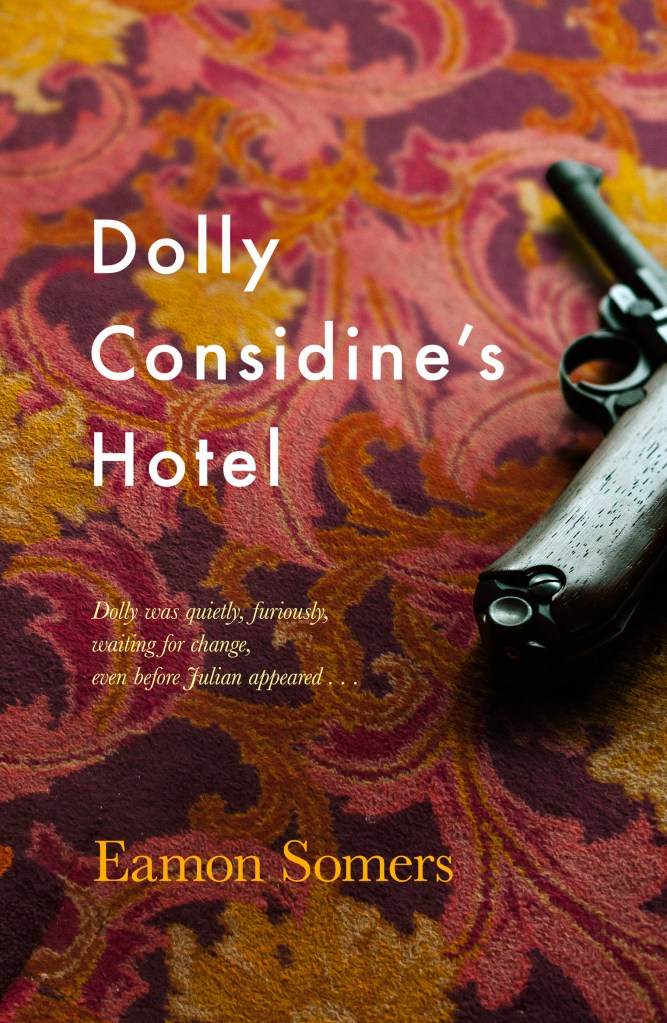
Cover image of Dolly Considine’s Hotel by Eamon Somers – colourful carpet with a black pistol on the floor

Eamon, You are very welcome to my WRITERS CHAT series. Congratulations on Dolly Considine’s Hotel which was published by Unbound in 2021. I must thank you for taking the time to do a reading as part of this WRITERS CHAT – readers, you’ll find the reading mid-way through this chat so treat it like an interval!

SG: Before we get into the details of the characters, history, politics and love in Dolly Considine’s Hotel, I was struck by the honesty with which you describe the writing journey and path to publication. I think it’s very refreshing. Can you talk a little about this and your experience with Unbound and may I, in the same breath, comment on the perfect cover. I just love that patterned carpet and the revolver. It captures so much of what the novel is about.

ES: Hi Shauna, it’s an absolute pleasure and a privilege to be invited onto your famous writers chat. Let me start with the cover which was designed by book designers Mecob and has received a lot of praise. I tracked down the patterned carpet photo on Shutterstock, it was taken by Irish photographer Julie A Lynch and she called it “creepy old hotel in ireland carpet”. If anyone knows Julie, please pass on my gratitude to her for such a great image.

I submitted an earlier novel to over 100 agents and publishers. One agent was interested, and we worked for months to get it ready to send out. But without success. He told me to put that novel in my bottom drawer and to write another. I resurrected something I had previously worked on, and Dolly was born. But by the time I had an acceptable draft, the agent had moved on, and I started the submission business again. Eventually, just as I was about to give up and self-publish, Unbound said ”yes”.   

Unbound operates like a traditional publisher, except that their financial model requires publication costs to be raised through a crowdfunding campaign, run by the author on the Unbound website. That was hard work, but very rewarding especially because it introduced me to the world of promotion via social media. With so many books being published it appears that unknown and debut novelists have little chance of finding readers (and as, importantly, reviews) unless they embrace the world of Twitter and Instagram.  

SG: Yes, these days as well as writing the novel writers are expected to promote their work across multiple social media platforms – hard work when you need to be writing! But now let’s talk about the structure of Dolly Considine’s Hotel. There’s a split timeline for most of the book – between 1950s and 1980s – and it’s through the two stories, running along almost like parallel tracks that we come to understand the significance of the Dolly’s hotel as the main character. Coupled with the wonderful chapter titles (for example, “No Time To Be Squeamish”, “Julian Remembers the smell of chocolate that encircled the Cadbury girls”, “A visit to the theatre”) and the short, snappy chapters, the novel is a surprisingly fast read at over 500 pages. Did the structure play as important a part in writing as it does in the reading experience?

ES: I didn’t start out to write anything complex. I wanted to set the story in a version of an hotel I had briefly worked in when I was in my early twenties. And because I was very disillusioned with Ireland after the pro-life referendum was passed and the possibility of divorce was rejected, I wanted to portray life in the early ‘80s. I admit to wanting to write something a bit different from the usual linear story: hero/heroine overcoming obstacles to find themselves or love. More importantly I wanted to play with readers, to upset their trust a little, hint at unspoken complexities, cast doubt on the certainties they expected, give them shaky ground, like a fairground ride. At the time of writing, experimental writers were beginning to play with multimedia things and to give readers some power to control the story. But that wasn’t for me, instead I tried to give entertaining variety from which readers could choose what to believe and what to just laugh at. This may not answer your question, but the hotel building has been around for two hundred years, and I wanted to share the histories that made it the complex entity that it is today. History doesn’t happen overnight; it is built up and built upon over many years. Ghosts have to come from somewhere. And Dolly has lived/is living through periods. She chose her path (or it chose her) in the ‘50s, when she moved into the hotel, taking with her own family’s history.

SG: I found there was a lot to laugh, disbelieve, and wonder… but alongside this playing with the reader, one of the main themes is that of identity and gender; the names we call each other, the names we call ourselves, the limitations and expectations of society and of ourselves. Dolly’s hotel is a type of refuge for those who want to step outside the norms of 1950s/1980s Ireland. And of course, Dolly Considine – and through the hotel – plays with notions of power and politics, from her seduction of GI and Cathal, to her hold over the staff. Can you talk about Dolly, identity and gender?

ES: Identity is very important to me. I was married at 22 and was the father of two children by the time I found out/acknowledged I was gay and my marriage broke up. Often when I meet new people it is the fact that I have children that emerges rather than the fact that for nearly forty years I have lived in a committed relationship with another man. So (as a committed zealot) I feel obliged to correct any assumptions.  Less frequently, but equally, I feel obliged not to deny my children when I make new gay friends. This is who I am, as is my Irishness, and my confused class heritage.

If Dolly or other characters defy expectations, then I am pleased. The female characters perhaps try to control their environments, but I think they have to reduce their expectations, so they are in line with what is possible. And although it was Julian that was the inspiration, I had wanted more for Dolly than she got. So, in that sense I let her down and allowed the lion’s share of attention go to the male protagonist.

SG: And to be honest that is probably why I picked her out for that question! I wanted more for her too!

I loved how the meta-narrative of the novel that Julian is writing – “The Summer of Unrequited Love” – evolves with the main narrative (that of the hotel) in such a way that we have trouble distinguishing between the action in Julian’s notebooks and those in the hotel, just as Julian himself does. At one stage, “It had only been seven or eight hours, but his fingers were twitching as if they’d never hold a pen again.” And, for example, we’re in a scene in which Julian’s lover, Bláthín, has had most of the wine:

‘The wine was gone. She’d had the most of it.’ He whispered the words to fix them in his head. It would be a springboard line for his journal. He leaned into the low table to search for blank paper she wouldn’t miss; even his own mother kept scraps for shopping lists. His pen already in his hand, twisting like a divining rod tuned to blank paper.

How important to you were these parallel stories which reflect and talk to each other to what you wanted to say through the novel about the acts of perceiving, recording, and writing?

ES:  The parallel stories confront the reader with a messy, erotic, unashamed version of Ireland. In the extract you choose, Julian is writing his fictional Summer of Unrequited Love, while also participating in the real-life events of Dolly Considine’s Hotel.

Julian is a young idealist, and a “real” artist, ready to “suffer” for his art. But equally there is the serious work of how a writer portrays their characters. Which aspects of their behaviour will best represent them? Julian wants only meaningful characteristics, the ones (perhaps just one) that will resonate instantly with his readers; he wants to ignore those that merely pad out the portrait.

But Josie’s story, Sylvia’s story, Dolly’s father’s story, Brendan’s story all explore, and as you say, talk to the main and ostensibly more reliable/truthful narrative, and hopefully in their own way, produce a more meaningful truth and deeper feelings in the mind of the reader.

Eamon reads two short extracts featuring Dolly and Julian

(total time: 4 mins, 10 seconds)

Eamon Somers reading two short extracts which focus on Dolly and Julian

SG: Thank you for such a wonderful reading, Eamon. So, following on from that reading, we can say that much of Dolly Considine’s Hotel examines bodies and terminations – ideological, political, literary – through acting and enacting, writing and reading, interpreting and imagining. It’s a slow build – starting with Mikhail Mayakovsky/ the Mother Ireland scene and returning to it later – and continuing with the series of “Terminations” in Julian’s notebook – whilst following the adventures of Julian’s body in the hotel and beyond. I also couldn’t help feeling that the side exploration of urban/rural – for example, when Bláthín tells Julian in Cavan to “listen to the babies…you can’t come down here and trample anywhere you like. You have to respect the established order.” – also echoed this theme of bodies. I thought it was an interesting way to explore choice. Can you comment on this?

ES: Although it is not foregrounded except perhaps in Cathal’s naming, and Julian’s frustration at not understanding the history of the state’s inception, I was conscious of the civil war all the time I was writing the book. As a nationalism sceptic I don’t want to big up too much the “idealism” of 1916 and the war of independence, but for me the civil war marked the termination of those aspirations embodied in the Irish Literary Renaissance of the 19th century, and which were then fetishised and mythologised in the new state. Mother Ireland and her pregnancy reminds us of the loss of idealism and choice that the pro-life victory represents. Many of us who grew up in cities (but especially Dublin) under Eamonn De Valera and Bishop John Charles McQuaid were made to feel that the authentic Irish lived in the country. Dubliners are Jackeens, they took the king’s shilling, they were not to be trusted. Bláthín has absorbed the myths and is retelling them in her radio work, but she also recognises that Julian might have his own working class inner-city naive truth.

SG: Yes, of course, there’s the theme and voice of class running through the novel too. Now, we’ve discussed some of the themes and narratives but I can’t leave this Writers Chat without mentioning the humour and the chance encounter (or was it a chance!?) between Paddy/ Julian and the mysterious Malone in Busárus that sets Julian on the road to Dolly’s hotel. You really capture that era (1983), one in which the world outside Ireland was full of possibilities but an Ireland which was closed in on itself in every way (economically, sexually and so on). Can you talk about the genesis of this beginning?

ES: The people of Ireland’s 26 counties often get criticised for ignoring and/or completely misunderstanding what life is like for people who live in the North of Ireland. I wanted to play with the complexities and to allow Julian to have what he considered to be reasonable (but were often conspiratorial) interpretations for the things he witnessed/imagined about Malone, and about Dolly and GI – viz the safe house. But I also wanted a cross border romantic interest, even if the erotic only went as far as Julian wearing Malone’s pants and underwear.

SG: And speaking of pants and underwear, the erotic – particularly, male – is key to the novel and yet is not the only theme that defines it. How would you categorise Dolly Considine’s Hotel – if it can be categorised or boxed?

ES: I think of Dolly Considine’s Hotel as a post-gay novel, a book where the issue of sexuality is taken for granted.  This doesn’t make characters nicer or less nice or even more worked out, but their sexuality is just a fact, like their eye colour. Recent years have seen a market opening up for gay fiction across all genres, however in my writing I seem to have been regarded as either too gay for mainstream publishers or not gay enough for niche publishers.  And although it was not my intention when writing the book, I’d love to think that Dolly can bridge that divide.

SG: To finish up, Eamon, some fun questions

  • Countryside or city? Except for three months when I was eleven (on a Gael Linn scholarship in Connemara) I have always lived in cities. Like many city dwellers I secretly think I would love the countryside, but in reality, suspect I will always prefer to visit rather than live there.
  • Tea or Coffee?  I am definitely a coffee person. But have very little time for fussy machinery, or coffee shops, and except for weekends, will settle for instant. I switch to decaf at noon.
  • Bus or train?  I love trains, especially for long journeys. But in the city I like buses, so much better for linking London’s villages. And during covid, somehow safer than the underground.
  • First draft handwritten or typed? Typed, onto my old Amstrad in 1998, although I was also very fond of a notebook, but mainly for late night drunken ramblings.
  • What’s next on your reading pile? I supported my fellow Unbound author Patrick McCabe’s crowdfunding campaign for his latest book, Poguemathone and I’m looking forward to getting stuck into that.

With thanks to Eamon Somers and Unbound for the copy of Dolly Considine’s Hotelpurchase the book here

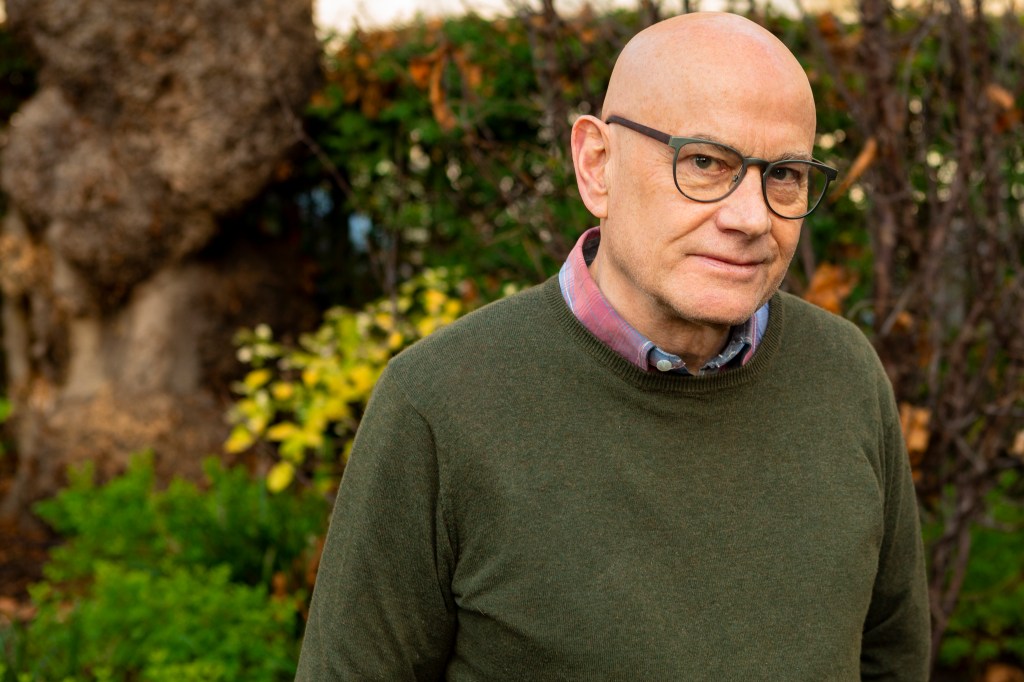
Photograph of Eamon Somers (courtesy of Justin David)