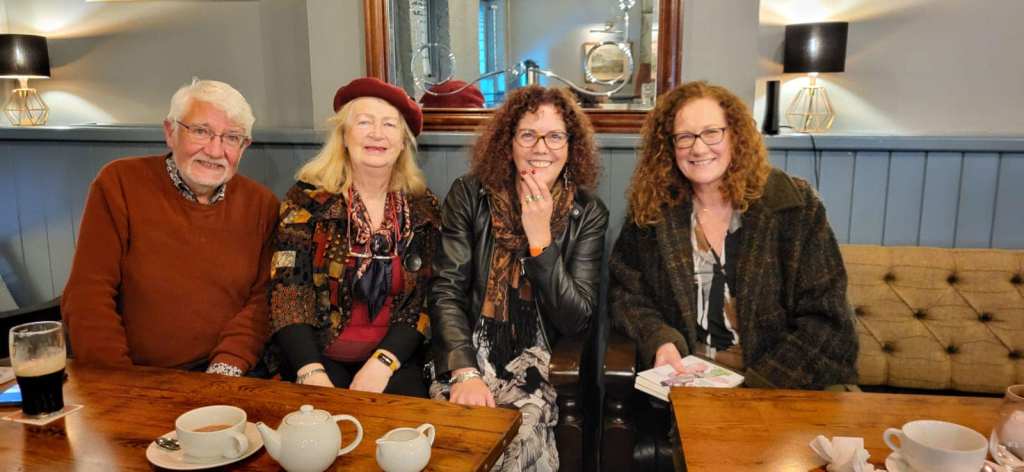
L to R: Daragh Bradish, Jean O’Brien, Shauna Gilligan, Eithne Lannon seated in Revels, Rathfarnham at The Listeners.
Thanks to poets Daragh Bradish and Ron Carey for the invitation to read as a guest writer at the November Listeners session in Revels in Rathfarnham. I enjoyed reading fromMantlesand discussing all things Brigid.
It was a great evening and so lovely to hear poetry from Jean O’Brien, Darragh Bradish, Maurice Devitt, Eamon Mag Uidhir and Eithne Lannon among others. I look forward to the next Listeners session in December!
Cauvery, You are very welcome back to my WRITERS CHAT series. Many congratulations on the upcoming September publication of your fourth novel The Inheritance (Hope Road: London, 2024). Your previous novels The Tainted (2020), Paddy Indian (2001) and The Uncoupling (2003) were received with acclaim with Sue Leonard declaring The Uncoupling “a gem of a novel.”
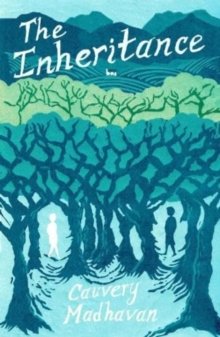
Cover image of The Inheritance showing rows of blue mountains with a white cottage in the middle; below the cottage are layers of green and blue trees in which stand figures of two children, white and blue.
SG: Let’s start with the stunning cover image (shown above) which captures the dual storylines – that of Marlo in 1986 and a child narrator, Coichin, in 1602 – as well one of the main themes running through The Inheritance that creative expression (writing, painting) can provide safe ways to name identity and belonging. Can you talk about the cover image, the design and origin? Did you have input and choice?
CM: I was very lucky to have the same cover designer, James Nunn, who designed the cover for The Tainted, work on the cover for The Inheritance. James read the book and incorporated the physical features of the Beara Penninsula and very cleverly used the two little boys in the story as well. When I saw the design I was so struck with the fact that one of the children was ghostly white and I loved it instantly. My only brief to him had been I wanted a cottage on the cover! So I was really happy at the way he had interpreted the theme of the book. The cover design is hugely influenced by what the sales team think. And as an author you have to trust that they know their business.
SG: Much of The Inheritance explores how the familiar is made strange and how the strange is made familiar through the notion of the outsider – Marlo is brought up in England and moves to rural Cork when he inherits a cottage. Of course, this inheritance is also, as he discovers, as much about identity and home as landscape and place. There’s a lovely scene where Marlo is overcome by the landscape:
He stood for a while letting it soak in then walked to the very large ancient vault, circling it several times, examining the monumental stones placed on top of each other before wandering around the fallen tombs, running his fingers across the weathered slabs, the names and dates ravaged and erased over many centuries. He wondered if he was directly descended from any of the people buried here.
Were these themes important to you as you wrote the novel or did they emerge after you’d written the narrative?
CM: Since I don’t plot my novels more than a page or two ahead as I am writing, I must admit that these themes emerged as I was writing but quite unbeknownst to me. It wasn’t even clear to me till much after I had finished the manuscript, on rereading it and reading the comments from my editor Sue Cook, that I realized landscape and place was so central to the book. I guess that is because I feel that the landscape of Beara is imprinted on my soul and I hardly even knew I was writing about it!
SG: And in a way, that’s what we see in The Inheritance: the landscape of Beara imprinting itself on Marlo’s soul. The dialogue in its unapologetic Hiberno-English stands out and brought out in this reader considerations of language, how we communicate through oral and written words (Marlo), non-verbal language, and through visual art and senses (Sully). Marlo observes, realising how death changes everything:
Imperceptible lifts of the chin and little sideways twitches of the head meant everything when the men had nothing left to say…The women on the other hand were all taking at the same time.
In contrast, Coichin tells us in his narrative – echoing young Sully who also appears mute while also reflecting on how Marlo experiences Beara – “I’ve always been a watcher. What else could you be if you couldn’t speak?” (113).
The Inheritance encouraged me to pause and watch both people and landscape around me…Could you comment on listening and watching in The Inheritance?
CM: Such a fantastic question Shauna. It has made me realize that I am actually a proper watcher myself: a watcher-listener of inflections, in the way language is delivered, silently or spoken. When it comes to language and how it is conveyed Beara is the best teacher. In Beara language is not just speech – it’s the tilt of the head, the shrug of shoulder, a kick of a stone. Of course this is a universal thing with languages but in Beara the subtilties are ever so subtle.
As far as landscape is concerned I have never tired and will never tire of observing what Beara has to offer. I find I drive slowly, walk slowly and whether you’re looking at the grand picture of an entire range of mountains or a little micro world of flora and fauna on a stone wall there is so much to observe and absorb. Every season, the time of the day, your own mood at that moment determines and colours what you see.
And Marlo himself, when he is on the bus and out and about on his business I imagine him to be no different. The landscape, and knowing that some of it belongs to him, definitely has a profound effect on him.
SG: Really interesting connecting the mood with what you see. I loved the humour in The Inheritance which comes out in Marlo’s narrative. I particularly liked the blind calf that Marlo looks after. At one stage he asks himself “Of course, I must the only man in the world who needs to feed a blind calf before a first date.”
Without any spoilers, could you talk about the motif of seeing and not seeing/ knowing and not knowing that this blind calf represents – there are a lot of secrets which stem from shame imposed by a judgemental society and church that emerge in the novel.
CM: A friend of mine, who lives at the very tip of the Beara peninsula, had many years ago told me about a blind calf that she had been allowed to keep as a pet when she was a child. For these last 20 years while I planned and plotted this book I was determined to include a blind calf!
I guess sometimes as a writer you project your own aspirations and expectations on to your characters and for me to love Marlo and be invested in his character meant he absolutely had to love animals.
At the at the back of my mind I was of course telling the story of how disability of any kind was looked upon as something that needed to be hidden and how the trauma of that shame affected even the most loving of families. If you look at the character of Dolores she was in her own way disabled by her sheer physical size as it did not conform to what a woman should look like. So nonconformity is itself viewed as a disability.
SG: Alongside these serious and essential themes, The Inheritance is the story of love. Again, without spoilers could you outline your development – as you wrote the various drafts – of Kitty and her relationship to both her son Sully and new-comer Marlo.
CM: I had initially planned that Kitty would be a kind of modern day female druid into the healing arts and shamanic traditions – someone who Marlo would find fascinating! But very quickly her voice made itself quite clear to me: she was a strong, pragmatic woman dealing with grief by losing herself in the upbringing of her son Sully. Her life was one of practical needs, of how to keep going financially and how to sort out help for Sully. She was not looking for a man in her life. I think outside of the narrative in the book she consults John Bosco and asks his opinion of Marlo. I’m quite certain of this! I absolutely loved the way Marlo fell head over heels for her versus Kitty’s reaction – she considers his interest with greater care – her son comes first!
SG: I love how you know what Kitty did outside of the narrative! Finally, Cauvery, some fun questions:
Is Beara your favourite part of County Cork? Not just Cork, in all of Ireland.
Forest or mountains? Forest
Silence or music when writing? Silence
Can you name two books you’ve read over the last year that stand out for you?Christ on a Bike by Orla Owen. Ghost Mountain by Ronan Hession.
Wonderful choices! Lastly, what are you reading right now? I’m writing my next book and for it I’m reading historian Ramachandra Guha’s India after Gandhi.
Thanks so much, Cauvery, for your generous answers and I wish you much success with The Inheritance which publishes in September 2024.
Photograph of author Cauvery Madhavan in a colourful patterned blouse looking straight at the camera. Photograph by Ger Holland. Photograph used courtesy of author and photographer.
I’ve had the fortune of working with some wonderful writers and mentors over the last week or two at The Irish Writers Centre in Dublin. I’m now at the stage where my writing needs to simmer. Writing with feedback. Writing that needs editing. Writing that needs re-writing. It’s always good to have a few projects on the go. Part of this process – for me – is to dive into reading. A few of the books that I’ll be immersing myself in over the next few weeks are pictured below:
Fishamble Firsts: An Anthology of First Plays by New Playwrights edited by Jim Culleton (New Island)
Good Behaviour by Molly Keane (Virago)
This Plague of Souls by Mike McCormack (Tramp Press)
The Inheritance by Cauvery Madhavan (Hope Road)
A Good Enough Mother by Catherine Dunne (Betimes Books)