reading and listening to music: the triumphs of being not myself
Susan Sontag, Pilgrimage
It started with my mobile – old, about four, five years old – which had reached its storage limit. And I thought, that’s right. Too much and too many. So instead of adding storage – more, more, more – I started letting go. Removing. Deleting. Images. Files. Applications. Accounts. Email lists. Subscriptions.
I began to hear the space, to feel my thinking, to let things be. I returned to reading for the act in and of itself, without a question in mind, without a purpose or a deadline. A gift of time. Let the body chose the words it needs: what calls? The cover – the title – the cover image – the first line – a page opened at random and a word?
And it continues. The shedding. And in doing so, a containment of sorts. An affirmation. Re-affirmation. Con-firmation. What is it we tell ourselves we need – or can release – with all this virtual and physical stuff? To remind ourselves of who we are? Or to be someone else?
Above, a photograph of books currently in progress or recently read:
Mary O’Donoghue The Hour After Happy Hour
Johanna Hedva Your Love Is Not Good
Amy Key Arrangements In Blue
The Paris Review 243
Susan Sontag Stories
Not pictured but recently read: Helen Blackhurst Swimming on Dry Land and Alison Wells Random Acts Of Optimism.
While I have disconnected myself from Twitter/X, and will, into the future, very occasionally use Instagram and Facebook, you can still connect with me through this blog.
Book cover of “Ships in The Desert” showing a black and white photograph of a ship in the desert.
Jeff, You are very welcome to my WRITERS CHAT series. Congratulations on this intriguing collection of essays, Ships in the Desert (SFWP: Bethesda, Maryland, 2022). The collection fit right into the non-fiction I’ve been reading lately and congratulations on the recent awards your collection has received: The Eric Hoffer Book Award (Culture category) and the Foreword Reviews INDIES Book of the Year Award (Essays category).
SG: I’d like to situate Ships in the Desert within a canon – let’s say, following in the footsteps of great American nature writers such as Aldo Leopold, John McPhee and, given the type of landscape your essays examine, Mary Austin. Environmental destruction and (western) capitalism have been the concern for many essayists, writers like Annie Dillard and Janisse Ray spring to mind here, but in this collection, you bring us to Communism, to the old Soviet bloc, and show us (I quote) a “goulash of languages”, “nuanced picture of Muslims”, and, what seems to me a real “tribute to the life-giving bounty of the Aral Sea”. Do you see this collection of essays as contributing to a growing collection of important nature writing?
JF: Naturally, whether it’s considered important or not isn’t up to me; others must be the judge of that. I do very much hope it contributes in some way, however small, to the body of literature of the natural world. I think what we call nature writing is in a state of transition right now, one which corresponds to how quickly the natural environment has been changing around us due to climate change. We need to address this somehow, and the older model of nature writing, which was born out of a nineteenth century meditative pastoralism, doesn’t hold up as well today. Don’t get me wrong: Thoreau will always rank among my favourites! I still love the work of Wordsworth. But while writing in different countries, they both came out of a Romantic period aesthetic that glorified the individual. I don’t think we can do that anymore. We need a literature that shows us how to work together.
I’m a big fan of the writers you mention, particularly John McPhee and Annie Dillard, and I’m not trying to suggest in any way that they or the others failed to properly emphasize community or that their work is no longer important. I’m very much indebted to them as they were indebted to Rachel Carson and John Muir and Ralph Waldo Emerson and all those who came before them. But just as Carson and McPhee and Dillard—among many others—moved the literature forward, so are we at a point where it feels it needs to move forward again. In my book I intentionally combined science writing with memoir, travel writing, literary journalism, and even outright environmental advocacy because I didn’t want to be limited by or beholden to the conventions of any one of those genres. I felt I needed another way to present the material and its message. My hope is that others find some kind of value in it, though again, that’s not for me to decide. All I can do is try to honour my subjects by presenting them in what seems the best way possible, which is going to be different for every subject, every book.
SG: Thanks for that insight – I like how you let the work present itself and the reader decide on the value, and certainly, I found the title essay of the collection, Ships in the Desert, one of the most informative and interesting. You speak of being haunted by what you saw – nature’s destruction for “white gold”, cotton:
“If you don’t plant cotton, you will be jailed/ If you don’t pick cotton, you will be killed”
It seems profit and growth trumps all. You warn that
“if we’re not careful, the twenty-first century could well be defined not by terrorism or the growing disparity between rich and poor but water wars.”
Given the war in Ukraine and the continuing climate and natural resource crises, do you still believe this is the case?
JF: I wish I didn’t, but it still seems probable and even likely to me. Most of the climate and natural resources crises occurring right now are linked to water shortages in some way. It’s true that weather is cyclical, and we will occasionally see temporary relief from water issues, as we did with an unusually wet past winter in the American West that refilled many badly depleted reservoirs. But the long-term trend continues to indicate that our water issues are, overall, getting worse, not better. Average temperatures around the world are growing hotter. The science is very clear on this.
In my book, I wrote of the falling Ogallala Aquifer, the toxicity of Owens Lake and the Salton Sea in the U.S. These problems continue to worsen. At the same time, new crises have developed. The Great Salt Lake, Lake Mead, the Colorado River, and the Mississippi River all hit historic lows last year. While there has been some rebound from that, there’s still a lot of reason for concern. The conservation nonprofit American Rivers considers the Colorado River, particularly the portion that runs through the Grand Canyon, the most endangered river in the country. This is a river system that provides water to forty million people in the U.S. and Mexico.
Famines are often linked to droughts. Wars, both legal and lethal, continue to be fought over water rights. Water is at the heart of so many issues, which makes sense: It’s what sustains life.
SG: Yes, water is at the very heart of life. Your essays don’t only shine a light on environmental catastrophes that many people might not be aware of (this reader included) but also provides great insight into the country and people of “beautiful, crazy, haunting, surreal Kazakhstan”. I was moved by the opening essay, “Itam” in which you paint a portrait of great care for families and animals, but not much, if any, self-care and I particularly enjoyed the random details of western music still popular there (the live version of the Eagle’s “Hotel California”, Chris de Burgh’s “The Lady in Red”, and Louis Armstrong’s “What a Wonderful World.”), the wonderful dancing at the wedding (Itam). For me, this merging of personal experience with the communal, and connecting it to place threaded these essays together. Can you talk a little about this in relation to the order of the essays in the collection?
JF: Because the two longest essays are strongly focused on environmental and cultural issues, it was important to me to bring the personal into the book in some meaningful way as well, and so it opens and closes with my host family in Kazakhstan, while the remaining three essays focus on more personal feelings about my time there. I very much wanted that kind of balance in the book. While much of it is about catastrophe in the big picture, there is also something of hope as found in the personal. That’s really where hope is to be found. We can’t look to the big corporations to save us. They’re rootbound to the container of capitalism. To change their growth pattern from one focused solely on profits to something more holistic would take too much pruning, if it’s even achievable at all. For better or worse, it’s going to fall on us individuals to effect change, working in coalitions, community by community. It can be done—if we have time. That’s really the biggest challenge we’re up against. The longer we wait, the more challenging it gets.
SG: Interesting to hear that you feel hope is in the personal, and of course, we can’t look to big corporations to save us (as capitalism would have us believe). Following on from the personal, much of what you discuss in these essays is actually philosophical and spiritual. You link place. Having travelled and lived in various countries and cultures, I can appreciate how being a stranger, you can see a place with new eyes, for both good and bad. In “Place as Self,” you talk about how places, like people, change, but that they are
more often like comets, or rivers…But time passes, and the next time we look, we see that a wildfire roared over the mountain one fine spring day when the wind was stretching its limbs uphill, and now the mountain is an unrecognisable old man. A six-lane superhighway runs through a neighbourhood we once knew and loved.
You talk of the difficulty of capturing the spirit of the place
“Examining a place in a particular time freezes portions of it. Our writing then becomes like an archival film”
and it felt, for a reader who came to the collection and to Kazakhstan blind, that you did capture the spirit, as you encountered it. The idea of place and self not being static, but still needing to be cared for and protected really stayed with me long after finishing the collection. Looking back to that time now, and if you were to return to those places – even though some of the people are no longer there, and even though, the places will have changed – do you think the spirit might still be the same?
JF: Good question! I think the answer depends on how one views it. Certainly, in a place with a history as long as Kazakhstan’s, going well back before even the Great Silk Road, there’s a certain spirit that isn’t going to vanish over the course of a decade or two. On the other hand, I do believe that our personal experience of the spirit of a place is unique to a particular time, which I write about in the essay you mention, “Place as Self.” In that sense, even a year or two can be enough to irrevocably change how a place feels to us. Kazakhstan has moved on since I lived there, and so have I. It’s in a different place, so to speak, just as I am now.
My wife recently visited her family there, and she told me her home country was both familiar and unfamiliar at the same time. There’s so much new growth in terms of buildings and roads that she hardly recognized her home city. Yet the cultural habit of not smiling in public remains. Having lived in the U.S. for many years, smiling all the time has become natural to my wife, but her family thought it was unnatural, forced, and it often took strangers aback. That said, a few were pleasantly surprised by the smiling stranger who made them feel good. She had changed, and it changed her interactions with those around her. All of this is natural. We can’t expect things to remain the same, nor should we want them to.
SG: I can completely get that – returning to the once-home, the familiar being made strange. And another strong linking thread is the idea of foreigners being missionaries both actually and metaphorically. If we take the motivation for writing the essays as a spiritual one – to preserve or capture your experience but also that of the place with you in it – and then apply this to traditional missionary work, as you examine in the essay “The Missionary Position”, to what extent was the writing of Ships in The Desert an act of saving, a part of your missionary role?
JF: As I state in the introduction of the book, the Peace Corps has three goals, and the third goal is to help educate about the host countries volunteers serve in. Kazakhstan, despite its long and spectacular history, despite its great geographical size, despite its modern importance as an oil and gas producer, still largely remains unknown to most people in the western world. I harbour no illusions of being able to write anything definitive about such a country, especially from my foreigner’s viewpoint, but I certainly was and am conscious of wanting to help introduce this place to many in the English-speaking world who might otherwise have only heard of it through the Borat films.
But more than that, I wanted to present my experiences of the place as an example to others that there’s a larger world to explore. I wanted to emphasize the interconnectedness of peoples and cultures on this planet. I’m a missionary of the idea of human potential. If there’s anything I want to save, it’s those ideas. It does feel like these ideas are under attack today, that people are retreating into a kind of medieval clannishness, sometimes literally behind walls. Yes, we face a lot of problems, and some of them are scary, but we’re not going to solve them by separating from and fearing each other. We’ve got to work together.
SG: Yes, we are coming back to the personal always merging with the communal, and necessity to work together. But what a great thought you’ve placed in my mind: a missionary of the idea of human potential! You went to Kazakhstan in your role as a Peace Corps Volunteer and part of this role is that you are
“forbidden to proselytize on two subjects – religion and politics – or to work directly with anyone involved in such activities.”
This restriction seemed to limit your exploration of the role of both of these subjects in relation to the connections between environment and money making. You clearly point out in “More than Tenge and Tiyn” that
It was a world where money mattered immensely though not in the same way as in the States, where our aspirations are, by and large, for increasing levels of luxury. In Kazakhstan, especially in those hardscrabble days, it was a matter of survival.
You draw parallels (in “Ships in the Desert”) between the drainage and diversion of rivers with policies in LA (drainage of Owens Lake), and I wonder if there are some parallels to be drawn here between poverty and educational opportunities in Kazakhstan and in many of the impoverished minorities in the United States – and elsewhere.
It strikes me that what you speak of is the unequal state of our world which echoes the environmental destruction. In many ways this reminded me of how John McPhee examines the relationship between humans and nature in The Control of Nature (and he also examines LA). Janisse Ray says in Ecology of a Cracker Childhood “our relationship with the land wasn’t one of give and return. The land itself had been the victim of social dilemmas”. Can you comment on this?
JF: I understand this idea very much. I grew up in a corner of Ohio that had been, within only four generations before me, the Great Black Swamp. It was the last section of the state to be inhabited. Even the Native Americans didn’t live there; they only made forays into it for hunting. The first white settlers who arrived faced swarms of mosquitoes and malaria and a slog of mud so deep that one stretch of an early log plank highway was famous for having an inn every mile—that’s only as far as the wagons could make it each day. The log highway just kept sinking into the earth.
Yet, of course, a swamp is a special entity of its own with its own ecology and its own spirit. And the white settlers not only broke that spirit, they obliterated it. My great-great-great grandfather was among those who in 1850s began systematically turning an impenetrable stretch of sodden woods and prairies roughly the size of County Tipperary into rich black farmland. There was no give and return—there was no give at all on the part of the white settlers. By the time I was growing up, there was hardly a trace of wildness left. It had become essentially a monoculture of either corn or soybeans.
This is a story of human interactions with the land that has played out the world over. I certainly recognized it in the story of the Aral Sea. However, I don’t believe we intentionally punish the land. We simply don’t think deeply enough about our relationship with it. We take and take from it, and no relationship can survive such one-sidedness, and so it may appear the land has been victimized. But since we depend on the land, we only end up victimizing ourselves. It makes no sense on any level, including financial, to destroy the source of our food, our livelihoods, our homes. Topsoil in the American Midwest has eroded at an average rate of 1.9 millimetres per year over the past 160 years, meaning about a foot of topsoil has been lost in that time. It may not sound like much until you realize it takes anywhere from 100 to 500 years to build one inch of topsoil—that’s 1,200 to 6,000 years to replace the foot we’ve lost.
Obviously, we’re falling behind at an alarmingly fast rate, and there’s a certain point where we won’t be able to recover. As with our climbing temperatures. As with our declining potable water sources. As with our rising sea levels. In Ireland, coastlines could rise by as much as a foot by 2050, resulting in serious flooding, as is predicted for coastlines around the globe. I don’t like sounding like an alarmist, but this is all simple science. We can measure it, track it. We can see where it’s likely headed.
Why wouldn’t we want to face this and do what we can to mitigate it? Part of the reason relates to what you mention about poverty. Climate change disproportionally affects poorer people, we know that, and the poor have been systematically disenfranchised the world over. They—which is really most of us, the 99 percent who are not part of the 1 percent who own almost half of the world’s wealth—don’t have a strong voice in the matter. And the people in power are making too much money to be motivated to make many meaningful changes. But it will come to bite the wealthy someday, too. Again, we’re all interconnected with each other as much as we’re interconnected with the physical world. As I note in my book, quoting John Muir, “When we try to pick out anything by itself, we find it hitched to everything else in the Universe.”
SG: Well, it’s been wonderful connecting with you through your writing, Jeff, and those statistics you quote are stark reminders of what science simply tells us. Let’s finish up with some fun questions:
Boat or Plane? Boat! I love being on the water.
Tea or Coffee? Coffee, no doubt about it overall, though I also enjoy tea. Living in Kazakhstan helped nurture a love of green tea in particular. So, coffee in the morning or with pie! Green tea in the afternoon or later. With fresh dates or dried apricots, it especially reminds me of Central Asia.
Camera or memory? Tough one! I love photography. I love the art of it, and it’s also a useful documentary tool. But I must go with memory on this one. Ultimately, it’s the more powerful tool, especially for a writer.
Very interesting! I didn’t expect that answer! So what’s next on your reading pile? I often read to prepare for the classes I teach, so lately that included an overview of short fiction from Kate Chopin to today. I also have a queue of books to review, both fiction and poetry. Once I catch up, I’d like to dive into some Murakami.
Oh an overview of short fiction – sounds like a treat. Mind you, Murakami is a wonderful escape to follow that. So where do you hope to travel to next? I’ve always wanted to visit Africa. Kenya, Egypt, Mali, and Morocco are probably the African countries I’d most like to see first. Japan is high on my list. New Zealand. And I’ve been wanting to return to Scotland and Ireland! In my first visits there I never made it to Edinburgh or all the way to the west coast of Ireland or to Yeats country, and I would love to visit those places.
And wouldn’t some of those travels be amazing by boat…if time allowed! Thank you, Jeff for such engagement with my questions and I hope these essays travel far.
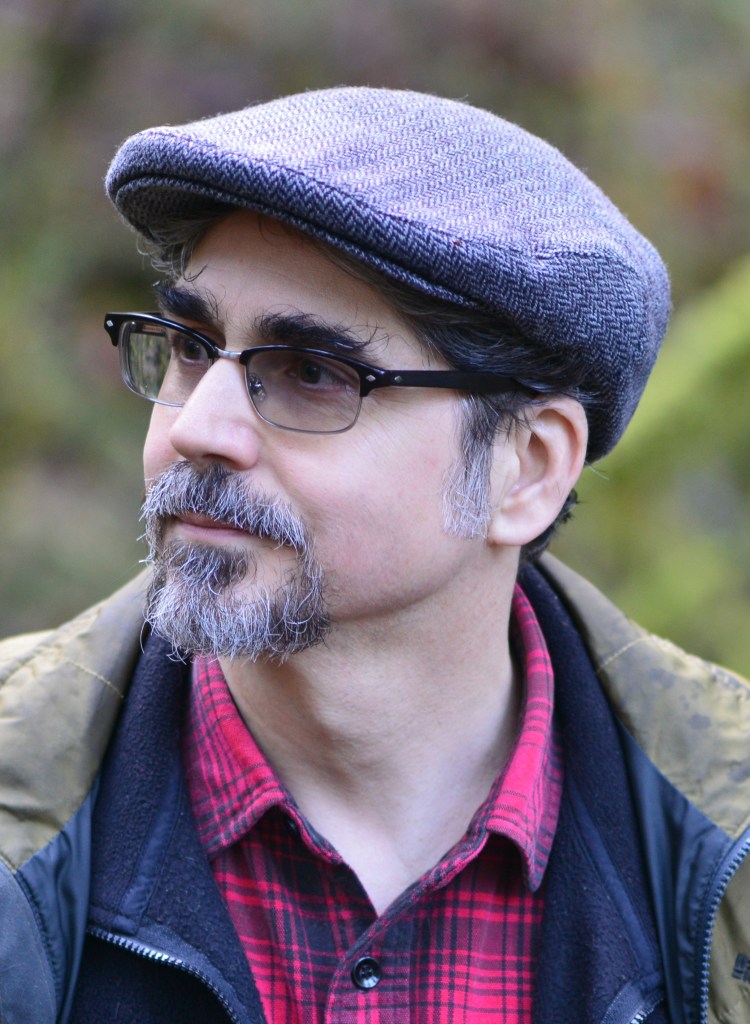
Photograph of Jeff Fearnside looking to the left, wearing a red check shirt, black cap and glasses. Photograph used with permission, courtesy of Jeff Fearnside.
With thanks to Kristina Darling, Penelope Consulting and SFWP for the copy of Ships in the Desert.
Order Ships in the Desert here and for UK based, order here.
Kevin, You’re very welcome to my Writers Chat series. We’re going to chat about your third novel Youth (The Lilliput Press: Dublin, 2023) which is set in Balbriggan, your hometown. We’re publishing this on Bloomsday as a nod to the importance and wonder of place in the novel.
Cover of “Youth” by Kevin Curran showing a wall, railings upon which sits a young man looking away from the camera.
SG: Let’s start with the title. As I was reading Youth, there were a number of phrases that were repeated so often (for example, “Allow”, “If yuno, yuno”, “that’s a bar”) that I found myself giving the novel alternative titles. However, Youth encompasses not only the communal essence of your four protagonists but also the main theme. Can you talk about the process in naming this novel?
KC: Starting out the working title was ‘Wandering Rocks’ which you can probably guess came from Joyce’s Ulysses. That chapter and the way Joyce swept along the city streets and dipped in and out of people’s lives was one of the main inspirations for the novel. The title Youth was then settled on a year or two later. I seem to like one-word titles as I get embarrassed talking about my work to friends, family and colleagues, and I find a one word response to, ‘what’s your book called?’ keeps things simple and avoids any strange looks or explanations.
SG: That’s interesting, as I picked up on threads relating to Ulysses so it’s like shadows of your first thoughts are still there. On the topic of themes – and so often they only emerge through the writing rather than follow the intentions of the author – it felt to me, though much of the narrative is overtly downbeat, at times despairing, and many of these youth are trapped in circumstance, ultimately Youth is a novel of hope. Would you agree?
KC: 100%. You can’t be around the kids I’ve been around for over a decade and see how they interact with each other and face into the challenges they face and not feel hope. Balbriggan is Ireland’s most diverse and youngest town, so I like to say Balbriggan is Ireland’s future now. And from what I see, the kids aren’t interested in all the anti-immigration rhetoric. In my home town and the school I teach in, diversity and multi-culturalism is a way of life, second nature. Kids from all nations and cultures sit beside each other and become friends despite what noise you hear online. That’s what I experience every day. There’s your hope.
SG: Indeed. It’s like life itself is hopeful, and the online “life”…well, you’ve said it. I’m really interested in the role language plays in Youth. For me, this is what makes it such a stand-out book. While I struggled, at first, to get into the rhythm of not only the voices of our four narrators, but the intent and reciprocation of their language with each other, internally (for example, Tanya), and then with the responsible (or not so responsible) adults in their lives. Could you talk about your intention and the writing process here?
KC: Each character comes at language in a very different way, whether consciously or not.
Angel is trying to fit in and find his tribe through language, which in his case is London slang, his friends’ parents’ African slang, and Dublin slang.
Princess is creating herself through her language, and is mindful that how she speaks will define her.
Dean’s language has been infiltrated by the internet and porn and toxic masculinity and Tanya’s language has been lost to an unfiltered internet flow of reported speech without much thought given to what she is reporting or how she is reporting it. Her language is immediate.
The writing process for everyone – apart from Princess – was to keep the vocabulary quite tight and to work then within the rhythm and confines of a limited vocabulary. In Angel’s case (with thanks to my students) I was able to create a fairly comprehensive slang dictionary that became the foundations for all of Angel’s language, and then Dean and Tanya’s language was again always limited in expression to keep the rhythm and flow. Princess was the only language in an aesthetic sense that I really pushed.
SG: Youth is also being released as an audio book which will be really superb – it struck me that it is a novel that is lyrical in its movement – almost musical (alongside Pelumi’s input) – and yet also cinematic. Place, pace and rhythm are essential components – characters? – in this novel. It feels as if you walked the streets of Balbriggan, if not literally, then in your head, like Joyce did for Ulysses but at the same time, Youth taps into the universality of human experience. Could you comment on this?
KC: Like you said, I literally walked the streets of Balbriggan for the six years I wrote the book. Even up until the last night before submitting the final draft to the publisher, I was down Mainstreet checking out what type of button was on the traffic light – whether it was a silver circle or silver triangle – to make sure everything I put in about the town was as on point as possible.
Throughout the writing of the book I would either take pictures of things, like the pavements (to get the names of manhole covers, look at the chewing gum stains on the paths) or stand in the street (not obviously – because that would look too weird) and see where the shadows fall and how the street felt at certain times of day and night etc.
I was hoping the deeper I went on Mainstreet and into the town and the estates and the particulars of the place, the more it would become real for the reader, and by extension more universally felt by the reader. It’s the old John McGahern thing isn’t it, the local and the universal.
SG: Thank you for such an insight into your process – and that time, and care, and dedication to place really shows in the writing. Structurally, the narrative of Youth is told in four voices – two male, two female – with every character trying to get beyond their circumstances. It felt, at times, that the voices merged, in particular, the more the lives of Dean and Angel criss-crossed, the more scripted their language and narrative seemed, and as this happens, they start to find ways to be their whole selves not a choreographed online version – through unlikely connections/love and by engaging in every day life tasks – behind the deli in SuperValu; cutting hair. But despite this, they both continue to try and fit into a version of gang culture that is, at times comical, and others, frighteningly dangerous. Dean observes: “Begrudgery, yeah. But something else. Control and an ability to define you. People in this town want power over you.” Could you talk about the theme of power and masculinity through the experiences of Dean and Angel?
KC: Masculinity was central to the book from the early stages. I remember when Moonlight by Barry Jenkins came out I wanted to show the movie to one of my TY classes. 50% of the class would have been Black-Irish and I always tried to bring some sort of representation into the texts we studied. But when the kids heard about the content of the film they didn’t want to watch it. This got me thinking about Angel and Pelumi in particular and how the façade of a dominant, strong, overtly hetro-sexual lad had to be on show all of the time and how drill music in particular with its hyper violent and mysoginistic lyrics again demanded the people rapping take a certain stance. I would talk to some rappers about this (who have since become quite successful within the genre) and they would say it was a pose to gain views, listens, traction, and once they had this they could soften their stance and transition into hip-hop and not be such a caricature.
Dean, with his father being a famous boxer, and literally famous for fighting, offered an interesting insight into the world of masculinity, power and violence when seen through the prism of expectations and family reputations. In Balbriggan growing up (as with all towns I’m sure) there were always family names that carried weight – they were known to be tough and to be involved in fights. But I grew up with some of the lads, and then I taught their sons and daughters and nephews and nieces and you see behind the façade again of this tough living, hard fighting exterior and you realize the pressures they’re under to be this type of person.
SG: Oh that’s a great film and I could see how you’d have loved to use it to initiate real conversations about masculinities. However, if Dean and Angel have family history and circumstances stacked up against them, then Princess and Tanya are overtly fighting and kicking back against patriarchy and a version of toxic masculinity that they try to (subtly and not so subtly) break down. I was interested in the roles of their mothers (and Tanya’s grandmother) in their narratives. I loved how Tanya’s mother gives stark yet loving advice (“Listen to me. That sorta shit isn’t normal. And everyone doesn’t do it.”). In contrast, Princess’s mother is mainly absent, caring for her own mother in Nigeria. Can you talk a little about female relationships and grandmother/mother/daughter bonds in Youth?
KC: In the novel in general I tried to keep parents as absent as possible so as to let the teenage characters live as freely as possible. But in the case of Dean, his father’s influence became larger as the drafts continued, and Tanya’s father was central to her story. But in the case of Princess and Angel, I wanted to especially cut them off from any adult influence to give a sense of them having to live this 2nd generation life in the town on their own terms. You will notice they are the two who need to work and who basically have to navigate their futures alone.
So, I kept Princess’s mother’s influence sparse because of this need to highlight how alone Princess is in dealing with the obstacles of being the ‘first’ in her family to be born in Ireland and have to deal with this dichotomy.
Florence Adebambo read the voice of Princess in the audiobook and I felt Florence portrayed this brilliantly. Florence was able to subtly show the difference between Princess and her mother and sister. Florence gave the mother a strong Nigerian-Irish accent, and Becky a slighter less pronounced accent, whereas Princess’s accent is unmistakably Irish.
Tanya on the other hand, being Balbriggan born, has the full matriarchy behind her. Her granny was always intended as a strong support, someone we could see Tanya could be herself around and show the reader her softer side around. Tanya’s mother on the other hand was always there to highlight the generation gap, even though, as we learn in the book, there is only 17 years between Tanya and her mother.
But every woman in the book I think comes across as a strong woman, with strong opinions and strong character. It was important Tanya was not seen as a victim, and no other woman for that matter was seen as weak and ‘needing’ the males in the novel.
SG: You’re a teacher yourself, and I liked how you shone a light on both the pressures of and opportunities the education system seemingly offers. For Princess, in particular, achieving in school is what will help her out of her familial and social constraints. She has a colour-coded system of highlighting her text books and uses this same science to observe behaviour, at times with great humour. Observations on trying to obtain work experience in a pharmacy:
“This is my future, my life after all. I’m like, why worry about how you look to this girlo with the blonde hair and Fanta skin? I’ve been raised to stick up for myself. Fight for everything”
“No one should be doing what I’m doing for free…Luminous yellow highlighter, general observation: Cynicism doesn’t come without a cost. Pink highlighter, specific life-advancement threats: Other people will let you down.”
Can you talk a little about the role of education in Youth.
KC: My grandfather grew up in the tenements and through scholarships, made his way to UCD. I was his first grandson to go to UCD and he gave me half the fees for a Masters in Literature in UCD (the other half was funded by the money I got for my 21st party from friends and family!!) I was the only student from my school to go to UCD in my year and even though it was a lonely experience, it was character defining one.
Obviously as a teacher, education is incredibly important to me. I tell my Leaving Cert students every year that the Leaving Cert is the one opportunity they will have in their life to sit and compete with their peers from richer houses, towns and schools – fee paying schools who charge thousands of euros a year – and they can challenge them on an even footing. I know a lot of people give out about the current Leaving Cert exam, but from an English teaching perspective, the exam really gives the students from my DEIS school an opportunity to even up the disadvantages in society they might have faced earlier in their lives, and they will probably face later in their lives. So, yeah, education and libraries as sanctuaries for learning, are central to the core message in Youth.
SG: But not only sanctuaries for learning but for transformation. So much of living in Youth happens on and is dictated by social media – not only for the youth, but also for characters like Barry. From the outset, was this your intention or did this aspect of the narrative evolve with the characters and story? Did you engage in research about social media and the youth?
KC: When you’re around teenagers like I am for the number of years I have been, you can’t help but observe how social media is beginning to alter how teenagers behave and interact. I wrote the story ‘Saving Tanya’ in 2014 for the ‘Young Irelanders’ anthology. In that story I was quite specific with the social media platforms being used, but I learned from that story to kind of pull back from the actual specifics of the platforms but to still deal with social media.
In the case of Tanya I wanted to show that even though she thinks her phone and social media is her comfort blanket, it’s actually smothering her slowly.
The actual form for Tanya’s chapters came quite late in the drafts. I had her firstly as a ‘Living with the Kardashians’ documentary type thing, and then I changed her to a script, but then, finally, I landed on the current form, which I think works brilliantly to display the all-pervasive nature of social media in a teenager’s life, but also to show the real, lived experience behind the posts.
As for Barry, his social media output seems to be representative of a lot of angry, keyboard warriors from his generation.
Research wasn’t too heavy. I was able to chat to my classes – from sixteen year olds to eighteen year olds, and we would discuss what they felt about social media, and what they experienced on-line. The feedback from the girls was eye-opening. Just the hassle almost every girl gets on-line from weirdos (mostly adult men) sending them DMs shocked me.
I also went onto Tik-Tok for a while to get a sense of the dynamic of it. Jesus, that was rough. I deleted the app as soon as I didn’t need to research any more. That place is insane!
SG: All that for your art! Hats off, I’ve not even watched a Tik-Tok! So, we’ll end this Writers Chat, Kevin, with some short questions:
Do you subscribe to or watch anything on YouTube? I don’t subscribe to anything on Youtube, but for the past four months since I finished the novel (and have had a bit of time in the evenings) I reckon I have watched every interview Zadie Smith has given on Youtube. I also watched a lot of Claire Keegan interviews and old writers too like Lorraine Hansberry and Arthur Miller on Youtube. Fascinating insights into craft.
Music as you write – and if so, what music? No music. I need total silence and just the sound of the street outside when I write.
Mountains or Sea? Sea. Always the sea. I won’t bore you with my swimming stories, but I swim all year round. And no, I don’t wear a Dryrobe.
Ha! Longhand or laptop? Always longhand first. Even in the edits stage when I need to extend a scene, add a small bit in here or there, I always write longhand. I find a pen and paper, no technology, no light from the screen, no flashing icons, creates the closest connection with the story and the page.
What are you reading now? A Kestral for a Knave by Barry Hines, Elizabeth Strout’s Olive Kitteridge, Flannery O’Connor’s Mystery & Manners, Toni Morrison’s Recitatif….the list goes on.
Some great reading there – I recently returned again to Mystery and Manners. I always get something new each time I read those essays.Thanks for such brilliant engagement with my questions and I wish you much success with Youth which can be purchased here.
Follow Kevin Curran on Twitter: @kevlcurran
Thank you to The Lilliput Press and Peter O’Connell Media for an advance copy of Youth.
Photograph of Kevin Curran against a wall of colourful graffiti. Photograph by Elaine McGrath used with kind permission.